Chanukah Interlude

In the absence of matters scientific from the next few pages of Yevamot, here is a gift for Chanukah. It's a biblical-and-near-Eastern-studies-themed parody of I am the Very Model of a Modern Major General, from The Pirates of Penzance.

Enjoy, and Happy Chanukah. 

If the embedded video does not display correctly, you can watch it here

Wow, that Joshua Tyra is one funny man.


Print Friendly and PDF

Yevamot 75a~ Voltaire, Rabbi Yishmael, and the man with one testicle

In 1587, Pope Sixtus V decreed that all marriages in which the man did not have two testicles in the scrotum should be dissolved.  Voltaire (1694-1778), felt the need to share some further observations on the testes and the Pope's edict, in his Philosophical Dictionary:

This word [testes] is scientific, and a little obscure, signifying small witnesses. Sixtus V... declared, by his letter of the 25th of June, 1587, to his nuncio in Spain, that he must unmarry all those who were not possessed of testicles. It seems by this order...that there were many husbands in Spain deprived of these two organs...We have beheld in France three brothers of the highest rank, one of whom possessed three, the other only one, while the third possessed no appearance of any, and yet was the most vigorous of the three.

...[The] Parliament of Paris, on the 8th of January, 1665, issued a decree, asserting the necessity of two visible testicles, without which marriage was not to be contracted.

Which brings us to today's daf, Yevamot 75a. To catch up quickly: The Mishnah (on 70a) listed the circumstances under which a Cohen is not allowed to eat terumah. Among those banned from this edible delight is a Cohen with an injury to his testicles - and this same injury, the Mishnah continues, when found among other Jewish men, may prevent that man from marrying. 

In discussing the details of what kind of testicular injury results in a ban on marriage, we read the following:

אמר רבי ישמעאל בנו של ר' יוחנן בן ברוקה שמעתי מפי חכמים בכרם ביבנה כל שאין לו אלא ביצה אחת אינו אלא סריס חמה וכשר סריס חמה

Rabbi Yishmael the son of Rabbi Yochanan ben Berokah said: I heard from the sages in  the vineyard at Yavneh that whoever has only one testicle [at birth] is called "sterile from the sun" [i.e. naturally sterile] and is allowed to marry...

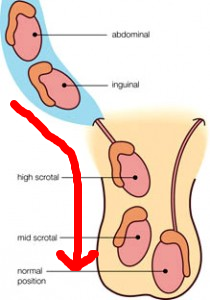
So according to this report of Rabbi Yishmael, the sages in Yavneh allowed a man born with one testicle to marry.  The Talmud is describing a condition known as cryptorchidism in which one or sometimes both of the testes remains undescended and hide somewhere within the abdomen.

 To understand why the testes take this hike, there's some embryology involved. Rather than explain with words, here is a stunning animation showing why the testes develop where they do and how they descend. Grab a cup of coffee and listen as Rimsky-Korsakov's Scheherazade op. 35 plays in the background. The formation of the testes begin at 1:02 if you are in a hurry (but don't be).

Animation is derived from Keith L. Moore, T.V.N. Persaud, Mark G. Torchia, "Before We Are Born: Essentials of Embryology and Birth Defects", 8th edition. Elsevier, 2012.

 If you didn't watch the video, here is what you need to know:

Image of testicle descending.jpg

Got it? OK.  So the testes develop in the abdominal cavity and migrate southwards into the scrotum. Usually they land there by birth, or soon after, if they behave themselves.  Which they don't always do. Sometimes one of the pair (and very rarely both) fail to migrate. Sometimes they descend and then, apparently disappointed by their new cool accommodations, bolt back north to the warmth of the abdomen.

Which brings us to the question, just how common is cryptorchidism?

The best answer will be an educated guess because the data is not great. One of the few studies of the epidemiology of this condition comes from the medical examination of English schoolboys published in 1941. It reported that the incidence of cryptorchidism in 3,300 boys under 15 was almost 10%, but that this number dropped to less than 1% in boys older than 15.

And then in this paper comes this delicious line. 

Sir Robert Hutchison tells me that he knew a man in whom descent occurred while he was an undergraduate at Oxford (an event duly celebrated by a party)
— Smith RE. The undescended testicle. The Lancet 1941;14: 747-751

A more recent  study from 2007  put the incidence of undescended testes at 1-4.6% at birth (depending on the infant birthweight), while at age 11 the incidence is anywhere from 1.6-2.2%. The incidence is higher in low birth-weight and premature boys.

What is clear is that there is an association with fertility and cryptorchidism, even when the testicle that went AWOL is retrieved and secured in the scrotum.

The incidence of azoospermia in men with unilateral cryptorchidism is 13% regardless of the fate of the testis
— Canadian Urological Association Journal, 2011

Which brings us back to the prohibition against a man with injured testes (or penis- as in Deut. 23:2:   לא יבא פצוע דכא וכרות שפכה בקהל) marrying. It is related to his presumed inability to father a child.   Voltaire seems to have been unsure of the role of the testes (whether one, two, or in one lucky case "three",) but Rabbi Yishmael's  סריס חמה, a man with only one visible testicle, while certainly less fertile than a normal man, is capable of fathering a child.  Hence his marriage, while not encouraged, is recognized, and this is codified as normative Jewish law.

   סריס שקדש, בין סריס חמה בין סריס אדם, וכן אילונית שנתקדשה, הוי  קדושין

 (שולחן ערוך אבן העזר הלכות קידושין סימן מד, ד) 

If a man with one testicle married, whether this condition is from birth or later acquired, he is legally married.

Today, an undescended testicle is surgically brought into the scrotum at an early age, so that the cryptorchidism described by Rabbi Yishmael has been virtually eliminated, as have been some very interesting parties at the University of Oxford.


Print Friendly and PDF

He's not Rav Ashi*, He's Rav Levin

I know it's not science, or medicine, but bear with me.

Last Thursday, while enjoying a wonderful dinner on the Upper West Side, I met Rav Henoch Levin. He heard me giving a brief Devar Torah on the Daf. (This in order for me to get the free dessert offered for those who do so. It was delicious. The dessert, not the Devar Torah. The Devar Torah was brief. But I digress.) Anyway the point is that we got talking and it turns out that this man is one of the editors of...the Schottenstein Talmud. And not just one of the editors; he wrote - among other things -  parts of the very volume (Yevamot II) we are studying in Daf Yomi. So, what to do? I whipped out the volume from my overnight bag and asked him to sign it. Which he kindly did.  

Wishing you many happy dapim, now and forever
— Henoch Moshe Levin (one of the editors)

So now I can claim that I have a volume of the Talmud...signed by one of the editors of the Talmud. Beat that.


*Rav Ashi (c. 352-457 CE) , from the town of Sura, was one of the first editors of the Talmud.  But not one of the last.


Print Friendly and PDF

Yevamot 72a~ Blood letting and permissive anemia

א”ר פפא הלכך יומא דעיבא ויומא דשותא לא מהלינן ביה ולא מסוכרינן ביה והאידנא דדשו בה רבים שומר פתאים ה’
Rav Pappa said...we should not circumcise on a cloudy day or on a day of severe south winds, and we should not let blood on these days. But now that so many people do in fact do these procedures on these days we can apply the principle “God protects this simple”
— Yevamot 72a

Blood-letting was a simple enough and rather brutal procedure. You went to the blood letter and he sliced into your vein. After a while, when the blood-letter had determined that you'd lost just the right amount of blood, the wound was bandaged, and off you went, looking forward to being cured of whatever had led you to the blood-letter in the the first place. The procedure was thought to be the way to cure any number of illnesses, including fever and  asphyxia (Yoma 84a). It dates back at least to the 5th century BCE, and is mentioned in the writings of Erasistratus (300-260 BCE) who opposed the procedure, and Galen (c. 130-200 CE) who used it and taught that it was an important tool that could heal the sick.

Blood-letting is frequently mentioned in the Talmud. Most famously, in Shabbat 129a, there is an extensive discussion of some of the do's and dont's of blood letting:

Rab Judah said in Rab's name: One should always sell [even] the beams of his house and buy shoes for his feet. If one has let blood and has nothing to eat, let him sell the shoes from off his feet and provide the requirements of a meal therewith. What are the requirements of a meal? — Rab said: Meat; while Samuel said: Wine. Rab said meat: life for life. While Samuel said, Wine: red [wine] to replace red [blood]. ..For Samuel on the day he was bled  a dish of pieces of meat was prepared; R. Johanan drank until the smell [of the wine] issued from his ears; R. Nahman drank until his milt swam [in wine]; R. Joseph drank until it [the smell] issued from the puncture of bleeding. Raba sought Wine of a [vine] that had had three [changes of] foliage.

…Rab and Samuel both Say: If one makes light of the meal after bleeding his food will be made light of by Heaven, for they say; He has no compassion for his own life, shall I have compassion upon him!

Rab and Samuel both say: He who is bled, let him, not sit where a wind can enfold [him], lest the cupper drained him [of blood] and reduced it to [just] a revi’it,  and the wind come and drain him [still further], and thus he is in danger.

Samuel was accustomed to be bled in a house [whose wall consisted] of seven whole bricks,  and a half brick [in thickness]. One day he bled and felt himself [weak]; he examined [the wall] and found a half-brick missing.

Rab and Samuel both say: He who is bled must [first] partake of something and then go out; for if he does not eat anything, if he meets a corpse his face will turn green; if he meets a homicide he will die; and if he meets swine, it [the meeting] is harmful in respect of something else.

Rab and Samuel both say: One who is bled should tarry awhile and then rise, for a Master said: In five cases one is nearer to death than to life. And these are they: When one eats and [immediately] rises, drinks and rises, sleeps and rises, lets blood and rises, and cohabits and rises.

Samuel said: The correct interval for blood-letting is every thirty days. Samuel also said: The correct time for bloodletting is on a Sunday Wednesday and Friday, but not on Monday or Thursday…

There is absolutely no place for this intervention today, other than for the rare illness called polycythemia vera.  In this illness, the body makes too many red blood cells (hence its name, poly=many, kytos=cells, hamia=blood), and one way to keep the illness in check is to remove those excess blood cells at a regular intervals.  But other than for this disease, blood-letting, (called today phlebotomy or venepuncture, which do sound a whole lot more palatable but describe the same procedure) is harmful. Do not try this at home.  

Having made this very clear, let's introduce some nuance. Palliative blood-letting may be useless, but from this is does not follow that it is a good idea to restore the hematocrit (the concentration of red blood cells in the blood) to normal in every disease state. For example, virtually all patients on  dialysis (due to chronic kidney disease) become anemic, but in these patients, trying to restore the hemoglobin concentration to a higher level (~13g/dL for those interested) seems to be associated with increased risk, when compared with those in whom the hemoglobin level was lower. And when tiny premature babies get anemic, there does not seem to be an advantage to keeping the hemoglobin in a higher range (though to be fair, more research needs to be done). But these two examples do not in any way lend support to the notion that blood-letting is anything other than a bad idea.  

Photo of bloodletting in 1860.  Yes, that's right, 1860.  From the Burns Archive

Photo of bloodletting in 1860.  Yes, that's right, 1860.  From the Burns Archive

The procedure, which had been in use for at least 2,000 years, only stopped being part of standard medical practice in the late 19th century.  Writing in 1875, one Englishman could not bring himself to believe that the era of blood-letting was really  over. "Is the relinquishment of bleeding final?" he wrote, 

or shall we see by and by, or will our successors see, a resumption of the practice? This, I take it, is a very difficult question to answer; and he would be a very bold man who, after looking carefully through the history of the past, would venture to assert that bleeding will not be profitably employed any more.

(In fact, blood letting was even suggested as a therapy during a severe influenza outbreak at a British Army camp in northern France in the winter of 1916-17.  Amazing.) While we no-longer practice this all but useless intervention, the prayer associated with it is worth recalling. Maimonides ruled (Berakhot 10:21) that before undergoing blood-letting, the patient pray the procedure be effective,and this ruling is found as part of normative Jewish practice, recorded in the שולחן ערוך אורח חיים רל ס׳ק ד:

הנכנס להקיז דם אומר "יהי רצון מלפניך ה' אלהי שיהא עסק זה לי לרפואה כי רופא חנם אתה". ולאחר שהקיז אומר "ברוך רופא חולים

Before undergoing blood letting say: May it be your will Lord my God, that this procedure will heal me, for you are an unconditional healer. And when it is finished he says: Blessed are you God, healer of the sick.

The procedures have changed, but the prayers have stayed the same.


Print Friendly and PDF