Yevamot Interlude~ Henry VIII, Yibum, and the Sotheby's Auction

About thirty years ago, while a medical student in London, I had the good fortune of visiting the Valmadonna Trust Library, the finest private library of Hebrew books in the world. (How I got there is another story for another time).  And while there, I held the Talmud that once belonged to Westminster Abbey. It also may been owned by Henry VIII, who had brought it from Venice in order to help him end his marriage to Catherine of Aragon, the first of his many wives. The story of Henry VIII's purchase of the Bomberg Talmud - the first complete printed Talmud -  actually hinges on Yevamot, and whether the rules of levirate marriage, or yibum, applied to him. 

Catherine of Aragon was actually a widow, having first been married to Henry's older brother Arthur.  About six months after Catherine married Arthur he died childless, and in 1509 his younger brother Prince Henry married his widow. (Is this beginning to sound familiar?) One more thing to know: Catherine claimed that her marriage to Arthur had never been consummated; this is important later in the story. (And here is an interesting historic footnote: it was Catherine's parents, Ferdinand and Isabella who had expelled the Jews from Spain.)

Fast forward to 1525. Henry is now King Henry VIII, and has had one daughter with Catherine. He wanted a son, and now wished to marry Ann Boleyn, but what was he to do with Catherine, his existing wife?  Divorce, remember, was tricky for this Catholic King.  And here is where the Talmud comes in.  

Henry argued that his marriage to Catherine should be dissolved since it was biblically forbidden for a man to marry his sister-in-law.  (Henry claimed years earlier that he could marry her because the marriage to his brother had not been consummated. See, I told you that was important information...)

Turpitudinem uxoris fratris tui non revelavit
עֶרְוַ֥ת אֵֽשֶׁת־אָחִ֖יךָ לֹ֣א תְגַלֵּ֑ה עֶרְוַ֥ת אָחִ֖יךָ הִֽוא
— Lev 18:16 in the Vulgate

But as we all know from the last several weeks of study, the Bible commands a man to marry his widowed sister-in-law if his brother died without children. Since Arthur died childless, it could be argued that Henry was now fulfilling the biblical requirement of levirate marriage - known as yibum.

quando habitaverint fratres simul et unus ex eis absque liberis mortuus fuerit uxor defuncti non nubet alteri sed accipiet eam frater eius et suscitabit semen fratris sui
כִּֽי־יֵשְׁב֨וּ אַחִ֜ים יַחְדָּ֗ו וּמֵ֨ת אַחַ֤ד מֵהֶם֙ וּבֵ֣ן אֵֽין־ל֔וֹ לֹֽא־תִהְיֶ֧ה אֵֽשֶׁת־הַמֵּ֛ת הַח֖וּצָה לְאִ֣ישׁ זָ֑ר יְבָמָהּ֙ יָבֹ֣א עָלֶ֔יהָ וּלְקָחָ֥הּ ל֛וֹ לְאִשָּׁ֖ה וְיִבְּמָֽהּ
— Deut. 25:5, in the Vulgate

How was this conundrum to be resolved? Let's have Jack Lunzer, the custodian of the library, tell the story. (You can also see the video here. Sorry about the ads. They are beyond our control.) 

Adapted from Dailymotion.com

As Lunzer tells us, the Talmud was obtained from Venice to help King Henry VIII find a way to divorce his wife (and former sister-in-law) Catherine, and so be free to marry Ann Boleyn. In fact, it's a little bit more complicated than that.  Behind the scenes were Christian scholars who struggled to reconcile the injunction against a man marrying his sister-in-law, with the command to do so under specific circumstances. In fact the legality of Henry's marriage had been in doubt for many years, which is why Henry had obtained the Pope's special permission to marry. 

John Stokesley, who later became Bishop of London, argued that the Pope had no authority to override the word of God that forbade a man from marrying his brother's wife. As a result the dispensation the Pope had given was meaningless, and Henry's marriage was null and void. In this way, Henry was free to marry.  But what did Stokesley do with the passages in Deuteronomy that require yibum?  He differentiated between them.  The laws in Leviticus, he claimed, were both the word of God and founded on natural reason. In this way they were moral laws; hence they applied to both Jew and Christian.  In contrast, the laws found in Deuteronomy, were judicial laws, which were ordained by God to govern (and punish) the Jews - and the Jews alone. They were never intended to apply to any other people, and so Henry's Christian levirate marriage to Catherine was of no legal standing. There was therefore no impediment for Henry to marry Ann.  As you can imagine, this rather pleased the king.

It remains unclear whether the Valmadonna Library Bomberg Talmud is indeed the very same one that Henry had imported from Venice. According to Sotheby's and at least one academic,  it actually came from the library of an Oxford professor of Hebrew, who bequeathed it to the Abbey.  In any event, the Bomberg Talmud lay undisturbed at Westminster Abbey for the next four hundred years.  How Lunzer obtained it for his library is possibly the greatest story in the annals of Jewish book collecting.  In the 1950s there was an exhibition in London to commemorate the readmission of the Jews to England under Cromwell. Lunzer noted that one of the books on display, from the collection of Westminster Abbey, was improperly labelled, and was in fact a volume of a Bomberg Talmud.  Lunzer called the Abbey the next day, told them of his discovery, and suggested that he send some workers to clean the rest of the undisturbed volumes.  They discovered a complete Bomberg Talmud in pristine condition, and Lunzer wanted it. But despite years of negotiations with the Abbey, Lunzer's attempts to buy the Talmud were rebuffed.  

Mr. Lunzer, we at the Abbey consider our Babylonian Talmud to be part of the Abbey itself.
— Howard Nixon, Librarian of Westmisnter Abbey (as remembered by Jack Lunzer)

Then in April 1980, Lunzer's luck changed. He read in a brief newspaper article that the original 1065 Charter of Westminster Abbey had been purchased by an American at auction, but because of its cultural significance the British Government were refusing to grant an export license. Lunzer called the Abbey, was invited for tea, and a gentleman's agreement was struck. He purchased the Charter from the American, presented it to the Abbey, and at a ceremony in the Jerusalem Chamber of  Westminster Abbey the nine volumes of Bomberg's Babylonian Talmud were presented to the Valmadonna Trust. It's a glorious story, and it's so much better when Lunzer himself tells it, as he does here: (You can also see the video here, and end it at 14.35. We continue to apologize for those ads.)

Adapted from Dailymotion.com

The Valmadonna Trust Library - all of its 13,000 books and manuscripts, including the Westminster Abbey Talmud, is now on sale at Sotheby's in New York. It can be yours for about $35 million.  But if you buy it, you must agree to two conditions set by Lunzer: that the Library remain whole, and that it be made available to scholars. In that way, just as I once held that magical Talmud, others may continue to do so. 

Update, dec 2015

The Westminster Abbey talmud was sold separately at auction for $9.3 million.    

Print Friendly and PDF

Yevamot 80a~ The Premature Child is like a Stone

[This was originally posted on Yevamot 42a. Since we have many new readers since then, it's going up again, with only a couple of slight differences.]

...it is the women who make the judgments and ... insist that the eighth-month babies do not survive, but the others do.
— Hippocrates, On the Seventh-Month Child


...בן שמנה הרי הוא כאבן ואסור לטלטלו אבל אמו שוחה עליו ומניקתו מפני הסכנה

A child born in the eighth month of pregnancy is (not going to live and so is) treated like a stone; it is forbidden to move him (on Shabbat). However his mother may bend over him and may nurse him because of the danger (to her if she does not do so...)

This belief - that a fetus of seven months gestation may survive, but one born in the eighth month of gestation cannot do so - is very odd. But it wasn't a uniquely Jewish belief.

Homer's Iliad, written around the 8th century BCE,  records that a seven month fetus could survive. But it is not until Hippocrates (c. 460-370 BCE, or some 500 years before Shmuel), that we find a record of the  belief that a fetus of eight months' gestation cannot survive, while a seventh month fetus (and certainly one of nine month gestation) can.  His Peri Eptamenou (On the Seventh Month Embryo) and Peri Oktamenou (On the Eight-Month Embryo) date from the end of the fifth century BCE, but this belief is viewed with skepticism by Aristotle.

In Egypt, and in some other places where the women are fruitful and are wont to bear and bring forth many children without difficulty, and where the children when born are capable of living even if they be born subject to deformity, in these places the eight-months' children live and are brought up, but in Greece it is only a few of them that survive while most perish. And this being the general experience, when such a child does happen to survive the mother is apt to think that it was not an eight months' child after all, but that she had conceived at an earlier period without being aware of it.

The belief that an eight month fetus cannot survive has a halakhic reification: Maimonides ruled that if a boy was born prematurely in the eighth month of his gestation and the day of his circumcision (8 days after his birth) fell out on shabbat, the circumcision - which otherwise would indeed occur on shabbat, is postponed until Sunday, the ninth day after his birth. 

ומי שנולד בחדש השמיני לעבורו קודם שתגמר ברייתו שהוא כנפל מפני שאינו חי... אין דוחין  השבת אלא נימולין באחד בשבת שהוא   יום תשיעי שלהן     

(הלכות מילה 1:11)

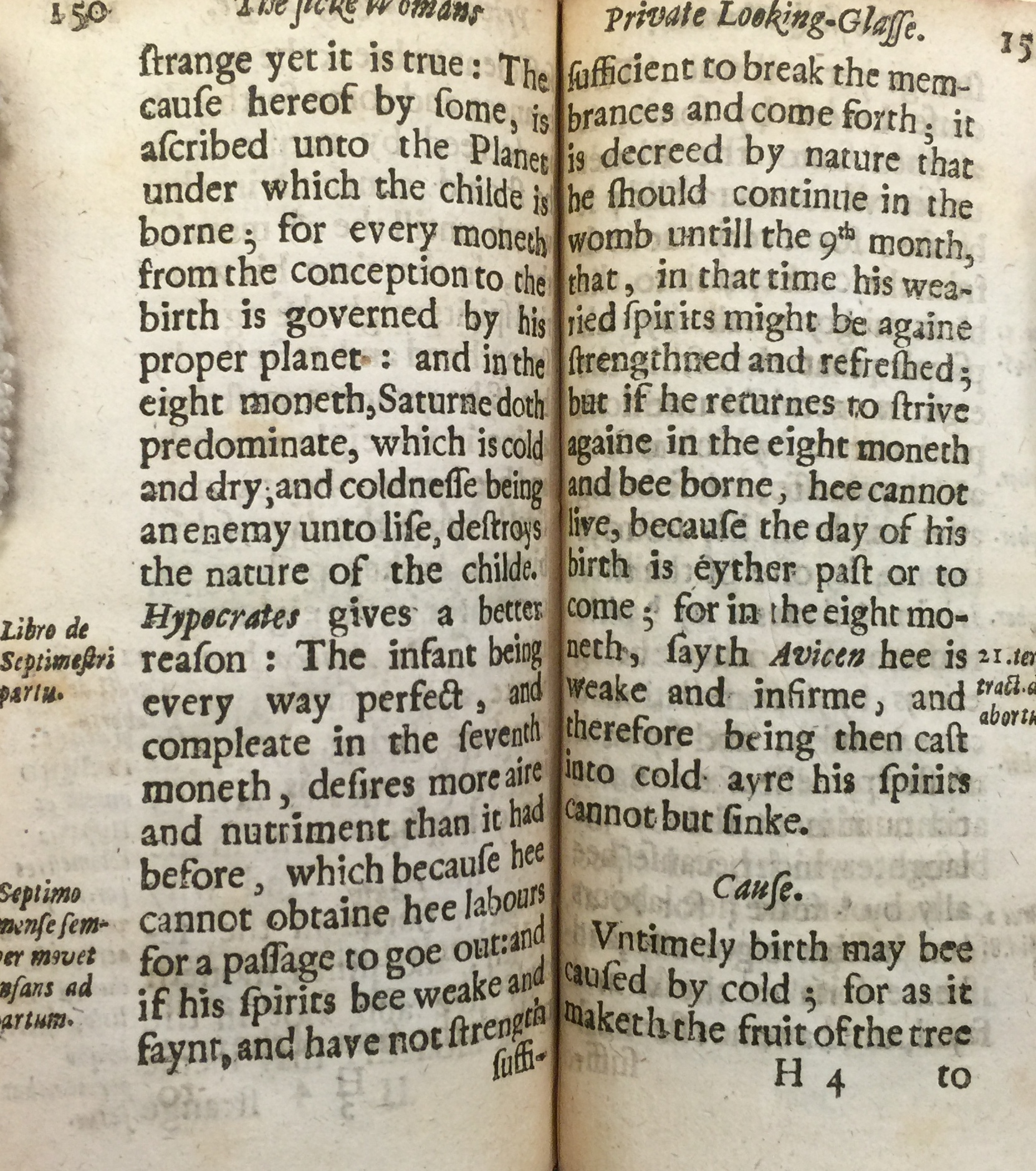
This belief persisted well into the early modern era. Here is a state of the art medical text published in 1636  by John Sadler.  Read what he has to say on the reasons that an eight month fetus cannot survive (and note the name of the publisher at the bottom of the title page-surely somewhat of a rarity then) : 

John Sadler. The Sicke Womans Private Looking Glasse. London 1636. From the Collection of the National Library of Medicine, Bethesda MD

John Sadler. The Sicke Womans Private Looking Glasse. London 1636. From the Collection of the National Library of Medicine, Bethesda MD

Saturn predominates in the eighth month of pregnancy, and since that planet is "cold and dry"," it destroys the nature of the childe". That, or some odd yearning of the child to be born in the seventh but not the eight month (according to Hippocrates) is the reason that a child born at seven and nine months' gestation may survive, but not one born at after only eight months.

Today, gestational length is of course critical, and, all things being equal, the closer the gestational length is to full term, the greater the likelihood of survival.   We can say with great certainty, that an infant born at 32 weeks or later (that's about eight months) is in fact more likely to survive than one born at 28 weeks (a seven month gestation.) In fact, a seven month fetus has a survival rate of 38-90% (depending on its birthweight), while an eight month fetus has a survival rate of 50-98%. Here is the data, taken from a British study.

Draper Elizabeth S, Manktelow Bradley, Field David J, James David. Prediction of survival for preterm births by weight and gestational age: retrospective population based study  BMJ 1999; 3…

Draper Elizabeth SManktelow BradleyField David JJames DavidPrediction of survival for preterm births by weight and gestational age: retrospective population based study  BMJ 1999; 319:1093

More recently, a study from the Technion in Haifa showed that even the last six weeks of pregnancy play a critical role in the development of the fetus. This study found a threefold increase in the infant death rate in those born between  34 and 37 weeks when compared full term babies.  

You can read more on the history of the eight month fetus in a 1988 paper by  Rosemary Reiss and Avner Ash.  From what we have reviewed, the talmudic belief in the unusually low survival rate of an eight month fetus (compared to a seven month one) is one that was widely shared in the ancient world. And one that is not supported by any of the evidence we now have.

Print Friendly and PDF

Chanukah Interlude

In the absence of matters scientific from the next few pages of Yevamot, here is a gift for Chanukah. It's a biblical-and-near-Eastern-studies-themed parody of I am the Very Model of a Modern Major General, from The Pirates of Penzance.

Enjoy, and Happy Chanukah. 

If the embedded video does not display correctly, you can watch it here

Wow, that Joshua Tyra is one funny man.


Print Friendly and PDF

Yevamot 75a~ Voltaire, Rabbi Yishmael, and the man with one testicle

In 1587, Pope Sixtus V decreed that all marriages in which the man did not have two testicles in the scrotum should be dissolved.  Voltaire (1694-1778), felt the need to share some further observations on the testes and the Pope's edict, in his Philosophical Dictionary:

This word [testes] is scientific, and a little obscure, signifying small witnesses. Sixtus V... declared, by his letter of the 25th of June, 1587, to his nuncio in Spain, that he must unmarry all those who were not possessed of testicles. It seems by this order...that there were many husbands in Spain deprived of these two organs...We have beheld in France three brothers of the highest rank, one of whom possessed three, the other only one, while the third possessed no appearance of any, and yet was the most vigorous of the three.

...[The] Parliament of Paris, on the 8th of January, 1665, issued a decree, asserting the necessity of two visible testicles, without which marriage was not to be contracted.

Which brings us to today's daf, Yevamot 75a. To catch up quickly: The Mishnah (on 70a) listed the circumstances under which a Cohen is not allowed to eat terumah. Among those banned from this edible delight is a Cohen with an injury to his testicles - and this same injury, the Mishnah continues, when found among other Jewish men, may prevent that man from marrying. 

In discussing the details of what kind of testicular injury results in a ban on marriage, we read the following:

אמר רבי ישמעאל בנו של ר' יוחנן בן ברוקה שמעתי מפי חכמים בכרם ביבנה כל שאין לו אלא ביצה אחת אינו אלא סריס חמה וכשר סריס חמה

Rabbi Yishmael the son of Rabbi Yochanan ben Berokah said: I heard from the sages in  the vineyard at Yavneh that whoever has only one testicle [at birth] is called "sterile from the sun" [i.e. naturally sterile] and is allowed to marry...

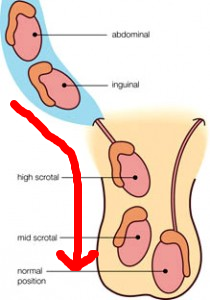
So according to this report of Rabbi Yishmael, the sages in Yavneh allowed a man born with one testicle to marry.  The Talmud is describing a condition known as cryptorchidism in which one or sometimes both of the testes remains undescended and hide somewhere within the abdomen.

 To understand why the testes take this hike, there's some embryology involved. Rather than explain with words, here is a stunning animation showing why the testes develop where they do and how they descend. Grab a cup of coffee and listen as Rimsky-Korsakov's Scheherazade op. 35 plays in the background. The formation of the testes begin at 1:02 if you are in a hurry (but don't be).

Animation is derived from Keith L. Moore, T.V.N. Persaud, Mark G. Torchia, "Before We Are Born: Essentials of Embryology and Birth Defects", 8th edition. Elsevier, 2012.

 If you didn't watch the video, here is what you need to know:

Image of testicle descending.jpg

Got it? OK.  So the testes develop in the abdominal cavity and migrate southwards into the scrotum. Usually they land there by birth, or soon after, if they behave themselves.  Which they don't always do. Sometimes one of the pair (and very rarely both) fail to migrate. Sometimes they descend and then, apparently disappointed by their new cool accommodations, bolt back north to the warmth of the abdomen.

Which brings us to the question, just how common is cryptorchidism?

The best answer will be an educated guess because the data is not great. One of the few studies of the epidemiology of this condition comes from the medical examination of English schoolboys published in 1941. It reported that the incidence of cryptorchidism in 3,300 boys under 15 was almost 10%, but that this number dropped to less than 1% in boys older than 15.

And then in this paper comes this delicious line. 

Sir Robert Hutchison tells me that he knew a man in whom descent occurred while he was an undergraduate at Oxford (an event duly celebrated by a party)
— Smith RE. The undescended testicle. The Lancet 1941;14: 747-751

A more recent  study from 2007  put the incidence of undescended testes at 1-4.6% at birth (depending on the infant birthweight), while at age 11 the incidence is anywhere from 1.6-2.2%. The incidence is higher in low birth-weight and premature boys.

What is clear is that there is an association with fertility and cryptorchidism, even when the testicle that went AWOL is retrieved and secured in the scrotum.

The incidence of azoospermia in men with unilateral cryptorchidism is 13% regardless of the fate of the testis
— Canadian Urological Association Journal, 2011

Which brings us back to the prohibition against a man with injured testes (or penis- as in Deut. 23:2:   לא יבא פצוע דכא וכרות שפכה בקהל) marrying. It is related to his presumed inability to father a child.   Voltaire seems to have been unsure of the role of the testes (whether one, two, or in one lucky case "three",) but Rabbi Yishmael's  סריס חמה, a man with only one visible testicle, while certainly less fertile than a normal man, is capable of fathering a child.  Hence his marriage, while not encouraged, is recognized, and this is codified as normative Jewish law.

   סריס שקדש, בין סריס חמה בין סריס אדם, וכן אילונית שנתקדשה, הוי  קדושין

 (שולחן ערוך אבן העזר הלכות קידושין סימן מד, ד) 

If a man with one testicle married, whether this condition is from birth or later acquired, he is legally married.

Today, an undescended testicle is surgically brought into the scrotum at an early age, so that the cryptorchidism described by Rabbi Yishmael has been virtually eliminated, as have been some very interesting parties at the University of Oxford.


Print Friendly and PDF