Israel's Noble History

Free Clipart

Israeli Nobel Prize Winners for $200 Please, Alex

Quick. Name three Israelis who have won a Nobel Prize. Come on. You can do this. Still need a hint? Click here. See, I told you you'd know.  

Picture of Agnon.jpg

OK, those were easy. How about this one.  Which Israel won a Nobel Prize for literature? Need a hint? He was awarded it in 1966 for " his profoundly characteristic narrative art with motifs from the life of the Jewish people" and his photo is shown here. Still not sure? You may have read his work on Rosh Hashanah and Yom Kippur which was translated into English as Days of Awe...Of course; it was Shai Agnon, who was born in Galicia, moved to what was then Palestine (twice) and died in Jerusalem in 1970.

As of this year there have been twelve Israeli winners of the Nobel Prize. We've noted Agnon as the single winner for literature, and (as you may have answered correctly) there have been three winners of the Nobel Peace Prize: Menachem Begin (1978), Yizhak Rabin and Shimon Peres (both in 1994).  That leaves eight more prizes. In honor of Yom Ha'atzmaut, Israel's Independence Day, we will pause from our analysis of science in the Talmud and reflect on the Israeli winners of this prize, given each year (in accordance with the will of Alfred Nobel) "to those who, during the preceding year, shall have conferred the greatest benefit on mankind."

Daniel Kahneman, Economics, 2002

Following at an eight year prize-drought, Israel picked up her fifth Nobel in 2002, when Daniel Kahneman was awarded the 2002 Prize in Economics. In his biographical sketch, Kahneman credits his early days in the IDF with the first cognitive illusion he discovered.

… after an eventful year as a platoon leader I was transferred to the Psychology branch of the Israel Defense Forces….We were looking for manifestations of the candidates’ characters… we felt…we would be able to tell who would be a good leader and who would not. But the trouble was that, in fact, we could not tell... The story was always the same: our ability to predict performance at the school was negligible...I was so impressed by the complete lack of connection between the statistical information and the compelling experience of insight that I coined a term for it: “the illusion of validity.” Almost twenty years later, this term made it into the technical literature. It was the first cognitive illusion I discovered.
— Daniel Kahneman, Biographical sketch at Nobelprize.org

(Last summer I was about two-thirds of the way through Kahneman's recent best-seller Thinking Fast and Slow, when I left it on a flight from Tel Aviv. Please let me know if you find it.) 

Ciechanover and Hershko, Chemistry 2004

In 2004 Aaron Ciechanover and Avram Hershko, both from the Technion in Haifa (together with Irwin Rose), were awarded the Nobel Prize in Chemistry for their discovery of how cells breaks down some proteins and not others. They discovered ubiquitin-mediated proteolysis, a process where an enzyme system tags unwanted proteins with many molecules another protein called ubiquitin. The tagged proteins are then transported to the proteasome, a large multi-subunit protease complex, where they are degraded.

Robert Aumann, Economics, 2005
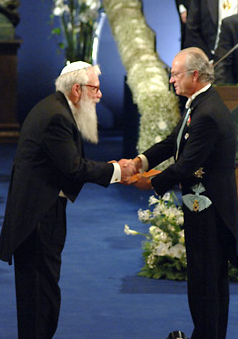
Robert Aumanm from the Hebrew University won the 2005 Nobel Prize in Economics for his work on conflict, cooperation, and game theory (yes, the same kind of game theory made famous by John Nash, portrayed in A Beautiful Mind). Aumann worked on the dynamics of arms control negotiations, and developed a theory of repeated games in which one party has incomplete information.  The Royal Swedish Academy of Sciences noted that this theory is now "the common framework for analysis of long-run cooperation in the social science." The kippah-wearing professor opened his speech at the Nobel Prize banquet with the following words (which were met with cries of  אמן from some members of the audience):

ברוך אתה ה׳ אלוקנו מלך העולם הטוב והמיטב

The four-minute video of his talk should be required viewing for every modern-orthodox high school student (and their teachers). 

Ada Yonath, Chemistry, 2009

Remember ribosomes from high school? They are the machines inside all living cells that read messenger RNA and link amino acids in the right order to make proteins.  In 2009, Ada Yonath from the Weizmann Institute shared the Nobel Prize in Chemistry for her work on the structure and function of the ribosome. Specifically, she reported their three-dimensional structure and her work in the 1980s was "instrumental for obtaining the robust and well diffracting ribosome crystals that eventually led to high resolution structures of the two ribosomal subunits." Why is this important?  Well, many antibiotics target the ribosomes of bacteria, and so knowledge of how antibiotics bind to the ribosome may help in the design of new and more efficient drugs.  

Available structures of antibiotics targeting the small ribosomal subunit (30S). From Franceschi and Duffy. Structure-based drug design meets the ribosome. Biochemical Pharmacology 2006; 71; 1016-1025.

Available structures of antibiotics targeting the small ribosomal subunit (30S). From Franceschi and Duffy. Structure-based drug design meets the ribosome. Biochemical Pharmacology 2006; 71; 1016-1025.

Dan Shechtman, Chemistry, 2011

in 1982, Shechtman was working at the US. National Institute of Standards and Technology. As he was  looking through an electronic microscope at the structure of new material that he was studying, and noted that the atoms had arranged themselves "in a manner that was contrary to the laws of nature." 

אין חיה כזו – There is no such entitiy" was how he recalled responding to what he had seen.  Shechtman double checked his findings and submitted them for publication; the paper was rejected immediately, not worthy even of being sent on for peer review.  But Shechtman did manage to get his work published, work that the Nobel Committee found questioned a fundamental truth of science: that all crystals consist of repeating, periodic patters. Shechtman's discovery of what were later to be called quasicrystals  was important not only because of what he found. It was important that he found. Here's why:

Over and over again in the history of science, researchers have been forced to do battle with established “truths”, which in hindsight have proven to be no more than mere assumptions. One of the fiercest critics of Dan Shechtman and his quasicrystals was Linus Pauling, himself a Nobel Laureate on two occasions. This clearly shows that even our greatest scientists are not immune to getting stuck in convention. Keeping an open mind and daring to question established knowledge may in fact be a scientist’s most important character traits.
— The Swedish Academy of Sciences. The Nobel Prize in Chemistry 2011. Information for the Public


Arieh Warshel and Michael Levitt, Chemistry 2013

Israel's two most recent Nobel Prize winners are Arieh Warshel and Michael Levitt. In 2013 they shared the prize in, yes, you've guessed it...Chemistry, (together with Marin Karplus, a Jew, but not yet an Israeli).  Working together in the 1970s on GOLEM, the supercomputer at the Weizmann Institute, they developed computer programs that could simulate chemical reactions with the help of quantum physics.  These programs, and their offshoots, are used in a variety ways, from optimizing solar panels to designing new drugs.

The Last Word

There you have it. Twelve remarkable Israelis who have contributed to peace efforts, science and literature, and whose efforts were recognized by a Nobel Prize. As we celebrate Yom Ha'atzmaut, let's give the last word to the 2005 winner Robert Aumann, who noted in his banquet speech just  what it really important in life. 

We have participated in the human enterprise – raised beautiful families. And I have participated in the realization of a 2000-year-old dream – the return of my people to Jerusalem, to its homeland.
— Robert Aumann, Nobel Prize banquet speech, 2005.

Print Friendly and PDF

Ketuvot 75a ~ Halitosis

 תלמוד בבלי כתובות עה, א  

תנא, הוסיפו עליהן זיעה ושומא וריח הפה

[The following defects are grounds for divorce:] Excessive perspiration, a mole, and bad breath...(Ketuvot 75a)

Bertrand's Bad Breath and Jane AUsten's Sufferings

In his autobiography, the great British philosopher and mathematician Bertrand Russell (d. 1970) wrote of his personal ills, and how they affected Lady Ottoline Morrell (one of the women with whom he was an affair):

I suffered from pyorrhea although I did not know it, and this caused my breath to be offensive, which I also did not know. She could not bring herself to mention it, and it was only after I had discovered the trouble and had it cured that she let me know how much it had affected her.

Jane Austen, the genteel author of Pride and Prejudice, did not suffer from bad breath, but she does  seem to have suffered from the bad breath of others. In one of her not so genteel letters, she wrote that "Miss Debary, Susan and Sally made their appearance and I was as civil to them as their bad breath would allow me."  (This sentence proves, once more, that the pen is indeed mightier than the sword.)

The Causes of Bad Breath

Bertrand Russell and Jane Austen were not alone. Overall, about one in four adults suffers from bad breath on a regular basis. There are a large number of causes of  bad breath (or halitosis, from the Latin halitus, meaning exhalation). In the young it is usually caused by a coating of the tongue, whereas in older people, the cause is more likely to be tooth decay or gum disease. Whatever the proximate cause, the final pathway to halitosis is usually microbial action in the mouth (most commonly by gram negative anerobic bacteria,) which release volatile sulphur compounds including hydrogen sulphide. It's these compounds that cause the odor we know as halitosis.

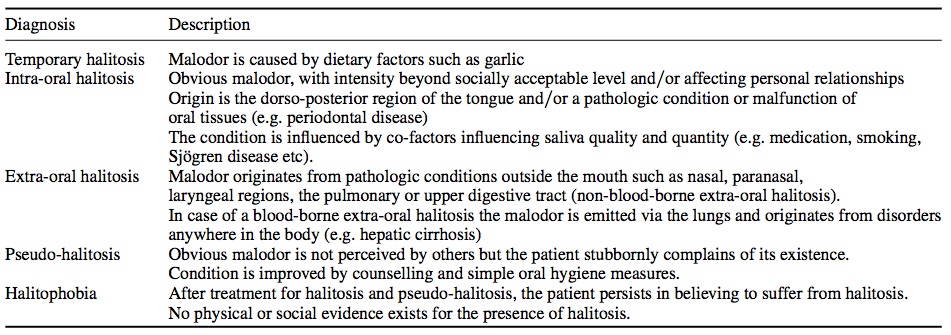
From Seemann R. et al.  Halitosis management by the general dental practitioner—results of an international consensus workshop. Journal of Breath Research. 2014: 8: 1-6.

From Seemann R. et al.  Halitosis management by the general dental practitioner—results of an international consensus workshop. Journal of Breath Research. 2014: 8: 1-6.

Dentists have been encouraged to grade the halitosis based on the distance at which it can be detected, or the strength of the smell.  So Grade 3 halitosis on the Distance Malodor Scale is when the breath can be clearly detected "if the observer approached to a distance of about 100 cm to the mouth of the patient". (Really. I'm not making this up.) 

Morning Breath: Due to the reduced saliva production during night, anaerobic putrefaction will increase, causing the typical morning breath. This is a non-pathological form of halitosis. The problem will disappear as soon as oral hygiene measures are taken...women manifest higher VSC levels than men in the morning. This phenomenon needs to be further investigated to understand its impact.
— Bollen C. Beikler T. Halitosis: the multidisciplinary approach.International Journal of Oral Science (2012) 4, 55–63

Bad Breath in the Talmud

The passage on halitosis in this daf has achieved a certain notoriety, as evidenced by this newspaper snippet from the Curiosity Shop column in The Victoria Advocate, a daily newspaper out of Victoria Texas (Jewish population: about twenty families):

The Victoria Advocate, October 14, 2000.

The Victoria Advocate, October 14, 2000.

Options, Other Than Divorce

Bad breath is not only grounds for divorce. It is also a condition that renders a Cohen unfit to serve in the Temple. The Talmud suggests that a Cohen with halitosis should chew on peppers, which were considered to be antidote to bad breath. In this way he could become eligible to serve once more.  As for a woman so afflicted, such a cure would not be possible, since, as Rashi points out, a husband and wife need to talk often, and talking is hard to do with a mouth full of peppers:

אפשר דנקט פילפלא בפומיה ועביד עבודה אבל גבי אשה לא אפשר

רשי: גבי אשה  - שהוא מדבר עמה כל שעה -  לא אפשר

What then, can the couple do to save their marriage? Well, how about these suggestions: try brushing your teeth and tongue often; try using mouthwash several times a day, and try visiting your dentist. In fact, just try to follow the advice of this dentist

Do not divorce you partner if he/she has bad breath!
Your dentist and hygienist can help. Just call them.
— Nicholas Calceterra DDS. Directions in Dentistry, October 6 2013.


Print Friendly and PDF

Ketuvot 71b ~ Abstinence, Kedushah, and a Spiritual Marriage

On daf 61b the Mishnah outlined how often, according to the Torah, a husband should have conjugal relations with his wife. Just to remind you, here are the rules:

העונה האמורה בתורה הטיילין בכל יום הפועלים שתים בשבת החמרים אחת בשבת הגמלים אחת לשלשים יום הספנים אחת לששה חדשים דברי רבי אליעזר

Conjugal rights that are defined in the Torah are as follows: Tayalin (students who are at home with their wives every night) must be intimate each day; laborers, twice a week; donkey drivers (who would be away for six days at a time), once a week; camel drivers, once in thirty days; sailors, once in six months. This is the teaching of Rabbi Eliezer.

The Mishnah seems here to be descriptive, rather then prescriptive. Tayalin are home every day, so their conjugal obligation is daily. But camel drivers are away for up to a month at a time, so their conjugal obligation is...once a month. 

Vows of Abstinence

So far so good. But what happens if one of the partners vows to abstain from marital relations? Is such a marriage sustainable? This question is partially addressed in the Mishnah on 61b:

 המדיר את אשתו מתשמיש המטה ב"ש אומרים שתי שבתות בית הלל אומרים שבת אחת

If [a husband] takes a vow to forbid his wife from marital relations with him, Bet Shammai say that if the term of the vow was up to two weeks, [he need not divorce her], and Bet Hillel say that if the term was only one week [he need not divorce her]

The Mishnah is dealing with a vow of abstinence made by the husband. But what about such a vow made by a wife? That question is dealt with in today’s daf.

דאמר רב כהנא "הנאת תשמישי עליך" כופה ומשמשתו

Rav Kahanah said: If a wife vows: "The pleasure of cohabiting with me is forbidden to you" [the vow has no legal standing and the husband] can force her [to ignore the vow and] to cohabit with him.

In this case, the wife is attempted to forbid the husband from cohabiting with her, but since she has no legal power to do this, the vow has no legal standing. But the Talmud then teaches that if the wife vows not to have the pleasure of marital relations, the vow can take legal effect – since it is a vow she made on herself.

Spiritual Marriages

In 2001, Pope John Paul II beatified the husband and wife team of Luigi (d. 1951) and Maria (d. 1965) Quattrocchi-Beltrame. And what did this couple (-the first married couple to be so recognized-) do that earned them this extraordinary recognition? There were several achievements, but among them was their decision to engage in a spiritual marriage, that is, a marriage in which, as an expression of piety, the couple jointly undertook a vow of sexual abstinence. Based on what we’ve learned over the last several pages of the Talmud, you would expect that such “spiritual” marriages would be quite antithetical to Jewish practice. And you’d be largely, but not completely correct. Enter Exhibit A, Benjamin Brown’s recent remarkable paper, The Sexual Abstinence of Married Men in Gur, Slonim, and Toledot Aharon.

The Sexual Abstinence of Married Hasidim

Brown (no relation to me,) is a gifted researcher in the Department of Jewish Thought at the Hebrew University.  His 2013 paper reveals a little known practice of the Hasidic sects of Ger, Slonim and Toledot Aharon.  These sects do not require complete abstinence of sexual relations within a marriage, but they start to get very close.  They radicalized a notion of Kedushah (holiness) and in this radical version, married men limited to the minimum the frequency of sexual intercourse with their wives. Brown records how the fourth Gerer Rebbe, Israel Alter (d. 1977) inaugurated the Ordinances on Holiness, which were never published “nor, in all probability, ever formulated systematically.” Instead, they were communicated from the Rebbe to his senior hasidim, “who later became the community’s first marriage guides (madrikhim), and they passed them on to the community...” Here they are, as condensed by the good professor:

  1. The couple shall have sexual intercourse only once a month, on leil tevilah (the night after the wife’s immersion in the mikveh at the end of her halakhically prescribed menstrual period).

  2. The couple shall refrain from sexual intercourse from as early as the seventh month of pregnancy.

  3. After the wife has given birth, the couple shall refrain from sexual intercourse for a further period of six months.

  4. During intercourse, the couple shall aim to minimize physical contact. The husband shall wear some of his clothes, including his tsitsit (considered a segulah—supernatural remedy—against the sexual drive) and will not hug or kiss his wife or engage in any behaviour that is not required for the performance of the act of intercourse itself.

  5. The husband shall direct his thoughts as far away as possible from the sexual act.

For the Slonim Hasidim, only one rule was  formulated: there was to be no sexual intercourse on Shabbat, because the “crude physical act of intercourse would defile the spirituality of the holy day.” The Slonim Hasidim take this rule very seriously; there is a saying among them that “a man who has sexual intercourse on Friday night is not allowed to recite the Nishmas (shorthand for nishmat kol hai)—a paragraph in the Sabbath morning prayer, considered one of the high points of the Sabbath service in the Slonim tradition.”

Finally Brown turned to R. Avraham Yitzhak Kohn (d. 1996) who led one of the two factions of the Toledot Aharon sect in Jerusalem. In his pamphlet called דברי קדושה he urged his followers to adopt some of the stringencies of kedushah, but he was more moderate than either Gur or Slonim.

He [R. Avraham Yitzhak Kohn] permitted sexual intercourse not only on both leil tevilah and leil Shabbat (Sabbath night, i.e. Friday night),but also whenever the wife expressed her desire for it (never overtly but rather by subtle indications such as self-adornment or the use of perfume). Moreover, the Rebbe permitted the moderate expression of physical affection between husband and wife. Hugs and kisses are allowed, and during intercourse are even recommended…
— Benjamin Brown, 2013. Kedushah: The Sexual Abstinence of Married Men in Gur, Slonim, and Toledot Aharon

It is not surprising that rabbinic leaders outside of the Hasidic community criticized these practices. The Hazon Ish, (R. Avraham Yeshayahu Karelitz, d. 1953) was especially concerned about the effect of these stringencies on a newly wed couple (though Brown notes that Karelitz himself was reported to have abstained in physical contact with his wife). The head of the Slobodka Yeshiva, Rabbi Yitzhak Isaac Sher (d. 1952) was also concered, and outlined his thoughts in his work קדושת ישראל:

As for the bad habits that many of them have adopted in error, believing that in order to maintain themselves in holiness they must refrain from talking to their wives—the rabbis must strive to make them realize that this kind of holiness is the very essence of impurity…and that the husband must speak to his wife, addressing her with wondrously affectionate words of placation. ( p27).

Brown believes that there are three sociological forces that may explain these rather extreme hasidic practices:

(a) the inherent hasidic quest for spiritual renewal, which in time generated a range of supererogatory mysticism substitutes; (b) the overriding Orthodox tendency toward halakhic stringency; (c) the hasidic struggle to resist the promiscuous sexuality of modern society, which prompted the rebbes to construct defensive fences even around the limited sphere of sexual activity that is permissible within the boundaries of halakhah.

So there you have it. Despite all we have learned in the Talmud over the last several pages, sexual abstinence within marriage is certainly to be found in some sections of the Jewish community.

House Work and Intimacy

Predicted Sexual Frequency by Men’s Share of Housework. From Kornrich et al. Egalitarianism, Housework, and Sexual Frequency in Marriage. American Sociological Review 2012; 78 (1): 26-50. 

Predicted Sexual Frequency by Men’s Share of Housework. From Kornrich et al. Egalitarianism, Housework, and Sexual Frequency in Marriage. American Sociological Review 2012; 78 (1): 26-50. 

If there is one thing that all hasidic sects emphasize, it is the clearly defined gender roles that men and women are expected to have within their society. This is in stark contrast to the way in which many contemporary marriages have evolved.  According to the Emory sociologist Sabino Kornrich and his colleagues Julie Brines and Katrina Leupp, this evolution has challenged "the notion of marriage as an institution ensnared in a stalled gender revolution, [and] this new perspective asserts that today’s marriages are more egalitarian, flexible, and fair than those of the past." For many couples, this evolution revolves around housework, and some research showed that  - at least in the US - couples who have more equal divisions of labor are less likely to divorce than are couples where one partner is the breadwinner and the other takes care of the household duties. But this may come at an unexpected price. In their study of (rather old) data from the National Survey of Families and Households, Kornrich and his collegues concluded that

...shifting from a household in which women perform all of the core household tasks to one where women perform none of the core household tasks is associated with a decline in sexual frequency of nearly 1.6 times per month. Given a mean sexual frequency in this sample of slightly over five, this is a large difference.
— Kornrich et al. Egalitarianism, Housework, and Sexual Frequency in Marriage. American Sociological Review 2012; 78 (1): 26-50.

It's So Confusing...

Some hasidic sects may encourage sexual abstinence within marriage, but do they understand that their preservation of traditional gender roles might actually lead to a greater frequency of sexual relations between and wife and husband? And what is the modern orthodox Jew to do when she asks her husband to vacuum, or he asks his wife to take out the trash? Do they realize that in complying, these egalitarian couples may be endangering their most intimate lives? One thing is certain: further research is needed.

...sex is an important component of marriage. Blumstein and Schwartz’s classic, American Couples (1983), identified sex (in addition to money and power) as a key good around which marriages—indeed all intimate partnerships—are organized. Sexual frequency is of interest for researchers because it is positively linked to emotional satisfaction and physical pleasure, and couples with greater sexual frequency are less likely to divorce or break up...
— Kornrich et al. Egalitarianism, Housework, and Sexual Frequency in Marriage. American Sociological Review 2012; 78 (1): 26-50.

Print Friendly and PDF

Ketuvot 67b ~ Blushing and Shaming

 תלמוד בבלי כתובות סז ב 

נוח לו לאדם שימסור עצמו לכבשן האש ואל ילבין פני חבירו ברבים

It is better for a person to jump into a fiery furnace, rather than embarrass his friend in public

As a child, I blushed easily. This did not rise to the level of an illness (I think) but I was most certainly aware of of how easily I blushed, and so were some of my high school teachers, who would only need to call my name and my face would turn red. (I now know this is not that uncommon. The easy blushing that is. Actually, nor is the cruelty of teachers, now I come to think of it.)  Darwin called blushing "the most peculiar and the most human of all expressions." It occurs when the face, ears, neck and upper chest redden on darken in response to perceived social scrutiny or evaluation. 

When Do We Blush?

There appear to be four social triggers that result in blushing: a) a threat to public identity; 2) praise or public attention 3) scrutiny, and oddly enough, 4) accusations of blushing. This last trigger is especially fascinating: just telling a person that they are blushing - even when they are not - can trigger a blush. 

Blushing is not only triggered by certain social situations; it also triggers other responses in those who blush. The most commonly associated behaviors are averting the gaze and smiling. Although gaze aversion is a universal feature of embarrassment, its frequency differs across cultures: in the United kingdom 41% report averting their eyes when they are embarrassed, whereas only 8% of Italians report doing so. Smiling is also a common response. Up to a third of those who are embarrassed display a "nervous" or "silly grin." 

Why Do We Blush?

It is unclear why humans blush. Of course, we blush when we are embarrassed, but why should this physiological response occur? The blood vessels in the face (and the other areas that blush) seem to differ structurally from other vessels, and so respond in a unique way. But just how they do so, and why, remains a physiological mystery.  Here's the surgeon Atul Gawande's explanation, from the pages of The New Yorker.

Why we have such a reflex is perplexing. One theory is that the blush exists to show embarrassment, just as the smile exists to show happiness. This would explain why the reaction appears only in the visible regions of the body (the face, the neck, and the upper chest). But then why do dark-skinned people blush? Surveys find that nearly everyone blushes, regardless of skin color, despite the fact that in many people it is nearly invisible. And you don’t need to turn red in order for people to recognize that you’re embarrassed. Studies show that people detect embarrassment before you blush. Apparently, blushing takes between fifteen and twenty seconds to reach its peak, yet most people need less than five seconds to recognize that someone is embarrassed—they pick it up from the almost immediate shift in gaze, usually down and to the left, or from the sheepish, self-conscious grin that follows a half second to a second later. So there’s reason to doubt that the purpose of blushing is entirely expressive.

There is, however, an alternative view held by a growing number of scientists. The effect of intensifying embarrassment may not be incidental; perhaps that is what blushing is for. The notion isn’t as absurd as it sounds. People may hate being embarrassed and strive not to show it when they are, but embarrassment serves an important good. For, unlike sadness or anger or even love, it is fundamentally a moral emotion. Arising from sensitivity to what others think, embarrassment provides painful notice that one has crossed certain bounds while at the same time providing others with a kind of apology. It keeps us in good standing in the world. And if blushing serves to heighten such sensitivity this may be to one’s ultimate advantage.

Blushing and Crossing Boundaries

So blushing may confer an advantage. It keeps us in good social standing, insuring that we do not step outside of the bounds of accepted behavior. This notion is supported by some recent work (published more than a decade after Gawande's 2001 article) that supports this notion of blushing having a social utility.  Those who blush frequently showed a positive association between blushing and shame. These frequent blushers generally behaved less dominantly and more submissively. Writing in the journal Emotion in 2011 (yes, that really is the name of this academic journal), three Dutch psychologists demonstrated that blushing after a social transgression serves a remedial function. In their (highly experimental lab) work on human volunteers, blushers were judged more positively and were perceived as more trustworthy than their non-blushing counterparts.  

Still, helpful as it may be to regain the trust of others, social embarrassment can come at a huge cost - including the suicide of those who have been embarrassed. In the Talmud, embarrassing another person is called הלבנת פני חבר - literally translated as "making the face of another turn white." This is of course quite the opposite of what actually occurs when a person blushes, and seems to suggest another, deeper level of embarrassment, (though it's not something discussed in the scientific literature). According to the Talmud, the person is so embarrassed that the blood drains from his face, causing him to turn pale.  This raises an interesting question: if  blushing serves an important social function - reminding a person that he has violated rules which should be held sacred - why does the Talmud tell us to to avoid causing embarrassment? Hasn’t a person been caught in the act of  violating our rules?  Shouldn’t we all blush a little in Elul?

Print Friendly and PDF