Nedarim 80~ Rabbi Yossi on Bathing and Laundry

נדרים דף עט, א - פא, א 

ואלו נדרים שהוא מפר, דברים שיש בהן ענוי נפש: אם ארחץ ואם לא ארחץ ...אלא דאמרה הנאת רחיצה עלי לעולם אם ארחץ היום, ורבי יוסי סבר: ניוול דחד יומא לא שמיה ניוול

מעיין של בני העיר, חייהן וחיי אחרים - חייהן קודמין לחיי אחרים, בהמתם ובהמת אחרים  בהמתם קודמת לבהמת אחרים, כביסתן וכביסת אחרים - כביסתן קודמת לכביסת אחרים, חיי אחרים וכביסתן - חיי אחרים קודמין לכביסתן, רבי יוסי אומר: כביסתן קודמת לחיי אחרים

כביסה אלימא לר' יוסי, דאמר שמואל: האי ערבוביתא דרישא מתיא לידי עוירא, ערבוביתא דמאני מתיא לידי שעמומיתא, ערבוביתא דגופא מתיא לידי שיחני וכיבי


These are the vows [made by a wife] that a husband may revoke: matters that involve self-afflction. For example [a wife made a vow] "If I bathe and if I do not bathe..."

What could this mean? She said The pleasure of bathing is forbidden to me forever if I bathe today. And Rabbi Yossi believes that not bathing for one day is not called repugnance...

If a spring belonged to townspeople, [but it does not supply the needs of everyone, whose needs take precedence?] When it is a question of their own lives or the lives of strangers, their own lives take precedence;  the lives of their cattle or the cattle of strangers - their cattle take precedence over those of strangers; their laundering or that of strangers - their laundering takes precedence over that of strangers. But if the choice lies between the lives of strangers and their own laundering, the lives of the strangers take precedence over their own laundering. R. Yossi ruled: Their laundering takes precedence over the lives of strangers...

[The discomfort of not laundering clothes is greater than that of not bathing] according to Rabbi Yossi, as Shmuel taught: filth on the head leads to blindness, dirty clothes leads to dementia, not bathing leads to boils and sores...

Clean Body, Clean Clothes

The passage on today's page in the Talmud seeks to understand the Mishnah (learned yesterday) which taught that a husband may annul his wife's vow if it would interfere with her bathing regime and hence cause her to become, well, smelly and unattractive.  In contrast to this, Rabbi Yossi (a student of Rabbi Akivah and who lived in Israel in the second century CE.) taught that this vow cannot be annulled since he understands that it only prevents her from bathing for a single day - and this brief abstinence does not cause her to become repugnant in her husband's eyes.  In tomorrow's daf the analysis is completed when it is discovered that Rabbi Yossi, while not seeming to be bothered by a lack of one day of bathing, was indeed very bothered by a lack of clean laundry.  How bothered? Well, if it's your water and you only have enough to clean your own laundry or to give an outsider a life sustaining drink, guess who is going to be wearing some clean clothes! Rabbi Yossi was so bothered by dirty clothes that he valued them over life itself (so long as that life was not your own). It seems rather odd, does it not, for Rabbi Yossi to allow a wife to do without bathing for a day and yet hold clean clothing to be really important? To answer this, we need to dive in to the history of bathing.

Jewish, Roman and Early Christian Bathing Habits

The Talmud is replete with statements that emphasize the importance of daily bathing.  A תלמיד חכם (scholar) is forbidden to live in a town that does not have at least one bathhouse, and Hillel the Elder taught his students that going to wash in the bathhouse was a מצוה, since there was a responsibility to care for the human body, created as it was in the very image of God. Hillel seems to have left a cleanliness legacy in his family: his grandson, Rabban Gamliel (who lived in the early part of the first century CE.) was so in need of bathing that he allowed himself to wash on the first night after his wife died - an act that was understood to be forbidden.  In the Jerusalem Talmud, the precedent of Rabban Gamliel is further analyzed. When a rabbi developed boils during his period of mourning (which the Talmud assumes was due to a lack of washing) a certain Rabbi Yassa allowed him to wash immediately - "for otherwise he could die." Rabbi Yassa extended his ruling to allow bathing on (wait for it...) Tisha Be'Av and Yom Kippur - so long as the bathing was to alleviate discomfort rather than for pleasure.   

The famous Greek physician Hippocrates, (died c. 370 BC) wrote about the healing power of warm (and very cold) baths.  But as Katherine Ashenburg wrote in The Dirt on Clean, her definitive (and very readable) history of bathing, "...while the Greeks appreciated water...the Romans adored it."  The Roman desire of cleanliness and their culture of bathing is of course well known to anyone who has visited a Roman ruin in Israel, Italy or elsewhere. The focus on bathing seems to have changed with the fall of the Roman empire and the rise of Christianity. Ashenburg explains that since the first Christians were Jews, a way of distinguishing themselves was to ignore the Jewish laws of ritual purity, which involved so much hand washing and body dipping.  Although ritual purity is not the same as cleanliness, the two became linked, and with the opposition to the Jewish rules of ritual cleanliness, there rose a Christian opposition to bathing.  In the middle ages, some monastic orders allowed only three baths a year, "but monks whose holiness trumped cleanliness could decline any or all baths."

Jesus’ indifference to ritual purity accorded with what later became a wider Christian distrust or neglect of the body.
— Katherine Ashenburg. The Dirt on Clean (North Point Press 2007) p 54.

What few bathhouses there were in medieval Europe were closed during the years of the Great Plague, since the best science of the day taught that heat and water created openings on the skin, through which the plague would enter.  "Sadly, the best medical advice of the day probably doomed many people, for the dirtier people were, the more likely they were to harbor Pulex irritants, the flea now believed to have carried the plague bacillus from rats to humans."

Eilizabeth I of England bathed once a month, as she said, “whether I need it or not.” But the seventeenth century raised the bar: it was spectacularly, even defiantly dirty. Elizabeth’s successor, James I, reportedly washed only his fingers, The body odor of Henri IV of France (1553-1610) was notorious, as was that of this son Louis XIII. He boasted, “I take after my father, I smell of armpits”.
— Ashenburg. The Dirt on Clean. p99.

Clean Linens and Rabbi Yossi

While washing the body was generally avoided in seventeenth century Europe, clean clothes were most certainly demanded, especially among the middle and upper classes.  "Clean linen" writes Ashenburg, "was not a substitute for washing the body with water - it was better than that, safer, more reliable and based on scientific principles." And here perhaps is an echo of the position of Rabbi Yossi in today's page of Talmud.  To be clear: Rabbi Yossi was not arguing that bathing was not important - rather he argued about the length of time a person could forgo a bath and not become "repulsive" to a spouse.  But his emphasis on the need for laundered and clean clothes is striking.  The Talmud (Nedarim 81a) relates Rabbi Yossi's concerns to a teaching of the physician ShmuelFilth on the head leads to blindness, dirty clothes leads to dementia, and not bathing leads to boils and sores..." According to Rabbenu Nissim, (a fourteenth century commentator known by his acronym as the Ran), the first and third of these conditions may be cured - but not the dementia caused by dirty clothes. That's why Rabbi Yossi claimed that the water needed to do the laundry was so important.  Here's the text of the Ran:

כשגופו מזוהם שאינו רוחץ תמיד מביאו לידי שיחנא וכיבי אבעבועות המכאיבות ולאלו יש רפואות אבל שעמום קשה מהן אלמא כביסה אלימא מרחיצה

Bathing and Healing

In a 2002 a review of the history of spa therapies was published in Annals of the Rheumatic Diseasesthe authors noted that several randomised controlled trials had studied the effects of spa therapy in rheumatoid arthritis and osteoarthritis but that "definite judgment about its efficacy is impossible because of methodological flaws in these studies." However, "...overall, the results showed positive effects lasting for three to nine months. Recently, a randomised controlled trial has shown that spa therapy is clearly effective in ankylosing spondylitis. Two intervention groups followed a three week course of spa therapy at two different spa resorts, and were compared with a control group who stayed at home and continued standard treatment consisting of anti-inflammatory drugs and weekly group physical therapy. Significant improvements in function, pain, global wellbeing, and morning stiffness were found for both intervention groups until nine months after spa therapy." 

Bathing - and clean clothes - are social customs that have changed and changed again over time. We  know of no evidence to support Rabbi Yossi's link between dementia and clean clothes, but at other times and on other cultures clean clothes were indeed valued far beyond a clean body.  And today, bathing and doing the laundry still seem like rather good ideas.

Throughout the ages the interest in the use of water in medicine has fluctuated from century to century and from nation to nation. The (medical) world has viewed it with different opinions, from very enthusiastic to extremely critical, and from beneficial to harmful. Today, spa therapy is receiving renewed attention from many medical specialties and health tourists, and having a revival. However, the exact therapeutic potential of spa therapy still remains largely unknown. Better and more profound scientific evidence for its efficacy is therefore warranted, in particular for its effects on the musculo-skeletal system.
— van Tubergen and van der Linden. A Brief History of Spa Therapy. Ann Rheum Dis 2002;61:275
Print Friendly and PDF

Nedarim 66b ~ False Teeth, and False, False Teeth

נדרים סו, ב

תנא שן תותבת היתה לה ועשה לה רבי ישמעאל שן של זהב משלו. כי שכיב רבי ישמעאל פתח עליה ההוא ספדנא הכי בנות ישראל על ר' ישמעאל בכינה המלבישכן

A woman had a false tooth [that detracted from her beauty], and Rabbi Yishmael made a gold tooth for her.  When Rabbi Yishmael died, a eulogy was delivered that began: "Daughters of Israel, weep over Rabbi Yishmael, who clothed you...(Nedarim 66b)

A Roman False Tooth?

Several years ago there was a little academic skirmish over the question of Roman false teeth. A group of French anthropologists reported that they had found "a wrought iron dental implant of a second upper premolar from a Gallo-Roman necropolis at Chantambre (Essonne, France), from the first or second century AD."  That would date the implant to right around the time that Rabbi Yishmael lived.  

 Details of the false tooth. a, Antero-lateral view of the skull. The iron-made dental implant is where the right second upper premolar would have been. b, Retro-alveolar X-ray of the right maxilla. The implant was dropped after being handled a…

 Details of the false tooth. a, Antero-lateral view of the skull. The iron-made dental implant is where the right second upper premolar would have been. b, Retro-alveolar X-ray of the right maxilla. The implant was dropped after being handled and it broke near its apical third into two pieces that were then glued together again. The line of breakage is visible on this X-ray picture. The alveolar wall and the pseudo-root fit perfectly together. Only an area one to two millimetres high in contact with the mesial alveolar wall shows an absence of contact between the bone and the implant. From Crubezy et al.  False teeth of the Roman World.  Nature 1998; 391; 29.

The owner of the alleged false tooth seemed to have had it in place for at least a year before he died, (since it was somewhat well integrated into the surrounding bone known as the alveolar wall,) leading to the suggestion that "this implant might have been functional." The French anthropologists concluded that the false tooth "... in addition to its exceptional aspect and the technical craft it required, gives remarkable clues about medicine and anatomy in this rural community of the first or second century AD."

A Fake False Tooth?

Others were not convinced.  An American anthropologist, Marshall Becker, published a letter critical of the French conclusions.  The skill needed to produce a false tooth today is considerable, and it would be very unlikely "to be accepted by a human body under questionably sterile conditions." Instead, suggested Becker, the tooth was a natural one that had been stained "with oxides from proximity  with an iron-rich object."

The ability of ancient “surgeons” throughout the world to cut pieces from human skulls and to have many of their patients survive is equally amazing. But whether they were interested in or capable of creating true dental implants in my view requires more evidence.
— Marshall Joseph Becker. A Roman "implant" reconsidered. Nature 1998; 394; 534.

The French anthropologists fought back.  No metal objects had been found near the skull, and "metallurgical analysis unambiguously identifies it as metal and not as a biological tissue...Thus our anatomical, morphological, metallurgical and microscopic analyses of this specimen document, without question, the successful implantation of this dental prosthesis."  Becker was undeterred, and went on to publish a lengthy analysis of fifteen prostheses that had been found at various archeological sites.  "Poor scholarship", he wrote, " and the gullibility of authors over the decades has filled the literature with fanciful accounts." These included a "dental bridge" unearthed at Pompeii, dental "crowns" unearthed in tombs in Florence, a "false tooth" found in the head of an Egyptian mummy, and a "filled tooth" found in Lachish, Israel, that dates back to the Iron Age.  Marshall claimed that none were what they were claimed to be, and he noted that as recently as 1969 "the successful anchorage of dental implants in dogs was still in the experimental stages." None of the archeological findings "satisfy the primary requirements needed to conclude that they might be a true dental implant or even a variation on the known types of ancient dental prostheses."

Rabbi Yishamel's Other Prosthetics

We don't know whether the false tooth described in the daf today was a true dental implant, or some kind of wired tooth splinted to an adjoining one. But it seemed to have made all the difference to the woman for whom Rabbi Yishmael had it fashioned. In fact a parallel text found in the Jerusalem Talmud has Rabbi Yishmael going even further: According to that text  (ירושלמי נדרים פרק ט הלכה ח) Rabbi Yishmael made the blemished young woman a golden false tooth - and a golden false eye: "עשה לה עין של זהב שן של זהב". Our aesthetics have changed over the many centuries that separate us from Rabbi Yishmael. But his care of the maimed and the impoverished of his time is a record over which there is no archeological dispute.  

Print Friendly and PDF

Nedarim 65a ~ Bad Dog. Very Bad Dog.

נדרים סה, א

קונם לבית זה שאני נכנס שהכלב רע בתוכו או שהנחש בתוכו, אמרו לו מת הכלב או שנהרג הנחש הרי הן כנולד ואינו כנולד

If a person [takes a vow and] says : It is forbidden for me to enter this house because there is an evil dog inside, or a snake inside, and they said to him that the dog died, or that the snake was killed, these circumstances are like new developments [and so the vow is rendered void]. (Nedarim 65a)

JEWS AND DOGS

From this Mishnah in today's daf yomi, we learn a couple of things about dogs in the period of the Mishnah (that is, in Israel in the decades around 200CE). First, we learn that Jews, or those who interacted with Jews, kept them. And second, that some of them were very bad dogs.  So bad, that you'd literally swear not to visit a house that housed one of these mutts.   

Jews and dogs don't traditionally get along. In Bava Kamma 93a, Rabbi Eliezer does not mince his words: רבי אליעזר הגדול אומר: המגדל כלבים כמגדל חזירים .למאי נפקא מינה? למיקם עליה בארור

Rabbi Eliezer the Great said: Soemone who breeds dogs is like someone who breeds pigs. What is the practical outcome of this comparison? To teach that those who breed dogs are cursed...
— BT Bava Kama 83a.

The American Veterinary Medical Association estimates that in the US there are about 43 million households that own almost 70 million dogs; that means over one-third of the households in the US own a dog.  (Fun Fact: Cats are owned by fewer households in the US, but are more often owned in twos or more. That means that there are more household cats - some 74 million - than there are dogs.) In the UK, a 2007 study estimated that 31% of all households owned a dog. In Israel, over 10% of all families own a dog

BAD DOGS

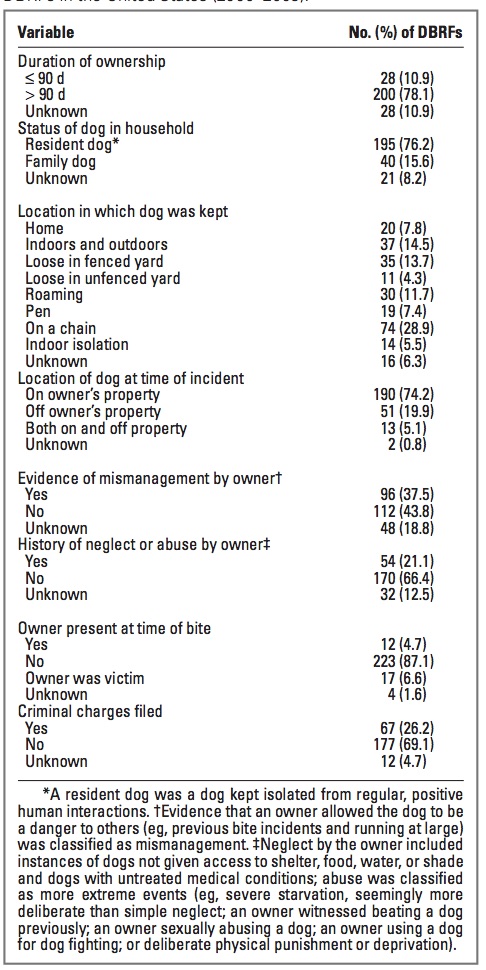
There are some really bad dogs. In a 10 year period from 2000-2009, one paper identified 256 dog-bite related fatalities in the US. Of course that's a tiny number compared to the overall number of dogs owned, but that's still 256 too many; the tragedy is compounded when you read that over half the victims were less than ten years old

Partaken, GJ. et al. Co-occurrence of potentially preventable factors in 256 dog bite–related fatalities in the United States (2000–2009). Journal of the American Veterinary Medical Association 2013. 243:12: 1726-1736.

Partaken, GJ. et al. Co-occurrence of potentially preventable factors in 256 dog bite–related fatalities in the United States (2000–2009). Journal of the American Veterinary Medical Association 2013. 243:12: 1726-1736.

Az a yid hot a hunt, iz oder der hunt keyn hunt nit, oder der yid iz keyn yid nit

If a Jew has a dog, either the dog is no dog, or the Jew is no Jew
— Sholem Aleichem. Rabtshik. Mayses far Yidishe Kinder. Ale Verk. Warsaw 1903

Fatalities from dog bites are rare. Dog bites are not. Over my career as an emergency physician I must have treated hundreds of patients with dog bites. And my experience is pretty typical. One recent study estimated that more than half the population in the US will be bitten by an animal at some time, and that dogs are responsible for 80-90% of these injuries. 

GOOD DOGS

Although Jews are thought not to have a historical affinity for dogs, one theologian has reassessed the evidence. In his 2008 paper Attitudes toward Dogs in Ancient Israel: A Reassessment, Geoffrey Miller  suggests that in fact dogs were not shunned in Israelite society. He notes that the remains of over a thousand dogs were discovered in a dog cemetery near Ashkelon dating from about the 5th century BC. It was described as "by far the largest animal cemetery known in the ancient world" by Lawrence Stager who also pointed out that during this period, Ashkelon was a Phoenician city - not a Jewish one. Miller surveys several mentions of dogs in the Bible and the Book of Tobit, and concludes that at least some Israelites "valued dogs and did not view them as vile, contemptible creatures." Joshua Schwartz from Bar-Ilan University surveyed Dogs in Jewish Society in the Second Temple Period and in the Time of the Mishnah and Talmud (a study that marked "...the culmination of several years of study of the subject of dogs...").  He found that while "most of the Jewish sources from the Second Temple period and the time of the Mishnah and Talmud continue to maintain the negative attitude toward dogs expressed in the Biblical tradition" there were some important exceptions. There were sheep dogs (Gen. Rabbah 73:11) and hunting dogs (Josephus, Antiquities 4.206) and guard dogs (Pesahim 113a), and yes, even pet dogs (Tobit, 6:2), though Schwartz concedes that "it is improbable that dogs in Jewish society were the objects of the same degree of affection as they received in the Graeco-Roman world or the Persian world."  

A certain person invited a sage to his home, and [the householder] sat his dog next to him. [The sage] asked him, ‘How did I merit this insult?’ [The house-holder] responded, ‘My master, I am repaying him for his goodness. Kidnappers came to the town, one of them came and wanted to take my wife, and the dog ate his testicles.
— PT Terumot 8:7

Very Good Dogs

Whatever your feeling about dogs, lets's be sure to remember that they serve alongside soldiers in the IDF, where they save lives. In 1969, Motta Gur (yes, the same Mordechai "Motta" Gur who commanded the unit that liberated the Temple Mount in the Six Day War, and who uttered those immortal words "The Temple Mount is in our hands!" הר הבית בידינו‎,) wrote what was to become a series of children's books called Azit, the Canine Paratrooper (later turned into a popular feature film with the same title. And now available on Netflix. (Really. It is available on Netflix.)  But IDF dogs don't just feature in fiction. They are a fact, and an amazing addition to the IDF, where they make up the Oketz unit.  Here's a news report (in Hebrew) about the amazing work these dogs - and their handlers- perform. These are very good dogs indeed.

[Mostly a repost from Ketuvot 41.]

Print Friendly and PDF

Nedarim 50b ~ Shmuel, Colonoscopies, and the Pillcam

Shmuel: Astronomer and Doctor Extraoirdinaire

Shmuel (c. 165- 257 CE) was a fascinating talmudic rabbi, who lived in Nehardea in Babylon. (Nehardea is located in what is today Anbar province in Iraq, and is under the control of ISIS. Heritage visits are therefore not recommended.)  Shmuel's areas of special interest were medicine and astronomy. He taught that all illnesses could be traced to "the air"  (הכל ברוח)  - or as we might put it today, the environment - and although he was a modest man, he was certain of his medical and astronomical skills.   He claimed to know the cure for  all but three medical conditions, (...כל מילי ידענא אסותייהו לבר מהני תלת) and he declared that he knew astronomy so well that the stars of the sky were as familiar to him as were the streets of Nehardea where he lived.

Although I am as familiar with the paths of the stars as with the streets of Nehardea, I can not explain the nature or the movements of the comets..
— TB Berachot 58b

Abdominal Pains? Swallow This...

In today's page of talmud, Shmuel offers another of his medical teachings - a way to diagnose gastrointestinal disorders.  

 מאי ביצה טורמיטא? אמר שמואל עבדא דעביד לה שוי אלפא דינרי! ומעייל לה אלפא זימני במיא חמימי ואלפא זימני במיא קרירי עד דמתזוטרא כי היכי דבלעיתה. ואם אית כיבא סריך עלה וכד נפקא ואתיא ידע אסיא מאי סמא מתבעי ליה ובמאי מתסי

What is meant by a turmita egg? Shmuel said [that it is such an important diagnostic tool] that  a slave who knows how to prepare it properly is worth a thousand dinars.  He puts the egg into hot water a thousand times and into cold water a thousand times, until the egg has shrunk so that it may be swallowed whole.  If a person has a stomach illness, a residue forms over the egg, and when the patient excretes it, the egg can be examined and the doctor will know which medicine is needed and how to heal the patient....(Nedarim 50b)

All this may seem rather fanciful, but Shmuel was trying to solve a huge problem: when we want to understand how the gastrointestinal system is functioning, how do we look at, and get information from a place where the sun don't shine?  Shmuel devised a remote probe - in his case a hard-boiled egg -  to send in and retrieve the necessary information. Two thousand years later, an Israeli medical device company has updated this idea, and in doing so has revolutionized the way we can investigate intestinal disorders.

The Israeli Pillcam - Shmuel's Idea in Action 

Image of PillCam-Colon2.jpg

One way that your doctor can figure out what is wrong with your gastrointestinal system is to take a look. For a many years, that meant sedation and inserting a scope the width of your index finger down the mouth and into the stomach, or up the rectum and into the colon. But an Israel company has changed all that, using Shmuel's idea (sort of).  Given Imaging, based in Yokne'am, has developed a pill which contains a camera capable of sending high quality images from the depths of your guts straight to your doctor's computer. You just swallow the pill and let it send images from deep inside you.

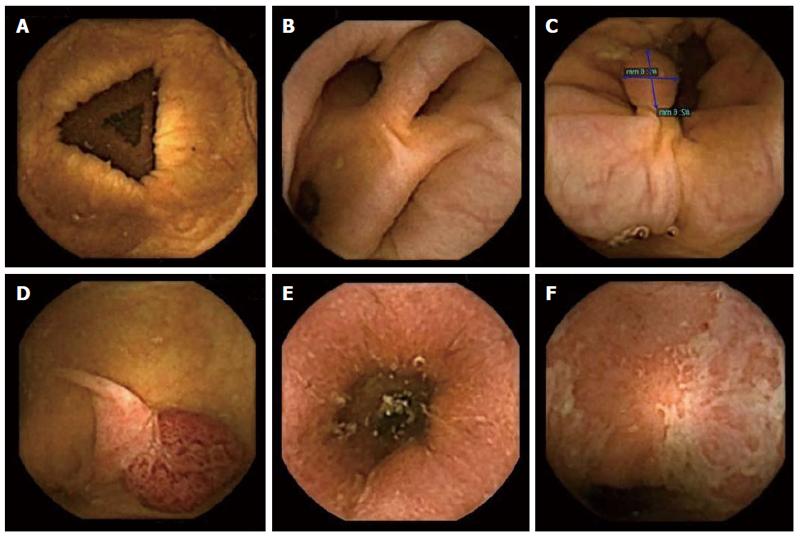
Normal colon and findings visualized at colon capsule endoscopy. A: Normal colon; B: Diverticula; C, D: Polyps; E, F: Ulcerative colitis. From Spada et al. Colon capsule endoscopy: What we know and what we would like to know. World Journal…

Normal colon and findings visualized at colon capsule endoscopy. A: Normal colon; B: Diverticula; C, D: Polyps; E, F: Ulcerative colitis. From Spada et al. Colon capsule endoscopy: What we know and what we would like to know. World Journal of  Gastroenterology 2014: 7; 20(45): 16948-16955.

There are of course limits to the pillcam technology - for one thing if a lesion is seen in the images, it will need to be biopsied, and that needs an old fashioned endoscopy exam.  But it is a wonderful option for GI doctors and their patients. Perhaps even Shmuel would have been willing to give up his very shriveled hard-boiled egg for the opportunity to swallow a new, shiny, white Israeli pillcam.   

Print Friendly and PDF