Gittin 2a ~ A Very Determined Envoy

המביא גט ממדינת הים צריך שיאמר בפני נכתב ובפני נחתם

If an envoy brings a Get to Israel from abroad, he must declare "it was written in my presence and signed in my presence" (Gittin 2a)

In the first chapter of Gittin, we address the laws that apply to an envoy (שליח) who is charged with bringing a Get, a Jewish Bill of Divorce, to a woman living overseas.  Such cases were clearly prevalent, so much so that they open this tractate, devoted to the rules of divorce.

For many hundreds of years, these messengers carried out their religious duties and delivered the Get, but did so without much recognition in our literature.  Today, one such envoy will be recognized for perhaps the most arduous trip ever undertaken to deliver a Get. That trip, which began in 1830, was from London to Sydney, Australia, and back again. It covered over 27,000 nautical miles and took close to thirteen months. The trip is detailed in Jeremy Pfeffer's book From One End of the Earth to the Other, from where the following information is taken. 

Book Cover, Pfeffer.jpg

Rabbi Aaron Levy of Lissa

The envoy who undertook this daunting trip was Aaron Levy, born in 1795 in western Poland. He arrived in London in 1811, where he taught in cheder and worked as a calligrapher and sofer. At the time, many convicted of crimes were sentenced to exile in Australia. Of the Jewish population of Australia, which numbered about 1,550, about 44%  - some 684 (!) - were convicts. Rabbi Levy was to find one of those convicts - a serial counterfeiter who used many aliases - by the name (or rather a name) of  Samuel Levi. Levi had been sentenced to death in London for repeated crimes of  counterfeiting, but the sentence had been commuted to transportation for life in 1808.  Samuel had left behind his wife in London, and now, after some 29 years of marriage, she wanted to obtain a Get and divorce him. Here is the charge to Levy, as recorded in the notes of the London Bet Din:

On 23rd Mencachem Av 5590 [August 12, 1830] there appeared before us...a woman Mindela who is commonly known as Minka bat Yehuda Leib, and she appointed R. Aaron ben R. Yehuda of Lissa to be her agent to receive a Get from her husband Samuel who is commonly known as Long Zanvil ben Mordechai ben Meir who lives in Sydney on the sea coast in the State of South Wales...And let it be known that after discussing the matter the Gaon, Head of the Bet Din, and the Bet Din determined that the above R. Aaron, who is the agent for receipt (שליח לקבלה) of the above woman, will first effect the Get as an agent of accept acceptance before a Bet Din and witness to the handing over [of the Get].  And after he has received the Get from him with the intent of receiving, he will instruct the man to appoint him as his agent of delivery (שליח להולכה) and execute the Get as is required for an agent for transmission.

The kind of agency that Rabbi Levy used was not common. Usually the envoy was acting on the husband's behalf to deliver a Get to his wife. Here however, Levy was acting on the wife's behalf to receive the Get from her husband. Once Levy received the Get, it would immediately take effect, even if the good rabbi never made it back to London. In addition Rabbi Levy would have to act as a Sofer and write the Get, and convene a Bet Din in Australia to verify the procedure.  But first he would have to find Long Zanvil.

R. Levy left for Australia on August 17, 1830 and arrived some three months later, on December 21, 1830.  While there, he managed to track down Long Zanvil and convinced him to give a Get to his estranged wife. He then wrote the Get, and found five Jewish laymen: three to to act as a Bet Din and two to witness the handing over of the Get from the husband to the Rabbi. Rabbi Levy stayed in Sydney for five months, during which time his skills as a Sofer were put to good use. He sold a new Sefer Torah to the community, which he likely wrote himself, and repaired mistakes in several others.  

In early May 1831, Levy set sail to London, with a cow, a gift from the Jewish community of Sydney, which would provide him with fresh milk during his long voyage.  He arrived home after four months at sea, and a couple of weeks later the London Bet Din convened a session to formally hand over the Get to Minka. Here is what happened, as recorded in the notes of the London Bet Din

On the 27th of Tishrei 5592 [October 4, 1831], further to what is written above, the Gaon, Head of the Bet Din, executed the Get in accordance with the law of an agent for transmission...And when the agent gave the Get to the woman Mindela, who is commonly known as Minka bat Yehuda Leib, he declared "I wrote the Get with intent (לשמה) and the witnesses also signed it before me with the intent for the purpose of divorce.

Some Questions about the Voyage

A number of questions remain about the trip.  Here are a few of them:

  1. Why did Mindela wait for over twenty years before asking for a Get?

  2. Who financed the voyage, which cost about 100 pounds, which is over $15,000 today?

  3. Why did Rabbi Levy undertake the voyage without knowing where Long Zanvil was living, and whether he was prepared to give a Get

Jeremy Pfeffer, the author of the book that details the trip, believes that there had to have been some communication between the couple, and that the voyage was likely financed by Rabbi Levy himself. Pfeffer writes:

To the best of our knowledge, he was not related to any of the parties involved nor did he receive any great monetary renumeration for the mission. Putting our contemporary cynicism aside, we may believe that his motives were simply altruistic; there was a wrong that needed to be corrected and he alone could do so. And so we may fairly conclude that he undertook the mission to Australia simply for its own sake and for the sake of Heaven, לשמה ולשם שמים.

Two years after his return from Australia, Rabbi Levy was appointed to the London Bet Din where he served as Dayan and Secretary. His mission, now all but forgotten, is a wonderful example of a rabbi doing the right thing to help a women obtain a Get. יהי זכרו ברוך.

Print Friendly and PDF

Gittin ~ On Divorce, Then and Now

From Salon.com

From Salon.com

Today, those learning in the one-page-of-talmud-a-day daf yomi cycle begin a new tractate, called Gittin. As its title suggests, it is focussed on the laws of divorce. So let's look at divorce in the western world.    

Divorce in the Western WOrld

As you can see in the chart below, the current average rate of divorce in the countries that make up the Organization for Economic Co-operation and Development (OECD) is about two per thousand people; in the US the figure is almost three per thousand, while in Israel the figure is just below the OECD average. In many countries the rate is lower than it was in 1995, but in nearly all it is much higher than it was way back in 1970.

Crude divorce rate, 1970, 1995 and 2012. From OECD Family Database.  

Crude divorce rate, 1970, 1995 and 2012. From OECD Family Database.  

THE CHANGING RATES OF DIVORCE IN THE US

 In the 1970s there was a surge in the divorce rates in the US (and throughout the industrialized world), and in 1977 the sociologist Amir Etzioni issued a dire prediction. If the rates of divorce continued to rise as they had done over the preceding years, "not one American family" would be left intact by the 1990s. But by 1981 the divorce rates levelled off (and more couples were choosing to live together without getting married). By 1998 the divorce rate was 26% lower than it had been in 1979. (This data is found in Marriage, A History by Stephanie Coontz.)

No party can oblige continuance in contradiction to its end and design.
— Thomas Jefferson, in Norma Basch, Framing American Divorce. University Of California Press 2001.

In the US, statistics on rates of marriage and divorce are published by the National Center for Health Statistics, which is a branch of the Centers For Disease Control and Prevention.  The latest data for the US were published in 2021. It shows that the probability of divorce depends on the length of the marriage. Sadly the probability of divorce increases as the duration of the marriage increases.  The probability of a marriage of five years or less ending in divorce is about 20%; the probability of a marriage of twenty years ending in divorce is a massive 48%.  And second marriages fare a little worse: by ten years of marriage 32% of those married for the first time will have divorced in the US, compared to 46% of those in their second marriage.

There is some good news. The US divorce has been falling fast in recent years, and it hit a record low in 2019. For every 1,000 marriages in the last year, only 14.9 ended in divorce. This is the lowest rate we have seen in 50 years. It is even slightly lower than 1970, when 15 marriages ended in divorce per 1,000 marriages. 

However, the rate of marriage in the US also reached an all-time low in 2019. For every 1,000 unmarried adults in 2019, only 33 got married. This number was 35 a decade ago in 2010 and 86 in 1970. So on balance, maybe things are basically the same.

Divorce rates in the US. Source: The New York Times.

Divorce rates in the US. Source: The New York Times.

Divorce in Christianity, The UK and the Colonial US

The Church essentially forbade divorce for most of its history, basing itself mostly on Mark 10:9: "what therefore God has joined, let no man put asunder." This left its mark on attitudes towards divorce. (We came across one example of the difficulty in obtaining a divorce when we examined King Henry VIII and his plight to get one of his marriages annulled.)  In the United Kingdom of 400 years ago, a divorce required a special Act of its Parliament; this, and its cost made it available only to those with money and privilege. It was only in 1857 that a new law was passed that removed divorce from the control of the Church and made it a civil affair. But husbands and wives were treated very differently by this new law. A husband could obtain a divorce on the grounds of his wife's adultery. But for a wife to obtain a divorce, she had to prove both adultery and an additional "matrimonial offense". The early colonists in the US had similar laws; divorce was allowed only in cases of adultery, habitual drunkenness, desertion, cruelty, or impotence. What we call today "no-fault" divorces have only been around since the 1970s.

JEWISH DIVORCE, THEN AND NOW

It is challenging to get a good count of the rates of divorce in the Jewish communities around the world.  One of the rare examples of such data can be found in Jeremy Pfeffer's book From One End of the Earth to the Other, which examines the London Bet Din in the first half of the nineteenth century, and its relationship to the Jewish convicts deported to Australia. (We will return to this fascinating book in our next post.) Pfeffer examined in great detail the marriage and divorce records of the London Bet Din, and discovered that between 1805 and 1855 there were 347 divorces. This turns out to be about one divorce per thousand married Jews, and he notes that the current rate of divorce is "an order of magnitude greater." In fact the current divorce rates in England and Wales are about twelve per thousand married persons, "and there is no reason to suppose that it is significantly lower amongst present day English Jews." 

The indissolubility of marriage is a main principle of English law, asserted without any exception or reserve in the formularies of the Church, in which the parties pledge themselves, either to other, that they will live together so long as they both shall live, and until death shall part them.
— Hector Davies Morgan (of Trinity College Oxford). The Doctrine and Law of Marriage, Adultery and Divorce. 1826. p214

Divorce Rates and Religious Committment

Another study published over 30 years ago reviewed the relationship between rates of divorce and levels of religious commitment. It was based on the 1981 Greater New York Population study which sampled over 4,000 Jewish households, and it made the following observation:

As one might expect, we see the lowest rate of divorce among the Orthodox. In comparison, we see a slight rise among the Conservative, a doubling among the Reform, and a quadrupling for those who do not identify themselves as members of the major denominations. It is the Orthodox community that is most frequently held up as the most effective transmitter of traditional Jewish family values, and these results are consistent with our thesis of a relationship between Jewish commitment and divorce. 

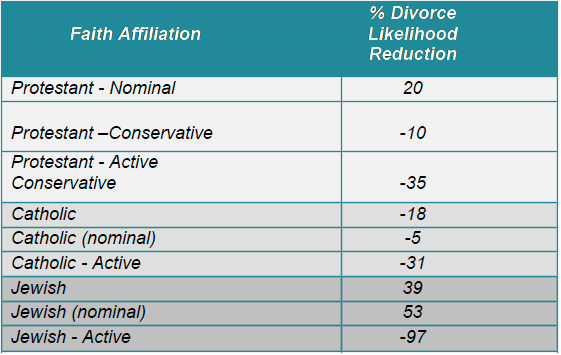
Further support for these findings can be found in more recent work from Focus on the Family ("a global Christian ministry dedicated to helping families thrive"). They report the following relationships between faith affiliation and divorce rates:

Of course we have no idea about whether the lower rate of divorce among active Protestants, Catholics and Jews is because religious practice increases marital harmony or, as a cynic might claim, peer pressure makes those who are more actively religious are reluctant to divorce. Still, a 97% reduction in the divorce rate in those who are "actively Jewish" is pretty impressive.

As we have noted, it took many centuries for secular societies (even in countries that are deeply Catholic) and the church to allow for more equitable divorce laws. For most of that time, Jewish divorce law was in some aspects the most enlightened of any society.  It allowed for divorce on the grounds of incompatibility, but at the same time allowed only the husband to control the process. If he did not wish to divorce, no divorce could take place.   But the last great change to Jewish divorce law was over 900 years ago, when Rabbenu Gershom forbade a man from divorcing his wife against her will. It is probably time for orthodox Judaism to take another look at the issue

Print Friendly and PDF

Sotah 45b ~ Talmudic Embryology

As we approach the end of Sotah, we turn our attention to a new topic: theories of embryonic development, and compare talmudic views with those of modern science. Here is what today's page of Talmud - daf yomi - has to say on the topic:

סוטה מה, ב

מהיכן הולד נוצר מראשו וכן הוא אומר ממעי אמי אתה גוזי ואומר גזי נזרך והשליכי וגו' אבא שאול אומר מטיבורו ומשלח שרשו אילך ואילך

From where is the fetus formed? From its head, as the verse says (Ps.71:6): "From my mother's womb you pulled me out (gozi)". And it says later (Jeremian 7:29) "Pull out (gozi) your hair and throw it away.." [This second verse shows that the verb goz is used to describe the head. So the verse from Psalms must also refer to the head. According to Rashi the verse in Psalms should be read as "You formed me from my head."] Abba Shaul says that the fetus is created from its navel, and from there it sends out roots in all directions. (Sotah 45b)

Embryonic Development in Antiquity

In 1934, Joseph Needham, a British historian and embryologist, published A History of Embryology, in which he traced the history of how the embryo was thought to develop from antiquity to modern times. In this fascinating book we learn that Hippocrates (c. 460-370 BCE) believed that the fetus was formed by extracting breath from its mother, and that a series of small fires within the uterus gave rise to the bones and other organs of the embryo.  Aristotle (384-322 BCE) added some details about the role of the umbilical cord.  According to Needham, Aristotle understood that the role of the umbilicus was to nourish the fetus: The vessels of the umbilicus join onto the uterus like the root of a plant and through the cord the fetus receives its nourishment. Elsewhere, Aristotle claims that head of the fetus forms first. Galen (c. 129-216 CE) also used the analogy of the umbilicus serving like the root of a plant.  According to Galen, the embryo grew from menstrual blood, and then from the blood that nourished it through the umbilical cord.

What Actually Happens

Development of the Umbilical cord. A: The posterior body wall is established. B: the vitelline duct form as the cells form a head and tail end, fold inwards on their lateral sides. C: The umbilical cord forms as the yolk sac and vitelline duct fuse.…

Development of the Umbilical cord. A: The posterior body wall is established. B: the vitelline duct form as the cells form a head and tail end, fold inwards on their lateral sides. C: The umbilical cord forms as the yolk sac and vitelline duct fuse. From O'Donnell K. Glick P, Caty M. Pediatric Umbilical Problems. Pediatric Clinics of North America. 1988 24 (1) 792.

At its earliest stage the embryo consists of a sheet of cells, an amniotic cavity and a yolk sac. The sheet of cells develops a head (cranial) and bottom (caudal) end, and grows around most of the yolk sac. This enclosed yolk sac then grows into the gut of the embryo.  The part of the yolk sac that is not surrounded by the embryo is still connected to it by a thin tube called the vitelline duct.  This duct then fuses with the contained yolk sac, and forms a larger bundle of vessels we call the umbilical cord. This occurs between the 4th-8th week of gestation (calculated from the first day of the last menstrual cycle).  

It is clear then, that embryo does not grow from the head or from umbilical cord.  As you can see from the diagram, the fetus do not grow from the head. In fact the head develops from the early cells of the embryo as it takes on a cranial-caudal polarity, sometime around 3-4 weeks gestation, when the embryo is about 3mm in length. Neither does the embryo grow from the umbilical cord, as Abba Shaul claimed. In fact it is the umbilical cord that grows out from the early embryo, and not the other way around. (For more on talmudic embryology, see Samuel Kottek's 1981 paper Embryology in Talmudic and Midrashic Literature.)

As we will see in more detail in the winter of 2019, talmudic embryology reflected the prevailing Greek theories of the times. But those theories developed without the benefit of microscopes and the other tools later available to scientists. It was perfectly reasonable to claim that the embryo grew from its head, since even in antiquity the importance of the head for life was clear. No less unreasonable was the view that the embryo grew from the umbilical cord, for that cord does in fact sustain the embryo as it grows and matures inside the womb. But two wrong but reasonable theories does not make one correct one. Sometimes however, the rabbis of the Talmud were spot on with their embryology. For example, here is Rav Simlai (3rd century CE, and the rabbi who brought you the famous count of 613 commandments) describing how the fetus sits within the womb.  Compare his words below with the famous sketch of Leonardo Da Vinci.Then answer this question: How did he know?

R. Simlai delivered the following discourse: What does an embryo resemble when it is in the bowels of its mother? Folded writing tablets. Its hands rest on its two temples, its two elbows on its two legs and its two heels against its buttocks. Its head lies between its knees, its mouth is closed and its navel is open, and it eats what its mother eats and drinks what its mother drinks...
— Niddah 30b
Leonardo Da Vinci. Studies of the Fetus in the Womb. Drawn between 1510-1513.

Leonardo Da Vinci. Studies of the Fetus in the Womb. Drawn between 1510-1513.

Print Friendly and PDF

Rashi and Why Women Light the Menorah

Don't Share This With Your Young Children

Ask a well-educated Jewish child about the origins of Chanukah, and they will likely tell you about the wicked Greeks who defiled the Temple, about the brave Maccabees who fought them, and about the miracle of the oil.  But in Rashi's commentary to the Talmud where this story is told, there is another part of the story. Here it is:

דאמר רבי יהושע בן לוי: נשים חייבות בנר חנוכה, שאף הן היו באותו הנס

 רש"י שם:  שגזרו יוונים על כל בתולות הנשואות להיבעל לטפסר תחלה  

Rabbi Yehoshua ben Levi said: Women are obligated to take part in the lighting, for they were included in that miracle...

Rashi: For the Greeks made an edict that all virgins who were about to marry must first have intercourse with the Prefect...

The great French exegete Rashi (d.1105) is referencing the Law of the First Night - Jus Primae Noctis, also known more graphically as The Right to the Thigh - Droit du Cuissage. We first encountered this when studying Ketuvot 3a. So let's go back to that daf.  

MAZAL TOV; WHEN'S THE WEDDING?

Today, when a bride and groom wish to secure a wedding day, it will depend on their budget and the availability of the caterer. My, how things have changed. In the times of the Mishnah, the wedding day was decided by the availability of the local rabbinic court, the Bet Din. Then, a wedding (of a virgin) could only take place on the night before the Bet Din convened.  This would ensure that if, after their magical first night, the groom suspected that his bride had not been a virgin, he could take his claim to court the very next day.  

מפני מה אמרו בתולה נשאת ליום הרביעי שאם היה לו טענת בתולים היה משכים לב”ד

Why did they teach that a virgin must only marry on a Wednesday? So that if the groom questioned her virginity, he could hurry to the Bet Din...
— Ketuvot 3a

The Talmud (Ketuvot 3a) explains that this happy custom changed during a period of persecution. Rabbah, a forth century Babylonian sage, explained what this is all about: "[The authorities] said, "a virgin who gets married on Wednesday will first have intercourse with the governor" (הגמון). In order to avoid this awful legal rape, the wedding was moved a day early, to fly, so to speak, under the radar of the local governor. 

JUS PRIMAE NOCTIS IN THE TALMUD & MIDRASH

The law that Rabbah referenced is the same one that Rashi claims was imposed on Jewish brides by the Greeks. Its origins are further explained in the Talmud Yerushalmi, which dates it to the time of the Bar Kochba revolution:

 תלמוד ירושלמי כתובות פרק א הלכה ה  

בראשונה גזרו שמד ביהודה שכן מסורת להם מאבותם שיהודה הרג את עשו...  והיו הולכין ומשעבדין בהן ואונסין את בנותיהן וגזרו שיהא איסטרטיוס בועל תחילה התקינו שיהא בעלה בא עליה עודה בבית אביה 

In the beginning, they [the Romans] decreed destruction in Judea (for they had a tradition that Yehuda killed Esau) ... and they enslaved them and raped their daughters, and decreed that a soldier would have intercourse [with a bride] first. It was then enacted that her husband would cohabit with her while she was still in her father's house. 

A reference to Primae Noctis also appears in the Midrash Rabbah, a collection of rabbinic homilies edited sometime in the forth or fifth century. As told in Genesis 6, “the sons of God saw that the daughters of man were beautiful (tovot), and they took wives from whoever they chose.” The Midrash focuses on that word beautiful, and explains:


בראשית רבה (וילנא) פרשת בראשית פרשה כו 

אמר רבי יודן טבת כתיב, משהיו מטיבין אשה לבעלה היה גדול נכנס ובועלה תחלה, הדא הוא דכתיב כי טבת הנה, אלו הבתולות ויקחו להם נשים מכל אשר בחרו, אלו נשי אנשים, 

“Rabbi Judan said the word tovot (טבת) – beautiful – is written in the singular, [but read as a plural]. Meaning that the bride was made beautiful for her husband, but the lord of the nobles had intercourse with her first...”

JUS PRIMAE NOCTIS...IN THE MOVIES

There are numerous references to Primae Noctis in ancient and modern literature, from the Epic of Gilgamesh to The Marriage of Figaro. One recent example can be seen in the movie Braveheart, when the evil King Edward gallops into a village, to interrupt a wedding celebration. “I’ve come to claim the right of Primae Noctis. As lord of these lands, I will bless this marriage by taking the bride into my bed on the first night of her union.”  And as the groom is restrained by Edward's henchmen, Edward reminds the peasants “it is my noble right.”  

Jus Primae Noctis. Is there a more fearsome example of feudal barbarism? Of what one scholar called “a male power display…coercive sexual dominance…and male desire for sexual variety”?  But the legend, despite its appearance in many guises, is, fortunately, likely to be nothing more than just that: a legend.  

JUS PRIMAE NOCTIS...IS A LEGEND

Perhaps the most comprehensive investigation of the legend of Primae Noctis is The Lord's First Night: the Myth of the Droit de Cuissage, by the French social scientist Alain Boureau. His careful analysis is particularly important since, as we have seen, Rashi, our favorite French commentator, cites this legend twice. After a meticulous two-hundred page review of every alleged appearance of the legend, Boureau is clear:

[T]he droit de cuissage never existed in medieval France. Not one of the arguments, none of the events insinuated, alleged or brandished, holds up under analysis.
— Alain Boureau, The Lord's First Night.

Others scholars agree with Boureau. In 1881, the German historian Karl Schmidt concluded that the right never existed.  In 1973, the historian J.Q.C. Mackrell noted that there is "no reliable evidence" that it existed. And Prof. Tal Ilan, now at the Free University of Berlin, addressed the myth of Primae Noctis in a magnificently titled 1993 paper: Premarital Cohabitation in Ancient Judea. Prof. Ilan noted that that “all medieval literature that evokes the custom of Jus Primae Noctis has been proven to be folkloristic and has no historical basis.” But what about the evidence from the Talmuds, and the Midrashim? Don’t they provide evidence that Primae Noctis was indeed practiced in the time of the Talmud? Not so, claims the professor:

If a motif of this sort could have appeared in a sixteenth-century document and upset the entire history of medieval Europe for the next two centuries, the same motif likewise could have cropped up in the fourth -or fifth-century Palestinian Talmud, falsely describing events of the second century.

Instead, Prof Ilan suggests that the Talmud used the myth of Primae Noctis to excuse the behavior of some prospective couples, who would engage in sexual relations before they married.  “the jus primae noctis was conveniently drawn in order to explain and justify a custom that seemed to the rabbis to undermine their view of proper conduct in Jewish society.”

Some events do take place but are not true; others are—although they never occurred.
— Elie Wiesel, Legends of Our Time

There is some further support to the claim that primae noctis never existed, and it is not one I have seen suggested before.  It is a claim from silence.  I've checked over 100,000 responsa, and there is not one on this topic. Not a single one.  If primae noctis really was a law of the Greek and Roman empires, and a feudal right across medieval Europe, then why were its implications for the Jewish community never discussed in the responsa literature?  This silence supports the conclusions of work done by Boureau, Ilan and others: it never existed. In fact Boureau wonders what muddled thinking would lead anyone to believe it existed in the first place: 

It has been clear from the start that no matter what social restrictions were put on conduct and the management of wealth, and no matter how violent mores became, the principle of free choice of an unfettered matrimonial life was the most sacred area of individual liberty in medieval Europe. The Church, European society's principal normative center, very early removed all restrictions on the marriage of dependents, and it imposed consent as a sacramental value.  No juridicial form, no custom, could attack that principal...sanctified in the twelfth century by the establishment of the sacrament of matrimony.  

HISTORY AND HERITAGE

The historian David Lowenthal has explained the differences between history and heritage. While history "seeks to convince by truth," heritage "passes on exclusive myths of origin and endurance, endowing us alone with prestige and purpose." Heritage, continues Lowenthal, commonly alters the past: sometimes it selectively forgets past evils, and sometimes it updates the past to fit in with our modern sensibilities. Sometimes it upgrades the past, making it better than it was, and sometimes it downgrades the past, to attract sympathy.  And so, how we read the Talmud will depend on whether we see it as a work of history or as a book of our heritage.  

There you have it...some of it fact, and some of it fiction, but all of it true, in the true meaning of the word
— Miles Orvel, The Real Thing: Imitiation and Authenticity in America

There are stories both wonderful and terrible from our Jewish past. Some are factual, and some are not, and a measured approach to how we might approach these stories has been suggested by Judith Baumel and Jacob J. Schacter. They explored the claim (published in The New York Times) that in 1942, ninety-three Beis Yaakov schoolgirls in Cracow committed suicide rather than face rape by their German captors. They concluded that the evidence to support the truth of the story is not conclusive one way or the other

Whether or not it actually happened as described is difficult to determine, but there is certainly no question that it could have happened...in response to those claiming that the incident was "unlikely" to have occurred, let us remind the reader that the period in question was one during which the most unlikely events did occur, when entire communities were wiped out without leaving a single survivor...Maybe it did happen. But maybe again it didn't. Could it have happened? Of course.

So Why Should Women Light the Menorah?

It seems very unlikely that Rashi's explanation for why women should light the Menorah has any factual basis; the legend of Primae Noctis is not likely to have been trueBut some stories are true, even though they never happened. Ask yourself, from what you know about Jewish history, could it have been true? Yes. And that's what makes it all the more terrifying. Sadly, we have plenty of tragic stories from our Jewish history, and there is no need to create one that probably never happened. 

But if Rashi's reasoning was based on a myth, why should women - who according to traditional teaching are exempt from a positive time bound command - why should they light?  For an answer that should satisfy moderns, we need look no further than the Code of Jewish Law - the Sulchan Aruch (written about 460 years after Rashi's death).   

שולחן ערוך אורח חיים הלכות חנוכה סימן תרעה סעיף ג 

 אשה מדלקת נר חנוכה, שאף היא חייבת בה

 A women should light a light on Chanunkah, for she is obligated to do so...

So there you have it. Women should light...because they should light. We need no more of a reason than that.

Happy Chanukah.

Print Friendly and PDF