Gittin 49b ~ Who Wants to Marry More?

גיטין מט, ב

יותר ממה שהאיש רוצה לישא אשה רוצה להנשא

More than a man desires to wed, a woman desires to be wed.(Gittin 49b).

When a couple marries under traditional Jewish law, the husband undertakes several financial obligations which are outlined in the ketuvah. Among these, he agrees to provide money for his wife in the event that the couple divorce or that he dies.  In today's daf, the Talmud discuss what kind of land the husband may provide for this payment to his wife. Rabbi Yehuda opined that the land may be of inferior (rather than average or superior) quality.  The reason is that a women is so eager to marry, that she will do so even if her right to collect her ketuvah payment was limited to inferior land.  Or as the Talmud puts it, יותר ממה שהאיש רוצה לישא אשה רוצה להנשא: "More than a man desires to wed, a woman desires to be wed" (Gittin 49b).  Since she will agree to marry even if she will only receive inferior quality land in the event of divorce or her becoming a widow, there was simply no need to demand the husband provide any better land.  

We have come across a similar concept when we studied Ketuvot (86b). There the Talmud asks: what would happen if a man owes money to both a debtor and to his ex-wife to pay for her ketuvah? The answer given is that if this unlucky person can only repay one of the debts, he should repay the creditor and not his ex-wife. Although this ruling might discourage women from getting married in the first place, the Talmud was not be concerned, because "more than a man desires to wed, a woman desires to be wed."  

We've had other occasions to look at sweeping statements made by the rabbis of the Talmud about ways women view marriage. Resh Lakish famously stated (יבמות 118) that "it was better for a women to live with a husband than to live alone" (though you may recall that there were at least four ways to understand this statement of Resh Lakish). We also noted that the late Rabbi J.B. ("the Rav") Soloveitchik believed that this statement reflected "an existential fact." (It also turned out that he was wrong.) While the Talmud does not seem to suggest that its psychological insight is an "existential fact," does it have any validity to it in today's society? Do women really want to be married more than men?

SOCIETAL NORMS CHANGE VERY FAST

In June 2015, the US Supreme Court ruled that same sex marriage was guaranteed by the Constitution. The lesson here is that societal norms of about all aspects of marriage are changing very quickly. It may indeed have been true in talmudic times that women wanted to marry more than did men, but our society is vastly different. And with that note of caution, we may proceed.

The history of marriage is one of both continuity and change.
Changes, such as the decline of arranged marriages and the abandonment of the law of coverture, have worked deep transformations in the structure of marriage, affecting aspects of marriage once viewed as essential. These new insights have strengthened, not weakened, the institution. Changed understandings of marriage are characteristic of a Nation where new dimensions of freedom become apparent to new generations.
— US Supreme Court Opinion 14-556 decided June 25, 2015.

WHO WANTS TO BE MARRIED?

In 2011 the anthropologist Helen Fisher and two colleagues released the "largest and most comprehensive nationally-representative study of single men and women ever done." They surveyed 5,200 single people in the US aged 21 to over 65, and found "a new picture of single Americans emerges that is radically different than it was 50 years ago..." And what of the talmudic claim that women are more eager to marry?

This national survey clearly shows that men are just as eager to marry as women are; 33% of both sexes want to say “I do. (Helen Fisher 2011. The Forgotten Sex: Men.)

So today in the US (at least according to Fisher's survey,) it is not correct to say that women want to be married more than men. Some of Fisher's other findings about the attitudes of single men might surprise you too:

Men in every age group are more eager than women to have children.  Even young men. Among those between ages 21 and 34, 51% of men want kids, while 46% of women yearn for young.  Men are less picky too.  Fewer men say it is important to find a partner of their own ethnic background (20% of men vs 29%  of women said this is a “must have” or “very important”); and fewer say they want someone of their own religion (17% of men vs 28% of women said this is a “must have” or “very important”).   Men are also more likely to have experienced love at first sight...

Let's give the last word to Dr Fisher, (who serves as an advisor to Match.com), and remember the danger of assuming that human nature does not change.  

My colleagues and I have put over 60 men and women ages 18-57 into a brain scanner to study the brain circuitry of romantic passion.  We found no gender differences.  This..study supports what I have long suspected: that men are just as eager to find a partner, fall in love, commit long term and raise a family.

It’s an illuminating, indeed myth-shattering, new set of scientific data.  And the sooner we embrace these findings, and fling off our outmoded and unproductive beliefs about both sexes, the faster we will find—and keep–the love we want.

[Repost from Yevamot 118.]

Print Friendly and PDF

Gittin 39a ~ Rabbi Meir on Maximizing Meaning

גיטין לט, א

אין אדם מוציא דבריו לבטלה

A person does not say things without reason...(Gittin 39a)

In a discussion about the nature of a slave's ownership rights, the Talmud questions the degree to which a person's inarticulate declaration may be understood.  Rabbi Meir (c.~2nd century CE) is cited as establishing an important hermeneutic principle, which has become known as the Principle of Charity.  This principle has been widely discussed by contemporary philosophers, most notably by three Americans, Willard Quine (d. 2000),  Ronald Dworkin (d. 2013) and Donald Davidson (d. 2003).

The Principle of Charity

The Principle of Charity asks the reader (or listener) to interpret the text they are reading (or words they are hearing) in a way that would make them optimally successful.  Here's how Moshe Halbertal from the Hebrew University explained it:

[A]lthough a person’s words might be read as self-contradictory and thus meaningless, they should not be interpreted in that way. If someone tells us he feels good and bad, we should not take his statement as meaningless but rather understand by this that sometimes he feels good and sometimes bad, or that his feelings are mixed. (Moshe Halbertal. People of the Book. Harvard University Press 1997, p27.)

Other philosophers of language, like the late American analytical philosopher Donald Davidson developed this Principle of Charity. “We make maximum sense of the words of others,” wrote Davidson, “when we interpret in a way that optimizes agreement.” But sometimes The Principle of Charity requires that the reader change the meaning of the text in order to maximize the likelihood of agreement with the author’s words, as long as such a rational or coherent interpretation is available to the reader. It is the attempt to read the text in the “best” possible light.

We could include in this discussion Ludwig Wittgenstein (d. 1951). In his Philosophical Investigations he claimed that there is no single correct way that language works. Instead, there are "language games" - with the rules of the game changing as the needs of the speaker change. Or the American philosopher John Searle's important work Speech Acts, in which speech follows certain rules, and it is the context of the words that determine which rules are in force.  Or the father of deconstruction, the French Sephardi philosopher Jacques Derrida (d. 2004) who believed that once they are cut off from their author, words can mean something other than what they meant in their original context. Or J.L Austin or Paul Ricoeur or, well, we could go on and on.

But from today's daf, we should remember that it was Rabbi Meir who first introduced us to the hermeneutic Principle of Charity. Now can you please fix that Wiki article so that Rabbi Meir gets his just recognition?

[Partial repost from Ketuvot 58.]

Print Friendly and PDF

Gittin 30b ~ Longevity II: Death and Wealth

גיטין ל ,ב

חברך מית אשר איתעשר לא תאשר

If you hear that your friend has died, believe it. But if you hear that he became wealthy, don't believe it. (Gittin 30b)

calculator.jpeg

Not every aphorism can be scientifically tested.  Is a bird in the hand really worth two in the bush? Which species of bird? How old? How far away is the bush?  How many cooks is too many to spoil the broth?  Aphorisms are short phrases that summarize a basic truth, and as such they that do not easily lend themselves to scientific scrutiny. Having admitted this, let's have some fun anyway by subjecting a talmudic aphorism to just such scrutiny.  The aphorism is found in today's page of Talmud, (Gittin 30b) and declares that a person is more likely to die than become wealthy. It is cited in the name of Rav Pappa, who himself declares it to be a common saying. He died around 375 CE in Babylonia.

Some Cautions

To be completely fair, the saying should be compared to the conditions of the society in which it arose.  Although we have tried to estimate longevity back in Babylonia, we don't have anywhere near the mortality data by decade that we would need. Nor do we know what was meant by the term wealthy, and what proportion of the Jewish population of fourth-century Babylonia attained such wealth.  So let's be really unfair and analyze the aphorism using contemporary data from one part of the developed world - the United States.

What do we talk about when we talk about wealthy?

It is hard to agree on a definition of wealthy. We could use the famous Mishnah in Avot (4:1) as a measure: "איזהו עשיר? השמח בחלקו": "Who is wealthy? One who is satisfied with what he has." The problem with this definition is that an unsatisfied billionaire would not be counted as wealthy. But because wealth usually refers to an amount of money, that's the understanding we will use.

In the recently published academic text Geographies of the Super-RichIain Hay (the Distinguished Professor of Human Geography at Flinders University in Australia, no less) notes that wealth takes on "different meanings depending on one's age, culture, ideology and personal point of view." Some have defined it as the ability to live comfortably off the interest of one's wealth - a figure in the EU of about 3 million euros (or about $3.3 million).  In the UK, some researchers defined the wealthy as those who owned £5 million or more in disposable assets, while in the US, entry into Richistan begins with a household worth of $1million. If we agree to use the definition of wealthy - or High Net Worth Individuals (HNWI) as individuals who hold financial assets in excess of $1million, then this is what the numbers look like:

Top Five Largest Net Worth Populations

Rank Country High Net Worth Population
1 United States 3,104,000
2 Japan 1,739,000
3 Germany 924,000
4 China 535,000
5 United Kingdom 454,000

Data from the World Wealth Report 2007, and cited in Hay, I (ed). Geographies of the Super-Rich. Edward Elgar 2013. p6

Given that the US population in 2007 was about 300 million, then the wealthy make up about 1%

Next, we need to figure out the age at which millionaires become, well, millionaires. According to data from here, it takes 32 years for the average self-made millionaire to reach that lofty goal. (We will ignore inherited wealth, to keep things simple.)  More specifically, 

  • 1% became wealthy before the age of 40

  • 3% became wealthy between age 40 and 45

  • 16% became wealthy between age 46 and 50

  • 28% became wealthy between age 51 and 55

  • 31% became wealthy between age 56 and 60

  • 21% became wealthy after the age of 60

What are Your chances of Dying?

The Social Security Administration's Actuarial Life Table shows the probability of death at a given age.  Here is the data summarized by decade:

Age Probability of Death for Men Probability of Death for Women
20 0.1% <0.1%
30 0.1% 0.1%
40 0.2% 0.1%
50 0.5% 0.3%
60 1.1% 0.6%
70 2.4% 1.6%
80 6.1% 4.4%

The Upshot - The Aphorism Seems Correct

So now let's put this all together. As you can see in the table below, by age 40 you have about a 0.01% chance of having become a self-made millionaire. At that same age, your chances of dying are far higher: 0.2% for men and half that for women. In other words, at age 40 you are twenty times more likely to die than to become a self-made millionaire if you are a man. Women have slightly better odds: They are only ten times more likely to die at that age than to become a millionaire.

Probability estimates of dying or beomming a self-made millionaire in the US

Age Probability of Death for Men Probability of Death for Women Proportion of millionaires who achieved wealth by age Prevalence of millionaires in the general population by age
20 0.10% <0.10% <1% <0.01%
30 0.10% 0.10% 1% 0.01%
40 0.20% 0.10% 1% 0.01%
50 0.50% 0.30% 19% 0.19%
60 1.10% 0.60% 59% 0.59%
70 2.40% 1.60% 21% 0.21%
80 6.10% 4.40% unknown unknown

Things don't change much with age. Most self-made millionaires make their money between the age of 50 and 60. The likelihood of death at age 60 is 1.1% for men - twice as high as the likelihood of a having become a self-made millionaire, though for women the odds are about the same.

It would seem that the aphorism quoted in today's page of Talmud is indeed correct - at least for the population in the US, based on some very rough statistical estimates.  Given that the mortality rates were far higher in centuries past, this aphorism was probably so obviously true that it needed no statistical back flips to support it.  


Print Friendly and PDF

Gittin 28a ~ Longevity I: How Long Do We Live?

גיטין כח, א

מתני' המביא גט והניחו זקן או חולה נותן לה בחזקת שהוא קיים

גמ' אמר רבא לא שנו אלא זקן שלא הגיע לגבורות וחולה שרוב חולים לחיים אבל זקן שהגיע לגבורות וגוסס שרוב גוססין למיתה לא

 איתיביה אביי המביא גט והניחו זקן אפי' בן מאה שנה נותן לה בחזקת שהוא קיים תיובתא ואי בעית אימא כיון דאיפליג איפליג

MISHNAH: If an agent brought a Get and the husband was an old man or was sick, he should still give it to the wife on the assumption that the husband is still alive...

old-man-laughing.jpg

GEMARA: Rava said: [this Mishnah] speaks only of a husband who is not yet eighty years old and of a husband who is ill [but not dying], because most ill people recover. But if the husband is an old man who has already reached the age of eighty, or was in the process of dying, then the Get should not be given to the wife, because most people who are dying do actually die. 

Abaye raised the following objection [to Rava from a Baraisa]: 'If an agent was bringing a Get and he left when the husband was old, even a hundred years old, he should give it to the wife on the assumption that the husband is still alive. 

This is indeed a refutation [to Rava]. But it is still possible to accept Rava’s position, because [in the case of the Baraisa] if a man reaches such an exceptional age, he is altogether exceptional and unlike other elderly men [and so it may be assumed that the elderly husband is still alive when his appointed agent reaches the wife to give her the Get.]

This is the first of a two part examination of statements of longevity in the Talmud, and how they measure up against data from the sciences today.  Was Rava correct in assuming the outer limit of longevity to be around 80 years, and do those who make it into their golden years have good odds of making it even further? Let's take a look.

Nasty, Brutish and Short

It's quite a challenge to estimate how long most people lived way, way back. But there are some data to suggest that life was, as Thomas Hobbs wrote in his Leviathan "nasty brutish and short". For example, in the Bronze Age - that would be the time in which the Patriarch Abraham, Isaac and Jacob lived lived - life expectancy was about 20-30 years.  So yes, Abraham's death at the age of 175, or Sarah's at the age of 127, are both examples of ultra-extreme-turbo-charged longevity.   

Life Expectancy: From the Epipalaeolithic Period to the Iron Age. From Oded Galor and Omer Moav.Life Expectancy: From the Epipalaeolithic Period to the Iron Age. Unpublished paper 2005.

Life Expectancy: From the Epipalaeolithic Period to the Iron Age. From Oded Galor and Omer Moav.Life Expectancy: From the Epipalaeolithic Period to the Iron Age. Unpublished paper 2005.

Longevity of Human and Other Primates

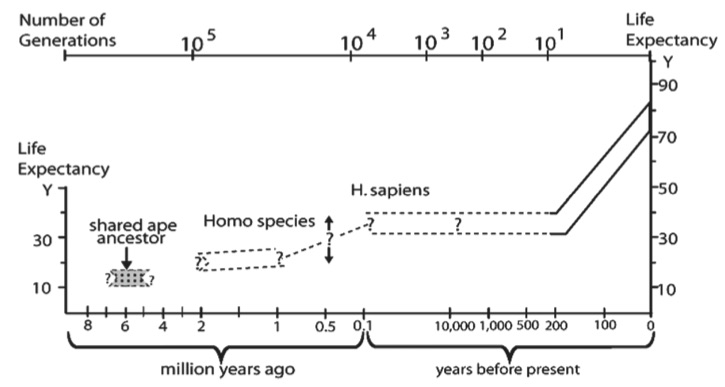
Among all the primates, humans have the greatest life expectancy at birth.  Before the industrial era, human life expectancy at puberty was about 30 years, about twice that of chimpanzees.  Based on evidence from tooth eruption found in skulls it has been possible to estimate the life expectancy of the earliest common ancestor of humans and the great apes. But all this was long ago and far away, and, let's be honest, we really don't know very much about what happened back then. However we do have better data about more recent societies, so let's jump to life under the Romans...

Evolution of the human life expectancy (LE).&nbsp;The LE at birth of the shared great ape ancestor is hypothesized to approximate that of chimpanzees, which are the closest species to humans by DNA sequence data. The LE of chimpanzees at puberty is …

Evolution of the human life expectancy (LE). The LE at birth of the shared great ape ancestor is hypothesized to approximate that of chimpanzees, which are the closest species to humans by DNA sequence data. The LE of chimpanzees at puberty is about 15 years, whereas pre-industrial humans had LE at puberty of about 30 years Since 1800 during industrialization, LE at birth as well as at later ages has more than doubled. LE estimates for ancestral Homo species are hypothesized to be intermediate based on allometric relationships . Ages of adult bones cannot be known accurately after age 30 even in present skeletons .The proportion of adults to juveniles does, however, suggest a shift toward greater LE at birth. The few samples in any case cannot give statistically reliable estimates at a population level. The number of generations is estimated at 25 years for humans.From Finch, C.  Evolution of the Human Lifespan, Past, Present, and Future: Phases in the Evolution of Human Life Expectancy in Relation to the Inflammatory Load. Proceedings of the American Philosophical Society. 2012:156 (1). 9-44

Life Expectancy in the Roman Empire

Life Table for the Roman Empire, adapted from Parkin, TG. Demography and Roman Society. John Hopkins University Press 1992.

Life Table for the Roman Empire, adapted from Parkin, TG. Demography and Roman Society. John Hopkins University Press 1992.

In Roman society, lifespan remained pretty short, and it was still rather brutish. One-third of all new-borns died within their first year of life.  This high infant death rate put the average life expectancy at birth to 20-30 years. But if an infant made it beyond that stormy first year, her projected life expectancy was 33 years. Indeed as you got older, your projected life expectancy increased: if you made it to the age of 45 (and only 6% of the population did) then your projected life expectancy was whopping 61 years, as you can see in the chart. However, very few reached the age of 60, and it is estimated that fewer that 1 in 1,000 (0.001%) lived to age 80.  (By comparison, today in Israel over 3% of the population is over 80. In the US its almost 4%.) Based on a number of sources, the historian John Barclay wrote "that people who died in their 60s would be considered to have lived a full life."

Life Expectancy in the Middle Ages and Beyond

Life Expectancy (at birth) in England 1540 -1870. From Wrigley, E.A., and R.S. Schofield.&nbsp;The Population History of England 1541-1871: A Reconstruction Harvard University Press,1981. 

Life Expectancy (at birth) in England 1540 -1870. From Wrigley, E.A., and R.S. Schofield. The Population History of England 1541-1871: A Reconstruction Harvard University Press,1981.


Life in the middle ages was not much better. Life expectancy at birth was around 35 years. As urbanization increased and people began to live in closer proximity  to one another, the mortality risk increased.  Two Israeli scholars estimate that "...life expectancy at birth fell from about 40 at the end of the 16th century to about 33 in the beginning of the 17th century while mortality rates increased by nearly 50%."  Life expectancy continued to remain low by modern standards over the next few centuries, although there was an upward trend.

Life Expectancy in the Modern World

Things have gotten much better, very quickly. In the US the average length of life was about 47 years in 1900. Today it is almost double that. This is true for all of the economically developed countries, thought if you want to maximize your chances for a long life, you should live in Monaco; the life expectancy is almost 90 years. But unfortunately only about 30,000 people live there. (This data comes from the CIA, so it must be true.) Although there remains a large disparity in life expectancy between the developed world and Africa, life expectancy is increasing across the globe as a whole.

By Rcragun (Own work) [CC BY 3.0 (http://creativecommons.org/licenses/by/3.0)], via Wikimedia Commons

By Rcragun (Own work) [CC BY 3.0 (http://creativecommons.org/licenses/by/3.0)], via Wikimedia Commons

Back to the Talmud

In the passage from the Talmud with which we opened, Rava suggests that a man who has reached eighty is at the very limit of his natural life-span, and may die at any time. If such a person sent an agent to end his marriage - and presuming the trip was relatively long - we cannot assume the elderly husband will still be alive by the time the agent reaches his destination.  Rava's assumption is supported by the evidence we have reviewed here. Today, life expectancy in the economically advanced nations hovers right around 80 years, and so Rava's 80 year suggestion seems particularly fitting. But will it remain so in the future? Over the last century the average length of life doubled: could this happen again over the span of the present century?  There is no end to "experts" predicting a huge increase in longevity, but for the foreseeable future a slow increase to around 100 years (at least in the developed nations) is certainly possible. This is not to suggest that Rava's estimates were only correct for us today. It would seem in that in many earlier societies, eighty years was a reasonable guess for the outer limit of how long it is possible to live.  

There's one other point. Abaye objected to Rava by citing a Baraisa:  "If an agent was bringing a Get and he left when the husband was old, even a hundred years old, he should give it to the wife on the assumption that the husband is still alive."  To reconcile this with Rava, the Talmud suggests that once a person has reached an old age, he has shown himself to be "exceptional" (איפליג). Actuarial studies today show that this is indeed the case - and it is certainly likely to have been true in Rava's time. (He died around the age of 70 in 352 CE in Babylonia). In Roman times, although chances were against you living to 50 - if you did make it to that birthday you could expect to live a further eleven years. And take a careful look at the chart below, which shows life expectancy today once you make it to 65 years of age or better.

Estimates of life expectancy at selected ages, in two longitudinally followed US populations for persons who remain fully functional.&nbsp;Values in parentheses represent the average lifespan (mean age at death). From Manton KG, Stallard E, Tolley H…

Estimates of life expectancy at selected ages, in two longitudinally followed US populations for persons who remain fully functional. Values in parentheses represent the average lifespan (mean age at death). From Manton KG, Stallard E, Tolley HD. Limits to human life expectancy: evidence, prospects and implications. Population and Development Review 1991. 17 (4): 603-637.

Today, if you make it to 85, you might expect another 20 years of life (or only 11 if you are man). So the Talmud is spot on - once you prove yourself to have exceptional longevity, the future looks pretty good. Until it doesn't.

Next time on Talmudology, Longevity II:

"If  you hear that your friend died, believe it. If you hear that he became wealthy, don't believe it."

Our days may come to seventy years, or eighty, if our strength endures;
— Psalm 90.
Print Friendly and PDF