The Changing Institution of Marriage

Today the Daf Yomi cycle embarks on a study of the laws of marriage, as it begins the first page of Kiddushin.  As we have noted before, marriage in talmudic times had very little to do with love. And by very little I mean nothing. Within the tractate of Kiddushin, love, (or one of its conjugates) appears twenty-four times. Yet in only one instance is it in the context of spousal love - (and that is a quote from משלי 9:9). This was not a result of talmudic law, but rather a reflection of the institution of marriage across all cultures for about five thousand years.

A (REALLY BRIEF) HISTORY OF THE INSTITUTION OF MARRIAGE

The historian Stephanie Coontz noted that for most of history, marriage was not primarily about individual needs. Instead it was about "getting good in-laws and increasing ones's family labor force."  In ancient Roman society "something akin to marriage was essential for the survival of any commoner who was not a slave...A woman needed a man to do the plowing.  A man needed a woman to spin wool or flax, preserve food, weave blankets and grind grain, a hugely labor-intensive task." Marriage was essential to survive. So it comes as no surprise that historically, love in marriage was seen as a bonus, not as a necessity. In many societies (including that described in the Talmud), a woman's body was the property first of their fathers, and then of their husbands. A woman had to follow, as Confucious put it, the rule of three obediences: "while at home she obeys her father, after marriage she obeys her husband, after he dies she obeys her son." 

This pattern existed for centuries. Here's a rather graphic, but certainly not isolated example.  In the 1440s in England, Elizabeth Paston, the twenty-year old daughter of minor gentry, was told by her parents that she was to marry a man thirty years her senior. Oh, and he was disfigured by smallpox.  When she refused, she was beaten "once in the week, or twice and her head broken in two or three places." This persuasive technique worked, and reflected a theme in Great Britain, where Lord Chief Baron Matthew Hale declared in 1662 that "by the law of God, of nature or of reason and by the Common Law, the will of the wife is subject to the will of the husband." Things weren't any better in the New Colonies, as Ann Little points out (in a gloriously titled article "Shee would Bump his Mouldy Britch; Authority, Masculinity and the Harried Husbands of New Haven Colony 1638-1670.) The governor of the New Haven Colony was  found guilty of "not pressing ye rule upon his wife." 

It is with this historical perspective that the attitudes of the rabbis in Kiddushin (and in the Talmud in general) should be judged.  Marriage was an economic arrangement, and so it required economic regulation.  Here's just one example we have previously noted (and there are dozens): the Mishnah in Ketubot  ruled that a widow may sell her late husband's property in order to collect the money owed to her in the ketubah without obtaining the permission of the court.  This leniency was enacted, (according to Ulla) "משום חינה" - so that women will view men more favorably when they understand that the ketubah payment does not require the trouble of going to court. Consequently (and as Rashi explains) women will be more inclined to marry. Which leaves the reader to wonder just for whom this law was really enacted. 

...the older system of marrying for political and economic advantage remained the norm until the eigthteenth century, five thousand years after we first encountered it in the early kingdoms and empires of the Middle East.
— Stephanie Coontz. Marriage, a History. New York, Viking 2005. 123.

The Changing Face of Marriage

According to the US Census Bureau, married couples made up 70% of all households in the US in 1970. In 2012 they accounted for less than 50%. As the prevalence of married couple declined, that of cohabiting (ie. non-married couples) has increased. A CDC survey found that 48% of women interviewed in 2006-2010 cohabited as a first union, compared in only 34% in 1995. Of those who cohabit, about half of the unions result in marriage, and a third dissolve within five years.  
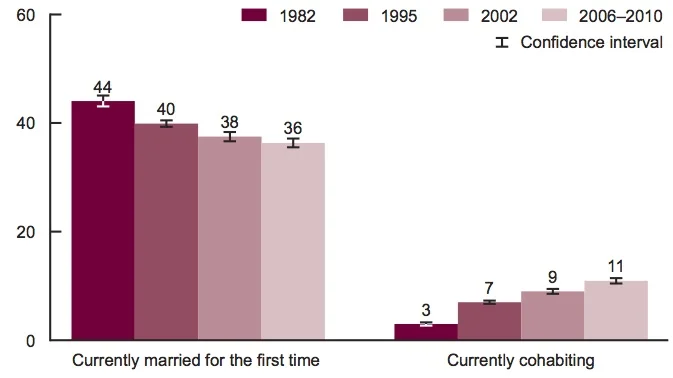
Current marital and cohabiting status among women under 44 years of age, United States: 1982, 1995, 2002, and 2006–2010. From Copen C. et al.  First Marriages in the United States: Data From the 2006–2010 National Survey of Family Growth. Natio…

Current marital and cohabiting status among women under 44 years of age, United States: 1982, 1995, 2002, and 2006–2010. From Copen C. et al.  First Marriages in the United States: Data From the 2006–2010 National Survey of Family Growth. National Health Statistics Report 49. March 2012.

Not surprisingly, cohabiting partners are also increasing likely to be the site for childrearing.  In 2002 about 15% of children were born to cohabiting parents; by 2011 this had risen to over 25%. In January, a review in The Economist noted that the rate of children born to unmarried parents ("out of wedlock") averages 39% in western countries - a five-fold increase since 1970. 

Policymakers wish they could change the trend. Unmarried parents are more likely to split up. Their children learn less in school and are more likely to be unhealthy or behave badly. It is hard to say how much of this difference is due to marriage itself, however, because unmarried parents differ a great deal from married ones. They are poorer, less well-educated and more likely to be teenagers, for example. (The Economist, Love and Marriage, Jan 14, 2016)
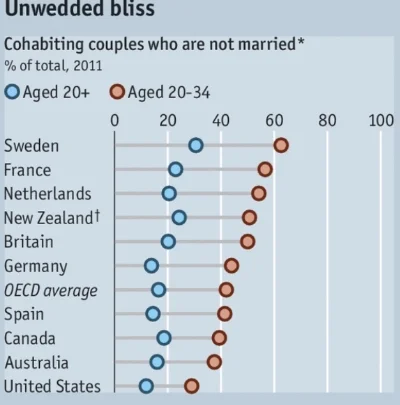
From The Ecomonist, based on OECD data.

From The Ecomonist, based on OECD data.

The discussion of marriage in the Talmud revolves around its contractual arrangements. But for most Jews today, the concept of marriage revolves around love. Economics have nothing to do with it. Western society has changed its beliefs about the nature of marriage, and so have we.  Still not convinced? Then answer this. Did your parents marry for love or money? If you are married - did you marry for love or for economic advancement (and how did that work out)? If you are not married, but want to be, what is driving you? The search for the love of your life, or the search for physical security? And if you have children - or grandchildren, would you want them to marry because they loved their significant other, or because it would be a good way to unite two families and insure financial stability? If your answers were like mine, they were closer to contemporary secular values about marriage than they were to the models of marriages described in the Talmud. And that's probably a very good thing.

Print Friendly and PDF

Gittin 89a ~ Breastfeeding in Public

גיטין פט,א 

אכלה בשוק, גירגרה בשוק, הניקה בשוק – בכולן רבי מאיר אומר תצא

If a married woman ate in the street, or walked with her head held high in the street, or nursed in the street - in all these cases Rabbi Meir said that she must leave her husband.


In the penultimate page of Gittin, the Talmud discusses immodest behavior. Rabbi Meir declared that three displays are so immodest that  any wife who expressed them should also be suspected of adultery. One of these behaviors is "nursing in the street." As a consequence, if a wife were to breastfeed in public, she cannot stay with her husband because of the possibility (- or is it the probability? -) that she had also committed adultery. 

Let's clear one thing up right away. Maimonides, in his Mishneh Torah rejects the position of Rabbi Meir, as does the definitive Shulchan Aruch  (אבן העזר ו, טז) :

רמב"ם הלכות איסורי ביאה פרק יז הלכה כא 

יצא קול על הבתולה שהיא בעולה אין חוששין לה ותנשא לכהן גדול, יצא עליה קול שהיא שפחה אין חוששין לה ותנשא אפילו לכהן, יצא לה שם מזנה בעיר אין חוששין לה, ואפילו הוציאה בעלה משום שעברה על דת יהודית או בעדי דבר מכוער ומת קודם שיתן לה גט הרי זו מותרת לכהן שאין אוסרין אשה מאלו אלא בעדות ברורה או בהודאת פיה

...if a husband divorced his wife because she transgressed Jewish practice or because she did a repulsive thing - and he died before he was able to give her the Get (Bill of Divorce), she is permitted to marry a Cohen [who is normally forbidden to marry a divorcee]. For we do not forbid a woman to her husband for any of these reasons unless there is clear evidence, or she admits to it herself (Mishneh Torah Hil. Issurei Biah 17:21).

As we have noted many times, societal definitions of immodest behavior change over time and between locations, and are continuing to evolve. Perhaps no better example of this evolution are attitudes towards breastfeeding in a public space. Rabbi Meir's attitude, while it may appear extreme, was in fact one that prevailed until recently in many cultures - especially our own. (That is why Pope Francis made headlines two years ago when he encouraged mothers in the Sistine Chapel to nurse their children.)

Public Breastfeeding laws

1.  THE US

In a 2013 review of  breastfeeding laws in the US, researchers at Harvard noted that the majority of states have legislation permitting women to breastfeed in any location and exempting breastfeeding from indecency laws.  However, less than half the states require employers to provide break time accommodations, prohibit employment discrimination based on breastfeeding or offer breastfeeding women exemption from jury duty.

The first breastfeeding law was passed in New York in 1984 with legislation exempting breastfeeding from public indecency offences. In 1993, Florida and North Carolina enacted laws to permit women to breastfeed in any public or private location. In 1994, Iowa passed the first legislation to excuse or postpone jury duty for breastfeeding women... Minnesota passed a law that required employers to provide break time and a private space for mothers to express milk.
— Nguyen, TT. Hawkins, SS. Current state of US breastfeeding laws. Maternal & Child Nutrition 2013. 9: 350-358.

Currently, women who breastfeed are exempt from public indecency laws in 29 states in the US. Fewer states - only nineteen  -  have laws encouraging or requiring provisions for break time and private accommodations where an employee can express milk or breast-feed. But 15 of these 19 states do not require breast-feeding provisions if doing so "would unduly disrupt operations". These laws not only make the lives of breastfeeding mothers (and their children) much easier; evidence suggests that state laws that support breast feeding are associated with increased  breastfeeding rates - and the health benefits that follow.

Nguyen, TT. Hawkins, SS. Current state of US breastfeeding laws. Maternal & Child Nutrition 2013. 9: 350-358.

Nguyen, TT. Hawkins, SS. Current state of US breastfeeding laws. Maternal & Child Nutrition 2013. 9: 350-358.

2.  THE UK

In the United Kingdom, breastfeeding in public was addressed in the Equality Act of 2010. Under this legislation, treating a woman unfavorably because she is breastfeeding is sex discrimination and against the law.  The Act protects nursing mothers in public places such as parks, sports and leisure facilities, and when using public transport.  They are also protected in stores, restaurants, hotels movie theatres (known as "cinemas" there), and gas stations. In Scotland it is a criminal offense to try to prevent a woman from feeding a child under two in any place in which the public has access and in which the child is entitled to be. Anyone who tries to do so can be prosecuted under the Equality Act.

3.  ISRAEL

A 2007 survey of pediatricians, family physicians, and gynecologists in Israel concluded that physicians had a positive disposition towards breastfeeding but that their knowledge about it was somewhat low. The authors noted that "it is highly important to increase physicians’ awareness of breastfeeding women’s needs," though they did not address the issue of nursing in public. A 2004 report from the Kenesset (עידוד הנקה בישראל) noted that only 32% of Jewish mothers were breastfeeding their infants a six months, (compared with 50% of Arab mothers,) but the report did not address nursing in public. In 2013 a bill came before the Kenesset to protect women who nursed in public spaces. The bill has not yet become law, but its supporters hope that it will be resubmitted in the current Kenesset.   

Breastfeeding in Public - One Rabbi's Responsum

Rabbi Brad Artson of the Zeigler School of Rabbinic Studies in Los Angeles has written a thoughtful תשובה (responsum) on the question of breast feeding in public. "When it was possible to avoid baring the breast," he wrote, reviewing several talmudic passages, "it seems to be the preferred approach of the rabbis. Forced stripping [which was part of the Sotah ritual] was a sign of humiliation. And, finally, the rabbis dispute whether or not such an act as public breast-feeding is a sufficient cause for divorce (ultimately deciding that it is not)." He concluded his twelve page responsum  (which was approved 14 to 3) with these words: 

Reading the sources in the light of these considerations, I understand halakhah to permit public breast-feeding, including in a Beit Midrash or synagogue sanctuary during a worship service, so long as it is done in a modest, subtle, and dignified fashion. (This requirement would be met, for example, by using a cloth or towel to cover breast and baby, by the maternity shirts specially made for this purpose, or by nursing in the rear of the room.) It is also preferable that Jewish institutions provide places where mothers who prefer to nurse in private may do so.

Many synagogue arks are emblazoned with the words דע לפני מי אתה עומד , know before Whom you stand. In Torah study and in prayer, we are in the presence of the One whose salvation is intimated through human nursing:


לְמַעַן תִּינְקוּ וּשְֹבַעְתֶּם מִשֹּׁד תַּנְחֻמֶיהָ לְמַעַן תָּמֹצּוּ וְהִתְעַנַּגְתֶּם מִזִּיז כְּבוֹדָהּת

"That you may suck, and be satisfied with the breasts of her consolations; that you may drink deeply, and be delighted with the abundance of her glory.”


Jewish institutions, in particular, have an obligation to welcome, facilitate, and support nursing mothers and their babies.

These are words that Jews of any and all denominations should get behind.

An amendment no. 6 and printed in the Congressional Record to establish that no funds may be used to enforce any prohibition on women breastfeeding their children in Federal buildings or on Federal property.
— Bill Summary & Status 106th Congress (1999 - 2000) House Ammendment 295.
Former airwoman Tara Ruby photographed active duty soldiers at Fort Bliss in El Paso, Texas, September 2015.

Former airwoman Tara Ruby photographed active duty soldiers at Fort Bliss in El Paso, Texas, September 2015.

NEXT TIME ON TALMUDOLOGY: THE CHANGING INSTITUTION OF MARRIAGE

Print Friendly and PDF

Gittin 67b~ Might Talmudic Medicines Really Work?

doctors giving medicine.gif

For the next three days, those who study the Talmud following the one-page-a-day Daf Yomi cycle will spend some time reading about cutting edge medical practices.  In Babylon. About 1,500 years ago. Here's a smattering of some of those practices:

For  sun-stroke

  • the remedy is on the first day to take a jug of water, [if it lasts] two days to let blood, [if] three days to take red meat broiled on the coals and highly diluted wine. For a chronic heat stroke, he should bring a black hen and tear it lengthwise and crosswise and shave the middle of his head and put the bird on it and leave it there till it sticks fast, and then he should go down [to the river] and stand in water up to his neck till he is quite faint, and then he should swim out and sit down. If he cannot do this, he should eat leeks and go down and stand in water up to his neck till he is faint and then swim out and sit down. (Gittin 67b).

For blood rushing to the head

  • take shurbina [a kind of cedar] and willow and moist myrtle and olive leaves and poplar and rosemary and yabla [a herb] and boil them all together. The sufferer should then place three hundred cups on one side of his head and three hundred on the other. Otherwise he should take white roses with all the leaves on one side and boil them and pour sixty cups over each side of his head. (Gittin 68b.)

For migraine

  • take a woodcock and cut its throat with a white zuz over the side of his head on which he has pain, taking care that the blood does not blind him, and he should hang the bird on his doorpost so that he should rub against it when he goes in and out. (Gittin 68b.)

For a cataract

  • take a scorpion with stripes of seven colors and dry it out of the sun and mix it with stibium in the proportion of one to two and drop three paint-brushfuls into each eye — not more, lest he should put out his eye. (Gittin 69a.)

For night blindness

  • take a string made of white hair and with it tie one of his own legs to the leg of a dog, and children should rattle potsherds behind him saying 'Old dog, stupid cock'. He should also take seven pieces of raw meat from seven houses and put them on the doorpost and [let the dog] eat them on the ashpit of the town. After that he should untie the string and they should say, 'Blindness of A, son of the woman B, leave A, son of the woman B,' and they should blow into the dog's eye. (Gittin 69a.)

For catarrh [or a lung infection?] 

  • take about the size of a pistachio of gum-ammoniac and about the size of a nut of sweet galbanum and a spoonful of white honey and a Mahuzan natla of clear wine and boil them up together...He can also take the excrement of a white dog and knead it with balsam, but if he can possibly avoid it he should not eat the dog's excrement as it loosens the limbs. (Gittin 69a-b.)

For swelling of the spleen

  • take the spleen of a she-goat which has not yet had young, and stick it inside the oven and stand by it and say, 'As this spleen dries, so let the spleen of So-and-so son of So-and-so' dry up'. (Gittin 69b.)

For a stone in the bladder

  • take three drops of tar and three drops of leek juice and three drops of clear wine and pour it on the penis of a man or on the corresponding place [i.e. the urethra] in a woman. Alternatively he can take the ear of a bottle and hang it on the penis of a man or on the breasts of a woman. Or he can take a purple thread which has been spun by a woman of ill repute or the daughter of a woman of ill repute and hang it on the penis of a man or the breasts of a woman. Or again he can take a louse from a man and a woman and hang it on... (Gittin 69b.)

We could go on but no doubt you've got the idea.  I doubt there are many of us eager to eat balsam mixed with dog excrement to ease our winter coughs (For those who are, remember: the Talmud tells us to go easy on the excrement.) But I will share with you the remarkable healing properties of two ancient remedies. To be sure, neither is a talmudic concoction, but their stories have implications for those too. 

A rich source of new antimicrobials potentially resides in medieval and early modern medical texts
— Harrison F, Roberts AEL, Gabrilska R, Rumbaugh KP, Lee C, Diggle SP. 2015. A 1,000-year-old antimicrobial remedy with antistaphylococcal activity. mBio 6(4):e01129- 15.

A 1,000-Year-Old Antimicrobial Remedy

Bald’seyesalve.A facsimile of the recipe, taken from the manuscript known as Bald’s Leechbook (London, British Library, Royal 12, D xvii).

Bald’seyesalve.A facsimile of the recipe, taken from the manuscript known as Bald’s Leechbook (London, British Library, Royal 12, D xvii).

I am not aware of any published descriptions of attempts to test these talmudic remedies. But a recent paper described something close. It was an attempt to reproduce a remedy described in Bald's Leechbook, an English medical text written in the tenth century. This text, which exists as a single copy in the British Library in London, contains a number of remedies, including those for what appear to be microbial infections.  Here's one of them:  

Make an eyesalve against a wen [a lump in the eye]: take equal amounts of cropleac [an Allium species] and garlic, pound well together, take equal amounts of wine and oxgall, mix with the alliums, put this in a brass vessel, let [the mixture] stand for nine nights in the brass vessel, wring through a cloth and clarify well, put in a horn and at night apply to the eye with a feather; the best medicine.

Image of a hordeolum.jpeg

The most likely clinical condition that correlates with a wen is a hordeolum, or, in non-medical language, a sty. It's a bacterial infection of an eyelash follicle, caused by a common bacterium called Staph. Aureus. They are easily treated with antibiotic cream and warm compresses. A group of medical researchers (with the help of a historian from the School of English and Centre for the Study of the Viking Age at the University of Nottingham) tested the effect of Bald’s eyesalve on Staph. aureus. They wanted to to determine if it worked at all.  If it did, they wanted to see if its efficacy could be attributed to a single ingredient, or whether it only worked when all the ingredients were combined according to the instructions laid down by Bald.  

Of course the first thing the scientists needed to do was to figure out what some of ingredients were. For example, copleac might be an onion, or a leek. (Actually, they couldn't figure out which of the two it was, so they made two variants of the recipe.) Next, they took both the recipe, and controls, which were the individual ingredients alone, and after leaving them to stand for "nine nights" as the Leechbook requires (læt standan ni􏰍on niht) they applied them to colonies of Staph Aureus. Then they counted the number of colonies of the bacteria that remained.

Two hundred microliters of ES-Onion or ES-Leek (batch A, filled circles, and batch B, open circles) or of each individual ingredient preparation was added to five 1-day-old cultures of S. aureus growing at 37°C in a synthetic wound. After 24 h of fu…

Two hundred microliters of ES-Onion or ES-Leek (batch A, filled circles, and batch B, open circles) or of each individual ingredient preparation was added to five 1-day-old cultures of S. aureus growing at 37°C in a synthetic wound. After 24 h of further incubation, the collagen was dissolved to recover cells for agar plate counts. The control treatment was sterile distilled water left to stand for 9 days in the presence of brass, which was also present in all other preparations, to simulate the presence of a copper alloy vessel Asterisks denote treatments whose results were significantly different from those of the control. From Harrison F, Roberts AEL, Gabrilska R, Rumbaugh KP, Lee C, Diggle SP. 2015. A 1,000-year-old antimicrobial remedy with antistaphylococcal activity. mBio 6(4):e01129-15.

To their great delight they found the recipe was only effective when all the ingredients were present. They even tested whether it was necessary to wait for nine days and reported that "the number of viable cells left after treatment with either version...was [significantly] lower when the eyesalve had been left to stand for 9 days prior to use." In other words, the potion concocted only worked when the recipe was followed in its entirety; skipping any part decreased the efficacy.    

What is the remedy for a boil? — Abaye said: [A mixture of] ginger and silver dross and sulphur and vinegar of wine and olive oil and white naphtha laid on with a goose’s quill.
— Gittin 86a

But the next experiments were no less remarkable. The researchers tested the potion on methicillin-resistant Staph. Aureus (MRSA) which is an entirely modern "superbug". Through the indiscriminate and widespread use of antiobiotics, this strain of Staph. Aureus has grown resistant to the usual antibiotics, and is very real health problem.  The researchers tested the onion (ES-O) and leek (ES-L) versions against a standard antibiotic used to treat MRSA, called vancomycin, using mice that had been infected with the superbug. Vancomycin, the standard modern therapy, did not cause significant reductions in viable bacteria, but "ES-O and ES-L caused statistically significant drops in the numbers of viable cells recovered from wounds." In fact when compared to our modern vancomycis, the Leechbook potions caused a ten-fold reduction in the number of viable MRSA cells recovered. Of course there's a long way between a single small study done on cell cultures and mice, and a drug that is safe and effective in humans. But this story reveals how come very old medical texts may contain treatments that work. 

For more on the the story of the discovery of Bald'eye remedy, listen to this wonderful podcast:

If medieval physicians really did use observation and experience to design effective antimicrobial
medicines, then this predates the generally accepted date for the adoption of a rational scientific method (the formation of the Royal Society in the mid-17th century) and the modern age of antibacterial medicine (Lister’s use of carbolic acid in the late 19th century) by several hundred years.
— Harrison F, Roberts AEL, Gabrilska R, Rumbaugh KP, Lee C, Diggle SP. 2015. A 1,000-year-old antimicrobial remedy with antistaphylococcal activity. mBio 6(4):e01129-15

The 2015 Nobel Prize for an Ancient Remedy

...take one bunch of Qinghao, soak in two sheng of water, wring it out to obtain the juice and ingest it in its entirety
— Extract from The Handbook of Prescriptions for Emergency Treatments by Ge Hong (283–343 CE).

Another example of the medical wisdom of some ancient texts was acknowledged by the Nobel Prize Committee, no less. Last year, the Nobel Prize in Medicine was shared by the Chinese physician Youyou Tu "for her discoveries concerning a novel therapy against Malaria." Professor Tu led a team that screened more than 2,000 traditional Chinese medical herbs for antimalarial activity. Extracts from a herb known locally as Qinghao, (Artemisia annua) inhibited the malarial parasite and was successfully tested on mice in 1971. Clinical studies in the 1980s established the efficacy of artemicinin (as it came to be called). This drug is now part of the standard treatment for malaria worldwide.  Yet it was first identified in a Chinese medical text from the third century CE. - the era of the Mishnah and early Talmud.

Ancient texts certainly may contain efficacious treatment, though the odds are stacked against them. Today only a very tiny number of compounds that are screened for possible medical benefit ever make it to early trials, and of those most fail. It would take a lot of convincing to get Pfizer to test a "woodcock with its throat cut with a coin" for headache.  Until then, it is best to follow the words of another very old source of wisdom, Rav Sherira Gaon, who died around the year 1000 CE. (and so lived around the time of the composition of Bald's Leechbook). 

אוצר הגאונים, חלק התשובות, גיטין דף ס"ח ע"ב, סימן שע

צריכין אנן למימר לכון, דרבנן לאו אסותא אינון, ומילין בעלמא דחזונין בזמניהון...אמרונין, ולאו דברי מצוה אינון. הלכך לא תסמכון על אלין אסותא, וליכא דעביד מינהון מידעם, אלא בתר דמיבדיק וידע בודאי מחמת רופאים בקיאים, דההיא מילתא לא מעיקא לה וליכא דליתיה נפשיה לידי סכנה. והכין אגמרו יתנא ואמרו לנא אבות וסבי דילנא, דלא למעבד מן אילין אסותא אלא מאי דאיתיה

We must tell you that the rabbis were not physicians. Whatever they saw in their day, they addressed, but these matters are not mitzvot. Therefore, do not rely on these remedies. They must not be applied until they have been tested by expert physicians, who can be sure that the remedy will not cause harm or danger. This is what our ancestors have taught us. We should not apply these remedies unless they have been tested...

Print Friendly and PDF

Gittin 60a ~ Queen Helena and Her Gift to the Temple

All or Nothing?

In today's page of Talmud, there is an interesting (and most welcome) digression from the laws of divorce and the ownership of slaves. The Talmud asks whether just a part of the Torah may be committed to writing, or if the text must be produced as a whole. Here's the original question:

בעא מיניה אביי מרבה מהו לכתוב מגילה לתינוק להתלמד?...  א"ל אין כותבין 

Abaye asked Rabbah: "May a scroll containing only a portion of the Torah text be written for a young child to be taught from?" Rabbah answered: "We may not write portions of the Torah." 

The Talmud then questions Rabbaha's ruling: 

איתיביה אף היא עשתה טבלא של זהב שפרשת סוטה כתובה עליה

They asked a question on this: She also made a golden tablet on which the Sotah passage was inscribed.

Someone, some she, had presented to the Temple a copy of a portion of the text of the Torah carved out on a golden tablet. It was the text of the rite of the Sotah, which was then copied from this golden tablet onto a scroll and later dissolved in water. From the story of this golden tablet, the Talmud challenges Rabbah's ruling, because it shows that it is indeed permitted to reproduce only part of the text of the Torah. 

We won't dwell on how this issue is finally resolved. Instead, let's find out more about the woman who made the donation.  Her identity is revealed in a Mishnah in the third chapter of Yoma:

King Monobaz had all the handles of all the vessels used on Yom Kippur made of gold. His mother Helena had a golden candlestick made over the door of the Hechal.  She also had a golden tablet made, on which the portion about the Sotah was inscribed. 

So that's who it was. Queen Helena. 

QUEEN HELENA, PATRON OF THE SECOND TEMPLE

We first met the Queen when we studied Nazir, of all places, where it turns out she was a Jew-by-choice:

 מעשה בהילני המלכה שהלך בנה למלחמה ואמרה אם יבוא בני מן המלחמה בשלום אהא נזירה שבע שנים ובא בנה מן המלחמה והיתה נזירה שבע שנים ובסוף שבע שנים עלתה לארץ והורוה ב"ה שתהא נזירה עוד שבע שנים אחרות ובסוף שבע שנים נטמאת ונמצאת נזירה עשרים ואחת שנה

A story happened with Queen Helena. Her son went to war and she declared "If my son returns in peace from the war I will be a nezirah for seven years." Her son returned from the war and she was a nezirah for seven years At the end of these seven years she went up to live in the Land of Israel, and Bet Hillel ruled for her that she must be a nezirah for another seven years [because Bet Hillel ruled that the time period of nezirut observed outside of Israel does not count.] At the end of the [second] period of seven years she became impure [which meant she needed to serve the entire period again], and so she was a nezirah for a total of twenty-one years...(Nazir 19b)

In this passage Queen Helena, who died around 50 CE.,  is one of the few people in the Talmud identified as having become a nazarite, and quite possibly the only one who became a nazarite three times over.  But there is a lot more to her story.  Elsewhere in the Talmud (בבא בתרא יא, א) her son is credited with saving Jerusalem from famine (at least according to Rashi there). And in the Mishnah in Yoma (37a), from where the brief quote in today's Daf-Yomi comes from, the Queen dedicated to the Temple both a golden candelabra and a tablet on which the section of the Sotah was written.   

THE QUEEN IN THE WRITINGS OF JOSEPHUS

While the Talmud records a number of stories about Queen Helena, the great Jewish historian Josephus provided some additional information about her life, which corroborate some of the stories told about her in the Talmud.

About this time it was that Helena, Queen of Adiabene, and her son Izates, changed their course of life, and embraced the Jewish customs, and this on the occasion following: Monobazus, the king of Adiabene, who had also the name of Bazeus, fell in love with his sister Helena, and took her to be his wife, and begat her with child. But as he was in bed with her one night, he laid his hand upon his wife's belly, and fell asleep, and seemed to hear a voice, which bid him take his hand off his wife's belly, and not hurt the infant that was therein, which, by God's providence, would be safely born, and have a happy end. This voice put him into disorder; so he awaked immediately, and told the story to his wife; and when his son was born, he called him Izates...

A certain Jewish merchant, whose name was Ananias, got among the women that belonged to the king, and taught them to worship God according to the Jewish religion. He, moreover, by their means, became known to Izates, and persuaded him, in like manner, to embrace that religion; he also, at the earnest entreaty of Izates, accompanied him when he was sent for by his father to come to Adiabene; it also happened that Helena, about the same time, was instructed by a certain other Jew and went over to them...

But as to Helena, the king's mother, when she saw that the affairs of Izates's kingdom were in peace, and that her son was a happy man, and admired among all men, and even among foreigners, by the means of God's providence over him, she had a mind to go to the city of Jerusalem, in order to worship at that temple of God which was so very famous among all men, and to offer her thank-offerings there. So she desired her son to give her leave to go there; upon which he gave his consent to what she desired very willingly, and made great preparations for her journey, and gave her a great deal of money, and she went down to the city Jerusalem, her son conducting her on her journey a great way. Now her coming was of very great advantage to the people of Jerusalem; for whereas a famine did oppress them at that time, and many people died for want of what was necessary to procure food withal, Queen Helena sent some of her servants to Alexandria with money to buy a great quantity of corn, and others of them to Cyprus, to bring a cargo of dried figs. And as soon as they were come back, and had brought those provisions, which was done very quickly, she distributed food to those that were in want of it, and left a most excellent memorial behind her of this gift, which she bestowed on our whole nation. And when her son Izates was informed of this famine, he sent great sums of money to the men in Jerusalem...(Josephus, Antiquities, XX, 2.)


THE QUEEN IN THE WRITINGS OF NEUSNER

In 1964 the (then young) historian Jacob Neusner published a paper in the Journal of Biblical Literature titled The Conversion of Adiaben to Judaism: A New Perspective.  Neusner claimed that the account of Josephus about the conversion of Queen Helena and the Adiabene's ruling family to Judaism "cannot reasonably be rejected,"  and he located Adiabene in ancient Assyria, in what is today called Armenia.  He reminded his readers that the Queen was married to her brother Monobazus (which is apparently what royalty did in that part of the world) and that it was Monobazus who was first converted to Judaism.  But he goes one step further, and asks what political motivation lay behind this conversion.

His answer is this: the Jews of the Near and Middle East in the first century were "a numerous and politically important group" and "in Armenia, as well as in other areas, Jewish dynasts held power, if briefly..."  In addition, "Palestinian Jewry was a powerful and militarily significant group. It was by no means out of the question for Palestine to regain its independence of Rome, perhaps in concert with the petty kings of the Roman orient." By converting to Judaism, the House of Adiabene might position itself as a powerful player should the Roman empire fall. In this way, noted Neusner, Queen Helena and her royal house were repeating a maneuver made half a century earlier by Herod, who, while remaining loyal to Rome, had "tried to win friends in other Roman dependencies, as well as Babylonian Jewry." In fact the Adiabenes went a step further than had Herod, and encouraged the revolution against Rome in 66 CE. They may have done so, suggested Neusner, in order to gain the throne in Jerusalem itself.

 If the Jews had won the war against Rome, who might expect to inherit the Jewish throne? It was not likely that Agrippa II could return to the throne, for he and his family were discredited by their association with Rome and opposition to the war. Some Jews probably expected that the Messiah would rule Judea, but this could not seriously have effected the calculations of the Adiabenians. Indeed, from their viewpoint, they might reasonably hope to come to power. They were, after all, a ruling family; their conversion could not matter to the Palestinian Jews any more than Agrippa I's irregular lineage had prevented him from winning popular support. Their active support of the war, their earlier benefactions to the city and people in time of famine, their royal status, and the support they could muster from across the Euphrates, would have made them the leading, if not the only, candidates for the throne of Jerusalem.


QUEEN HELENA'S FINAL RESTING PLACE

Rehov Helena Hamalka.jpg

Neusner concedes that the conversion of Helene and Izates was not only a political act. Rather, he suggests that is is important to take note of the political consequences of their religious action.  It would seem though, that Queen Helena's family recognized the deeply religious consequences of her decision to embrace Judaism.  Josephus later records that when, having returned to Adiabene, the Queen died, her son "sent her bones...to Jerusalem, and gave order that they be buried at the pyramids their mother had erected" (Josephus, Antiquities, XX, 4). This suggests that, whatever else it was, Queen Helena's conversion was also recognized by her family as a religious act; her son recognized her connection to Jerusalem, and arranged for her to be interred there, near what is now the American Colony Hotel. Today, we remember the Queen with a street named after her in downtown Jerusalem. We also remember her as as the convert Queen who became a nazarite, and as the only women in the Talmud who is recorded as having made a donation to the Second Temple.

Print Friendly and PDF