Kiddushin 16b ~ Measuring Puberty

קידושין טז, ב

בן תשע שנים שהביא שתי שערות שומא מבן ט' שנים ויום אחד עד בן י"ב שנה ויום אחד ועודן בו שומא ר' יוסי בר' יהודה אומר סימן בן י"ג שנה ויום אחד דברי הכל סימן 

If a nine year old grows two hairs [in the pubic region] the growth should be attributed to a mole [and not as a sign of sexual maturity]. [If these hairs grow] from the age of nine years and one day until twelve years and one day, and they are still there [when the child reaches twelve, one opinion is that they should be attributed to a] mole, and Rabbi Yossi bar Rabbi Yehuda says they are a sign of sexual maturity. [If these hairs grow] when the child is thirteen years old and one day, then everyone agrees they are a sign of sexual maturity...(Kiddushin 16b)

Pre-Modern Descriptions of Puberty

The way in which children develop into adults has fascinated us for centuries.  In fact, the earliest surviving statement on human growth dates back to the sixth century BCE, (not long after the prophet Jeremiah lived) and is by the Athenian poet Solon. One critic described his poem as combining "scientific sense with philosophical probability (if not, regrettably, with poetic elegance)." Here is Solon:

A young boy acquires his first ring of teeth as an infant and sheds them before he reaches the age of seven years. When the god brings to an end the next seven year period, the boy shows the signs of beginning puberty. In the third hebdomad, [ a period of seven years] the body enlarges, the chin becomes bearded and the bloom of the boy's complexion is lost. In the forth hebdomad physical strength is at its peak and is regarded as the criterion of manliness; in the fifth hebdomad a man should take thought of marriage and seek sons to succeed him. In the sixth hebdomad a man's mind is in all things disciplined by experience and he no longer feels the impulse to uncontrolled behavior. In the seventh he is at his prime in mind and tongue and also in the eighth, the two together making fourteen years. In the ninth hebdomad, though he still retains some strength, he is too feeble in mind and speech for the greatest excellence. If a man continues to the end of the tenth hebdomad, he has not encountered death before due time.

Hippocrates believed that puberty could be delayed in areas where "the wind is cold and the water is hard". Rabbi Shimon ben Gamliel (d. 70CE) would have agreed, because he thought that the growth of pubic hair was hastened in those who used the bathhouse regularly.  But it is especially interesting to compare Aristotle's writings on puberty with those of the Talmud (which of course were codified several hundred years later).

In man, maturity is indicated by a change in the tone of the voice, by an increase in size and an alteration in appearance of the sexual organs, and also by an increase in size and alteration in appearance of breasts, and above in the hair growth above the pubes.

Aristotle (d. 322 BCE) seems to have put a lot of weight on the growth of pubic hair, just like the rabbis of  in the Talmud did many years later. Galen, who died in 199 CE, was cautious about timing the onset of puberty: "Some begin puberty at once on the completion of the fourteenth year, but some begin a year or more after that" (De Sanitate Tuenda, or p288 of this translation). Jumping forward several centuries, we find that girls in Tuscany in 1428 were allowed to marry aged eleven and a half, although they were forbidden to live with their husbands until they were twelve. However the Bishop of Florence (later canonized as Saint Anthony) declared that cohabitation was allowed "provided the girl had reached puberty." 

The Tanner Scale

Today, the stage of sexual maturity in children is most commonly measured using the Tanner scale, described by the British pediatrician James Tanner, who died in 2010.  (He wrote a fascinating History of the Study of Human Growth as a sort of a hobby, but his day job was working as a Professor at the Institute of Child  Health in London.)  Here is how Tanner described his scale in boys, (from his original paper published in 1970):

Stage 1: Pre-adolescent. The velus [sic] over the pubes is no further developed than that over the abdominal wall, i.e. no pubic hair.

Stage 2: Sparse growth of long, slightly pigmented downy hair, straight or slightly curled, appearing chiefly at the base of the penis. This stage is difficult to see on photographs, particularly of fair-headed subjects...

Stage 3: Considerably darker, coarser, and more curled. The hair spreads sparsely over the junction of the pubes. This and subsequent stages were clearly recognizable on the photographs.

Stage 4: Hair is now adult in type, but the area covered by it is still considerably smaller than in most adults. There is no spread to the medial surface of the thighs.

Stage 5: Adult in quantity and type, distributed as an inverse triangle of the classically feminine pattern. Spread to the medial surface of the thighs but not up the linea alba or elsewhere above the base of the inverse triangle.

There has been less discussion in the literature as to whether the appearance of pubic hair has advanced in females, although this does seem to be the case, pubarche having advanced by at least 6 months. The PROS study found stage II pubic hair to be apparent in African-American females at a mean age of 8·78 years and 10·51 years in whites.
— Slyper, AH.The pubertal timing controversy in the USA, and a review of possible causative factors for the advance in timing of onset of puberty. Clinical Endocrinology (2006) 65, 1–8

Tanner also described other signs of sexual maturity, since growth of pubic hair is not the only maker.  In boys, for example, Tanner used a five-stage system for genital growth: in stage one, the  "testes, scrotum, and penis are of about the same size and proportion as in early childhood," whereas in stage two, "the scrotum and testes have enlarged and there is a change in the texture of the scrotal skin..."  Tanner noted that the stages of pubic hair development and the stages of genital development differ, so that a boy may reach full genital maturation sooner than he reaches stage five on the pubic hair scale.  
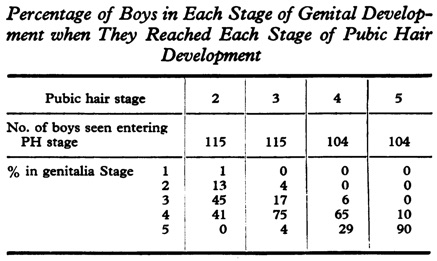
From Marshall A. Tanner JM. Variations in the pattern of pubertal changes in boys. Archives of Disease in Childhood 1970. 45: 13-25.

From Marshall A. Tanner JM. Variations in the pattern of pubertal changes in boys. Archives of Disease in Childhood 1970. 45: 13-25.

Tanner's work reveals what we already know intuitively. Maturity, whether sexual or emotional, is a process that takes time and proceeds through many stages. The rabbis of the Talmud relied predominantly on one marker of adulthood:  sexual maturity as evidenced by a minimal of pubic hair growth.  But they used it in conjunction with the age of the child.  They also understood that the onset of these signs might be sooner in some children and later in others.

Sequence of events in puberty in girls (top) and boys. From Marshall A. Tanner JM. Variations in the pattern of pubertal changes in boys. Archives of Disease in Childhood 1970. 45:22.

Sequence of events in puberty in girls (top) and boys. From Marshall A. Tanner JM. Variations in the pattern of pubertal changes in boys. Archives of Disease in Childhood 1970. 45:22.

In most European countries, the age of the onset of puberty (as measured by the onset of menstruation) has fallen by about a year per century. Boys also seem to be developing earlier than previously, possibly by more than a year. Data from the US National Health and Nutrition Examination Survey (NHANES III) study of boys aged 8 –19 years, suggests that the mean age of onset of male genital development based on visual inspection is now about nine years for African-Americans and ten years for white boys.

Another First?

Last year we analyzed talmudic statements of R. Hiyya (who lived in the second half of the second century,) and Rava, (d. 350CE) who appear to have been the first to report an association between obesity and delayed puberty in boys.  They claimed that puberty may be delayed in boys who are underweight, and this association has now been confirmed. As we noted then, none of the researchers has credited these talmudic sages for being the first to notice these associations. But Rava and R. Hiyya were first, and firsts count for something in science. The Baraita in today's daf  may be the first recorded discussion of the lower limits of sexual maturity. But the rabbis of the Talmud used other markers of maturity, like breast development which is discussed in Masechet Niddah (47a).They distinguished between "lower" and "upper" signs of puberty, and so presaged the work of Tanner. (The rabbis also ruled that "all girls who are examined are examined by women". Thank heavens.)

There were several reasons why the Talmud had to codify the stages of physical maturity.  Among these were to allow a father to decide to whom his daughter would marry.

A father who declares...my daughter is twelve years and a day is believed in order to marry the child off...(רמב׳ם הל׳ אישות ב:כג)

Today, any notion that a child under the age of twelve (or sixteen for that matter) would be mature enough to marry is utterly repugnant to us. But according to the UN in developing countries, one in every three girls is married before reaching the age of eighteen, and one in nine is married by the age of fifteen.  When we read the Talmud we often get a glimpse into a Jewish world very different from our own. But some practices of that world still exist outside of the Jewish community today, to the shame of us all. 

From United Nations Children’s Fund, Ending Child Marriage: Progress and prospects, UNICEF, New York, 2014.

From United Nations Children’s Fund, Ending Child Marriage: Progress and prospects, UNICEF, New York, 2014.
Print Friendly and PDF

Kiddushin 7a ~ Does Marriage Make You Happier?

קידושין ז, א

אמר ריש לקיש: טב למיתב טן דו מלמיתב ארמלו

Resh Lakish said: It is better for a woman to live as tad du than to live alone...

In a 1975 lecture to the Rabbinical Council of America, Rabbi J.B. ("the Rav") Soloveitchik,  quoted the aphorism of Resh Lakish found in today's page of Talmud.  The Rav went on to explain that it was "based not upon sociological factors...[but] is a metaphysical curse rooted in the feminine personality. This is not a psychological fact; it is an existential fact." Wow.  Is this statement of Resh Lakish really an existential fact? To answer this, we need to first answer another question - what do his words actually mean?

One way to understand the aphorism is as follows:  "A widow would rather live in misery than live alone." But that's not the only translation, which depends on the exact meaning of the Aramaic phrase טן דו (tan du).  There are a number of possibilities.

Rashi

Let's start with Rashi and his explanation to our text:

בגופים שנים בעל ואשתו ואפילו אינו לה אלא לצוות בעלמא

Tan Du: Two bodies. A husband and wife; even if he is nothing more to her than company.

This explanation of Rashi's does not suggest that married misery is preferred over a single life. This is a slightly different explanation that Rashi gave in when we met this phrase in Yevamot.

טן דו - גוף שנים. משל הדיוט הוא, שהנשים אומרות טוב לשבת עם גוף שנים משבת אלמנה

Tan Du: Two bodies. This is a common maxim, for women say that it is better to live as two than to live alone.

So according to Rashi in both Yevamot and here in Kiddushin, Resh Lakish never addresses living in misery. He just made the observation that women prefer marriage over a single life.

JASTROW'S DICTIONARY

Not so Marcus Jastrow, whose dictionary (published 1886-1903) became a classic reference text for students of the Talmud. Jastrow translated טן דו as a load of grief, an unhappy married life. This will become very important later, so make note. 

THE SONCINO TRANSLATION

Moving on, the Soncino translation of Kiddushin (first published in 1966) echoes Jastrow's translation: "It is better to carry on living with trouble than to dwell in widowhood".  This is similar to the Soncino translation of the same phrase when found in Yevamot 118: "It is preferable to live in grief than to dwell in widowhood." However, a footnote to the text in Yevamot notes that "Levy compares it with the Pers., tandu, two persons." (The reference here is to Jacob Levy's  German Dictionary Chaldisches Worterbuch uber die Targumim - Aramic Dictionary of the Targums and a Large Part of Rabbinic Literature.) Why did Isidore Epstein, editor of the Soncino Talmud, choose to use Jastrow's translation over that of Levy - and that of Rashi? Answering that will take us too far off track, so we will leave it for another time... 

MELAMED'S ARAMAIC-HEBREW-ENGLISH DICTIONARY

Melamed's Aramaic-Hebrew-English Dictionary (Feldheim: Jerusalem 2005) follows Rashi : "טן דו = two bodies." 

THE ARTSCROLL TRANSLATION

The ArtScroll Schottenstein Talmud basis its translation on Rashi: "It is better to live as two together than to live alone." However a footnote (note 18) brings its meaning closer to that of Jastrow and the Soncino: "I.e it is better to be married  - even to a husband of mediocre stature - than to remain single." 

THE KOREN STEINSALTZ TRANSLATION

In his Hebrew translation of the Aramaic text found in Yevamot 118, Rabbi Steinsaltz follows Rashi, and translates  טן דו as "two bodies." A side note points out that the true origin of the phrase is not known, though it likely comes from Persian.

The newer English Koren Talmud follows the same translation: "It is better to sit as two bodies, ie., to be married, than to sit alone like as a widow. A woman prefers the any type of husband to being alone."  Elsewhere in the Koren series, (Yevamot 118a) there is a note, (written by Dr. Shai Secunda), which is more definitive than the Hebrew note. Tan Du is from middle Persian, meaning together.  It's nothing to do with being miserable.

TESHUVOT HAGE'ONIM

I've left perhaps the strongest textual witness for last: how the words Tan Du were understood during the period of the Geonim (c. 589-1038). In 1887 Avraham Harkavy published a collection of responsa from this period that he found in manuscripts held in the great library of St. Petersburg. In this collection is a reference to our mysterious words:

  טן דו בלשון פרסי שני בני אדם. ארמלו יחידות 

טן דו in Persian means two people. ארמלו means alone.

Chronologically, this is our earliest source, and, therefore, perhaps our most compelling. Case closed.

VARIATIONS OF THE RESH LAKISH RULE

So far we have the following four versions of what we will now call the Resh Lakish Rule:

It's better for a woman to be...

  • ....married and unhappy than single  (Jastrow)

  • ...in a less desirable or mediocre marriage than no marriage at all (ArtScroll footnote).

  • ...miserable and married than to be a widow (Soncino).

  • ...with a husband than to be alone (ArtScroll, Koren, Melamed, Rashi, Teshuvot Hage'onim)

WHAT IF TAN DU MEANS MISERABLE?

It seems that the translation of  טן דו as miserable originated with Jastrow, and that those who translate Resh Lakish as saying "misery is better than being single" are following in the Jastrow tradition. If we were to evaluate the Resh Lakish Rule per Jastrow (and Soncino and an ArtScroll footnote), the question is, what, precisely, constitutes  a "miserable marriage"? One in which the woman feels physically safe but emotionally alone? One in which her husband loves her dearly but is  unable to provide for her financially? Or one in which she has all the money she needs but her husband is an alcoholic? Tolstoy has taught us that each unhappy family (and presumably each miserable marriage) is unhappy in its own unique way. The point here is not to rank which is worse. 

[In the 1950s, a] bad marriage was usually a better option for a woman, especially if she had a child, than no marriage at all.
— Stephanie Coontz. Marriage, A History.Viking 2005. p288

Today it would be utterly silly (and incredibly rude and insulting) to suggest that a woman is better off miserable than single.  But after our review, that does not appear to be what Resh Lakish ever said.  What he really said was this: a woman would be better off (טב) married than living alone (as a widow). Resh Lakish didn't explain what he meant by better off, so we will have to assume that what he meant was a measure of overall well-being, or what we call... happiness. What we want to know, is how this understanding of Resh Lakish stands up today. Was the Rav correct when he called this "an existential fact"?

MEASURING HAPPINESS & HAPPINESS INEQUALITY

Happiness inequality exists and has been well documented. University of Pennsylvania economists Betsy Stevenson and Justin Wolfers, (who live together, but not within the bonds of marriage), note that

“...the rich are typically happier than the poor; the educated are happier than those with less education; whites are happier than blacks; those who are married are happier than those who are not; and women—at least historically—have been happier than men.”

But why is this so? Don't we all oscillate around a set point of happiness, regardless of what life may throw at us? Some psychologists think so.

LOTTERY WINNERS & ACCIDENT VICTIMS: THE SET POINT THEORY OF HAPPINESS

According to the set point theory of happiness, we all revolve around our own, innate happiness point. When we are faced with adversity, we do, to be sure, become sadder. But we eventually bounce back to where we were before, back at our set point. Similarly, when met with some good mazal, we are, for a period, more happy. But then we return to our innate set point for happiness, wherever that was prior to the good fortune. The evidence for this comes from a classic study which found that "lottery winners were not much happier than controls" and that accident victims who were paralyzed "did not appear nearly as unhappy as might have been expected." (The problem is that this study used a tiny sample - there were only 22 lottery winners and 29 paralyzed accident victims - so we need to be very cautious in generalizing from it.) 

Married people are – on average – happier than those who are single, but perhaps this fact does not suggest causation. Some would argue that it's just a correlation. A grumpy person, unable to hold down a job and miserable to be around, is not likely to find another individual willing to marry him. So it’s not that marriage makes you happier –it’s that happier people are more likely to find a partner and get married. According to this set point theory of happiness, the Resh Lakish Rule would not be supported, since the act of marrying would have no overall long-term effect on happiness.

THE MORE IS BETTER THEORY OF HAPPINESS

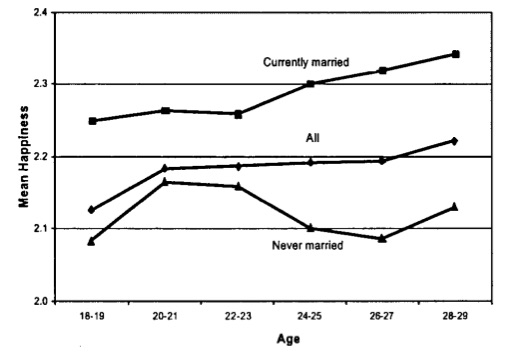
However, evidence from a 15 year longitudinal study of 24,000 people suggests that "marital transitions can be associated with long-lasting changes in satisfaction."  This would support the claim that marriage is causally related to happiness. It's not that you went from being a happy person who was once single to being a similarly happy person who is now married. What actually happened was that the marriage had an effect on just how happy you became.  And data from other large cohort studies show that happiness increases when people marry. Just look at the happiness of women by marital status in the figure below. Was Resh Lakish onto something?

Mean happiness of women by marital status, birth cohort of 1953-1972, from ages 18-19 and 28-29. From Easterlin, RA. Explaining Happiness. Proceedings of the National Academy of Sciences 2003. 100 (19): 11176-11183.

Mean happiness of women by marital status, birth cohort of 1953-1972, from ages 18-19 and 28-29. From Easterlin, RA. Explaining HappinessProceedings of the National Academy of Sciences 2003. 100 (19): 11176-11183.

All this supports the Resh Lakish Rule that people are happier when they are married. (I say people because all the evidence applies equally to men too.) But we can get even more specific, because Resh Lakish used the word ארמלא, which most likely means widowed (and hence has a secondary meaning of being alone). There is actually data that applies to this more specific Resh Lakish claim about widows, and it comes from The Roper Center at the University of Connecticut. 

From Economics and Happiness, ed Bruni L. Oxford University Press 2005.

From Economics and Happiness, ed Bruni L. Oxford University Press 2005.

As shown in the table, 62% of women who are widowed want to be happily married.  (Of course this also means that about 40% of widowed women would rather not be married -  even happily. That’s a huge proportion. Still, the overall finding still supports the Resh Lakish Rule.) The women's perspective is the most important perspective in this conversation, and when women (widows) were asked, most wanted to be married again. Widows indeed wish to live as two rather than live alone. I don't think this amounts to anything like an existential fact, as claimed by the Rav. But the evidence from the social sciences would certainly support the Resh Lakish Rule.

Print Friendly and PDF

Happy Pi Day 2016, and Happy Birthday Albert Einstein

WHAT IS PI DAY, AND WHEN IS IT CELEBRATED?

Today, March 14, is celebrated by many in the US as Pi Day.  Why? Well, in most of the world, the date is written as day/month/year. So in Israel, all of Europe, Australia, South America and China, today's date, March 14th, would be written as 14/3. 

But not here in the US. Here, we write the date as month/day/year; it's a uniquely American way of doing things. (Like apple pie. And guns.) So today's date is 3/14. Which just happen to be the first few digits of pi, the ratio of the circumference of a circle to its diameter.

And that's why each year, some (particularly geeky) Americans celebrate Pi Day on March 14 (3/14).  Last year, we noted, was Pi'ish than all others, since the entire date (when written the way we do in the US, 3/14/15) reflects five digits of pi, and not just the first three: 31415. Actually we got even more geeky: This day last year, at 9:26 and 53 seconds in the morning, the date and time, when written out, represented the first ten digits of Pi: 3141592653.

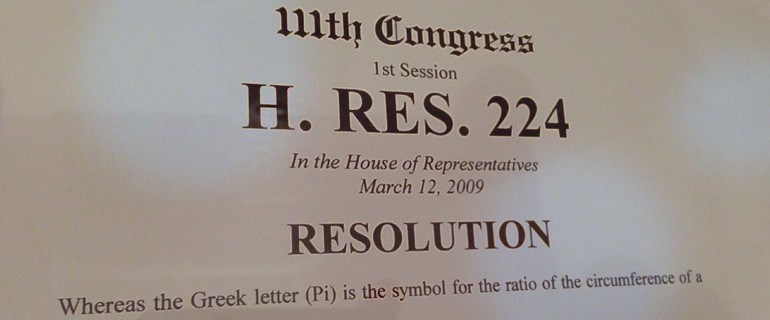
So that's why Pi Day is celebrated here in the US -  and probably not anywhere else. (It has even be recognized as such by a US Congressional Resolution. Really. I'm not making this up. And who says Congress doesn't get anything done?) 


PI IN THE BIBLE

In the ּBook of Kings (מלאכים א׳ 7:23) we read the following description of  a circular pool that was built by King Solomon. Read it carefully, then answer this question: What is the value of pi that the verse describes?

מלכים א פרק ז פסוק כג 

ויעש את הים מוצק עשר באמה משפתו עד שפתו עגל סביב וחמש באמה קומתו וקוה שלשים באמה יסב אתו סביב 

And he made a molten sea, ten amot from one brim to the other: it was round, and its height was five amot, and a circumference of thirty amot circled it.

Answer: The circumference was 30 amot and the diameter was 10 amot. Since pi is the ratio of the circumference of a circle to its diameter, pi in the Book of Kings is 30/10=3. Three - no more and no less.

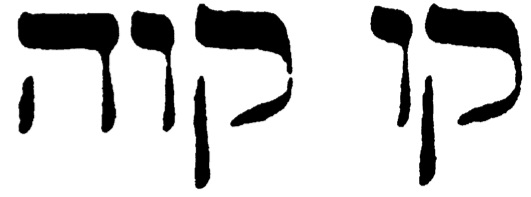
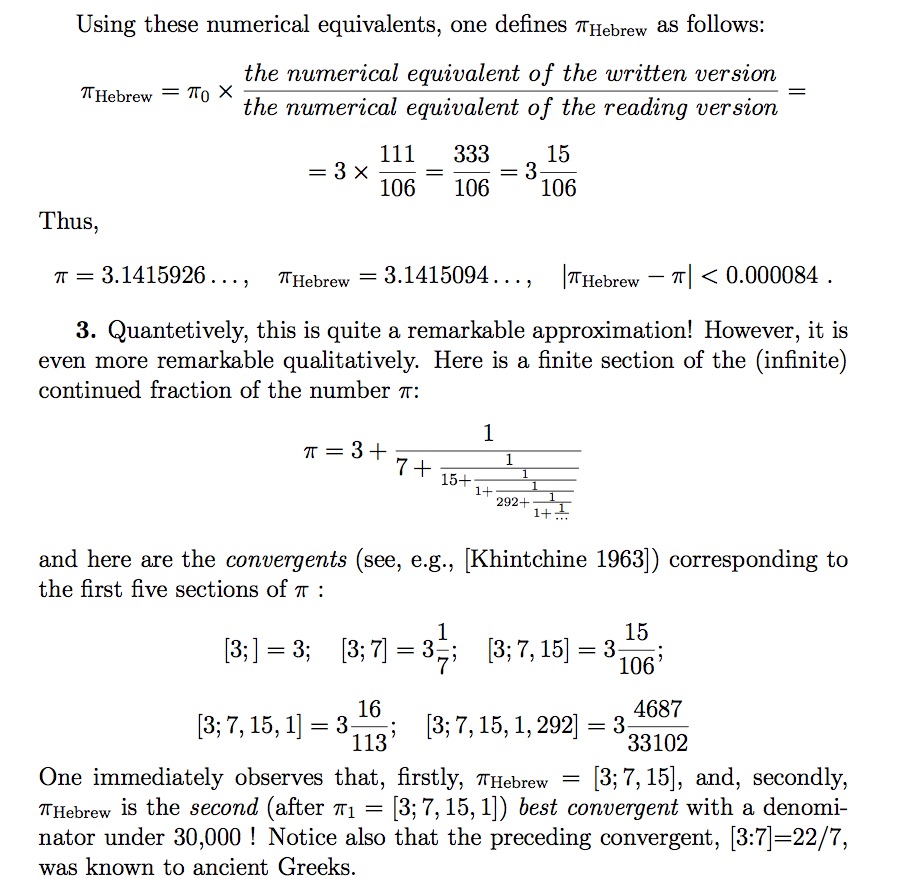
There are lots of papers on the value of pi in the the Bible. Many of them mention an observation that seems to have been incorrectly attributed to the Vilna Gaon.  The verse we cited from מלאכים א׳ spells the word for line as קוה, but it is pronounced as though it were written קו.  (In דברי הימים ב׳ (II Chronicles 4:2) the identical verse spells the word for line as קו.)  The ratio of the numerical value (gematria) of the written word (כתיב) to the pronounced word (קרי) is 111/106.  Let's have the French mathematician Shlomo Belga pick up the story - in his paper (first published in the 1991 Proceedings of the 17th Canadian Congress of History and Philosophy of Mathematics, and recently updated), he gets rather excited about the whole gematria thing:

A mathematician called Andrew Simoson also addresses this large tub that is described in מלאכים א׳ and is often called Solomon's Sea. He doesn't buy the gematria, and wrote about it in The College Mathematics Journal.

A natural question with respect to this method is, why add, divide, and multiply the letters of the words? Perhaps an even more basic question is, why all the mystery in the first place? Furthermore, H. W. Guggenheimer, in his Mathematical Reviews...seriously doubts that the use of letters as numerals predates Alexandrian times; or if such is the case, the chronicler did not know the key. Moreover, even if this remarkable approximation to pi is more than coincidence, this explanation does not resolve the obvious measurement discrepancy - the 30-cubit circumference and the 10-cubit diameter. Finally, Deakin points out that if the deity truly is at work in this phenomenon of scripture revealing an accurate approximation ofpi... God would most surely have selected 355/113...as representative of pi...

Still, what stuck Simoson was that "...the chroniclers somehow decided that the diameter and girth measurements of Solomon's Sea were sufficiently striking to include in their narrative." (If you'd like another paper to read on this subject, try this one, published in B'Or Ha'Torah - the journal of "Science, Art & Modern Life in the Light of the Torah." You're welcome.)

PI IN THE TALMUD

The Talmud echoes the biblical value of pi in many places. For example:

תלמוד בבלי מסכת עירובין דף יד עמוד א 

כל שיש בהיקפו שלשה טפחים יש בו רחב טפח. מנא הני מילי? - אמר רבי יוחנן, אמר קרא : ויעש את הים מוצק עשר באמה משפתו עד שפתו עגל סביב וחמש באמה קומתו וקו שלשים באמה יסב אתו סביב 

"Whatever circle has a circumference of three tefachim must have a diameter of one tefach."  The problem is that as we've already noted, this value of pi=3 is not accurate. It deviates from the true value of pi (3.1415...) by about 5%. Tosafot is bothered by this too.

תוספות, עירובין יד א

והאיכא משהו. משמע שהחשבון מצומצם וכן בפ"ק דב"ב (ד' יד:) גבי שני טפחים שנשתיירו בארון ששם ספר תורה מונח שהיא בהיקפה ששה טפחים ופריך כיון דלאמצעיתו נגלל נפיש ליה משני טפחים וכן בתר הכי דמשני בספר דעזרה לתחלתו נגלל ופריך אכתי תרי בתרי היכי יתיב משמע דמצומצם לגמרי וקשיא דאין החשבון מדוקדק לפי חכמי המדות

Tosafos can't find a good answer, and concludes "this is difficult, because the result [that pi=3] is not precise, as demonstrated by those who understand geometry." 

PI IN THE RAMBAM

In his commentary on the Mishnah (Eruvin 1:5) Maimonides makes the following observation:

פירוש המשנה לרמב"ם מסכת עירובין פרק א משנה ה 

צריך אתה לדעת שיחס קוטר העיגול להקפו בלתי ידוע, ואי אפשר לדבר עליו לעולם בדיוק, ואין זה חסרון ידיעה מצדנו כמו שחושבים הסכלים, אלא שדבר זה מצד טבעו בלתי נודע ואין במציאותו שיודע. אבל אפשר לשערו בקירוב, וכבר עשו מומחי המהנדסים בזה חבורים, כלומר לידיעת יחס הקוטר להקיפו בקירוב ואופני ההוכחה עליו. והקירוב שמשתמשים בו אנשי המדע הוא יחס אחד לשלשה ושביעית, שכל עיגול שקוטרו אמה אחת הרי יש בהקיפו שלש אמות ושביעית אמה בקירוב. וכיון שזה לא יושג לגמרי אלא בקירוב תפשו הם בחשבון גדול ואמרו כל שיש בהקיפו שלשה טפחים יש בו רוחב טפח, והסתפקו בזה בכל המדידות שהוצרכו להן בכל התורה.

...The ratio of the diameter to the circumference of a circle is not known and will never be known precisely. This is not due to a lack on our part (as some fools think), but this number [pi] cannot be known because of its nature, and it is not in our ability to ever know it precisely. But it may be approximated ...to three and one-seventh. So any circle with a diameter of one has a circumference of approximately three and one-seventh. But because this ratio is not precise and is only an approximation, they [the rabbis of the Mishnah and Talmud] used a more general value and said that any circle with a circumference of three has a diameter of one, and they used this value in all their Torah calculations.

So what are we to make of all this? Did the rabbis of the Talmud get pi wrong, or were they just approximating pi for ease of use?  After considering evidence from elsewhere in the Mishnah (Ohalot 12:6 - I'll spare you the details), Judah Landa, in his book Torah and Science, has this to say:

We can only conclude that the rabbis of the Mishnah and Talmud, who lived about 2,000 years ago, believed that the value of pi was truly three. They did not use three merely for simplicity’s sake, nor did they think of three as an approximation for pi. On the other hand, rabbis who lived much later, such as the Rambam and Tosafot (who lived about 900 years ago), seem to be acutely aware of the gross innacuracies that results from using three for pi. Mathematicians have known that pi is greater than three for thousands of years. Archimedes, who lived about 2,200 years ago, narrowed the value of pi down to between 3 10/70 and 3 10/71 ! (Judah Landa. Torah and Science. Ktav Publishing House 1991. p.23.)

HAPPY BIRTHDAY, EINSTEIN

Today, March 14, is not only Pi Day. It is also the anniversary of the birthday of Albert Einstein, who was born on March 14, 1879. As I've noted elsewhere, Einstein was a prolific writer; one recent book (almost 600 pages long) claims to contain “roughly 1,600” Einstein quotes. So it's hard to chose one pithy quote of his on which to close.  So here are two.  Happy Pi Day, and happy birthday, Albert Einstein.

As a human being, one has been endowed with just enough intelligence to be able to see clearly how utterly inadequate that intelligence is when confronted with what exists.
— Letter to Queen Elisabeth of Belgium, September 1932
One thing I have learned in a long life: That all our science, measured against reality, is primitive and childlike — and yet it is the most precious thing we have.
— Banesh Hoffman. Albert Einstein: Creator and Rebel. Plume 1973
Print Friendly and PDF

The Changing Institution of Marriage

Today the Daf Yomi cycle embarks on a study of the laws of marriage, as it begins the first page of Kiddushin.  As we have noted before, marriage in talmudic times had very little to do with love. And by very little I mean nothing. Within the tractate of Kiddushin, love, (or one of its conjugates) appears twenty-four times. Yet in only one instance is it in the context of spousal love - (and that is a quote from משלי 9:9). This was not a result of talmudic law, but rather a reflection of the institution of marriage across all cultures for about five thousand years.

A (REALLY BRIEF) HISTORY OF THE INSTITUTION OF MARRIAGE

The historian Stephanie Coontz noted that for most of history, marriage was not primarily about individual needs. Instead it was about "getting good in-laws and increasing ones's family labor force."  In ancient Roman society "something akin to marriage was essential for the survival of any commoner who was not a slave...A woman needed a man to do the plowing.  A man needed a woman to spin wool or flax, preserve food, weave blankets and grind grain, a hugely labor-intensive task." Marriage was essential to survive. So it comes as no surprise that historically, love in marriage was seen as a bonus, not as a necessity. In many societies (including that described in the Talmud), a woman's body was the property first of their fathers, and then of their husbands. A woman had to follow, as Confucious put it, the rule of three obediences: "while at home she obeys her father, after marriage she obeys her husband, after he dies she obeys her son." 

This pattern existed for centuries. Here's a rather graphic, but certainly not isolated example.  In the 1440s in England, Elizabeth Paston, the twenty-year old daughter of minor gentry, was told by her parents that she was to marry a man thirty years her senior. Oh, and he was disfigured by smallpox.  When she refused, she was beaten "once in the week, or twice and her head broken in two or three places." This persuasive technique worked, and reflected a theme in Great Britain, where Lord Chief Baron Matthew Hale declared in 1662 that "by the law of God, of nature or of reason and by the Common Law, the will of the wife is subject to the will of the husband." Things weren't any better in the New Colonies, as Ann Little points out (in a gloriously titled article "Shee would Bump his Mouldy Britch; Authority, Masculinity and the Harried Husbands of New Haven Colony 1638-1670.) The governor of the New Haven Colony was  found guilty of "not pressing ye rule upon his wife." 

It is with this historical perspective that the attitudes of the rabbis in Kiddushin (and in the Talmud in general) should be judged.  Marriage was an economic arrangement, and so it required economic regulation.  Here's just one example we have previously noted (and there are dozens): the Mishnah in Ketubot  ruled that a widow may sell her late husband's property in order to collect the money owed to her in the ketubah without obtaining the permission of the court.  This leniency was enacted, (according to Ulla) "משום חינה" - so that women will view men more favorably when they understand that the ketubah payment does not require the trouble of going to court. Consequently (and as Rashi explains) women will be more inclined to marry. Which leaves the reader to wonder just for whom this law was really enacted. 

...the older system of marrying for political and economic advantage remained the norm until the eigthteenth century, five thousand years after we first encountered it in the early kingdoms and empires of the Middle East.
— Stephanie Coontz. Marriage, a History. New York, Viking 2005. 123.

The Changing Face of Marriage

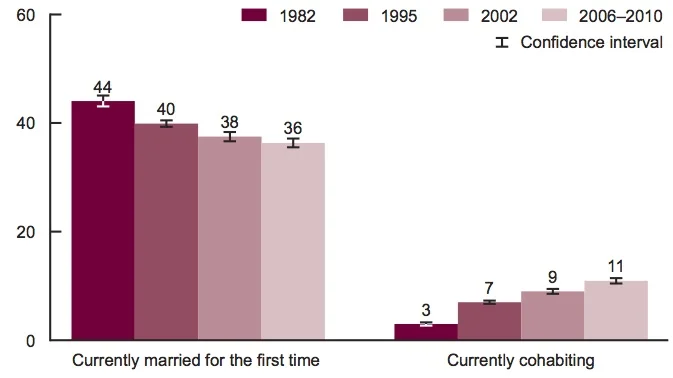
According to the US Census Bureau, married couples made up 70% of all households in the US in 1970. In 2012 they accounted for less than 50%. As the prevalence of married couple declined, that of cohabiting (ie. non-married couples) has increased. A CDC survey found that 48% of women interviewed in 2006-2010 cohabited as a first union, compared in only 34% in 1995. Of those who cohabit, about half of the unions result in marriage, and a third dissolve within five years.  

Current marital and cohabiting status among women under 44 years of age, United States: 1982, 1995, 2002, and 2006–2010. From Copen C. et al.  First Marriages in the United States: Data From the 2006–2010 National Survey of Family Growth. Natio…

Current marital and cohabiting status among women under 44 years of age, United States: 1982, 1995, 2002, and 2006–2010. From Copen C. et al.  First Marriages in the United States: Data From the 2006–2010 National Survey of Family Growth. National Health Statistics Report 49. March 2012.

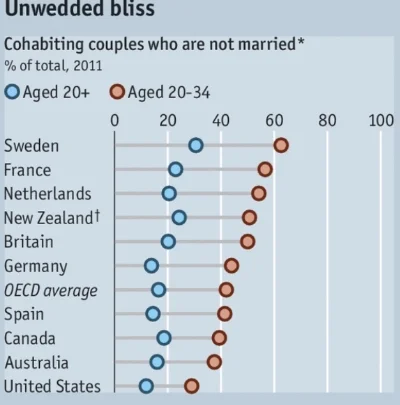
Not surprisingly, cohabiting partners are also increasing likely to be the site for childrearing.  In 2002 about 15% of children were born to cohabiting parents; by 2011 this had risen to over 25%. In January, a review in The Economist noted that the rate of children born to unmarried parents ("out of wedlock") averages 39% in western countries - a five-fold increase since 1970. 

Policymakers wish they could change the trend. Unmarried parents are more likely to split up. Their children learn less in school and are more likely to be unhealthy or behave badly. It is hard to say how much of this difference is due to marriage itself, however, because unmarried parents differ a great deal from married ones. They are poorer, less well-educated and more likely to be teenagers, for example. (The Economist, Love and Marriage, Jan 14, 2016)
From The Ecomonist, based on OECD data.

From The Ecomonist, based on OECD data.

The discussion of marriage in the Talmud revolves around its contractual arrangements. But for most Jews today, the concept of marriage revolves around love. Economics have nothing to do with it. Western society has changed its beliefs about the nature of marriage, and so have we.  Still not convinced? Then answer this. Did your parents marry for love or money? If you are married - did you marry for love or for economic advancement (and how did that work out)? If you are not married, but want to be, what is driving you? The search for the love of your life, or the search for physical security? And if you have children - or grandchildren, would you want them to marry because they loved their significant other, or because it would be a good way to unite two families and insure financial stability? If your answers were like mine, they were closer to contemporary secular values about marriage than they were to the models of marriages described in the Talmud. And that's probably a very good thing.

Print Friendly and PDF