Bava Kamma 39a ~ Injuries from Bullfighting

Let's Run with the Bulls
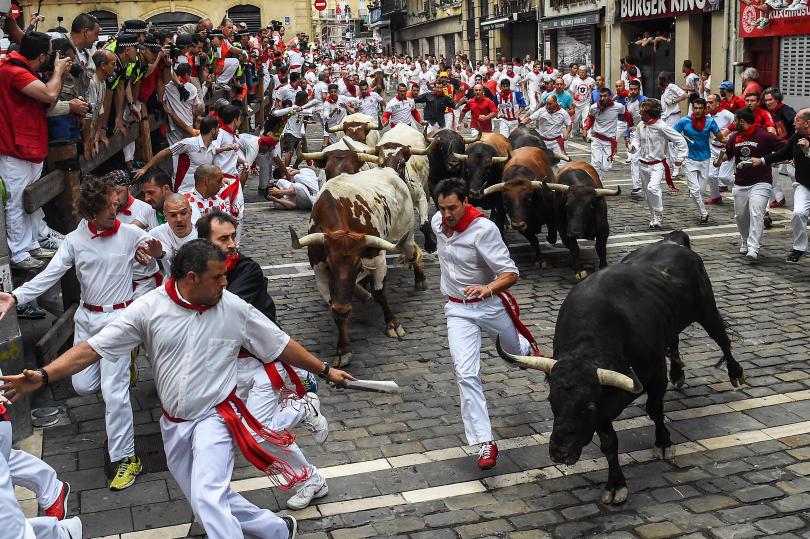
Don't try this at home.  In fact, don't try this anywhere.

Don't try this at home.  In fact, don't try this anywhere.

As I write these words, the annual Running of the Bulls is taking part in Pamplona, Spain. (According to NPR yesterday, the score was Bulls: 4, People: 0.  The bulls always win, and it's not over yet. There are another seven days of running to go.) Which is a glorious coincidence since we have reached a remarkable passage in the Talmud that addresses the legal liabilities of bulls whose job was to gore people. Here is that passage from a Mishnah which we read in today's Daf Yomi:

 בבא קמא לט, א 

שור האצטדין אינו חייב מיתה שנאמר כי יגח ולא שיגיחוהו

A bull of the arena [that killed a person] is not liable to the death penalty, for the verse states [Ex. 21:28] "If an ox gores" - which implies that an ox that is compelled to gore [is exempt]. (Bava Kamma 39a.)

According to Rashi, bulls were trained to fight against each other (שמיוחד לנגיחות ומלמדין אותו לכך). Tosafot takes it up a notch; back on page 24b Tosafot noted that the bulls were trained to fight people. (.לא דמי לשור האצטדין שהאדם נלחם עמו להורגו) In other words, we are describing a bullfight.

 A Jewish Bullfighter from the Upper West Side

Before we go further, let's frame this liability by watching a video. It is, I am fairly certain, the only video evidence of a lady Jewish bullfighter from New York's Upper West Side. Her name is Rachel Wolf, and her day job is to raise money for Shaare Zedek Hospital in Jerusalem. But here she is, in Peru in 2010, 'fighting' (kinda) a bull (kinda).  Note: No Jews, matadors, or animals were harmed in the making of this video. Listen our for the screams of "Yay Rachel" over the rather cheesy background music.

Now imagine if the still sizable horns on that little bull had met, not the matador's cape, but the matador. Or worse still, Rachel. According to the Mishnah, the bull would not be subject to any penalty, since it was bred to gore, and so did not really do so of its own volition. Which seems rather fair to me. (Sorry, Rachel.)  

Injuries from Bullfighting

Far from a theoretical ruling, the Mishnah addresses a real issue for those countries in which bullfighting is still a national pastime. (I'm talking about you, Spain. And Portugal. And you too, Mexico, Columbia, Ecuador, Venezuela and Peru.)  Not surprisingly, all countries in which bullfighting is practiced continue to see the nasty injuries that result. And I'm not talking about those of the bull. 
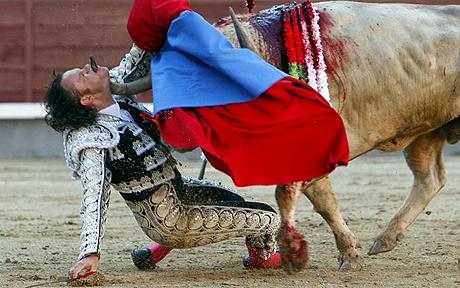
In May 2010 Julio Aparicio slipped while fighting this half-ton bull.  The horn of the animal tore into the bullfighter's throat and emerged through his mouth.  Aparicio underwent six hours of surgery; doctors performed an emergency t…

In May 2010 Julio Aparicio slipped while fighting this half-ton bull.  The horn of the animal tore into the bullfighter's throat and emerged through his mouth.  Aparicio underwent six hours of surgery; doctors performed an emergency tracheotomy and worked to reconstruct his throat, jaw, tongue and the roof of the mouth. But don't worry. He made a full recovery and returned to the bullfighting arena ten weeks after the goring.  

A considerable risk of serious, life-threatening injuries is inherent to bullfighting. Penetrating inguinal and perineal trauma with injury to the femoral vessels represents a specific, potentially fatal injury.
— Rudloff, U. Gonzalez, V. Fernandez, E. et al. Chirurgica Taurina: A 10-Year Experience of Bullfight Injuries. Journal of Trauma. 2006; 61: 970–974.

In 2005 a group of surgeons published an enticingly titled paper: Chirurgica Taurina: A 10-Year Experience of Bullfight Injuriesbased on data collected from the Plaza de Toros Nuevo Progreso, the second-largest bullfighting arena in Mexico. 

Over the ten year study period, 2,328 bullfights  were included. Seven hundred and fifty bull- fighters were identified, of which 68 -that's 9% - required emergency medical care by the surgical trauma service Not surprisingly, the most common site of injury was the lower extremity (55 of 99 injuries), followed by the upper extremity, the groin, the perineum, and the abdomen. And there were some really nasty injuries. "Of the seven perineal injuries" wrote the authors, 

all involved the scrotum with varying degrees of scrotal hematoma and avulsion of the scrotal skin leaving the testicle bare in one case. There was one case of rectal perforation requiring a diverting colostomy. Of the five abdominal injuries, two breached the peritoneum causing bleeding from the small bowel mesentery in one case, and prolapse of the omentum in the other. In two other cases the bullfighters had separate wounds of entry and exit caused by the horn which had passed tangentially through the layers of the abdominal wall...

Another paper, Bullhorn and Bullfighting Injuries, reported on fifteen bullfighting injuries. Here they are:
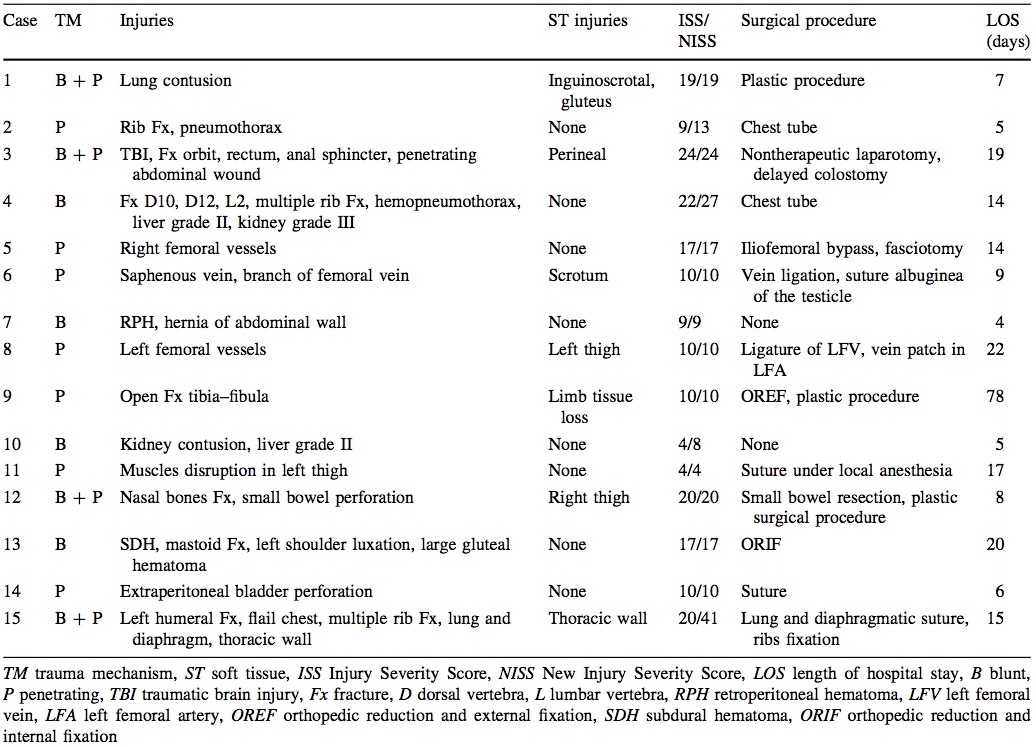
 From Garcia-Marin, A. Turegano-Fuentes, F.  Sanchez-Artega A et al.  Bullhorn and Bullfighting Injuries.  Eur J Trauma Emerg Surg (2014) 40:687–691. 

 From Garcia-Marin, A. Turegano-Fuentes, F.  Sanchez-Artega A et al.  Bullhorn and Bullfighting Injuries.  Eur J Trauma Emerg Surg (2014) 40:687–691. 

A Jewish Bullfighter from the Fifteenth Century

The fact that the Mishnah addresses the liability of a bull that injures or kills in the arena suggests that Jews were indeed involved in the business of bullfighting. But through the centuries this Jewish involvement seems to have been rare.  Evidence for this is found in a manuscript in the British Museum. It was written sometime in the fifteenth century, and it parodies a bullfight in which Jews appear as both spectators and participants.  In a paper analyzing the parody, Elena Lourie notes that the point of the poem was

clearly to ridicule the Jews and their cowardice when confronted by a brave and ferocious bull...Although fourteenth and early fifteenth-century records reveal the presence of three or four Jewish lion tamers in Saragossa and Pamplona, entrusted with the keeping of the king's lions...there can be no doubt that they were oddities and that the very notion of Jews engaged in bullfighting went against the canon of what was considered proper and was intended to strike the reader as a thing, in itself, ridiculous and grotesque.

...And one from the Twentieth Century

Aside from Rachel, I know of only one other Jew who entered the arena - the professional matador Sidney Franklin (1903-1976). Franklin, who wrote an autobiography Bullfighter from Brooklynleft New York (and his orthodox Jewish upbringing) in 1922, and moved to Mexico City, where he started his career as a professional bullfighter.  Ernest Hemingway was rather impressed with the Jewish matador from Brooklyn; he wrote a chapter about Franklin in Death in the Afternoon, and included pictures of Franklin at work in the arena. Let's end with Hemingway's description of Franklin at work:

Franklin is brave with a cold, serene and intelligent valor but instead of being awkward and ignorant he is one of the most skillful, graceful and slow manipulators of a cape fighting today. His repertoire with the cape is enormous but he does not attempt by a varied repertoire to escape from the performance of the veronica as the base of his cape work and his veronicas are classical, very emotional, and beautifully timed and executed. You will find no Spaniard who ever saw him fight who will deny his artistry and excellence with the cape...He is a better, more scientific, more intelligent, and more finished matador than all but about six of the full matadors in Spain today and the bullfighters know it and have the utmost respect for him.

שוורים שמשחקין בהן ומלמדין אותן ליגח זה את זה אינם מועדים זה לזה. ואפילו המיתו את האדם אינן חייבין מיתה שנאמר כי יגח לא שיגיחוהו
Bulls that are taught to gore one another and that are used in tournaments are not considered to be ‘warned.’ Even if such a bull kills a person it is not liable to the death penalty...
— רמב"ם משנה תורה הל׳ נזיקי ממון פרק ו ,ה

Next time on Talmudology: Injuries from Cows.

Print Friendly and PDF

Bava Kamma 35a ~ Analgesia for Animals

בבא קמא לה, א

ההוא תורא דהוה בי רב פפא דהוה כיבין ליה חינכיה עייל ופתקיה לנזייתא ושתי שיכרא ואיתסי

There was an ox in the house of Rav Pappa that had a toothache. It went inside, pushed the cover off a beer barrel, drank the beer, and was healed.

Descartes on Animal Pain

The silly notion that animals do not feel pain is widely thought to have originated with the French philosopher Rene Descartes (1596-1650). "They eat without pleasure, cry without pain, grow without knowing it; they desire nothing, fear nothing, know nothing". While these words were those a student of Descartes, the contemporary philosopher Peter Harrison notes that they are generally thought to capture the essence of Descartes' view of animals. "The father of modern philosophy" continues Harrison, "is credited with the opinion that animals are non-sentient automata, an opinion for which over the centuries he has been ridiculed and vilified."

To be able to believe that a dog with a broken paw is not really in pain when it whimpers is a quite extraordinary achievement, even for a philosopher.
— John Cottingham. "A Brute to the Brutes?' Descartes's Treatment of Animals. Philosophy 1978; 53; 551-559.

Scientists Ignoring Animal Pain

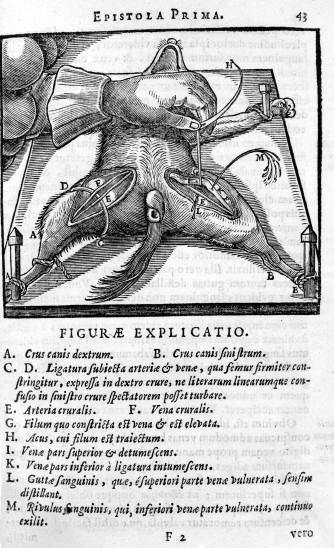
Vivisection of a dog. From J. Walaeus. Epistola Prima de Motu Chyli et Sanguinis (1647).

Vivisection of a dog. From J. Walaeus. Epistola Prima de Motu Chyli et Sanguinis (1647).

The debate as to Descartes' true view is fascinating, but need not detain us. What is certain is that the pain that animals undoubtedly feel was either denied as existing, or overlooked for centuries by scientists.  Animals were used for experiments of the most horrendous kind in the names of science, even when the pain was evident to those who were causing it. Here, for example, is the French physiologist Claude Bernard (d. 1878), who felt that without vivisection, 'neither physiology not scientific medicine is possible': 

A physiologist is not a man of fashion, he is a man of science, absorbed by the scientific idea where he pursues: he no-longer hears the cry of animals, he no-longer sees the blood that flows, he sees only his idea...no anatomist feels himself in a horrible slaughter house; under the influence of a scientific idea, he delightfully follows a nervous filament through stinking livid flesh, which to any other man would be an object of disgust and slaughter.

It is sometimes said that people in the seventeenth century had no motion of cruelty to animals and Descartes even argued that animals are mere machines, incapable of feeling pain. It is also said there was so much cruel treatment of one human being by another in the seventeenth century that what was done by the vivisectionists to animals would scarcely have seemed horrendous.
— David Wootton. Bad Medicine. Oxford University Press 2006. 108-109.

Do Fish Feel Pain? - Yes!

The tropical Zebrafish grow to about 2.5 inches in length.  And they don't like pain.

The tropical Zebrafish grow to about 2.5 inches in length.  And they don't like pain.

Rav Pappa's ox sought out pain relief from beer, but recent evidence has shown that it's not just oxen who like to have their pain relieved.  So do fish.  In a paper in the The Journal of Consciousness Studies, Lynn Sneddon demonstrated that not only can fish feel pain, but that they are willing to pay a cost to get pain relief. Zebrafish, like humans, prefer an interesting environment to a boring one. When given a choice, these fish swim in an enriched tank with vegetation and objects to explore, rather than in one that is bare. With me so far? OK. Next, Sneddon, from the University of Liverpool in the UK, injected the tails of the zebrafish with acetic acid, which no doubt annoyed them, but did not cause any change in their preference for the interesting tank over the one that was bare.  Finally, she injected the fish with acetic acid, but added a painkiller into the water of the bare tank. This time, the fish chose to swim into the bare but drug filled tank. Fish who were injected with saline as a control remained in the enriched tank and did not swim into the drug enhanced bare tank.  The conclusion: zebrafish are willing to pay a cost in return for getting relief from their pain. Similar observations have been made in rodents too; when in pain, they will self administer analgesics, preferring to drink analgesic dosed water or eat dosed food when presented with a choice. 

Defining Animal Pain

In the scientific world there was  - and perhaps still is -  a debate about the nature of pain that animals may feel.  Sneddon, the fish physiologist, wrote that if we are to conclude that animals experience pain in a way similar to humans, then (1) "animals should have the apparatus to detect and process pain; (2) pain should result in adverse changes in behavior and physiology; and (3) analgesics (painkillers) should reduce these responses..." Thanks to advances in microscopy and physiology, today we know that animals have many of the anatomical features (like nerves that transmit the pain stimulus) needed to process pain.  

The Ox of the House of Rav Pappa

Rav Pappa's ox demonstrated the second and third of Sneddon's features: pain changed the behavior of the ox (off it trotted to find pain relief ), and analgesia, (in this case beer) indeed reduced the pain response.  Of course we are left wondering how it was known that the ox of the house of Rav Pappa specifically had a toothache, (and not say sinusitis or a bad migraine), but based on what we know about the ways in which fish and rodents will seek out an environment in which painkillers are available, the story is no where near as fanciful as we might suspect.  

קיצור שולחן ערוך - קצא

אָסוּר מִן הַתּוֹרָה לְצַעֵר כָּל בַּעַל חָי. וְאַדְּרַבָּא, חַיָב לְהַצִּיל כָּל בַּעַל-חַי מִצַּעַר 

It is forbidden to cause pain to any living creature. In fact a person is required to save any living creature from pain...(Abbreviated Code of Jewish Law by Shlomo Ganzfreid, 1864).


Print Friendly and PDF

Bava Kamma 32a ~ Liability for Intimate Injuries

בבא קמא לב,א

בעא מיניה רבה בר נתן מרב הונא המזיק את אשתו בתשמיש המטה מהו כיון דברשות קעביד פטור או דלמא איבעי ליה לעיוני

Rabbah bar Nassan asked Rav Huna this question: If a man injured his wife during sexual intercourse, what is the law regarding his liability? Do we say that since he is acting with permission of his wife, he is not liable? Or perhaps we say that he should have been more careful to avoid injuring his wife, and therefore he is liable to pay her damages? (Bava Kama 32a)

In the daf we will learn tomorrow, the Talmud records a series of legal precedents to help decide this perplexing question, and concludes that a wife does not have any legal culpability in causing her injury, however active or passive she may have been. Therefore, the husband is legally deemed responsible for damages and must compensate his wife, which is codified in the authoritative Code of Jewish Law (שולחן ערוך אבן העזר סימן פג ,ב).

Intimate Injures in the Medical Literature

The Talmud’s case discussion is not simply theoretical. Injuries during consensual sexual intercourse are not uncommon, and over the years I’ve treated several in the emergency department. Because of sexual taboos however, the amount of scientific knowledge in this area has been very limited, particularly regarding the female. In one (very small) study, about 5% of women reported an injury after consensual intercourse, compared with 41% of the woman who were forced to have non-consensual intercourse.

A more recent study from the University of Manchester in England evaluated genital injuries in a cohort of 68 women who had recently had consensual penile-vaginal intercourse, and compared them with a group of 500 women who had been victims of non-consensual penile-vaginal intercourse. Of the 68 women, one (1%) had a single injury, and three (4%) had more than one injury.  One woman had a laceration, another had an abrasion, and a third had bruising.  The posterior fourchette was the most commonly injured area both in women who had consensual intercourse and those in whom intercourse was not consensual. 

Another study, from emergency medicine researchers, looked at the rates of genital injury in adolescents (aged 13-17) who had either consensual (51 women) or non-consensual (204 women) sexual intercourse. They found rates far higher than the Manchester study: anogenital trauma was documented in 73% of adolescent females after consensual sexual intercourse (versus 85% of victims of sexual assault). The researchers helpfully add that several predisposing factors have been suggested: “first coitus, rough or hurried coitus, intoxication, variant coital positions, anatomical disproportion, mental factors (fear of discovery), postmenstrual state, and clumsiness.” (Really. Clumsiness.)

Men Too

Rabbah bar Nassan’s legal question concerned only the husband causing damage to his wife, and does not address another kind of coital injury: that caused of husband.  One of these injuries is a penile fracture, and over the last six decades about 1,330 cases have been reported in 183 medical publications. I’ve treated these too. But don’t worry: they are a lot worse than they already sound. Sexual intercourse is the most common cause, and inexplicably, “more than half of the [reported] cases are from Mediterranean countries including Turkey.” Here, for example, is a case in the Asian Journal of Urology published last June:

A 54-year-old male presented to the emergency department with penile injury. The trauma occurred when the patient was having sexual intercourse with his wife at around 2 o’clock in the early morning. His wife kneeled forward and he penetrated from behind. The patient then accidentally collided his penis into his wife’s buttocks. He felt a popping sensation and reported rapid detumescence followed by severe penile pain and hematoma formation.

And here are the causes and complications of a fracture of the penis in 32 unhappy men treated in the Department of Urology in Tehran.

Asgari, MA. Hosseini, SY. Safarinejad, MR. et al. Penile  Fractures: Evaluation, therapeutic approaches and long-term results. The Journal of Urology 1995: 155; 148-149. 

Asgari, MA. Hosseini, SY. Safarinejad, MR. et al. Penile  Fractures: Evaluation, therapeutic approaches and long-term results. The Journal of Urology 1995: 155; 148-149. 

Rabbah bar Nassan asked only about the rights of a wife to claim compensation for intimate injuries from her husband. But he might well have asked the question about compensation for the husband. In this age of equality, it seems only fair.

שולחן ערוך אבן העזר הלכות כתובות סימן פג סעיף ב 

המזיק את אשתו בתשמיש המטה, חייב בנזקיה 

Print Friendly and PDF

Bava Kamma 24b ~ Dogs, Bites and Liabilities

בבא קמא כד, ב

ת"ש שיסה בו את הכלב ... פטור מאי לאו פטור משסה וחייב בעל כלב? לא אימא פטור אף משסה אמר רבא אם תמצי לומר המשסה כלבו של חבירו בחבירו חייב שיסהו הוא בעצמו פטור מאי טעמא כל המשנה ובא אחר ושינה בו פטור

Come an hear [a proof from a Mishnah in Sanhedrin]:

If one incited a dog [against another person]...he is not liable. Who is "not liable"? Does this mean that the inciter is not liable, but that the dog's owner is liable? No. Say that this Mishnah means that even the one who incites is not liable. Rava said the following: Even if you conclude that when a person incites a dog against his fellow, [that the owner is liable], if the victim incited the dog against himself, [and brought the attack upon himself, then in this case the dog's owner] is also not liable. What is the reason for Rava's ruling? Because whenever a person acts in an irregular way, and another person comes along and acts in an irregular way against him, [the second party] is not liable.

JEWS AND DOGS

From this passage in today's daf yomi, we learn a couple of things about dogs in the period of the Mishnah. First, we learn that Jews, or those who interacted with Jews, kept them. And second, that some of them were very bad dogs.  

Jews and dogs don't traditionally get along. Later in our tractate, (Bava Kamma 83a,) Rabbi Eliezer does not mince his words: 


רבי אליעזר הגדול אומר: המגדל כלבים כמגדל חזירים .למאי נפקא מינה? למיקם עליה בארור

Rabbi Eliezer the Great said: Someone who breeds dogs is like someone who breeds pigs. What is the practical outcome of this comparison? To teach that those who breed dogs are cursed...

The American Veterinary Medical Association estimates that in the US there are about 43 million households that own almost 70 million dogs; that means over one-third of the households in the US own a dog.  (Fun Fact: Cats are owned by fewer households in the US, but are more often owned in twos or more. That means that there are more household cats - some 74 million - than there are dogs.) In the UK, a 2007 study estimated that 31% of all households owned a dog. In Israel, over 10% of all families own a dog

BAD DOGS

Most dogs are wonderful pets, but a few are really bad. In a 10 year period from 2000-2009, one paper identified 256 dog-bite related fatalities in the US. Of course that's a tiny number compared to the overall number of dogs owned, but that's still 256 too many; the tragedy is compounded when you read that over half the victims were less than ten years old

Partaken, GJ. et al. Co-occurrence of potentially preventable factors in 256 dog bite–related fatalities in the United States (2000–2009). Journal of the American Veterinary Medical Association 2013. 243:12: 1726-1736.

Partaken, GJ. et al. Co-occurrence of potentially preventable factors in 256 dog bite–related fatalities in the United States (2000–2009). Journal of the American Veterinary Medical Association 2013. 243:12: 1726-1736.

Az a yid hot a hunt, iz oder der hunt keyn hunt nit, oder der yid iz keyn yid nit

If a Jew has a dog, either the dog is no dog, or the Jew is no Jew
— — Sholem Aleichem. Rabtshik. Mayses far Yidishe Kinder. Ale Verk. Warsaw 1903

Although fatalities from dog bites are rare, dog bites are not. Over my career as an emergency physician I must have treated hundreds of patients with dog bites. And my experience is pretty typical. One recent study estimated that more than half the population in the US will be bitten by an animal at some time, and that dogs are responsible for 80-90% of these injuries. 

GOOD DOGS

Although Jews are thought not to have a historical affinity for dogs, one theologian has reassessed the evidence. In his 2008 paper Attitudes toward Dogs in Ancient Israel: A Reassessment, Geoffrey Miller  suggests that in fact dogs were not shunned in Israelite society. He notes that the remains of over a thousand dogs were discovered in a dog cemetery near Ashkelon dating from about the 5th century BC. It was described as "by far the largest animal cemetery known in the ancient world" by Lawrence Stager who also pointed out that during this period, Ashkelon was a Phoenician city - not a Jewish one. Miller surveys several mentions of dogs in the Bible and the Book of Tobit, and concludes that at least some Israelites "valued dogs and did not view them as vile, contemptible creatures." Joshua Schwartz from Bar-Ilan University surveyed Dogs in Jewish Society in the Second Temple Period and in the Time of the Mishnah and Talmud (a study that marked "...the culmination of several years of study of the subject of dogs...").  He found that while "most of the Jewish sources from the Second Temple period and the time of the Mishnah and Talmud continue to maintain the negative attitude toward dogs expressed in the Biblical tradition" there were some important exceptions. There were sheep dogs (Gen. Rabbah 73:11) and hunting dogs (Josephus, Antiquities 4.206) and guard dogs (Pesahim 113a), and yes, even pet dogs (Tobit, 6:2), though Schwartz concedes that "it is improbable that dogs in Jewish society were the objects of the same degree of affection as they received in the Graeco-Roman world or the Persian world."

A certain person invited a sage to his home, and [the householder] sat his dog next to him. [The sage] asked him, ‘How did I merit this insult?’ [The house-holder] responded, ‘My master, I am repaying him for his goodness. Kidnappers came to the town, one of them came and wanted to take my wife, and the dog ate his testicles.
— PT Terumot 8:7

Liability for Dog Bites in the US

In contrast to the talmudic rule requiring three occurrences of goring or biting before an animal is considered "forewarned" and so liable to pay full damages, many states have a "one bite and you're out rule". But New York, for example has a law that has aspects of the talmudic category of mu'ad, at least according to this opinion:

New York Agriculture & Markets Code section 123 (part of the Laws of New York) addresses a dog owner's potential civil liability when the owner's dog injures another person. The statute covers both injuries caused by bites and non-bite injuries, like those suffered when a dog knocks a person to the ground. The statute states that the owner of a "dangerous dog" is liable if the dog causes injuries to another person, to livestock, or to another person's companion animal, like a disability service dog.

The statute defines a "dangerous dog" as one that:

 - attacks and either injures or kills a person, farm animal, or pet without justification, or

 - behaves in a way that causes a reasonable person to believe that the dog poses a "serious and unjustified imminent threat of serious physical injury or death."

However, the statute specifically states that a law enforcement dog carrying out its duties cannot be considered a "dangerous dog." 

Under New York's "dangerous dog" statute, a dog owner is "strictly liable" for all medical bills resulting from injuries caused by a "dangerous dog." This means that if the dog is found to be dangerous, the dog's owner must pay the injured person's medical bills (or bills for the treatment of injuries to livestock or pets) even if the dog's owner had taken reasonable precautions to control or restrain the dog. For other types of damages resulting from a dog bite or dog-related injury, the injured person must usually prove that the dog's owner was negligent. In other words, the injured person must show that the dog's owner failed to use reasonable care to prevent the injuries from occurring (failed to take reasonable steps to control or restrain the animal, in other words). For example, suppose that a dog slips out of its own yard, breaks down the neighbor's fence, and enters the neighbor's yard, where it bites the neighbor. While the injured neighbor may be able to recover the costs of medical care under New York's strict liability rule, the neighbor cannot recover the costs of replacing the broken fence unless the neighbor can show that the dog's owner failed to take reasonable steps to keep the dog in its own yard. 

The legal category of mu'ad - an animal (or more precisely here, a dog) that was forewarned as being a danger is clearly noted in New York Agriculture & Markets Code section 123. The law allows  charges to be filed if:
 - the dog was previously declared to be a "dangerous dog"
 - the owner negligently allows the dog to bite someone, and the injury suffered is a "serious injury."

If a "dangerous dog" overcomes an owner's attempts to restrain it and kills a person, the owner may also be charged with a misdemeanor. Any owner who faces a criminal charge relating to a dog bite might also face civil liability if the injured person decides to sue in civil court.

Here's how the lawyer Mary Randal explains the factors that courts take into account when deciding if a dog owner is liable for the damages of a pet. See how many times there is an echo to the talmudic concept of mu'ad:

Previous bites. This one is pretty easy. If a dog bites once, the owner will forevermore be on notice that the dog is dangerous. But even this is not as straightforward as it may appear; for example, at least one court has ruled that if a puppy nips someone, its owners are not necessarily on notice that the dog is dangerous. (Tessiero v. Conrad, 588 N.Y.S.2d 200 (App. Div. 1992).)

Barking at strangers. If a dog, usually kept in the house or a fenced yard, barks at strangers but has never threatened a person, its owners will probably not be liable if it bites someone. (See, for example, Slack v. Villari, 476 A.2d 227, cert. denied, 482 A.2d 502 (Md. 1984) and Collier v. Zambito, 1 N.Y.3d 444 (2004).)

Threatening people. A dog that often growls and snaps at people who come near it when out in public, but hasn't ever actually bitten someone, is a different case entirely. The dog's actions should put its owner on notice that the dog might bite someone. If the dog does bite, the owner will be liable. (See, for example, Fontecchio v. Esposito, 485 N.Y.S.2d 113 (1985).)

Jumping on people. The owner of a friendly, playful, and large dog, which is in the habit of jumping on house guests, will be liable if the exuberant dog knocks over a friend who comes to the door one day. The owner knew that the dog behaved this way and might injure someone because of its size.

Frightening people. If a dog likes to run along the fence that separates his yard from the sidewalk barking furiously, or chases pedestrians or bicyclists, the owner may be liable if the dog causes an injury. At least one court, however, has ruled that an owner wasn't responsible for foreseeing that a barking dog could frighten someone so much she would run into the street. (Nava v. McMillan, 123 Cal. App. 3d 262 (1981).)

Fighting with other dogs. If a dog that is gentle with people has a history of fights with other dogs, that's probably not enough to put the owner on notice that the dog might bite a person. Courts usually recognize that canine society has its own rules, and the way a dog behaves under them isn't a reliable predictor of how it will act toward humans. (As one court put it, the “question was the dog's propensity to attack a human. The canine code duello is something else. That involves the question of what constitutes a just cause for battle in the dog world, or what justifies a resort to arms, or rather to teeth, for redress.” (Fowler v. Helck, 278 Ky. 361 (1939).)

Fight training. If a dog has been trained to fight, a court will almost certainly conclude that the owner should have known that the dog is dangerous. (This conclusion is disputed by some people experienced with dogs used for fighting, who maintain that there is no connection between a dog's drive to fight other dogs and its aggression toward people. However, a dog that has been agitated and abused when used for fighting may be dangerous.)

Complaints about the dog. If neighbors or others complain to the owner that a dog has threatened or bitten someone, the owner would certainly be on notice that the dog is dangerous. But in one Alabama case, where a dog's owner had been scolded by a neighbor for having a dog that was a "nuisance," the court ruled that the owner did not have any knowledge that his dog was dangerous. (Rucker v. Goldstein, 497 So. 2d 491 (Ala. 1986).)

The dog's breed. Generally, courts don't consider dogs of certain breeds to be inherently dangerous. So if you have a German shepherd, a court probably won't conclude that you should have known, just because of the dog's breed, that it might injure someone. (See, for example, Roupp v. Conrad, 287 A.D.2d 937, 731 N.Y.S.2d 545 (2001).) But in some places, pit bulls and a few other breeds have been defined by law as dangerous dogs.

VERY GOOD DOGS

Whatever your feeling about dogs, lets's be sure to remember that they serve alongside soldiers in the IDF, where they save lives. In 1969, Motta Gur (yes, the same Mordechai "Motta" Gur who commanded the unit that liberated the Temple Mount in the Six Day War, and who uttered those immortal words "The Temple Mount is in our hands!" הר הבית בידינו‎,) wrote what was to become a series of children's books called Azit, the Canine Paratrooper (later turned into a popular feature film with the same title. And now available on Netflix. (Really. It is available on Netflix.)  But IDF dogs don't just feature in fiction. They are a fact, and an amazing addition to the IDF, where they make up the Oketz unit.  Here's a news report (in Hebrew) about the amazing work these dogs - and their handlers- perform. These are very good dogs indeed.

Print Friendly and PDF