Bava Basra 167a ~ Torture & coerced testimony

In tomorrow's page of Talmud we read of three incidents in which torture (or according to some, the threat of torture) was used to obtain a confession of a crime. In the first two, Abaye suspected that bills of sale had been forged. "כפתיה ואודי" - Abaye  bound the suspects to a post, and they confessed. In the third case it was Rava who suspected that his own signature and that of the elderly Rav Acha bar Adda had been forged. Rava too, bound the suspect to a post, after which not only did the suspect confess to forging both signatures, but he went on to explain how he had forged that of the elderly Rav Acha, whose hands had a tremor. 

 אנחי ידאי אמצרא ואמרי לה קם אזרנוקא וכתב

I placed my hands on the rope of a bridge while signing. Others say he stood on a skin bottle and signed.

Other cases of coerced Confessions

We first encountered coerced confessions when we studied Bava Metzia. There, we read that Mar Zutra The Pious had coerced a student to confess to his crime.

בבא מציא כד, א

מר זוטרא חסידא אגניב ליה כסא דכספא מאושפיזא חזיא לההוא בר בי רב דמשי ידיה ונגיב בגלימא דחבריה אמר היינו האי דלא איכפת ליה אממונא דחבריה כפתיה ואודי

Mar Zutra the Pious was involved in an incident in which a silver cup was stolen from his host. Later, Mar Zutra saw a certain student wash his hands and dry them on his friend's garment. Mar Zutra said: "this is the one who stole the cup, for he has no consideration for his friend's property. Mar Zutra bound the student to a post and coerced him, and he confessed to the crime (Bava Metzia 24a).

For completeness, we should note that there is a fourth passage in the Talmud (Niddah 25b) that also uses the language of כפתיה ואודי.  In that passage, a man was accused on having intercourse with his wife when she was ritually impure. He too was bound and confessed, though it is not clear who was ordering the binding.

He was bound and he confessed
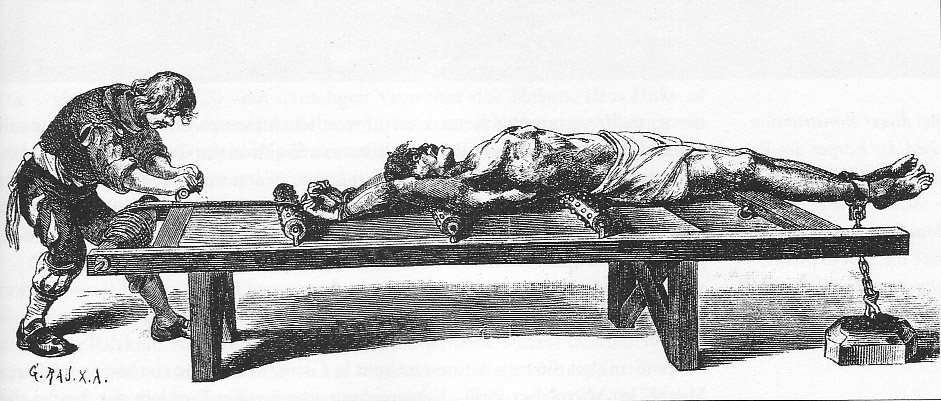
Courtesy of Wikimedia.

Courtesy of Wikimedia.

The phrase that is used in all four cases is כפתיה ואודי "they bound him and he confessed." The root of the word to bind is כפת, which is used in rabbinic literature to mean to tie or to bind. Rabbi Asher ben Yechiel (Germany ~1250-1327), known as the Rosh, is certain that the suspect was tortured. In his commentary on the passage in Bava Metzia, he wrote וכפתיה בשוטי עד דאודי "he flogged him with rods until he confessed." (As in חושך שבטו שונא בנו ואהבו שחרו מוסר "spare the rod and spoil the child," from Proverbs 13:24.) Rabbi Betzalel ben Avraham Ashkenazi (Israel ~1520-1594) in his commentary to Bava Metzia called Shitah Mekubetzet agrees that coercion was used, although he is unsure if it was physical or psychological:

כפתוהו ואודי. יש מפרשים כפתוהו על העמוד והלקוהו בשוטים. ויש מפרשים כפתיה בדברים שנדוהו אם לא יודה האמת

Some explain that he was tied to post and flogged. Others explain that he was verbally coerced (and threatened with excommunication) until he confessed.

False Confessions

In a 2010 paper published in the Stanford Law Review, Brandon Garett notes that DNA testing has now exonerated over forty people who falsely confessed to rapes and murders. He wonders how an innocent person could convincingly confess to a crime he never committed. For example, in 1990  Jeffrey Deskovic a seventeen-year-old, was convicted of rape and murder. Deskovic was a classmate of the fifteen-year-old victim, had attended her wake, and was eager to help solve the crime. During one of several police interrogations he “supposedly drew an accurate diagram,” which depicted details concerning “three discrete crime scenes” which were not ever made public. "In his last statement, which ended with him in a fetal position and crying uncontrollably," wrote Garrett, "he reportedly told police that he had “hit her in the back of the head with a Gatoraid [sic] bottle that was lying on the path.” Police testified that, after hearing this, the next day they conducted a careful search and found a Gatorade bottle cap at the crime scene."

Scholars increasingly study the psychological techniques that can cause people to falsely confess and have documented how such techniques were used in instances of known false confessions.
— Garrett, B.L. The Substance of False Confessions. Stanford Law Review 2010. 62 (4): 1051-1119.

Deskovic was convicted of rape and murder and served more than fifteen years of a sentence of fifteen years to life. Then in 2006, new DNA testing not only excluded him, but also matched the profile of a murder convict who subsequently confessed and pleaded guilty. So how did Deskovic know all the details of the crime to which he confessed? Here is what the District Attorney noted in the post-exoneration inquiry:

...Given Deskovic’s innocence, two scenarios are possible: either the police (deliberately or inadvertently) communicated this information directly to Deskovic or their questioning at the high school and elsewhere caused this supposedly secret information to be widely known throughout the community.

Another paper, this time in the North Carolina Law Review, analyzed 125 cases of "proved interrogation-induced false confessions, which, the authors note with some pride, is "the largest cohort of interrogation-induces false confession cases ever identified and studied in the literature." It makes terrifying reading.  

It is of course really hard to study in the laboratory the psychological effects of torture and coercion and how they produce false confessions.  But scientists try anyway. For example, a very recent paper from a team from the New School for Sociological Research in New York and the University of California studied the effect of sleep deprivation on false confessions.  When compared to those who had rested, participants were over four times more likely to sign a false statement if they were deprived of one night's sleep.  In another recent peer-reviewed paper, (Constructing Rich False Memories of Committing Crime) psychologists used suggestive retrieval techniques on some rather nice Canadian undergraduates. They found that up to 70% of those interviewed 

were classified as having false memories of committing a crime (theft, assault, or assault with a weapon) that led to police contact in early adolescence and volunteered a detailed false account. These reported false memories of crime were similar to false memories of noncriminal events and to true memory accounts, having the same kinds of complex descriptive and multisensory components.

They continue: 

Our finding that young adults generated rich false memories of committing criminal acts during adolescence supports the notion that false confessions and gross confabulations can take place within interview settings. The Innocence Project has shown that about 25% of false convictions are attributable to faulty confession evidence...The kind of research presented here is essential in the quest to help prevent memory-related miscarriages of justice.

False Memories Become Real

In a recent article in The New Yorker, Rachel Aviv reported on the remarkable story of how DNA evidence exonerated six convicted killers. Despite this, two of them had detailed memories of the killing that they didn't commit. One was a woman named Ada Taylor who confessed to a woman’s murder in 1989 and for two decades believed that she was guilty.

She served more than nineteen years for the crime before she was pardoned. She was one of six people accused of the murder, five of whom took pleas; two had internalized their guilt so deeply that, even after being freed, they still had vivid memories of committing the crime. In no other case in the United States have false memories of guilt endured so long. The situation is a study in the malleability of memory: an implausible notion, doubted at first, grows into a firmly held belief that reshapes one’s autobiography and sense of identity.

Of course murder is not the same as forging a document, but the lesson for those in criminal justice is the same. People confess to all sorts of things - especially when they are coerced or tortured- and can even forge false memories of the crimes of which they were accused.  

Permitted Coercion in Jewish Law

In the Code of Jewish Law, the שולחן ערוך, the passage in Bava Basra is the basis for the legal right to extract a confession from a person suspected of forging business documents.

שולחן ערוך חושן משפט מב, ג

ואם צריך לכוף בעל השטר ולהכותו כדי שיודה יעשה כדי שיוציא הדין לאמיתו

If it is necessary, the owner of the document (who is suspected of forgery) may be beaten in order for him to confess and the truth to come out...

This certainly made me feel uncomfortable, but let's put this into some context. Torture has been a part of many judicial systems, and was a feature of  Roman law.  Perhaps most notoriously it was used by the Inquisition, after Pope Innocent IV issued a papal bill Ad extirpanda in 1252 which authorized its use by the Church.  Closer to home, the US has recently grappled with, and condemned cases in which the Central Intelligence Agency tortured prisoners, as the Senate Select Committee on Intelligence (partially) revealed in 2014. But among the thousands of legal decisions in the Babylonian Talmud, there are only four rabbis who are named as having tortured or coerced a suspect to confess. And that low number, though it is not zero, should provide us with some solace.  

Print Friendly and PDF

Bava Basra 155b ~ Delayed Puberty in Boys

In today's page of Talmud we read about the treatment for the delayed onset of puberty:

כי אתו לקמיה דרבי חייא אי כחוש אמר להו זילו אבריוהו ואי בריא אמר להו זילו אכחשוהו דהני סימנין זמנין דנתרי מחמת כחישותא וזמנין דנתרי מחמת בריותא

Whenever people came to Rabbi Hiyya [with a case of a man who had not developed pubic hair]  he would tell them, if [the man was] thin, ‘Let him gain weight’; and if they were overweight he would say ‘Go lose weight’; for these signs [of sexual maturity] are sometimes delayed as a result of emaciation and sometimes  as a result of obesity.   (Yevamot 97a)

Rabbi Hiyya probably lived in the second half of the second century, and the treatment he suggested is one of the earliest examples associating nutritional status and delayed puberty.  Elsewhere in the Talmud we find this statement attributed to Rava, who died around 350 CE. But whoever suggested it first, I have found nothing in the works of Hippocrates, Aristotle and Galen that address this issue, so this association does not appear to have been a widely held belief in antiquity that was simply being echoed in the Talmud. 

There has been some discussion of what appears to be the increasingly earlier onset of puberty in girls. In fact, menarche, (the age of a girl's first menstrual period) has been steadily decreasing by a consistent three years per century of record keeping. However, R. Hiyya was addressing not the early onset of puberty in girls, but its delayed appearance in boys.  He noted that this delay was sometimes related to extremes of nutritional status, and so in these cases, was amenable to intervention.

R.Hiyya may have been the first first to report an association of obesity and delayed puberty in boys.

R.Hiyya was on to something. He (or Rava) may in fact have been the first to report an association between obesity and delayed puberty in boys.  This association has been confirmed by several studies which found that obesity has different effects on puberty in boys and girls. In girls, obesity is associated with earlier puberty, while in boys it has the opposite effect, and delays sexual maturation. But it was not until 2010 this association was confirmed by a longitudinal population-based study. This reported that a "higher BMI z score trajectory" (i.e. obesity)  during early to middle childhood may be associated with later onset of puberty among boys. 

The finding that puberty may be delayed in boys who are underweight has also been confirmed. As far as I can tell, none of the researchers has credited Rava (who died around 350 CE.) or Rabbi Hiyya for being the first to notice these associations. But they were first, and firsts count for something in science.

Print Friendly and PDF

Bava Basra 142 ~ Maternal Deaths

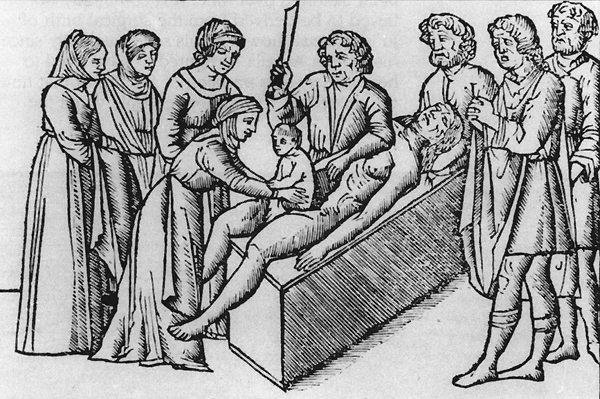
Suetonius' Lives of the Twelve Caesars, 1506 woodcut.

Suetonius' Lives of the Twelve Caesars, 1506 woodcut.

Continuing the laws of inheritance, the Talmud rules that a fetus is not able to inherit from its mother until it is born. Then comes this technical question:  

למימרא דהוא מיית ברישא והא הוה עובדא ופרכס תלתא פרכוסי אמר מר בר רב אשי מידי דהוה אזנב הלטאה שמפרכסת

Does this mean that [when a pregnant womean dies,] the fetus always dies first [i.e. before its mother]? But there was a case where a pregnant woman died and after that the fetus thrashed around three times? Mar bar Rav Ashi said: That movement of the fetus does not indicate that it was alive. It was rather like the severed tail of a lizard, which thrashes about."

According to Mar bar Rav Ashi, the movement of a fetus inside its dead mother is not an indication of independent life. Instead it demonstrates reflex movements.  Here is one of those squirming detached lizard tails.

i saw this big lizard outside but it wasnt moving so my dad told me to poke it but it still wouldnt move so he threw mre a board i hit the lizard with it then it crawled at least a few inches then my dad told me to make its tail come off so i put the board on its tail then it crawled away and left it bloody tail beside and it started scwerming around enjoy!!

Mar bar Rav Ashi's explanation does not however, apply across all cases of the death of a pregnant woman. This is made clear by the Talmud in Arachin 7b:

Rabbi Nachman said in the name of Shmuel: A woman who sat on the birthstool and died on the Sabbath, we bring a knife and cut open her abdomen and remove the fetus.

This teaching clearly allows for the possibility that a fetus could survive the death of its mother. In fact the Talmud expands on the teaching of Mar bar Rav Ashi.  The observation that in cases of maternal death the fetus dies first seems to only be true in cases in which there is a "natural death." However, in cases in which a pregnant woman was executed, it is the mother who dies first, followed by the demise of the fetus:

ערכין ז, א

הני מילי לגבי מיתה איידי דוולד זוטרא חיותיה עיילא טיפה דמלאך המות ומחתך להו לסימנין אבל נהרגה היא מתה ברישא

This applies only to [her natural] death, because the child's life is very frail, the ‘drop’ [of poison] from the angel of death enters and destroys its vital organs, but in the case of death by execution she dies first.

Gruesome as this discussion is, the Talmud is likely correct. "Natural" maternal deaths that occur are likely from causes that will inevitably have led to the prior death of the fetus, like massive hemorrhage or sepsis.  In the case of execution, the sudden death of the mother would occur before that of the fetus. Thankfully, the execution of pregnant women no-longer occurs in our society, but a similar outcome can occur when the mother is a victim of severe traumatic injury.  We will return to this in June 2019, when we study Arachin in the Daf Yomi cycle.

Maternal Death Rates

Maternal deaths are defined as by the World Health Organization as the death of a woman whilst pregnant or within 42 days of delivery or termination of pregnancy, from any cause related to, or aggravated by pregnancy or its management, but excluding deaths from incidental or accidental causes. Worldwide, there are at least 287,000 such deaths each year. A recent study of maternal deaths in 115 countries noted that there are three main causes: Bleeding, high blood pressure (leading to complications like eclampsia) and infection.  Here in the US, maternal deaths are among the highest in the developed world, as an investigation from NPR last month detailed. Each year, 700-900 women die from pregnancy or childbirth-related causes, or about 14 per 100,000 live births. By comparison, the rate in Israel is 5 deaths per 100,000 live births.

Tragic as each of these deaths are, it was once a lot worse, and in the nineteenth century doctors played a major role in causing maternal deaths.  In Vienna, Dr. Ignaz Semmelweiss (d. 1865) noted that the death rates in one maternity ward were three or four times higher than in a second ward. He suggested, after much sleuthing, that the cause was the dirty hands of medical students. These students came straight from performing autopsies to examining their pregnant and post-partum patients, with no hand washing in between. In an era before the germ theory of disease, his suggestion that something was carried on the hands of the medical students was widely ignored, but he instituted compulsory hand-washing anyway. And within a year the death rate dropped to zero.

Over the past century the maternal death rate in the US has declined by over 99%, although there are still significant racial and economic disparities. Passages such as the one we read in today's Daf Yomi remind us that for centuries, giving birth was a dangerous experience.  

Print Friendly and PDF

Bava Basra 126b ~ The Healing Power of Saliva

In a chapter that deals with the rules of inheritance, there is this interesting aside:

בבא בתרא קכו, ב

 ההוא דאתא לקמיה דרבי חנינא אמר ליה מוחזקני בזה שהוא בכור אמר ליה מנא ידעת אמר ליה דכי הוו אתו לגבי אבוה אמר להו זילו לגבי שכחת ברי דבוכרא הוא ומסי רוקיה ודלמא בוכרא דאמא הוא גמירי בוכרא דאבא מסי רוקיה בוכרא דאמא לא מסי רוקיה

A certain person once came before R. Hanina and said to him, 'I am sure that this man is firstborn'.  R. Hanina said to him, 'How do you know?' — The person replied to him: 'Because when people came to his father,  he used to say to them: "Go to my son Shikhath, who is firstborn and his saliva heals'. Might he not have been the firstborn of his mother only [but not of his father]? There is a tradition that the saliva of the firstborn of a father heals, but that of the firstborn of a mother does not heal.

Being declared a firstborn son was a big deal in talmudic times, for that lucky son would inherit twice the share of any other brothers.  (Daughters only inherit where there are no sons, or offspring of sons.) In the case brought before R. Hanina, there were two claims. One, that the Shikhath was a firstborn, based on the fact that his father called him "firstborn", and second that he was his father's firstborn by any woman. The evidence for that is the claim that his saliva heals. In talmudic society, only the saliva of a firstborn of a father heals. In his commentary on this passage, the Rashbam adds that the healing properties of saliva refer to its use as an eye medication. What are we to make of these claims that saliva heals, but only if it is the saliva of a firstborn son?

The many functions of human saliva

Saliva is an amazing material, and one we too often take for granted.  The many functions of saliva were reviewed in a paper published in The Archives of Oral Biology in 2015. We make a lot of it - about half a liter per day - and we need it to moisten and lubricate our mouths. It plays a critical role in taste, since it helps dissolve the foods into components that transmit taste on the tongue.  Saliva is also a key component of digestion. One of its main components is alpha-amylase, which appears to have a role in the breakdown of starch. It also protects the oral mucosa and esophagus not only by acting as a lubricant, but by buffering the acids in the stomach that sometimes make their way north into our mouths. The dentists among you will already know that saliva protects the teeth against abrasion, attrition, erosion, and dental caries, by removing uneaten food debris from the mouth. This debris, especially if sugary or acidic, can damage our teeth when bacteria feed off them. Saliva also has activity against bacteria, viruses and fungi.  For example, submandibular saliva inhibits the HIV-1 virus, even when diluted several-fold, and saliva inhibits the growth of candida, an opportunistic oral fungus.   

Saliva and wound healing

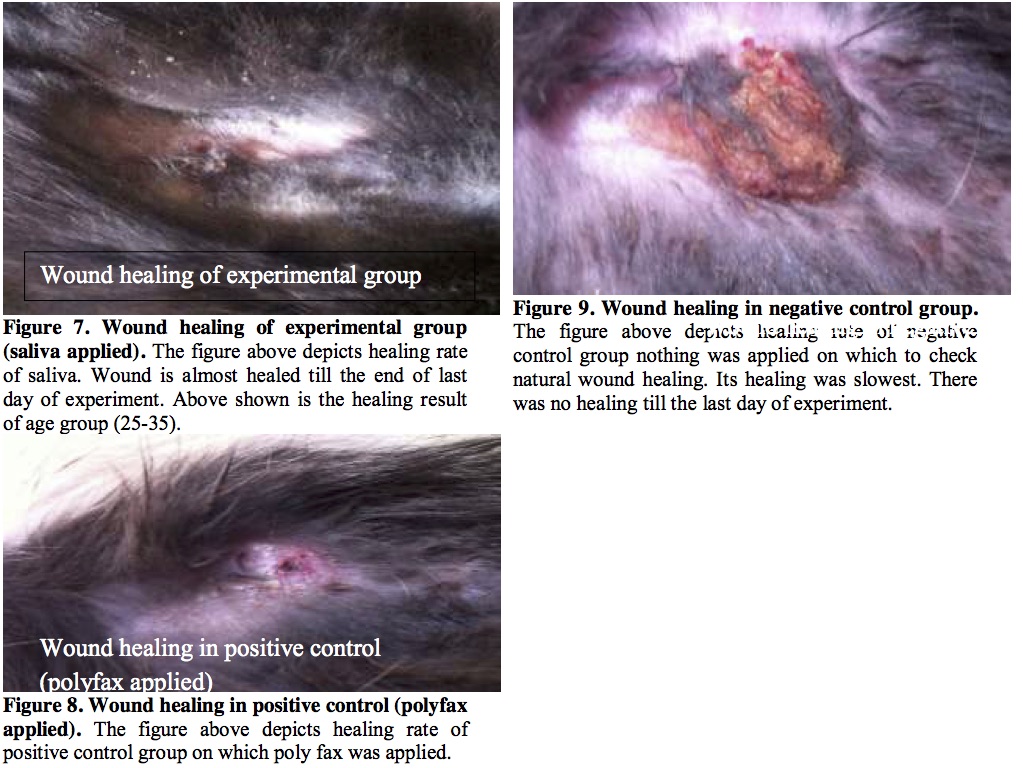
Last year, scientists from Lahore in Pakistan tested the ability of human saliva to heal wounds. They collected saliva from 24 willing human spitters, and applied the saliva to 2cm x 2cm wounds on the backs of  thirty "fully grown adult male rabbits weighing 2.0 to 3.4kg..." Three rabbits were controls and received no treatment. Another three had standard antibiotic ointment applied to their wounds, and the remaining lucky 24 rabbits had saliva applied every two hours for two weeks.  The Pakistani scientists noted "the healing speed of wounds on which saliva was applied was higher than the wounds on which wound healing medication (polyfax) was applied, and there was pus formation in the wound of negative control on which natural healing was observed." They concluded that "healthy human saliva possess significant (p<0.05) antimicrobial as well as wound healing properties. This innate ability of human saliva, mainly attributed to histatin protein, suggests that salivary proteins can be further used for medicinal purposes."

Wound healing properties of saliva, polyfax, and control on induced wounds on the backs of rabbits. From Haq et al. &nbsp;Antimicrobial and Wound Healing Properties of Human Saliva.&nbsp;Int. J. of Pharm. Life Sci. 2016. 7 (2);&nbsp;4911-4917.

Wound healing properties of saliva, polyfax, and control on induced wounds on the backs of rabbits. From Haq et al.  Antimicrobial and Wound Healing Properties of Human Saliva. Int. J. of Pharm. Life Sci. 2016. 7 (2); 4911-4917.

Healthy human saliva possess significant antimicrobial as well as wound healing properties. This innate ability of human saliva, ... suggests that salivary proteins can be further used for medicinal purposes.”
— ul-Haq, F et al. Antimicrobial and Wound Healing Properties of Human Saliva. International Journal of Pharmacy and Life Sciences. 2016:4911-4917

The histatins to which the Pakistani researchers referred are a group of proteins in the saliva which in 2008 were found to promote wound healing.  Cuts in the mouth heal much more quickly than do cuts elsewhere on the body: researchers have found that "wounds in the oral cavity heal much faster than skin lesions, with similar wounds healing in 7 days in the oral cavity compared with several weeks on the skin," and this is thought to be due to these histatins in the saliva.  

The mouth is a very dirty place

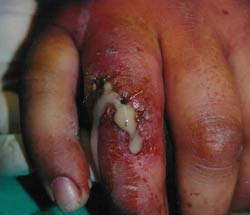
A nasty fight-bite injury, due to bacteria found in the mouth.

A nasty fight-bite injury, due to bacteria found in the mouth.

All this sounds rather interesting and would seem to support the use of saliva to heal, just as the saliva of Shikhath was said to do in today's page of Talmud. If however you find yourself with a wound and no local pharmacy, you might want to consider this before licking yourself.  The mouth is a terribly dirty place, microbiologically speaking.  It is full of nasty bacteria viruses and fungi, which the saliva only just manages to keep at bay.  I have seen dozens of  "fight-bites" in the ED. They are the outcome of a fist hitting a tooth (usually late on a Saturday night) and the hand often becomes badly infected as the bacteria in the victim's mouth, now safely hidden away deep in the crevice of the wound on the assailant's knuckle, go to work.  The result isn't pretty.

Vespasian, and others who healed with their saliva

The belief that saliva can heal the eyes is not limited to today's page of Talmud. You can find a detailed history in the 1891 paper by Frank Nicolson, The Saliva Superstition in Classical Literature. Perhaps one of the most striking examples of saliva as an ophthalmic medication is from the works of Tacitus, a Roman senator and historian, who died around 120 CE.  In his Histories, he recounts the story of Vespasian, - the same Vespasian who fought the Jewish insurrection in Judea and whose son Titus destroyed the Second Temple in 70 CE.  

In the months during which Vespasian was waiting at Alexandria for the periodical return of the summer gales and settled weather at sea, many wonders occurred which seemed to point him out as the object of the favor of heaven and of the partiality of the Gods. One of the common people of Alexandria, well known for his blindness, threw himself at the Emperor's knees, and implored him with groans to heal his infirmity...He begged Vespasian that he would deign to moisten his cheeks and eye-balls with his spittle... Vespasian, supposing that all things were possible to his good fortune, and that nothing was any longer past belief, with a joyful countenance, amid the intense expectation of the multitude of bystanders, accomplished what was required...the light of day again shone upon the blind. Persons actually present attest [this fact], even now when nothing is to be gained by falsehood.

(In case you were wondering, Vespasian was not a firstborn, but the third child born to his parents.)

Jesus is also said to have healed the blind with his saliva, as told in Mark 8:23-25:

They came to Bethsaida, and some people brought a blind man and begged Jesus to touch him. He took the blind man by the hand and led him outside the village. When he had spit on the man’s eyes and put his hands on him, Jesus asked, “Do you see anything?” He looked up and said, “I see people; they look like trees walking around.” Once more Jesus put his hands on the man’s eyes. Then his eyes were opened, his sight was restored, and he saw everything clearly.

In sum, the belief that saliva could heal the eyes and cure the blind was not only found in Jewish culture, but was part of Roman and early Christian legend. We now know that purified saliva does contain proteins and growth factors with anti-microbial and wound healing properties. However, the notion that saliva taken from the mouth might be helpful for failing eyesight is entirely without scientific foundation, because you are more likely to introduce an infection than you are to cure one. Even if you are a firstborn, an emperor, or a messiah.

Print Friendly and PDF