Avodah Zarah 27a ~ Circumcision and Hemophilia A

עבודה זרה כז, א

 ישראל שמתו אחיו מחמת מילה ולא מלוהו 

A Jew whose brothers died following their circumcisions, and was not circumcised.... 

fig1.jpg

In today's Daf Yomi, the Talmud considers whether a Jew who was not himself circumcised may serve as a mohel. This situation could arise when the newborn baby had older brothers who died from bleeding following their circumcisions. The young brother is then exempt from the mitzvah to be circumcised.

We first encountered this situation while studying Yevamot (64a) where cases of post-circumcision deaths are described. To understand the today's daf, we need to remind ourselves of the genetics of hemophilia.

X-linked Hemophilia A

יבמות סד, א 

תניא מלה הראשון ומת שני ומת שלישי לא תמול דברי רבי רבן שמעון בן גמליאל אומר שלישי תמול רביעי לא תמול... א"ר יוחנן מעשה בארבע אחיות בצפורי שמלה ראשונה ומת שניה ומת שלישית ומת רביעית באת לפני רבן שמעון בן גמליאל אמר לה אל תמולי

It was taught: If she circumcised her first son and he died, and her second son and he too died, she should not circumcise her third son, so taught Rebbi.  Rabbi Shimon ben Gamliel stated that she should indeed circumcise her third child, but [if he died] she must not circumcise her forth...Rabbi Yochanan said that there was once a case in Zippori in which four sisters had sons:  The first sister circumcised her son and he died, the second sister circumcised her son and he died, the third sister circumcised her son and he died, and the forth sister came to Rabbi Shimon ben Gamliel and he told her "you must not circumcise your son" (Yevamot 64:)

The Talmud here is describing a disease that is affected through the maternal line (hence the four sisters - all of whom seem to pass this disease on to their male children). The disease is X-linked Hemophilia A; the term X-linked indicates that the faulty gene is carried on the X chromosome, which is men is always inherited from the mother. Hemophilia A is an X-linked recessive genetic disease, first described by the American physician John Conrad Otto, who in 1803 described a bleeding disorder that ran in families and mostly affected the men. John Hay from Massachusetts published an account of a "remarkable hemorrhagic disposition" in the New England Journal of Medicine in 1813.

Hay, John. Account of a Remarkable Haemorrhagic Disposition, Existing in Many Individuals of the Same Family. New England Journal of Medicine 1813:2;3;221-225.

Hay, John. Account of a Remarkable Haemorrhagic Disposition, Existing in Many Individuals of the Same Family. New England Journal of Medicine 1813:2;3;221-225.

 If the mother is a carrier  - as were each of the four sisters in Zippori - then she has a one in four chance of passing on the disease to a child, and that affected child will always be a son:
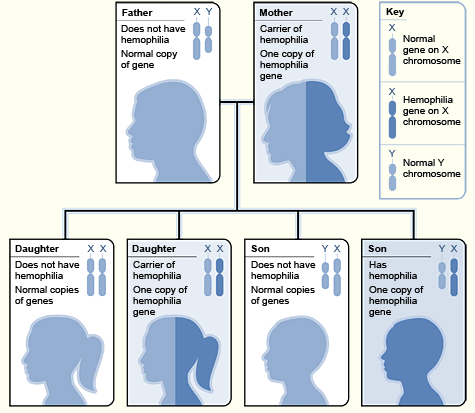
Courtesy NHLBI

Courtesy NHLBI

In Yevamot, the rabbis argued over a technical point - that is, how many cases of bleeding are needed to establish a pattern. According to Rebbi (that is  Rebbi Yehuda Ha-Nasi, c. 135-217 CE.) two cases were sufficient, while Rabbi Shimon ben Gamliel insisted on three cases before ruling that there was a life threatening pattern.  Indeed the disease in boys must have been very perplexing, because (as you can see in the diagram above) not every boy would be affected. In fact, if the mother is a carrier and the father is not, there is only a 50% chance of a boy having hemophilia.  It is this fact that perhaps explains the dispute between Rebbi and Rabbi Shimon ben Gamliel regarding how many children need to exhibit the disease before we can assume that any future male child will also have it.  If every boy born in the family would have been a hemophiliac, Rabbi Shimon's ruling would have seemed unnecessarily cruel.  But since by chance, half of the boys born might not have hemophilia, the need to demonstrate the prevalence of the disease (in a society in which its genetic foundations were not known) seems eminently sensible.

In  Hemophilia A there are various genetic mutations that result in low levels of clotting factors. These levels may be only mildly decreased, or so low that severe life threatening hemophilia results. It is treated with transfusions of clotting factors which restore the levels to normal. Although these transfusions must be given several times a week in those with severe disease, there is hope that recombinant clotting factors can lengthen the time between the needed transfusions.

Later in Yevamot, the Mishnah records the case of a priest who was not circumcised -  because of the deaths of his brothers when they underwent the procedure. So this law was certainly practiced, and the Talmud records not only the earliest known description of hemophilia, but the emphasis on the preservation of life as a normative Jewish practice. 

רמב׳ם משנה תורה הל׳ מילה ב, א

הַכּל כְּשֵׁרִין לָמוּל. וַאֲפִלּוּ עָרֵל וְעֶבֶד וְאִשָּׁה וְקָטָן מָלִין בְּמָקוֹם שֶׁאֵין שָׁם אִישׁ

Everyone is qualified to perform the operation of circumcision. Where there is no adult circumcised male, (Israelite), it is performed by an uncircumcised Israelite, a bondman, a woman or a minor. 

[Repost from Yevamot 64a.]

Print Friendly and PDF

Avodah Zarah 24a ~ Maternal Imprinting

From here.

From here.

The Parah Adumah, the red heifer, was used in several ceremonies in the Temple. It was, however, a rare animal. In today's page of Talmud there is a detailed discussion as to whether a red heifer born to an idol-worshipper could be used. The concern was that the heifer, or one of its ancestors, might have been used by the idol-worshipper for beastiality. Should this have happened, it was forbidden to use the red heifer as a sacrifice. The Talmud relates that in fact an idol-worshipper called Daba ben Natina had sold a red heifer to his Jewish neighbors. To insure that the heifer's mother had not been the object of beastiality, the pregnant cow had been watched "משעה שנוצרה" – from the moment it was impregnated. Then comes an obvious question: how could anyone be sure that the cow was indeed pregnant with a red calf which would warrant safeguarding her? Perhaps the calf  would be born another color? 

Here is the answer: "כוס אדום מעבירין לפניה בשעה שעולה עליה זכר" -"while the mother was copulating, the farmer would show her a red cup." That would insure that she would give birth to a little red calf that would grow into a bigger red heifer. The belief that what a mother sees during conception and gestation will affect her offspring is called maternal imprinting or psychic maternal impressions, or mental influence, or maternal imagination, or (my favorite) maternal fancy

The history of the belief in maternal impressions is one of great antiquity...it is also one of practically world-wide distribution. [It can be found in] such far apart lands as India, China, South America, Western Asia and East Africa..the Esquimaux, the Loango negros, and the old Japanese.
— John William Ballantyne. Teratogenesis: an Inquiry into the Causes of Monstrosities. Edinburgh, Oliver & Boyd 1897. 24

Maternal Imprinting in jewish sources

The earliest mention of maternal imprinting is the story of Yaakov and his division of the goats he watched for his uncle Lavan (Gen 30:25-43, 31:1-12).  As wages, Yaakov asked for all the speckled goats, while Lavan would get to keep the plain ones.  Yaakov then took several wooden rods from which he peeled the bark, and left these now speckled rods in front of a water trough.   The female goats stared at the rods while they are drinking and mating, and this in turn caused them to give birth to speckled kids, all of which Yaakov got to keep. That's how maternal imprinting works.  

The Midrash and Talmud are replete with the belief in maternal imprinting. Perhaps the most famous story is that of Rabbi Yochanan (~180-279 CE) who would regularly sit in front of the mikveh (ritual bath). He did this so that women leaving there would see him, and be blessed with sons as handsome as he was.

בבא מציעא פד, א

ר' יוחנן הוה אזיל ויתיב אשערי טבילה אמר כי סלקן בנות ישראל מטבילת מצוה לפגעו בי כי היכי דלהוו להו בני שפירי כוותי גמירי אורייתא כוותי

Rabbi Yochanan would go and sit by the entrance to the ritual bath. He said to himself: When Jewish women come up from their immersion [after their menstruation,] they should see me first so that they have beautiful children like me, and sons learned in Torah like me. 

Rabbi Akiva used maternal imprinting to save a king from a rather embarrassing situation:

מדרש תנחומא נשה, ז

מַעֲשֶׂה בְּמֶלֶךְ הָעַרְבִים שֶׁשָּׁאַל אֶת רַבִּי עֲקִיבָא, אֲנִי כּוּשִׁי וְאִשְׁתִּי כּוּשִׁית וְיָלְדָה לִי בֵּן לָבָן, הוֹרְגָהּ אֲנִי, שֶׁזָּנְתָה תַּחְתַּי. אָמַר לוֹ: צוּרוֹת בֵּיתְךָ שְׁחֹרוֹת אוֹ לְבָנוֹת. אָמַר לוֹ: לְבָנוֹת. אָמַר לוֹ: כְּשֶׁהָיִיתָ עוֹסֵק עִמָּהּ, עֵינֶיהָ נָתְנָה בְּצוּרוֹת לְבָנוֹת וְיָלְדָה כַּיּוֹצֵא בָּהֶם. וְאִם תָּמֵהַּ אַתָּה בַּדָּבָר, לְמַד מִן צֹאנוֹ שֶׁל יַעֲקֹב, שֶׁמִּן הַמַּקְלוֹת הָיוּ מִתְיַחֲמוֹת, שֶׁנֶּאֱמַר: וְיִחֲמוּ הַצֹּאן אֶל הַמַּקְלוֹת (בראשית ל, לט). וְהוֹדָה מֶלֶךְ הָעַרְבִים וְשִׁבַּח לְרַבִּי עֲקִיבָא

A king of Arabia once asked Rabbi Akiva, “I am black and my wife is black, yet she gave birth to a white child. Shall I have her executed for infidelity?” Rabbi Akiva responded by inquiring if the statues in his house where white or black. He said to Rabbi Akiva that they were white.  Rabbi Akiva explained to the king that during conception his wife's eyes were fixed on the white statues and so she bore a white child...the king agreed and praised Rabbi Akiva

Maternal Imprinting in Greek Thought, and Beyond

In 1998 Professors Wendy Doniger and Gregory Spinner published perhaps the most comprehensive review of imprinting, in a paper titled Misconceptions: Female Imaginations and Male Fantasies in Parental Imprinting. They noted Empedocles, who lived in the fifth century BCE, wrote that 

the fetuses are shaped by the imagination of the women around the time of conception. For often women have fallen in love with statues of men, and with images, and have produced offspring which resemble them.

Soranus of Ephesus, another Greek physician who lived in Rome and Alexandria (and who was a contemporary of Rabbi Yochanan) firmly believed in imprinting, both for animal husbandry and in humans:

Some women, seeing monkeys during intercourse, have borne children resembling monkeys. The tyrant of the Cyprians, who was misshapen, compelled his wife to look at beautiful statues during intercourse and became the father of well-shaped children; and horse-breeders, during covering, place noble horses in front of the mares.

Let's jump forward a millennium.   In 1282 it was reported that an infant was born with hair and claws like a bear. The Pope at the time "straightway ordered the destruction of all pictures of bears in Rome." This story is from John Ballantyne, a Scottish physician who in 1897 published Teratogenesis: an Inquiry into the Causes of Monstrosities. According to Ballantyne, in the seventeenth century, the belief in maternal impressions "reigned supreme."  Here is another example of the kind of thing it led to:


And then things get even weirder:

In 1726 the matter of maternal impressions was brought still more prominently before the profession and the public in England in connexion [sic] with the notorious case of an "Extraordinary Delivery of Rabbets" which was alleged to have occurred in the case of Maria Tofts of Godlyman in Surrey; she had a great longing for 'Rabbets"in early pregnancy.

Pregnancy and the fetus

Maternal imprinting is a rather extreme form of what we all know to be true; that what happens to a pregnant mother affects the fetus she is carrying. Here are two of the countless examples of this.  If a mother drinks enough alcohol while pregnant, the fetus will be born with Fetal Alcohol Syndrome. This syndrome includes facial abnormalities, growth delays, abnormal development of organs, and reduced immunity.  If a mother is infected with measles (rubella) early in pregnancy, the baby will likely be born with congenital rubella syndrome, which includes cataracts, congenital heart disease and brain damage.  But these examples do not imply that a woman who eats eggs will have children with large eyes or that a woman who eats an esrog will have fragrant children, as the Talmud (Ketuvot 60b) declares. Some things a pregnant mother does will have a huge effect on the fetus she carries. Some won't have any affect at all.  

John Ballantyne, the Scottish physician concluded his book noting, as we have, that of course there are some things a mother does that will affect fetal outcome. "To this extent" he wrote, "I believe in the old doctrine of maternal impressions; this is, I think, one grain of truth in an immense mass of fiction and accidental coincidence."

It's not the red cup after all

Red cup.jpeg

Back to today's page of Talmud.  It would seem that all you needed to produce a Parah Adumah was to place a red cup next to the mating cattle.  So why didn't every farmer use the red cup protocol to breed a red heifer? After all, these animals commanded fantastic prices because of their rarity. The answer offered by the Talmud is that the red cup protocol only worked with a herd of cattle that were known (במוחזקת) to produce red heifers.  Without that breeding history, the red cup protocol was useless. So this really wasn't about the red cup. It was about the genes, and that's the kind of parental imprinting that really does work.

A surprising large number of people, in different cultures and over many centuries, have believed that a woman who imagines or sees someone other than her sexual partner at the moment of conception may imprint that image upon her child- thus predetermining its appearance, character or both.
— Doniger W. Spinner G. Female Imaginations and Male Fantasies in Parental Imprinting. Daedalus 127 (1), No. 1, Science in Culture (Winter, 1998). 97-129

[Special thanks to Rabbi Dr. Eddie Reichman, medical historian and Talmudology reader who has been researching maternal imprinting for years, and was kind enough to share his material.]

Print Friendly and PDF

Avodah Zarah 17b ~ What Gender is that Bee?

From here.

From here.

Rabbi Elazar ben Perata was in trouble. When the  Romans heard him being called him by the title "Rabbi" they arrested him.Teaching Torah was banned, and to be identified as a Rabbi, a teacher of Torah, invoked the death penalty. To save his life, Rabbi Elazar denied the charge. Instead, he claimed, he was simply a teacher (rabban) of weavers.  So the Roman authorities tested him on his knowledge of weaving:

עבודה זרה יז, ב

 אייתו ליה תרי קיבורי אמרו ליה הי דשתיא והי דערבא איתרחיש ליה ניסא אתיא זיבוריתא אותיבא על דשתיא ואתאי זיבורא ויתיב על דערבא אמר להו האי דשתיא והאי דערבא

They brought him two coils of wool and said to him: Which is the warp, and which is the woof?  A miracle occurred, as a female bee came and sat on the warp, and a male bee came and sat on the woof. Rabbi Elazar ben Perata said to them: This is the warp, and that is woof.

Rabbi Elazar understood the message the two bees were sending. The male was sitting on the woof, which is threaded into the warp. The female bee was on the warp, which is fixed in the loom and receives the woof. 

What is going on here?  Is it in fact the case that male and female bees are distinguishable? It turns out that they are. Sort of.

Queens, Drones, and Workers

A hive contains three kinds of bees. First, there are thousands of worker bees. These are the ones that you see flying around collecting nectar from flowers, or annoying you in the Sukkah.  All worker bees are female. The hive also has one Queen, whose sole task is to lay eggs.  Obviously, the queen is female. She stays in the hive and is attended to by special worker bees who become nurse bees.  And then there are the male drone bees, whose only job is to mate with a virgin queen. They leave the hive and fly to drone congregation areas, where, in midair, they mate (or attempt to mate) with a virgin queen.  Then they fall to the ground and die.

Comparison of worker, drone and queen.jpg

 The male drones are about twice the size of the female worker bees.  According to a helpful article (Differences in drone and worker physiology in honeybees) published in 2005, the weight of an emerging worker is 70-100mg.  In contrast, the weight of an emerging drone is around 260mg - over two-and-a-half times heavier. Drones also have bigger eyes and rounded, more stocky bodies. 

Drone bees are the hapless males within a colony. They seemingly have little or no purpose within the colony: they take no part in hive building or maintenance; they don’t defend the colony (drones do not possess a sting); they don’t gather food or nurture the larvae.
— Barnsley Beekeepers Association

A typical hive contains one queen, about 60,000 worker bees, and a few hundred drones.  You are likely to have seen hundreds of worker bees over the years.  You are, however, far less likely to have seen a drone.  In fact, you may never have seen one. But they are out there.

Rashi vs. Tosafot

warp and woof II.jpg

According to Rashi, Rabbi Elazar was able to distinguish between a smaller female worker (זיבוריתא) and a larger male drone (זיבורא). The worker sat on the warp, and the drone sat on the woof. Since the woof is inserted into the warp, Rav Elazar deduced that the woof was indicated by the male drone. Because there is indeed a difference in size and gross morphology between the workers and the drones, it is entirely possible that Rav Elazar could identify each. Assuming that he had great eyesight and was an experienced apiarist.

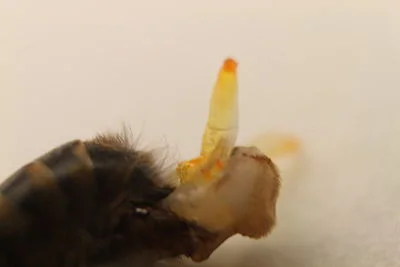
Drone Bee Phallus. From here.

Drone Bee Phallus. From here.

Tosafot disagrees.  There is no way, claims Tosafot, that Rabbi Elazar's eyesight was that good. Now not knowing anything about bees, you might agree. After all, the penis of a drone bee is very, very small. But as we have seen, to determine the gender of a bee you don't have to get that close.  You just have know what you're looking for in terms of the body size and morphology.   


Tosafot therefore suggests that the Talmudic words זיבוריתא and זיבורא do not refer to a female and a male of the same species. Instead, the words refer to two different species, which Rabbi Elazar could identify from a distance. The species זיבוריתא, written in a female form, was sitting on the warp. The species זיבורא, written in a male form, was sitting on the woof, since the woof goes into the warp.

There are thousands of species of bees and their larger cousins, the hornets.  It is entirely possible that Rabbi Elazar noted that the two insects on the loom were two different species called by two similar but distinct names. Tosafot is incorrect to claim that the gender of a bee cannot be determined from a distance.  But the alternative theory is also scientifically plausible.

We have already learned that honey has some amazing medicinal properties.  Today we learn that bees too, can save a life.  So next time you are bothered by bees, act kindly. After all, they saved Rabbi Elazar's life.


NEXT TIME ON TALMUDOLOGY:  MATERNAL IMPRINTING

Print Friendly and PDF

Avodah Zarah 12b ~ Vinegar, Leeches and Rav Huna

עבודה זרה יב ,ב

ת"ר לא ישתה אדם מים לא מן הנהרות ולא מן האגמים לא בפיו ולא בידו אחת ואם שתה דמו בראשו מפני הסכנה מאי סכנה סכנת עלוקה

The Sages taught: A person should not drink water from rivers or from ponds either by drinking from the water directly with his mouth, or by collecting the water with one hand alone. And if he drank in this manner, his blood is upon his own head, due to the danger. What is this danger? It is the danger of swallowing a leech.

There are about 680 identified species of leeches (so far). Most are found in freshwater, and are found on every continent except Antarctica. You should stay away from them.

In western developed countries, our drinking supplies are safe to drink (mostly). But around the world leeches are still found in water that is used for human (and animal) consumption.  Today's page of Talmud reminds us of the danger that leeches once imposed. That danger is still very much present.

The Nile Leech. And others

The Koren Talmud notes that one species of leech, the Nile leech (Limnatis nilotica) can still be found in bodies of water in Israel.  Indeed leeches are found across the Middle East. Ten years ago, a case report was published in the Turkish Journal of Parasitology which described what happened when Limnatis nilotica  got into the nose of a poor five year-old girl in Turkey.

The doctor who was trying to aspirate the blood in the patient’s mouth noticed the bloody formation moving slightly. This formation was removed by an otolaryngologist under local anesthesia and was brought to the parasitology laboratory and identified as a leech.
— Agin, H. et al. Türkiye Parazitoloji Dergisi, 32 (3): 247 - 248, 2008

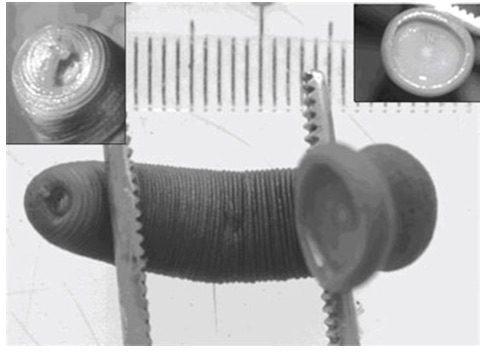
The girl had nose bleeds and had vomited blood over three days.  She required an urgent blood transfusion, and while trying to remove blood from the girl's nose the doctor "noticed the bloody formation moving slightly." The bloody moving formation was carefully removed and sent to the pathology laboratory where it was identified. It was a leech. Here is a picture of the villain:

Leech obtained from the case. From Agin, H. et al. Severe Anemia Due to the Pharyngeal Leech Limnatis nilotica in a Child. Türkiye Parazitoloji Dergisi, 32 (3): 247 - 248, 2008

Leech obtained from the case. From Agin, H. et al. Severe Anemia Due to the Pharyngeal Leech Limnatis nilotica in a Child. Türkiye Parazitoloji Dergisi, 32 (3): 247 - 248, 2008

This is certainly not an isolated incident.  In fact, there are so many reports of leeches in the medical literature, that an Iranian group published a meta-analysis of leeches "as a live foreign body." 

Selection of published literature on leech infestations. From Saki, N. et al. Meta Analysis of the Leech as a Live Foreign Body: Detection, Precaution and Treatment. Pakistan Journal of Biological Sciences 2009: 12 (24); 1556-1563

Selection of published literature on leech infestations. From Saki, N. et al. Meta Analysis of the Leech as a Live Foreign Body: Detection, Precaution and Treatment. Pakistan Journal of Biological Sciences 2009: 12 (24); 1556-1563

The more you read, the more the meta-analysis gets scary. Here is another table, detailing the 28 patients the Iranians had seen at their hospital in Ahwaz, Iran. (Fun fact about Ahwaz: in 2011 the World Health Organization declared it to be the most air-polluted city in the world. Ahwaz: If our leeches don't kill you, our air will.)

Detail of 28 leech infested patients seen over a ten year period at Ahwaz Jondishapour Universtiy of Medical Science, Ahwaz, Iran. From Saki, N. et al. Meta Analysis of the Leech as a Live Foreign Body: Detection, Precaution and Treatment. Pakistan …

Detail of 28 leech infested patients seen over a ten year period at Ahwaz Jondishapour Universtiy of Medical Science, Ahwaz, Iran. From Saki, N. et al. Meta Analysis of the Leech as a Live Foreign Body: Detection, Precaution and Treatment. Pakistan Journal of Biological Sciences 2009: 12 (24); 1556-1563

The longest leech they found was a whopping 10 cm (over 4 inches) that had taken up residence in the back of the mouth. Why didn't the patient feel that massive creature? Well, leeches are crafty; they secrete an analgesic so the victim doesn't feel the bite. At most, you might feel a little wiggling.  

Vinegar. Really?

Today's page of Talmud not only cautions us to be careful when drinking from a spring or river. It also suggests a treatment for leech attachment: 

אמר רבי חנינא הבולע נימא של מים מותר להחם לו חמין בשבת ומעשה באחד שבלע נימא של מים והתיר רבי נחמיה להחם לו חמין בשבת אדהכי והכי אמר רב הונא בריה דרב יהושע ליגמע חלא

 Rabbi Hanina says: In the case of one who swallows a water leech [nima], it is permitted to perform labor on Shabbat and heat water for him to drink on Shabbat, as his life is in danger. And in fact there was an incident involving one who swallowed a water leech, and Rabbi Neḥemya permitted them to heat water for him on Shabbat. In the meantime, until the water is ready, what should he do? Rav Huna, son of Rav Yehoshua, said: He should swallow vinegar.

As it turns out, Rav Huna's advice to drink vinegar can be found in today's medical literature. The Ahwaz team offers this suggestion:

If the leech is in the nares or upper pharynx, it be detached by applying 30% cocaine, 1:10,000 adrenalin or dimethyl phthalate to it. Another method is irrigation with strong saline, vinegar, turpentine or alcohol.

Rav Huna's treatment with vinegar seems to be supported in the medical literature. So next time you travel to Ahwaz, take some along with you.    

Print Friendly and PDF