Bechorot 55a ~ Where Does Your Blood Come From?

בכורות נה, א

אמר רב כהנא כרותא דדמא כבדא

Rav Kahana also states: The source of blood is the liver.

The liver has long been considered a very special organ (as indeed it is). The Babylonians used the organ for divination, as is mentioned in our own Book of Ezekiel (21:26):

כִּי־עָמַד מֶלֶךְ־בָּבֶל אֶל־אֵם הַדֶּרֶךְ בְּרֹאשׁ שְׁנֵי הַדְּרָכִים לִקְסָם־קָסֶם קִלְקַל בַּחִצִּים שָׁאַל בַּתְּרָפִים רָאָה בַּכָּבֵד׃

For the king of Babylon has stood at the fork of the road, where two roads branch off, to perform divination: He has shaken arrows, consulted teraphim, and inspected the liver.

The Greek physician Galen (129-c.207 CE) believed that the liver stored the four humors of the body, and, just like Rav Kahana, he claimed that it produced blood. But both were mistaken

Where your blood actually comes from
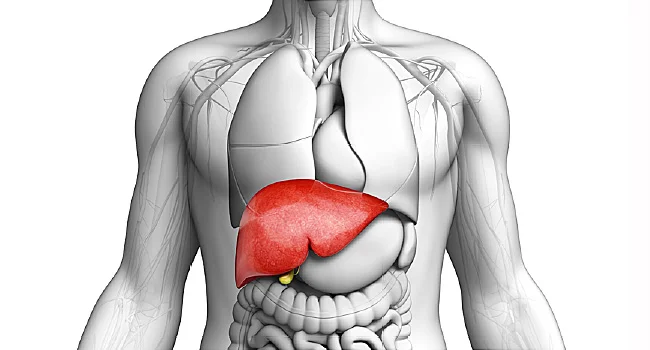
Diagram of liver.jpg

Blood is not made in the liver (unless you are a fetus) but in the bone marrow, which is the spongy middle bit of bones. And your bone marrow works really hard. Each day it makes 200,000,000,000 red blood cells, 150,000,000,000 platelet cells, and 20,000,000,000 lymphocytes. It all begins with an all powerful stem cell, which then can turn into (among other things) a red blood cell that carries oxygen and has life of only 120 days), a mast cell which is involved in inflammation and allergies, a neutrophil (also known as a “white blood cell”) which fights infections, or a macrophage, which is a microscopic vacuum cleaner and whose job get rid of all the cellular bits and pieces that don’t belong.

Hematopoiesis_simple.png


If one considers the annual cumulative cell production, one can calculate a total blood cell production rate of about...88 kg per year
— Fliedner T. M et al. Structure and Function of Bone Marrow Hemopoiesis: Mechanisms of Response to Ionizing Radiation Exposure. Cancer Biotherapy and Radiopharmaceuticals 2002; 17 (4) 405-426.

But in The Fetus, the Liver does make blood

In the growing embryo, blood is first made in the yolk sac, but at about 6 weeks gestation the fetal liver takes over. The liver happily churns out all the cells of the blood line, until, at about 5 months gestation, the bone marrow takes over. So neither Rav Kahana nor Galen were totally mistaken when he declared that the source of blood is the liver.

Print Friendly and PDF

Happy Yom Yerushalayim From Talmudology

The Nobel Prize, Jerusalem, and Being a Mensch

As we celebrate the liberation of Jerusalem with prayer and festive meals (and in Jerusalem itself, with parades and barbeques) let’s remind ourselves of a person who personifies the essence of a commitment to Jewish tradition, science and Zionism: Robert Aumann.

As we have mentioned before, in 2005 Aumann was awarded the Nobel Prize in Economics. It recognized his work on conflict, cooperation, and game theory (yes, the same kind of game theory made famous by John Nash, portrayed in A Beautiful Mind). Aumann worked on the dynamics of arms control negotiations, and developed a theory of repeated games in which one party has incomplete information.  The Royal Swedish Academy of Sciences noted that this theory is now "the common framework for analysis of long-run cooperation in the social science."

Jews have been yearning for the land of Israel, and for Jerusalem, for close to 2000 years – ever since the destruction of the Temple by the Romans in the year 70, and the ensuing exile of the Jewish people. In our central prayer, which we recite three times a day, we ask the Lord to “return to Jerusalem Your city in mercy, and rebuild it and dwell therein.” Jerusalem is mentioned many thousands of times in the scriptures, in our other prayers, in the Talmud, and indeed in all our sources. So when the state of Israel was established in 1948, my brother and I made a determination eventually to make our lives there.
— Robert Aumann. "Biographical." From Nobel.org

Aumann’s speech to the Swiss Academy was a moving testimony to the Zionist dream, in which he was proud to have played a part. And Aumann knows the price of this dream; his oldest child, Shlomo, was killed in action while serving in the Israel Defense Forces in the 1982 Lebanon War.

Here is what the good Professor said in Stockholm. It is surely the only Nobel Prize Banquet Speech ever to mention the return of the Jewish people to Jerusalem.

.ברוך אתה יי אלו-ינו מלך העולם הטוב והמיטיב

Blessed are you, God, our Lord, Monarch of the Universe, who is good and does good.

After partaking of a meal with fine wines, we recite this benediction when we are served with a superb wine.Your Royal Highnesses, we have, over the years, partaken of many fine wines. We have participated in the scientific enterprise: studied and taught, preserved, and pushed forward the boundaries of knowledge.

.למדנו ולימדנו, שמרנו ועשינו

We have participated in the human enterprise – raised beautiful families. And I have participated in the realization of a 2000-year-old dream – the return of my people to Jerusalem, to its homeland. And tonight, we have been served with a superb wine, in the recognition of the worth of our scientific enterprise. I feel very strongly that this recognition is not only for us, but for all of game theory, in Israel and in the whole world – teachers, students, colleagues, and co-workers. And especially for one individual, who is no longer with us – the mother of game theory, Oskar Morgenstern.

So, I offer my thanks to these, to the Nobel Foundation and the Nobel Committee, to our magnificent hosts, the country of Sweden, and to the Lord, who is good and does good.

For me, life has been – and still is – one tremendous joyride, one magnificent tapestry. There have been bad – very bad – times, like when my son Shlomo was killed and when my wife Esther died. But even these somehow integrate into the magnificent tapestry. In one of his beautiful letters, Shlomo wrote that there can be no good without bad. Both Shlomo and Esther led beautiful, meaningful lives, affected many people, each in his own way.
— Robert Aumann.

Robert Aumann and his cousin, Oliver Sacks

In 2015 the late great neurologist and author Oliver Sacks wrote a moving piece called The Sabbath. In it he recalled growing up in the orthodox Jewish community of north-west London. “Though I could not understand the Hebrew in the prayer book” he wrote “I loved its sound and especially hearing the old medieval prayers sung, led by our wonderfully musical hazan.”

But Sacks had a secret: he was attracted to men. His father made him admit to this, but Sacks asked that he not tell his mother. Sacks continues:

He did tell her, and the next morning she came down with a look of horror on her face, and shrieked at me: “You are an abomination. I wish you had never been born.” (She was no doubt thinking of the verse in Leviticus that read, “If a man also lie with mankind, as he lieth with a woman, both of them have committed an abomination: They shall surely be put to death; their blood shall be upon them.”)

The matter was never mentioned again, but her harsh words made me hate religion’s capacity for bigotry and cruelty.

Sacks wrote about his homosexuality for the first time in his 2015 autobiography On the Move: A Life. And he found love later in his life, with his partner Bill Hayes, with whom he lived until Sacks died in 2015.

The cruel treatment Sacks received from his mother must have been a life-long burden, but Sacks found some solace in the behavior of his cousin - Robert Aumann. Let’s let Sacks tell the story:

During the 1990s, I came to know a cousin and contemporary of mine, Robert John Aumann, a man of remarkable appearance with his robust, athletic build and long white beard that made him, even at 60, look like an ancient sage. He is a man of great intellectual power but also of great human warmth and tenderness, and deep religious commitment — “commitment,” indeed, is one of his favorite words. Although, in his work, he stands for rationality in economics and human affairs, there is no conflict for him between reason and faith.

He insisted I have a mezuza on my door, and brought me one from Israel. “I know you don’t believe,” he said, “but you should have one anyhow.” I didn’t argue.

Towards the end of his life Sacks paid one last visit to Aumann.

I had felt a little fearful visiting my Orthodox family with my lover, Billy — my mother’s words still echoed in my mind — but Billy, too, was warmly received. How profoundly attitudes had changed, even among the Orthodox, was made clear by Robert John when he invited Billy and me to join him and his family at their opening Sabbath meal.

The peace of the Sabbath, of a stopped world, a time outside time, was palpable, infused everything, and I found myself drenched with a wistfulness, something akin to nostalgia, wondering what if: What if A and B and C had been different? What sort of person might I have been? What sort of a life might I have lived?

Robert Aumann, is not just a Zionist or a Nobel Laureate. He something far, far more important. He is a mensch.

Print Friendly and PDF

Bechorot 45b ~ Syndactyly, and Talmudology Keeps a Promise

Remember Polydactyly?

In April 2016, which is to say over three years ago, Talmudology wrote about polydactyly, when the Daf Yomi cycle studied Kiddushin 25. There we wrote: “We will discuss syndactyly when we study tractate Bechorot, (daf 45a), on June 1st, 2019,  הבעל"ט” And here we are. Tomorrow, June 1st 2019 (which is Shabbat) we will learn Bechorot 45, and we are therefore delighted to keep our promise and explain syndactyly, which is the condition in which one or more adjacent digits are fused together. But first, have a quick re-read of that earlier post; it will help put this medical condition into perspective…….Done? OK then, here we go.

The Cohen with fused digits

Tomorrow we continue the discussion of physical abnormalities which would prohibit a Cohen from serving in the Temple. The Mishnah reads as follow:

בכורות לה,ב

אצבעותיו מורכבות זו על זו או קלוטות למעלה עד הפרק כשר למטה מן הפרק וחתכה כשר

A priest whose fingers or toes are configured one upon the other, or one whose fingers or toes are attached, is likewise disqualified. But if they were attached from above the palm of the hand or the bottom of the foot only until the middle joint, he is fit. If they were attached below the joint, higher up on the finger or toe, and he cut to separate them, he is fit. 

The case here is a Cohen with, say two fingers or two toes that are fused together, so that it appears that there is a digit missing. The hand may look like this:

Palm view of classic simple syndactyly of left long and ring fingers. Over 50% of all webbed fingers occur like this.From here.

Palm view of classic simple syndactyly of left long and ring fingers. Over 50% of all webbed fingers occur like this.From here.

maydeletesmaller.jpg

Or in extreme cases like this:

The hand of the patient with syndactyly of several digits. From Biesecker L.G.The Greig cephalopolysyndactyly syndrome. Orphanet Journal of Rare Diseases 2008, 3:10

The hand of the patient with syndactyly of several digits. From Biesecker L.G.The Greig cephalopolysyndactyly syndrome. Orphanet Journal of Rare Diseases 2008, 3:10

These photos are all obviously from young children, which is good news. Surgeons are able to separate the fused fingers or toes, generally when the infant is 1-2 years old, and so there are now few adults around in whom the condition went uncorrected.

The Classification of Syndactyly

Syndactyly (from the Greek syn = together; dactylos=digit) occurs in about 2-3 per 10,000 live births In 10-40% there is a family history of the condition and is twice as common among males (remember these facts for later). In about half of all cases there are bilateral and symmetrical fusions, and while it may be an isolated finding, in many cases it is part of a genetic disorder like Apert’s or Poland’s syndrome.

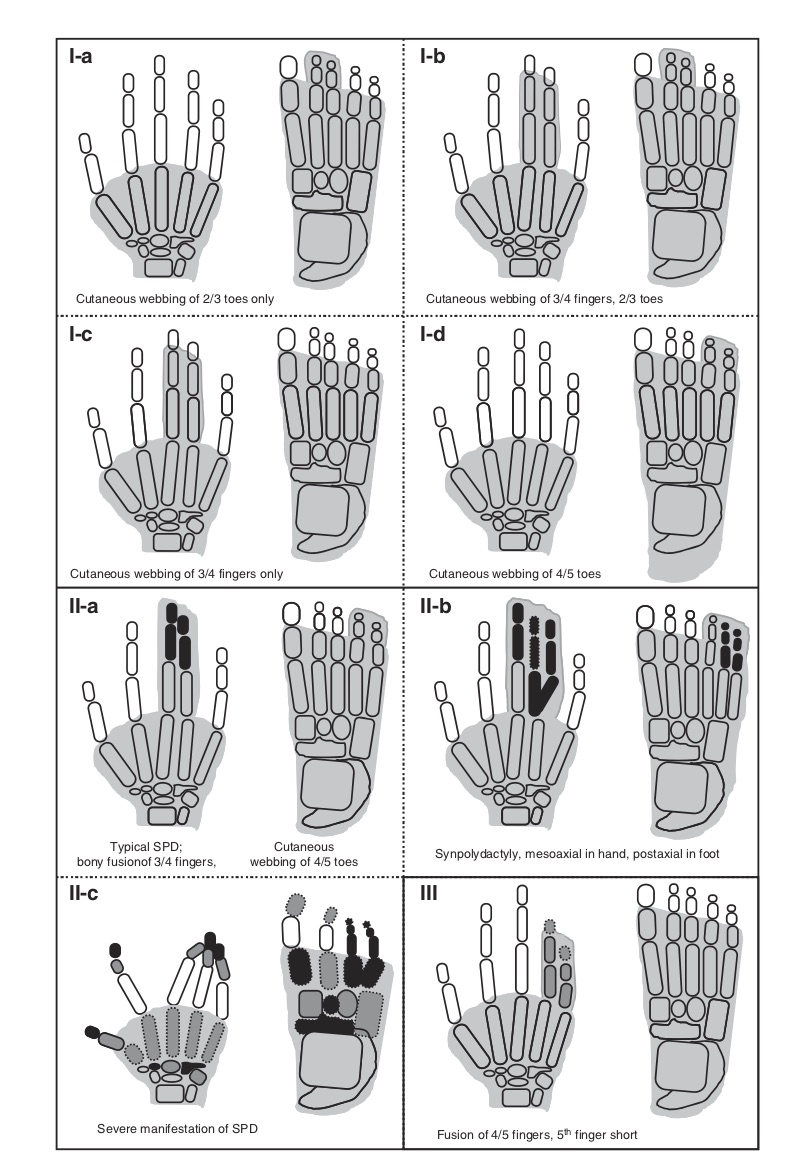
There are several different types and subtypes, depending on whether the condition is classified based on an anatomical approach, a genetic or molecular approach, a descriptive approach or an embryological classification. One classification, from a 2012 review of the topic published in The European Journal of Human Genetics, is shown below.

Schematic diagrams of syndactyly types (I-a–III). Shaded digits depict cutaneous fusion only, while bony synostosis is represented by black digital elements within the shaded area. The grey digital elements show hypoplastic phalanges or clinodactyly…

Schematic diagrams of syndactyly types (I-a–III). Shaded digits depict cutaneous fusion only, while bony synostosis is represented by black digital elements within the shaded area. The grey digital elements show hypoplastic phalanges or clinodactyly/brachydactyly. The digital elements with amorphous borders symbolize dysplastic bones. From Malik S. Syndactyly: phenotypes, genetics and current classification. European Journal of Human Genetics (2012) 20, 817–824;

What Causes Syndactyly? It’s often the genes

Syndactyly sometimes runs in families, so in these cases a genetic cause was long suspected. For example, fusion of the fourth and fifth metacarpals (an uncommon type of syndactyly) was first described 1928 and was initially thought to have an X-linked recessive trait. It was later classified as an autosomal dominant inheritance, found in some families with male-male transmission as well as females affected. But we are now able to exactly pinpoint some of the genetic causes. Type I, Apert syndrome, is associated with the FGFR2 gene (to be exact the the loci 10q26). Type II, (Carpenter syndrome) is linked to RAB23 gene, and Type V, also known as Pfeiffer syndrome is been linked to the FGFR 1 and 2 genes.

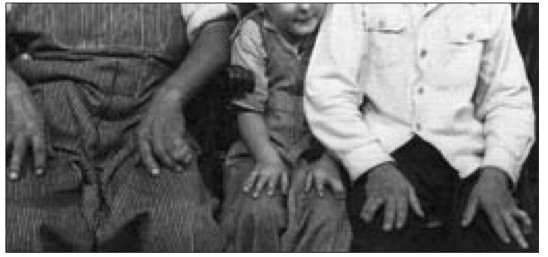
A family with three generations of ring and small finger involvement, none of which was ever surgically corrected. From Flatt A. Webbed Fingers. In The Care of Congenital Hand Anomalies, 2nd ed. St. Louis: Quality Medical Publishing, Inc., 1994:228–…

A family with three generations of ring and small finger involvement, none of which was ever surgically corrected. From Flatt A. Webbed Fingers. In The Care of Congenital Hand Anomalies, 2nd ed. St. Louis: Quality Medical Publishing, Inc., 1994:228–275.

Why did the Mishnah Discuss Syndactyly in Cohanim?

At first, the discussion of syndactyly as a disqualification for a Cohen seems rather odd. I mean really, how many cases could there have been? But the reason that the Mishnah spent time on this is now obvious. In many cases it is a genetic disorder, mostly affecting men. To be a Cohen you must be the child of a father who is a Cohen. As we have already learned, there are several “Cohen related genes,” and now we can add to the list the possibility that one of the many genetic causes of syndactyly was linked to those who were Cohanim, and who might pass the gene to their male children.

As we saw in an earlier post, the rabbis of the Mishnah and Talmud described different medical observations without realising that they originated from a single cause (like alcoholic liver disease) or had a genetic component. How lucky we are to have this knowledge at our fingertips (sorry). The rabbis would have wanted no less.

[Extra credit: The Wiki page on Syndactyly notes that “The earliest appreciation of syndactyly as a birth anomaly…can be traced back to the Andalusian Muslim surgeon Al-Zahrawi (d. 1013 CE).” This should obviously be corrected, since it was mentioned as a birth defect in the Mishnah, edited c. 200 CE, some eight hundred years earlier. Can someone please edit the page so that it is accurate? Thanks.]

Print Friendly and PDF

Bechorot 44 (Part II) ~ Urinary Tract Infections, Infertility and Other Dangers of Long Sermons

When you’ve got to go, you’ve got to go

בכורות מד,ב

אמר רבי אבא בריה דרבי חייא בר אבא משתינין מים בפני רבים ואין שותין מים בפני רבים ותניא נמי הכי משתינין מים בפני רבים ואין שותין מים בפני רבים ומעשה באחד שביקש להשתין מים ולא השתין ונמצא כריסו צבה

urinal.jpeg

Rabbi Abba, son of Rabbi Ḥiyya bar Abba, says that Torah scholars may urinate in public and they need not be concerned with issues of modesty, [because holding back from urinating causes bodily harm]. But they may not drink water in public, as such conduct is unbefitting a Torah scholar. And this is also taught in a baraita: Torah scholars may urinate in public, but they may not drink water in public. And there was an incident involving one who sought to urinate, and he did not urinate, and his belly was found to be swollen.

This is one of those delightful passages in which we learn that Talmudic manners were sometimes the very opposite of our modern ones. Because of the perceived dangers of not urinating when necessary, Torah scholars were permitted, or rather encouraged, to urinate whenever the urge arose, even in public. Drinking in public, however, was not allowed, since this was considered uncouth behavior. And then we read a couple of stories in which the urgent public urination of a Torah scholar is described.

שמואל איצטריך ליה בשבתא דרגלא נגדו ליה גלימא אתא לקמיה דאבוה א"ל אתן לך ד' מאה זוזי וזיל אהדר עובדא את דאפשר לך דלא אפשר ליה ליסתכן

Shmuel needed to urinate on the Shabbat [when everyone came to hear halakhot relating to the impending Festival. In order to afford him privacy], they spread a sheet for him. Shmuel then came before his father, who said to him: I will give you four hundred dinars if you will go and retract this incident, [i.e., if you will state publicly that one may not hold back from urinating even at the expense of one’s privacy.] Since you are an important man, you can have others spread a sheet around you. But with regard to one who cannot have others spread a sheet for him, should he endanger himself by seeking privacy? You must therefore teach that no-one should hold back from urinating even in public.

Shmuel’s father was willing to pay him the massive sum of 400 dinars for Shmuel to clarify to the public that “one should not hold back from urinating even in public.” Then comes another story, (describing what must be one of the weirdest incidents in the Babylonian Talmud). While walking over a bridge, Mar Bar Rav Ashi had the urge to urinate. As he was micturating, he was told that his mother-in-law was on her way, which was presumably a suggestion that hurry up and finish. To which he replied, with a most memorable turn of phrase, emphasising just how important it was to urinate when the urge is felt: “I would have even urinated in her ear”(באודנה).

But what was it that the rabbis feared might happen if you delayed micturition? Infertility. They believed that failing to urinate frequently enough would render a person sterile. And they tell a chilling example of this happening in the tractate Yevamot.

The lecture that went on for too long

רב גידל איעקר מפרקיה דרב הונא רבי חלבו איעקר מפרקיה דרב הונא רב ששת איעקר מפרקיה דרב הונא

Rav Gidel became sterile on account of Rav Huna’s lectures, Rav Chelbo became sterile on account of Rav Huna’s lectures and Rav Sheshet became sterile on account of Rav Huna’s lectures...
— Yevamot 64b

Rav Huna had a lot to answer for.  His lectures went on, and on, and on, and on and on and on.  Rashi (Yevamot 62b) explained the relationship between these lengthy classes and infertility:

איעקר מפרקיה דרב הונא.שהיה מאריך בדרשיו וצריכים למי רגלים ומעמידים עצמן ונעקרים כדתניא בבכורות 

Rav Huna would give lengthy sermons and [his students] would need to urinate. But they held it in, and as a result became sterile, as we read in Bechorot.

The suggestion here is that holding-it-in can lead to problems of fertility, and there is a least a theoretical scientific reason why Rav Huna's lengthy classes had the unintended consequence of lowering the reproductive rates of his students.  

Urinary tract infections and infertility

As it turns out, there is a clear relationship between male infertility and repeated infections of the genitourinary tract. Here, for example, is  how one urology textbook opens its chapter on male genital tract infections and infertility:

Male Genital Tract Infections and Infertility. Neal, DE, Weinstein, SH. In Male Reproductive Dysfunction ed Kandeel FR. Informa Healthcare 2007

Male Genital Tract Infections and Infertility. Neal, DE, Weinstein, SH. In Male Reproductive Dysfunction ed Kandeel FR. Informa Healthcare 2007

Any male GU infection such as prostatitis, urethritis or epididymo-orchitis can reduce both sperm count and the quality of the seminal fluid. OK, but what does that have to do with not urinating when you feel the urge? Well here's the thing: that not-going-when-you-need-to is really not a good idea.

It's quite a challenge to determine scientifically the effect of holding-it-in (and hereafter referred to as delayed micturition, because it sounds nicer) on the risk of getting a urinary tract infection.  You can't very easily randomly assign one large group of healthy volunteers to urinating whenever they want, and a second to urinating only three times a day.

However, there are a couple of observational studies that may be able to tell us something about the risk of delayed micturition.  A 1968 study of 112 women with a documented UTI reported that further UTIs could be reduced by voiding  every two hours during the day (which sounds rather too good to be true). And a 1979 study from the (not-very-widely-read-but-it-really-is-a-journal) Scandinavian Journal of Urology and Nephrology reported that the frequency of UTI was significantly higher among women with three or less voidings per day compared with those who have to go four or more times per day. (Whether this is true for women outside of northern Jutland where the study was conducted remains unclear.)

So a decreased voiding frequency is associated with an increased number of infections, and urinary tract infections are associated with decreased fertility. Thus by the rule of transitive relations (or something clever like it) decreased voiding may indeed be associated in a causative way with decreased fertility.  

All this is highly speculative, and it would certainly be unusual for male sterility to directly result from delayed micturition.  But here's the weird thing: teachers are slightly more likely to suffer urinary tract infections when compared with the general population. Is that because they too, like their students, hold-it-in? (Yes, I know it didn't reach statistical significance, but the authors thought it was important to note, and so do I.)   

Kovess-Masféty, V. Do teachers have more health problems? Results from a French cross-sectional survey. BMC Public Health 20066:101;1-13

Kovess-Masféty, V. Do teachers have more health problems? Results from a French cross-sectional survey. BMC Public Health 20066:101;1-13

Poor Rav Huna, talking on and on and on, while his miserable students had to sit there with their legs crossed and could likely only think of only one thing. We will give the last word to Rav Acha bar Yaakov, another hapless student of Rav Huna. 

אמר רב אחא בר יעקב שיתין סבי הוינא וכולהו איעקור מפרקיה דרב הונא לבר מאנא

Rav Acha bar Yaakov said, we were a group of sixty students, and all of us became sterile because of Rav Huna's lectures - except me (Yevamot 64b).

Students be warned.

[Partial repost from here.]


Print Friendly and PDF