Middot 37b ~ The Lineage of the Cohen

On the very last page of the tractate Middot that deals with the architecture of the Temple in Jerusalem, we read this touching scene described in the Mishnah:

מדות לז, ב

לִשְׁכַּת הַגָּזִית, שָׁם הָיְתָה סַנְהֶדְרִי גְדוֹלָה שֶׁל יִשְׂרָאֵל יוֹשֶׁבֶת וְדָנָה אֶת הַכְּהֻנָּה, וְכֹהֵן שֶׁנִּמְצָא בוֹ פְסוּל, לוֹבֵשׁ שְׁחוֹרִים וּמִתְעַטֵּף שְׁחוֹרִים, וְיוֹצֵא וְהוֹלֵךְ לוֹ. וְשֶׁלֹּא נִמְצָא בוֹ פְסוּל, לוֹבֵשׁ לְבָנִים וּמִתְעַטֵּף לְבָנִים, נִכְנָס וּמְשַׁמֵּשׁ עִם אֶחָיו הַכֹּהֲנִים. וְיוֹם טוֹב הָיוּ עוֹשִׂים, שֶׁלֹּא נִמְצָא פְסוּל בְּזַרְעוֹ שֶׁל אַהֲרֹן הַכֹּהֵן, וְכָךְ הָיוּ אוֹמְרִים, בָּרוּךְ הַמָּקוֹם בָּרוּךְ הוּא, שֶׁלֹּא נִמְצָא פְסוּל בְּזַרְעוֹ שֶׁל אַהֲרֹן. וּבָרוּךְ הוּא, שֶׁבָּחַר בְּאַהֲרֹן וּבְבָנָיו לַעֲמֹד לְשָׁרֵת לִפְנֵי ה' בְּבֵית קָדְשֵׁי הַקֳּדָשִׁים:

In the chamber of hewn stone the great Sanhedrin of Israel used to sit and judge the priesthood. A priest in whom was found a disqualification used to put on black garments and wrap himself in black and leave the premises of the Temple. One in whom no disqualification was found used to put on white garments and wrap himself in white and go in and serve along with his brother priests. They used to make a feast because no blemish had been found in the seed of Aaron the priest, and they used to say: Blessed is the Omnipresent, blessed is He, for no blemish has been found in the seed of Aaron. Blessed is He who chose Aaron and his sons to stand to minister before the Lord in the Holy of Holies.

What was the “disqualification” about which the Mishnah speaks? It arose as a result of aspersions about the lineage of the Cohen, as Maimonides describes in his Mishnah Torah:

רמב’ם חל׳ ביאת המקדש, ו, יא

בֵּית דִּין הַגָּדוֹל הָיוּ יוֹשְׁבִין בְּלִשְׁכַּת הַגָּזִית. וְעִקַּר מַעֲשֵׂיהֶם הַתָּדִיר שֶׁהָיוּ יוֹשְׁבִין וְּדָנִין אֶת הַכְּהֻנָּה וּבוֹדְקִין הַכֹּהֲנִים בְּיוּחֲסִין וּבְמוּמִין. כָּל כֹּהֵן שֶׁנִּמְצָא פָּסוּל בְּיִחוּסוֹ לוֹבֵשׁ שְׁחוֹרִים וּמִתְעַטֵּף שְׁחוֹרִים וְיוֹצֵא מִן הָעֲזָרָה. וְכָל מִי שֶׁנִּמְצָא שָׁלֵם וְכָשֵׁר לוֹבֵשׁ לְבָנִים וְנִכְנָס וּמְשַׁמֵּשׁ עִם אֶחָיו הַכֹּהֲנִים

The Great Court sat in the Chamber of Hewn Stone. Their most important and most frequent task was to rule on the ancestry and disqualifications of the priests [who served in the Temple]. Any priest in whom there was a disqualification because of their ancestry would dress in black and wear a black headscarf and would leave the Courtyard. And a priest who was found to be of appropriate ancestry would dress in white and enter to serve with his fellow priests.

The decision would be made on the testimony of priest and those who knew of his lineage, as described in this Mishnah :

משנה כתובות דף כג עמוד ב 

וכן שני אנשים, זה אומר כהן אני וזה אומר כהן אני - אינן נאמנין, ובזמן שהן מעידין זה את זה - הרי אלו נאמנין; רבי יהודה אומר: אין מעלין לכהונה על פי עד אחד

Likewise in the case of two men; one says, "I am a Cohen", and the other says "I am a Cohen", they are not believed. If however they testify about one another they are believed. R. Yehuda said: we do not elevate [a person] to the status of Cohen based on the testimony of only one witness....

But what if the Cohen was mistaken about his ancestors? What if the witnesses were being paid to dupe the locals into believing the Cohen was legitimate? Is there an alternative to the methods mentioned in this Mishnah? In today’s world of genetic testing there just might be.

The Saturday Night Live Cohen 

My friend Misha Galperin, (the former CEO of the Jewish Federation of Greater Washington and  CEO of International Development at The Jewish Agency) is a Cohen. Only he didn't know it when he arrived in America from the Soviet Union.  Here's what happened, as told to me in a recent email that he kindly allowed me to share:

Five months after arriving in the US, I am sitting in the lounge of Yeshiva University's dorm watching SNL with my tutor who was teaching me Alef Bet is so I can start classes on Monday.
A skit starts with guest host Leonard Nimoy dressed as Mr. Spock - with ears - and at the end he raises his right palm in the symbolic gesture and says: "Live long and prosper!"
I turn to the tutor and ask him what this gesture means. Why?--he asks. "Because my father taught me this, and his father taught it to him before being murdered by Nazis in 1941. My father did not know what it meant, but he taught me..."

And so Misha learned that he was a Cohen from Saturday Night Live. But not all Cohanim are so lucky. (Fun fact: Leonard Nimoy ז’ל wrote about his decision to give Mr. Spock this priestly hand salute in his 1997 autobiography I Am Not Spock.)  With neither witnesses nor TV to help, is there another way to establish one's genealogy as a member of the priestly class? That's where the Cohen Gene comes in.  

The Cohen Gene

If all Cohanim are descended from Aaron, and the privilege is only transmitted from father to son, then perhaps being a Cohen can be genetically linked to a chromosome that is only passed from father to son. And there is such a chromosome. It's the Y chromosome, and all (fertile) men carry a copy that comes only from their biological father. (Quick recap: girls are XX and boys are XY. So all girls carry one X chromosome from mum and one X chromosome from dad. Boys, on the other hand, only get their X chromosome from mum, and their Y chromosome from dad. This can lead to other problems like hemophilia, which we've talked about elsewhere.) That's exactly what prompted  Karl Skorecki from the Technion, and colleagues from University College London, to analyze the Y chromosome in Cohanim and compare it to the rest of the Jewish population.  In 1997 they published a paper in Nature that looked at a special bit of the Y chromosome called YAP. Actually, they looked at 6 kinds of the YAP haplotype, (a haplotype being what geneticists call bunches of DNA sequences), and compared their frequency in Cohanim and non-Cohanim.    

Skorecki K, et al. Y Chromosomes of Jewish Priests. Nature 1997. 385:32.

Skorecki K, et al. Y Chromosomes of Jewish Priests. Nature 1997. 385:32.

As you can see highlighted, the YAP+ haplotype was found in only 1.5% of those who self-identified as Cohanim, but in over 18% of non-Cohanim.  The different frequency was found in both Ashkenazi and Sephardi Cohanim,  a result that the authors claimed was "consistent with an origin for the Jewish priesthood antedating the division of world Jewry into Ashkenazic and Sephardic communities."

These Y-chromosome haplotype differences confirm a distinct paternal geneology for Jewish priests.
— Skorecki et al. Nature 1997. 385: 32.

David Goldstein, who directs the  Center for Human Genome Variation at Duke University, also published a study on the Y-chromosome of Cohanim, using a sample that included the DNA swabbed "from the mouths of sunbathers on the beaches of Tel Aviv." Here is what Goldstein concluded:

Despite the high levels of variation, we could see a clear difference between Cohen and Israelite chromosomes. The most common chromosomes observed in the Israelites (that is, non-Cohen and non-Levite Jews) were found in only 12% of the Israelite individuals sampled. By contrast, more that half of the Cohen Y chromosomes were identical at the sites considered - that is, the majority of the self-identified Cohanim had the same type of Y chromosome. Even more remarkable, this same type of Y was found at high frequencies in both Ashkenazi (45%) and Sephardi (56%) Cohanim. (Goldstein, p.31)

Goldstein named this chromosome type the Cohen Modal Haplotype, and claimed that it showed "definitively" that Cohen status was not adopted (i.e. made up by some, eager for the benefits) but inherited.  And now things started to get really interesting. 

Dating the Original Aaron

So all, (all right, not all, but certainly most) of the approximately 500,000 Cohanim alive today seem to have originated from a common ancestor - a primordial Cohen. And just when did he live? Well, by analyzing small differences in the Cohen Modal Haplotype, and assuming that a generation time is 25 years, Goldstein et al. stated (with a confidence interval of 95%) that the origin of the priestly Y chromosome was "sometime during or shortly before the Temple period in Jewish history."

Not So Fast...

OK, a couple of things need to be noted here, before anyone claims that "genetics proves the Bible." First- as Goldstein himself notes in his book, his numbers may be off, by quite a bit:

Permit me here, after what was for me the first - and still one of the few - real thrills of discovery that punctuate the tedium and detail of science, the necessary reality check. Our results appeared to be a striking confirmation of the oral tradition. It even led to repeated claims in the press that my colleagues and I "found Aaron's Y chromosome." But although three thousand years is our best guess [as to when Primordial Cohen may have lived] the range of possible dates was and is very broad. Given our uncertainty about the ways mutations happen and how fast, we may be off by several hundred years or more in either direction. (Goldstein p.38).

Second, some later work done by Skorecki (he of the Technion 1997 Nature paper) suggests that the class of Cohanim may have had more than one common ancestor.  This work posits that there was not one primordial Cohen, but a few clans of Cohanim, from whom all later Cohanim are descended. (Or more technically stated:"...lineages characterized by the 6 Y-STRs used to define the original Cohen Modal Haplotype are associated with two divergent sub-clades...and thus cannot be assumed to represent a single recently expanding paternal lineage.")

And finally, work from Brigham Young University (and boy, those guys are really into ancestry) reminds anyone looking to do a quick Cohen DNA test to be careful.

The Cohen Modal Haplotype is observed in high frequency within the Cohanim, but also presents with significant incidence in other non-Jewish populations. The occurrence of the CMH in deeply divergent SNP haplogroups also indicates a lack of specificity of the CMH to the ancient Hebrew population. As such, inference of relation to Jewish populations for individuals or groups should be performed with caution when using the original CMH definition, as a false-positive result is likely.

 "A false positive is likely" - in other words, the test may show you are a Cohen, but really...you aren't. 

Genetic Testing - It's Not Just for Cohanim

And now that a Cohen "Gene" may have been identified, what about the rest of us non-Cohanim? Some have used genetic testing to discover a forgotten heritage or find long-lost cousins.  One rather keen family member of Polonsky rabbinic lineage (claiming in passing to be descended from King David, the Kalonymos family, and Rashi) used the presence of a "relatively rare R-M124 haplotype" on the Y chromosome to confirm a common ancestor and find a new marker that represents "Polonsky rabbinic lineage." (I confess I am jealous. My grandfather drove a black London taxi, and last time I checked, Rashi was not one of my known ancestors.) 

It's Not About Your Ancestors, It's About You

רמב"ם הלכות שמיטה ויובל פרק יג הלכות יב –יג 

ולמה לא זכה לוי בנחלת ארץ ישראל ובביזתה עם אחיו? מפני שהובדל לעבוד את יי לשרתו ולהורות דרכיו הישרים ומשפטיו הצדיקים לרבים שנאמר יורו משפטיך ליעקב ותורתך לישראל, לפיכך הובדלו מדרכי העולם לא עורכין מלחמה כשאר ישראל ולא נוחלין ולא זוכין לעצמן בכח גופן, אלא הם חיל השם שנאמר ברך יי חילו, והוא ברוך הוא זוכה להם, שנאמר: אני חלקך ונחלתך

ולא שבט לוי בלבד אלא כל איש ואיש מכל באי העולם אשר נדבה רוחו אותו והבינו מדע להבדל לעמוד לפני יי לשרתו ולעובדו לדעה את יי והלך ישר כמו שעשהו האלהים ופרק מעל צוארו עול החשבונות הרבים אשר בקשו בני האדם הרי זה נתקדש קדש קדשים. ויהיה יי חלקו ונחלתו לעולם ולעולמי עולמים ויזכה לו בעה"ז דבר המספיק לו כמו שזכה לכהנים ללוים, הרי דוד עליו השלום אומר: יי מנת חלקי וכוסי אתה תומיך גורלי

Why did the Levi'im not receive a portion in the inheritance in Israel and in the spoils of war like their brethren? Because they were set aside to serve God, to minister to Him and to instruct the masses about His just paths and righteous judgments... Therefore they were set apart from the mundane matters of the world. They do not wage war like the remainder of the Jewish people, nor do they receive an inheritance, nor do they acquire for themselves through their physical power. Instead, they are God's legion...and He provides for them...

Not only the tribe of Levi, but any human whose spirit moves him and who understands with his wisdom to set himself aside and stand before God - to serve Him and minister to Him and to know Him, proceeding justly as God made him, removing from his neck the yoke of the many mundane things which people seek - that person is sanctified like the Holy of Holies [in the Temple]. God will be his portion and heritage forever and will provide what is sufficient for him in this world, just as He provides for the Cohanim and the Levi'im...

Maimonides, in his Mishnah Torah,  reminds us about what is really important. It's not bringing a witness into town and telling everyone who your ancestors are. And it's not getting a DNA test to prove your stock. It's about searching for religious meaning in a world of materialism.  And that search is open to anyone, woman or man, Jew or not, Cohen, Levi, or even a plain old Yisrael.  

[Repost from Ketuvot 23b]

Print Friendly and PDF

Middot 34a ~ The Temple as a Model of the Solar System

The Second Temple in Jerusalem. On the right are the three northern gates into the courtyard. From front to back they are The Women’s Gate (שער הנשים), The Gate of the Offering (שער הקרבן), and The Gate of the Ray (שער הניצוץ).

The Second Temple in Jerusalem. On the right are the three northern gates into the courtyard. From front to back they are The Women’s Gate (שער הנשים), The Gate of the Offering (שער הקרבן), and The Gate of the Ray (שער הניצוץ).

In tomorrow’s page of Talmud, we read the following Mishnah that describes the architecture of the Temple in Jerusalem.

מדות לד, א

שִׁבְעָה שְׁעָרִים הָיוּ בָעֲזָרָה, שְׁלשָׁה בַצָּפוֹן וּשְׁלשָׁה בַדָּרוֹם וְאֶחָד בַּמִּזְרָח. שֶׁבַּדָּרוֹם, שַׁעַר הַדֶּלֶק. שֵׁנִי לוֹ, שַׁעַר הַבְּכוֹרוֹת. שְׁלִישִׁי לוֹ, שַׁעַר הַמָּיִם. שֶׁבַּמִּזְרָח, שַׁעַר נִקָּנוֹר, וּשְׁתֵּי לְשָׁכוֹת הָיוּ לוֹ, אַחַת מִימִינוֹ וְאַחַת מִשְּׂמֹאלוֹ, אַחַת לִשְׁכַּת פִּנְחָס הַמַּלְבִּישׁ, וְאַחַת לִשְׁכַּת עוֹשֵׂי חֲבִתִּין

There were seven gates in the courtyard [of the Temple the stood in Jerusalem]: three in the north and three in the south and one in the east. In the south: the Gate of Kindling, and next to it the Gate of the First-borns, and then the Water Gate. In the east: the Gate of Nicanor. It had two chambers, one on its right and one on its left. One was the chamber of Pinchas the dresser and one the other the chamber of the griddle cake makers.

The Temple was not only the physical resting place of God on earth. It was also a model of the universe itself, and built into it was the very structure of our solar system. Here’s how.

Rabbi Moses Isserles: Halachist and Astronomer

For Ashkenazi Jews who practice their faith, perhaps the most important figure is Rabbi Moses Isserles (d. 1572). R. Isserles, better known by his acronym as the Rema, earned this accolade because of his gloss on the Shulhan Arukh, the code of Jewish law, which had been written by a Sephardic Jew, Joseph Caro (d. 1575). Caro’s magnum opus was the defining code of Jewish law, but it had a serious deficiency in that it lacked the customs and rulings of the Ashkenazi Jews of Germany and Poland. Moses Isserles redressed this defect by writing a commentary and supplement for the Ashkenazi Jews, and as a result the Shulhan Arukh with Isserles’ gloss became the authoritative code and guide for all Polish-German Jews. The Shulhan Arukh was first published in Venice in 1565 and went through six editions in Caro’s lifetime alone, with Isserles’ gloss becoming the authoritative reference work for Ashkenazi Jews. 

But the Rema’s scholarship was not limited to the vast field of Jewish law, and he was deeply interested in astronomy. He wrote a commentary on the Hebrew translation of Georg Peuerbach’s Theoricae Novae Planetarum (New Theories of Planets), which had been published in 1473. He also wrote a more esoteric work of astronomy entitled Torat Ha’olah (The Laws of the Burned Sacrifice), in which he demonstrated how the Temple in Jerusalem symbolized a wide range of astronomical phenomena. The Rema claimed that there was a direct numerical relationship between the Temple and these phenomena, and he wove together a wide range of earlier rabbinic sources and non-Jewish astronomers to prove his thesis. For example, he wrote that the altar of the Temple corresponded to the layout of the heavens, and that the seven gates leading into the temple corresponded to the seven planets.

The Azarah [the large courtyard in the Temple] was a reflection of the World of the Spheres as we have explained, which is why they stated that it had seven gates, which represented the seven planets, Saturn, Jupiter, Mars, the Sun, Venus, Mercury and the Moon. For each of these planets has its own gate in its own particular path, and the path of one is not like the path of another. Three of the gates in the Temple are on the left and three on the right, representing the three planets to the right of the sun which are the major ones. These are hinted to in the gates on the east, as I will explain. And the three gates to the left represent the three planets to the left of the Sun which stands in the middle, like a king in the middle of his soldiers. And in truth this fact has persuaded the astronomers to believe that the sun is at the center of all the stars [Torat Ha’olah 12b].

Philo: The Menorah was also a Model of the Solar System

The Rema was following a long tradition of ascribing allegorical meaning to the Temple and its various contents. Perhaps the earliest to do so was Philo of Alexandria, a Jewish biblical commentator who lived in the first century. He wrote of the allegorical meaning of the menorah, the seven-branched candelabrum that was placed in the Tabernacle and later in the Temple in Jerusalem:

[F]rom this candlestick there proceeded six branches, three on each side, projecting from the candlestick in the center, so as altogether to complete the number of seven; and in all the seven there were seven candles and seven lights, being symbols of those seven stars which are called planets by those men who are versed in natural philosophy; for the sun, like the candlestick, being placed in the middle of the other six, in the fourth rank, gives light to the three planets which are above it, and to those of equal number which are below it, adapting to circumstances the musical and truly divine instrument.

The menorah as symbol of the order of the planets from the Earth. From here. Don’t be confused - this is not a model of the heliocentric solar system. Rather, the sun is the fourth of seven ‘planets’ from Earth, so it is in the middle.

The menorah as symbol of the order of the planets from the Earth. From here. Don’t be confused - this is not a model of the heliocentric solar system. Rather, the sun is the fourth of seven ‘planets’ from Earth, so it is in the middle.

The famous Spanish commentator Isaac ben Moses Arama (c. 1420–1494) also described the Menorah as a model of the solar system, in his commentary on the Torah called Akedat Yitzhak (The Binding of Isaac). It is fascinating to read see how Arama weaved the Ptolemaic geocentric system into his allegorical interpretation of the menorah, echoing Philo’s commentary:

The Sun is the central branch, for it is that which is required to lead all the others. [The three branches on each side represent] the three planets, three on one side and three on the other, which serve to help and support the perfection of one’s intentions. . . .

It is easy to mistakenly read Arama’s allegorical interpretation as placing the Sun at the center of the solar system, but this is not what he described. Rather, Arama outlined the order of the planets of the Ptolemaic system. These were the seven planets in the order in which they orbited the Earth, with the Moon closest and Saturn furthest away, as shown in the figure above.

Allegory is re-interpreted…allegorically

Although Isaac Arama’s interpretation would have been understood in the early-fifteenth-century pre-Copernican world, this allegory made no sense if the Sun was not the fourth planet of seven presumed to be orbiting the Earth. Hayyim Yosef Pollak, a nineteenth-century rabbi who wrote a commentary onAkedat Yitzhak, noted this problem. Pollak paraphrased Arama’s explanation in a post-Copernican way:

The six branches that come out from the sides hint at the six types of partial wisdom [contained in the Torah] that help to complete the main type of wisdom [represented by the central branch]. . . . You can also imagine the Sun is the largest and most central of the planets, and around it orbit the other six planets. . . .

Although both Arama and Pollak interpreted the central branch of the menorah as allegorically representing the Sun, their cosmology was completely different. Pollak’s interpretation is not in fact what Arama had originally written, leading to the curious, if not entirely unexpected, situation of an allegorical explanation itself being interpreted allegorically. 


The Menorah and the Catholic Church

A similar exegesis was made by a Carmelite priest from Calabria in southern Italy, Paolo Antonio Foscarini, in a letter that he wrote in 1615. Foscarini’s goal was to demonstrate how the Bible could be reconciled with the new Copernican model. In the letter Foscarini suggested that the six branches of the Menorah found in the Temple corresponded to the six “heavens,” or planets, that orbit the Sun.

And could it not be that, in the marvelous structure of the candlestick placed in the Tabernacle of God, our most loving God wished to represent secretly to us the system of the universe and in particular of the planets?…it could be that these branches signify the six heavens which rotate around the sun as follows. Saturn, which is the slowest and furthest away, completes its path around the sun through all twelve signs of the zodiac in thirty years; Jupiter, which is closer, in twelve years; Mars, which is closer still, in two years. The earth, which is closer than that, moves through its path together with the orb of the moon in one year, i.e twelve months. Venus, which is still closer than all of these, in nine months. Finally Mercury, which is closest of all to the sun, in less than three months…

Having described the six branches, the Sacred Text goes on to discuss the cups, the small globes and the flowers [that adorned the branches of the Menorah]…Could it be that these three cups…are intended to signify globes (like our own earth)…? More precisely, could it be that they signify those globes [i.e moons] discovered by the telescope which are associated with Saturn, Jupiter Venus and perhaps other planets…

Alas, the letter (“Concerning the Opinion of the Pythagoreans and Copernicus About the Mobility of the Earth and the Stability of the Sun”) didn’t get a wide readership. It was was placed on the Index of Forbidden Books in March 1616 as “completely prohibited and condemned.”

The Second Temple in Jerusalem was a spectacular building, and its loss is still mourned in our daily prayers. So the next time you gaze up at the starry night, pause for moment to reflect on the grandeur of what once was.

Vincent van Gogh painted Starry Night in 1889 during his stay at the asylum of Saint-Paul-de-Mausole. From the collection of the Museum of Modern Art, New York.

Vincent van Gogh painted Starry Night in 1889 during his stay at the asylum of Saint-Paul-de-Mausole. From the collection of the Museum of Modern Art, New York.

Print Friendly and PDF

Tamid 32a ~ How High is the Sky? (And How to Measure It)

Tomorrow we will read a wondrous page of Talmud, that includes a discussion of astronomical distances.

תמיד לא, ב

:עשרה דברים שאל אלכסנדרוס מוקדון את זקני הנגב אמר להן

[תמיד לב, א]

מן השמים לארץ רחוק או ממזרח למערב אמרו לו ממזרח למערב תדע שהרי חמה במזרח הכל מסתכלין בה חמה במערב הכל מסתכלין בה חמה באמצע רקיע אין הכל מסתכלין בה

וחכמים אומרים זה וזה כאחד שוין שנאמר (תהלים קג, יא) כגבוה שמים על הארץ [וגו'] כרחוק מזרח ממערב ואי חד מינייהו נפיש נכתוב תרווייהו כי ההוא דנפיש ואלא חמה באמצע רקיע מ"ט אין הכל מסתכלין בה משום דקאי להדיא ולא כסי ליה מידי

Alexander of Macedon asked the Elders of the Negev about ten matters.

He said to them: Is the distance from the heavens to the earth further, or is the distance from east to west further? They said to him: From east to west is a greater distance. Know that this is so, as when the sun is in the east, everyone looks at it without hurting their eyes, and when the sun is in the west, everyone looks at it without hurting their eyes. By contrast, when the sun is inthe middle ofthe sky, no one looks at it, as it would hurt their eyes. [This shows that the sun’s place in the middle of the sky is not as far from the earth as its remote positions in the extreme east and west].

But the Sages say: This distance and that distance are equal, as it is stated: “For as the heaven is high above the earth, so great is His kindness toward them that fear Him. As far as the east is from the west, so far has He removed our transgressions from us” (Psalms 103:11–12). [The verses compare the extent of God’s kindness and His removal of transgressions to vast expanses.] And if one of the distances is greater than the other, let the verse write that both of God’s enumerated attributes are like the measure that is greater. But if so, with regard to the sun in the middle of the sky, what is the reason that no one looks at it? It is because it stands exposed and nothing covers it, [whereas it is partially screened when it is in the east or the west.]

Method for measuring the distance from the Earth to the Moon. From Joseph Delmedigo’s 1629 masterpiece, Sefer Elim, p152.

Method for measuring the distance from the Earth to the Moon. From Joseph Delmedigo’s 1629 masterpiece, Sefer Elim, p152.

Alexander on tour…

The path of the sun, based on the famous passage in Peaschim 94b.

The path of the sun, based on the famous passage in Peaschim 94b.

Historians know that Alexander the Great waged a famous campaign against Gaza and Egypt in 332 BCE. That would have placed him in or near the area in southern Israel known as the Negev, and it is while he was there that he asked the local sages whether the distance to the heavens is greater than the distance from east to west. To moderns, this is a silly question, but not to Alexander and his contemporaries. They believed that the world was a flat saucer, covered with water on which the earth floated in the middle. They also believed above us lay a solid vault that contained the stars, and which the rabbis referred to as the rakia. So which was greater, the distance up to the heavenly vault that held the sun and the stars, or the distance from one side of the earth to the other? It’s a fair question.

November 11 2019 - The Transit of Mercury

November 11, 2019: Mercury transits the sun from east to west. The horizontal yellow line represents the ecliptic, and the top is North. Make sure you are using a sun-filter on your telescope, and don’t try this with hand-held binoculars (too wobbly…

November 11, 2019: Mercury transits the sun from east to west. The horizontal yellow line represents the ecliptic, and the top is North. Make sure you are using a sun-filter on your telescope, and don’t try this with hand-held binoculars (too wobbly to see). From here.

And here is how it looks in real life through a telescope. Mercury is the black dot in the lower part of the image. At top is a more blurry sunspot. From here.

And here is how it looks in real life through a telescope. Mercury is the black dot in the lower part of the image. At top is a more blurry sunspot. From here.

On November 11, the tiny planet of Mercury will transit (that’s astronomy-speak for “passing in front of”) across the sun. These events get astronomers very excited. You may recall that back in June of 2012 Venus was in transit across the face of the sun, leading many to spend a sunny day peering into a telescope for a glimpse. (I did. It was amazing.)

Back in the nineteenth century, the transit of Venus was of huge scientific importance because by observing it from various locations and using some clever trigonometry, astronomers could calculate the distance from the Earth. Knowing this would allow the distance of other planets from the Earth to be calculated, which would then give the answer to one of the most important astronomical questions of the time: Just how big is the solar system?

Using the transit of Venus to determine the distance from the earth to the Sun. For a deep dive into how the math works see this delightful article in the December 2003 edition of Mathematics Magazine.

Using the transit of Venus to determine the distance from the earth to the Sun. For a deep dive into how the math works see this delightful article in the December 2003 edition of Mathematics Magazine.

The transit of Venus always occurs twice in eight years, followed by a gap of 105.5 or 121.5 years. The first time it could be viewed was in 1639, but that transit was witnessed by only two observers. By the time of the paired transits of 1761 and 1769, scientific instruments were accurate enough to provide the data needed for the all-important calculations. So in 1760 and again in 1768 the major European nations including Britain, France, Spain and Russia sent teams across the globe to measure the transit times of Venus. Perhaps the most famous expedition was that led by Captain James Cook who sailed from London to Tahiti and made a series of accurate measurements that allowed the all-important calculations to be made.

Anyway, in a couple of weeks the tiny planet of Mercury will also transit the sun. In the past, this event too could have been used to calculate the size of the solar system. But it wasn’t. The planet is just too small and too far away, and the telescopes of the time were too inaccurate for any scientifically valid measurements to be taken. Instead, astronomers waited for the larger and more visible planet Venus to transit, which also caught the attention of some important Jewish authors.

Three Jewish responses to measuring the size of the universe

  1. Sefer Haberit 1797

The first Hebrew book to discuss the transit of Venus was Sefer Haberit, The Book of the Covenant, first published in 1797 in Brno. That also makes it the first Hebrew book to discuss the measurement of astronomical distances.

The author was Pinhas Hurwitz, a self-educated Jew from Vilna. Sefer Haberit was divided in two parts; the first, consisting of some two hundred and fifty pages is a scientific encyclopedia, addressing what Hurwitz called human wisdom (hokhmat adam) and focuses on the material world. The second part, shorter than the first at only one hundred and thirty pages, is an analysis of divine wisdom (hokhmat elohim), and focuses on spiritual matters. Sefer Haberit was an encyclopedia, and contained information on astronomy, geography, physics, and embryology. It described all manner of scientific discoveries, from the barometer to the lightening rod, and gave its readers up to date information on the recent discovery of the planet Uranus, and the (not so recent) discovery of America. Sefer Haberit was also incredibly popular; it has been reprinted some thirty times, was translated into Yiddish and Ladino, and remains available today.

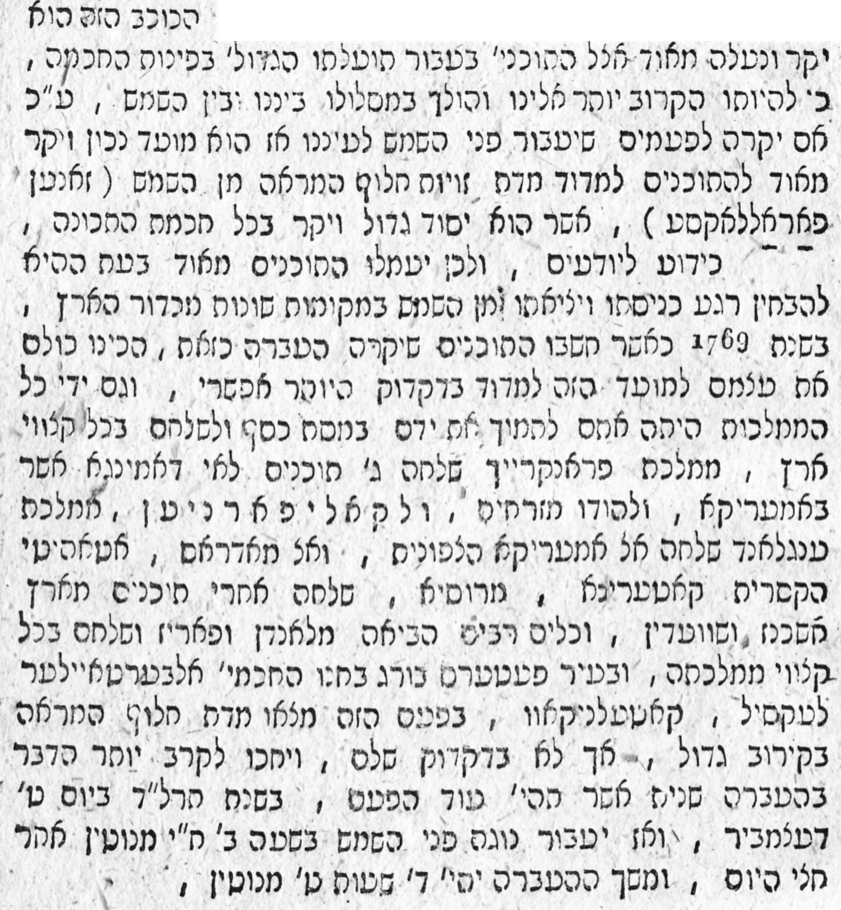
In a section on solar and lunar eclipses, Hurwitz recalled the transit of Venus in 1769. He described how Cook’s expedition had almost been in vain when some of their scientific instruments were stolen the night before the transit, and how, thanks to the team’s valiant efforts, the stolen instruments were returned. Here is the original text:

Text of Sefer Haberit in one.png

And I have twice witnessed a solar eclipse caused by the moon. The first was in the Hague in Holland, and the second in Vilna in Lita, the city of my birth. During my life there was also a transit of across the sun by the planet Venus, which passed in front of it as a tiny round black dot…

This transit [of 1769] became famous across the world before it had even occurred. In British universities they examined and calculated the orbits of the planets and discovered that at a specific time Venus will pass across the face of the sun. Several years prior, they published that this event would be visible at a specific time in one location and at another time in another location…So one year prior a number of wealthy adventurers left England and sailed for more than a year to reach distant shores. They reached the island of Tahiti in the Americas, together with their telescopes and equipment to see the transit under the best conditions…

On the day before the event they set up their equipment at a specific location to be ready for the transit. But overnight the locals stole all the equipment, and then denied having done so, making the entire trip almost fruitless. But after intense negotiations they returned it all, and the transit of Venus occurred at the exact time that had been predicted…

Cook eventually returned to England with his measurements, which together with those from several other observations from Lapland to California eventually allowed the Sun-Earth distance to be calculated. (Oh, and that bit about the equipment being stolen. It is mostly true. A quadrant went missing. Here is how Cook described what happened next in his journal: “… it was not long before we got information that one of the natives had taken it away and carried it to the Eastward...I met Mr Banks and Mr Green about 4 miles from the Fort returning with the Quadrant, this was about Sunset and we all got back to the Fort about 8 oClock.”)

What is of interest here is that Hurwitz did not inform his readers of the real reason that the transit was to be observed.  There is no mention of the way in which the transit of Venus could be used to determine the size of the solar system or the distance from the sun to the Earth, which were of course the real reasons for all the time and effort being spent in observing it.  Why did Hurwitz leave all this out, and suggest instead that the reason for sending Captain Cook all the way from London to Tahiti was to see if the predictions for the time of the transit were accurate?

The answer lies in the fact that Hurwitz was somewhat conflicted about his belief in the model suggested by Copernicus in which the Earth and all the planets revolve around a stationary sun.  Although in some places in Sefer Haberit he spoke highly of the Copernican model, Hurwitz ultimately sided with the Tychonic universe in which all the planets except the Earth revolve around the Sun, while the Sun orbits a stationary Earth, dragging the planets along with it. He did this for a number of scientific and theological reasons, including a belief that the Earth was the crowning glory of creation. “All of the planets were only created for the sake of this Earth, and everything was created for the sake of mankind on the Earth...even if the purpose of these other heavenly creations is not always clear to us.”Since the Earth was the reason for creation, it was only fitting that it lay at the center of the universe.

Hurwitz described the goal of Cook’s expedition to Tahiti as testing the predictions of the timing of the transit, when in fact its mission was far more important than that. But since Hurwitz ultimately rejected the Copernican model, he chose not to discuss the real reason for Cook’s expedition, namely to provide data that would allow the size of the Copernican solar system to be calculated.  Instead, Hurwitz described the mission as one to verify the times of the predicted transit, as a sort of test of the ability of astronomers to predict these kinds of events.  Although he did not reveal the real goals of the expedition, he noted that is was a great success, and that transit of Venus occurred precisely the times predicted. Which it did.

The range of solar parallax values derived from the 1769 transit, and thus the length of the astronomical unit, drew ever closer other values accepted today. ...a modern radar-based value for the astronomical unit is 92,955,000 miles.
And based on his analysis of the 1769 transit of Venus, Thomas Horsby wrote in 1771 that “... the mean distance of the Earth from the Sun will be 93,726,900 English miles.”
Eight-tenths of a percent difference. Absolutely remarkable.
— Teets, D. Transits of Venus and the Astronomical Unit. Mathematic Magazine 2003; 75 (5); 347.

2. Kochava Deshavit 1835

We have previously discussed the Jewish scientist extraordinaire Chaim Zelig Slonimski, For our new readers here is a recap.

Chaim Zelig Slonimski. Kochava DeShavit 1835.

Chaim Zelig Slonimski. Kochava DeShavit 1835.

To coincide with the appearance of Halley's Comet in 1835, a Hebrew book called Kokhava Deshavit (The Comet) was published in Vilna. It described where and when the comet would be visible with precise coordinates for the inhabitants of Bialystok, as well as an explanation of the nature of comets and their orbits. The author was the remarkable Hayyim Zelig Slonimski, (1810-1904), the founding editor of Hazefirah (The Dawn), a weekly Hebrew-language newspaper first published in Warsaw in 1862. He also wrote Mosdei Hokhmah (The Foundation of Wisdom), a work on algebra, and struck up a friendship with the famed German naturalist and explorer Alexander von Humboldt (1769–1859). Not content with all this, Slonimski invented a method to send two telegraphs simultaneously over one wire (which was a very big deal at the time,) and developed a calculating machine that he later presented to the Imperial Academy of Sciences in St. Petersburg. It was so successful that in 1845 the Russian minister of education made Slonimski an honorary citizen, a remarkable honor given the general oppression faced by the Jews at the time. So yes, Jewish scientist extraordinaire.

Writing in Kokhava Deshavit Slonimski explained why the transit was so important: “if [Venus] happens to pass in front of the sun and we can see it, that would be the time for astronomers to measure the angle it subtends in front of the sun (solar parallax), which is a fundamental and valuable [measure] for astronomy, as those who know these things understand. This is the reason that astronomers went to such lengths at that time to measure the moment of its [Venus’] conjunctions at various locations across the Earth. In 1769, when astronomers calculated that the transit would occur, they all prepared for this time in order to provide the most precise measurements…” [Small print: Slonimski here is absolutely correct. Solar parallax is an angular measurement that is one-half of the angular size of the Earth as seen from the sun. The reason the measurement is so important is that the distance to the sun is the radius of the Earth divided by the solar parallax.]

…Germany sent three astronomers to Domingo in the Americas and to East India, and England sent them to North America, Madras, and Tahiti. The Russian Empress Catherine sent people to follow astronomers from Germany and Sweden. They brought lots of equipment from London and Paris which they sent to the four corners of her empire…

They calculated the angle of parallax with great precision, but it was not quite accurate enough. They will get a better measurement at the next opportunity. This will occur in the Jewish year 5634 [1874] on the ninth of December, when Venus will again transit the sun at 2.18pm. The transit will last 4 hours and 9 minutes.

The reader can almost see the smile on Slonimski’s face as he shared the start time of the transit. In fact Slonimski viewed these kinds of calculations as one of the great triumphs of astronomy. When in 1846 astronomers discovered the planet Neptune, they did so on the basis of a series of calculations that suggested the existence of a planet to account for irregularities in the orbit of Uranus. And Slonimski was overjoyed, imbuing the moment with a religious patina:

The findings of this amazing discovery have struck every wise person with awe. Nothing like this in the history of humanity has ever occurred since God created man on the Earth. For can a person sit at home and use his human mind to calculate and then find a completely hidden celestial object thirty-six times as far away as the Sun is from the Earth? Yet indeed he can point to the sky and say “look, aim your telescopes there. That is where you will find another planet that orbits the Sun”…

3. Nivreshet Lenez Hahamah 1898

The third Hebrew book to discuss the measurement of astronomic distance is Nivreshet Lenez Hachama (The Chandelier of the Sunrise), published in Jerusalem in 1898. Its author was the geocentric Hayah David Spitzer. He rejected Copernicus and his heliocentric model, believing instead that the entire universe revolved around the Earth, because “everything, including the Sun, was created for the Earth and for Israel who dwell on it and keep the Torah.” Spitzer’s main interest was in determining the precise times of sunrise and sunset in halakhah, and he spent hours carefully measuring these times in and around Jerusalem.

Spitzer rejected all the calculations about the size of the solar system and the distance to the nearest stars that had been calculated using the observations of the transit of Venus, as well as estimates of the speed of light that had been made in the nineteenth century. He did so on both ‘scientific’ and religious grounds. For example, if as astronomers claimed, some stars were 24,000 light years away from Earth, their light could not have reached the Earth that had only existed for some 6,000 years. In addition, what purpose would there have been in creating such remote stars, whose light served no purpose for those on Earth? Finally, since the speed of light is not mentioned in the Talmud, the notion that light has a finite speed cannot be correct. Here is the original text.

Hayah David Spitzer, Nivreshet Lenez Hahamah(Jerusalem: Blumenthal, 1898). 35a.

Hayah David Spitzer, Nivreshet Lenez Hahamah(Jerusalem: Blumenthal, 1898). 35a.

We find various discussions in out Talmud about the size of the universe, and the distance to and the size of the stars. But we there is no mention at all about the idea that sunlight or light from the stars takes a finite time to reach us. If there was even the remote possibility that this was so our sages would certainly have discussed it in detail…

Spitzer claimed that anyone could perform a simple experiment that would refute the notion that light took a finite time to travel vast distances. If, during the day, the door to a house was suddenly closed, it should still be possible to see an image of the sun for some time since the light would take time to travel from the site of the now closed door across the room and into the eye of the observer. Similarly, 

if we open a closed door or window…we should not be able to see sunlight for some time, and we should be forced to sit in darkness as if the doors had not been opened. What can be said of this idiocy and stupidity, at which any person would laugh? Rather, as soon as a person opens his eyes he stops seeing nothing and when he opens his eyes at night he immediately sees all the stars, both those nearby that need sixteen years for their light to travel, and those far away whose light takes one hundred and twenty years to reach us.

Sptizer 34b.

Sptizer 34b.

Oy. Even when judged by the scientific standards of his own time, Spitzer’s work was astonishingly naive. To explain why he adopted this extreme (and extremely uninformed) position, you need to understand that Spitzer believed that the entire scientific process had but one goal in mind - to destroy the fundamentals of Jewish belief: “Their entire aim is to deny God’s Torah, to destroy religion, to confuse those who would disagree with them and to embarrass and belittle the sages of Israel.”


These three rabbinic authors had three quite different ways of approaching both the history of the transit of Venus and the measurement of distances that was deduced from it. Hurwitz was certainly inquisitive about all things scientific, but did not reveal the real goals of the expeditions to observe the transit, because they would raise further questions about the model of the solar system in which he believed- a model in which the Earth was the unmoving center. Slonimski informed his readers of the real goals of the observations and had no issues – religious or scientific - with accepting a universe in which the Earth was not the center. But for Spitzer, the enterprise of astronomy was a vast conspiracy to undermine Torah values. He therefore stretched to reject any science that the transit of Venus bequeathed to future generations.

Alexander was not just another conqueror in the ancient world. He severed that world from its past. He hellenized it, and at the same time he delivered a lethal blow to its traditions.
— G. W. Bowersock. The Invention of Time. The New York Review of Books. Nov 7, 2019, 29.

Humanity has been intrigued by the heavens for as long as recorded history. The answer Alexander the Great received from the Elders of the Negev was not based any mathematical principles or measurements of the planets or stars. It was based on a more important and more trustworthy source: the word of God. Over a millennia later, the Temple in Jerusalem was interpreted as a model of the solar system, with its gates representing the planets. That’s next time, on Talmudology.

[Partial repost from a here.]

Print Friendly and PDF

Tamid 27b ~ Open Defecation

On Monday, the first day of the festival of Sukkot, we will study Tamid 27. So print this up to read as you sit in your sukkah, or visit a friend who has invited you in.

While hiking in Alaska many years ago, one of my sons noted that there was one big advantage about urinating outside. “You can’t miss.”

תמיד כז, ב

א"ל רב לחייא בריה וכן א"ל רב הונא לרבה בריה חשיך תקין נפשך וקדים תקין נפשך כי היכי דלא תרחק תוב וגלי כסי וקום 

Rav said to his son Hiyya, and likewise Rav Huna said to his son Rabba: Relieve yourself when it gets dark, and relieve yourself before day break, [even if you have no particular need to do so. The reason is that the streets are mostly empty at these times, and one can relieve himself near his home without concern that he might be seen. This is important,] so that you will not have to relieve yourself [during the day, when the streets are full,] and you will be compelled to retain your feces while you distance yourself, which is liable to jeopardize your health. [Furthermore, when relieving yourself, you should behave modestly.] Sit down first and only then uncover yourself; afterward, cover yourself first and only then stand up.

Open Defecation - a Worldwide Problem

In 2018 a small team of public health and civil engineering experts conducted a survey of open defecation in the American city of Atlanta. Yes. Atlanta. America’s 37th most populous city, and home to the busiest airport in the world. They identified and mapped thirty-nine open defecation sites, the majority of which were located within just 400 meters of a soup kitchen. San Fransisco has also been challenged with open defecation on its streets. An NBC report last year found more than “300 piles of feces” throughout the downtown area, leading Dr. Lee Riley, an infectious disease expert at the University of California to conclude that areas of the city are even dirtier than the slums in some developing countries.

Image+Stop+Open+Defecation.jpg

As its name implies open defecation is the practice of defecating in the open environment rather than using any kind of toilet. Although great progress has been made in reducing the practice, it still remains a serious challenge to public health. India is likely to be the country that comes to mind in association with open defecation, but that country has in fact made tremendous strides. “Sanitation is more important than independence,” Mahatma Gandhi remarked at a time when more than three-quarters of the population defecated in the open. Just two weeks ago, on the 150th anniversary of Gandhi’s birth, the Prime Minister Narendra Modi declared India free of open defecation. India launched its Swachh Bharat (Clean India) campaign in 2014, and Modi claimed that since then “toilets have been provided to more than 600 million people in 60 months, building more than 110 million toilets…No one was ready to believe earlier that India will become open defecation-free in such a short period of time. Now, it is a reality.” Critics are not convinced that the rates of open defecation have fallen as rapidly as Modi claimed, but there is no doubt the country has made a remarkable effort to improve the situation. According to the World Health Organization, the campaign saved as many as 300,000 deaths.

Defecating in the open is as old as humankind. As long as population densities were low and the earth could safely absorb human wastes, it caused few problems. But as more people gathered in towns and cities, we gradually learned the link between hygiene and health and, in particular, the importance of avoiding contact with feces. Today open defecation is on the decline worldwide, but nearly 950 million people still routinely practice it. Some 569 million of them live in India. Walk along its train tracks or rural roads, and you will readily encounter the evidence.
— National Geographic Magazine, August 2017
The percentage of people defecating in the open air declined worldwide from 1990 to 2015, with the most dramatic reductions in some of the least developed countries. Yet nearly 950 million people still practice this public health hazard. From Nation…

The percentage of people defecating in the open air declined worldwide from 1990 to 2015, with the most dramatic reductions in some of the least developed countries. Yet nearly 950 million people still practice this public health hazard. From National Geographic Magazine, August 2017.

Open defecation, as strange as this may sound to Westerners, offers young women a welcome break from their domestic confines and the oversight of in-laws and husbands
— National Geographic Magazine August 2017.

Bathrooms with locks - a Jewish gift to humanity

Two days ago we read a Mishnah that introduced a rather radical notion for the time: lockable latrine stalls. Here it is:

משנה תמיד כו,א

ומדורה היתה שם ובית הכסא של כבוד זה היה כבודו מצאו נעול יודע שיש שם אדם פתוח בידוע שאין שם אדם

And a fire was burning there [in a tunnel off of the the side of the Temple in Jerusalem]…and there was a bathroom of honor in the Chamber of Immersion. This was its honor: If one found the door closed, he would know that there was a person there, and he would wait for him to exit before entering.

Restored view of Ithidiki’s lavatory on Amorgos, built in the mid-4th century BCE. From G.P. Antoniou, Lavatories in Ancient Greece. Water Science and Technology, Water Supply 7:1; 156-164.

Restored view of Ithidiki’s lavatory on Amorgos, built in the mid-4th century BCE. From G.P. Antoniou, Lavatories in Ancient Greece. Water Science and Technology, Water Supply 7:1; 156-164.

This notion of privacy was not always shared. Prof Ann Olga Kolowki-Ostrow of Brandeis University is the world’s expert about Roman toilets, and author of the fascinating Archaeology of Sanitation in Roman Italy: Toilets, Sewers, and Water Systems. Virtually every home excavated in Pompeii and Herculaneum has its own private toilet she notes, but the Romans used two terms for their toilets, latrina and forica. The latrina was found in a home or private space and was not publicly accessible, whereas the forica was an open plan multi-seat facility. In contrast, the Mishnah and this passage of Talmud remind us that for Jews, the toilet was supposed to be a very private space.

More Advice on Hygiene

Today’s page of Talmud continues with more advice about what today we would call hygiene:

שטוף ושתי [שטוף] ואחית וכשאתה שותה מים שפוך מהן ואח"כ תן לתלמידך 

When you drink wine, rinse the cup first and only then drink from it; after you drink, rinse the cup and only then set it back in its place. But when you drink water, it is not necessary to rinse the cup afterward; rather, pour out some of the water to rinse the rim of the cup, and afterward you may give the cup to your student, if he wants to drink.

The Essenes and Hygiene

Although ancient Judaism often encouraged frequent bathing and the washing of shared utensils, some sects really emphasized it. One of the most well known was the Essenes, a sect that broke away from Jerusalem and whose members lived around the Dead Sea from the second century BCE to the first century CE. It was this sect that gave us the Dead Sea Scrolls, and in the these scrolls are strict rules for where the Essenes were allowed to defecate. According to a report published in Nature, these places had to be “far enough away from the camp not to be visible, sometimes as much as 3,000 cubits (1.4 kilometres) away in a northwesterly direction. They also had to bury their feces and perform a ritual all-over wash in the local waters afterwards.” The report continues:

At Qumran, following such instructions would take the Essene men to a nicely secluded spot behind a mound. And … the soil there bears the hallmarks of a latrine — and one not used by the healthiest of people.

Dead eggs from intestinal parasites, including roundworm (Ascaris), whipworm (Trichuris), tapeworm (Taenia) and pinworm (Enterobius vermicularis), were preserved in the soil. "If you look at a latrine from the past you will always find these parasites," comments Piers Mitchell, a medical practitioner and archaeologist at Imperial College London, UK.

It seems a pretty ordinary picture of ancient ill health, says Mike Turner, a parasitologist at the University of Glasgow, UK. He describes the pinworm rather aptly as "common as muck", adding that to use its presence to argue that the Essenes wrote the Dead Sea Scrolls is "an interesting bit of lateral thinking…”

[One researcher, J. Zias] is certain that the toilet was used by the scrolls' authors. He was already convinced that the Essenes lived at Qumran from previous studies of the local graveyard, which contains remains of almost exclusively men, which fits with the fact that the Essenes were a monastic sect.

What's more, the men buried there had an average age at death of 34, making them a sickly bunch. But it wasn't the toilet parasites that finished them off, Zias suggests, but their ritual of post-poo bathing in a stagnant pool.

Geography worked against the Essenes because the pool in which they cleansed themselves was filled with run-off collected during the winter months. "Had they been living in Jericho 14 kilometers to the north, where one finds fresh spring water, or in other sites whereby one has an oasis, they would have lived quite well," Zias says.

What rotten luck: a religious code that emphasized bathing, but not the cleanliness of the water itself.

Although it lacked any idea about the causes of communicable diseases, the Talmud sometimes contained what we now understand to be very good public health advice. And the requirement to remove human waste far from habitation predates the Talmud. It is found in the text of the Torah itself:

וְיָד֙ תִּהְיֶ֣ה לְךָ֔ מִח֖וּץ לַֽמַּחֲנֶ֑ה וְיָצָ֥אתָ שָׁ֖מָּה חֽוּץ׃ 

וְיָתֵ֛ד תִּהְיֶ֥ה לְךָ֖ עַל־אֲזֵנֶ֑ךָ וְהָיָה֙ בְּשִׁבְתְּךָ֣ ח֔וּץ וְחָפַרְתָּ֣ה בָ֔הּ וְשַׁבְתָּ֖ וְכִסִּ֥יתָ אֶת־צֵאָתֶֽךָ׃ 

כִּי֩ יְה-וָ֨ה אֱלֹקיךָ מִתְהַלֵּ֣ךְ ׀ בְּקֶ֣רֶב מַחֲנֶ֗ךָ לְהַצִּֽילְךָ֙ וְלָתֵ֤ת אֹיְבֶ֙יךָ֙ לְפָנֶ֔יךָ וְהָיָ֥ה מַחֲנֶ֖יךָ קָד֑וֹשׁ וְלֹֽא־יִרְאֶ֤ה

בְךָ֙ עֶרְוַ֣ת דָּבָ֔ר וְשָׁ֖ב מֵאַחֲרֶֽיךָ׃

Further, there shall be an area for you outside the camp, where you may relieve yourself. With your gear you shall have a shovel, and when you have squatted you shall dig a hole with it and cover up your excrement. Since the Lord your God moves about in your camp to protect you and to deliver your enemies to you, let your camp be holy; let Him not find anything unseemly among you and turn away from you.

As we sit in our temporary dwellings and celebrate the festival of Sukkot, perhaps now is the perfect time to think about how fortunate we are that we no-longer have to dig our own outside latrines. It’s something that the Children of Israel, wandering for forty years in the desert, might have really appreciated.

Print Friendly and PDF