Niddah 19a ~ The Many Colors and Properties of Blood

It is an inherently human characteristic to assign meaning to blood.
— Melissa Meyer. Thicker Than Water: The origins of blood as symbol and ritual. New York. Routledge 2005. p16

נדה יט, א

תניא נמי הכי שחור כחרת עמוק מכן טמא דיהה אפי' ככחול טהור ושחור זה לא מתחלתו הוא משחיר אלא כשנעקר הוא משחיר משל לדם מכה לכשנעקר הוא משחיר 

It was taught in a baraita: The black color of blood that is impure is blood as black as cheret. If the black is deeper than that, the blood is ritually impure; if the black is lighter than that, even if it is still as dark as blue, the blood is ritually pure. And this black blood does not blacken from its outset, when it is inside the body; rather, it blackens only when it is removed from the body. This is comparable to the blood of a wound, which is initially red, but when it is removed from the body it blackens.

In the discussion over the various kinds of uterine bleeding that render a woman ritually impure, the Talmud pauses to consider the color of the blood itself. Perhaps blood is only considered to be, well, blood, when it is red. Rabbi Abahu thought so, and brought a proof from the Second Book of Kings (3:22):

אמר רבי אבהו דאמר קרא (מלכים ב ג:כב) "ויראו מואב את המים אדומים כדם" למימרא דדם אדום הוא אימא אדום ותו לא

Rabbi Abbahu said that the verse states: “And the sun shone upon the water, and the Moabites saw the water some way off as red as blood” [which indicates that blood is red. The Talmud asks:] Is this to say that blood is red? If so, one can say that only blood that is red like the blood of a wound [is ritually impure], and no more colors of blood are impure.

On the left, bright red oxygenated (arterial) blood. On the right, darker deoxygenated (venomous) blood.

On the left, bright red oxygenated (arterial) blood. On the right, darker deoxygenated (venomous) blood.

the many colors of blood

This is not the first time we have encountered talmudic hematology and a discussion of the color of blood. When we studied Chullin (87b) we read the following

חולין פז, ב
אמר רב יהודה אמר שמואל כל מראה אדמומית מכפרין ומכשירין וחייבין בכסוי… ר' אסי מנהרביל אומר בצללתא דדמאי

Rav Yehuda says in the name of Shmuel: All mixtures of blood and water that maintain a reddish and render food susceptible to contracting ritual impurity, and are included in the obligation of covering the bloodhue are considered blood and effect atonement by being presented on the altar…Rabbi Asi of Neharbil says: The statement of Rav Yehuda is referring to the clear part of the blood [ i.e., plasma. If the plasma has a reddish hue due to the blood, it has the status of blood and can render food susceptible to contracting ritual impurity].

That is one of the earliest references to a component of the blood known today as plasma. Here is how Rashi explains what Rav Yehuda was describing:

בצללתא דדמא - באותן מים שהם מן הדם עצמן כשהוא נקרש יש סביבותיו צלול כמים ואם יש

The clear part of the blood: The liquid that is part of the blood itself. When blood clots, it is surrounded by a clear liquid…

Left: Clotted blood separated into three layers. Right: unclotted blood.

Left: Clotted blood separated into three layers. Right: unclotted blood.

It took another couple of thousand years for us to understand the nature of this “clear part of the blood.” Sure, blood looks uniformly red, but if you let it stand (and not clot) or better yet spin a sample in a centrifuge you will notice that to the naked eye it is made up of several components. At the bottom is a layer of dark red stuff, made up of red blood cells - you know, the ones that carry oxygen from the lungs around the body. On top of that is a thinner, lighter layer, made up of white blood cells that fight infection and platelets that are vital in forming blood clots. This layer is known as the buffy coat, from the word buff meaning yellowish (sort of like a manilla envelope). At the very top is a third layer with a yellowish tinge. We call that plasma, and it is what Rav Yehuda called “the clear part of the blood” - צללתא דדמא. So that is the plasma.

Today’s page of Talmud does not address the separate color of the plasma, but the combined color of blood that has been left to clot outside of the body.

THE COMPONENTS OF BLOOD

Absorption spectra for fully oxygenated and fully deoxygenated human hemoglobin. From here.

Absorption spectra for fully oxygenated and fully deoxygenated human hemoglobin. From here.

As anyone who has cut their knee will know, the blood that first oozes out is not bright red but a darker hew. This is blood from the venous side of the circulation; there is little oxygen in this blood since it has all been extracted by the muscles and organs that need it. The hemoglobin molecules in the red blood cells shine a different, darker color when they are not carrying a molecule of oxygen. Hence the darker blood.

Hopefully you’ve never done this, but cutting an artery is a whole different story. The blood does not trickle out. It gushes out like a little fountain. And it is bright, bright red. It comes out under force because the arteries are connected directly to the heart and carry the blood under pressure. It is bright red because the hemoglobin has just taken a trip through the lungs where they have happily bound to a molecule of oxygen. And oxyhemoglobin is bright red.

As the Talmud notes, once blood leaves the body it darkens (as oxyhemoglobin and other proteins break down) and turns black. The rabbis ruled that this denatured black blood is as ritually impure as its brighter red former self.

the Sacred as Red

Red menstrual symbolism carried over into folk speech. Early modern Europeans frequently referred to menstruation as “monthly red flowers:’ “The blood-red soils of the Rouergue district” led the southwest French to say that a woman did not” ‘have her monthlies: she ‘went to Rodez,’” ...
— Melissa Meyer. Thicker Than Water: The origins of blood as symbol and ritual. New York. Routledge 2005. p9

“Red has always connoted blood in all its ambiguous, multivocal meanings “ wrote Melissa Meyer in her 2005 book Thicker Than Water: The origins of blood as symbol and ritual. There are so many examples of this in the rich tradition of Judaism. At a brit, the Jewish circumcision ceremony, the community responds in unison and chants a verse from Ezekiel (16, 6):

“וָאֶעֱבֹר עָלַיִךְ וָאֶרְאֵךְ מִתְבּוֹסֶסֶת בְּדָמָיִךְ וָאֹמַר לָךְ בְּדָמַיִךְ חֲיִי וָאֹמַר לָךְ בְּדָמַיִךְ חֲיִי

And when I passed by you, and you were weltering in your blood, and I said to you – In your blood you shall live, and I said to you – In your blood you shall live.” At the brit, blood is life affirming. But when expelled from the uterus, blood symbolizes the missed opportunity for life and transmits ritual impurity. As if to emphasise the multivocal meanings of the color, the most important ritual of purification described in the Torah (Numbers 19) required the ashes of a heifer. And not just any heifer. A red one, known as para adumma (פָרָה אֲדֻמָּה) the red cow.

זֹאת חֻקַּת הַתּוֹרָה אֲשֶׁר־צִוָּה יְה’ לֵאמֹר דַּבֵּר אֶל־בְּנֵי יִשְׂרָאֵל וְיִקְחוּ אֵלֶיךָ פָרָה אֲדֻמָּה תְּמִימָה אֲשֶׁר אֵין־בָּהּ מוּם אֲשֶׁר לֹא־עָלָה עָלֶיהָ עֹל׃ וּנְתַתֶּם אֹתָהּ אֶל־אֶלְעָזָר הַכֹּהֵן וְהוֹצִיא אֹתָהּ אֶל־מִחוּץ לַמַּחֲנֶה וְשָׁחַט אֹתָהּ לְפָנָיו׃ וְלָקַח אֶלְעָזָר הַכֹּהֵן מִדָּמָהּ בְּאֶצְבָּעוֹ וְהִזָּה אֶל־נֹכַח פְּנֵי אֹהֶל־מוֹעֵד מִדָּמָהּ שֶׁבַע פְּעָמִים׃

This is the ritual law that the LORD has commanded: Instruct the Israelite people to bring you a red cow without blemish, in which there is no defect and on which no yoke has been laid. You shall give it to Eleazar the priest. It shall be taken outside the camp and slaughtered in his presence. Eleazar the priest shall take some of its blood with his finger and sprinkle it seven times toward the front of the Tent of Meeting.

In many other cultures, both sacred and taboo objects are colored red. Here is Meyer (p9):

Indians bloodied or reddened sacred statuettes and stones. Sacred trees in Madagascar and Estonia were painted with blood. Greeks tinged Dionysian statues red. Romans touched up Jupiter's face with red colorants prior to festivals. In the Congo and West Africa, some native groups marked the new moon by applying fresh red pigment to sacred statues. The Chukchi daubed sacred tent poles and charms with blood.

Nothing evinced women's fertility more than the color red. Across cultures, many believed that menstrual blood retained in the womb formed a fetus. This most powerful substance was of particular concern when it had obviously not gone to create a child. The Zaramo of Tanzania extensively ritualized mkole tree sap, which turned from white to red, powerfully symbolizing female fertility cues. Fathers gave Nepalese girls red clothing at menarche. Unmarried girls wore red beaded necklaces. Pubescent Navajo girls wore red sashes during their puberty ritual, the kinaalda. Menstruating women often protected their communities by marking themselves red. Women of the Brazilian Tapuya, African Gold Coast, and Kaffir painted their bodies red. Among Victoria tribes, menstruating women were painted red from the waist up. Menstruating Australian Dieri women wore red pigment around their mouths. In India, menstruating women wore blood-stained scarves around their necks."

THe blood of the young and the Failed start-up AMbrosia

The Mishnah on today’s page identified the color of blood as "that which flows from a wound” (איזהו אדום? כדם המכה). On page 19b the Talmud returns to the color of blood:

אמי ורדינאה א"ר אבהו כדם אצבע קטנה של יד שנגפה וחייתה וחזרה ונגפה ולא של כל אדם אלא של בחור שלא נשא אשה ועד כמה עד בן עשרים

The Sage Ami of Vardina says that Rabbi Abbahu says: It is red as the blood that flows from the smallest finger of the hand, which was wounded and later healed and was subsequently wounded again. And this is not referring to the finger of any person, but specifically to the finger of a young man who has not yet married a woman. And furthermore, this does not mean any young man; rather, until what age must he be? Until twenty years old.

Rabbi Abahu who lived in Israel in the third century, declared that there was something special about the blood of a young person - or rather, that of a young unmarried man. It looked different. There is no truth to that declaration: the blood of the young and the blood of the old are identical in color. Even the blood of a person with obstructive pulmonary disease (and hence a slightly lower oxygen content) appears identical to that of a perfectly healthy person; only a machine might tell them apart. Rabbi Abahu wasn’t the only one who believed that certain sources of human blood had special properties. The Roman naturalist and author Pliney the Elder (23-79 CE) lived some two-hundred years before Rav Abahu. He thought it hard to find anything more marvellous than menstrual blood:

 On the approach of a woman in this state, must will become sour, seeds which are touched by her become sterile, grafts wither away, garden plants are parched up, and the fruit will fall from the tree beneath which she sits. Her very look, even, will dim the brightness of mirrors, blunt the edge of steel, and take away the polish from ivory. A swarm of bees, if looked upon by her, will die immediately;

For Pliney, menstrual blood could do all manner of things: It kills, animates, and blunts knives all at once. Today you can also find claims that a young person’s blood will heal you (though not that it blunts knives).

In 2016 a startup called Ambrosia offered to sell you a therapeutic blood transfusion from “donors age 16-25.” And the cost of a dose of this young person’s plasma? A mere $8,000. The company’s chief executive is Jesse Karmazin, who graduated medical school but never completed any other medical training. Ambrosia claimed it was running a clinical trial, though it was doing nothing of the sort, and by mid -2017 some 600 people had been gullible enough to part with their $8,000. All of this was a bit much, even for the fairly patient U.S. Food and Drug Administration. In February of this year the FDA issued a statement that shut down the company:

Simply put, we’re concerned that some patients are being preyed upon by unscrupulous actors touting treatments of plasma from young donors as cures and remedies. Such treatments have no proven clinical benefits for the uses for which these clinics are advertising them and are potentially harmful. There are reports of bad actors charging thousands of dollars for infusions that are unproven and not guided by evidence from adequate and well-controlled trials. The promotion of plasma for these unproven purposes could also discourage patients suffering from serious or intractable illnesses from receiving safe and effective treatments that may be available to them. We strongly urge individuals to consult their treating physicians prior to considering the use of such products for aging indications or for the treatment of conditions such as dementia, Parkinson’s disease, multiple sclerosis, Alzheimer’s disease, heart disease or post-traumatic stress disorder given the known and unknown risks associated with their use

(By the way, in 2016 Karmazin and the Massachusetts Board of Registration in Medicine had reached an agreement: Karmazin voluntarily agreed to cease practicing medicine in the state, and left, apparently for Florida. As others have noted, this tactic is typically used by doctors who are threatened with the loss of their medical license.)

It would of course be a wonderful thing if indeed a young person’s blood could transmit new life and vigor into the old. It does just that, when we transfuse it into those who have anemia, hemophilia or life-threatening blood loss from trauma. It doesn’t kill bees or reverse aging but its life sustaining properties are plentiful. Now go donate some.

[Partial repost from here.]



Print Friendly and PDF

Niddah 18a ~ Talmudic Probability Theory

נדה יח, א 

  א"ר זירא: כל קבוע כמחצה על מחצה דמי ..מנא ליה לר' זירא הא? ...מתשע חנויות, כולן מוכרות בשר שחוטה ואחת בשר נבלה, ולקח מאחת מהן ואינו יודע מאיזה מהן לקח - ספיקו אסור, ובנמצא - הלך אחר הרוב, 

dice.jpg

R. Zera said: Any doubt about something that is fixed in its place is considered be a fify-fifty chance... Where does he learn this from ? [From a Baraisa which teaches the following. Consider a town in which] there are nine shops, all of which sell kosher meat, and one store that sells sells meat that is not kosher. If a person bought meat from one of these [ten] stores but he cannot recall from which, his doubt means that the meat is forbidden. But if he found a piece of meat [in the street and he cannot tell from which store it came] he may follow the majority [and assume the meat is kosher]...

As Dov Gabbay and Moshe Koppel noted in their 2011 paper, there is something odd about talmudic probability. If we find some meat in an area where there are p kosher stores and q non-kosher stores, then all other things being equal, the meat is kosher if and only if p > q.This is clear from the parallel text in Hullin (11a) where the underlying principal is described as זיל בתר רובא – follow the majority. Or as Gabbay and Koppel explain it:

Given a set of objects the majority of which have the property P and the rest of which have the property not-P, we may, under certain circumstances, regard the set itself and/or any object in the set as having property P.
— Gabbay and Koppel 2010

In other words, what happens is that if there are more kosher stores than there are trief, the meat is considered to have become kosher. It's not that the meat is most likely to be kosher and may therefore be eaten.  Rather it takes on the property of being kosher

We encountered another example of talmudic probability theory way back in February 2015 on page 9a of Ketuvot. There, a newly-wed husband claims that his wife was not a virgin on her wedding night. The Talmud argues that his claim needs to be set into a context of probabilities:

  1. She was raped before her betrothal.

  2. She was raped after her betrothal.

  3. She had intercourse of her own free will before her betrothal.

  4. She had intercourse of her own free will after her betrothal.

Since it is only the last of these that renders her forbidden to her husband (stay focussed and don't raise the question of a husband who is a Cohen), the husband's claim is not supported, based on the probabilities. Here is how Gubbay and Koppel explain the case - using formal logic:

 
Detail from Gabbay paper.jpg
 

Oh, and the reference to Bertrand's paradox? That is the paradox in which some questions about probability - even ones that seem to be entirely mathematical, have more than one correct solution; it all depends on how you think about the answer. One if its formulations goes like this: Given a circle, find the probability that a chord chosen at random will be longer than the side of an inscribed equilateral triangle. Turns out there are three correct solutions. Gubbay and Koppel claim that just like that paradox, the solution to many talmudic questions of probability will have more than one correct answer, depending on how you think about that answer.

Rabbi Nahum Eliezer Rabinovitch (b.1928) is the Rosh Yeshiva of the hesder Yeshivah Birkat Moshe in Ma'ale Adumim.  (He also has a PhD. in the Philosophy of Science from the University of Toronto, published in 1973 as Probability and Statistical Inference in Ancient and Medieval Jewish Literature.)  Rabbi Rabinovitch seems to have been the first to point out the relationship between Bertrand's paradox and talmudic probability theory in his 1970 Biometrika paper Combinations and Probability in Rabbinic Literature. There, the Rosh Yeshiva wrote that "the rabbis had some awareness of the different conceptions of probability as a measure of relative frequencies or a state of general ignorance."

James Franklin, in his book on the history of probability theory, notes that codes like the Talmud (and the Roman Digest that was developed under Justine c.533) "provide examples of how to evaluate evidence in cases of doubt and conflict.  By and large, they do so reasonably. But they are almost entirely devoid of discussion on the principles on which they are operating." But it is unfair to expect the Talmud to have developed a notion of probability theory as we have it today. That wasn't its interest or focus. Others have picked up this task, and have explained the statistics that is the foundation of  talmudic probability. For this, we have many to thank, including the Rosh Yeshiva, Rabbi Rabinovitch שליט׳א.

(The [Roman] Digest and) the Talmud are huge storehouses of concepts, and to be required to have an even sketchy idea of them is a powerful stimulus to learning abstractions.
— James Franklin. The Science of Conjecture: Evidence and Probability Before Pascal, 349.

[Repost from here.]

Print Friendly and PDF

Niddah 17a ~ Overnight Eggs and the Danger of Breast Cancer

THIS IS THE SECOND OF TWO POSTS FOR NIDDAH 17,

WHICH WILL STUDIED TOMORROW, SHABBAT.

*****

For a longer analysis of the evolution of the stringency of overnight eggs, see the essay published today on The Lehrhaus here.

Notice the OU kosher approval on the lower right.

Notice the OU kosher approval on the lower right.

In today’s page of Talmud we read a list of actions that according to the great second century sage Rabbi Shimon bar Yochai are liable to kill you. Here they are:

נדה יז, א

אמר ר"ש בן יוחי ה' דברים הן שהעושה אותן מתחייב בנפשו ודמו בראשו האוכל שום קלוף ובצל קלוף וביצה קלופה והשותה משקין מזוגין שעבר עליהן הלילה והלן בבית הקברות והנוטל צפרניו וזורקן לרה"ר והמקיז דם ומשמש מטתו

Rabbi Shimon ben Yoḥai further says: There are five actions with regard to which one who performs them is held liable for his own life, and his blood is upon his own head, i.e., he bears responsibility for his own demise. They are as follows: One who eats peeled garlic or a peeled onion or a peeled egg, and one who drinks diluted drinks; all these are referring to items only when they were left overnight. And one who sleeps at night in a cemetery, and one who removes his nails and throws them into a public area, and one who lets blood and immediately afterward engages in intercourse.

It is the first on the list, the eating of eggs or garlic that has been left peeled overnight, on which we will focus. At first blush you might think that this concern need not be taken seriously today. Imagine my surprise then, when I found it on the kashrut certification while flying from Israel.

From my airline meal insert….

From my airline meal insert….

“The eggs are not “beitsim shelau” - no “overnight” eggs.” This caused a wave of relief as a realized I had one less safety issue to worry about on the flight, but raised a series of other questions, not the least of which was what on earth were “overnight eggs” and why was I not familiar with this requirement? Well, mostly because it was not a kashrut requirement, until recently.

Overnight Eggs and the Jewish codes of Law

Although Rabbi Shimon bar Yochai considered the eating of overnight eggs to be life-threatening, his concern was a unique opinion in the Talmud. It was not codified as law by either Maimonides in his twelfth-century Mishneh Torah, nor the sixteenth century authoritative Shulchan Aruch, the Code of Jewish Law. It was mentioned here and there in a few rabbinic responsa, but they essentially ruled there was no need for concern. In fact it was all but ignored until it appeared in a work called Shulchan Aruch Harav that was first published in 1816. It was written by the first hasidic leader of the Chabad-Lubavitch dynasty, R. Shneur Zalman of Liadi (1745-1812) who is also known as the Ba’al ha-Tanya or the Alter Rebbe. “A person should not put cooked or other food or drinks under the bed because an evil spirit rests on them,” he wrote. “This applies even if they are placed in a metal container. Nor should he eat peeled garlic nor peeled onions nor peeled eggs that have been left overnight, because an evil spirit rests on them – even if they are kept in a sealed cloth. But if he left some of the root… or some of the shell they are permitted.”

The Shulchan Aruch Harav is of course of great importance to Lubavitch hasidim, but is perhaps less so to those outside of this community. The next step in the emergence of overnight eggs as a contemporary kashrut concern was a responsa by R. Yekutiel Halberstam (1905-1994). R Halberstam lost his family in the Holocaust, and rebuilt a new life in Natanya in northern Israel, where he led the Klausenberg hasidim (and built Laniado Hospital). In 1975 he wrote a long responsa (later published in his work Divrei Yatziv,) in which he could not be clearer:

The practice of being punctilious about not eating peeled eggs left overnight was widespread among our fathers and mothers. And when I set my heart to explain the issue, I noted that there are those among the later rabbis who issued a number of lenient rulings on the matter. But I will stand to defend the practice and to strengthen the customs of our ancestors, who were not lenient in any way about this.

The details are of course important, and R. Halberstam cites many works. If you take the time to read them, most actually demonstrate the very opposite of his conclusion. But what is of interest today is not the history of this belief. It is the claim made by R. Halberstam that eating overnight eggs causes cancer. Let me say that again. R. Halberstam claimed that there is a direct link between eating these dangerous products and cancer (specifically breast cancer, which is of course very prevalent in among Ashkenazi Jews, in large part due to the high prevalence of three breast cancer genetic mutations). Here is the editor’s note to Rabbi Halberstam’s responsa. The original Hebrew text is also shown below, for those who don’t believe me…

Overnight eggs cause cancer. From Divrei Yatziv, Yoreh Deah 1:31.

Overnight eggs cause cancer. From Divrei Yatziv, Yoreh Deah 1:31.

It is right to reproduce here what our teacher and author amplified in his holy talk given at a festive meal on Lag Ba’Omer 5736 [1976]:

I have sat and considered the cause of a number of terrible cases, which we learn about to our sadness, in which people fall ill to the well-known disease [i.e. cancer] God forbid, for which there is no cure… And after pondering the matter I have reached a conclusion, which my heart tells me is as clear as the day. It is because people are no longer cautious about not eating peeled eggs that have been left overnight in the way that they once wereIt is known that the nature of this disease [cancer] is because of growths within that spread and undermine the basis of human life and its continuation. And the rule of causation [that like causes like] explains the spread of this disease: since they are lax about this prohibition for various reasons. Similarly, other incurable malignant diseases are due to the evil spirit in these things. Perhaps this is what is hinted at in the Talmud when it uses the language “the fault is his...” [lit. “his blood is upon his own head.”] Immediately after eating [these eggs] it is already a certainty, and he is like a condemned man, God forbid. After eating they immediately cause damage to his organs. They may lay dormant for weeks or years, but they will ultimately strike him. Hence, from the first time he ingests them “the fault is his” It matters not whether they are eaten accidentally or deliberately, for in this respect they are like one who consumes a poison. It is therefore incumbent on everyone to be especially careful about this matter.

OVERNIGHT EGGS AND CONTEMPORARY US KASHRUT

Overnight eggs are addressed by both the Orthodox Union (OU) and the Kof-K, which provide kosher supervision for thousands of products in the US. Their conclusions are at best confusing. For example, the OU notes a permissive ruling from R. Moshe Feinstein, the author of Igrot Moshe. “This would provide a basis for certification of all commercial egg, garlic and onion products but would not permit a caterer to crack eggs for the next day’s breakfast or to cut onions and garlic for the next day’s salad. Others do not accept this approach.” The OU doesn’t explicitly declare its position, but it sort of does. You can buy overnight eggs that are OU certified (and parve). I did. They were delicious.

Kof K-1.png
Kof K-2.png

the Two magesteria of Science and Religion

In his Rocks of Ages: Science and Religion in the Fullness of Life, the late paleontologist Stephen J. Gould wrote of two magesteria or domains where one form of teaching holds the appropriate tools for meaningful discourse and resolution.

In the magisterium of science is "the empirical realm: what the Universe is made of (fact) and why does it work in this way (theory). The magisterium of religion extends over questions of ultimate meaning and moral value.These two magisteria do not overlap, nor do they encompass all inquiry…

We should ask scientific questions to the scientist, and meaning or moral questions to religious thinkers. That’s a pretty good way to stay out of trouble, and in fact is fully recognized in the Talmud itself. In a few days we will read the following:

נדה כ, ב

?אמר רבי זירא … דאמינא בטבעא לא ידענא, בדמא ידענא

Rabbi Zeira said … If I am not acquainted with the science of things, how can I possibly know about examining blood?

In other words, for Rabbi Zeira to opine about the religious status of a physiological process, he knew that he must fully understand it from a scientific perspective.

Here is another example of the same idea.In an unrelated incident later in the Talmud (Niddah 22b) there is a question about the origin of a uterine discharge. Notice the order in which things were asked:

ובאה ושאלה את אבא ואבא שאל לחכמים וחכמים לרופאים

- she came and asked my father whether she was impure. And my father asked the other Sages, and the Sages asked the doctors, and the doctors said to them.”

In fact this stepwise progression is mentioned twice -with the ultimate medical authority resting not with the rabbis, but with the doctors of the day.

Everything gives you cancer

In 2013 Jonathan Schoenfeld and John Ioannidis published one of my all-time favorite scientific papers: “Is everything we eat associated with cancer? A systematic cookbook review.” They noted the that dozens of foods or nutrients are associated with an increased risk of cancers. Did any of these published associations make any scientific sense? How solid were the conclusions, statistical significance and reproducibility of the literature that made these claims?

We selected ingredients from random recipes included in The Boston Cooking-School Cook Book...PubMed queries identified recent studies that evaluated the relation of each ingredient to cancer risk...

Associations with cancer risk or benefits have been claimed for most food ingredients. Many single studies highlight implausibly large effects, even though evidence is weak...
— Schoenfeld J and Ioannidis J. Is everything we eat associated with cancer? A systematic cookbook review. Am J Clin Nutr 2013;97:127–34.

In the chart below each dot represents a research paper that examined a food and its association with cancer. If the dot is to the left of the vertical line it reduces the risk of cancer. If it is to the right it increases it. Just look at wine on the first line as an example of the problem. There were nine studies; six suggested it decreased the risk of cancer (though they disagreed on the amount of that risk reduction) and three suggested it increased the risk. Coffee is even more muddling; the studies were evenly split, other than the one that found no relationship at all. It’s an embarrassing mess.

Effect estimates reported in the literature by ingredients. Only ingredients with >10 studies are shown. From Schoenfeld J and Ioannidis J. Is everything we eat associated with cancer? A systematic cookbook review. Am J Clin Nutr 2013;97:127–34.

Effect estimates reported in the literature by ingredients. Only ingredients with >10 studies are shown. From Schoenfeld J and Ioannidis J. Is everything we eat associated with cancer? A systematic cookbook review. Am J Clin Nutr 2013;97:127–34.

Be skeptical

Overall, “the vast majority of these claims were based on weak statistical evidence.” Individual studies reported larger effect sizes than did the meta-analyses, meaning that when the studies on a particular food were grouped together and reviewed as a whole, the was no effect on the rates of cancer. “Our findings support previous evidence” wrote Schoenfeld and Ioannidis “suggesting that effect sizes are likely to trend closer to the null as more data are accumulated.” The more research is done, the less there appears to be any effect at all between these foods and cancer.

I’ve worked in many different fields, and it’s hard to find another field that seems to be performing so poorly. It does draw amazing attention in the news, but nothing seems to be validated. I can’t think of any other field that has that constellation of failure.
— John Ioannidis. How Washington keeps America sick and fat. Politico 11/4/2019

This paper is a good reminder that not everything that is published in a peer-reviewed journal is certain (even if the authors think it is). As a reader it is best to maintain a stance of respectful skepticism. That is especially true about claims that a food causes cancer, whether those claims are made by a researcher or a rabbi.


For a longer analysis of the evolution of the stringency of overnight eggs, see the essay published today on The Lehrhaus here.


NEXT TIME ON TALMUDOLOGY: TALMUDIC PROBABILITY THEORY


Print Friendly and PDF

Niddah 17b ~The Chatam Sofer, Rationalism, and Anatomy That Isn't There

This is the first of two posts for Niddah 17, which will studied on Shabbat. The second post will be published tomorrow, Friday.

Print them up and enjoy.

In August 2013 a paper published in the otherwise sleepy Journal of Anatomy caused quite a sensation. Although doctors have been dissecting the human body for centuries, it seems that they missed a bit. A team from Belgium announced that they had discovered a new knee ligament, which they called the anterolateral ligament. On today’s page of Talmud the rabbis describe the opposite phenomena. They identify an anatomical part that in reality does not exist at all.  This part is called the aliyah, which usually refers to an attic or the upper chamber of a house.

נדה יז, ב

משל משלו חכמים באשה החדר והפרוזדור והעלייה דם החדר טמא דם העלייה טהור נמצא בפרוזדור ספקו טמא לפי שחזקתו מן המקור

The Sages had a parable with regard to the structure of the sexual organs of a woman [based on the structure of a house]: The inner room represents the uterus, and the corridor [perozdor] leading to the inner room represents the vaginal canal, and the upper story represents the bladder. 

Blood from the inner room is ritually impure. Blood from the upper story is ritually pure. If blood was found in the corridor, there is uncertainty whether it came from the uterus and is impure, or from the bladder and is pure. Despite its state of uncertainty ,it is deemed definitely impure, due to the fact that its presumptive status is of blood that came from the source ,i.e., the uterus, and not from the bladder. 

What anatomy is being discussed here? In particular, what is the aliyah, the “attic” of female genital anatomy? It turns out to be complicated.

the Aliyah surrounds the ovaries

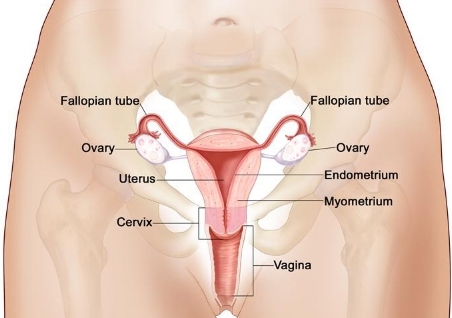
From the Mishanh in Niddah, it is clear that the aliyah sometimes bleeds, and that this blood becomes visible when it passes into the vagina. Maimonides identifies the aliyah with the space that contains the ovaries and the fallopian tubes. In modern medicine the ovaries and the Fallopian tubes and tissues that support them are called the adenxa. They are further from the vagina that the uterus, and so this identification does not fit in with Abaye's anatomy in which the aliyah is closer to the vagina than is the uterus.

רמב׳ם הל׳ איסורי ביאה ה, ד

ולמעלה מן החדר ומן הפרוזדוד, בין חדר לפרוזדוד, והוא המקום שיש בו שתי ביצים של אישה, והשבילים שבהן מתבשלת שכבת זרע שלה--מקום זה הוא הנקרא עלייה.  וכמו נקב פתוח מן העלייה לגג הפרוזדוד, ונקב זה קוראין אותו לול; והאבר נכנס לפנים מן הלול, בשעת גמר ביאה

Above the uterus and the vagina, between the uterus and the vagina, is the place in which the two ovaries are found, and the tubes along which the sperm from intercourse matures, this place is called the aliyah. (Maimonides, Mishneh Torah Issurie Bi'ah 5:4)

As we said, the problem is that the space which contains the ovaries is inside the abdomen, and this space does not connect with the vagina. It connects via the Fallopian tubes with the uterus.  Although Maimonides does not identify the aliyah as the ovaries themselves, some have done so. But the problem with this is that the ovaries don't bleed unless they develop a large cyst which then ruptures. But even in this case they bleed into the abdomen, or into the uterus, again via the Fallopian tubes, and not directly into the vagina.

Menachem ben Shalom (1249-1306) known as the Meiri, wrote an important commentary on the Talmud call Bet Habechirah - בית הבחירה and in it he too identifies the aliyah as the space between the uterus and the vagina in which the ovaries are found. He notes that in this space there are many blood vessels which may rupture and bleed directly into the vagina (עורקים שמתבקעים לפעמים), but as we have noted this is not biologically correct. Any bleeding from the adnexa is via the Fallopian tubes into the uterus itself, and certainly not directly into the vagina.

The Aliyah is the vagina

In his classic Biblisch-Talmudische Medezin published in 1911Jacob Preuss identified the aliyah as the vagina. "It can be assumed with reasonable certainty" he wrote "that the cheder refers to the uterus, that the prosdor is the vulva, and that the aliyah is the vagina." However certain he may have been, Preuss is the only one to make this identification, which does not fit in with the text of the Mishanh. So let's try another suggestion.

The Aliyah is the Bladder

Sefer Ha'Arukh, Venice 1552.

Sefer Ha'Arukh, Venice 1552.

Natan ben Yechiel of Rome, who died in 1106, wrote an influential lexicon of talmudic terms called the Sefer Ha'Arukh (ספר הערוך) which was first published around 1470. In that work the aliyah is identified as the urinary bladder. This identification also cannot be correct, because the bladder does not empty into the vagina, and because it does not lie between the uterus and the vagina but anterior to them. The commentary in the Schottenstein Talmud to Niddah 17b notes that a connection between the urethra and the vagina (known as a urethero-vaginal fistula) might account for bleeding from the bladder into the vagina. This is possible - though it is of course not normal anatomy.  

From here.

From here.

The AliyaH is a completely new structure

Meir ben Gedaliah of Lublin (d.1616) also considered the location of the aliyah in his modestly titled book Meir Einei Hakhamim - מאיר עיני חכמים - (Enlightening the Eyes of the Sages) first published in Venice in 1618.  He locates it between the uterus and the bladder, and provides two helpful schematics. The problem is that there is no such organ. You won't find it if you dissect a cadaver, and you won't find it in any textbook of anatomy (like this one). And as one astute radiologist and reader of Talmudology recently told me, you won't find it on an MRI either. Here is the text. 

Maharam Lublin. Meir Einei Hakhamim. Venice 1618. p255b.

Maharam Lublin. Meir Einei Hakhamim. Venice 1618. p255b.

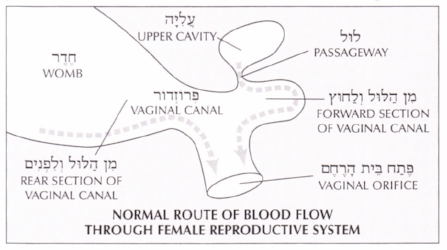
This non-existent anatomy is also pictured in the Schottenstein Talmud (Niddah 17b), based on the difficult Mishanah.  

From Schottenstein Talmud Niddah 17b. Note that this does NOT correspond to the known female anatomy, but is a schematic based on Rashi's understanding.

From Schottenstein Talmud Niddah 17b. Note that this does NOT correspond to the known female anatomy, but is a schematic based on Rashi's understanding.

The CHatam Sofer on the Aliyah

Moses Schreiber known as Chatam Sofer, (d. 1839) was a leader of Hungarian Jewry and he too weighed in on the issue in his talmudic commentary to Niddah (18a).

What is the "corridor" or the "room" or the "roof" or the "ground" or the "aliyah" ? After some investigation using books and authors experts and books about autopsies it is impossible to deny the facts that do not accord with the statements of Rashi or Tosafot or the diagrams of the Maharam of Lublin...but you will find the correct diagram in the book called Ma'asei Tuviah and in book Shvilei Emunah...therefore I have made no effort to explain the words of Rashi or Tosafot for they are incompatible with the facts...

Tuviah HaCohen, the Doctor from Padua

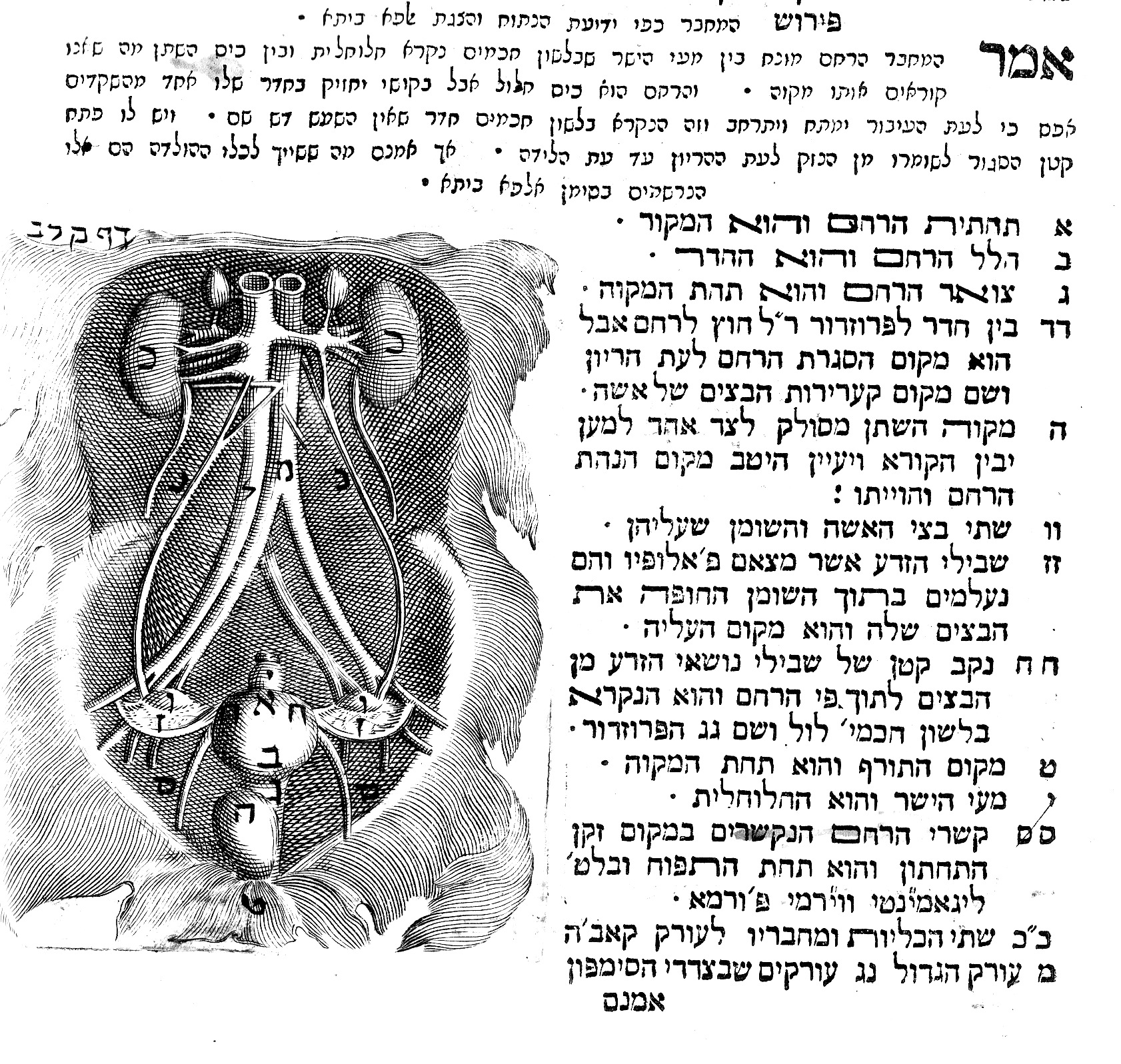
I couldn't find the diagram in any edition of the Shvilei Emunah to which the Chatam Sofer refers, so let's look at the diagram from Ma'asei Tuviah, (“the best illustrated Hebrew medical work of the pre-modern era”) which I happen to have in my own library.

Detail from Tuviah HaCohen, Ma'aseh Tuviah, Venice 1708. p132b.

Detail from Tuviah HaCohen, Ma'aseh Tuviah, Venice 1708. p132b.

A careful reading of the annotation (זז) reveals that Tuviah HaCohen (1652-1729) identifies the aliyah as that area containing the ovaries and the Fallopian tubes. In doing so he followed the opinion of Maimonides that we cited earlier, even though that does not in any way fit in with the understanding of Abaye and his ruling that blood found in the vagina that comes from the aliyah is not impure because it does not come from the uterus. Any gynecologist (or first year medical student completing their anatomy dissections) will tell you that blood from the adnexa (the ovaries and Fallopian tubes) can only get into the vagina via the uterus. But the most interesting part of this diagram is the very first line of text, at the top of the image. 

פירוש המחבר כפי ידיעת הנתוח  

The author's explanation according to knowledge gained from an autopsy

Anatomical Theatre, Palazzo del Bo, at the University of Padua. It was built in 1594 by the anatomist who helped found modern embryology, Girolamo Fabricius. From here.

Anatomical Theatre, Palazzo del Bo, at the University of Padua. It was built in 1594 by the anatomist who helped found modern embryology, Girolamo Fabricius. From here.

Here, perhaps for the first time, anatomical knowledge from an autopsy is being shared in Hebrew. At the medical school in Padua, two bodies (one of each sex) had to be dissected each year, and all the students attended- Tuviah included.  As a medical student, Tuviah would have stood in the famous anatomical theater and watched the dissection, perhaps following along in one of the textbooks based on those dissections. 

Facts Matter

As the Chatam Sofer noted, facts matter. The illustration in the work of the Maharam of Lublin was an example of trying to get the facts to fit the text of the Mishnah (or more precisely, the explanations of Rashi and Tosafot) but in doing so the Maharam created a fictitious anatomical part.

It is very unlikely that the rabbis of the Talmud witnessed human dissections. In the ancient world two Greeks, Herophilus of Chalcedon and  Erasistratus of Ceos (who lived in the first half of the third century BCE) were "the first and last ancient scientists to perform dissections of human cadavers." Facts about human anatomy became clear once human dissection began in the fourteenth century, but as is demonstrated by the Maharam of Lublin, these lessons did not always diffuse into the Jewish community.  The Chatam Sofer is often - and rightly  - cited as a force for tradition against the challenges from the outside world. But the Hatam Sofer, at least in so far as gynecology was concerned, had no time for a theory when the facts show otherwise. In an age of "alternative facts" the Chatam Sofer is a model of rationalism.

[Mostly a repost from here.]

Print Friendly and PDF