From the Talmudology Chanukah Archives: Rashi and Why Women Light the Menorah

Don't Share This With Your Young Children

The festival of Chanukah begins this evening. Ask a well-educated Jewish child about the origins of Chanukah, and she will likely tell you about the wicked Greeks who defiled the Temple, about the brave Maccabees who fought them, and about the miracle of the oil.  But in Rashi's commentary to the Talmud there is another part of the story. Here it is:

דאמר רבי יהושע בן לוי: נשים חייבות בנר חנוכה, שאף הן היו באותו הנס

 רש"י שם:  שגזרו יוונים על כל בתולות הנשואות להיבעל לטפסר תחלה  

Rabbi Yehoshua ben Levi said: Women are obligated to take part in the lighting, for they were included in that miracle...

Rashi: For the Greeks made an edict that all virgins who were about to marry must first have intercourse with the Prefect...

The great French exegete Rashi (d.1105) is referencing the Law of the First Night - Jus Primae Noctis, also known more graphically as The Right to the Thigh - Droit du Cuissage. We first encountered this when studying Ketuvot 3a. So let's go back to that daf.  

MAZAL TOV; WHEN'S THE WEDDING?

Today, when a bride and groom wish to secure a wedding day, it will depend on their budget and the availability of the caterer. My, how things have changed. In the times of the Mishnah, the wedding day was decided by the availability of the local rabbinic court, the Bet Din. Then, a wedding (of a virgin) could only take place on the night before the Bet Din convened.  This would ensure that if, after their magical first night, the groom suspected that his bride had not been a virgin, he could take his claim to court the very next day.  

מפני מה אמרו בתולה נשאת ליום הרביעי שאם היה לו טענת בתולים היה משכים לב”ד

Why did they teach that a virgin must only marry on a Wednesday? So that if the groom questioned her virginity, he could hurry to the Bet Din...
— Ketuvot 3a

The Talmud (Ketuvot 3a) explains that this happy custom changed during a period of persecution. Rabbah, a forth century Babylonian sage, explained what this is all about: "[The authorities] said, "a virgin who gets married on Wednesday will first have intercourse with the governor" (הגמון). In order to avoid this awful legal rape, the wedding was moved a day early, to fly, so to speak, under the radar of the local governor. 

JUS PRIMAE NOCTIS IN THE TALMUD & MIDRASH

The law that Rabbah referenced is the same one that Rashi claims was imposed on Jewish brides by the Greeks. Its origins are further explained in the Talmud Yerushalmi, which dates it to the time of the Bar Kochba revolution:

 תלמוד ירושלמי כתובות פרק א הלכה ה  

בראשונה גזרו שמד ביהודה שכן מסורת להם מאבותם שיהודה הרג את עשו...  והיו הולכין ומשעבדין בהן ואונסין את בנותיהן וגזרו שיהא איסטרטיוס בועל תחילה התקינו שיהא בעלה בא עליה עודה בבית אביה 

In the beginning, they [the Romans] decreed destruction in Judea (for they had a tradition that Yehuda killed Esau) ... and they enslaved them and raped their daughters, and decreed that a soldier would have intercourse [with a bride] first. It was then enacted that her husband would cohabit with her while she was still in her father's house. 

A reference to Primae Noctis also appears in the Midrash Rabbah, a collection of rabbinic homilies edited sometime in the forth or fifth century. As told in Genesis 6, “the sons of God saw that the daughters of man were beautiful (tovot), and they took wives from whoever they chose.” The Midrash focuses on that word beautiful, and explains:

בראשית רבה (וילנא) פרשת בראשית פרשה כו 

אמר רבי יודן טבת כתיב, משהיו מטיבין אשה לבעלה היה גדול נכנס ובועלה תחלה, הדא הוא דכתיב כי טבת הנה, אלו הבתולות ויקחו להם נשים מכל אשר בחרו, אלו נשי אנשים, 

“Rabbi Judan said the word tovot (טבת) – beautiful – is written in the singular, [but read as a plural]. Meaning that the bride was made beautiful for her husband, but the lord of the nobles had intercourse with her first...”

JUS PRIMAE NOCTIS...IN THE MOVIES

There are numerous references to Primae Noctis in ancient and modern literature, from the Epic of Gilgamesh to The Marriage of Figaro. One recent example can be seen in the movie Braveheart, when the evil King Edward gallops into a village, to interrupt a wedding celebration. “I’ve come to claim the right of Primae Noctis. As lord of these lands, I will bless this marriage by taking the bride into my bed on the first night of her union.”  And as the groom is restrained by Edward's henchmen, Edward reminds the peasants “it is my noble right.”  

Jus Primae Noctis. Is there a more fearsome example of feudal barbarism? Of what one scholar called “a male power display…coercive sexual dominance…and male desire for sexual variety”?  But the legend, despite its appearance in many guises, is, fortunately, likely to be nothing more than just that: a legend.  

JUS PRIMAE NOCTIS...IS A LEGEND

Perhaps the most comprehensive investigation of the legend of Primae Noctis is The Lord's First Night: the Myth of the Droit de Cuissage, by the French social scientist Alain Boureau. His careful analysis is particularly important since, as we have seen, Rashi, our favorite French commentator, cites this legend twice. After a meticulous two-hundred page review of every alleged appearance of the legend, Boureau is clear:

[T]he droit de cuissage never existed in medieval France. Not one of the arguments, none of the events insinuated, alleged or brandished, holds up under analysis.
— Alain Boureau, The Lord's First Night.

Others scholars agree with Boureau. In 1881, the German historian Karl Schmidt concluded that the right never existed.  In 1973, the historian J.Q.C. Mackrell noted that there is "no reliable evidence" that it existed. And Prof. Tal Ilan, now at the Free University of Berlin, addressed the myth of Primae Noctis in a magnificently titled 1993 paper: Premarital Cohabitation in Ancient Judea. Prof. Ilan noted that that “all medieval literature that evokes the custom of Jus Primae Noctis has been proven to be folkloristic and has no historical basis.” But what about the evidence from the Talmuds, and the Midrashim? Don’t they provide evidence that Primae Noctis was indeed practiced in the time of the Talmud? Not so, claims the professor:

If a motif of this sort could have appeared in a sixteenth-century document and upset the entire history of medieval Europe for the next two centuries, the same motif likewise could have cropped up in the fourth -or fifth-century Palestinian Talmud, falsely describing events of the second century.

Instead, Prof Ilan suggests that the Talmud used the myth of Primae Noctis to excuse the behavior of some prospective couples, who would engage in sexual relations before they married.  “the jus primae noctis was conveniently drawn in order to explain and justify a custom that seemed to the rabbis to undermine their view of proper conduct in Jewish society.”

Some events do take place but are not true; others are—although they never occurred.
— Elie Wiesel, Legends of Our Time

There is some further support to the claim that primae noctis never existed, and it is not one I have seen suggested before.  It is a claim from silence.  I've checked over 100,000 responsa, and there is not one on this topic. Not a single one.  If primae noctis really was a law of the Greek and Roman empires, and a feudal right across medieval Europe, then why were its implications for the Jewish community never discussed in the responsa literature?  This silence supports the conclusions of work done by Boureau, Ilan and others: it never existed. In fact Boureau wonders what muddled thinking would lead anyone to believe it existed in the first place: 

It has been clear from the start that no matter what social restrictions were put on conduct and the management of wealth, and no matter how violent mores became, the principle of free choice of an unfettered matrimonial life was the most sacred area of individual liberty in medieval Europe. The Church, European society's principal normative center, very early removed all restrictions on the marriage of dependents, and it imposed consent as a sacramental value. No juridicial form, no custom, could attack that principal...sanctified in the twelfth century by the establishment of the sacrament of matrimony.

HISTORY AND HERITAGE

The historian David Lowenthal has explained the differences between history and heritage. While history "seeks to convince by truth," heritage "passes on exclusive myths of origin and endurance, endowing us alone with prestige and purpose." Heritage, continues Lowenthal, commonly alters the past: sometimes it selectively forgets past evils, and sometimes it updates the past to fit in with our modern sensibilities. Sometimes it upgrades the past, making it better than it was, and sometimes it downgrades the past, to attract sympathy.  And so, how we read the Talmud will depend on whether we see it as a work of history or as a book of our heritage.  

There you have it...some of it fact, and some of it fiction, but all of it true, in the true meaning of the word
— Miles Orvel, The Real Thing: Imitiation and Authenticity in America

There are stories both wonderful and terrible from our Jewish past. Some are factual, and some are not, and a measured approach to how we might approach these stories has been suggested by Judith Baumel and Jacob J. Schacter. They explored the claim (published in The New York Times) that in 1942, ninety-three Beis Yaakov schoolgirls in Cracow committed suicide rather than face rape by their German captors. They concluded that the evidence to support the truth of the story is not conclusive one way or the other

Whether or not it actually happened as described is difficult to determine, but there is certainly no question that it could have happened...in response to those claiming that the incident was "unlikely" to have occurred, let us remind the reader that the period in question was one during which the most unlikely events did occur, when entire communities were wiped out without leaving a single survivor...Maybe it did happen. But maybe again it didn't. Could it have happened? Of course.

So Why Should Women Light the Menorah?

It seems very unlikely that Rashi's explanation for why women should light the Menorah has any factual basis; the legend of Primae Noctis is not likely to have been trueBut some stories are true, even though they never happened. Ask yourself, from what you know about Jewish history, could it have been true? Yes. And that's what makes it all the more terrifying. Sadly, we have plenty of tragic stories from our Jewish history, and there is no need to create one that probably never happened. 

But if Rashi's reasoning was based on a myth, why should women - who according to traditional teaching are exempt from a positive time bound command - why should they light?  For an answer that should satisfy moderns, we need look no further than the Code of Jewish Law - the Sulchan Aruch (written about 460 years after Rashi's death).   

שולחן ערוך אורח חיים הלכות חנוכה סימן תרעה סעיף ג 

 אשה מדלקת נר חנוכה, שאף היא חייבת בה

 A women should light a light on Chanunkah, for she is obligated to do so...

So there you have it. Women should light...because they should light. We need no more of a reason than that.

Happy Chanukah.

[A repost from December 2017.]

Print Friendly and PDF

Niddah 58b ~ Bed Bugs

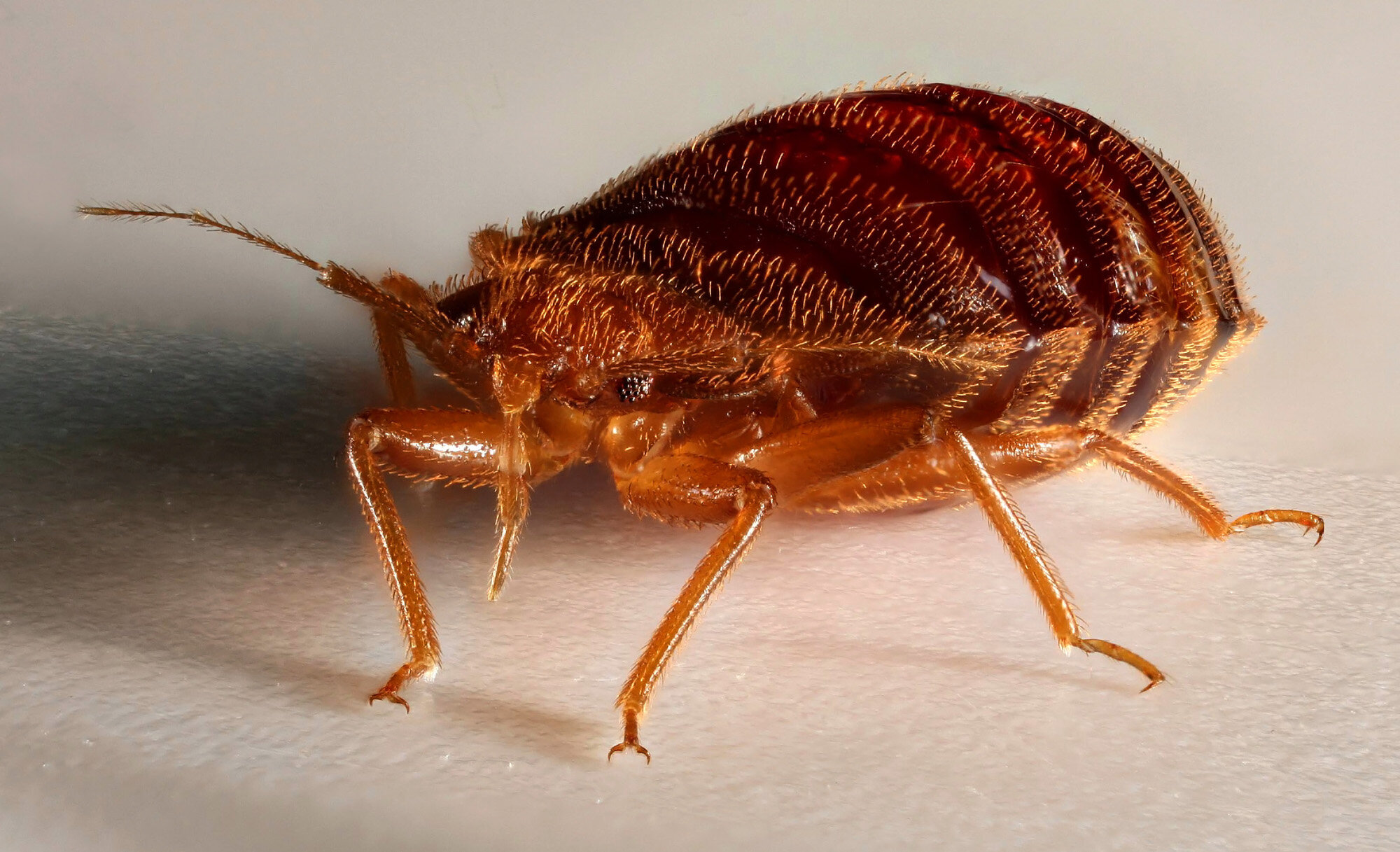
The adult bed beg. They are about the size of an apple seed, 5mm or so, but may be larger if they have recently fed. From here.

The adult bed beg. They are about the size of an apple seed, 5mm or so, but may be larger if they have recently fed. From here.

Bed bugs have been an increasing presence in our lives since the 1980s. While outbreaks in New York city hotels left everyone itching, the bugs are an international menace. They have been reported in Canada, Germany, Australia and Israel. In a 2014 interview, Dr. Kosta Mumcuoglu, a parasitologist from the Hebrew University told The Jerusalem Post that the incidence of bed bugs had increased by 150% over a five-year period, and that they were developing resistance to insecticides. Bed bugs, it seems, have become a feature of modern living. Just like they were during Talmudic times, as discussed in today’s page of Talmud.

The Talmud spends some time discussing this pest because of its ability to leave blood stains that are similar in appearance to those that might render a woman ritually impure.

נדה נח, ב

שאין לך כל מטה ומטה שאין בה כמה טיפי דם מאכולת

There is no bed of any kind on which there are not several drops of blood of a louse.

Bed bug infestations have been reported increasingly in homes, apartments, hotel rooms, hospitals, and dormitories in the United States since 1980
— Goddard J. deShazo R. Bed Bugs (Cimex lectularius) and Clinical Consequences of Their Bites. JAMA 2009: 301 (13): 1358-1366.
A series of bites in a line is characteristic of bedbug bites. From Delaunay P. et al. Bedbugs and Infectious Diseases. Clinical Infectious Diseases 2011; 52(2):200–210.

A series of bites in a line is characteristic of bedbug bites. From Delaunay P. et al. Bedbugs and Infectious Diseases. Clinical Infectious Diseases 2011; 52(2):200–210.

From here.

From here.

Bed bugs are insects from the Cimicidae family. All species are obligate hematophages (meaning that they can only ingest and live on blood) but only two species, Cimex lectularius and Cimex hemipterus, readily feed on humans (though others may rarely do so as well). They are about 5mm long, the size of an apple seed, and are easily visible to the untrained eye, resembling small cockroaches. But you are more likely to see them after they have feasted in blood, when they may increase in length by 50% and weigh twice as much as a unsated bug. According to a thorough review of the subject in the Journal of the American Medical Association, bedbugs “generally avoid light, hide during the day, and feed at night. Hiding places are usually within 1 to 2 meters of suitable hosts and include seams in mattresses, crevices in box springs, backsides of headboards, spaces under baseboards or loose wall-paper, and even behind hanging pictures. Adult bed bugs have an average life span of 6 to 12 months and can survive up to a year without feeding.” I am itching already…

Over my years in the ER I saw many rashes that were from bed bugs, mostly, but not exclusively, in the homeless. Only about 30% of people bitten have a reaction to the bug bite, but in those who do the rash can be very uncomfortable. There are usually several raised red lesions in a line. Scratching can lead to bleeding, and in some cases to a local infection.

Cimicid infestations result in multimillion dollar damage in the hospitality industry, poultry industry, and private and communal households. Costs arise from payment for pest control, damage to social reputation, replacement of infested infrastructure, and claims for monetary reparation.
— Reinhardt K. Siva-Jothy M. T. Biology of the Bed Bugs (Cimicidae). An. Rev. Entomol. 2007: 52:351–74
Areas and localities in Israel, in which there were treatments against bedbug infestations. Based on a survey of 143 “pest management professionals” in 2009. From Mumcuoglu K. Shalom U. Questionnaire survey of common bedbug (Cimex lectularius) infes…

Areas and localities in Israel, in which there were treatments against bedbug infestations. Based on a survey of 143 “pest management professionals” in 2009. From Mumcuoglu K. Shalom U. Questionnaire survey of common bedbug (Cimex lectularius) infestations in Israel. Israel Journal of Entomology 2010:40; 1-10.

The Smell (and Taste) of a Bed bug

Today’s page of Talmud continues with these fun facts:

ת"ר פשפש זה ארכו כרחבו וטעמו כריחו ברית כרותה לו שכל המוללו מריח בו ארכו כרחבו לענין כתמים

This bedbug, its length is equal to its width, and its taste is like its foul smell. A covenant is made with it, i.e., it is a law of nature, that anyone who squeezes it will smell its foul odor.

Apparently, the foul odor which the Talmud describes resembles “rotting raspberries.” Most people cannot detect this smell - perhaps the Talmudic nose was more sensitive than our modern one, but today bed bugs are detected using a canine rather than a human nose. Dogs are widely employed by pest management companies, and from rigorous studies we know that dogs can detect even a single adult bed bug. Dogs can also discriminate live bed bugs from dead ones and in one controlled experiment in hotel rooms, “dogs were 98% accurate in locating live bed bugs.”  The dogs could also differentiate the live bed bugs from other general household pests, such as cockroaches, termites, and carpenter ants. And so thankfully, there is no-longer a need to smell or taste a bed bug in order to identify it. It’s too bad that canine detection was not available in Babylon a couple of thousand years ago.

Print Friendly and PDF

Niddah 55b ~ The Nasolacrimal Duct

Have you ever wondered why, when you cry, you need to blow your nose? Today we find out the answer. The Talmud is currently discussing which kinds of bodily fluids are capable of transmitting ritual impurity in a person who has gonorrhea (called a zov). After declaring that nasal mucous transmits impurity, the next problem is do define what exactly is meant by nasal mucous (מי האף)?

נדה נה, ב

מאי מי האף ? אמר רב בנגררין דרך הפה לפי שאי אפשר למי האף בלא צחצוחי הרוק ור' יוחנן אמר אפילו בנגררין דרך החוטם אלמא קסבר מעיין הוא ורחמנא רבייה

What are these nasal fluids? Rav says: This is referring to fluids that are emitted via the mouth of a person. They are impure because it is impossible for the nasal fluids to flow through the mouth without containing traces of saliva, which are impure. And Rabbi Yochanan says: The baraita is referring even to fluids that are emitted via the nose. Evidently, Rabbi Yochanan maintains that nasal fluids are categorized as a flow of bodily fluids, and the Merciful One included it among the impure bodily fluids of a zav…”

Choose your ophthalmologist Carefully

Things get a little more complicated when the Talmud takes a surprising turn, citing a teaching that warns against having an idolator treating a Jew with an eye salve. This would cause blindness, since the Talmud thinks that the idolator would undoubtedly use a poison that would blind the Jewish patient.

If you were unlucky enough to find yourself in this predicament, there is a solution, at least according to Rav Chiyya bar Gurya: you can suck the poison from your eyes into your mouth and spit it out (יכול לגוררן ולהוציאן דרך הפה).

Rashi tries to explain the anatomical process:

דסבר אם נתן העובד כוכבים לתוכו סם המות יכול לגוררו ולהוציאו דרך פיו כדרך הרוקקין שמושכין מי האף בפיהם ע"י רוח נשימתם לגופן

He believes that…the poison can be removed by drawing it into the mouth. Just like someone who spits snorts the nasal mucous into their mouth by breathing in.

THE NASOLACRIMAL DUCT

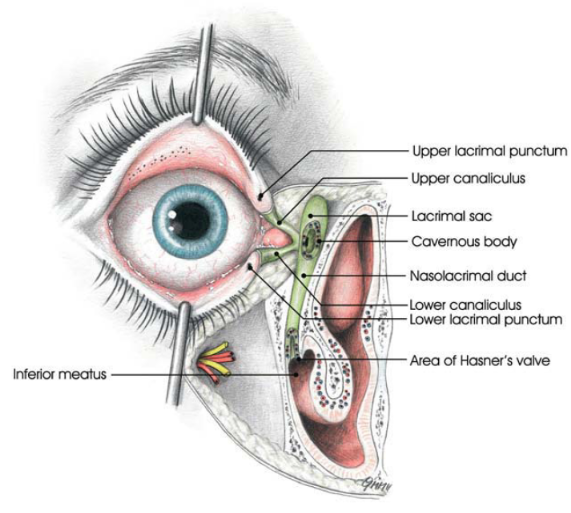
There is indeed an anatomical connection between the eyes and the nose. It is called the nasolacrimal duct, and its job is to collect the tears from around the eyes and channel them down into the nose. Our tears are present all the time, and not just when we cry. They protect and lubricate the front of the eye and remove dust particles from its surface. But they need to be disposed of. Hence the nasolacrimal duct.

The nasolacrimal duct is surrounded by a boney canal created by the maxillary and lacrimal bones and opens into the inferior meatus of the nose. From Tillmann B. Atlas der Anatomie. Springer. Berlin 2005.

The nasolacrimal duct is surrounded by a boney canal created by the maxillary and lacrimal bones and opens into the inferior meatus of the nose. From Tillmann B. Atlas der Anatomie. Springer. Berlin 2005.

When tears are produced, they are directed from the surface of the eyes into the nasolacrimal duct by the coordinated contraction of the muscle surrounding the eye. From there, collagen fibers that surround the duct twist and wring out the duct, in the same way you would wring out a wet pair of socks by twisting them along their axis. Like this:

How the eyelids direct tears down the nose. The surrounding orbicularis muscle closes from the lateral side towards the nose, moving the tear film to nasolacrimal duct. From Weber, R. ed. Atlas of Lacrimal Surgery. Springer Berlin 2007, 5.

How the eyelids direct tears down the nose. The surrounding orbicularis muscle closes from the lateral side towards the nose, moving the tear film to nasolacrimal duct. From Weber, R. ed. Atlas of Lacrimal Surgery. Springer Berlin 2007, 5.

However, the function of the nasolacrimal duct is not under conscious control. This makes the suggestion of Rav Chiyya bar Gurya (via Rashi) that you could “snort your tears into your mouth” difficult to understand. Because you cannot. That aside, today’s passage reminds us of the existence and function of the nasolarcrimal duct, to which perhaps you will now pay greater attention.

Giving thanks for Human Anatomy

Hidden in the Bodleian Library in Oxford is a manuscript of a prayer book copied by a German Jew called Chaim in 1327. And in that prayer book (Opp. 758, p436b-438b) is a section called Birkat Ha-Eivarim, “Blessings over the Organs” that contains thirty-eight blessings.

Blessed are You our God for my ears and their hearing

Blessed are You our God for my eyes and their seeing

Blessed are You our God for my spleen and for my kidneys and their warmth

These blessings never made it into the standard prayers we say today, and were written when the human body was certainly more mysterious and less well understood than it is today. The nasolacrimal duct is an organ of wonder too, and perhaps it is included in this, another of the blessings found in Birkat Ha-Eivarim.

Blessed are You our God for my eyelids and their blinking.

NEXT TIME ON TALMUDOLOGY: BED BUGS

Print Friendly and PDF

Niddah 48a - The Effect of the Environment on Puberty

Continuing an exploration of all things pubertal, the famous Rabban Shimon ben Gamliel suggests that the onset of puberty depends on where you live. Rabbi Shimon thinks that it depends on your social-economic background.

נדה מח,א

תניא רשב"ג אומר בנות כרכים תחתון ממהר לבא מפני שרגילות במרחצאות בנות כפרים עליון ממהר לבא מפני שטוחנות ברחים ר"ש בן אלעזר אומר בנות עשירים צד ימין ממהר לבא שנישוף באפקריסותן בנות עניים צד שמאל ממהר לבא מפני ששואבות כדי מים עליהן ואיבעית אימא מפני שנושאין אחיהן על גססיהן 


It is taught in a baraita, with regard to the appearance of signs indicating puberty in young women, that Rabban Shimon ben Gamliel says: In the case of young women who reside in cities, the lower sign [pubic hair] appears more quickly than the upper sign [breast growth], because they frequent the bathhouses, which stimulates the growth of the hair. By contrast, in the case of young women who reside in villages, the upper sign appears more quickly than the lower sign, because they grind with mills, which develops their breasts. 

Rabbi Shimon ben Elazar says: There are differences in the rate of development of the breasts. In the case of the daughters of the wealthy, the growth of the breast on the right side arrives more quickly than that of the left side, as it rubs against their upper body cloaks, which are worn by the wealthy. By contrast, in the case of the daughters of the poor, the growth of the breast on the left side arrives more quickly than that of the right side, because they draw jugs of water on that side. And if you wish, say instead that the left breast develops more quickly because they carry their younger brothers on their left sides.

Factors that influence Puberty

We have already learned that according to Rabbi Hiyya there is a relationship between body weight and the onset of puberty, a concept that has been firmly supported by modern research.  On today's page of Talmud Rabban Shimon ben Gamliel suggests that the environment can also influence the onset of puberty. And he was right. There is plenty of evidence from across the world that pubertal development differs between urban and suburban children.

In 1992 researchers compared the pubertal development of seventh graders in rural Iowa and suburban Chicago. They found that in general, the rural girls and boys were more developed than their suburban counterparts. A 2012 study published in the Annals of Human Biology found that there may be different demographic patterns in pubertal status among rural youth compared with urban youth in the US, but the researchers made it hard to figure out which group might be delayed.

Other studies comparing pubertal development among rural and urban youth, primarily from outside the US, consistently report a delayed onset of puberty in rural adolescents as compared to their urban counterparts. For example, a study published in 2000 examined "the prevalence of the first ejaculating emission" for 83,902 Chinese boys aged 9 through 18 years. It found a significant difference between urban and rural  boys and even plotted this out on a nice graph, shown below.

Prevalence of post- spermarcheal boys with ages in Chinese urban, rural, and their combined total group. From Cheng-Ye J. and Ohsawa S. Onset of the Release of Spermatozoa (Spermarche) in Chinese Male Youth. Am. J. Hum. Biol. 2000: 12;577–587.

Prevalence of post- spermarcheal boys with ages in Chinese urban, rural, and their combined total group. From Cheng-Ye J. and Ohsawa S. Onset of the Release of Spermatozoa (Spermarche) in Chinese Male Youth. Am. J. Hum. Biol. 2000: 12;577–587.


They also found that within a single ethnic group there were significant geographic variations; the age of spermache was later for boys living in the north (where it is colder and wetter) compared to those living in the south (where it is hotter and more humid). However, in contrast to the 1992 US study, the urban Chinese boys had a later onset of puberty. Go figure.

Urban and Rural Children in Kazakhstan and beyond

Another study examined “Puberty in modernizing Kazakhstan”and compared rural and urban children. It used the Kazakhstan Health and Nutrition Examination Survey (KHAN-ES) that studied the effects of the living environment on the nutrition and health of urban and rural Kazakh children. In this study, the researchers reported the relationship between the environment, ethnicity and pubertal status in KHAN-ES children. They found that the environment had a strong influence on the timing of puberty. The rural children had a delayed puberty as compared with urban peers and this was especially evident at B2 and G2 stages

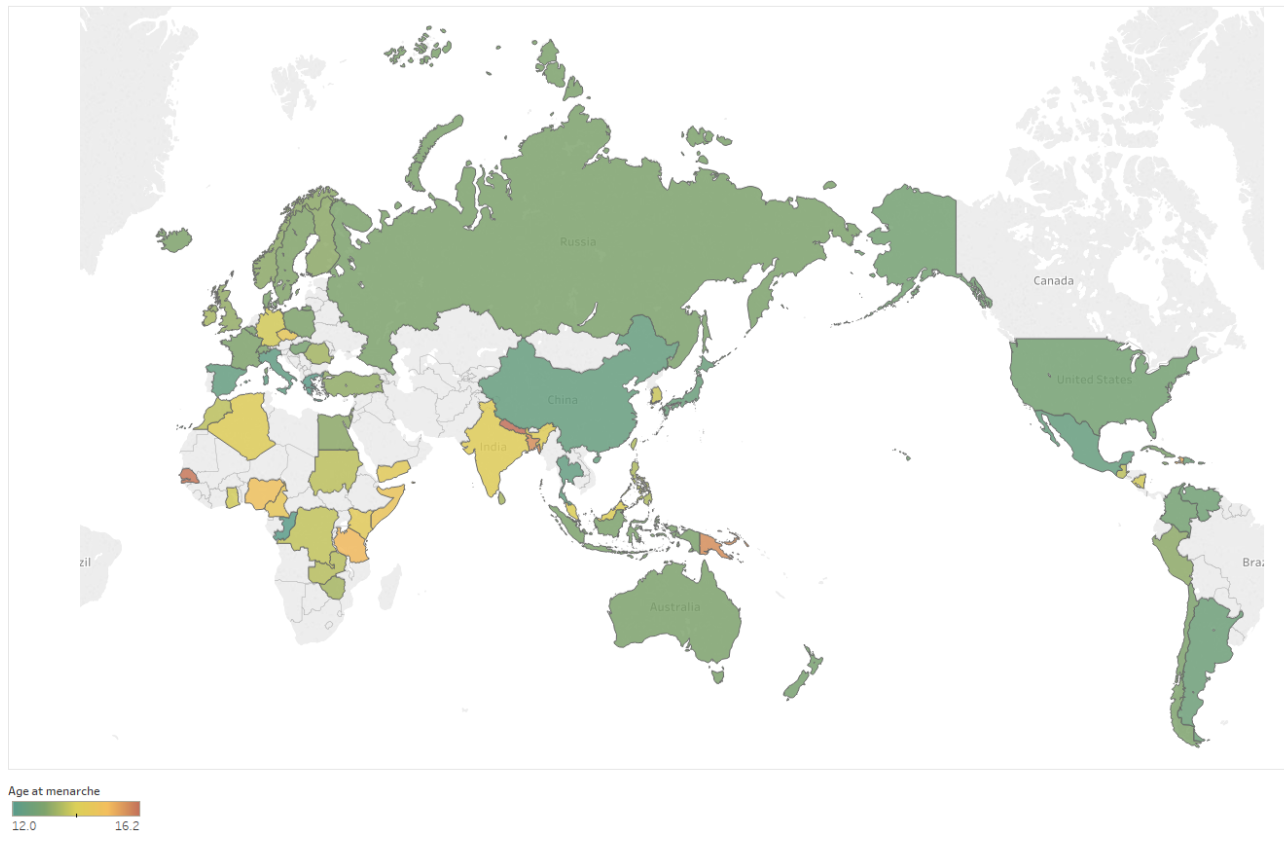
Something is going on. Perhaps rural adolescents have differential environmental exposures compared with urban or suburban adolescents, and some of these may change the rate of pubertal development. A study that examined the age of menarche (the first menstrual period) showed variability across many countries. In Israel, for example, the average age of menarche was 13.3 years; in Nepal it was 16.2 years. Here is what it looks like globally:

Variability of Ages at Menarche and Menopause. From here.

Variability of Ages at Menarche and Menopause. From here.

We still have a lot of work to figure out the complex interactions of all the factors that determine the onset of puberty. But both Rabban Shimon ben Gamliel and Rabbi Shimon ben Elazar were correct in linking the environment and socio-economic factors to the way in which our children develop into adults.

Print Friendly and PDF