Berachot 34b ~ Where on Earth is the Garden of Eden?

From here.

From here.

In today’s page of Talmud the rabbis seek to explain the meaning of the verse found in Isaiah (64:3)

וּמֵעוֹלָם לֹא־שָׁמְעוּ לֹא הֶאֱזִינוּ עַיִן לֹא־רָאָתָה אֱלֹהִים זוּלָתְךָ יַעֲשֶׂה לִמְחַכֵּה־לוֹ׃ 

Such things had never been heard or noted. No eye has seen [them], O God, but You, Who act for those who trust in You.

According to Rabbi Yochanan this refers to the reward that God has in store for those who are completely (and not just mostly) righteous. Rabbi Yehoshua ben Levi gave a more alcohol suffused explanation. It refers to wine that has been preserved in its grapes since the six days of creation, and which, apparently, no eye has ever seen. And then comes this third explanation, which explained the verse geographically.

ברכות לד, ב

. רַבִּי שְׁמוּאֵל בַּר נַחְמָנִי אָמַר: זֶה עֵדֶן, שֶׁלֹּא שָׁלְטָה בּוֹ עֵין כׇּל בְּרִיָּה. שֶׁמָּא תֹּאמַר: אָדָם הָרִאשׁוֹן הֵיכָן הָיָה? בַּגָּן. שֶׁמָּא תֹּאמַר: אָדָם הָרִאשׁוֹן הֵיכָן הָיָה? בַּגָּן. וְשֶׁמָּא תֹּאמַר: הוּא גַּן, הוּא עֵדֶן, תַּלְמוּד לוֹמַר: ״וְנָהָר יוֹצֵא מֵעֵדֶן לְהַשְׁקוֹת אֶת הַגָּן״, גַּן לְחוּד וְעֵדֶן לְחוּד

Rabbi Shmuel bar Nachmani said: That is Eden, which no creature’s eye has ever surveyed. Lest you will say: Where was Adam the first man? Wasn’t he there and didn’t he survey Eden? The Gemara responds: Adam was only in the Garden of Eden, not in Eden itself. And lest you will say: It is the Garden and it is Eden; two names describing the same place. That is not the case, as the verse states: “And a river went out from Eden to water the Garden” (Genesis 2:10). Obviously, the Garden exists on its own and Eden exists on its own. 

So according to Rabbi Shmuel bar Nachmani, the Garden of Eden was actually two places, one called the Garden, and one called Eden. And no one has seen either.

John Calvin’s Hunt for the Location of the Garden of Eden

It wasn’t only Jews who wondered where the Garden of Eden was, (and for now let’s just assume they are one and the same, geographically). The great Church reformer John Calvin (d. 1564) opined on the question too.

Moses says that one river flowed to water the garden, which afterwards would divide itself into four heads. It is sufficiently agreed among all, that two of these heads are the Euphrates and the Tigris; for no one disputes that . . . (Hiddekel) is the Tigris. But there is a great controversy respecting the other two. Many think, that Pison and Gihon are the Ganges and the Nile; the error, however, of these men is abundantly refuted by the distance of the positions of these rivers. Persons are not wanting who fly across even to the Danube; as if indeed the habitation of one man stretched itself from the most remote part of Asia to the extremity of Europe. But since many other celebrated rivers flow by the region of which we are speaking, there is greater probability in the opinion of those who believe that two of these rivers are pointed out, although their names are now obsolete. Be this as it may, the difficulty is not yet solved. For Moses divides the one river which flowed by the garden into four heads. Yet it appears, that the fountains of the Euphrates and the Tigris were far distant from each other…

What Calvin is getting at is that the Bible suggests that the location of the Garden of Eden is at a point where four large rivers in the levant flow into one, and there is no such place. Perhaps, Calvin goes on to suggest, the geography changed as a result of the Great Flood.

And the Hunt of the Ben Ish Chai

One famous rabbi spent some time pondering the same question that so consumed Calvin. This rabbi was Joseph Hayyim (1834–1909) who was born in Baghdad, and at the age of twenty-five succeeded his father as leader of the Jewish community there. He authored a work that is widely read by Sephardic Jews to this day called Ben Ish Chai (The Son of Man Lives), and by which Hayyim came to be called. The book is a collection of halakhah and ethical discourses based on the weekly portion read from the Torah. In addition, he published three volumes of responsa between 1901 and 1905 called Rav Pe’alim (Many Acts); a fourth volume was posthumously published in 1912.

In an undated question, the Ben Ish Chai was asked about the location of the Garden of Eden. In one tradition, the garden was located “on the other side of the world,” somewhere below the equator in the southern hemisphere. However, the questioner continued, the world has been circumnavigated, and the Garden of Eden has not been identified. Where then is it located?

He began his answer by pointing out that the sages of the Talmud did not travel far and had certainly never explored the entire globe. He quoted from the eighteenth century work Sefer Haberit, which seems to have been the only text from which the Ben Ish Chai drew his scientific information, and claimed that although the evidence suggested that the world was indeed a globe, the matter was still disputed. It was on this supposed dispute that Ben Ish Chai built his criticism of the scientific method. “Everything is built on conjecture,” he claimed, and scientific explanations were constantly being overturned or revised. He appealed to an argument that had been made by several other skeptics of the Copernican idea that the Earth did not lie the center of the universe.

Even when [a scientific idea seems] persuasive, it is likely to be rejected and overturned, because later enlightened people will come to understand something that arises from the natural world that had not been understood by those earlier. [These earlier people] had invented their own system based on their understanding. When an objection to an earlier system arises, the entire system is destroyed, because when a foundation is destroyed the whole house crumbles. This is very common, and we see generation after generation adding to the understanding of the natural world. It is like a dwarf standing on the shoulders of a giant, and later generations see further than those who came earlier. Over the last two thousand years a number of systems have been developed and overridden in the fields of natural sciences and astronomy. One builds and another destroys, like the building of [the Egyptian cities of] Pitom and Ramses.

There were grounds therefore to be deeply skeptical of scientific claims about the world. Part of this may be due to the limitations of the human senses, but it was the very way in which science progressed - or the way in which he thought that it progressed, that led to skepticism of the Ben Ish Chai. He then turned to the question of the geocentric Earth and claimed that there was a continuing scientific controversy about whether the Earth or the Sun was stationary. Because the proofs, such as there were, were based on conjecture, the matter remained unsolved. The Ben Ish Chai was also unimpressed by the ability of astronomers to predict the precise times of future solar eclipses. He subscribed to a widely held myth that all science originated with the Jews, and claimed that any predictive ability demonstrated by astronomers was a result of Jewish knowledge of the stars and planets having been passed from Adam down to Noah and Abraham and then out into the world at large. This would explain why astronomers could accurately predict many events, but it in no way proved that their theoretical models were correct. In fact, the Ben Ish Chai remained deeply suspicious not only of the assertion that the Earth revolved around the stationary Sun, but of all the scientific statements made by astronomers.

So where did the Ben Ish Chai think the Garden of Eden was located?

In his long responsum, the Ben Ish Chai eventually returned to answer the original question about the location of the Garden of Eden and noted that, although it may be located on the Earth itself, it existed on a different spiritual plane and would therefore not be perceived by the human senses. Of course, this was all that needed to be said for the original question to have been addressed. The rest of the responsum, criticizing the truth claims of science, was irrelevant, but he had used the opportunity to explain his thoughts on the matter. As a result of his skepticism, he remained in doubt as to which model of the universe was correct, and he implied that the reader should adopt a similarly skeptical approach to science. Interestingly, the Ben Ish Chai did not address any of the nineteenth-century scientific demonstrations that supported the Copernican model, like Foucault’s pendulum or Bessel’s demonstration of stellar parallax, and there is no evidence that he knew of them.

Unfortunately, the Ben Ish Chai had a conception of scientific progress that was not accurate. Although scientific explanations do indeed change, it is only rarely the case that this happens in the drastic way he described: “like an edifice that comes crashing down because of its weak foundation.” Much more often, new scientific theories or explanations modify those that already exist, so that they better fit experimental data or observations. Such modifications do not destroy the earlier theories, as the Ben Ish Chai would have us believe, but allows them to have greater explanatory power.

And as for that elusive search for the Garden of Eden? Rabbi Shmuel bar Nachmani seems to have been correct all along. So far as we know, no human eyes have seen it.

[Mostly taken from this book, where you can read a lot more about Copernicus and Jewish thought.]


Print Friendly and PDF

Berachot 33a ~ Injuries from Cows

Under what circumstances of threatened physical danger may a person interrupt her prayers? Getting too close to snakes is not a good idea, but cows are a problem too.

ברכות לג, א

אָמַר רַבִּי יִצְחָק: רָאָה שְׁווֹרִים — פּוֹסֵק. דְּתָנֵי רַב הוֹשַׁעְיָה: מַרְחִיקִין מִשּׁוֹר תָּם — חֲמִשִּׁים אַמָּה, וּמִשּׁוֹר מוּעָד — כִּמְלוֹא עֵינָיו 

Rabbi Yitzchak said: One who saw oxen coming toward him, he interrupts his prayer, as Rav Hoshaya taught: One distances himself fifty cubits from an innocuous ox [shor tam], an ox with no history of causing damage with the intent to injure, and from a forewarned ox [shor muad], an ox whose owner was forewarned because his ox has gored three times already, one distances himself until it is beyond eyeshot.

So today we will discuss injuries from oxen and cows. But first, just what is an ox?

Just what is an ox?

The Hebrew word used in the Talmud is shor - (שור, rhymes with shore). Consider the following verse from Leviticus 22:27:

שור או כשב או עז כי יולד והיה שבעת ימים תחת אמו 

Here are some of the ways it is translated into English:

  • When a bull or a goat is born, it shall be seven days under its mother... (Robert Alter. The Five Books of Moses. [Alter seems to have forgotten to translate the word כשב]).

  • When an ox or a sheep or a goat is born, it shall be seven days under its mother...(S.R. Hirsch. The Pentateuch, translated into English by Isaac Levy.)

  • When any of the herd, or a sheep, or a goat is brought forth, then it shall be seven days under its dam..(The Pentateuch, translated into English by M. Rosenbaum and A.M. Silberman.)

  • When an ox or a sheep or a goat is born, it shall stay seven days with its mother...(The JPS Torah Commentary, ed. N. Sarna.)

  • When a bullock or a sheep or a goat is brought forth, then it shall be seven days under its dam...(Koren Jerusalem Bible.)

  • When a calf, a lamb or a goat is born, it is to remain with its mother for seven days...(New International Version.)

  • When a bullock, or a sheep, or a goat, is brought forth, then it shall be seven days under the dam...(King James Bible)

There are more, but you get the point. The word shor (שור) has been translated as a bull, an ox, a calf, a bullock and as a collective, any of the herd.  The Koren Talmud and the Soncino Talmud translate it as ox.  The ArtScroll Schottenstein Talmud as a bull. Confused? Me too.

Here are some of The Shorter Oxford English Dictionary definitions of an ox:

1. The domestic bovine quadruped (sexually dist. as bull and cow); in common use, applied to the male castrated and used for draught purposes, or reared to serve as food.

2. Zool. Any beast of the bovine family of ruminants, including the domestic European species, the 'wild oxen' preserved in certain parks in Britain, the buffalo, bison, gaur, yak, musk-ox, etc.

In his late nineteenth century translation of the Jerusalem Talmud into French, Moise Schwab translated the word shor as "le bouef" (rather than "le teureau"). De Sola's English translation of the Mishnah, published in 1843, uses the word ox. So does the 1878 compendium by Joseph Barclay, and the first complete English translation of the Talmud, by Michael Rodkinson, published between 1896 and 1903.  The translation of shor as ox is goes back to these early translations, but the suggestion that the meaning of the word is a 'castrated male bovine quadraped' is certainly wrong. Jews are forbidden to castrate their animals, and a castrated bull would have been ineligible to use as a sacrifice. And so we must conclude that the best translation of the word shor (שור) is a bull (well done, ArtScroll!).  

The delightfully named lecturer Dr. Goodfriend from California State University recently published a lengthy paper (in this book) on the various terms for cattle in the Bible, and the question of whether a castrated bull (a gelding) could have been offered as a sacrifice in the Temple.  The good professor Goodfriend concludes that indeed the prohibition against the castration of animals "would have placed the Israelite farmer at a disadvantage as fewer suitable animals would have been available for his use." One possible way to overcome come this (other than to use cows for ploughing) would have been to import castrated bulls from those who lived outside of Israel.  

And having sorted that out, let’s turn to the fun topic of the day. Injuries from cows.

Cow-related trauma is a common among farming communities and is a potentially serious mechanism of injury that appears to be under-reported in a hospital context. Bovine-related head-butt and trampling injuries should be considered akin to high-velocity trauma.
— Murphy, CG. McGuire, CM. O’Malley, N. Harrington P. Cow-related trauma: A 10-year review of injuries admitted to a single institution. Injury 2010. 41: 548–550.

Injuries from Domestic bulls (and Cows too)

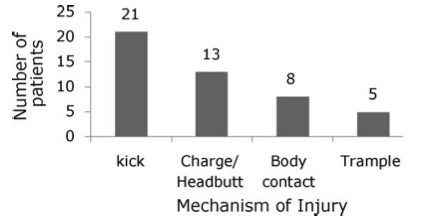
Mechanisms of injury from cows. From Murphy, CG. McGuire, CM. O’Malley, N. Harrington P. Cow-related trauma: A 10-year review of injuries admitted to a single institution. Injury 2010. 41: 548–550.

Mechanisms of injury from cows. From Murphy, CG. McGuire, CM. O’Malley, N. Harrington P. Cow-related trauma: A 10-year review of injuries admitted to a single institution. Injury 2010. 41: 548–550.

Much of the fourth chapter of the Talmud in Bava Kamma addresses injuries from domestic bulls and cows. In today’s page of Talmud Rabbi Yitzchak reminded the devout not to get too lost in their prayers if there are cows (or bull or oxen) in the vicinity. It turns out that they cause all kinds of injuries even today. In 2009, orthopedists from Our Lady of Lourdes Hospital in Ireland published a fascinating paper entitled Cow-related trauma: A 10-year review of injuries admitted to a single institution. Over a decade, the hospital admitted 47 people with cow related trauma, most of whom sustained their injuries from kicking (unlike matadors, who suffer from horn related injuries). And next time you feel like walking across a field containing some gentle-looking cows, remember this: one of the patients was admitted with a head injury, a hip fracture and hypothermia after being trampled on by his herd of cattle in a field and found a number of hours later. (There are no details as to whether the injury occurred during shacharit or mincha).

If a bull be a goring bull and it is shown that he is a gorer, and he does not bind his horns, or fasten the bull, and the bull gores a free-born man and kills him, the owner shall pay one-half a mina in money. If he kills a man’s slave, he shall pay one-third of a mina.”
— Code of Hammurabi, Articles 251–252.

In another paper Blunt Bovine and Equine Trauma - from La Crosse Lutheran Hospital in Wisconsin, researchers provided this illustrative case:

A 57-year-old male was pinned to the ground by a 2,000 pound dairy bull and repeatedly knocked to the ground forcefully at least seven times before he was able to crawl from the pen…Examination revealed the following injuries: bilateral flail chest, 13 rib fractures, bilateral hemopneumothoraces, renal contusion, two forearm fractures, left shoulder dislocation, bilateral scapula fractures, and dental alveolar fractures. The patient was treated by...mechanical ventilation for 15 days…His hospital course was complicated by Klebsiella pneumonia and at 16-month followup he remained severely dyspneic, unable to perform his usual farm work.

Cattle look gentle, and for the most part, they are.  But they are large beasts with incredible strength. Hikers, (and farmers) beware. Please pray safely.

[Partial repost from here.]

Print Friendly and PDF

Berachot 29b ~ “Why are Sunsets Red?” asked the Rabbi and the Scientist

Photo by the Talmudology. Sunset from Clearwater Florida, Jan 29, 2020.

Photo by the Talmudology. Sunset from Clearwater Florida, Jan 29, 2020.

ברכות כט, ב

דְּאָמַר רַבִּי חִיָּיא בַּר אַבָּא אָמַר רַבִּי יוֹחָנָן: מִצְוָה לְהִתְפַּלֵּל עִם דִּמְדּוּמֵי חַמָּה. וְאָמַר רַבִּי זֵירָא: מַאי קְרָאָה — ״יִירָאוּךָ עִם שָׁמֶשׁ וְלִפְנֵי יָרֵחַ דּוֹר דּוֹרִים״

Rabbi Chiyya bar Abba said that Rabbi Yochanan said: It is a mitzva to pray with the reddening of the sun. And Rabbi Zeira said: What is the verse that alludes to this? “Let them fear You with the sun and before the moon, generation after generation” (Psalms 72:5)…

According to Rabbi Chiyya, the best time to pray is at sunrise and sunset. But why is the sun red around the time that it rises and sets? Elsewhere, the Talmud has an answer for that.

בבא בתרא פד,א

בצפרא דחלפא אבי וורדי דגן עדן בפניא דחלפא אפתחא דגיהנם – ואיכא דאמרי איפכא

In the morning it becomes red as it passes over the site of the roses of the Garden of Eden, [whose reflections give the light a red hue]. In the evening the sun turns red because it passes over the entrance of Gehenna, whose fires redden the light. And there are those who say the opposite [in explaining why the sun is red in the morning and the evening, i.e., in the morning it passes over the entrance of Gehenna, while in the evening it passes over the site of the roses of the Garden of Eden.]

 
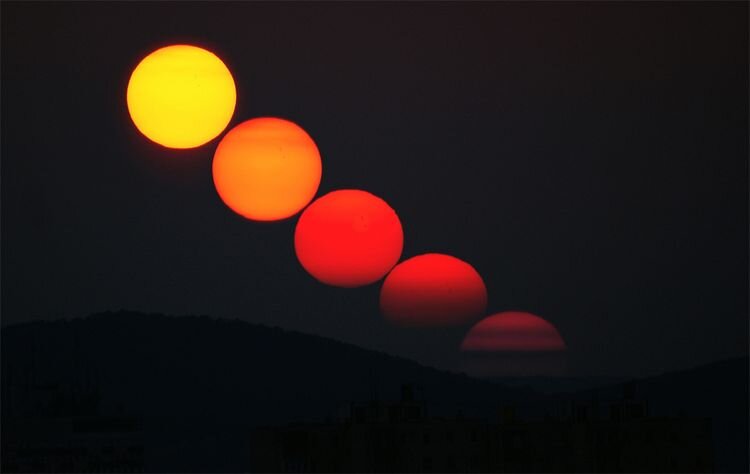
The sequence above shows the setting Sun dipping toward the western horizon. As the Sun sinks lower, its color becomes more reddened. From here.

The sequence above shows the setting Sun dipping toward the western horizon. As the Sun sinks lower, its color becomes more reddened. From here.


Why sunrise & sunset are red - the science

Here is the scientific explanation. At sunrise and sunset the light from the sun is not directly overhead, but from its position on the horizon it must pass through more of the atmosphere to reach our eyes, as you can see here.

From here.

From here.

You may recall that ever since Newton and his prism we have known that white light is made up of many different wavelengths, or colors of light (Figure 1 below). As the sun’s white light passes through our atmosphere, the shorter wavelengths of light are scattered (Figure 2). And the longer the path through our atmosphere, the more the shorter wavelengths of light are scattered away from the original white sun beam. All of that scattered light (Figure 3) is from the shorter, blue end of the spectrum, which is what colors the sky blue. The remaining unscattered light is at the red end of the spectrum, and that’s why the sun appears red at sunrise and sunset, and why the clouds that reflect it are colored red.

From here.

From here.

The Poet and the Scientist

Science is not the only way of understanding the world. Artists, poets, philosophers and religions all add different kinds of knowledge about the very same physical world that science explains. Science explains that a red sunrise is a result of physics. Rabbi Chiyya explained that it is because the sun reflects the red roses of the Garden of Eden. Which explanation most satisfies your mind. And which most satisfies your heart?

In philosophy [i.e.science] one must proceed from wonder to no wonder, that is, one should continue one’s investigation until that which we thought strange no longer seems strange to us; but in theology, one must proceed from no wonder to wonder, that is…[until] that which does not seem strange to us does seem strange, and that all is wonderful.
— Isaac Beekman. Journal tenu par Isaac Beekman de 1604 a 1634. Ed C de Waard. The Hague: M Nijhoff, 1939-53. vol 2, p375.
Print Friendly and PDF

Berachot 28b ~ How Many Vertebrae Do We Have?

In this page of Talmud the rabbis want to know why there were originally eighteen blessings recited in the silent prayer known as the Amidah. One rabbi suggested they correspond to the eighteen mentions of God in Psalm 29. Another thought they correspond to the number of times God’s name appeared in the Shema. But a third opinion was that they do not correspond to God’s name, but to something else entirely. A feature of human anatomy:

ברכות כח, ב

אָמַר רַבִּי תַּנְחוּם אָמַר רַבִּי יְהוֹשֻׁעַ בֶּן לֵוִי: כְּנֶגֶד שְׁמוֹנֶה עֶשְׂרֵה חוּלְיוֹת שֶׁבַּשִּׁדְרָה

…Rabbi Tanchum in the name of Rabbi Yehoshua ben Levi said: They correspond to the eighteen vertebrae in the spine

Now this is all well and good, but didn’t Rabbi Tanchum know there are actually many more than eighteen vertebrae in the spine?

How many vertebraE are there in the spine?

Gray_111_-_Vertebral_column-coloured.png

As you can see in the colored image, there are seven cervical vertebrae, and they end at the shoulders. Below these are twelve thoracic vertebrae, that end at the hips. Then come five lumbar vertebrae, which end at the sacrum, which itself consists of five fused vertebrae. And right at the bottom of your bottom is the coccyx, also known as the tail bone, which consists of three or five fused vertebrae, depending on how you count. That’s a total of 24 individual vertebrae and at least eight more that are fused. One thing is for sure: it’s not eighteen.

So How do we get to Eighteen?

The Koren English Talmud is sensitive to this anatomical conundrum, and explains that it is the number of vertebrae “in the spine beneath the ribs.” But the twelve ribs are attached to the twelve thoracic vertebrae, which would leave either seven vertebrae (five lumbar plus a sarcrum and coccyx) or thirteen to fifteen vertebra in various degrees of fusion. But not eighteen.

Here is the explanation of the Schottenstein (ArtScroll) English Talmud:“In stating the number of vertebrae in the spine the Rabbis apparently referred only to those below the neck. This accounts for seventeen vertebrae. The identity of the eighteenth vertebra mentioned here is unclear.” But that’s not quite right either. There are nineteen (12 thoracic and 7 lumber) spine below the neck. Not eighteen. So that doesn’t work.

We get closer to a plausible explanation when we read the commentary of the ArtScroll Hebrew Talmud. Here it is, in free translation:

In the language of the Rabbis, the word “spine” (שדרה) does not include the entire vertebral column, because the vertebrae in the neck are counted separately in the Mishnah (Ohalot 1:8). The Rabbis count of eighteen vertebrae apparently includes the back [thorax], the hips [lumbar] and one additional vertebra, either in the neck or in the base of the spine…

In other words, perhaps the rabbis of the Talmud saw the division of the spine in a different way than we do today. Just because we count seven cervical vertebrae this does not mean that is the number that others before us counted. Just ask Leonardo DaVinci.

We can see a clear progression in terms of the accuracy with which da Vinci’s anatomical drawings were developed and how his drawings were influenced by his mindset, not just as an anatomist but also as an engineer and scientist; and to some extent, by the prevailing scholastic views at that time. His anatomical depictions were clearly far ahead of their era and have served to improve our understanding of the true anatomy and function of the vertebral column and spinal cord.
— Bowen G. Gonazales J. Iwnaga J et al. Leonardo da Vinci (1452–1519) and his depictions of the human spine. Childs Nerv Syst (2017) 33: 2067–2070.

The Spine in Leonardo’s Drawings

The way that the great anatomist Leonardo da Vinci (d. 1519) drew the spine evolved over time. In a 2017 paper on da Vinci’s depictions of the human spine, the authors note that in an early sketch “he may have used his knowledge of engineering to devise a concept that would functionally fit the movements of which the cervical spine is capable rather than trying to illustrate the exact anatomical detail.” They continue:

The vertebrae are portrayed in a rudimentary manner, many lacking a foramen to convey the neurovascular supply, an intervertebral disc, or the spinous process necessary for muscular insertion and rib articulation in the thoracic spine. It may be better to view this depiction as a conceptual illustration of how the structure accommodates its function. 

Just take a moment to count the number of vertebrae in the neck that Leonardo drew below.

That’s right. There are thirteen! That can’t be right! Because of these clear inaccuracies the authors wrote that this drawing was made prior to Leonardo’s any dissection of the anatomical region in question. (By the end of his life Leonardo claimed to have dissected thirty human bodies, as well as those of countless sheep and oxen.)

Now take a look at the drawing below, made later in Leonardo’s career, which is much more anatomically accurate. But as you can see, there is no obvious place to end the cervical vertebrae and start the thoracic. Or end the thoracic and start the lumbar. It’s just one one long beautiful anatomical structure.

Leonardo da Vinci. The vertebral column c.1510-1. Detail of the first accurate depiction of the spine in history, with its distinct sections and curvatures all correctly shown. From the Royal Collection Trust.

Leonardo da Vinci. The vertebral column c.1510-1. Detail of the first accurate depiction of the spine in history, with its distinct sections and curvatures all correctly shown. From the Royal Collection Trust.

Leonardo suggested a division of sorts which are shown by the thin lines, one of which is labeled with the shape of a “d.” Take a look at the same Leonardo image, with the count of the number of vertebrae in between each division added.

Annotated Leonardo's drawing of the lateral spine.png

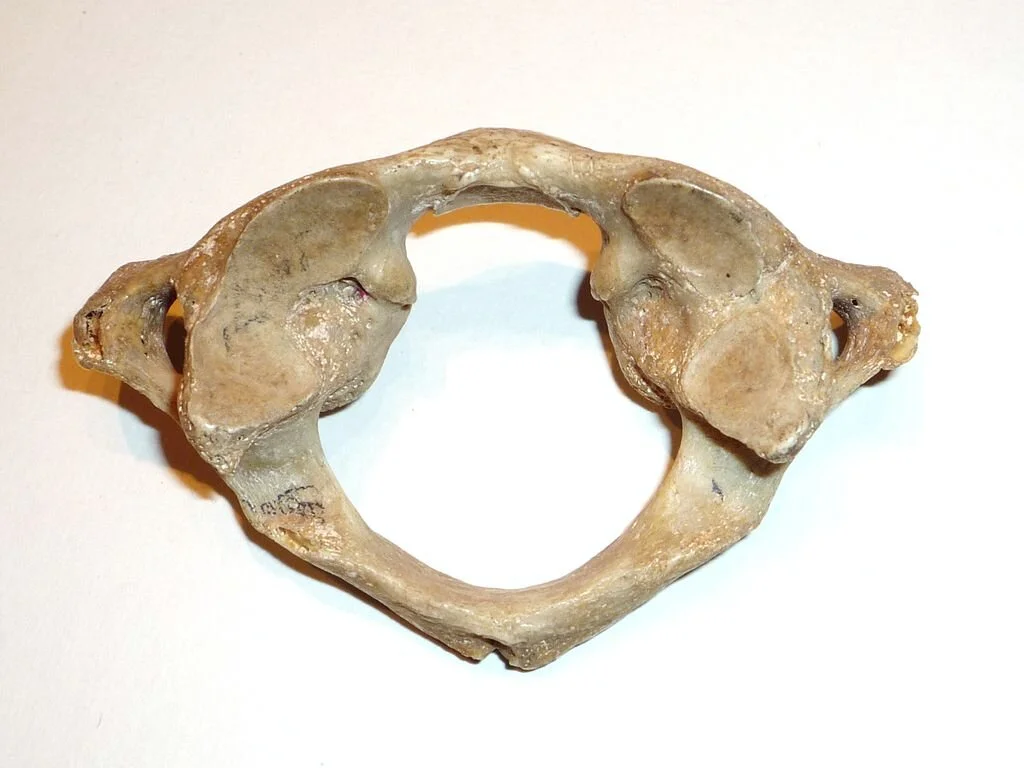
As you can see they add up to 18 if you count the spines of the vertebrae. But there is one missing vertebrae, the very first one at the top of the neck. Take another look. See it? It is called the atlas, and its unique feature is that it has no spinous process, as you can see below:

The first vertebra, known as the atlas.

The first vertebra, known as the atlas.

The atlas is the first of what we count as the seven cervical vertebrae. But it looks very different from the other six below it.

The atlas is the first of what we count as the seven cervical vertebrae. But it looks very different from the other six below it.

So if you don’t count the vertebrae without a spinous process - and it is very different from all the other (unfused) vertebrae - then you don’t need to look for the missing vertebra. It never got lost. We just started our numbering based on a different criteria. Why on earth would the rabbis have counted seven cervical vertebrae as we do, rather than six or even eight? (And yes, I know there is this Mishnah that states there are eighteen vertebrae, eight of which are in the neck: “וּשְׁמֹנֶה עֶשְׂרֵה חֻלְיוֹת בַּשִּׁדְרָה…שְׁמֹנָה בַצַּוָּאר.” But read it agin. It does not appear to be actually counting only bones.)

Leonardo’s anatomical drawings is a reminder that the human body has been seen and dissected in different ways, and Rabbi Tanchum’s count is as precise as our own. Different, but precise.

Print Friendly and PDF