Talmudology Bonus: The Most Common Words in the Talmud

Some 62 days ago we began a new cycle of learning with the opening of the very first tractate of the Talmud, called Berachot. At that time we discussed how many words there are in the Babylonian Talmud. As you may recall, thanks to our friends at Sefaria, the answer was 1,860,131.

Tomorrow we will close the study of Berachot, and as a parting gift we share the wonderful work of Moshe Margulies of Silver Spring Maryland. I was lucky enough to hear Moshe present his findings at a local Siyyum Hashas in early January, and he kindly agreed to share them with you, our dear Talmudology reader. His question was this: What are the most common words and names in our beloved Babylonian Talmud?

First some methodology: He downloaded the PDF files of every tractate of the Talmud from here. Then he used a word count generator, (but only looked at the top 2500 words in each tractate.) And finally, he copied the counts into Excel, and performed the analysis in Tableau.

The most common word in the Talmud is…

“He said”. אמר. Of course it is. Because the Talmud is a written record of centuries of oral debate. Mostly by men (hence the “he said”), but sometimes by women. Here are the top 50 word frequencies in the Babylonian Talmud. It is interesting to learn though, of the second most frequent word: “No.” More on that later.

Most frequent words.jpg

As Moshe pointed out, what is is striking is the big the gap is between the most frequent word, which is mentioned more than 35,000 times and the 25th word, which is mentioned a mere 6,000 times.  “Without knowing anything about the Gemera, this tells us what it is focused on.  Telling us things. Saying over what other people have said. Tradition.”  

And the most common name is…

“Rav” and “Rebbi” are at the top, which isn’t much of a surprise, since they are both the monikers of two specific talmudic rabbis, and are also used as a general honorific, much like Professor is used within universities. But Yehuda wins the award for being the most frequently mentioned name.  

Rava and Abaya are two of the most commonly cited pair of rabbis who sparred against each other. Although they always seem to be mentioned together, this analysis discovered that Rava is the 5th most common name and Abaya is the 9th most common name.  Weird, no?

Also note the gap between the top name, Rav – which is listed nearly 18,000 times, and fifteenth placed Yosef – which is listed a mere 1,900 times.

Top 15 Names.jpg

Continuing with the theme of famous sparring rabbis, Shamai is listed nearly 40% more times than Hillel, even though the Talmud almost always rules in favor of Hillel. Who knew?

The Longest word in the Talmud

Can you guess? It is….מדאורייתא “from the Torah.” At least it is the longest of any word that appears in the top 2500 most common words. Please let us know if you find a longer one.

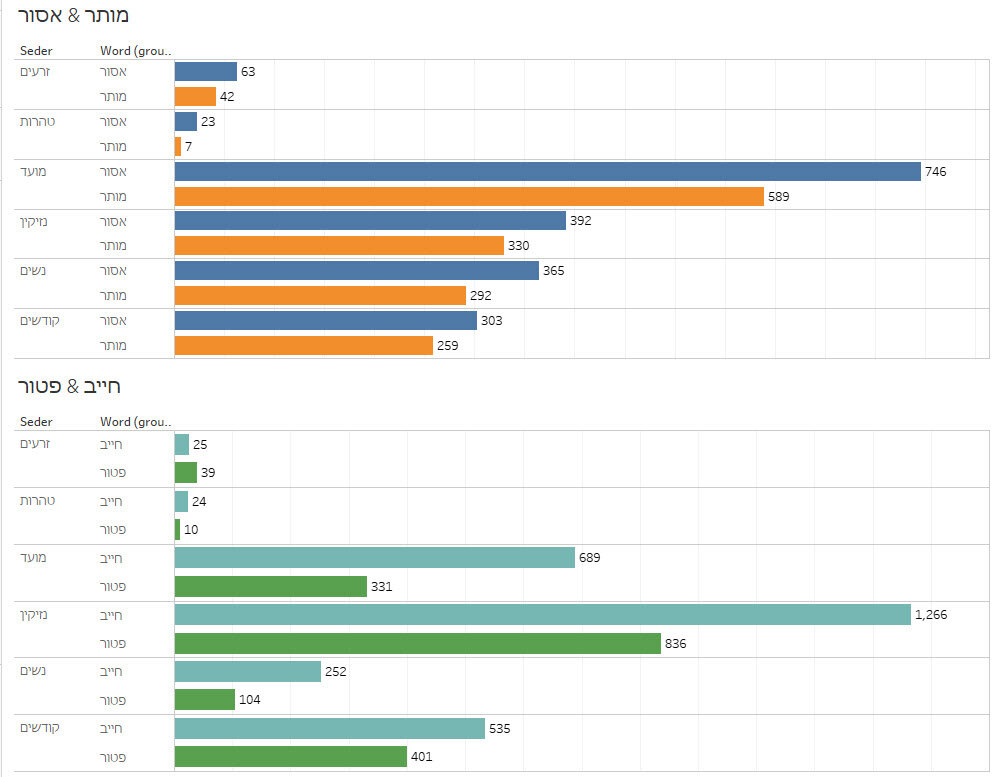
Which is more likely? Permitted or forbidden?

We will end this fascinating analysis with this question: is the Talmud more likely to “permit” or to “forbid”? The answer seems to vary by tractate and which precise word you are using, but overall assur - “forbidden” beats mutar - “permitted” and is listed 300 more times.

Liable and Exempt.jpg

You can find the dataset and results of Moshe’s analysis at Tableau, where you can also do an analysis of your own. In fact, if you are sitting alone with nothing to do in quarantine, this might be a useful way to pass the time.

Shabbat Shalom, and Stay Safe, from Talmudology.

Print Friendly and PDF

Berachot 62a ~ Open Defecation

ברכות סב, ב

וְכֵן אָמַר לֵיהּ רַבִּי זֵירָא לְשַׁמָּעֵיהּ: חֲזִי מַאן דְּאִיכָּא אֲחוֹרֵי בֵּית חֶבְרַיָּא, דְּבָעֵינָא לְמִפְנֵי

Rabbi Zeira told his servant: See who is behind the study hall, as I need to defecate…

Today’s page of Talmud addresses defecation, how to remain modest during this most immodest of activities, and how to avoid demons that lurk in the latrines.

הַהוּא בֵּית הַכִּסֵּא דַּהֲוָה בִּטְבֶרְיָא, כִּי הֲווֹ עָיְילִי בֵּיהּ בֵּי תְרֵי — אֲפִילּוּ בִּימָמָא מִתַּזְּקִי. רַבִּי אַמֵּי וְרַבִּי אַסִּי הֲווֹ עָיְילִי בֵּיהּ חַד וְחַד לְחוֹדֵיהּ — וְלָא מִתַּזְּקִי. אָמְרִי לְהוּ רַבָּנַן: לָא מִסְתְּפֵיתוּ? אָמְרִי לְהוּ: אֲנַן קַבָּלָה גְּמִירִינַן, קַבָּלָה דְּבֵית הַכִּסֵּא — צְנִיעוּתָא וּשְׁתִיקוּתָא. קַבָּלָה דְיִסּוּרֵי — שְׁתִיקוּתָא וּמִבְעֵי רַחֲמֵי. 

The Gemara relates: There was a particular bathroom in the city of Tiberias, where, when two would enter it, even during the day, they would be harmed by demons. When Rabbi Ami and Rabbi Asi would each enter alone, they were not harmed. The Sages said to them: Aren’t you afraid? Rabbi Ami and Rabbi Asi said to them: We have learned through tradition: The tradition to avoid danger in the bathroom is to conduct oneself with modesty and silence. The tradition to end suffering is with silence and prayer.

And there is advice from today’s page of Talmud.

אָמַר עוּלָּא: אֲחוֹרֵי הַגָּדֵר — נִפְנֶה מִיָּד. וּבַבִּקְעָה, כׇּל זְמַן שֶׁמִּתְעַטֵּשׁ וְאֵין חֲבֵרוֹ שׁוֹמֵעַ. אִיסִי בַּר נָתָן מַתְנֵי הָכִי: אֲחוֹרֵי הַגָּדֵר, כׇּל זְמַן שֶׁמִּתְעַטֵּשׁ וְאֵין חֲבֵרוֹ שׁוֹמֵעַ, וּבַבִּקְעָה — כׇּל זְמַן שֶׁאֵין חֲבֵרוֹ רוֹאֵהוּ 

With regard to where one may or may not go to defecate, Ulla said: Behind a fence, one need not distance himself from people and may defecate immediately. In a valley or open field, one must distance himself sufficiently so that if he passes wind, no one will hear him. Isi bar Natan taught as follows: Behind a fence one must distance himself sufficiently so that if he passes wind another does not hear him, and in a valley, one must distance himself sufficiently so that no one can see him.

During Talmudic times everyone defecated outside. So let’s discuss…open defecation.

Open Defecation - a Worldwide Problem

In 2018 a small team of public health and civil engineering experts conducted a survey of open defecation in the American city of Atlanta. Yes. Atlanta. America’s 37th most populous city, and home to the busiest airport in the world. They identified and mapped thirty-nine open defecation sites, the majority of which were located within just 400 meters of a soup kitchen. San Fransisco has also been challenged with open defecation on its streets. An NBC report last year found more than “300 piles of feces” throughout the downtown area, leading Dr. Lee Riley, an infectious disease expert at the University of California to conclude that areas of the city are even dirtier than the slums in some developing countries.

Image+Stop+Open+Defecation.jpg

As its name implies open defecation is the practice of defecating in the open environment rather than using any kind of toilet. Although great progress has been made in reducing the practice, it still remains a serious challenge to public health. India is likely to be the country that comes to mind in association with open defecation, but that country has in fact made tremendous strides. “Sanitation is more important than independence,” Mahatma Gandhi remarked at a time when more than three-quarters of the population defecated in the open. Just two weeks ago, on the 150th anniversary of Gandhi’s birth, the Prime Minister Narendra Modi declared India free of open defecation. India launched its Swachh Bharat (Clean India) campaign in 2014, and Modi claimed that since then “toilets have been provided to more than 600 million people in 60 months, building more than 110 million toilets…No one was ready to believe earlier that India will become open defecation-free in such a short period of time. Now, it is a reality.” Critics are not convinced that the rates of open defecation have fallen as rapidly as Modi claimed, but there is no doubt the country has made a remarkable effort to improve the situation. According to the World Health Organization, the campaign saved as many as 300,000 deaths.

Defecating in the open is as old as humankind. As long as population densities were low and the earth could safely absorb human wastes, it caused few problems. But as more people gathered in towns and cities, we gradually learned the link between hygiene and health and, in particular, the importance of avoiding contact with feces. Today open defecation is on the decline worldwide, but nearly 950 million people still routinely practice it. Some 569 million of them live in India. Walk along its train tracks or rural roads, and you will readily encounter the evidence.
— National Geographic Magazine, August 2017
The percentage of people defecating in the open air declined worldwide from 1990 to 2015, with the most dramatic reductions in some of the least developed countries. Yet nearly 950 million people still practice this public health hazard. From Nation…

The percentage of people defecating in the open air declined worldwide from 1990 to 2015, with the most dramatic reductions in some of the least developed countries. Yet nearly 950 million people still practice this public health hazard. From National Geographic Magazine, August 2017.

Open defecation, as strange as this may sound to Westerners, offers young women a welcome break from their domestic confines and the oversight of in-laws and husbands
— National Geographic Magazine August 2017.

Bathrooms with locks - a Jewish gift to humanity

Here is a Mishnah that introduces a rather radical notion for the time: lockable latrine stalls:

משנה תמיד כו,א

ומדורה היתה שם ובית הכסא של כבוד זה היה כבודו מצאו נעול יודע שיש שם אדם פתוח בידוע שאין שם אדם

And a fire was burning there [in a tunnel off of the the side of the Temple in Jerusalem]…and there was a bathroom of honor in the Chamber of Immersion. This was its honor: If one found the door closed, he would know that there was a person there, and he would wait for him to exit before entering.

Restored view of Ithidiki’s lavatory on Amorgos, built in the mid-4th century BCE. From G.P. Antoniou, Lavatories in Ancient Greece. Water Science and Technology, Water Supply 7:1; 156-164.

Restored view of Ithidiki’s lavatory on Amorgos, built in the mid-4th century BCE. From G.P. Antoniou, Lavatories in Ancient Greece. Water Science and Technology, Water Supply 7:1; 156-164.

This notion of privacy was not always shared. Prof Ann Olga Kolowki-Ostrow of Brandeis University is the world’s expert about Roman toilets, and author of the fascinating Archaeology of Sanitation in Roman Italy: Toilets, Sewers, and Water Systems. Virtually every home excavated in Pompeii and Herculaneum has its own private toilet she notes, but the Romans used two terms for their toilets, latrina and forica. The latrina was found in a home or private space and was not publicly accessible, whereas the forica was an open plan multi-seat facility. In contrast, the Mishnah and this passage of Talmud remind us that for Jews, the toilet was supposed to be a very private space.

More Advice on Hygiene

The Talmud has with more advice about what today we would call hygiene:

שטוף ושתי [שטוף] ואחית וכשאתה שותה מים שפוך מהן ואח"כ תן לתלמידך 

When you drink wine, rinse the cup first and only then drink from it; after you drink, rinse the cup and only then set it back in its place. But when you drink water, it is not necessary to rinse the cup afterward; rather, pour out some of the water to rinse the rim of the cup, and afterward you may give the cup to your student, if he wants to drink.

The Essenes and Hygiene

Although ancient Judaism often encouraged frequent bathing and the washing of shared utensils, some sects really emphasized it. One of the most well known was the Essenes, a sect that broke away from Jerusalem and whose members lived around the Dead Sea from the second century BCE to the first century CE. It was this sect that gave us the Dead Sea Scrolls, and in the these scrolls are strict rules for where the Essenes were allowed to defecate. According to a report published in Nature, these places had to be “far enough away from the camp not to be visible, sometimes as much as 3,000 cubits (1.4 kilometres) away in a northwesterly direction. They also had to bury their feces and perform a ritual all-over wash in the local waters afterwards.” The report continues:

At Qumran, following such instructions would take the Essene men to a nicely secluded spot behind a mound. And … the soil there bears the hallmarks of a latrine — and one not used by the healthiest of people.

Dead eggs from intestinal parasites, including roundworm (Ascaris), whipworm (Trichuris), tapeworm (Taenia) and pinworm (Enterobius vermicularis), were preserved in the soil. "If you look at a latrine from the past you will always find these parasites," comments Piers Mitchell, a medical practitioner and archaeologist at Imperial College London, UK.

It seems a pretty ordinary picture of ancient ill health, says Mike Turner, a parasitologist at the University of Glasgow, UK. He describes the pinworm rather aptly as "common as muck", adding that to use its presence to argue that the Essenes wrote the Dead Sea Scrolls is "an interesting bit of lateral thinking…”

[One researcher, J. Zias] is certain that the toilet was used by the scrolls' authors. He was already convinced that the Essenes lived at Qumran from previous studies of the local graveyard, which contains remains of almost exclusively men, which fits with the fact that the Essenes were a monastic sect.

What's more, the men buried there had an average age at death of 34, making them a sickly bunch. But it wasn't the toilet parasites that finished them off, Zias suggests, but their ritual of post-poo bathing in a stagnant pool.

Geography worked against the Essenes because the pool in which they cleansed themselves was filled with run-off collected during the winter months. "Had they been living in Jericho 14 kilometers to the north, where one finds fresh spring water, or in other sites whereby one has an oasis, they would have lived quite well," Zias says.

What rotten luck: a religious code that emphasized bathing, but not the cleanliness of the water itself.

Although it lacked any idea about the causes of communicable diseases, the Talmud sometimes contained what we now understand to be very good public health advice. And the requirement to remove human waste far from habitation predates the Talmud. It is found in the text of the Torah itself:

וְיָד֙ תִּהְיֶ֣ה לְךָ֔ מִח֖וּץ לַֽמַּחֲנֶ֑ה וְיָצָ֥אתָ שָׁ֖מָּה חֽוּץ׃ 

וְיָתֵ֛ד תִּהְיֶ֥ה לְךָ֖ עַל־אֲזֵנֶ֑ךָ וְהָיָה֙ בְּשִׁבְתְּךָ֣ ח֔וּץ וְחָפַרְתָּ֣ה בָ֔הּ וְשַׁבְתָּ֖ וְכִסִּ֥יתָ אֶת־צֵאָתֶֽךָ׃ 

כִּי֩ יְה-וָ֨ה אֱלֹקיךָ מִתְהַלֵּ֣ךְ ׀ בְּקֶ֣רֶב מַחֲנֶ֗ךָ לְהַצִּֽילְךָ֙ וְלָתֵ֤ת אֹיְבֶ֙יךָ֙ לְפָנֶ֔יךָ וְהָיָ֥ה מַחֲנֶ֖יךָ קָד֑וֹשׁ וְלֹֽא־יִרְאֶ֤ה

בְךָ֙ עֶרְוַ֣ת דָּבָ֔ר וְשָׁ֖ב מֵאַחֲרֶֽיךָ׃

Further, there shall be an area for you outside the camp, where you may relieve yourself. With your gear you shall have a shovel, and when you have squatted you shall dig a hole with it and cover up your excrement. Since the Lord your God moves about in your camp to protect you and to deliver your enemies to you, let your camp be holy; let Him not find anything unseemly among you and turn away from you.

How fortunate we are that we no-longer have to dig our own outside latrines, or make sure that no one is behind the Bet Midrash as we look for a spot to relieve ourselves.

[Mostly a repost from here.]

Print Friendly and PDF

Berachot 60a ~ Gender Determination

In the time of the Talmud and for centuries beyond, it was very important for a couple to produce male children. To this end, some rabbis suggested a technique to ensure that a boy was produced. Here it is described in today’s page of Talmud:

ברכות ס, א

וא"ר יצחק אשה מזרעת תחלה יולדת זכר איש מזריע תחלה יולדת נקבה

Rabbi Yitzchak said that if the woman emits seed first she gives birth to a male, and if the man emits seed first she gives birth to a female.

Today we will explore the topic of gender determination in the Talmud.

How to conceive a boy or a girl

In the tractate Niddah the statement about “emitting seed first” comes up several times, and in the name of a few different rabbis. And, as if emphasize its importance, the Talmud offers no fewer than four different supporting proofs for the principal. The first is the one that we just read in the name of Rav Ami:

נדה לא, א

אמר רבי יצחק אמר רבי אמי אשה מזרעת תחילה יולדת זכר איש מזריע תחילה יולדת נקבה שנאמר (ויקרא יג, כט) אשה כי תזריע וילדה זכר 

Rabbi Yitzchak says that Rabbi Ami says:The sex of a fetus is determined at the moment of conception. If the woman emits seed first, she gives birth to a male, and if the man emits seed first, she gives birth to a female, as it is stated: “If a woman bears seed and gives birth to a male”(Leviticus 12:2). 

The suggestion from the verse is that “if a woman bears seed” first, then she will “give birth to a male.” A second proof text from the Torah is provided by Rabbi Tzadok, this time from the story of our matriarch Leah.

תנו רבנן בראשונה היו אומרים אשה מזרעת תחילה יולדת זכר איש מזריע תחלה יולדת נקבה ולא פירשו חכמים את הדבר עד שבא רבי צדוק ופירשו (בראשית מו, טו) אלה בני לאה אשר ילדה ליעקב בפדן ארם ואת דינה בתו תלה הזכרים בנקבות ונקבות בזכרים 

The Sages taught: At first, people would say that if the woman emits seed first she gives birth to a male, and if the man emits seed first, she gives birth to a female. But the Sages did not explain from which verse this matter is derived, until Rabbi Tzadok came and explained that it is derived from the following verse: “These are the sons of Leah, whom she bore to Jacob in Paddan Aram, with his daughter Dinah”(Genesis 46:15). From the fact that the verse attributes the males to the females, as the males are called: “The sons of Leah,” and it attributes the females to the males, in that Dinah is called: “His daughter,” it is derived that if the woman emits seed first she gives birth to a male, whereas if the man emits seed first, she bears a female.

בנדה לא ,א–ב

The Talmud brings a third proof text, this one from the Book of Chronicles:

ויהיו בני אולם אנשים גבורי חיל דורכי קשת ומרבים בנים ובני בנים וכי בידו של אדם להרבות בנים ובני בנים אלא מתוך שמשהין עצמן בבטן כדי שיזריעו נשותיהן תחלה שיהו בניהם זכרים מעלה עליהן הכתוב כאילו הם מרבים בנים ובני בנים והיינו דאמר רב קטינא יכולני לעשות כל בני זכרים 

“And the sons of Ulam were mighty men of valor, archers, and had many sons and sons’ sons”(I Chronicles 8:40). Is it in a person’s power to have many sons and sons’ sons? Rather, because they delay while lying on wives’ abdomen, initially refraining from emitting semen so that their wives will emit seed first, in order that their children will be male, the verse ascribes them credit as though they have many sons and sons’ sons. And this statement is the same as that which Rav Ketina said: I could have made all of my children males,by refraining from emitting seed until my wife emitted seed first. 

And finally, the fourth proof text. A later passage in Niddah (Niddah 70b-71a) cites a number of questions that the sages of Alexandria asked of Rabbi Yehoshua. One of them was how can a man ensure he has male children? Rabbi Yehoshua told them the man should do two things: marry a woman who is fit for him, and act modestly during sexual intercourse. Hold on, the sages of Alexandria replied. Many men have done that, and it didn’t help! Rabbi Yehoshua then qualified his answer, and explained that in addition to marrying an appropriate woman and being modest, a man needs to pray for a son. Rabbi Yehoshua then cited a proof text from Psalms (127:3):

הנה נחלת ה' בנים שכר פרי הבטן

Behold, children are a heritage of the Lord; the fruit of the womb is a reward

So far so good. To have male children a man needs to marry an appropriate wife, act modestly when he is intimate with her, and pray. But now the Talmud asks a question based on the proof text. What is the act for which the reward are children?

א"ר חמא ברבי חנינא בשכר שמשהין עצמן בבטן כדי שתזריע אשתו תחילה נותן לו הקב"ה שכר פרי הבטן

Rabbi Chama, son of Rabbi Chanina, says: In reward for men withholding their semen in their belly in order to allow their wives to emit seed first, the Holy One, Blessed be He, gives him the reward of the fruit of the womb, [that is, sons].

These are the four different proof texts from the Bible to support the claim that if a woman emits her seed first, she will give birth to a boy. Of course now we need to determine what, precisely, is meant by the phrase “if the woman emits seed first” (מזרעת תחילה).

Understanding THE PHRASE

(i) Ovulation

Perhaps it could refer to ovulation. This makes sense to us since we understand that fertilization requires two “seeds,” the egg, and sperm. But this would not have made sense to the rabbis of the Talmud. They, like everyone else at the time (and indeed until the beginning of the seventeenth century) had no concept of mammalian ovulation. In fact it was the blood that was lost at menstruation that was believed to be the mother’s contribution to her child’s formation, and not any eggs she may produce.

A classic example of this lack of understanding of ovulation is found in the early medieval commentary of Moses ben Nachman, known as Ramban (1194–1270) to Leviticus 12:2. Here is the key bit:

כי האשה אע"פ שיש לה ביצים כביצי זכר או שלא יעשה בהן זרע כלל או שאין הזרע ההוא נקפא ולא עושה דבר בעובר

For even though a woman has ovaries like the testes of a man, either they do not produce eggs at all, or else the egg jells and contributes nothing to the fetus.

(ii) Orgasm

The other possibility is that “emitting seed first” refers to orgasm. If you want to have a boy, the rabbis said, the husband should allow his wife to have an orgasm before himself. This interpretation is favored by the historian of all things medical and talmudic, Fred Rosner. Here is what he wrote in Medicine in the Bible and The Talmud (Ktav Publishing and Yeshiva University Press 1977, p175):

It seems obvious…that the meaning must be orgasm rather than ovulation, for otherwise it would not make sense to speak of the men restraining themselves during intercourse in order to allow their wives to “emit seed” first.

Theories of sex determination in Antiquity

In a fascinating paper in the Journal for the Study of Judaism, the scholar Pieter van Horst wrote “it is certain that ancient Greek concepts of embryogenesis influenced Jewish theories about the coming-into-being of a foetus.” So let’s look at some of those theories.

Aristotle (384–322 BCE) recorded the belief (with which he did not agree) that male offspring come from the right side of the male and females from the left side; an embryo that develops in the “right side” of the uterus (whatever that means) becomes male while that which develops in the left side becomes female. Aristotle himself believed that the mother’s contribution to the fetus was menstrual blood, and it had the same origin as male semen, although it was not as developed.

Another Greek, Empedocles (c. 494-434 BCE) thought that “heat” (whatever that means) gave rise to males and cold to females. But the view in the Talmud about editing seed first can be traced further back to another Greek, Democritus of Abdera (c. 460 - c. 370 BCE). Democritus believed that the gender depended on the parent whose semen predominated, “not the whole of the semen, but that which has come from the part by which male and female differ from one another.”

By the time we get to Galen, the Greek physician of the second century, there was an acknowledgement that the mother contributed her own seed, but, as van Horst notes the thought was that“…female sperm is by far less perfect, thinner, and colder than male sperm; it serves only as food for the male semen in its development into an embryo.

The material surveyed so far covers the period of roughly 500 B.C.E. to 200 C.E. It has shown us that throughout this period a theory about female semen had its place side by side with a theory that denied females a contribution to embryogenesis.
— Pieter W. van Horst. Bitenosh's Orgasm. Journal for the Study of Judaism 2012. 43: 613-628.

A new understanding of a Dead Sea Scroll

It is with this background that van Hort explains an enigmatic passage in one of the Dead Sea Scrolls (1QapGen2:9-15), known as the Genesis Apocryphon. It is one of the original Dead Sea Scrolls discovered by Bedouin shepherds in 1946 and now held at The Shrine of the Book in Jerusalem.The scroll recounts a discussion between Noah and his father Lemech, who was worried that Noah was not really his own progeny. “I thought in my heart” says Lemech, “that the conception was the work of the Watchers, and the pregnancy of the Holy Ones, and it belonged to the Nephilim.” He suspects that his wife Bitenosh has committed adultery.

Then Bitenosh, my wife, spoke to me very harshly... (9) and said: 'Oh my brother and lord, remember my sexual pleasure!... (10) in the heat of intercourse, and the gasping of my breath in my breast.'" …(14) Remember my sexual pleasure!... (15) that this seed comes from you, that this pregnancy comes from you…

How, asks van Horst, could Bitenosh think that a reference to the pleasure she experienced when being intimate with Lamech would allay his suspicion? And here is his fascinating solution:

That could only be a convincing argument if that pleasure entailed the conception of their child at the moment the two of them (and no one else) were together. Since the author implies that Bitenosh's argument did convince Lamech, he must have meant her reference to her pleasure to be a conclusive argument. So "pleasure" must here definitely be something much more specific than just the fact that Bitenosh had a pleasant time with Lamech when they begot Noab. That is to say, most probably Bitenosh here refers to her orgasm on that occasion. The fact that not only Lamech but also Bitenosh had an orgasm at that moment is taken as a proof that it is the two of them, together who begot the child. That can only be the case if the female orgasm is here regarded as the event during which she emitted her own seed into her womb where it mingled with Lamech's seed so as to form the beginning embryo. It is only a double-seed theory that can explain why Bitenosh here takes recourse to an appeal to her moment suprême (to which Lamech was witness!) as a cogent argument…

It is fascinating to see how an originally Greek scientific concept here serves to allay the anxious suspicions of a biblical hero.

Yes. It is.

It wasn’t until the invention of the microscope and the work of Antonie van Leeuwenhoek (1632-1723) and Reinier de Graaf (1641-1673), that we began to understand what was really going on. The former described seeing sperm in semen, and the latter dissected pregnant rabbits and described the development of the egg in the ovary. (Fun fact: in his honor, the structure within which the egg matures is known to this day as a Graafian follicle.)

Other ways to have a baby boy

The scholar Moses Gastner who died in 1939 was a lifelong collector of Hebrew manuscripts. These later became part of the collectionso of both the Rylands Library in Manchester and the British Library in London. Gastner also translated the siddur, wrote a history of the Bible, and led the Spanish and Portuguese Congregation in London. Among his many works was a little-known entry (“Birth, Jewish”) in the two-volume Encyclopædia of Religion and Ethics published in New York in 1908. In the entry Gastner included material from his the vast collection of medical and magical manuscripts. Here is one, which Gastner does not date: 

If a woman is anxious to get sons, she must ask a shepherd to get the after-birth of a cow, dry it, and pound it, and drink the powder in wine.

If dried cow after-birth did not suit your tastes, there was this: 

Make a decoration of bear’s or wolf’s meat as much as a bean. If the animal is male the child will be male, and if it is female, the woman will give birth to a daughter.

The Talmud (Niddah 31b) suggested another, perhaps more palatable method to guarantee a baby boy:

אמר רבא הרוצה לעשות כל בניו זכרים יבעול וישנה 

Rava said: One who wishes to make all of his children males should engage in intercourse with his wife and repeat the act.

It’s not a secret any more

At the conclusion of his article on sex determination in the Talmud, Rosner wrote that the Talmud 

emphatically states that if a woman emits her semen first, she will bear a male, and if the man emits his semen first, she will bear a female. We have yet to understand what the Talmud means. The secret of sex predetermination remains hidden.

But this is not correct. We certainly do understand what the Talmud meant, where that meaning came from and what became of it. What once was certainly a mystery (but not a secret) is now well understood. The gender of offspring is determined by chromosomes, and nothing else. 

What actually determines the gender of a fetus

A human egg or sperm each contain 23 chromosomes. All eggs carry an X chromosome; each sperm carries an X or a Y chromosome. If a sperm with an X chromosome fertilizes the egg, the fetus grows into an XX female. If a sperm with an Y chromosome fertilizes the egg, the fetus grows into an XY male. That’s it. Simple.

[Reprint from Niddah 28a].

Print Friendly and PDF

Berachot 59b ~ Birkat HaChammah: The Blessing That Isn't There

ברכות נט, ב

תָּנוּ רַבָּנַן: הָרוֹאֶה חַמָּה בִּתְקוּפָתָהּ, לְבָנָה בִּגְבוּרָתָהּ, וְכוֹכָבִים בִּמְסִילּוֹתָם, וּמַזָּלוֹת כְּסִדְרָן, אוֹמֵר: ״בָּרוּךְ … עוֹשֵׂה בְרֵאשִׁית״. וְאֵימַת הָוֵי? אָמַר אַבָּיֵי: כׇּל עֶשְׂרִין וּתְמָנְיָא שְׁנִין, וְהָדַר מַחְזוֹר וְנָפְלָה תְּקוּפַת נִיסָן, בְּשַׁבְּתַאי בְּאוּרְתָּא דִּתְלָת נַגְהֵי אַרְבַּע

The Sages taught: One who sees the sun in the beginning of its cycle, the moon in its might, the planets in their orbit, or the signs of the zodiac aligned in their order recites: Blessed…Author of creation. The Gemara asks: And when is it that the sun is at the beginning of its cycle? Abaye said: Every twenty-eight years when the cycle is complete and returns to its genesis, and the Nisan, vernal, equinox, when the spring days and nights are of equal length, falls within the constellation of Saturn on the night of the third and eve of the fourth day of the week, as then their arrangement returns to be as it was when the constellations were first placed in the heavens.

This passage is the source for the rarest blessing in Judaism, known as Birkat HaChammah, the Blessing over the Sun. It can only be said on a Wednesday morning once every 28 years. The last opportunity you had was on Wednesday April 8 2009. Do you remember where you were then? (I was on a flight and I wasn’t the only passenger on the plane who looked out of the window and recited the blessing.) The ceremony was reported in The New York Times and commemorated with a special exhibition at the Jewish National and University Library in Jerusalem. But why can this event only be said on a Wednesday every 28 years? Abaye didn’t explain that. But we will.

The calculation of Birkat Hachammah

Abaye’s explanation of when this rare blessing occurs is based on a calculation cited by Shmuel. He claimed that the length of the solar year is exactly 365 days and six hours. And the word exactly is very critical, so remember it. Because the solar year had this regular length, the timing of the seasons would vary predictably, as described in a passage in Eruvin (56a.)


ערובין נו, א

אמר שמואל אין תקופת ניסן נופלת אלא בארבעה רבעי היום או בתחלת היום או בתחלת הלילה או בחצי היום או בחצי הלילה 

ואין תקופת תמוז נופלת אלא או באחת ומחצה או בשבע ומחצה בין ביום ובין בלילה ואין תקופת תשרי נופלת אלא או בשלש שעות או בתשע שעות בין ביום ובין בלילה ואין תקופת טבת נופלת אלא או בארבע ומחצה או בעשר ומחצה בין ביום ובין בלילה 

ואין בין תקופה לתקופה אלא תשעים ואחד יום ושבע שעות ומחצה ואין תקופה מושכת מחברתה אלא חצי שעה 

Shmuel stated: Spring can only occur at the start of one of the four quarters of the day: either at the beginning of the day or the beginning of the night, or in the middle of the day or in the middle of the night. 

The summer season can only begin at one and a half or seven and a half hours, which may be in the daytime or at night. Autumn can only begin at the third or ninth hour of the day or at night, and winter can only begin at the fourth and a half hour or the tenth and a half hour, which may be during the day or at night.

And the exact length of every season is ninety-one days seven and a half hours.

Let us untangle all this. The Bible clearly describes the Sun as having been created on the fourth of the seven days of creation (Gen. 1:16–19). In Jewish law, the day legally begins not at midnight, as it does in our Western calendar, but at sundown. So the fourth day, counting from Sunday, begins at sundown on Tuesday evening. According to the rabbis of the Talmud, the Sun was created at the very start of the fourth day of creation, at a time we would recognize today as 6 p.m. on Tuesday evening (assuming that the length of daylight is exactly 12 hours). This time is also assumed by these rabbis to be the vernal equinox, the time we call the start of spring.

To understand Shmuel’s explanation about the times for the start of the seasons, take a look at the table below. Remember that Shmuel’s solar year is exactly 365 days and 6 hours long. Since each of the four seasons occupies exactly one quarter of a year, each season is 91 days and 7.5 hours. Because the Sun was created at 6 p.m. on Tuesday evening (the start of the fourth day, which was spring in that first year of creation), the next season, summer, would begin exactly 91 complete days and 7.5 hours later. Since 91 complete days brings us back to 6 p.m. (but not a Tuesday), the start of summer may be calculated by adding 7.5 hours to the time of the start of spring, which is 1:30 a.m., or 7.5 hours into the night. The first fall season began 7.5 hours later than the first summer, or at 9 a.m., and the first winter began at 4: 30 p.m., or 10.5 hours into the day, assuming that daytime began at 6 a.m. This is outlined in the table and is in keeping with Shmuel’s statements about the start of the seasons.

Year Spring Summer Fall Winter
1 0 hours into the night
(6 p.m.)
71⁄2 hours into the
night
(1:30 a.m.)
3 hours into the day
(9 a.m.)
101⁄2 hours
into the day
(4:30 p.m.)
2 6 hours into the night
(midnight)
11⁄2 hours into
the day
(7:30 a.m.)
9 hours into the day
(3 p.m.)
41⁄2 hours into
the night
(10:30 p.m.)
3 0 hours into the day
(6 a.m.)
71⁄2 hours into
the day
(1:30 p.m.)
3 hours into the
night
(9 p.m.)
101⁄2 hours
into the night
(4:30 a.m.)
4 6 hours into the day
(midday)
11⁄2 hours into the
night
(7:30 p.m.)
9 hours into the
night
(3 a.m.)
41⁄2 hours into
the day
(10:30 a.m.)
5 Cycle repeats as for Year 1

According to Shmuel, the start of every fourth spring always occurs at 6 p.m. but does not fall on the same night of the week. It is not difficult to calculate on which night spring will begin every four years if the spring of year one began on a Tuesday. Four whole years later contain sixteen seasons, which each last 91 days and 7.5 hours. Thus, sixteen seasons contain (16 × 91 days + 16 × 7.5 hours) or 1,456 days and 120 hours. Now 120 hours are exactly 5 days, so four years contain 1,461 days, or 208 weeks and 5 days. Because every complete week added to the Tuesday evening start brings us back again to Tuesday evening, we need only add 5 days to the day of the week on which the season began to determine the day of the week on which it will begin four years later. If in the first year, spring began on a Tuesday night, in the fifth year, it will begin on a Sunday night; in the ninth year, it will begin on a Friday night, and so on. In fact, spring will not start at 6 p.m. on a Tuesday until a full twenty-eight years have passed, as we can see from the table below.

Year 1 5 9 13 17 21 25 29
Evening on which Spring begins: Tuesday Sunday Friday Wednesday Monday Saturday Thursday Tuesday

And so, according to Shmuel’s calendar, in the first year of every twenty-eight-year cycle, at precisely 6 P.M. on a Tuesday, the Sun returns to the exact position on the very same day of the week in which God had placed it at the very start of creation. This is why Abaye—who accepted Shmuel’s solar scheme—codified the blessing of the Sun to be recited at this interval, and the cycle came to be known as the Mahzor Hagadol—the great cycle. Even though the Sun returns to the same position every four years, this return only coincides with a Tuesday evening once every twenty-eight years. Although the Talmud seems to suggest that the blessing be recited on Tuesday evening, when Maimonides codified this ritual, he wrote that it should be performed “on the morning of the fourth day of the week,” which is what happens to this day.

But it’s a Fiction

However, the system of Shmuel that was adopted by Abaye is purely a religious construct, and although it claims to have an astronomical equivalent, there is no solar phenomenon that happens once every twenty-eight years. Let me repeat it so you are completely clear: there is no solar phenomenon that happens once every twenty-eight years.

Shmuel’s length of the solar year (which is of course not the time for the Sun to orbit the Earth, but rather for the Earth to complete one revolution around the Sun) is actually longer than the correct period of orbit, which is 365 days, 5 hours, 48 minutes, and 45 seconds. The length of the solar year as calculated by Shmuel is too long by over eleven minutes. And there is one more problem. Shmuel claimed that the seasons each last  91 days and 7.5 hours. But the seasons are not of equal length. This inequality occurs because the speed of the Earth is not constant. As a result, the length of the seasons varies and in the northern hemisphere, winter lasts about eighty-nine days and summer about ninety-three days. Furthermore, the length of daylight varies from place to place and changes over the course of the year. This means that daytime is not always exactly twelve hours, as it was assumed by Shmuel to be for the purposes of his calculations. To further complicate matters, Jewish law adopted another measure of the length of a solar year that is closer to (but still slightly longer than) the true length of the solar year. It is not surprising that one scholar of Judaism referred to the blessing of the Sun as “perhaps the most unusual periodic Jewish ritual currently practiced.” It is not only the rarest blessing; it is the only one we make over an event that is not actually happening.

Birkat Hachammah in Early Modern Jewish History

Despite its rarity and the fact that there is no true solar event occurring at the time of the ritual, the blessing of the Sun has become a much loved event and seems to have become increasingly important to Jews over the last few hundred years. One of the earliest descriptions of the ritual is provided by a student of Rabbi Jacob Moellin (known by the acronym Maharil). Here is the student’s description of preparations for the blessing of the Sun in the spring of 1421:

At that time Maharil told the town beadles to announce in the synagogue on the previous evening (i.e., Tuesday evening) that the next day—Wednesday—everyone should be careful to say the blessing at sunrise “Blessed are you Lord our God, king of the universe, who makes works of creation”...for at the start of every [twenty-eight year] cycle, the Sun returns to the exact spot in which it was placed at the creation of the world. . . .

Isaac Schorr, the rabbi of the town of Gewitsch now in the Czech Republic, described what happened when the weather refused to cooperate for the ritual blessing to be recited in 1757:

The people of the community were eager to serve and to bless by invoking God’s name; they were happy and rejoiced to do the will of their maker, for they cherished a mitzvah at its proper time… Their hopes were disappointed, however, and were turned into despair, for on that day, and the time of the onset of the equinox, the sky was overcast with clouds, and the sun could not be seen at all.

More recently, a solution to the vagaries of the weather was suggested by some rather enthusiastic followers of Rabbi Yoel Teitelbaum, leader of the Satmar Hasidim. They questioned whether a light plane could be hired to carry them above the clouds should the day be overcast, allowing then to perform the ritual blessing above the clouds. Although Rabbi Teitelbaum ruled that this flight was not required, the ritual is clearly one that has become an important, if rare, part of Jewish practice.

The Rabbi who was arrested at Birkat Hachammah

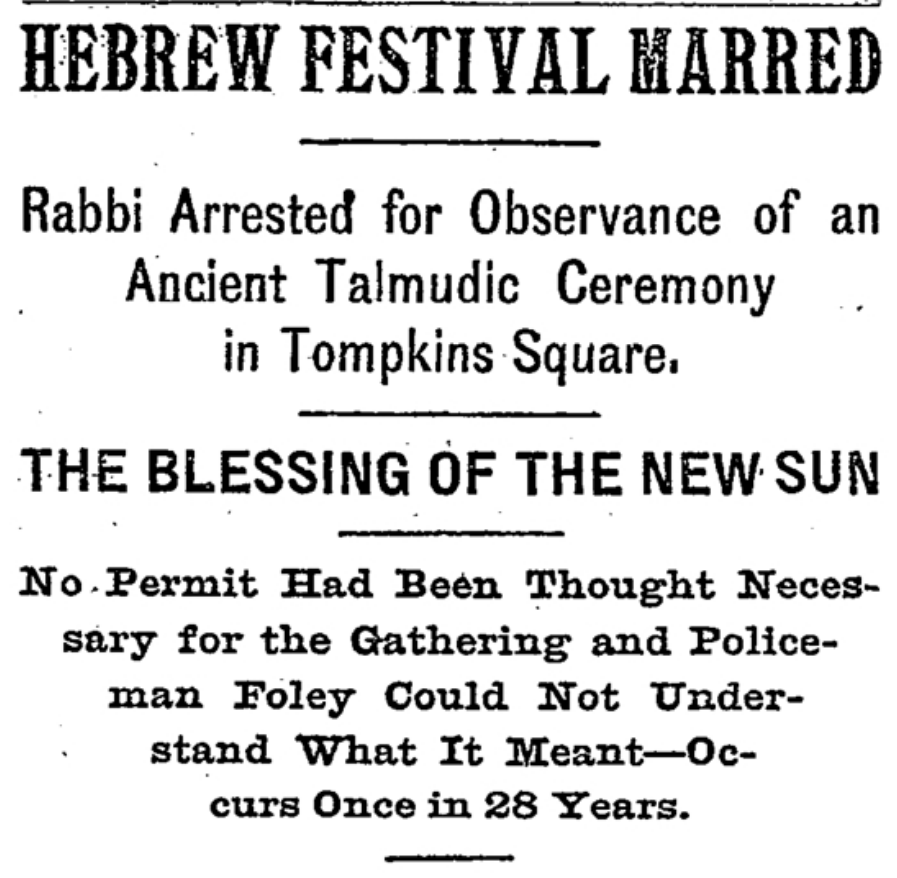
In April 1897 The New York Times reported on the arrest of one rabbi (and the flight of another) as they led a large group that had gathered to recite Birkat Hachammah. The whole things was a bit of a misunderstanding, or as The Times put it, “ The attempt of a foreign citizen [the Rabbi] to explain to an American Irishman [the police officer] an astronomical situation and a tradition of the Talmud was a dismal failure.” Here is the original. Read it through; it is absolutely delightful.

The New York Times, April 8, 1897.

The New York Times, April 8, 1897.

The Widespread Celebration of Birkat Hachammah

It was not only the Orthodox Jewish Community that celebrated the last Birkat Hachammah. Conservative, Reform, and Reconstructionist Jews also widely participated. For example Temple Beth Israel, a reform synagogue in York, Pennsylvania, encouraged children to attend this “once in a generation, multi-generational event” by joining a service at dawn on the lawn of the temple, followed by a “Dutch-treat breakfast” at a local diner. Other synagogues called on their members to use the event as a way to increase environmental awareness. One suggestion from the Reconstructionist movement was to undertake to “reduce my household’s carbon emissions by 10% by next Passover.” And the comedian Stephen Colbert lampooned the event on his popular cable television show, when he “freed his Jews.”

The next opportunity to say this blessing over the sun will be on Wednesday, 8 April 2037, (23 Nisan 5797). Let us all hope to be there.

Print Friendly and PDF