Shabbat 47a ~ Electricity on Shabbat

In a discussion on the permissibility of assembling various items on Shabbat, there is this:

הַמַּחֲזִיר קְנֵה מְנוֹרָה בְּשַׁבָּת — חַיָּיב חַטָּאת. קְנֵה סַיָּידִין — לֹא יַחֲזִיר, וְאִם הֶחֱזִיר — פָּטוּר, אֲבָל אָסוּר

One who reassembles the branch of a disassembled candelabrum on Shabbat is liable to bring a sin-offering. With regard to the plasterer’s pole, which has several component parts, one may not reassemble it ab initio, and if he reassembled it, he is exempt from bringing a sin-offering, although it is prohibited.

It is from this rather uninteresting remark that a major modern prohibition was derived. The Chazon Ish, Rabbi Avrohom Yishaya Karelitz (1874-1953) was the undisputed leading Haredi rabbi of his period in Israel, where he lived from 1933 until his death. He gave an entirely new interpretation to this passage and insisted that it was the source for the prohibition against turning electrical devices on and off on Shabbat.

Since its widespread use, the rabbis had that turning on say an incandescent light bulb was prohibited on Shabbat because it violated the ban against burning (because the metal in the bulb would become white hot) or cooking (because the metal in the bulb would become soft under the heat). These certainly were considerations, but the Chazon Ish added a new twist on an old ban. Here it is in the original:

חזון איש - אורח חיים - מועד, סימן נ

חזון איש - אורח חיים - מועד, סימן נ

In addition (to the prohibitions of cooking or burning) there is also the probation against fixing an object (מתקן כלי), since by turning on the switch it allows the circuit to become complete and the electric current can then flow. This is close to the prohibition against building which comes from the Torah, for he is fixing an object…

The source text for this ruling of the Chazon Ish is in today’s page of Talmud - the one with which we opened. Here is his explanation of the Talmud: 

Screen Shot 2020-04-20 at 3.52.43 PM.png

In Shabbat 47a we read “With regard to the plasterer’s pole, which has several component parts, one may not reassemble it. If nevertheless he did reassemble it, he is exempt from bringing a sin-offering, although it is prohibited.” It would appear that the ruling regarding the plasterer’s pole is comparable to its ruling regarding the pole of a lamp as appears in the prior clause, in that we are discussing attaching the pieces tightly, and nonetheless in the case of a plasterer’s pole one is exempt from the biblical violation of Shabbat. The reason is that the lamp is primarily used assembled, and when one disassembles it, it is not in order to use it but rather for a different purpose. However, the plasterer’s pole has two usable forms: to reach a low place a long pole is unsuitable, and to reach a high place a short pole is unsuitable. Thus, when one lengthens it temporarily, even if it is tightly joined, it is like stacking one tool on another to reach a high place and it is never really designated a “long pole.”

Here is how Dan Margulis, rabbi of the Riverdale Minyan explained the thinking of the Chazon Ish in his recent article on this topic published on The Lehrhaus:

As the Hazon Ish explains the Tosefta’s cases, it is prohibited to build a new tool or device on Shabbat because of “building.” Tools constructed of component parts which are then joined tightly are problematic for this reason. However, if the tool has two useful states—e.g. a plasterer’s pole which is used in both a long and short configuration—then no biblical violation is ever violated, since although the pieces are tightly joined, the tool always exists in an incomplete state of sometimes-short-sometimes-long.

In order to claim that the use of electricity on Shabbat constitutes a biblical violation, the Hazon Ish argues that (a) the joining of parts involved is considered “tight,” (b) that any electrical device is more similar to the lamp-pole (with one useful state) than the plasterer’s pole (with two interchangeable useful states), and, most importantly, (c) that this is an apt analogy to use as the basis for an entire model for the use of electricity in general…

The Hazon Ish claims that any electrical device is considered by Halakhah to be broken when the current is not flowing within it, since the “object” does not have the “form” necessary to be useful in the way in which it is normally used. When the electric current is connected to the “object” and its electrical components are activated, it attains the “form” necessary to become useful. In the case of the plasterer’s pole, the two lengths of wood which comprise the long handle are both objects. According to the Hazon Ish joining two objects together is a less intrinsic change than joining together an object and the electrical power which changes its form. Thus, the act of causing the current to flow through the electrical components constitutes an act of building the device itself—transforming it from a form in which it was unusable to a form in which it is usable…

And so, as Rabbi Margulis concludes, the Chazon Ish ruled that “enabling electrical current to flow through an electrical device currently powered down constituted building or repairing that device from a useless or unusable state to a useful one.” What it also important to note is that using a device “which remains on, even though its normal use involves opening and closing thousands of circuits is not the sort of boneh the Hazon Ish was concerned with.” This is important since it informs other rulings about using computers or smart watches on Shabbat that have been turned on earlier.

The operation of any electronic device involves the opening and closing of many circuits in the thousands or millions of transistors needed to complete even basic computational functions. However, since a transistor performs calculations and stores data with both the “on” and “off” states playing necessary and useful roles, the Hazon Ish would concede within his own paradigm that the operation of these electronics cannot possibly constitute a biblical violation of Shabbat, since their function is closer to the more lenient case of the plasterer’s pole than the more stringent case of the lamp-pole. Further, since the device as a whole remains on the entire time, and is never “dead” or without its tzurah, there can be no biblical violation of boneh as the Hazon Ish described in the normal use of an electronic device which remains on.

And all this from the simple observation of the Talmud about some guy plastering.

Print Friendly and PDF

Shabbat 34b ~ Sunrise, Sunset

Today’s page of Talmud deals with the topic of dusk or twilight, known in Hebrew as Bein Hashmashot. It is not quite night, and certainly still not day, so what may and may not be done during that period on Friday afternoon? Has Shabbat begun, in which case work is prohibited, or is it still technically Friday, in which case work is permitted?

שבת לד,ב

תָּנוּ רַבָּנַן: בֵּין הַשְּׁמָשׁוֹת סָפֵק מִן הַיּוֹם וּמִן הַלַּיְלָה, סָפֵק כּוּלּוֹ מִן הַיּוֹם, סָפֵק כּוּלּוֹ מִן הַלַּיְלָה — מְטִילִין אוֹתוֹ לְחוֹמֶר שְׁנֵי יָמִים. 

The Sages taught a baraita which discusses the range of problems that arise with regard to the twilight period. Twilight is a period of uncertainty. It is uncertain whether it consists of both day and night, it is uncertain whether it is completely day, and it is uncertain whether it is completely night. Therefore, the Sages impose the stringencies of both days upon it. If there is a stringency that applies on either of the days, one is obligated to adhere to it during the twilight period.

So far so good. But when does this liminal period start and end? There are at lest three opinions:

מִשֶּׁתִּשְׁקַע הַחַמָּה כָּל זְמַן שֶׁפְּנֵי מִזְרָח מַאֲדִימִין. הִכְסִיף הַתַּחְתּוֹן וְלֹא הִכְסִיף הָעֶלְיוֹן — בֵּין הַשְּׁמָשׁוֹת. הִכְסִיף הָעֶלְיוֹן וְהִשְׁוָה לַתַּחְתּוֹן — זֶהוּ לַיְלָה, דִּבְרֵי רַבִּי יְהוּדָה.

רַבִּי נְחֶמְיָה אוֹמֵר: כְּדֵי שֶׁיְּהַלֵּךְ אָדָם מִשֶּׁתִּשְׁקַע הַחַמָּה חֲצִי מִיל

רַבִּי יוֹסִי אוֹמֵר: בֵּין הַשְּׁמָשׁוֹת כְּהֶרֶף עַיִן, זֶה נִכְנָס וְזֶה יוֹצֵא, וְאִי אֶפְשָׁר לַעֲמוֹד עָלָיו

From when the sun sets, as long as the eastern face of the sky is reddened by the light of the sun. If the lower segment of the sky has lost its color, and the upper segment has not yet lost its color, that is the twilight period. If the upper segment has lost its color, and its color equals that of the lower one, it is night; this is the statement of Rabbi Yehuda.

Rabbi Nechemya says: The duration of the twilight period is the time it takes for a person to walk half a mil after the sun sets.

Rabbi Yossi says: Twilight does not last for a quantifiable period of time; rather, it is like the blink of an eye: This, night, enters and that, day, leaves, and it is impossible to calculate it due to its brevity.

We have previously met the opinion of Rabbi Yossi on the very first page of the Talmud. It deals with the obligation to recite three passages from the Torah called the shemah. These must be recited “when you lie down in the evening and when you stand in the morning” (Deuteronomy 6:7). The rabbis debate when these times might be, and link them several events, including sunrise and sunset. These two solar events are relatively easy to agree upon. But what about that period right after sunset and before nightfall, which we call dusk? Or that period right before sunrise and after the night, which we call dawn? Defining these periods of time are much more subjective, since they depend on shades of light, rather than the position of the sun on the horizon.

As we have seen, there are various opinions as to when these liminal periods start and end, including that of Rabbi Yossi, whose underscored the subjectivity of the whole enterprise.

Civil, Nautical, and Astronomical dusk

Jews were not the only ones that had to define the parameters of dusk and dawn. So too did astronomers. Their most widely accepted definitions depend on the position of the center of the sun below the horizon as seen at sea level, as shown below.

Image of Different stages of sunrise and sunset.png

Here are the definitions, according to the US National Weather Service.

1. Civil Twilight:  

This period begins in the morning, or ends in the evening, when the geometric center of the sun is 6 degrees below the horizon. Under these conditions (and absent absent fog or other restrictions,) the brightest stars and planets can be seen, the horizon and terrestrial objects can be discerned, and in many cases, artificial lighting is not needed.

2. Nautical Twilight:

This begins in the morning, or ends in the evening, when the geometric center of the sun is 12 degrees below the horizon.  In general, the term nautical twilight refers to sailors being able to take reliable readings via well known stars because the horizon is still visible, even under moonless conditions.  Absent fog or other restrictions, outlines of terrestrial objects may still be discernible, but detailed outdoor activities are likely curtailed without artificial illumination.

3. Astronomical Twilight:

This begins in the morning, or ends in the evening, when the geometric center of the sun is 18 degrees below the horizon.  During astronomical twilight, sky illumination is so faint that most casual observers would regard the sky as fully dark, especially under urban or suburban light pollution.  Under astronomical twilight, the horizon is not discernible and moderately faint stars or planets can be observed with the naked eye under a non light polluted sky. Point light sources such as stars and planets can be readily studied by astronomers under astronomical twilight.

What can you see at dusk?

What you could see during Bein Hashmashot will depend on where you happen to live. Back in 1952 a very determined group of astronomers demonstrated this with a series of illumination measurements at dusk. One was taken on Sacramento Peak New Mexico (altitude 2,800m) and the second “in the country in Maryland near sea level” (altitude 30m). “It was the impression of the observers that owing to the clearness of the mountain air the overhead and eastern portions of the sky during evening twilight were much darker relative to the western sky at Sacramento Peak than in Maryland.”

Zenith sky brightness values at Sacramento Peak New Mexico. From Koomen M.J. et al. Measurements of the Brightness of the Twilight Sky. Journal of the Optical Society of America 1952: 42 (5); 353-356.

Zenith sky brightness values at Sacramento Peak New Mexico. From Koomen M.J. et al. Measurements of the Brightness of the Twilight Sky. Journal of the Optical Society of America 1952: 42 (5); 353-356.

Another way of looking at this is by the change in brightness as we move from civil, through nautical and then astronomical twilight until we finally arrive at night.

Smoothed illuminance E (in lux) on a horizontal surface as a function of the zenith distance of the sun. From Grzegorz V. Rozenberg. Twilight: A Study in Atmospheric Optics. Springer Science, New York 1966. 18.

Smoothed illuminance E (in lux) on a horizontal surface as a function of the zenith distance of the sun. From Grzegorz V. Rozenberg. Twilight: A Study in Atmospheric Optics. Springer Science, New York 1966. 18.

Here is a description of what is happening, by the Russian physicist Georgii Vladimirovich Rosenberg, who was the Deputy Director of the Institute of Physics of the Atmosphere, (a part of the “Academy of Sciences of the USSR”). It explains why the sky is darker at higher altitudes and cleaner air:

Screen Shot 2020-04-03 at 1.14.21 PM.png

So yes, the more pollution, the more light scattering and the more you can see at twilight as the sun’s setting rays are refracted through the atmosphere. It’s counterintuitive. But hey, it’s science.

the long jewish tradition of being late for Shabbat

בבא קמא דף לב עמוד א 

אמר מר ומודה איסי בע"ש בין השמשות שהוא פטור מפני שרץ ברשות

The Master said above: And Isi concedes with regard to one who runs and causes damage at twilight on the eve of Shabbat that he is exempt, because he is running with permission. 

According to the talmudic sage Isi, if a person is running and as a result of his haste causes damage to others, he is exempt from damages if this happens at twilight on a Friday afternoon. Being late for Shabbat was clearly so common an occurrence that the rabbis had to make legal allowances for the late comers. But why were these people running? Not to compete a mundane activity, but to welcome the Shabbat Bride herself, as the Talmud continues:

בע"ש מאי ברשות איכא  כדר' חנינא דאמר ר' חנינא בואו ונצא לקראת כלה מלכתא ואמרי לה לקראת שבת כלה מלכתא רבי ינאי מתעטף וקאי ואמר בואי כלה בואי כלה

The Gemara asks: What is the reason that running at twilight on the eve of Shabbat is considered to be with permission? The Gemara answers: It is like that which Rabbi Chanina would say, as Rabbi Chaninah would say at twilight on the eve of Shabbat: “Come and let us go out to greet the bride, the queen. And some say that this is what he would say: Come and let us go out to greet Shabbat, the bride, the queen. Rabbi Yannai would wrap himself in his tallit and stand at the eve of Shabbat at twilight, saying: Come, bride; come, bride. 

Print Friendly and PDF

From the Passover Archives ~ The Chemistry of Chametz

It is Pesach (Passover) tomorrow night, so let’s review the chemistry of unleavened bread, called chametz.

מנחות ע,ב

מנא הני מילי אמר ריש לקיש אתיא לחם לחם ממצה כתיב הכא (במדבר טו, יט) והיה באכלכם מלחם הארץ וכתיב התם (דברים טז, ג) לחם עוני 

והתם גופה מנלן אמר ריש לקיש וכן תנא דבי ר' ישמעאל וכן תנא דבי ר' אליעזר בן יעקב אמר קרא (דברים טז, ג) לא תאכל עליו חמץ שבעת ימים תאכל עליו מצות לחם עוני דברים הבאים לידי חימוץ אדם יוצא בהן ידי חובתו בפסח יצאו אלו שאין באין לידי חימוץ אלא לידי סירחון

Wheat close-up.JPG

How do we know that matzah must be made from one of five species of grain [wheat, barley, oats spelt and rye]?  Reish Lakish said, and likewise a Sage of the school of Rabbi Yishmael taught, and likewise a Sage of the school of Rabbi Eliezer ben Ya’akov taught, that the verse states: “You shall eat no leavened bread with it; seven days you shall eat with it matzah, the bread of affliction” (Deuteronomy 16:3). This verse indicates that only with regard to substances that will come to a state of leavening does a person fulfill his obligation to eat matzah by eating them on Passover, provided that he prevents them from becoming leavened. This serves to exclude these foods, i.e., rice, millet, and similar grains, which, even if flour is prepared from them and water is added to their flour, do not come to a state of leavening but to a state of decay [sirḥon].

The important question we need to answer here is whether there is something fundamentally different about rice when compared to the five grain species that can become chametz. And is there any scientific support to the claim that rice spoils sooner than it ferments?

The Chemistry of bread making

To get at the answers we need to remind ourselves how plants make and consume starch. They take carbon dioxide from the atmosphere and water from the soil, and using the energy contained in sunlight (and the magic of chlorophyll) convert the two into a large sugar molecule we call starch. Plants use this starch to store and provide them with energy.

If you grind up wheat (or many other species of grain) you make flour which contains loads of starch. In addition to starch, flour contains proteins and enzymes which become important when the flour is mixed with water. Without going down a rabbit-hole of detail, here in general is what happens. First, an enzyme called beta-amylase breaks the large starch molecule down into a smaller molecule called maltose which is made up of two molecules of glucose. Another enzyme, maltase, breaks down each molecule of maltose into two molecules of glucose which is then broken down further to provide the plant with energy. Here is what it looks like:

From Lloyd, James R and Kötting, Oliver (July 2016) Starch Biosynthesis and Degradation in Plants. John Wiley & Sons, Ltd: Chichester.

From Lloyd, James R and Kötting, Oliver (July 2016) Starch Biosynthesis and Degradation in Plants. John Wiley & Sons, Ltd: Chichester.

If you add some yeast into that mix, a chemical reaction called fermentation occurs. Yeast, which is a fungus, consumes glucose and turns it into carbon dioxide and ethanol, which is an alcohol.

Yeast and fermentation.png

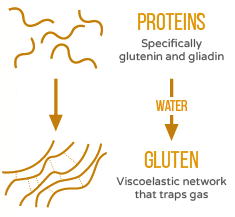
As the flour and water and yeast all mix together, two proteins in the flour called gliadin and glutenin (which are glutens) give the dough mixture its characteristic body, which strengthens the more it is mixed. The dough traps the carbon dioxide that is given off by the yeast cells, which causes the bread to rise. And that gives us the leavened bread we call chametz.

Proteins to Gluten.png

Of course when matzah is made, we do not add yeast to the dough. But there are yeast particles in the air and these will inevitably land on the dough where they will act in the same way, consuming glucose and creating carbon dioxide and alcohol. This process is much slower than when yeast is added when bread is made, but the plain dough will rise a little as a result.

The differences between grains and rice

Resh Lakish (together with those sages of the schools of Rabbi Yishmael and Rabbi Eliezer ben Ya’akov) claim that unlike grains, rice does not ferment when water is added to it. Instead it spoils. That’s why it may be eaten on Passover (unless of course you are an Ashkenazi Jew, in which case you still can’t eat it, but for another reason we’re not going to get into). Is this in fact the case?

I know next to nothing about plant biology. But Dr Angus Murphy does. He is Professor and Chair of the Department of Plant Science at the University of Maryland, and wrote the textbook on plant physiology. Dr. Murphy was kind enough to have a long chat with me over the phone and he agreed with the suggestion that grains and rice do very different things when mixed with water. The wheat seed is surrounded by the endosperm, which is itself covered by the aluerone layer. This aleurone is rich in amylase which as you recall is needed to breakdown starch into glucose (which is eaten by yeast which releases carbon dioxide and alcohol which causes the dough to rise…) However (most species of) rice do not contain this aleurone layer. So they have very little amylase, which means that it takes them a much longer time to convert starch into glucose. In fact it takes so long that by the time there is enough yeast in the dough for it to start to rise, bacteria in the air will have colonized the mixture and started breaking down the proteins in the dough. And that protein breakdown is what makes the mixture spoil, and which is what the Talmud calls סירחון. To conclude, Professor Murphy thought that the Talmud’s description of the difference between grain and rice was firmly based in plant biology.

The fine print and the final verdict

Distribution of variou types of amylases in rice grains. (Beta-Amylase activity was expressed in terms of maltose mg liberated in 3 min at 30°C by 1 g of ground rice samples.) From Ryu Shinke, Hiroshi Nishira & Narataro Mugibayashi. Types of Amy…

Distribution of variou types of amylases in rice grains. (Beta-Amylase activity was expressed in terms of maltose mg liberated in 3 min at 30°C by 1 g of ground rice samples.) From Ryu Shinke, Hiroshi Nishira & Narataro Mugibayashi. Types of Amylases in Rice Grains. Agricultural and Biological Chemistry 1973; 37:10, 2437-2438

Of course things are a little more complicated than that. (They always are.) Different kinds of wheat flour contain different amounts of amylase. Fine bleached white flour contains less amylase than say whole wheat flour, because the aleurone layer in whole wheat flour has not been broken down. Similarly, different species of rice contain different amounts of amylase, so that while standard white rice has very little, brown rice has considerably more. During talmudic times, the wheat flour would have been far less processed than any of the flour we would use today. As a result it would contain more amylase, and would have risen faster than would today’s four-water mixtures.

But as a rule of thumb, the Talmud is, biochemically speaking, spot on. When mixed with water, the five species of grain from which matzah may be made do undergo fermentation even without the addition of yeast, while rice will spoil long before the fermentation process becomes noticeable.

Talmudology wishes all its readers a very happy, and a very healthy Passover (or Easter).

Print Friendly and PDF

Shabbat 28b ~ Did Adam Sacrifice a Unicorn?

In today’s page of Talmud there is an unusual remark from Rabbi Yehudah:

שבת כח, ב

שׁוֹר שֶׁהִקְרִיב אָדָם הָרִאשׁוֹן קֶרֶן אַחַת הָיְתָה לוֹ בְּמִצְחוֹ, שֶׁנֶּאֱמַר: ״וְתִיטַב לַה׳ מִשּׁוֹר פָּר מַקְרִין מַפְרִיס״

The ox that Adam, the first man, sacrificed as a thanks-offering for his life being spared, had a single horn on its forehead, as it is stated: “And it shall please the Lord better than a horned [makrin] and hooved ox” (Psalms 69:32). The word makrin means one with a horn.

Rabbi Yehudah does not suggest just what animal this might have been, but that doesn’t stop us from trying to do so. How about a unicorn? To understand this suggestion we need a little more background.

The re'em in the Bible

The word ראם, re'em appears several times in the Hebrew Bible. Here, for example, is a verse from Deuteronomy (33:17) which describes the offspring of Joseph.

דברים לג: יז

בְּכ֨וֹר שׁוֹר֜וֹ הָדָ֣ר ל֗וֹ וְקַרְנֵ֤י רְאֵם֙ קַרְנָ֔יו בָּהֶ֗ם עַמִּ֛ים יְנַגַּ֥ח יַחְדָּ֖ו אַפְסֵי־אָ֑רֶץ וְהֵם֙ רִבְב֣וֹת אֶפְרַ֔יִם וְהֵ֖ם אַלְפֵ֥י מְנַשֶּֽׁה׃

Like a firstling bull in his majesty, He has horns like the horns of the re'em; With them he gores the peoples, The ends of the earth one and all. These are the myriads of Ephraim, Those are the thousands of Manasseh. 

The re'em is specifically identified by the great translator of the Bible Oneklos (~35-120 CE) as one of the species singled out in the Torah as being kosher:

דברים יד: ד–ה

 זֹ֥את הַבְּהֵמָ֖ה אֲשֶׁ֣ר תֹּאכֵ֑לוּ שׁ֕וֹר שֵׂ֥ה כְשָׂבִ֖ים וְשֵׂ֥ה עִזִּֽים׃ אַיָּ֥ל וּצְבִ֖י וְיַחְמ֑וּר וְאַקּ֥וֹ וְדִישֹׁ֖ן וּתְא֥וֹ וָזָֽמֶר׃

These are the animals that you may eat; the deer, the gazelle, the roebuck, the wild goat, the dishon, the antelope, the mountain sheep.

Onkelos translates that word דִישֹׁ֖ן into Aramaic as רֵימָא - the re'em. And then there is this passage from the Book of Job (39:9-12):

איוב לט:ט–יב

הֲיֹ֣אבֶה רֵּ֣ים עָבְדֶ֑ךָ אִם־יָ֝לִ֗ין עַל־אֲבוּסֶֽךָ׃ הֲ‍ֽתִקְשָׁר־רֵ֭ים בְּתֶ֣לֶם עֲבֹת֑וֹ אִם־יְשַׂדֵּ֖ד עֲמָקִ֣ים אַחֲרֶֽיךָ׃

Most English versions of this passage translate the word re'em as "wild ox"and so read: 

Would the wild ox agree to serve you? Would he spend the night at your crib?  Can you hold the wild ox by ropes to the furrow? Would he plow up the valleys behind you?

But not the King James Bible. It goes in an entirely different direction: 

Will the unicorn be willing to serve thee, or abide by thy crib? Canst thou bind the unicorn with his band in the furrow? or will he harrow the valleys after thee?

So according to the King James Bible, the re'em is a unicorn. Why on earth would the translators have chosen, of all creatures, the mythical unicorn as the re'em?

The men who [produced the King James Bible], who pored over the Greek and Hebrew texts, comparing the accuracy and felicity of previous translations, arguing with each other over the finest details of chapter and verse, were many of them obscure at the time and are generally forgotten now, a gaggle of fifty or so black-gowned divines whose names are almost unknown but whose words continue to resonate with us.
— Adam Nicoloson. God's Secretaries: The Making of the King James Bible. Harper Collins 2005. xi

The re'em is a unicorn. Or maybe not.

Well, they didn't. They merely followed the Septuagint, the Greek translation of the Hebrew Bible from the third century BCE. And the Septuagint translated the Hebrew re'em as μονόκερως - monokeros, or "one horned". Which is why the King James Bible translated it as a unicorn, from the Latin uni meaning "single" and cornu meaning "horn". And since, according to the Talmud, the Septuagint was created at the command of Ptolemy II by seventy-two Jewish sages, you could claim that the King James translation was following a long Jewish tradition.

King Ptolemy once gathered 72 Elders. He placed them in 72 chambers, each of them in a separate one, without revealing to them why they were summoned. He entered each one’s room and said: “Write for me the Torah of Moshe, your teacher”. God put it in the heart of each one to translate identically as all the others did.
— TB Megillah 9a-b

This translation made its way into later rabbinic commentary. For example, R. Dovid Kimche (1160-1235), in his dictionary of the Hebrew language called Sefer Hashorashim, wrote that the re'em has only one horn. And Abraham Yagel, (1553 – 1623), the Italian rabbi and exegete, mentioned a one-horned re'em that had been captured and brought to Portugal:

Book IV, ch. 45: 108a בית יער הלבנון 

ובימנו הובא בארץ פורטוגאלי מן האי האינדי׳ ראם אחד במצודה צדו אותו ומראה צורתו הביאו אח׳כ עוברי אורחות ימים והוא גדול מהפיל ומזרין בקסקשיו בכל עורו וקרן חזות עב על חוטמו אשר בו לחם מלחמות עם הפיל ועם שאר החיות

And in our days a re'em was brought to Portugal from India having been ambushed and trapped, and afterwards sea travellers reported how it looked. It is larger than an elephant and its scales cover all its skin. It has a thick horn on its nose which it uses in fights with the elephant and with other creatures...

As Natan Slifkin points out, what Yagel what was actually describing was a rhinoceros: "It was given to King Manuel of Portugal by Alfonso de Albuquerque, governor of Portuguese India. This was the first rhinoceros to be brought to Europe since Roman times, and it caused quite a sensation." Quite so.

But before we conclude that the re'em was a rhinoceros, there are a couple of problems. First, although it was once found in the Land of Israel, the rhinoceros remains so far discovered only go back to the Mousterian era, which ended about 35,000 years ago. That's quite a few years before the biblical period. Thus it is very unlikely that there were rhinoceri in Israel in the biblical period. And second, the re'em in the Bible is described as having two horns.  Two. "וְקַרְנֵ֤י רְאֵם֙ קַרְנָ֔יו" His horns are like the horns of the re'em" (Deut.33:17). So much for the rhinoceros or unicorn.

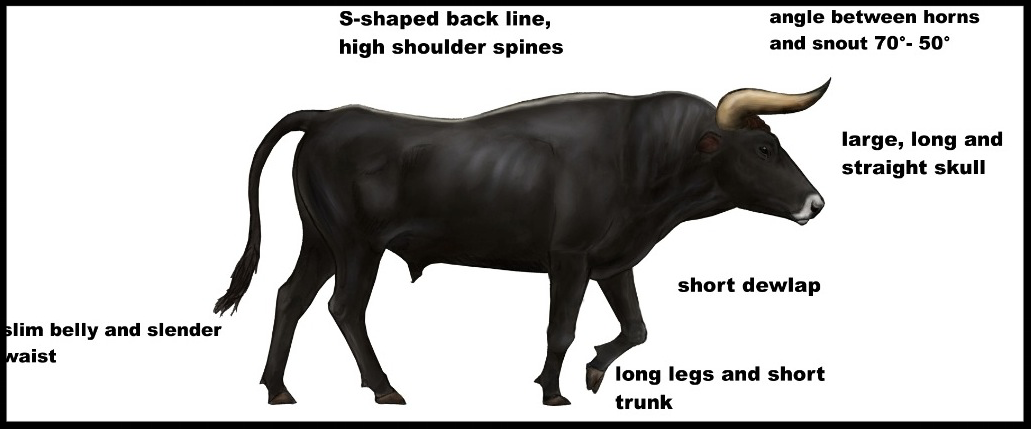
Artist's rendering of the aurochs. Is this the re'em mentioned in the Torah? From here.

Artist's rendering of the aurochs. Is this the re'em mentioned in the Torah? From here.

A better candidate: The Aurochs

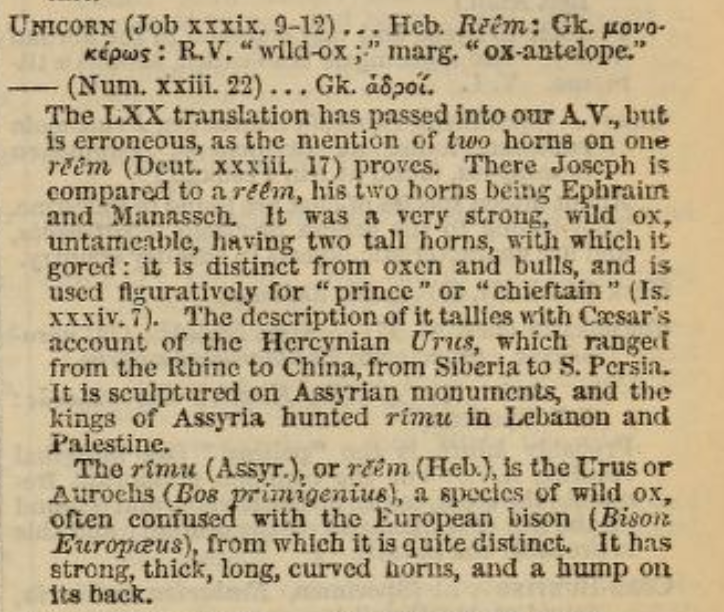
There is a better candidate for the mysterious re'em, but it is an animal neither you, nor I, nor anyone we know has ever seen. It is the aurochs, Bos primigenius, an enormous species of cattle that became extinct in 1627. The aurochs (pronounced oar-ox) weighed in somewhere around 1,500lb - or 700kg. That's certainly a big animal, though not as big as the Mount Tabor-sized beast described by Rabba bar bar Chana. It also has the added bonus of having two horns, just like the re'em described in the Torah. The suggestion that the re'em is the aurochs seems to have become popular with late nineteenth-century Christian scholars, as you can see here:

Sunday-School Teacher's Bible. Philadelphia, A.J Holman & Co. 1895. p115.

Sunday-School Teacher's Bible. Philadelphia, A.J Holman & Co. 1895. p115.

Matthew George Easton Illustrated Bible Dictionary. London, T. Nelson & Sons 1894. p678.

Matthew George Easton Illustrated Bible Dictionary. London, T. Nelson & Sons 1894. p678.

The Aurochs and the prehistoric cave paintings of LasCaux

Of all the animals that have intrigued human beings, perhaps none goes further back in time than the aurochs. Among the cave paintings of animals found in the Lascaux cave, are aurochs. And these paintings (there are nearly 6,000 of them) are from the Paleolithic period, 17,000 years ago.  The largest of the aurochs depicted there is over 15 feet long. There are similar paintings of the aurochs  in another cave system called La-Tete-Du-Lion in southern France, which has been dated to 26,000 BCE. We will, of course, never know with certainty whether the long-extinct aurochs was the re'em. But we have been fascinated with the aurochs for as long as we have walked the earth.  What better candidate could there be for the mysterious creature that somehow survived Noah's flood. 

Rabbi Yehudah and the Greeks

Perhaps then, the single horned animal that according to Rabbi Yehudah was sacrificed by Adam was the mythical unicorn. Rabbi Yehudah, also known as Yehudah bar Ilai, lived in the Galilee in the second century, some five hundred years after the Greek translation of the Hebrew Bible which introduced the re'em as μονόκερως - monokeros, or one horned. And he knew his Greek. In fact he held the Greek language in such a special esteem that he even allowed a Torah scroll to be written in it:

מגילה ט,א

א"ר יהודה אף כשהתירו רבותינו יונית לא התירו אלא בספר תורה 

And it is taught in another baraita that Rabbi Yehuda said: Even when our Rabbis permitted Greek, they permitted it only in a Torah scroll, and not for other books of the Bible, which must be written only in Hebrew.

A mythical animal as a sacrifice by the mythical first human. How fitting.

Detail from the Lascaux cave drawing, about 17,000 years old.

Detail from the Lascaux cave drawing, about 17,000 years old.

[A repost from Zevachim 113.]

Print Friendly and PDF