Shabbat 75a ~ Some Jewish Astronomers

שבת עה,א

 אָמַר רַבִּי שְׁמוּאֵל בַּר נַחְמָנִי אָמַר רַבִּי יוֹחָנָן: מִנַּיִן שֶׁמִּצְוָה עַל הָאָדָם לְחַשֵּׁב תְּקוּפוֹת וּמַזָּלוֹת — שֶׁנֶּאֱמַר: ״וּשְׁמַרְתֶּם וַעֲשִׂיתֶם כִּי הִיא חׇכְמַתְכֶם וּבִינַתְכֶם לְעֵינֵי הָעַמִּים״, אֵיזוֹ חָכְמָה וּבִינָה שֶׁהִיא לְעֵינֵי הָעַמִּים — הֱוֵי אוֹמֵר: זֶה חִישּׁוּב תְּקוּפוֹת וּמַזָּלוֹת

And Rabbi Shmuel bar Nahmani said that Rabbi Yochanan said: From where is it derived that there is a mitzva incumbent upon a person to calculate astronomical seasons and the movement of constellations? As it was stated: “And you shall guard and perform, for it is your wisdom and understanding in the eyes of the nations”(Deuteronomy 4:6). What wisdom and understanding is there in the Torah that is in the eyes of the nations, i.e., appreciated and recognized by all?  It is the calculation of astronomical seasons and the movement of constellations, as the calculation of experts is witnessed by all.

According to the great Rabbi Yochanan (or more likely Rabbi Yonatan, since he was Rabbi Shmuel’s teacher) it is a mitzvah for every person to calculate for herself the positions of the planets and constellations. This is also the position of the important work Sefer Mitzvot Gagdol (#47) complied by Moses ben Jacob of Coucy and completed in 1247. Moses gave two reasons for this mitzvah. The first is that by understanding astronomy, farmers will gain insight into the planting cycle. And secondly, a knowledge of astronomy and the passage of the seasons will help determine when additional months must be intercalated into the calendar so as to allow Pesach to be celebrated in the Spring. But Rabbi Yochanan’s prooftext “for it is your wisdom and understanding in the eyes of the nations” suggests that it is not just about an understanding of astronomy. That knowledge must be demonstrated to those outside of Judaism. And there is, in fact, a long tradition of Jews being astronomers, and sharing their knowledge far beyond the Jewish community. It started with the very first Jew: Abraham.

THE THREE Abraham the Astronomers

According to David Gans, Abraham, the first Jew, was also the first Jewish astronomer. Gans, who wrote his compendium on astronomy around 1612, believed that Abraham had obtained his own knowledge of the stars from none other than the primordial human, Adam.

Adam was an outstanding astronomer . . . and Josephus has written that when Abraham went down to Egypt because of the famine he taught them astronomy and mathematics and was praised by the Egyptians for his outstanding wisdom in these two disciplines....Abraham passed this knowledge to his son Isaac and grandson Jacob.

And so began our long tradition of taking a special interest in astronomy. It would be hard to call the early medieval practitioners astronomers in the modern sense of the word, since almost none actually sat around and looked at the motions of the heavens. Instead they translated works of astronomy into Hebrew, or drew up tables and charts of where the planets could be located, called ephemerides. One of the earliest was Sahl ibn Bishr al-Israili (c. 786–c. 845), also known as Haya al-Yahudi (Haya the Jew) who is believed to have been the first person to translate Ptolemy’s Almagest into Arabic, though not everyone believes that he was actually Jewish.

There is no doubt though that the famous exegete, grammarian and poet Abraham ibn Ezra (d.1167) was Jewish. And he was also a bit of an astronomer too. Actually what he did was mostly astrology, but hey, that’s what everyone did in the twelfth century. He was, according to Bernard Goldstein, “one of the foremost transmitters of Arabic scientific knowledge to the West,” and since Ibn Ezra was one of the first scholars to write on scientific subjects in Hebrew, he had to invent or adapt many Hebrew terms to represent the technical terminology of Arabic. Sadly, some of his translations and original works are no longer extant, but among his most famous works are Sefer Ha’Ibbur (The Book of Intercalation), about the calendar, and Sefer HaMeorot, on medical astrology.

A third “Abraham the Astronomer” was the Spanish Abraham bar Hiyya (d. 1136) who was also an important mathematician. This Abraham wrote Tzurat Ha’aretz (The Form of the Earth) on the formation of the heavens and the earth, as well as Cheshbon Mahalach HaKochavim (Calculation of the Course of the Stars).

Levi ben Gershon
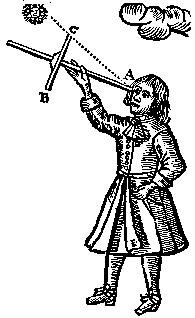
Measuring the height of a star with a Jacob's Staff. From John Sellers' Practical Navigation (1672).

Measuring the height of a star with a Jacob's Staff. From John Sellers' Practical Navigation (1672).

Levi ben Gershon (d.1344) -the “Ralbag” - lived a century later and made an enormous contribution to astronomy. He is well known as a Jewish philosopher and the author of Sefer Milhamot Ha-Shem, (The Wars of the Lord), which took some twelve years to write. He also wrote Ma’aseh Choshev, a work on mathematics. It was not widely read outside of Jewish circles since it was never translated from the Hebrew, though it contains a number of very important theorems. But Levi was also an astronomer in the sense of the word used today. According to the late Yuval Ne’eman, “he personally remeasured everything, basing his models on his own observations only. In that, he is rather unique for that period. Levi writes "no argument can nullify the reality that is perceived by the senses, for true opinion must follow reality, but reality need not conform to opinion" - certainly not the usual position in the Middle Ages.” The Ralbag is also generally credited with the invention of an astronomical device called Jacob’s Staff. It measured the angles between heavenly bodies, and was also used by European sailors for navigation. Levi’s contributions to astronomy are recognized today; there is a crater on the moon named after him.

David Gans, Astronomer Extraordinaire

Another Jewish astronomer who actually did real astronomy was David Gans, who we mentioned above. Gans was born in 1541 in Germany though he spent most of his later life in Prague. While there, he frequented the observatory of Tycho Brahe and Johannes Kepler and learned his astronomy directly from what he saw. His description of the time he spent inside the observatory is perhaps the only one of its kind in rabbinic literature: It’s worth reading just for that:

I can recount how in the year 5360 (1600) our exalted lord Emperor Rudolf (may his glory be uplifted), a man of wisdom, full of general knowledge and expert in astronomy, who values and honors those who are learned, sent a mission to Denmark to invite the eminent scholar Tycho Brahe. He was a scientist and learned in astronomy, and a man who is a prince among his people. The Emperor installed him in a castle in Benatky (which is about five parsaot from the capital Prague), where he remained isolated. [Rudolf] gave him a yearly allowance of three thousand talars together with bread, wine and beer, not to mention other gifts. There he lived with twelve others, all of whom were experts in astrology [sic] and in the large instruments [for measuring,] the likes of which had never been seen. The Emperor Rudolf built thirteen consecutive rooms, and in each room were special instruments that enabled them to view the paths of the all the planets and most of the stars.

Throughout the year they would make and record daily observations of the Sun’s orbit, its latitude and longitude and its distance from the Earth. At night they would carefully do the same for each of the six planets and most of the stars, noting their latitude, longitude and distance from the Earth. I, your author, was there on three separate occasions, each lasting five consecutive days. I sat with them in their observatory, and I saw how they worked. They did amazing work, not just with the planets but also with the stars, recognizing each by its name. When each star would cross the meridian its position would be measured with three different instruments, each operated by two experts. This position would then immediately be transcribed into hours and minutes, for which purpose [Tycho] had an amazing clock. I can testify that none of our ancestors had ever seen or heard of such a device, and it has never been described in a book, whether written by a Jew or Gentile.

And a Famous Jewish Female Astronomer

There are dozens and dozens of other examples of famous medieval and modern astronomers that we cannot include because of space (though you can find a partial listing here). But let’s end with a Jewish astronomer who just had an observatory named in her honor - Vera Rubin (1928-2016). She was born to Jewish immigrants in Philadelphia, educated at Vassar, Cornell and Georgetown, and moved to the Carnegie Institution in Washington in the 1960s. She studied the rotation of galaxies, and discovered that something other than their matter must be holding them together. As her obituary in The New York Times noted, “her work helped usher in a Copernican-scale change in cosmic consciousness, namely the realization that what astronomers always saw and thought was the universe is just the visible tip of a lumbering iceberg of mystery.” Being a woman in a man’s field had tremendous challenges, and called for ingenuity:

…she still had to battle for access to a 200-inch telescope on Palomar Mountain in California jointly owned by Carnegie and Caltech. When she did get there, she found that there was no women’s restroom. …Dr. Rubin taped an outline of a woman’s skirt to the image of a man on a restroom door, making it a ladies’ room.

Vera Rubin was elected to the National Academy of Sciences, and last year the Large Synoptic Survey Telescope was renamed the National Science Foundation Vera C. Rubin Observatory in recognition of her contributions to the study of dark matter and her outspoken advocacy for the equal treatment and representation of women in science. Despite her achievements she remained humble. “I’m sorry I know so little. I’m sorry we all know so little” she once said."But that’s kind of the fun, isn’t it?” Yes. It is.

Print Friendly and PDF

Shabbat 65b ~ Prosthetic Limbs

שבת סה, ב

הַקִּיטֵּעַ יוֹצֵא בְּקַב שֶׁלּוֹ, דִּבְרֵי רַבִּי מֵאִיר 

MISHNA: One with an amputated leg may go out on Shabbat with his wooden leg, as it has the legal status of a shoe; this is the statement of Rabbi Meir.

The more you look, the more that amputees and amputation appear in Jewish sources. Here are just a few:

  • “And you shall cut off her hand” (Deut. 25:12) is the Biblical punishment for a woman who, when trying to save her husband, mutilates the genitals of his attacker.

  • Men from the tribes of Reuven and Shimon cut off the thumbs and big toes of a Canaanite king they defeated in battle (Judges 1:6)

  • King David ordered the amputation of the hands and feet of the men who had killed Ish-Boshet (II Samuel 4:12).

  • The Midrash (Midrash Tehilim 137:4) relates that after the destruction of the First Temple the Jews exiled to Babylon cut off their own thumbs so that they would not be able to play their musical instruments in front of Nebuchadnezzer.

  • The hands of Yissachar from the village of Barkai were amputated as punishment for his contempt of the government (Pesachim 57b).

It is little wonder then, that the Talmud mentions prostheses, which, it turns out, have been around for as long as we have been hacking off limbs and digits.

The Wooden Big Toe Of Cairo

The earliest limb so far discovered was found on the mummified body in the necropolis at Thebes-West in Cairo. It is dated to about 950 BCE and is a wooden toe.

Wooden prosthesis, attached to the forefoot by a textile lace. From Nerlich, A.G. Zink A. Szeimies U. Hagedorn H.G. Ancient Egyptian prosthesis of the big toe. The Lancet 2000; 356: 2176–79

Wooden prosthesis, attached to the forefoot by a textile lace. From Nerlich, A.G. Zink A. Szeimies U. Hagedorn H.G. Ancient Egyptian prosthesis of the big toe. The Lancet 2000; 356: 2176–79

The toe’s owner was a woman who died sometime in her fifties. Pathologists determined that her toe had been amputated while she was alive, and that “the missing toe had been replaced by a wooden prosthesis painted dark brown and made up of three separate components.” They also concluded that this provided “compelling evidence that the surgical expertise to carry out toe, and possibly other amputations, sometimes followed by prosthetic replacement, was present in Egypt during this period.” Big toes are very important for getting about, since they carry about about 40% of our walking weight. Replacing it is therefore of great importance if the amputee is to regain any sort of independent ambulation. And notice how delightfully realistic the toe is. When a prosthesis was just called for, the artisan replicated the toe in all of its form, including its nail bed. I am sure the owner was rather pleased with the outcome.

The Wooden Foot of Hegesistratus of Elis

Living some five hundred years after the owner of the wooden toe, the Greek historian Herodotus (c. 484-425 BCE) recorded how the prophet Hegesistratus of Elis fell was captured by the Spartans and was condemned to death. Very much not wanting to die, Hegesistratos managed to get hold of a sword, and cut off his foot. This allowed him to remove the chains holding him, and then “this done, he tunneled through the wall out of the way of the guards who kept watch over him, and so escaped.” The reason I share this with you is because of what comes next: “After he was healed [he] had made himself a foot of wood.” After this very Aron Ralston move the prophet hobbled around for some time, but apparently he was never able to run quite fast enough, and his enemies soon caught up with him. “The enmity which he bore them brought him no good at the last, for they caught him at his divinations in Zacynthus and killed him.”

The Early Modern Prosthetic Limbs

In 1579 the French surgeon Ambroise Pare (1510–1590) published a description of the artificial limbs he fitted on his amputees. Writing in the journal International Orthopedics, Philippe Hernigou noted that Pare wanted them to be fully functional, and not just stop-gap solutions. “When he designed legs, he gave them a mechanical knee that could be locked when standing and bent at will. He drew up preliminary sketches of an arm that could be bent with a pulley that mimicked arm muscles.” But his mechanical hand seemed to have been his proudest invention. It was “operated by catches and springs, [and] was worn by a French Army captain in battle.” Apparently it worked so well that the captain was able to grip and release the reins of his horse.

Le Petit Lorrain. Les oeuvres d’Ambroise Paré 1633.

Le Petit Lorrain. Les oeuvres d’Ambroise Paré 1633.

The chicken with a prosthetic leg

It is clear from today’s page of Talmud that prosthetic limbs were used to help amputees. But another story in the Talmud suggested they may also have helped chickens. In Chullin (57b) there is a story about Rabbi Shimon ben Chalafta, whose chicken somehow dislocated its femur. And what did the good rabbi do? Why he made a prosthetic support for this poor bird:

ותרנגולת היתה לו לרבי שמעון בן חלפתא שנשמטה ירך שלה ועשו לה שפופרת של קנה וחיתה

Rabbi Shimon ben Chalafta had a hen whose femur was dislocated, and they made it a support out of the tube of a reed and it lived…

It is good to know that the rabbis’ care and concern for amputees and those with physical challenges extended to animals as well. We would expect no less.

Print Friendly and PDF

Shabbat 63 ~ Jews and Their Dogs

Az a yid hot a hunt, iz oder der hunt keyn hunt nit, oder der yid iz keyn yid nit

If a Jew has a dog, either the dog is no dog, or the Jew is no Jew
— Sholem Aleichem. Rabtshik. Mayses far Yidishe Kinder. Ale Verk. Warsaw 1903.

For those of you who (like me) own dogs, make sure they are properly trained. Because if they aren’t they may become bad dogs. And today’s page of Talmud offers some strong opinions about bad dogs.

שבת סג, א–ב

כׇּל הַמְגַדֵּל כֶּלֶב רַע בְּתוֹךְ בֵּיתוֹ מוֹנֵעַ חֶסֶד מִתּוֹךְ בֵּיתוֹ, שֶׁנֶּאֱמַר: ״לַמָּס מֵרֵעֵהוּ חָסֶד״ — שֶׁכֵּן בְּלָשׁוֹן יְוָנִית קוֹרִין לְכֶלֶב ״לַמָּס״. רַב נַחְמָן בַּר יִצְחָק אָמַר: אַף פּוֹרֵק מִמֶּנּוּ יִרְאַת שָׁמַיִם, שֶׁנֶּאֱמַר ״וְיִרְאַת שַׁדַּי יַעֲזוֹב״

Anyone who raises an evil dog within his home prevents kindness from entering into his home, since poor people will hesitate to enter his house. As it is alluded to in the verse: “To him that is afflicted [lamas], kindness from his friend and awe of the Almighty will leave” (Job 6:14), since in the Greek language they call a dog lamas. Rav Nachman bar Yitzchak said: One who keeps an evil dog in his home even divests himself of fear of Heaven, as it is stated at the end of that verse: “And awe of the Almighty will leave.”

הַהִיא אִיתְּתָא דַּעֲיַילָא לְהָהוּא בֵּיתָא לְמֵיפָא. נְבַח בָּהּ כַּלְבָּא, אִיתְעֲקַר וַלְדַּהּ. אֲמַר לַהּ מָרֵי דְבֵיתָא לָא תִּידְחֲלִי, דִּשְׁקִילִי נִיבֵיהּ וּשְׁקִילִין טוּפְרֵיהּ. אֲמַרָה לֵיהּ: שְׁקִילָא טֵיבוּתָיךְ וְשַׁדְיָא אַחִיזְרֵי, כְּבָר נָד וָלָד 

bad_dog-1400x1050.jpg

A pregnant woman who entered to use the oven in a certain house to bake, the dog in that house barked at her, and her fetus was displaced. The owner of the house said to her: Do not be afraid because his teeth have been removed and his claws have been removed. She said to him: Take your goodness and throw it on the thorns. Your encouragement is useless as the fetus has already been displaced and will certainly die.

This warning against keeping bad dogs is echoed elsewhere in the Talmud:

כתובות דף מא, ב 

ר' נתן אומר: מנין שלא יגדל אדם כלב רע בתוך ביתו, ולא יעמיד סולם רעוע בתוך ביתו? שנאמר: ולא תשים דמים בביתך

Rabbi Natan said: From where do we learn that a person should not raise a bad dog in his house, and should not place a rickety ladder in his house? [From the Torah, where] it states "You shall not place blood in your house" (Deut 22:8).

But it’s not just bad dogs. In Bava Kamma (93a), Rabbi Eliezer opined against all dogs, good and bad.  

רבי אליעזר הגדול אומר: המגדל כלבים כמגדל חזירים

One who breeds dogs is like one who breeds pigs

The American Veterinary Medical Association estimates that in the US there are about 43 million households that own almost 70 million dogs; that means over one-third of the households in the US own a dog.  (Fun Fact: Cats are owned by fewer households in the US, but are more often owned in twos or more. That means that there are more household cats - some 74 million - than there are dogs.) In the UK, a 2007 study estimated that 31% of all households owned a dog.

Bad Dogs

There are some really bad dogs. In a 10 year period from 2000-2009, one paper identified 256 dog-bite related fatalities in the US. Of course that's a tiny number compared to the overall number of dogs owned, but that's still 256 to many; the tragedy is compounded when you read that over half the victims were less than ten years old

Partaken, GJ. et al. Co-occurrence of potentially preventable factors in 256 dog bite–related fatalities in the United States (2000–2009). Journal of the American Veterinary Medical Association 2013. 243:12: 1726-1736.

Partaken, GJ. et al. Co-occurrence of potentially preventable factors in 256 dog bite–related fatalities in the United States (2000–2009). Journal of the American Veterinary Medical Association 2013. 243:12: 1726-1736.

Fatalities from dog bites are rare. Dog bites are not. Over my career as an emergency physician I must have treated hundreds of patients with dog bites. And my experience is pretty typical. One recent study estimated that more than half the population in the US will be bitten by an animal at some time, and that dogs are responsible for 80-90% of these injuries. 

Good Dogs

Although Jews are thought not to have a historical affinity for dogs, one theologian has reassessed the evidence. In his 2008 paper Attitudes toward Dogs in Ancient Israel: A Reassessment, Geoffrey Miller  suggests that in fact dogs were not shunned in Israelite society. He notes that the remains of over a thousand dogs were discovered in a dog cemetery near Ashkelon dating from about the 5th century BC. It was described as "by far the largest animal cemetery known in the ancient world" by Lawrence Stager who also pointed out that during this period, Ashkelon was a Phoenician city - not a Jewish one. Miller surveys several mentions of dogs in the Bible and the Book of Tobit, and concludes that at least some Israelites "valued dogs and did not view them as vile, contemptible creatures."

Joshua Schwartz from Bar-Ilan University surveyed Dogs in Jewish Society in the Second Temple Period and in the Time of the Mishnah and Talmud (a study that marked "...the culmination of several years of study of the subject of dogs...").  He found that while "most of the Jewish sources from the Second Temple period and the time of the Mishnah and Talmud continue to maintain the negative attitude toward dogs expressed in the Biblical tradition" there were some important exceptions. There were sheep dogs (Gen. Rabbah 73:11) and hunting dogs (Josephus, Antiquities 4.206) and guard dogs (Pesahim 113a), and yes, even pet dogs (Tobit, 6:2), though Schwartz concedes that "it is improbable that dogs in Jewish society were the objects of the same degree of affection as they received in the Graeco-Roman world or the Persian world."  

תלמוד ירושלמי (ונציה) מסכת תרומות פרק ח דף מו טור א /ה”ג

זמין חד רבן ואייתיב כלבא גביה אמר ליה ביזיון אנא חייב לך אמר ליה רבי טיבו אנא משלם ליה שביין עלון לקרתא עאל חד מינהון בעא מינסב איתתי ואכל ביציו

A certain person invited a sage to his home, and [the householder] sat his dog next to him. [The sage] asked him, ‘How did I merit this insult?’ [The house-holder] responded, ‘My master, I am repaying him for his goodness. Kidnappers came to the town, one of them came and wanted to take my wife, and the dog ate his testicles.’
— PT Terumot 8:7

Whatever your feeling about dogs, lets's be sure to remember that they serve alongside soldiers in the IDF, where they save lives. In 1969, Motta Gur (yes, the same Mordechai "Motta" Gur who commanded the unit that liberated the Temple Mount in the Six Day War, and who uttered those amazing words "The Temple Mount is in our hands!" הר הבית בידינו‎,) wrote what was to become a series of children's books called Azit, the Canine Paratrooper (later turned into a popular feature film with the same title (and once available on Amazon). But fighting dogs don't just feature in fiction. They are a fact, and an amazing addition to the IDF, where they make up the Oketz unit.  Here's a news report (in Hebrew) about the amazing work these dogs - and their handlers- perform. Keep them in your prayers.

[Mostly a repost from here.]

Print Friendly and PDF

Shabbat 61 ~ On the Ubiquity of Amulets

Among the things that may not be carried in public on Shabbat is an amulet, known in Hebrew as a קמיע -kemiah (pl. kemiaot). But that is only true of amulets that have not been demonstrated to be effective, as the Mishnah in yesterday’s page of Talmud (60a) made clear:

לֹא יֵצֵא הָאִישׁ … וְלֹא בְּקָמֵיעַ בִּזְמַן שֶׁאֵינוֹ מִן הַמּוּמְחֶה

A person may not go out on Shabbat… with an amulet when it is not from an expert…

In today’s page of Talmud, the corpulent Babylonian Rav Pappa (~300-375 CE) clarrified this ruling:

שבת סא,א

וְלֹא בְּקָמֵיעַ בִּזְמַן שֶׁאֵינוֹ מִן הַמּוּמְחֶה. אָמַר רַב פָּפָּא: לָא תֵּימָא עַד דְּמוּמְחֶה גַּבְרָא וּמוּמְחֶה קָמֵיעַ, אֶלָּא כֵּיוָן דְּמוּמְחֶה גַּבְרָא, אַף עַל גַּב דְּלָא מוּמְחֶה קָמֵיעַ 

Nor with an amulet when it is not from an expert: Rav Pappa said: This does not mean that one may only go out with an amulet if the person who wrote it is an expert and the amulet has proven effective. Rather, if the person who wrote it is an expert, even though the amulet has not proven effective, he may go out with it.

According to Rav Pappa, so long as the provenance of the amulet was from an expert, it may be carried. The Talmud then defines an “effective amulet”:

תָּנוּ רַבָּנַן: אֵיזֶהוּ קָמֵיעַ מוּמְחֶה — כֹּל שֶׁרִיפֵּא, וְשָׁנָה, וְשִׁלֵּשׁ. אֶחָד קָמֵיעַ שֶׁל כְּתָב וְאֶחָד קָמֵיעַ שֶׁל עִיקָּרִין, אֶחָד חוֹלֶה שֶׁיֵּשׁ בּוֹ סַכָּנָה וְאֶחָד חוֹלֶה שֶׁאֵין בּוֹ סַכָּנָה

The Sages taught in the Tosefta: What is an effective amulet? It is any amulet that healed one person once, and healed him again, and healed him a third time. That is the criterion for an effective amulet, and it applies to both a written amulet and an amulet of herbal roots; both if it has proven effective in healing a sick person who is dangerously ill, and if it has proven effective in healing a sick person who is not dangerously ill. It is permitted to go out with these types of amulets on Shabbat…

In the coming pages of Talmud there will be a long discussion of amulets and talmudic cures. In this age of heightened awareness of the need to disinfect, Talmudology would like to remind its readers not to actually take any of these talmudic remedies. Injecting bleach is also not a good idea. And with that warning let’s take a deep dive into the efficacy of amulets.

Amulet (noun):
a charm often inscribed with a magic incantation or symbol to aid the wearer or protect against evil such as disease or witchcraft...

...an ornament or small piece of jewelry thought to give protection against evil, danger, or disease.

Some Talmudic Amulets

Here are some of the many amulets listed in the Talmud:

  • A coin would be pressed against a wound to heal it - but this worked only if it had an image on it (משום צורתא, Shabbat 65a)

  • A shoe strap worn by a son on his left arm to alleviate the sadness from missing his father who may be traveling, or had perhaps died (Shabbat 66b).

  • Madder plants were worn around the neck as a cure. If it had three knots it could ward off illness; five would heal from illness and seven “שבעה אפילו לכשפים מעלי” - would prevent the effects of witchcraft - but only if the knots were not exposed to sunlight or moonlight (Shabbat 66b)

  • An even tekumah (preserving stone) which was worn by a woman to prevent miscarriage (Shabbat 66b)

  • A locust egg (Shabbat 67a)

  • The tooth of a fox (Shabbat 67a)

  • The nail that had been used to crucify a person (Shabbat 67a)

  • If a person had the ill fortune to have been bitten by a mad dog: “Let him bring the skin of a male hyena and write on it: I, so-and-so, son of so-and-so, am writing this spell about you upon the skin of a male hyena: Kanti kanti kelirus. And some say he should write: Kandi kandi keloros. He then writes names of God, Yah, Yah, Lord of Hosts, amen amen Selah. And let him take off his clothes and bury them in a cemetery for twelve months of the year, after which he should take them out, and burn them in an oven, and scatter the ashes at a crossroads. And during those twelve months of the year, when his clothes are buried, when he drinks water, let him drink only from a copper tube and not from a spring, lest he see the image of the demon in the water and be endangered, like the case of Abba bar Marta, who is also called Abba bar Manyumi, whose mother made him a gold tube for this purpose” (Yoma 84a)

  • To avert the spells of the demon Shavrirei, an evil spirit that rules over water: “Knock with the lid on the jug and say: So-and-so, son of so-and-so, your mother said to you to beware of the shavrirei verirei rirei yirei rei, found in white cups.” (Avodah Zara 12b).

Medieval amulet to protect mother and child against attack from the demon Lilith during childbirth. From Sefer Raziel, Amsterdam 1701.

Medieval amulet to protect mother and child against attack from the demon Lilith during childbirth. From Sefer Raziel, Amsterdam 1701.

Might a Jew use an Amulet from the Church of the Sepulcher?

Sefer Hasidim (The Book of the Pious) was composed in the twelfth and thirteenth centuries, and describes the religious life, beliefs and customs of the Jews of medieval Germany. It contains many unusual tales, and here is one of the best:

ספר חסידים # 1352

אישה אחת יהודית חלה בנה באתה [=באה] גויה ואמרה לה תני לבנך על זאת האבן לשתות ויתרפא אמרה היהודית מה טיבה של זאת האבן? אמרה הגויה שהביאו האבן מן השוחה והיא מן האבן שנטמא[יתכן וצ"ל נטמן] בה ישו ולכמה גוים נתנו לשתות ונתרפאו. אמרה היהודית כיוון שאמרה שהיא של ישו אין אנכי חפיצה שישתה בני על האבן ולא רצתה לעשות שום רפואה באותה אבן וזה :(דברים ו, 5) ובכל נפשך (שם יט, 9) לאהבה את ה' אלוקיך

The son of a Jewish woman fell ill. A gentile woman came and told her to give the boy a stone chip to swallow so that he would be cured. The Jewish woman asked, “where is this stone from?” The gentile replied that it was a stone from [the Church of the Holy Sepulcher in Jerusalem] where Jesus had been buried, and that many gentiles had been given similar stones and they had recovered.

The Jew replied that since she had told her it had come from Jesus, “I do not want my son to drink it” and she did not want to use the stone for any form of therapy. This is the meaning of the Torah “You shall love the Lord your God with all your soul,” and to “to love the Lord your God” (Deut. 5:1 and 19:9).

This story describes an attempt to heal a dying Jewish boy with a stone chip from either the Church of the Holy Sepulcher in Jerusalem (or possibly a stone chip from the Rock of Calvary within the same church). It echoes a tale found in the Talmud that points to the efficacy of shrines. Rabbi Akivah was once asked by a person “even though I do not believe that there is any substance to idol worship, don’t we see people who go with broken limbs to worship idols and come back when they are whole?” (לבי ולבך ידע דעבודת כוכבים לית בה מששא והא קחזינן גברי דאזלי כי מתברי ואתו כי מצמדי Avodah Zarah 55a).

In an email, Professor Ephraim Shoham-Steiner from Ben Gurion University explained to Talmudology that “the practice of chipping little stone fragments from the “stone of unction” or the bare rock of Calvary by pilgrims to Jerusalem is very well recorded and such a stone chip could have easily made its way to Europe. The common practice for healing was usually to pour water on the chip and then have the sick person drink the water or use the water as a healing potion.” In his fascinating paper in the Harvard Theological Review, Shoham-Steiner wrote that

Research has shown that both Jewish and Christian pious circles expressed concern over what seems to have been a rather widespread phenomenon, namely the interreligious exchange of domestic remedies, charms, and miracle cures. Attempts to limit and discourage this exchange fits within the larger framework typical of certain pietistic trends in both religions…For devout Jews like Rabbi Judah the Pious of Regensburg (d. 1217), the co-author and editor of the Book of the Pious, such exchanges [of Jewish and Christian domestic and medical knowledge] were especially objectionable when the methods of healing involved the use of ritually impure ingredients or typically non-Jewish (pagan or Christian) folk remedies. For their part, pious Christians objected to Jewish use of the healing powers of Christian saints…

In this story, the author praises a Jewish mother for rejecting her Christian neighbor’s offer to use a stone chip relic from no less then the ultimate Christian shrine — the Holy Sepulchre in Jerusalem.

I doubt that any practicing Jew today would consider using an amulet from a religious tradition outside of her own, but this story in Sefer Hasidim was clearly placed to warn the reader who might be tempted that the practice was not permitted. And it demonstrates the degree to which the use of amulets - even Christian ones - had penetrated the medieval Jewish community.

The Use of Amulets in an Israeli Intensive Care Unit

Amulets were not only a feature of medieval Jewish life. As a paper published from Assaf Harofeh hospital in Tel Aviv demonstrates, they certainly remain part of contemporary Jewish practice. The staff asked the parents of every child (Israeli and Arab) admitted to the Pediatric Intensive Care Unit (PICU) over a two-month period to complete a questionnaire, which included demographic data on the patient and the family, the use of talismans or other folk medicine practices, and the perception of the effects of these practices on the patient’s well-being.

They found that an astonishing 30% of the Jewish families used amulets and talismans in the ICU, irrespective of the socioeconomic status of the family or the severity of the patient’s illness. None of the Muslim families used them, but only eight Arab (compared with 42 Jewish) children were surveyed. Amulets and talismans were used significantly more by religious Jews, by families with a higher parental educational level, and where the hospitalized child was very young.

And what were these modern amulets, used by one in three of the families of these very sick children?

“A total of 25 objects were used. These included 16 holy books, a note written by a rabbi, a picture of a rabbi, a thread tied around the patient’s limb, and 6 other talismans. The most common types of amulets and talismans used in our pediatric ICU, in descending order of frequency, were:

Holy books — the whole Bible or a part thereof, e.g., the book of Psalms (Tehilim), placed on the patient’s bed, usually adjacent to his/her head or under the pil- low.

Photograph of a rabbi — usually placed on the patient's bed, or on the wall nearby.

Dollar note — a U.S. dollar note, sent by a well-known rabbi in the USA, usually placed on the patient's bed.

Card or note from a rabbi — with a written blessing, placed adjacent to the patient’s head or under the pillow.

Bottle of "holy water" or "holy oil" — to be applied to the patient's skin, once or several times, or poured in a glass and placed on the floor under the patient's bed. This liquid is usually prepared by a rabbi.

Red thread — tied around the patient's wrist or ankle.

Medallion — pinned to the clothes or hanging on a necklace. Common medallions are blue beads and amulets in the form of an eye or a palm with five fingers (hamsa, meaning five in Arabic).

Blessing by a rabbi — who prays next to the patient's bed or outside the ICU. If the rabbi cannot come personally, one of the patient’s relatives will go to the rabbi to obtain a blessing.

Adding a name — either a new first name or one or several letters. The names of angels in the Bible were usually added to the original names of male patients, and names of known personages in the Bible, or names with a certain meaning (for example, long living), were given to both male and female patients.

Changing the name — from the patient's original first name to a new one, in accordance with the above mentioned considerations.

Other types of talismans, amulets and various kinds of stones with various shapes — the most well-known is the hand-shaped hamsa. Others are hexagonal, circular, knife-shaped, rectangular, hexagram (Star of David), heart-shaped, amuletic rings, etc. These usually contain an inscription, e.g., one of the several names of God (Shaddai, Jehova, etc.), angels (Gabriel, Uriel, Raphael, etc.), rivers in Paradise (Gihon, Pishon, Hiddekel, etc.), and others (Zion, King David, Jerusalem), etc.

We believe that the frequent use of talismans, as found in this study, might express the families’ need for emotional and psychological support. We therefore suggest that this issue be taken seriously, and that consideration be given to increasing the involvement of psychologists in the global care of the critically ill child. We also contend that a greater awareness and follow-up by the staff is needed to understand, help and encourage families who use amulets as an extra treatment for children in the ICU.
— Barr, J. et al. Talismans and Amulets in the Pediatric Intensive Care Unit: Legendary Powers in Contemporary Medicine. IMAJ. 2000: 2; 278-281.

universal beliefs in the power of amulets

The belief in the power of amulets is a powerful one. It was true in talmudic times, and it remains so today. Some of the beliefs of the rabbis might feel strange to our modern minds, but they reflected what everyone believed back then. Galen, the second century Roman physician wrote that assertion that a peony root hung about the neck was effective against epilepsy and that stones of green jasper worn over the stomach cured stomach complaints. And here, as another example, is an amulet against the disease we call malaria, written in the third century by Quintus Serenus Sammonicus (d. 212 CE) who was the physician to the Roman emperor Caracalla.

Abracadabra image.png

Inscribis chartae, quod dicitur Abracadabra, Saepius: et subter repetas, sed detrahe summae, Et magis atque magis desint elementa figuris Singula, quae semper rapies et coetera figes, Donec in angustam redigatur litera conum. His lino nexis collum redimire memento.

Write several times on a piece of paper the word ‘Abracadabra,’ and repeat the word in the lines below, but take away letters from the complete word and let the letters fall away one at a time in each succeeding line. Take these away ever, but keep the rest until the writing is reduced to a narrow cone. Remember to tie these papers with flax and bind them round the neck.

After wearing the talisman for nine days, it was to be thrown over the shoulder into an eastward-running stream. Should this treatment fail, Sammonicus recommended the application of lion’s fat, or the wearing of cat’s skin tied with yellow coral and green emeralds around the neck.

Abracadabra written as an amulet remained popular for more than 1,500 years after it was mentioned by Sammonicus. In fact it was widely used during the outbreaks of bubonic plague in London in the seventeenth century, as Daniel Defoe recorded in his book Journal of a Plague Year.

But there was still another madness beyond all this, which may serve to give an idea of the distracted humour of the poor people at that time: and this was their following a worse sort of deceivers than any of these; for these petty thieves only deluded them to pick their pockets and get their money, in which their wickedness, whatever it was, lay chiefly on the side of the deceivers, not upon the deceived. But in this part I am going to mention, it lay chiefly in the people deceived, or equally in both; and this was in wearing charms, philtres, exorcisms, amulets, and I know not what preparations, to fortify the body with them against the plague; as if the plague was not the hand of God, but a kind of possession of an evil spirit, and that it was to be kept off with crossings, signs of the zodiac, papers tied up with so many knots, and certain words or figures written on them, as particularly the word Abracadabra, formed in triangle or pyramid, thus:—

     ABRACADABRA
     ABRACADABR     Others had the Jesuits’
     ABRACADAB         mark in a cross:
     ABRACADA             I H
     ABRACAD               S.
     ABRACA
     ABRAC          Others nothing but this
     ABRA               mark, thus:
     ABR
     AB                   * *
     A                    {*}

I might spend a great deal of time in my exclamations against the follies, and indeed the wickedness, of those things, in a time of such danger, in a matter of such consequences as this, of a national infection. But my memorandums of these things relate rather to take notice only of the fact, and mention only that it was so. How the poor people found the insufficiency of those things, and how many of them were afterwards carried away in the dead-carts and thrown into the common graves of every parish with these hellish charms and trumpery hanging about their necks, remains to be spoken of as we go along.

Rashi, who lived about 500 years earlier than Defoe, recognized Abracadabra and its disappearing letters. Here is his explanation of the talmudic amulet that we have already mentioned, to be used against the demon Shavrirei. To recall, the Talmud (Avodah Zara 12b) states that the incantation should include the phrase “your mother said to you to beware of the shavrirei verirei rirei yirei rei.” And here is Rashi:

רשי, עבודה זרה יב, ב

איזדהר משברירי שברירי ברירי רירי ירי רי בכסי חיורי - לחש הוא ומתמעט והולך משם השד כאשר הוא שומע מיעוט תיבות אות אחר אות עד רי וכן הוא הלחש להבריחו משם

He whispers and reduces the number of letters of the name of the demon. When the demon hears his name loosing letter after letter, until all that is left are the letters “rei” [he vanishes] and the whispering expels him from there…

Robert Boyle and His Powdered Toads

Robert Boyle (1627-1691) is considered the father of modern chemistry. He discovered the law that describes the inversely proportional relationship between the absolute pressure and volume of a gas, and Britain’s Royal Society of Chemistry gives out a Robert Boyle Prize for Analytical Science, named in his honor. But as Margaret Baldwin shows in her fascinating paper Amulet Therapy in Seventeenth-Century Medicine, Boyle was very fond of his amulets.

He believed that amulets of powdered toad cured urinary incontinence, while amulets of excised kidney stones, when tied to the wrists, relieved pain caused by stones in the kidneys. He cited the case of a friend who had been cured of violent cramps by wearing and handling the tooth of a hippopotamus. He had seen cases where plague had been cured, and cases where plague had been averted, by drinking an extract of horse dung and rotting ivy berries.

Boyle attributed the efficacy of amulets to the invisible material effluvia exuded by the chemical or animal substance contained in the externally applied medicine. Such particles entered through the pores of the skin, then passed into the blood and circulated throughout the body until they reached the diseased part, where their shape caused them to produce a lasting alteration in the textures of the body…

Boyle described himself as being of a frail and weak constitution and constantly prone to sickness. He recorded that he had been cured of a violent quotidian fever by amulets made of basalt, hops, and a quarter pound of blue currants tied upon his wrists. Chronically subject to violent nosebleeds, Boyle recounted one incident in which he had been afflicted in this manner while visiting his sister's house. As she happened to have on hand some moss from a dead man's skull (it had been sent her as a present from Ireland, where it was esteemed a useful remedy), Boyle tried the remedy on himself. But rather than stuffing it up his nostrils, as was the custom, he chose to hold it in his hand. Covering the moss with his fist "that the warmth might a little actuate the medicine," he found that the nosebleed stopped speedily, much to the wonder of the bystanders. Moreover, he recounted that he had not been troubled with a nosebleed for several years following the use of the moss. On another occasion, Boyle tried to cure himself of leg cramps by wearing a ring made of elk's hoof provided him by a physician. Boyle candidly reported that the remedy had failed to help his leg cramps, but noted that it had in fact relieved more moderate cramps in his hands and that it was his habit to keep the ring at his bedside for times when the finger cramps returned.

“Well, ah, I did inquire as to the contents, and I was not persuaded of any great good to come therefrom...but the man who sent it is a well-esteemed physician, and he says it is a remedy much thought of among the Florentine doctors who had had a large experience with Plague.”

”But what is it?” I asked again.

”It contains a dried toad,” she said
— Geraldine Brooks. Year of Wonders. Penguin 2001. 84

Judaism’s Most popular Amulet - The Mezuzah

On the front door of a Jewish home you will find an amulet, called a mezuzah. In fact, it is placed on all of the doors in the house, other than bathrooms and closets. My home has at least fifteen of them. The mezuzah is placed to fulfill the biblical command to “write the words of God on the gates and doorposts of your house" (Deut. 6:9).  The Rav Chaninah of Sura, who lived in the fourth century, suggested that the mezuzah could work to protect the inhabitants of the home in which it was placed:

מנחות לג, ב

אמר רבא מצוה להניחה בטפח הסמוך לרה"ר מאי טעמא רבנן אמרי כדי שיפגע במזוזה מיד רב חנינא מסורא אומר כי היכי דתינטריה 

Rava says: It is a mitzva to place the mezuza in the handbreadth adjacent to the public domain. The Gemara asks: What is the reason for this? The Rabbis say that it is in order that one encounter the mezuza immediately upon one’s entrance to the house. Rav Chaninah from Sura says: It is in order that the mezuza protect the entire house, by placing it as far outside as one can.

It is not clear if Chaninah’s position is an outlier. Several other passages in the Talmud can be read either as supporting this position or as suggesting that it is not the mezuzah per se that is protective. Instead, it serves as a reminder of God’s commandments. Nevertheless, later rabbinic literature began to ascribe supernatural powers to the mezuzah, like this passage from the Sheiltot (145), complied by Achai Gaon in the eighth century:

ארטבן שלח לרבינו הקדוש (רבי יהודה הנשיא) מרגלית ( פְּנִינָה ) אחת טובה שאין להעריך את שוויה; ואמר לו - שלח לי דבר שטוב כמותה. כתב לו רבינו הקדוש מזוזה אחת ושלח לו. שלח ארטבן ואמר לו - מה עשית? אני שלחתי לך דבר יקר שאין להעריך את שוויו ואילו אתה שלחת לי דבר ששווה מטבע אחת. שלח רבינו הקדוש ואמר לו - אתה שלחת לי דבר שאני צריך לשמור אותו; ואני שלחתי לך דבר שאתה ישן והיא (התורה) משמרת אותך, שכתוב (משלי ג, טו) ' יְקָרָה הִיא מִפְּנִינִים וְכָל חֲפָצֶיךָ לֹא יִשְׁווּ בָהּ' - חפציי וחפציך לא ישוו בה

מיד נכנס שד בביתו של ארטבן; ולא היה לו אלא בת אחת ובאו כל הרופאים ולא הועילו לה. כיון שנטל ארטבן את המזוזה ושם לה על הפתח - מיד ברחה אותה שדה; ונטל רבינו הקדוש מרגלית לעצמו

Artaban sent to our Holy Rabbi an invaluable pearl together with the message: Send me something as good. He wrote him a mezuzah and sent to him. Artaban sent him (word) and said: I sent you something priceless, and you send me something that is not worth anything.He sent him (an answer): You sent me something that I have to guard, and I sent you something that protects you when you sleep, as it is written “She is more precious than rubies, and all the things you can desire are not to be compared unto her” (Prov. 3:15). Your thing and my thing can not be compared to her.

Immediately entered a demon into the daughter of Artaban and this was his only daughter and all the physicians came and they could do nothing for her, (but) as soon as Artaban took the mezuzah and attached it to the door the demon fled from her at once and our Holy Rabbi kept the pearl to himself.

During the middle ages Jews started to add the names of angels or verses or other symbols with a distinctly magical character onto the parchment of the mezuzah for extra protection. Maimonides was dismayed by this custom, and ruled against it in his Mishnah Torah (Hilkhot Tefilin Mezuzah 5:4):

It is universal custom to write the word Shaddai on the other side of the mezuzah, opposite the blank space between the two sections. As this word is written on the outside, the practice is unobjectionable. They, however, who write names of angels, holy names, a biblical text or inscriptions usual on seals, within the mezuzah, are among those who have no portion in the world to come. For these fools not only fail to fulfill the commandment, but they treat an important precept that expresses the Unity of God, the love of him and his worship, as if it were an amulet to promote their own personal interests, for according to their foolish mind, the mezuzah is something that will secure for them advantage in the vanities of the world.

This didn’t do much to dissuade. In thirteenth century Spain, a kabbalist named Joseph Gikatilla penned Sod Hamezuzah (The Secret of the Mezuzah), in which he wrote:

The Holy One, blessed be He, because of His great love for Israel, gave them these two passages, which are Shema and Vehaya Im Shamoa, and they are the secret of the two passages called Gedulah (grace) and Gevurah (severity). Encompassing Gedulah and Gevurah are all the external forces, and in order to protect Israel from the external forces that surround Gedulah and Gevurah, which are called the mezuzot of the supreme palace, He commanded Israel to place a mezuzah on the gates of their homes, so that there should be no permission for the external forces to enter the homes of Israel, so that they cannot harm them.

And the secret: God shall pass over to plague Egypt, and He shall see the blood on the lintel and on the two doorposts, and so on (Exod 12:23). Now then, the mezuzah always stands in the place of those things that were done on the night they left Egypt, and the mezuzah guards at the entrance against all the external forces of impurity, so that they may not enter the house. Likewise, when a man goes out the door of his house, those camps of sanctity and purity that are attached to these two passages ‒ namely, Shema and Vehaya Im Shamoa ‒ they all go with the man who has a mezuzah in his doorway, and when he goes out the door of his house, they protect him from the harmful spirits and from all the external forces of impurity until he returns home. The mezuzah therefore protects a person when he enters his home, when he goes out ... and those angels that are appointed for those two passages in the mezuzah protect a man when he goes out the door of his house. And it is about this that it says, For He shall command His angels, for you, to protect you on all your paths, to carry you in His hands (Ps 91:11).

All of this goes to show that the talmudic belief in amulets must be contextualized. It was part of a worldview in which demons and witches were commonplace, and spells could be made or broken with the right ingredients. It was a worldview that continued for over fifteen hundred years. That amulets were once used by everyone should not be a surprise. Far more difficult to explain is the fact that they continue to be used by many Jews today.

Print Friendly and PDF