Eruvin 64 ~ Wine and Cognitive Function

In this page of Talmud we begin a long digression about the effects of wine, both good and bad. There is a dispute whether wine precludes a rabbi from rendering a legal decision. Rabbi Yehuda thought it did, but Rav Nachman thought the idea ridiculous. He claimed that he could only render a legal ruling after he had drunk some wine.

עירובין סד, א

אמר רב יהודה אמר שמואל שתה רביעית יין אל יורה אמר רב נחמן לא מעליא הא שמעתא דהא אנא כל כמה דלא שתינא רביעתא דחמרא לא צילא דעתאי 

Rav Yehuda said in the name of Shmuel: If one drank a quarter-log of wine, he may not issue a halakhic ruling, as the wine is liable to confuse his thinking. With regard to this second statement, Rav Nachman said: This halakha is not excellent, as concerning myself, as long as I have not drunk a quarter-log of wine, my mind is not clear. [It is only after drinking wine that I can issue appropriate rulings.]

What are we to make of Rav Nachman’s statement that he could only render a legal decision after he had some wine. Does alcohol indeed sharpen the mind?

Nope.

In study after study, alcohol actually impairs you cognitive function. (You can see more evidence of this if you joined me in the Emergency Department on a Saturday night.) For example, one study, published in 2000, demonstrated that alcohol impaired both the speed of information processing and as well as higher order cognitive abilities. While the study only used twenty subjects, I think we can all agree that these findings would be replicated in a larger population (see above regarding the ED). The authors concluded that

Alcohol administration resulted in impaired performance on perceptual organization, synthesis of thought, abstract thought, decision making and attention to detail, but not on short-term memory, visual memory, freedom from distractibility and anxiety and visuo-motor coordination.

It is of course, precisely the powers of abstract thought, decision making and attention to detail that are needed in order to render a fair legal decision of any sort. Another review of the action of alcohol on vigilance concluded that “nonverbal, spatial information processing are very sensitive to low doses of alcohol.” Alcohol is involved in over half of all fatal car crashes in the US and so on and so on. Alcohol does nothing to sharpen the mind.

...results show that alcohol impaired visual information processing, attention, abstract reasoning and visuo-motor coordination...
...the results indicate that all stages of information processing are impaired independently...
— Tzambazis, K. Stough, C. Alcohol impairs speed of information processing and simple and choice reaction time and differentially impairs higher order cognitive abilities. Alcohol & Alcoholism 2000. 35( 2 ) 197-201.

Rav Nachman and the CAGE Questionnaire

Why then did Rav Nachman believe that he could only render a legal decision after he’d had some wine? Here is one possibility: for people who have a drinking problem, the addiction to alcohol can lead to nasty withdrawal symptoms, that can only be alleviated with …more alcohol. Today, one of the four screening questions that are asked using the CAGE questionnaire to detect a possible drinking problem is “have you ever felt the need to drink first thing in the morning to steady your nerves?” It is precisely the need for alcohol in order to “think straight” (or to have the illusion of thinking straight) that is a warning sign of potential alcoholism.

Rav Nachman (d.~320C.E.) was a wealthy man, who had high self-esteem. He claimed that if anyone was worthy of being the Messiah in his generation “he must be like me” (אמר רב נחמן אי מן חייא הוא כגון אנא, see Sanhedrin 98b). He also owned an enormous wine cellar (see Berachot 51b). Of course none of this proves that Rav Nachman had what today we would call alcoholism, but it is an interesting idea to ponder.

Does Exercise help eliminate alcohol?

Elsewhere on today’s page of Talmud we read that exercise can increase the elimination of alcohol.

עירובין סו,ב

אמר רמי בר אבא דרך מיל ושינה כל שהוא מפיגין את היין

Rami bar Abba said: Walking a path of a mil, and similarly, sleeping even a minimal amount, will dispel the effect of wine that one has drunk. 

These observations are perfectly reasonable. Alcohol is eliminated in the body by the liver, although the rate at which it does so varies. It is faster in those who drink regularly, and slower in those who are alcohol naive. In general, the elimination rate is around 10-15mg/dL/hr in alcohol naive people and around 20mg/dL/hr or higher in those with chronic alcohol use. Try as you might, there is really nothing you can do to speed up this rate of elimination.

Does exercise help, as Rami bar Abba suggested? Well, there is one study that looked at this very question. In rats, which were fed alcohol mixed into their liquid diet “with use of a kitchen wire whisk and bowl.” They were then made to run on a little rodent treadmill and blood was removed from their tails at various time intervals. The researchers, from the University of Texas at Austin, concluded that “…running exercise for periods of at least 60 min will increase rates of ethanol clearance compared with rates measured at rest.” So if you are a rat with a hangover, a vigorous run for an hour might help you feel better. But what about us?

Well, it depends how much you exert yourself. A study published in 1982 tested the rates of alcohol elimination in a very small group of volunteers, who got drunk and hopped on an exercise bike. It found that

prolonged physical exercise produces an enhanced ethanol elimination if the intensity and duration of exercise are sufficient. But this finding has hardly any pathological meaning.The reasons for the enhanced elimination of blood alcohol are probably to be found in the elevated body temperature caused by physical exercise and in a supplementary loss of alcohol by perspiration and exhalation. The muscles are not able to utilize ethanol either directly or indirectly.

Time-dependent elimination of alcohol

Sleep does nothing to speed up the metabolism of alcohol either. But what if Rami bar Abba was not suggesting an activity, but rather a length of time? Perhaps he is in effect saying that the alcohol wears off in about the time it takes to walk a mil, or have a short nap. That certainly makes physiological sense. To which Rav Nachmun pointed out that this time period only applied after a small amount of wine (“a quarter log”). Any more than that could not be eliminated in such a short period. Also physiologically correct.

But Rami bar Avuha (not the same Rami as before) noted that if you are really intoxicated, you would need more time to sober up.

אָמַר רַב נַחְמָן אָמַר רַבָּה בַּר אֲבוּהּ: לֹא שָׁנוּ אֶלָּא שֶׁשָּׁתָה כְּדֵי רְבִיעִית, אֲבָל שָׁתָה יוֹתֵר מֵרְבִיעִית — כׇּל שֶׁכֵּן שֶׁדֶּרֶךְ טוֹרַדְתּוֹ וְשֵׁינָה מְשַׁכַּרְתּוֹ. 

Rav Nachman said that Rabba bar Avuh said: They only taught this with regard to one who has drunk a quarter-log of wine, but with regard to one who has drunk more than a quarter-log, this advice is not useful. In that case, walking a path of such a distance will preoccupy and exhaust him all the more, and a small amount of sleep will further intoxicate him.

Of course so long as you stop drinking, there is no way that a nap will further raise your alcohol level, but again, if you have drunk enough and take a nap you may wake with an awful hangover, which may make you feel as if you were intoxicated.

Time dependent elimination of alcohol at various doses. For “one drink” you might substitute a quarter log of wine.” For “four drinks” you might substitute the more potent “Italian wine.”

Time dependent elimination of alcohol at various doses. For “one drink” you might substitute a quarter log of wine.” For “four drinks” you might substitute the more potent “Italian wine.”

The Talmud is full of conflicting statements about wine and its intoxicating effects. In tomorrow’s page of Talmud Rav Chaninah claimed that the relaxed feeling a person gets after drinking wine put him in the same mindset as the Creator of the universe:

עירובין סה, א

אמר רבי חנינא כל המתפתה ביינו יש בו מדעת קונו שנאמר וירח ה׳ את ריח הניחוח וגו׳ 

Rabbi Chanina said: Whoever is appeased by his wine, i.e., whoever becomes more relaxed after drinking, has in him an element of the mind-set of his Creator, who acted in a similar fashion, as it is stated: “And the Lord smelled the sweet savor, and the Lord said in His heart, I will not again curse the ground any more for man’s sake” (Genesis 8:21).

And according to Rav Chanan bar Papa it is a sign of prosperity if “wine flows like water” in the house (Eruvin 65a). But rabbis also pointed out the dangers of drinking to excess. One explanation for the deaths of the sons of Aaron the High Priest (described in Lev.10) is that they were drunk when they performed in the Mishkan. Elsewhere we have discussed how the Talmud described alcoholic liver disease, and how it precluded a Cohen from service in the Temple. Like many things, wine would be taken in moderation. That lesson, taught in Avot D’Rabbi Natan, was true in talmudic times, and remains so in ours too.

אבות דרבי נתן 37:5

ח׳ דברים רובן קשה ומיעוטן יפה. יין מלאכה שינה ועושר ודרך ארץ ומים חמין והקזת דם 

There are eight things which are dangerous in excess but good in moderation: wine, work, sleep, [having] wealth, sexual relations, [bathing in] hot water, and bloodletting.


Want more? Here are some other Talmudology posts that also discuss alcohol and its effects:

Cohanim and alcoholic liver disease

The healing effects of alcohol

Too drunk to say no


Print Friendly and PDF

Talmudology Redux ~ Could the Vilna Gaon Have Stayed Awake Over Sukkot?

The Vilna Gaon, (lit. The Genius of Vilna) lived from 1720-1797, and today, the 19th of Tishrei, is the Hebrew anniversary of his death. He was one of the leading talmudic and halakhic authorities of his time. His works are widely studied to this day, and his legal opinions are often cited. Today’s question is: did the Vilna Gaon stay awake for several consecutive days one Sukkot? Here is the background:

The Vilna Gaon.

The Vilna Gaon.

In January 1788 the Vilna Gaon was involved in the kidnapping of a young Jewish man who had converted to Christianity. For his role in the kidnapping Rabbi Eliyahu (the given name of the Gaon) was arrested and held for over a month.  The case was later tried, and on September 15, 1789 (sic) the Gaon of Vilna, together with others involved in the kidnapping, was sentenced to twelve weeks in jail.  Although it is unclear how long he was imprisoned, he was there over Sukkot, and the Lithuanian authorities were hardly in the practice of providing imprisoned Jews with a sukkah.  But since one is not permitted to sleep outside of the sukkah, what was the Gaon to do?  Simple.  He’d stay awake, and by doing so he would not transgress the prohibition of sleeping outside the sukkah.  Here’s how the episode is described in the work Tosefet Ma’aseh Rav published in 1892. 

Detail of Maaseh Rav.png

Our Leader, teacher and Rabbi may he rest in peace, when he was imprisoned on Sukkot, tried with all his strength, and walked from one place to another, and held his eyelids open, and made an extraordinary effort not to sleep outside the sukkah – not even a brief nap – until the authorities released him to a sukkah.

We don’t know for how many nights the sixty-nine year-old Rabbi Eliyahu stayed awake, but is such a claim even plausible? As it turns out, it is.

The World Record for Staying Awake

The world record for staying awake is an amazing eleven days. Eleven days – that’s 264 hours (and 24 minutes to be precise) without sleep. It was set in 1965 by Randy Gardner, who was then seventeen years old. Gardner seems to have suffered little if any harm by his marathon period of sleep deprivation. But don’t try and beat the record. The Guinness Book of Records no longer has an entry for staying awake – because it is considered too dangerous an ordeal to undertake. (You can hear a review of sleep deprivation stunts in general and a wonderful interview with Gardner himself here.)

The Health Risks of Sleep Deprivation

What are the health risks of prolonged sleep deprivation? A 1970 study of four volunteers who stayed awake for 205 hours (that’s eight and a half days!) noted some differences in how the subjects slept once they were allowed to do so, but follow-up testing of the group conducted 6-9 months after the sleep deprivation showed that their sleep patterns were similar to the pre-deprivation recordings.

Although Randy Gardner and these four volunteers seem to have suffered no long-term health consequences of staying awake for over a week, scientists have long noted that sleep deprivation is rather bad for the body. Or to be more precise, the bodies of unfortunate laboratory rats who are not allowed to sleep. In these animals, prolonged sleep deprivation causes the immune system to malfunction. This results in infection and eventual lethal septicemia. The physiologist who kept these rats awake noted that there are “far-reaching physical implications resulting from alterations in immune status [which] may explain why sleep deprivation effects are risk factors for disease and yet are not well defined or specifically localized.” In other words, sleep deprivation makes rats really sick, but we don’t know how, or why…

One possible explanation was suggested in 2013 by a group from the University of Rochester Medical Center. They demonstrated that during sleep, the space between the cells of the brain (the interstitial space) increased by up to 60%, allowing toxic metabolites to be cleared. This raises the question of whether the brain sleeps in order to expel these toxic chemicals, or rather it is the chemicals themselves that drive the brain to switch into a sleep state.

The extracellular (interstitial) space in the cortex of the mouse brain, through which cerebral spinal fluid moves, increases from 14% in the awake animal to 23% in the sleeping animal, an increase that allows the faster clearance of metabolic waste…

The extracellular (interstitial) space in the cortex of the mouse brain, through which cerebral spinal fluid moves, increases from 14% in the awake animal to 23% in the sleeping animal, an increase that allows the faster clearance of metabolic waste products and toxins. From Suzana Herculano-Houzel. Sleep it out. Science 2013: 342; 316

Not having any sleep is bad for your health - but so too is going without enough sleep. Chronic restriction of sleep to six hours or less per night can produce cognitive performance deficits equivalent to up to two nights of total sleep deprivation. So be sure to get a full night's rest.

Hard, But Not Impossible

The world record set by Randy Gardner has implications for a talmudic decision. In the tractate Shavuot (26b) Rabbi Yochanan ruled that since it was impossible to stay awake for more than three days, any vow to do so is considered to have been a vow made in vain – and punishment follows swiftly.  Here is how the ArtScroll Talmud explains this ruling, (based on the explanation of the Ran).

Since it is impossible for a person to go without sleep for three days, the man has uttered a vain oath. Hence, he receives lashes for violating the prohibition (Exodus 20:7): לא תשא את שם ה׳ אלוקיך לשוה, You shall not take the Name of Hashem, your God, in vain. And since the oath -being impossible to fulfill -has no validity, he is not bound by it at all and may sleep immediately.

Maimonides codified this law and also assumed that it is impossible to stay awake for three consecutive days. 

רמב"ם הלכות שבועות פרק ה הלכה כ

נשבע שלא יישן שלשת ימים, או שלא יאכל כלום שבעת ימים וכיוצא בזה שהיא שבועת שוא, אין אומרין יעור זה עד שיצטער ויצום עד שיצטער ולא יהיה בו כח לסבול ואח"כ יאכל או יישן אלא מלקין אותו מיד משום שבועת שוא ויישן ויאכל בכל עת שירצה

If a person swore that he would not sleep for three days, or would not eat anything for seven days, or something similar, this is considered a false oath. We do not tell the person to stay awake until it is impossible to do so, or fast for as long as possible until the discomfort is too great to bear, and then allow him to eat or sleep. Rather he is punished with lashes immediately for making a false oath, and is then allowed to sleep or eat as much as he wants…

Based on Randy Gardner’s feat, Rabbi Yochanan was incorrect when he ruled that it was impossible to stay awake for three days. It's certainly not impossible, but that hardly means it's a good idea to try. 

It also means that the story of the Gaon of Vilna’s sleepless nights in that cold prison might indeed have occurred. Still it is best not to disrupt your usual sleep patterns. Perhaps that is why Rabbi Chaninah ben Chachina'i in Masechet Avot  (3:4) taught that one who stays awake at night "will forfeit with his life."  Now that's a warning to heed.

רבי חנינא בן חכינאי אומר הנעור בלילה ... הרי זה מתחייב בנפשו

HAPPY SUKKOT FROM TALMUDOLOGY

Sleep deprivation reduces learning, impairs performance in cognitive tests, prolongs reaction time, and is a common cause of seizures. In the most extreme case, continuous sleep deprivation kills rodents and flies within a period of days to weeks. In humans, fatal familial or sporadic insomnia is a progressively worsening state of sleeplessness that leads to dementia and death within months or years.
— Lulu Xie et al. Sleep Drives Metabolite Clearance from the Adult Brain. Science 2013. 342.317
Print Friendly and PDF

Sukkot Redux I ~ Gauss, Tosafot, and Counting the Sukkot Sacrifices

We are currently celebrating the seven-day festival (or eight outside Israel) of Sukkot (Tabernacles). When the Temple in Jerusalem stood, it was a time when a large number of animals were sacrificed. A very large number. For each of the seven days of the festival, in addition to two rams, fourteen lambs and one goat there were a number of bulls that were sacrificed. Thirteen on the first day, twelve on the second, eleven on the third, ten on the fourth, nine on the fifth, eight on the sixth and finally seven bulls on the last day.

במדבר 29:12-34

וּבַחֲמִשָּׁה עָשָׂר יוֹם לַחֹדֶשׁ הַשְּׁבִיעִי מִקְרָא־קֹדֶשׁ יִהְיֶה לָכֶם כָּל־מְלֶאכֶת עֲבֹדָה לֹא תַעֲשׂוּ וְחַגֹּתֶם חַג לַה׳ שִׁבְעַת יָמִים׃ 

וְהִקְרַבְתֶּם עֹלָה אִשֵּׁה רֵיחַ נִיחֹחַ לַה פָּרִים בְּנֵי־בָקָר שְׁלֹשָׁה עָשָׂר אֵילִם שְׁנָיִם כְּבָשִׂים בְּנֵי־שָׁנָה אַרְבָּעָה עָשָׂר תְּמִימִם יִהְיוּ…׃ 

וּבַיּוֹם הַשֵּׁנִי פָּרִים בְּנֵי־בָקָר שְׁנֵים עָשָׂר אֵילִם שְׁנָיִם כְּבָשִׂים בְּנֵי־שָׁנָה אַרְבָּעָה עָשָׂר תְּמִימִם׃… 

וּבַיּוֹם הַשְּׁלִישִׁי פָּרִים עַשְׁתֵּי־עָשָׂר אֵילִם שְׁנָיִם כְּבָשִׂים בְּנֵי־שָׁנָה אַרְבָּעָה עָשָׂר תְּמִימִם׃… 

and so on…

Numbers 29:34

Pablo Picasso: “Bull,” 1945

Pablo Picasso: “Bull,” 1945

On the fifteenth day of the seventh month, you shall observe a sacred occasion: you shall not work at your occupations.—Seven days you shall observe a festival of the LORD.— 

You shall present a burnt offering, an offering by fire of pleasing odor to the LORD: Thirteen bulls of the herd, two rams, fourteen yearling lambs; they shall be without blemish. 

The meal offerings with them—of choice flour with oil mixed in—shall be: three-tenths of a measure for each of the thirteen bulls, two-tenths for each of the two rams, 

and one-tenth for each of the fourteen lambs. 

And there shall be one goat for a sin offering—in addition to the regular burnt offering, its meal offering and libation. 

Second day: Twelve bulls of the herd, two rams, fourteen yearling lambs, without blemish… 

Third day: Eleven bulls, two rams, fourteen yearling lambs, without blemish…

and so on… 

So how many bulls would the manager of the Temple inventory have to make ready for the entire festival of Sukkot? Well, you could just add them up, which is not too hard (13+12+11+10+9+8+7=70), but there is another way, which is found in the medieval commentary known as Tosafot, on page 106 of the tractate Menachot. Let’s take a look. 

Another offering, another math problem

We read there that the mincha offering is accompanied by a minimum of a one-issaron measure of flour. But a mincha can also be accompanied by a multiple of that number, up to a maximum of 60 issronot. What happens if a person vows to bring a specific number of issronot of flour to accompany a mincha offering but cannot recall how many he had in mind? What number of issronot of flour should he offer? Well it’s a bit tricky. The sages ruled that a single offering using the full sixty issronot of flour is all that needs to be brought. But the great editor of the Mishnah, Rabbi Yehudah Hanasi disagreed. In a spectacular way. Here is the discussion:

מנחות קו, א

תנו רבנן פירשתי מנחה וקבעתי בכלי אחד של עשרונים ואיני יודע מה פירשתי יביא מנחה של ששים עשרונים דברי חכמים רבי אומר יביא מנחות של עשרונים מאחד ועד ששים שהן אלף ושמונה מאות ושלשים

The Sages taught in a baraita: If someone says: I specified that I would bring a meal offering, and I declared that they must be brought in one vessel of tenths of an ephah, but I do not know what number of tenths I specified, he must bring one meal offering of sixty-tenths of an ephah. This is the statement of the Rabbis. Rabbi Yehuda HaNasi says: He must bring sixty meal offerings of tenths in sixty vessels, each containing an amount from one-tenth until sixty-tenths, which are in total 1,830 tenths of an ephah.

Since there is a doubt as to the true intentions of the vow, Rabbi Yehudah HaNasi covers all the bases and requires that every possible combination of a mincha offering be brought. So you start with one mincha offering accompanied with one issaron of flour, then you bring a second mincha offering accompanied with two issronot of flour, then you bring a third mincha together with three issronot, and so on until you reach the maximum number of issronot that can accompany the mincha - that is until you reach sixty. The total number of Rabbi Yehudah HaNasi’s mincha offerings is then calculated: 1,830.

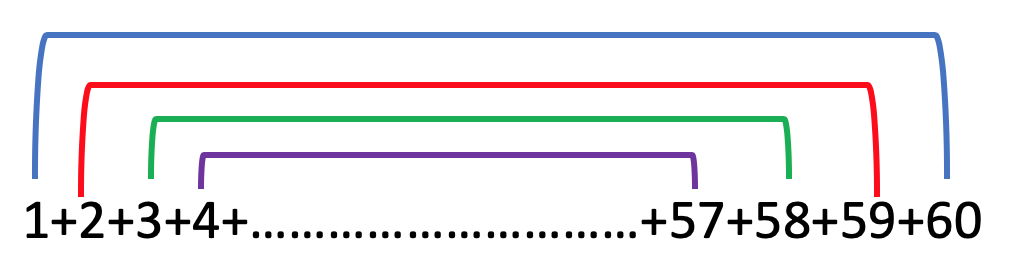
How did the Talmud arrive at that number? We are not told, and presumably you simply add up the series of numbers 1+2+3+4….+59+60, which gives a total of 1,830. That certainly would work. But Tosafot offers a neat mathematical trick to figure out the sum of a mathematical sequence like this:

שהן אלף ושמונה מאות ושלשים. כיצד קח בידך מאחד ועד ששים וצרף תחילתן לסופן עד האמצע כגון אחד וששים הם ס"א שנים ונ"ט הם ס"א ושלש ונ"ח הם ס"א כן תמנה עד שלשים דשלשים ושלשים ואחד נמי הם ס"א ויעלה לך שלשים פעמים ס"א

Screen Shot 2018-11-21 at 8.55.09 AM.png

How did we arrive at 1,830? Take the series from 1 to 60 and add the sum of the first to the last until you get to the middle. Like this: 1+60=61; 2+59=61; 3+58=61. Continue this sequence until you get to 30+31 which is also 61. You will have 30 sets of 61 (ie 1,830).

Tosafot continues with the math lesson, and let’s us know the total number of bulls sacrificed over the seven day festival of Sukkot:

Calculation for Sukkot.png

וכן נוכל למנות פרים דחג דעולין לשבעים כיצד ז' וי"ג הם עשרים וכן ח' וי"ב הם עשרים וכן ט' וי"א הם כ' וי' הרי שבעים

This method may also be used to count the number of sacrificial bulls on Sukkot, which are a total of 70. How so? [There are thirteen offered on the first day of sukkot, and one fewer bull is subtracted each day until the last day of sukkot, on which seven bulls are offered.] 13+7=20; 12+8=20; 11+9=20… [There are a total of 3 pairs of 20+ an unpairable 10]= 70.

In mathematical terms, the Tosafot formula for the sum (S) of the consecutive numbers in Rebbi’s series, where n is the number of terms in the series and P is the largest value, is S= n(P+1)/2. Which reminds us of…

Carl Friedrich Gauss

Carl Friedrich Gauss (1777-1855) was one of the world’s greatest mathematicians. He invented a way to calculate the date of Easter (which is a lot harder than you’d think), and made major contributions to the fields of number theory and probability theory. He gave us the Gaussian distribution (which you might know as the ”bell curve”) and used his skills as a mathematician to locate the dwarf planet Ceres. The British mathematician Henry John Smith wrote about him that other than Isaac Newton, “no mathematicians of any age or country have ever surpassed Gauss in the combination of an abundant fertility of invention with an absolute rigorousness in demonstration, which the ancient Greeks themselves might have envied.”

There is a delightful (though possibly apocryphal) story about Gauss as a bored ten-year old sitting in the class of Herr Buttner, his mathematics teacher. There are at least 111 slightly different versions of the story, but here is one, as told by Tord Hall in his biography of Gauss:

When Gauss was about ten years old and was attending the arithmetic class, Buttner asked the following twister of his pupils. “Write down all the whole numbers from 1 to 100 and add their sum…The problem is not difficult for a person familiar with arithmetic progressions, but the boys were still at the beginner’s level, and Buttner certainly thought that he would be able to take it easy for a good while. But he thought wrong. In a few seconds, Gauss laid his slate on the table, and at the same time he said in his Braunschweig dialect: “Ligget se” (there it lies). While the other pupils added until their brows began to sweat, Gauss sat calm and still, undisturbed by Buttner’s scornful or suspicious glances.

Screen Shot 2018-11-19 at 2.29.07 PM.png

How had the child prodigy solved the puzzle so quickly? He had added the first number (1) to the last number (100), the second number (2) to the second from last number (99) and so on. Just like Tosafot suggested. The sum of each pair was 101 and there were 50 pairs. And so Gauss wrote the answer on his slate board and handed it to Herr Buttner. It is 5,050.

THE Number of bulls=70

Gauss was raised as a Lutheran in the Protestant Church, and so he did not learn of this method from reading Tosafot. But it is delightful to learn that the same mathematical method that launched Gauss into his career as a mathematician predated him by at least four-hundred years and can be found on page 106a of Menachot, where it also applies to the festival of Sukkot.

Happy Sukkot from Talmudology

Print Friendly and PDF

Eruvin 56a ~ The Identity of the Constellation Eglah

In order to set the boundaries of a city with regards to where it may be permissible to carry, the Talmud states that one should “square” it, meaning an imaginary square is drawn to include within it the entire city.

This is a simple enough instruction, but we are not done. The sides of this imaginary square are to be aligned with the four cardinal directions, North, East, South and West. We are not told why this must be done. Instead the Talmud explains how this squaring is done. Here is one suggestion.

עירובין נו, א

תָּנוּ רַבָּנַן: בָּא לְרַבְּעָהּ — מְרַבְּעָהּ בְּרִיבּוּעַ עוֹלָם, נוֹתֵן צְפוֹנָהּ לִצְפוֹן עוֹלָם וּדְרוֹמָהּ לִדְרוֹם עוֹלָם, וְסִימָנָיךְ: עֲגָלָה בַּצָּפוֹן, וְעַקְרָב בַּדָּרוֹם. 

With regard to the measurements of a city’s boundaries, the Sages taught the following baraita: If, in order to measure the Shabbat limit, one comes to square a city, i.e., to extend the city’s boundaries to include all of its protrusions within an imaginary square, he squares it so that the sides of the square align with the four directions of the world. He sets the northern side of the square to align with the north of the world, and its southern side to align with the south of the world. And your sign by which you can recognize the directions of the world is as follows: The constellation of “eglah” is in the north and Scorpio is in the south. The directions of the city are determined by these constellations.

The Bull vs The Bear

These two constellations should be easy to identify. Let’s start with the second one mentioned. The word עַקְרָב means a scorpion, and Scorpio is one of the twelve signs of the zodiac. Good. But what about the first constellation eglah or agalah (there is a big difference as we will see). To what constellation might this refer? Agalah - עֲגָלָה means either a “wagon” or, when the same letters are vocalized as eglah, a “calf.” And then things really get interesting.

Eglah is Taurus

TheArtScroll English Talmud indeed identifies עֲגָלָה with Taurus, (as does the ArtScroll Hebrew translation). This would depend on vocalizing the word as “eglah” meaning a calf. This would most likely identify it as the bovine constellation we know as Taurus, the “Bull.” This was also the opinion of the great medieval commentator Rashi. He doesn’t explain the word’s meaning on this page of Talmud, but he does elsewhere. In the tractate Berachot (58b) he explains the meaning of the phrase רישא דעגלא - “the head of the eglah” as the constellation Bull, or Taurus:

רשי ברכות נח,ב

רישא דעגלא – ראשו של עגל והיינו מזל שור

But we are not done. When these two constellations are mentioned in Pesachim (94b), the medieval commentary known as Tosafot remarks that eglah cannot be Taurus, (and Scorpio cannot be Scorpio). It is all to do with a description of the universe that we cannot get into now, but will do so on February 23rd next year, when we study that page in the Daf Yom cycle. Here is that Tosafot:

תוס׳ פסחים צד, ב

מעולם לא מצינו עגלה בדרום ועקרב בצפון - צ"ל דעגלה לאו היינו מזל שור כדפי' בקו' ועקרב נמי אינו עקרב די"ב מזלות דבפ"ק דראש השנה (דף יא:) קאמר די"ב מזלות לעולם ששה למטה מן הארץ וששה למעלה וכשהא' עולה שכנגדו שוקע והכא אמר שאינן זזים ממקומן ושניהם לעולם למעלה אלא אחרים הם

So to sum, Rashi believed that eglah is Taurus - and that is the ArtScroll understanding. Tosafot claimed it cannot be Taurus, though he does not offer an alternative. Now let’s consider some more contemporary translations and explanations.

Eglah is Ursa Major

The Koren (Steinsaltz) English Talmud identifies eglah as another constellation entirely, and one that is not part of the twelve signs of the zodiac. It is called Ursa Major, “The Great Bear.” Ursa Major was called Ἄρκτος μεγάλη Arktos Megale - The Great Bear - by the second century astronomer Ptolemy, and was long associated with things north. (That’s where we derive the word arctic.) So this description could certainly have been known to the rabbis of the Talmud.

The classic Soncino English Talmud translates עֲגָלָה as “The Great Rear.” And it’s not a typo in which an “R” replaced a “B.” But why the Great Rear? Well as you can see from the image below, there are seven stars within the Ursa Major that are known as the Big Dipper. And where are they located? At the very rear of the bear.

Of course that only works if you imagine the stars forming a bear in a particular way. Here for example is how H.A. Rey - the creator of the Curious George series - depicted the The Great Bear in his wonderful book The Stars: A New Way to See Them. As you can see, the Great Bear is now made up by a very different set of lines, and the Big Dipper is no longer at its “Great Rear” but is instead part of the head of the bear.

 
H.A Rey. The Stars: A New Way to See Them. Houghton Mifflin 1980. 35.

H.A Rey. The Stars: A New Way to See Them. Houghton Mifflin 1980. 35.


So not everyone looks at a constellation and draws the same images. Here is another example, from Goldshmidt’s German translation of the Talmud which reads the word not as eglah but as as agalah: der Wagen.” Actually, Ursa Major or more precisely seven of its stars that are called the Big Dipper was once called Charles’ Wain, a name that came from the

…Middle English Charlewayn, from Old English carles wǣn, apparently from a common Proto-Germanic *karlas wagnaz (cognate with forms in other Germanic languages). It seems that this common Germanic name originally meant the ‘peasant's wagon’ (the churls' wagon) in contrast to the ‘woman's wagon’ (Ursa Minor). Later it was interpreted as ‘Charles's wagon’ and associated with Charlemagne.

So in another culture the seven stars of the Big Dipper were seen as a wagon. Which is precisely how you could vocalize the Hebrew word in question: agalah. If you take a look at the stars it is easy to see why. But in Holland the stars are popularly known as the "Saucepan" (Steelpannetje). Which you can also make out. It’s all in the eye of the beholder.

Here is a summary of what we found:

The Meaning and Pronunciation of the
Constellation  "עגלה"
Eglah = Calf Agalah = Wagon
Rashi Taurus
X
Tosafot Not Taurus X
Goldscmidt
(German)
The Wagon =
The Big Dipper
Soncino
(English)
X
The Big Rear =
The Big Dipper
ArtScroll
(English & Hebrew)
Taurus X
Koren
(English)
X Ursa Major

Which of these possibilities, Taurus, Ursa Major, or the Big Dipper, is the most likely? To find out let’s do some astronomy.

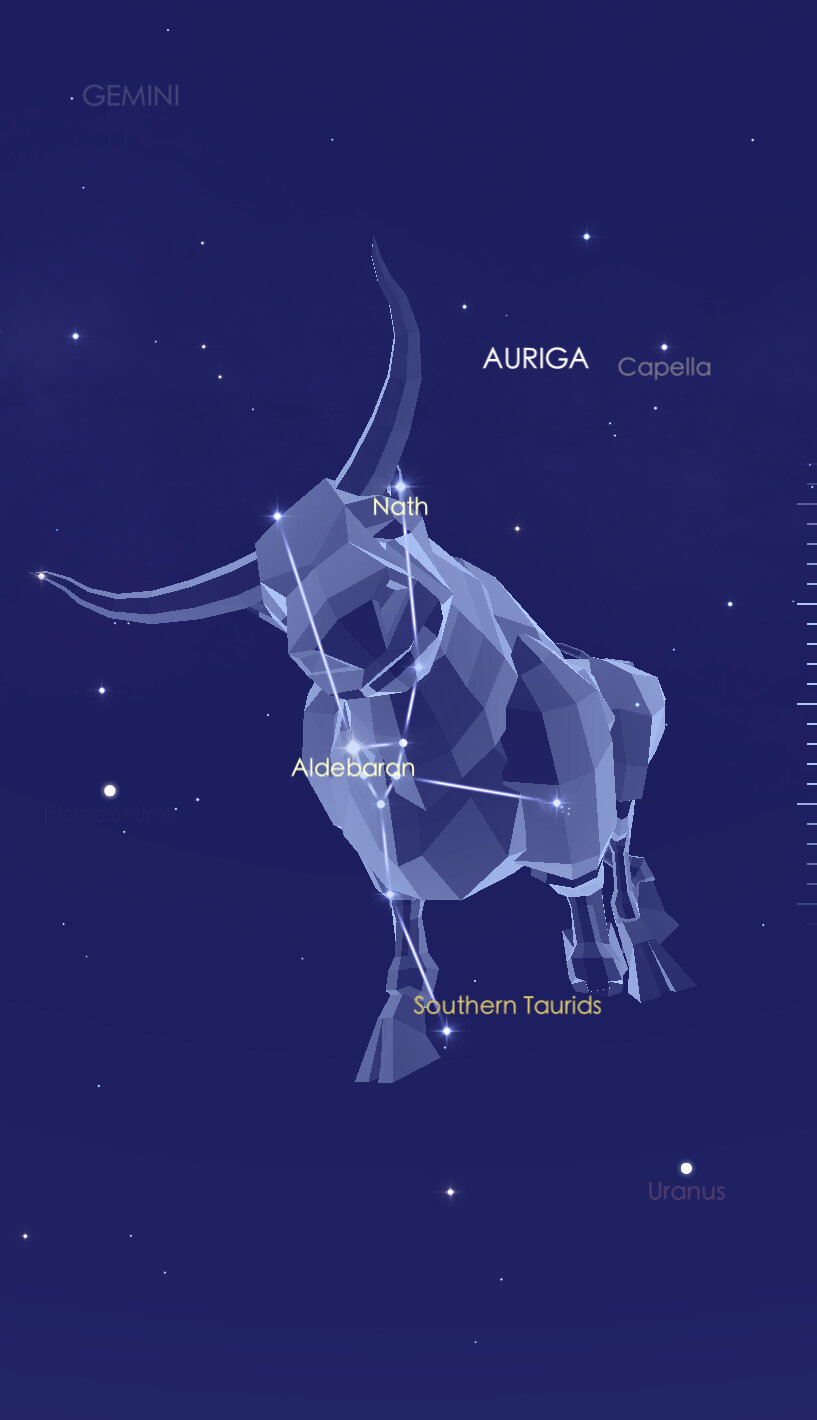
Taurus is a large constellation that is best seen (in the Northern Hemisphere) from November to February. In late November and December it can be seen the entire night. However by late March it appears for only a short time before sunrise and then almost completely disappears in the summer months. Although Taurus is always found in the northern sky moving from northeast to northwest, because it is sometimes only barely visible for an hour or so right before sunrise it could not always be used to find North.

 
Taurus. Image from the excellent app StarWalk 2.

Taurus. Image from the excellent app StarWalk 2.


Ursa Major “The Great Bear” is the third largest constellation in the sky, and is visible for the entire year. This constellation is circumpolar, meaning it never sets below the horizon. And because it is always near the north celestial pole, it is always in the northern part of the sky. So it could reliably be used year round to identify north.

As part of Ursa Major, the Big Dipper is also circumpolar. In fact it can be used to identify Polaris, the Pole star, around which the stars seem to revolve each night. And the Pole Star is also known as the North Star, because it is always in the north.

 
Ursa Major. Image from StarWalk2.

Ursa Major. Image from StarWalk2.


So Which is the Most likely?

While Taurus, Ursa Major, and the Big Dipper are all found in the northern sky, the most reliable of them for finding which direction is north are the last two, and particularly the Big Dipper. Here is how H.A. Rey draws its relationship to the North (Pole) star:

The relationship of the Big Dipper (aka the Wagon aka the Saucepan) and two of its “pointer” stars to the Pole star and hence to the North.

The relationship of the Big Dipper (aka the Wagon aka the Saucepan) and two of its “pointer” stars to the Pole star and hence to the North.

So if you are ever lost in the wilderness without GPS or a compass, remember this page of Talmud, look for the agalah (and not the eglah), and find your way back home.

Print Friendly and PDF