Happy Birthday Galileo

Galileo Galilei in a 1636 portrait by Justus Sustermans.

Galileo Galilei in a 1636 portrait by Justus Sustermans.

Today, February 15th, is a special day. It is the birthday of Galileo Galilei, who was born in Pisa on that day in 1564. Among his many achievements were his careful observations of the Earth’s moon, the identification of four of Jupiter’s moons, and the discovery that Venus, when observed through a telescope, has phases, just like that of our own moon. The only reasonable explanation of this was that Venus orbited the Sun, and not the Earth. And just like that, the geocentric model of the universe in which everything revolved around the Earth, came to a grinding halt.

Galileo’s Jewish Connection

Galileo taught astronomy to anyone who would listen, including Jews, and his most important Jewish student was Joseph Solomon Delmedigo who was born in Candia on the Island of Crete in 1591. At the age of fifteen Delmedigo left for Italy, where he enrolled in the University of Padua. For seven years there he studied astronomy, mathematics, natural science and medicine, and was taught by none other than Galileo Galilei, who was soon to become famous for both his observations of the planets and his clash with the Church.

When Delmedigo graduated he traveled to Lublin, Vilna, and Livona, where he spent much of his time working as a physician. He ultimately settled in Amsterdam where he published his Sefer Elim, a long book (it runs over four hundred pages) that deals with philosophy, science, mathematics, and astronomy.

“Galileo my Teacher” from Delmedigo, Sefer Elim, Amsterdam 1629. 148.

“Galileo my Teacher” from Delmedigo, Sefer Elim, Amsterdam 1629. 148.

In this book book Delmedigo outlined the reasons he accepted the Copernican model of the universe. In addition to explaining all of the theoretical support for the heliocentric model, he cited experimental evidence. If the planets revolved about the Sun and were illuminated by it, the amount of light that they reflect would depend on their location and distance from the Earth. And this is precisely what Delmedigo and his famous teacher had observed through the telescope

My teacher Galileo observed Mars when it lay close to the Earth. At this time its light was much brighter than that of Jupiter, even though Mars is much smaller. Indeed it appeared too bright to view through the telescope. I requested to look through the telescope, and Mars appeared to me to be elongated rather than round. (This is a result of its clarity and the movement of its rays of light.) In contrast, I found Jupiter to be round and Saturn to be egg-shaped.

This glorious passage reminds us that religiously observant Jews were sometimes at the very cutting edge of the new astronomy. How many could claim to have been instructed by the great Galileo himself?

But don’t get carried away

The historian Andre Neher (d. 1988) viewed Joseph Delmedigo as a fearless trailblazer whose goal was not only to influence his own community, but also the Catholic Church itself. In a paper published in 1977 he wrote:

When Delmedigo published Elim in 1629, he used the term “Rabbi” in speaking of his teacher Galileo. Rabbi Galileo! Was this not something of a challenge directed to the inquisitors in Rome who were then preoccupied with Galileo and who were not to let him go until his death in 1642? Free Galileo, Delmedigo seems to be saying, or release him to us; in the midst of our Jewish community, he will not be subjected to any trial, we shall not require him to make any retraction, we shall welcome him and honor him like a Rabbi in Israel!

Well, not quite. As I have written elsewhere, this account is linguistically, historically, and conjecturally incorrect. In the first place, although the term used by Delmedigo to describe Galileo was indeed the word rebbi, in this context, it means “my teacher,” and not “my rabbi.” By translating it in this way Neher was able to support his claim that the Jews were open, receptive, and respectful to new ideas emerging in astronomy; but the linguistic reality (and much else besides) does not bear this out.

Secondly, in the years prior to the publication of Sefer Elim in 1629, Galileo had not become the “preoccupation” of the Inquisition. The work that led to the trial by the Inquisition, Dialogue Concerning the Two Chief Systems of the World, was not published until 1632. And so Neher’s claim that Delmedigo was writing a message to release Galileo is chronologically incorrect. Finally, the notion that the Jewish community would not punish one of their own for expressing antinomian views is inaccurate. It was, after all, in Amsterdam itself, the city in which Delmedigo’s books were published, that the Jewish community excommunicated Spinoza in 1656 on account of “the horrible heresies which he practiced and taught.” So I don’t think that Neher’s assessment of Delmedigo as challenging the Inquisition on behalf of Galileo was accurate. But he was certainly correct in noting the important role that Galileo must surely have played in the education of the young Jew Joseph Delmedigo from Crete, who grew up and became the first Jewish Copernican.

A selection from the Talmudology Library Galileo Collection

A selection from the Talmudology Library Galileo Collection


Print Friendly and PDF

Pesachim 84a ~ Cartilage

In a Mishnah on this page of Talmud there is a discussion about which parts of the paschal offering may be eaten.

פסחים פד,א

כׇּל הַנֶּאֱכָל בְּשׁוֹר הַגָּדוֹל — יֵאָכֵל בִּגְדִי הָרַךְ, וְרָאשֵׁי כְנָפַיִם וְהַסְּחוּסִים

MISHNA: Anything that is fit to be eaten in an adult ox, [whose bones have fully hardened,] may be eaten in a young kid. And the soft ends of the ribs and the cartilage are soft enough to be considered edible and may therefore be eaten from the Paschal lamb.

What is Cartilage?

Cartilage comes in several different flavors other than roasted. There is articular cartilage, which acts as a solid lubricant. It covers the joint surfaces and ensures a frictionless movement of the surfaces of articulating joints, like your hips, knees and elbows. Then there is hyaline cartilage which acts like a more flexible versions of bone, and provides structural support. It is what gives your ears and nose their shape, and keeps your ribs attached to the breast bone. Finally fibrous cartilage is the stuff of which the menisci of your knees are made. These act as a cushion against the stress of walking, running and playing frisbee. When you tear a meniscus, you have torn fibrous cartilage.

We are not the only species to have cartilage. There is an entire class of fish known as the Chondrichthyes (from the Greek chondr meaning 'cartilage', and ichthys meaning 'fish,’) whose skeleton has no bone in it and is made from cartilage alone. This class includes sharks and sting rays.

Patients with cancer and chronic inflammatory disorders have used shark cartilage preparations for many years. Preclinical studies that support their beneficial effects are scanty, and reports of clinical trials have been anecdotal.
— D R Miller, G T Anderson, J J Stark, J L Granick, and D Richardson. Phase I/II trial of the safety and efficacy of shark cartilage in the treatment of advanced cancer. Journal of Clinical Oncology 1998 16:11, 3649-3655

Can Shark Cartilage Save your life?

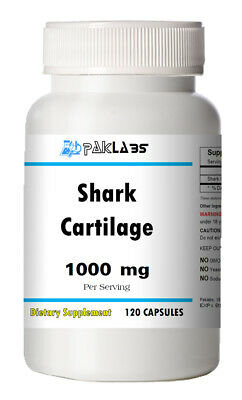
In 1992 William Lane and Linda Comac published Sharks Don't Get Cancer: How Shark Cartilage Could Save Your Life. Let’s get one thing straight right away. Sharks do get cancer. But since they generally spend their time out at sea and far away from scientists, it’s been hard to determine the true incidence of shark cancer. Anyway the reason that shark cartilage was of interest to the medical community was the fact that in 1983 it had shown to inhibit the growth of blood vessels. Since cancerous growths need a blood supply, if you can inhibit that supply you can, in theory, keep the growth in check or perhaps kill it completely.

This finding launched an industry, and not in a good way. It also later came to light that the shark cartilage product that William Lane was promoting , Benefin, was manufactured by, you guessed it Lane Labs, a company run by his son. In 1999, the U.S. Food and Drug Administration pursued an injunction against the company for illegally promoting the product as a cancer treatment. Then in 2005 a study of shark cartilage in patients with advanced breast or colorectal cancer found no benefit or suggestion of efficacy.

shark cartilage .jpg

The National Cancer Institute, part of the National Institutes of Health, has a webpage that reviews the use of cartilage (both bovine and shark) in cancer. In addition to the 2005 study that failed to show any clinical benefit, the site notes one trial of 60 patients with advanced cancer taking powdered cartilage by mouth. It is difficult to tease apart any effect of the cartilage since all but one patient had been treated with standard therapy before the trial. “The cancer stopped growing in 10 of the patients for 12 weeks or more and then began to grow again. The cancer did not shrink or go into remission in any of the patients.” So far, the US Food and Drug Administration (FDA) has not approved cartilage as a treatment for cancer, but a number of cartilage products are sold in the United States as dietary supplements.

...we have shown that several in vivo and in
vitro experimental studies have demonstrated that shark cartilage is a true source of biological compounds with antiangiogenic and antitumor properties. Unfortunately, those experimental findings have not been followed by reliable results in clinical trials, especially with cancer patients.
— Gonzalez R.P. Leyva A. Moraes M.O. Shark Cartilage as Source of Antiangiogenic Compounds: From Basic to Clinical Research. Biol. Pharm. Bull. 24(10) 1097—1101 (2001)

Is Shark Cartilage Kosher?

There is no need to consume shark cartilage, cow cartilage or cartilage in any form. It. Doesn’t. Work. Not for cancer and not for arthritis. But it is hardly a surprise to learn that against all the evidence some people still want to take it. So is it kosher?

The Rabbinical Council of Chicago has a helpful page on its website addressing the use of glucosamine and chondroitin. These are sold as supplements, usually to treat arthritis and are commonly produced from the soft shells and cartilage of shells of crabs, lobsters and shellfish, and sometimes from the cartilage of sharks. These are “…flavorful enough to be given the status of the fish they come from, and are therefore non-kosher.” But they continue:

However, there have been some prominent Poskim who have suggested halachic rationales as to why the considerable processing done to the shells and cartilage, might do away with the non-kosher status as well. Some Poskim accept those rationales, but most are undecided or reject such claims. However, most of those who hold that the glucosamine and chondroitin are inherently non-kosher, agree that someone suffering from arthritis may take those items in pill form because:

It is generally accepted that non-chewable pills are considered inedible non-foods and therefore are not required to be kosher.

A person who is incapacitated is permitted to “eat” non-kosher medicine in an “atypical manner”, and (almost) everyone agrees that swallowing a pill is not considered eating in a typical manner. This line of reasoning would only permit the consumption of items which have a history of being effective at curing the said illness, and at this point it seems that glucosamine and chondroitin meet that standard as a cure/relief for the symptoms of arthritis.

We may quibble with the last line, but anyway, the Chicago rabbis concluded that “many hold that glucosamine and chondroitin are not kosher but they may still be taken in pill form, especially by those who suffer from arthritis, but most Rabbis would not permit the inclusion of glucosamine and chondroitin powders in regular foods.” You can find a similar approach on the website of the Orthodox Union, which also notes that vegetarian glucosamine is available. No sharks or crabs are harmed in its making. If only there were an alternative for those Paschal lambs.

Print Friendly and PDF

Pesachim 75b ~ Burns and Ritual Impurity

The Torah details lots of rules about skin blemishes known as tzaraat. One of these blemishes is the result of a burn:

ויקרא 13:24

אוֹ בָשָׂר כִּי־יִהְיֶה בְעֹרוֹ מִכְוַת־אֵשׁ וְהָיְתָה מִחְיַת הַמִּכְוָה בַּהֶרֶת לְבָנָה אֲדַמְדֶּמֶת אוֹ לְבָנָה׃ וְרָאָה אֹתָהּ הַכֹּהֵן וְהִנֵּה נֶהְפַּךְ שֵׂעָר לָבָן בַּבַּהֶרֶת וּמַרְאֶהָ עָמֹק מִן־הָעוֹר צָרַעַת הִוא בַּמִּכְוָה פָּרָחָה וְטִמֵּא אֹתוֹ הַכֹּהֵן נֶגַע צָרַעַת הִוא׃ 

When the skin of one’s body sustains a burn by fire, and the patch from the burn is a discoloration, either white streaked with red, or white, the priest shall examine it. If some hair has turned white in the discoloration, which itself appears to go deeper than the skin, it is leprosy that has broken out in the burn. The priest shall pronounce him unclean; it is a leprous affection.

In today’s page of Talmud we read more about this case of tzaraat caused by a skin burn.

פסחים עה, ב

״מִכְוַת אֵשׁ״ — אֵין לִי אֶלָּא שֶׁנִּכְוָה בְּאֵשׁ וּבְגַחֶלֶת. נִכְוָה בְּרֶמֶץ, בְּסִיד רוֹתֵחַ, וּבְגִפְסִיס רוֹתֵחַ, וּבְכׇל דָּבָר הַבָּא מֵחֲמַת הָאוּר, לְאֵיתוֹיֵי חַמֵּי הָאוּר, מִנַּיִין? תַּלְמוּד לוֹמַר: ״מִכְוָה״ ״מִכְוָה״ רִיבָּה

From the phrase “a burn from fire,” I only know that if someone was burned by a fire or by a coal he is subject to the laws of tzaraat of a fire. With regard to one who is burned by hot ash, by burning lime, or by burning plaster, or by anything else that is burning and whose source of heat comes from fire, to include water heated by fire, from where is it derived that these cases are also considered a burn from fire? The verse states: A burn, a burn, twice. By repeating the term, it includes all these types of burns.

The Classification of Burns

The modern classification of burn severity is based on two features: the depth of the burn, and the amount of skin (the surface area) that is burned.

Three kinds of burn.jpg

First degree or superficial burns involve only the very superficial layer of skin called the epidermis. There is pain and redness, but there are no blisters and the wound is dry. This is commonly the burn you get with sunburn. Second degree or partial thickness burns involve two layers of skin, the epidermis and the dermis. These are painful, red and moist, and will form blisters over the first 24 hours. Third degree of full thickness burns go deeper into the subcutaneous tissues. They are red and white, and do not produce blisters. Fourth degree burns are deeper still; they involve the fascia and bone. The tissues are white and charred and again, no blisters are formed.

In addition to the depth of the burn they are classified by the area of skin involved. Burns that cover more than about 50% of the total surface area of the body are often fatal.

The Mishnaic Classification of Burns

The Mishnah in Nega’im discusses burns in the context of ritual impurity

נגעים 9:1

.. אֵיזֶה הוּא הַשְּׁחִין? לָקָה בְעֵץ אוֹ בְאֶבֶן אוֹ בְגֶפֶת אוֹ בְמֵי טְבֶרְיָא, כֹּל שֶׁאֵינוֹ מֵחֲמַת הָאֵשׁ, זֶה הוּא שְׁחִין. אֵיזוֹ הִיא מִכְוָה? נִכְוָה בְגַחֶלֶת אוֹ בְרֶמֶץ, כֹּל שֶׁהוּא מֵחֲמַת הָאֵשׁ, זוֹ הִיא מִכְוָה 

What is a "boil"? An injury received from wood, stone, peat, or the waters of Tiberius, or from any other object whose heat is not due to fire is a boil. What exactly is a "burn"? A burn caused by a live coal, hot embers, or any object whose heat is due to fire is a burning.

Burns, Fluid Loss and Skin Discharges

If it is not immediately clear why a burn should be associated with ritual impurity, remember that burns of a second degree or worse produce a yellow-green discharge (or more properly, an exudate. In fact in severe burns (second degree burns that involve more than about 15% of the body surface area) the fluid loss is so massive that if left untreated the patient will die of dehydration. To prevent this physicians use a general formula that guides the volume of fluids that should be provided to the burn patient in the first 4 hours:

Total amount of fluid to be given in the first four hours (cc) = weight (kg) x %body surface area involved/2.

Types of exudate (discharge) seen in burns. From Vowden P, Bond E. Meuleneire F. Managing high viscosity exudate. Wounds International 2015: 6 (1):

Types of exudate (discharge) seen in burns. From Vowden P, Bond E. Meuleneire F. Managing high viscosity exudate. Wounds International 2015: 6 (1):

And here is what the discharge from a burn can look like:

From Vowden P, Bond E. Meuleneire F. Managing high viscosity exudate. Wounds International 2015: 6 (1):

From Vowden P, Bond E. Meuleneire F. Managing high viscosity exudate. Wounds International 2015: 6 (1):

Yes, I agree. Nasty. But now let’s briefly turn to another kind of discharge, found in the person described in the Torah as a zov. In Leviticus chapter 15 we find the laws of the זב – zov - a man who experiences a discharge from his penis.

ויקרא טו, ב–ג

אִישׁ אִישׁ כִּי יִהְיֶה זָב מִבְּשָׂרוֹ זוֹבוֹ טָמֵא הוּא. וזֹאת תִּהְיֶה טֻמְאָתוֹ בְּזוֹבוֹ רָר בְּשָׂרוֹ אֶת־זוֹבוֹ אוֹ־הֶחְתִּים בְּשָׂרוֹ מִזּוֹבוֹ טֻמְאָתוֹ הִוא

When any man has a discharge issuing from his member, he is unclean. The uncleanness from his discharge shall mean the following—whether his member runs with the discharge or is stopped up so that there is no discharge, his uncleanness means this…

As we have noted previously, the condition that is described is gonorrhea. The word gonorrhea is from the Greek roots gone meaning seed and rhein, meaning flow, and so the description of this sexually transmitted disease is found in its very name. That flow is a a thick yellow-green discharge from the penis or vagina, and yes, it looks very similar to the discharge that can be seen with severe burns.

Note how similar it is to exudate from a burn. (And next time, please wear a glove.)

Note how similar it is to exudate from a burn. (And next time, please wear a glove.)

Genital discharges from gonorrhea are thick and yellow-green. So too are the discharges from a deep burn. Both are not only physically uncomfortable, but once, long ago, rendered a person ritually impure. Be careful to avoid both.

Print Friendly and PDF

Pesachim 75a ~ Where Does Lead Come From?

On this page of Talmud there is an excursus into a particularly brutal form of capital punishment called serefa, or burning. This punishment involved pouring molten lead down the throat of the condemned person. Among other unfortunates, it was administered to the married daughter of a Cohen who committed adultery.

ויקרא 21:9

וּבַת אִישׁ כֹּהֵן כִּי תֵחֵל לִזְנוֹת אֶת־אָבִיהָ הִיא מְחַלֶּלֶת בָּאֵשׁ תִּשָּׂרֵף׃

When the daughter of a priest defiles herself through harlotry, it is her father whom she defiles; she shall be put to the fire.

The Talmud then examines the meaning of the last two words:

פסחים עה, א

וְאֶלָּא ״בָּאֵשׁ״ לְמָה לִי? לְאַפּוֹקֵי אֲבָר מֵעִיקָּרוֹ

But if it so that the verse says “she shall be burned” to include all methods of burning, for what do I need the expression “in fire”? The Gemara answers: To exclude lead from its source.

What exactly is the meaning of “lead from its source?” Rashi, the eleventh century commentator offers this explanation:

אבר מעיקרו - שמוציאין אותו מן הקרקע רותח הוא בלא תולדת אש

Lead from its source: It is extracted from the earth in a molten form, without any additional heat from a flame.

This explanation was sufficient for the great late Rabbi Adin Steinsaltz to include it in his own commentary on this passage:

אבר מעיקרו. שבשעה שמוציאים את העופרת מקרקע היא רותחת מעצמה, ובעופרת רותחת זו אין מקיימים מצות שריפה, כיון שאין חומה בא על ידי האש

Lead from its source: When lead is mined from the ground it is molten, and the commandment of serefa [burning] cannot be performed with naturally burning lead, since it was not melted with fire…

The English ArtScroll Talmud also offers Rashi’s explanation without further comment. But it is wrong.

 
ArtScroll Talmud. Pesachim 75a.

ArtScroll Talmud. Pesachim 75a.


Where does lead come from?

The explanations of the great commentator Rashi and his modern day equivalent Rabbi Steinsaltz are both, unfortunately, incorrect. Lead is not mined from the ground in a molten form but is produced by smelting, in which heat is applied to a mixture of metals known as an ore in order to extract a base metal.

In 2012 a group of Israeli archeologists discovered what they claimed to be the earliest lead object in the Levant. The lead object, attached to a wooden shaft, was found in the deepest section of the large complex Ashalim cave in the northern Negev desert. Carbon dating placed it within the Chalcolithic period, late in the 5th millennium BCE. The archeologists noted that “the chemical analysis of the Ashalim Cave object indicates that the lead was likely to have been smelted from a relatively pure ore.”

Prior to the 4th millennium BCE, only a handful of lead objects made of metallic lead have been reported from datable contexts, all from northern Mesopotamia and eastern Anatolia. These include a bracelet from Yarim Tepe I found in a context dated to c. 5,700 BCE , and a small conical object from Arpachiyeh dated to the 5th millennium BCE . However, both objects were never inspected for their metallurgical properties, and their identification as being the products of lead smelting is conjectural, and is based on the rarity of native lead and the relative ease of lead smelting, which can be performed at temperatures below 800°C … Thus, it appears that the Ashalim Cave object, based on the concentration of trace elements such as cobalt, might be the earliest lead artifact proven so far to have been produced from smelted lead.

Smelted. But not harvested as natural lead.

No one knows what the lead object was used for. “We may speculate” the Israelis wrote, “that the lead object was originally used in another context, which would have made it possible to acknowledge its rarity and significance (e.g. as a macehead), before being re-used as a spindle whorl, joined to the wooden rod, at a later stage. Its eventual deposition in the deepest section of Ashalim Cave, in relation to the burial of selected individuals, serves as evidence of the symbolic significance it possessed until the final phase of its biography.”

The Ashamilm cave object. The lead cast is at the top, attached to a wooden stick. From Yahalom-Mack N, Langgut D, Dvir O, Tirosh O, Eliyahu-Behar A, Erel Y, et al. (2015) The Earliest Lead Object in the Levant. PLOS ONE 10 (12): e0142948. doi:10.13…

The Ashamilm cave object. The lead cast is at the top, attached to a wooden stick. From Yahalom-Mack N, Langgut D, Dvir O, Tirosh O, Eliyahu-Behar A, Erel Y, et al. (2015) The Earliest Lead Object in the Levant. PLOS ONE 10 (12): e0142948. doi:10.1371/journal.pone.0142948

Lead was originally a by-product of smelting whose goal was to extract silver, in a process known as cupellation. Analysis of the lead shows that it was likely smelted from lead ores originating in the Taurus range in Anatolia.

A retraction of sorts

Writing earlier this week on the Seforim Blog, Rabbi Dr. Shalom Z. Berger, who is one of the content editors of the Koren (Steinsaltz) Talmud gave some additional background to the question of the origin of lead. He and fellow editor Rabbi Michael “Micky” Siev, noted that “ lead is mined from the ground, and as far as we are aware, is not burning hot when it is extracted from the ground.” And so in the new English Koren Talmud they replaced the incorrect explanation with an updated one, as shown below. It is a reminder that good Talmud commentary, like good science, needs to be amended and updated when it is based on erroneous information. Rashi and Rabbi Steinsaltz would surely concur.

Koren Steinsaltz Talmud Pesachim vol IIp 65.

Koren Steinsaltz Talmud Pesachim vol IIp 65.

Print Friendly and PDF