Pesachim 104a ~Gods on Coins

In this page of Talmud Rabbi Yochanan refers to a rabbi as “The son of holy ones.” Naturally, the Talmud asks

פסחים קד, א

מַאן נִיהוּ ״בְּנָן שֶׁל קְדוֹשִׁים״? רַבִּי מְנַחֵם בַּר סִימַאי. וְאַמַּאי קָרוּ לֵיהּ ״בְּנָן שֶׁל קְדוֹשִׁים״? דְּלָא אִיסְתַּכַּל בְּצוּרְתָּא דְזוּזָא

Who is this person called “the son of holy ones”? It is Rabbi Menachem bar Simai. And why did they call him the son of sacred ones? Because he would not look at the forms on coins…

So Rabbi Menachem bar Simai was considered especially worthy because he refused to look at the image on the coin in his pocket. In its commentary, the Koren Steinsaltz Talmud adds that these images “were occasionally idolatrous symbols or some other prohibited image.” But as we will see, these images were hardly “occasional." Nearly every Greek or Roman coin in the ancient world had a god imprinted on them.

As you can see from the picture below, there were lots of gods on lots of coins, in this case, from Greece.

Images of Gods on Roman coins.jpg


Jonathan Williams was a curator of Iron Age and Roman coins at the British Museum, and wrote a fascinating article on Religion and Roman Coins in the 2007 Blackwell Companion to Roman Religion. In it, he noted that ever since coins were first used in western Asia Minor in the seventh century BCE, they have depicted religious icons.  “The earliest Roman coin types in the late fourth and early third centuries BCE drew heavily on the Greek repertoire, commonly depicting gods such as Mars, Hercules, or Apollo, and religious symbols – tripod, eagle on thunderbolt, caduceus (the herald’s staff ) – familiar from the Greek coinages of Italy and elsewhere.” The gods were everywhere. 

Michael Crawford’s seminal 1974 work Roman Republican Coinage is now available online, and it’s well worth taking a look at the sheer number of Roman coins which have an image of a god. Also worth consulting is the online Handbook of Biblical Numismatics, focused on ancient Jewish coins.

From the earliest introduction of true coinage in Rome around 300 B.C., portrayals of gods had regularly been used to advertise to the people of Italy the growing power of Rome; religious types continued to feature on coins through to the eventual fall of the Western Empire
— David Shotter, Gods, Emperors, and Coins. Greece & Rome ,1979 : 26 (1). 48-57

A Brief History of Coins from Israel

There were several periods of coinage in ancient Israel. Among these were the Yehud coinage from the Person period, around the 4th century BCE. An example is this coin that shows shows a deity seated on a winged wheel.

 
1024px-Zeus_Yahweh.jpg
 

After that we have coins from the Hasmonean coins (164 BCE.-37 BCE.). The surviving coins tend to show Jewish images. This one, for example, shows the Menorah, as we would expect a good Hasmonean coin to do.

 
Ancient_Menorah_Coin.jpg
 

Herodian coinage covers the period from 37 BCE to 90 CE. Coins from this era were issued by the various Herods, who were Jews of a sort who ruled over Israel. Many of the sages of the Talmud would have been familiar with these coins, which show images of the Herod in power, together with things like grapes or the bows of ships. Here is one from the period of Herod Archelaus (4 BCE–6 CE.)

 
Herod_Archelaus.jpg
 

Coins from the period of the Roman Procurators (6-41 and 44-48 CE) did not have images of gods, out of deference to the Jews who used them. In fact, as the Handbook of Biblical Numismatics notes,

somewhat surprising, in light of their poor attitude towards the Jews, the small bronze prutahs issued by the prefects abided by the strict interpretation of the Commandment against graven images. Except for the pagan religious symbols on the coins of Pontius Pilate the designs were probably not objectionable to the citizenry.

Later coins were made during the Judaea Capta period that followed the destruction of the Temple. During this time Emperor Vespasian “launched an extensive issue of coins commemorating the hard fought Roman victory over the tiny Jewish nation. The Judaea Capta series lasted for 25 years under Vespasian and his two sons who succeeded him as Emperor - Titus and Domitian. These commemoratives were issued in bronze, silver and gold by mints in Rome, the Roman Empire, and Judaea.” Here is an example:

 
The most common Judaea Capta coin, the silver denarius issued by Vespasian, picturing Judaea weeping beneath a Roman trophy, and the inscription IVDAEA. From here.

The most common Judaea Capta coin, the silver denarius issued by Vespasian, picturing Judaea weeping beneath a Roman trophy, and the inscription IVDAEA. From here.


In 130 CE., many decades after the Bar Kochba rebellion (during which time the rebels produced their own coins) the Roman Emperor Hadrian (117-138 CE) visited Judaea. On his return to Rome he issued coins to commemorate his trip. “His ADVENTVI AVG IVDAEA bronze sestertius, issued some time between 134 and 138 CE, shows the Emperor receiving a Jewish woman and two children who carry palm branches; in the background, a bull appears next to a sacrificial altar. The altar was a reference to the god Jupiter Capitolinus, to whom Hadrian had dedicated his new pagan temple.” This might be the first coin issued in Judea to have an image of a pagan ceremony on it.

ADVENTVI AVG IVDAEA c134-138 CE. Note the small sacrificial altar.

ADVENTVI AVG IVDAEA c134-138 CE. Note the small sacrificial altar.

In first century Roman Palestine, several cities were issued the right to mint their own coins. These of course produced coins with Jewish symbols, like this one from the important town of Zippori, which shows the Emperor Trajan on one side and a palm tree on the other:

Zippori 98-117 CE.

Zippori 98-117 CE.

But eventually even these cites started to depicting Roman gods, goddesses and temples. One of these (c. 160 CE) shows Antoninus Pius on one side. On the other is a Roman temple, dedicated to the worship of Jupiter "The Supreme God," which was erected on the former site of the Samaritan Temple on the top of Mt. Gerizim. Another coin struck under Antoninus Pius shows the temple of Artemis with a cult statue.

Coin with a Temple of Jupiter

Coin with a Temple of Jupiter

Coin with a Temple of Artemis

Coin with a Temple of Artemis

Rabbi Menahem bar Simai

Rabbi Menachem bar Simai, the rabbi who would not look at the images on his coins, lived in Israel among the first generation of rabbis who came after the redaction of the Mishnah, known as the Amoraim (c. 230–250 CE). The coins he would have seen (but not looked at) would have been increasingly Roman and shown more of their deities, like this one, a brass sestertius of Caligula (37–41 CE). It shows the emperor pouring a libation to a god on the obverse and sacrificing on the reverse.

Brass sestertius of Caligula (37–41 CE), showing the emperor pouring a libation like a god on the obverse and sacrificing on the reverse.

Brass sestertius of Caligula (37–41 CE), showing the emperor pouring a libation like a god on the obverse and sacrificing on the reverse.

Here is another one, closer to the period of Rabbi Menachem, showing the Temple to god Sol Elagabalus. Who knows, perhaps this is one of the coins that he found particularly offensive?

Gold aureus of Elagabalus (218–222 CE.), showing the image of the god Sol Elagabal being drawn in a chariot. 20 mm.

Gold aureus of Elagabalus (218–222 CE.), showing the image of the god Sol Elagabal being drawn in a chariot. 20 mm.

But you don’t have to go back two millennia to find gods on coins. Here is a more recent coin, depicting Zeus. In Canada.

 
Canadian Modern Coin with Zeus.jpg
 

The death of rabbi Menachem

The Jerusalem Talmud, the older (and less famous) brother of the Babylonian Talmud, tells what happened when the saintly Rabbi Menachem bar Simai died.

ירושלמי עבודה זרה יג, א /יח,א

כד דמך רבי נחום בר סימאי חפון איקונתא מחצלן אמר כמה דלא מחתון בחיויי לא יחמינון בדמכותיה

When Rabbi (Me)Nachem bar Simai died, they covered all the images, saying “just as in life he would not look at them, so too, in death he should not look at them”….

Not to be outdone, the Babylonian Talmud (Mo’ed Katan 25b) improves on the story and adds an element of the supernatural

מועד קטן כה,ב

כי קא ניחא נפשיה… דר' מנחם בר רבי סימאי אישתנו כל צילמניא והוו למיחצלייא

When Rabbi Menachem…passed away the faces of the statues became smooth as if they had been smoothed with a plasterer’s trowel.

In one version people removed the images that the late Rabbi Menachem found so objectionable. In another, it was done miraculously. But both are told to emphasize the respect in which he was held. Today, many countries continue the tradition of having sovereigns and rulers on their coins, while others have decided to use images of people who achieved great things in their lives by virtue of hard work rather than who their parents were. Rabbi Menachem would have been far more comfortable using those coins, and who knows, perhaps he would even have taken a peek at them.

1978 US dollar coin showing the famous suffragette Susan B. Anthony.  She was the first non-fictitious woman to be featured on an American coin.

1978 US dollar coin showing the famous suffragette Susan B. Anthony.  She was the first non-fictitious woman to be featured on an American coin.


1985 Israeli Coin showing the Russian Zionist leader and author Ze'ev Jabotinsky

1985 Israeli Coin showing the Russian Zionist leader and author Ze'ev Jabotinsky

You know who. And yes, it’s a real coin.

You know who. And yes, it’s a real coin.

Print Friendly and PDF

Announcing an Online Talmudology Event

Save the date:

Thursday March 11 at 7.00PM EST

[=4pm in Los Angeles, Midnight in London, 2am in Israel, and 11am Friday March 12 in Sydney, Australia]

Jeremy Brown is the author of New Heavens and a New Earth: The Jewish Reception of Copernican Thought (OUP 2013) and Influenza: The Hundred Year Hunt to Cure the Deadliest Disease in History (Simon and Schuster 2018). He writes on science and medicine in the Talmud at Talmudology.com. Dr. Brown is an emergency physician and works at the National Institutes of Health.

This live stream Zoom event is presented in relation to the special exhibit Jews in Space: Members of the Tribe in Orbit, on view September 13, 2020 through April 11, 2021. 

For free tickets click here

Print Friendly and PDF

From the Talmudology Purim Archives ~ Gender Fluidity, Male Lactation and Mordechai

Baby mil bottle.jpeg

Editor’s note: Unless you live in Australia, or New Zealand, or Jerusalem, today is the Jewish Festival of Purim, on which there is a tradition to create and recite spoofs called Purim Torah. These spoofs are usually very clever and witty, and may require a deep knowledge of rabbinic texts. But this post is not Purim Torah, although it may read as such if you have drunk a little too much alcohol. And drinking too much alcohol is definitely a Purim tradition. So drink up and read on…and I swear I am not making this stuff up.

Milk Producing Male Goats of The Talmud (MPMGOTT)

In the Talmud in tractate Chullin there is a discussion of about the prohibition of cooking meat and milk together. There are several teachings that are derived from the three places in the Torah where we read “You shall not cook a kid in its mother’s milk” (לא תְבַשֵּׁל גְּדִיח בַּחֲלֵב אִמּוֹ) Here is one of them, attributed to Shmuel:

חולין קיג, ב

בחלב אמו” ולא בחלב זכר

“…In its mother’s milk” indicates that one is not liable for cooking meat in the milk of a male goat

A male goat that grows udders and produces milk? Here is how the great exegete Rashi (1040-1105) explains the Talmud:

ולא בחלב זכר - שהיה לו חלב מועט מן הדדים כגון אם נשתנה והיו לו דדים

“And not in the milk of a male goat”: This means that there was a small amount of milk from the udder. For example if the male goat changed and grew udders.

To understand what on earth is going on here, we need to take a detour into the strange world of biologic gender fluidity. So strap in and here we go.

Clown_fish_in_the_Andaman_Coral_Reef.jpg

Fish

In their helpful 2003 paper Group Sex, Sex Change, and Parasitic Males: Sexual Strategies Among the Fishes and Their Neurobiological Correlates (published, obviously, in the Annual Review of Sex Research) the authors note that there is “tremendous sexual diversity exhibited by fishes” Consider for example the clownfish, also known as the anemonefish. They are sequential hermaphrodites, and first develop into males. These colorful fish thrive unharmed in the poisonous tentacles of the sea anemone, and while several fish may live within the same anemone, there is only one pair that mate. Should the dominant egg-laying female die, one of the largest males steps up and does what needs to be done. He changes into a female. This male-to-female change is called protandry. Other fish, like the sea wrasse, are all born female, and as the need arises change into a male. This trick is carried out in at least 500 species of fish, and is called protogyny.

Birds

The male Northern Cardinal (Cardinalis cardinalis) is a bright red color with a black mask over its beak and eyes. The female is a drab olive color, with a grey mask. In 2008 the ornithological world was rocked when a bird was sighted that was half-red and half-olive. Meaning it was half-male and half-female. The bird, sighted in the Black Hawk Forest Nature Preserve in northwestern Illinois, “was perched in a cockspur hawthorn tree.” Its right side was male, and its left, female. The cardinal evaded capture so it was not possible to analyze its genetic makeup. To be clear, this was not a bird that changed sex; it was one that appeared to be both sexes.

cardinal-pair-sideways-bonnie-t-barry-285.jpg
Split sex Cardinal.jpg

Humans

We all should have been taught in school that our gender is determined by which sex chromosomes we receive. If we get two female chromosomes -XX- (one from mom and one from dad) we are female, and if we get one X from mom and a Y from dad -XY- we are male. But like all things, it’s a little more complicated than that. In the 1980s, British researchers discovered the sex-determining gene on a tiny bit of the male Y chromosome and named it the sry gene. That gene tells the body to develop into a male or female appearing body. Sometimes the sry gene sneaks off of the Y gene and makes its way into the DNA of an XX female. As a result, she will develop male anatomy while genetically remaining an XX female. (Please read that sentence again, just to be sure you have understood it.) And sometimes the sry gene on an XY genetic male can mutate and not work. In that case, the genetic male appears to have the organs of a female, which is what occurs in Swyer syndrome. (You can hear more about the amazing sex-changing effects of sry in this fascinating podcast.)

Ready for more? In a small community in the Dominican Republic there have been a number of cases in which little girls grow a penis and turn into little boys. (Again, please re-read that sentence.) These observations were first reported to the scientific community in 1974, and are caused by a deficiency of the steroid 5a-Reductase. Here is how the BBC explained what is going on when they reported about it in 2015.

When you are conceived you normally have a pair of X chromosomes if you are to become a girl and a set of XY chromosomes if you are destined to be male. For the first weeks of life in womb you are neither…Then, around eight weeks after conception, the sex hormones kick in. If you're genetically male the Y chromosome instructs your gonads to become testicles and sends testosterone to a structure called the tubercle, where it is converted into a more potent hormone called dihydro-testosterone. This in turn transforms the tubercle into a penis. If you're female and you don't make dihydro-testosterone then your tubercle becomes a clitoris…the reason [some genetic males] don't have male genitalia when they are born is because they are deficient in an enzyme called 5-alpha-reductase, which normally converts testosterone into dihydro-testosterone.

So the boys, despite having an XY chromosome, appear female when they are born. At puberty, like other boys, they get a second surge of testosterone. This time the body does respond and they sprout muscles, testes and a penis.

So there you have it. Little girls, brought up as little girls, turn into boys, who develop male genitalia, and live as men. You see, they were never really girls in the XX sense. They were XY boys whose lack of sex hormones caused them to look like girls. Which brings us back to that page in the Talmud and the strange case of…

That male goat that produced milk

We have seen that there is great deal of natural gender fluidity in the animal world (and if for no other reason, this should make us more sensitive and understanding of those people who want to change their birth gender). But what about that milk-producing male goat? Well according to the website dedicated to “Goat Milk Stuff,” as bizarre as it seems, “there have even been bucks that have been known to give milk (yes, all bucks have teats, and no, a milking buck is not normal).” This was not a case of a male-to-female transformation. It was a case of male lactation.

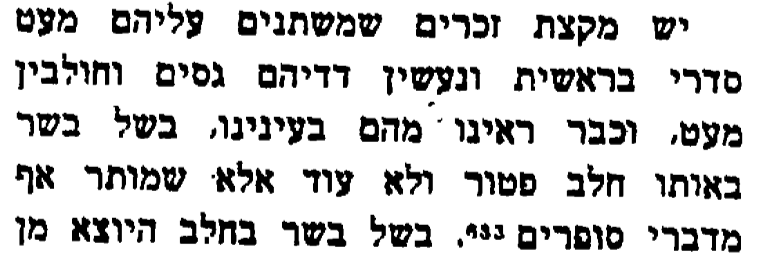
Writing in the 13th century in his classic commentary on the Talmud called Bet Habechirah, Menachem ben Solomon Meiri, known as the Meiri(1249–1306) wrote that he had seen examples of male milk-producing goats:

בית הבחירה. מכון התלמוד הישראלי השלם.ירושלים, תשל׳ד 432

בית הבחירה. מכון התלמוד הישראלי השלם.ירושלים, תשל׳ד 432

There are a few male [goats] in whom the works of creation are slightly changed and whose nipples become larger such that they produce a little milk. And we have seen them with our own eyes...
— Meiri, Bet Habechirah Chullin, 432

So too, did Khalifa al Nuaimi, a shepherd in the United Arab Emirates: Here is the 2009 report from The National, a newspaper in the United Arab Emirates.

As one of his prized male goats trotted up for some feed, he noticed the animal had seemingly developed a large udder. While he could not quite believe his eyes, the luckless creature proceeded to produce milk on demand, much like his female companions in the pen.

The local farmer made the discovery four days ago at his goat pen in Masakin, a suburb of Al Ain, the government news agency, WAM, reported yesterday. The animal's male organs are said to have been pushed back by the udder, described as "big and bulky". Mr al Nuaimi got a half-litre of good-quality milk from the goat. Dr Martin Wyness, of the British Veterinary Centre in Abu Dhabi, said it was unusual but not unheard of for male mammals to produce milk. "It's absolutely possible," he said.

what may be happening

The structure of the cells involved in producing milk in the male goat has been studied using immunofluorescence and electron microscopy techniques. It turns out they are smaller but higher in number than those found in normal males, which suggests that the anterior pituitary gland, which controls their function is probably acting in a weird way.

Another explanation of the milk-producing male goats of the Talmud (MPMGOTT) is that it is linked to estrogen-like compounds in the plants upon which they were feeding.

“It is now known that more than 50 plant species contain estrogen mimics known as phytoestrogens. Although the mechanisms are not completely understood, several plant secondary metabolites…can mimic the effects of steroidal estrogens. These non-steroidal compounds have similar overall structures or active sites as natural steroidal estrogen and can compete for binding sites on estrogen receptor proteins. Thus, plant compounds can have effects similar to endogenous estrogens”

This comes from an intriguing 2008 paper, Male lactation: why, why not and is it care? published in Trends in Ecology and Evolution. It points out that there are other mammalian species in which the male has been known to lactate, including sheep, rats, free-ranging Dayak fruit bats in Malaysia and the masked flying fox bats of Papua New Guinea. Male lactation was also recorded “in World War II prisoner of war camps when malnourished detainees were later liberated and provided with adequate nutrition. During the period of limited food supply, the prisoners suffered liver, testicular and pituitary atrophy” which messed things up. Once fully nourished, the lactation quickly ended.

But whatever the cause, Shmuel was neither drunk nor hallucinating when he claimed that male goats can produce milk. Because sometimes they do.

mordechai lactating on demand

Male lactation. It’s not just for goats and bats. Human males might do it too. Here is a story told in the Talmud (Shabbat 53b) and knowing what we now do, perhaps it not as fanciful as it might seem.

שבת נג,ב

מעשה באחד שמתה אשתו והניחה בן לינק ולא היה לו שכר מניקה ליתן ונעשה לו נס ונפתחו לו דדין כשני דדי אשה והניק את בנו

There was an incident where a man’s wife died, and she left him a son to nurse, and he did not have money to pay for a wet-nurse. And a miracle was performed on his behalf, and he developed breasts like the two breasts of a woman, and he nursed his son.

That’s a pretty impressive miracle, although it may seem a little less miraculous now that we understand so much about the role of the anterior pituitary gland. This father is not identified in the Talmud, but another lactating male is. And his name was Mordechai, the hero of the Purim story we read today. In the Book of Esther (2:7) we read וַיְהִ֨י אֹמֵ֜ן אֶת־הֲדַסָּ֗ה - that Mordechai “raised” or “sustained” Esther. Let’s pickup the story in Beresheet Rabbah (30:8), compiled between 300 and 500 CE.

מָרְדְּכַי זָן וּפִרְנֵס, אָמַר רַבִּי יוּדָן פַּעַם אַחַת חִזֵּר עַל כָּל הַמֵּנִיקוֹת וְלֹא מָצָא לְאֶסְתֵּר לְאַלְתָּר מֵינִיקָה, וְהָיָה מֵינִיקָהּ הוּא, רַבִּי בֶּרֶכְיָה וְרַבִּי אַבָּהוּ בְּשֵׁם רַבִּי אֱלִיעֶזֶר בָּא לוֹ חָלָב וְהָיָה מֵינִיקָהּ. כַּד דָּרַשׁ רַבִּי אַבָּהוּ בְּצִבּוּרָא גָּחוֹךְ צִבּוּרָא לְקָלֵיהּ,

But did Mordecai really feed and sustain Esther? R. Yudan said: On one occasion he went round to all the wet nurses but could not find one for Esther, so he himself suckled her. R. Berekiah and R. Abbahu said in the name of R. Eleazar: Milk came to him and he suckled her [and he never even tried to find a wet nurse]. When R. Abbahu taught this publicly, the congregation laughed

They laughed. Of course they did. It sounded like Purim Torah. But it can happen. Just ask those lactating goats. Now that’s some real Purim Torah.

happy purim from Talmudology


Print Friendly and PDF

Pesachim 96 ~ Blood to Prevent Plague

The Mishnah outlines some of the differences between the very first Passover that was celebrated while the Jews were still in Egypt, and the Passovers that were celebrated in the Temple in Jerusalem in the centuries that followed.

פסחים צו, א

מַתְנִי׳ מָה בֵּין פֶּסַח מִצְרַיִם לְפֶסַח דּוֹרוֹת? פֶּסַח מִצְרַיִם מִקָּחוֹ מִבֶּעָשׂוֹר, וְטָעוּן הַזָּאָה בַּאֲגוּדַּת אֵזוֹב, וְעַל הַמַּשְׁקוֹף וְעַל שְׁתֵּי הַמְּזוּזוֹת, וְנֶאֱכָל בְּחִפָּזוֹן, בַּלַּיְלָה אֶחָד. וּפֶסַח דּוֹרוֹת נוֹהֵג כׇּל שִׁבְעָה 

Image from here.

Image from here.

MISHNA: What are the differences between the Paschal lamb that the Jewish people offered in Egypt and the Paschal lamb offered in all later generations? The Paschal lamb the Jewish people offered in Egypt had to be taken from the tenth of the month of Nisan and required the people to sprinkle its blood with a bundle of hyssop, unlike the Paschal lamb in all later years, and its blood was also sprinkled upon the lintel and the two doorposts, and it was eaten with haste; in addition, the Paschal lamb in Egypt was only on one night, whereas the Paschal lamb throughout the generations is observed for seven days. 

The Talmud spends several pages discussing the differences between that first Passover and all those that came later. As a rule, we don’t do much sprinkling of blood on our doorposts these days, but that was not always the case. Since we are still in the throes of a pandemic, let’s take a look at an overlooked custom that arose in Turkey during a pandemic there, and how it was connected to this Mishnah.

The BLoody Question

Rabbi Chaim Palagi (1788-1868) was an important rabbi and leader of the Jewish community in Izmir (Smyrna), Turkey, and his influence was felt far beyond. Among his many books (somewhere between seventy and eighty!) is a collection of responsa called Chaim Beyad (חיים ביד), in which he was asked the following question:

Come and listen and I will tell you about whether the custom to write God’s name [שם הוי׳ה ב׳ה] with the blood from a circumcision is appropriate. And if it is argued that it is indeed permitted, because it provides protection during an epidemic (heaven forbid), whether it is permitted to write God’s name in red or in any color other than in black ink…

So apparently the Jews of Izmir used to take the blood from a Jewish baby that had just been circumcised paint God’s ineffable name with it onto a flag or poster and presumably hang it somewhere for protection against a pandemic. (I know what you are thinking: why on earth was there so much blood? What exactly were they doing wrong? Fair questions, but let’s stay focussed.) This practice had its roots in that very first Passover, where the blood of a lamb painted on a doorpost signaled that there would be no death in the house, for it was under God’s protection.

Rabbi Palagi’s answer is technical and difficult to follow, but in the end he seems to allow the practice if the scribe is “a person of great learning and an expert in Kabbalah and there is a great need.” Moderns would, I am sure, find the whole practice quite distasteful, but it reminds us that when things are desperate and there aren’t a lot of options, prayer and folk magic are invoked in the face of a pandemic. Today there is no need to adopt this practice. We have a vaccine.

Print Friendly and PDF