Rosh Hashanah 24b ~ Starry Images in Synagogues

On today’s page of Talmud, the Mishnah tells the story of Rabban Gamliel who had some special charts which he used to question the witnesses who claimed to have seen the new moon:

ראש השנה כד, ב

דְּמוּת צוּרוֹת לְבָנָה הָיוּ לוֹ לְרַבָּן גַּמְלִיאֵל בְּטַבְלָא וּבְכוֹתֶל בַּעֲלִיָּיתוֹ, שֶׁבָּהֶן מַרְאֶה אֶת הַהֶדְיוֹטוֹת, וְאוֹמֵר: הֲכָזֶה רָאִיתָ אוֹ כָּזֶה

Mishnah: Rabban Gamliel had a diagram of the different forms of the moon drawn on a tablet that hung on the wall of his attic, which he would show to the laymen who came to testify about the new moon (but were unable to describe adequately what they had seen). And he would say to them: Did you see a form like this or like this?

The Talmud asks why these charts with pictures of the moon were permitted. “Isn’t it written: “You shall not make with Me gods of silver, or gods of gold” (Exodus 20:19), which is interpreted as teaching: You shall not make images of My attendants, i.e., those celestial bodies that were created to serve God, including the sun and the moon?” This introduces an interesting discussion about precisely what images of the sun, the moon, and the stars are permitted. After a couple of tangential discussions, the Talmud gives three reasons why Rabban Gamliel was permitted to keep these charts: First, he was always surrounded by other people, so there was no suspicion that he would be worshipping the images. Second, perhaps the image of the moon was incomplete (דִּפְרָקִים הֲוָה), and it is only complete images of the moon that are forbidden, and finally perhaps he kept these charts to study and learn from them. This would be permitted “as it is written: “You shall not learn to do (לֹא תִּלְמַד לַעֲשׂוֹת) after the abominations of those nations” (Deuteronomy 18:9), which indicates that you may learn to understand and to teach.”

The Code of Jewish Law, the Shulhan Arukh codifies these rulings:

שולחן ערוך יורד דעה 141:4

וצורת חמה ולבנה וכוכבים אסור בין בולטת בין שוקעת ואם הם להתלמד להבין ולהורות כולן מותרות אפי' בולטות (ויש מתירין בשל רבים דליכא חשדא) (טור בשם הרא"ש)

It is forbidden to make any kind of model representation of the sun, the moon and the stars, whether in positive or negative relief, but if the models or images are to study from, they are all permitted.

It is clear from the Shulhan Arukh that it would be forbidden to make images of the sun and the moon and the stars as decorations. And yet this is precisely what has been uncovered in several ancient synagogues in Israel.

The Zodiac in the Shul

As a recent article published in Ha’artez noted, there are at several ancient synagogues in which pagan images of the zodiac can be found on floor mosaics. For example, they are the synagogues in Zippori, Hammat Tiberias, Hosefa (Usfiyya) and Huqoq in the north, and in Susya and Naaran in Judea. Perhaps the most famous is the excavation in Beit Alfa. Here is its mosaic:

In the center, wrote the eminent Israeli archeologist Rachel Hachili, the sun god  - Sol invictus - is represented by his bust and crown, his horses by their legs and heads, and his chariot by its front and two wheels.  Let us let Prof. Hachili walk us through the typical features of these remarkable mosaics:

The outer circle of the design contains the 12 signs of the zodiac, identified with the 12 months of the year. Aries is the first sign, being the first month of spring. According to his position in the circle, we see that at Nacaran and Husaifa the goes clockwise, while at Beth-Alpha and Tiberias, it goes counterclockwise. The signs (representing months) do not correspond to the seasons except at Tiberias and Antioch, where the zodiacal signs and seasons are coordinated, although at Antioch we have the personifications of the months rather than of the zodiacal signs.

There are a number of differences between these Jewish images of the Zodiac and those found in Roman Temples, but she noted that “by comparing the zodiacs of the four Jewish synagogue mosaic floors and tracing their origin and development from Roman art, it may be concluded that the Jewish zodiacal panel is a liturgical calendar. In every Jewish calendar, the form, composition, and balance of the three-part scheme are identical, suggesting the existence of a prototype…The design has its roots in the art of the preceding period with the two major designs which are part of the Jewish calendar: the astronomical zodiac and the agricultural calendar.

The Jewish scheme unified both of these into the distinctive design of the seasons, zodiacal signs, and sun god, signifying a liturgical calendar. When the synagogue replaced the Temple, the annual ritual acts, performed by the priests, were represented symbolically in synagogue art. The calendar became the frame of the annual rites now enacted by the community. Thus, it was guaranteed a central location in Jewish synagogue mosaic floors.

Clearly by the time of these synagogues, the fourth to sixth centuries C.E., the local Jews were comfortable with representational art. They would have presumably objected to representations of pagan gods, however, hence the solar deity in the synagogues was meant to represent the God of Israel, most scholars agree.
— Ha'aretz, September 16, 2020

Hellenists or Mainstream?

Some have seen these mosaics as evidence that the synagogues with them practiced a different form of Jewish worship. “It was not Rabbinic Judaism, which would eventually become Judaism as we know it” wrote Elon Gilad and Ruth Schuster in their article in Haaretz, “but at the time was only taking shape on the sidelines of the Jewish world. The Jews who prayed in these and other synagogues belonged to what was then the mainstream of Judaism but is now long forgotten: Hellenistic Judaism.” They suggest that “these shuls and their mosaics only seem strange when compared to the later synagogues of Rabbinic Judaism, but they are perfectly in line with the Roman cults of the period. Indeed, Hellenistic Judaism is best understood as a Roman cult.”

Gilad and Schuster continue:

The evolution of Judaism is quite similar to the evolution of biological species. It's not a neat progression from First Temple Judaism to Second Temple Judaism and then to Rabbinic Judaism, as Jewish history is often viewed. Rather, the religion evolved with time and some forms were false starts, while others spread and continue to evolve to this day, like Rabbinic Judaism, Christianity, Samaritanism, and Karaite Judaism.

To return to the metaphor of the dinosaurs and the tiny furry animals from which we evolved, we could say that Hellenistic Judaism with its zodiac mosaics was like the dinosaurs: great at the time but destined to go extinct – in the calamitous Early Middle Ages. It was the small, at the time almost imperceptible, Rabbinic Judaism that survived these disasters and became the Judaism of later periods, much like the rodents that survived the dinosaur-killing disaster from which we eventually evolved.

But others are not so sure. In his classic work Jewish Symbols in the Greco-Roman Period, the archeologist Erwin Goodenough (1893-1965) wrote that “the Zodiac in the synagogues, with Helios in the center, accordingly, seems to me to proclaim that the God worshiped in the synagogue was the God who had made the stars, and revealed himself through them in cosmic law and order and right, but who was himself the Charioteer guiding the universe and all its order and law.” He continued:

Actually the floor of Beth Alpha as a whole, the only one that shows the zodiac in its full original setting, seems to me to outline an elaborate con­ception of Judaism. In the center is presented the nature of God as the cosmic ruler. Above are the symbols of his specific revelation to the Jews, primarily the Torah in the Torah shrine; below in the sacrifice of Isaac is, I suspect, the atonement offered in the Akedah. All this is surrounded by familiar mystic symbols: birds, animals, and baskets within the intersticies of the vine. At the top of all inconspicuously stand the little fish and the bunch of grapes.

We are unlikely to ever determine which explanation is correct, but the zodiac mosaics certainly represented a Judaism quite different from that described in todays’ page of Talmud, in which there is an almost absolute prohibition against making images of the sun, the moon and the stars. Once upon a time, these images were part of synagogue decorations.

Print Friendly and PDF

Rosh Hashanah 22a ~ Another Tuviah the Doctor

In today’s page of Talmud there is the story told about a physician named Tuviah.

ראש השנה כב, א

מַעֲשֶׂה בְּטוֹבִיָּה הָרוֹפֵא שֶׁרָאָה אֶת הַחֹדֶשׁ בִּירוּשָׁלַיִם, הוּא וּבְנוֹ וְעַבְדּוֹ מְשׁוּחְרָר, וְקִבְּלוּ הַכֹּהֲנִים אוֹתוֹ וְאֶת בְּנוֹ וּפָסְלוּ אֶת עַבְדּוֹ. וּכְשֶׁבָּאוּ לִפְנֵי בֵּית דִּין — קִבְּלוּ אוֹתוֹ וְאֶת עַבְדּוֹ, וּפָסְלוּ אֶת בְּנוֹ

There was an incident with Tuviah the doctor. When he saw the new moon in Jerusalem, he and his son and his freed slave all went to testify. The priests accepted him and his son as witnesses and disqualified his slave, for they ruled stringently that the month may be sanctified only on the basis of the testimony of those of Jewish lineage. And when they came before the court, they accepted him and his slave as witnesses and disqualified his son, due to the familial relationship.

The story is told to demonstrate a disagreement over whether a father and son may jointly testify about having seen the new moon, because ordinarily witnesses must not be related. It also demonstrates another disagreement over whether a slave may give testimony about the new moon. But for our purposes we will not focus on either of these issues. Instead we will discuss a namesake of the Tuviah mentioned in this Mishnah. He was Tuviah Cohen, born in the town of Metz in northeastern France in 1652, and like the Tuviah in the Mishnah he was a physician “who saw the new.”

The Other Tuviah

Portrait of Tuviah Cohen, from his work  Ma’aseh Tuviah, Venice, 1708.

This Tuviah Cohen has long been a favorite of historians of science and Judaism. Perhaps this is because he was a reformer of sorts, ready to sweep away old superstitions and replace them with scientific knowledge. Perhaps it is because his book, Ma’aseh Tuviah, was “ ... the best-illustrated Hebrew medical work of the pre-modern era,” full of wonderful drawings about astronomy and anatomy. Perhaps it is because his book is so clearly printed and a pleasure to read in the original. Or perhaps it is because Cohen was so adamantly opposed to Copernicus that he called him the “Son of Satan”—which made his the first Hebrew work to attack Copernicus and his heliocentric system.

In fact, introducing new science was of such importance that it was the motivation behind the name of Cohen’s book, Ma’aseh Tuviah. Cohen reminded his readers of the Mishnah on Today’s page of Talmud: “It happened (ma’aseh) to Tuviah the doctor who saw the new [Moon] . . . and the Bet Din [rabbinic court] accepted his testimony.” Cohen saw himself as another doctor who would “see the new.

After his father’s untimely death, Tuviah’s mother remarried in 1664 when he was twelve years old. He studied in a yeshivah in Cracow, and at the age of twenty-six, entered the University of Frankfurt, where he began to study medicine. Despite being taken under the wing of Fredrick William, the elector of Brandenburg, and receiving a stipend from him, anti-Jewish sentiment prevented Cohen from graduating. As a result, he left for the University of Padua, where he graduated with a degree in medicine in 1683 and soon found employment as a physician in Turkey. He published his only work, Ma’aseh Tuviah (The Work of Tuviah), in Venice in 1708 and moved in 1715 to Jerusalem, where he died in 1729.

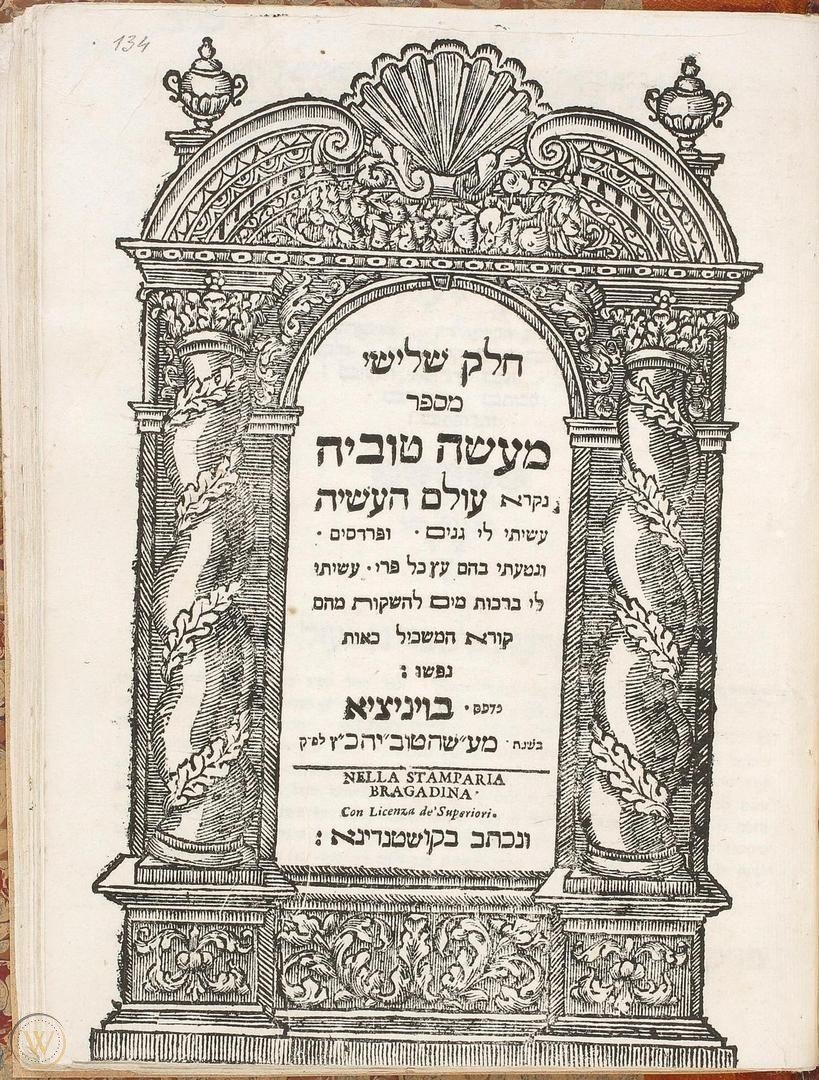
Front page of the first edition of Ma’aseh Tuviah, Venice 1707.

Tuviah’s Famous Encyclopedia

Tuviah painfully remembered one particular area in which he lacked knowledge: the discipline of astronomy. It was astronomy that the Talmud considered to be the example par excellence of Jewish wisdom that would be acknowledged by Gentiles. Examining the verse “For this is your wisdom and understanding among the nations” [Deut. 4:6], the Talmud had concluded that it referred to “the calculation of the seasons and the constellations,” that is, the ability to create an accurate calendar and to forecast the positions of the stars and planets. Tuviah was especially troubled by the taunts that Jews had no proper astronomical understanding, given the pride of place of astronomy in the Talmud. He recalled his days in the university:

We would undertake long debates with us every day about questions of belief, and would many times embarrass us asking “where is your wisdom and understanding—it has been taken from you and given to us!” Although we were knowledgeable in Bible, Talmud and Midrashim, we were like paupers when we debated them. This is why I became a zealot for the Lord and swore that before I died I would neither sleep nor rest until I had written a work that included knowledge and skills...for although we walk in this dark and bitter exile God has been our light and there are still wise and learned men among us. . . .

He therefore addressed this topic in detail in his encyclopedic Ma’aseh Tuviah.

The first depiction of the heliocentric system in Hebrew literature. From Ma’aseh Tuviah, Venice, 1708, 50b.

Copernicus is “the Firstborn of Satan”

Tuviah’s section on astronomy included the first depiction in Hebrew literature of the new(wish) heliocentric model of the universe, first published by Nicolas Copernicus in 1542. But having explained the new model (which by then was nearly two centuries old) he rejected it in favor of the traditional earth centered or geocentric model. And he did so with an unforgettable chapter title:

Chapter Four.
Bringing all the claims and proofs used by Copernicus and his supporters

showing that the Sun is at rest and the Earth is mobile;

and know how to refute him, for he is the First born of Satan.

The Rest of Tuviah’s Encyclopedia

Besides astronomy, the Tuviah’s encyclopedia contains dozens of other topics, all of which demonstrate that Tuviah was a product of his time (for how could he be anything other?) Ma’aseh Tuviah (which you can read and download here) contains a section on Hokmat HaPartzuf, which today we might recognize as an amalgam of phrenology, physiognomy and palm-reading. Tuviah defined Hokmat HaPartzuf as “the ability to divine the future, by understanding the form, size and limbs of the body, the way a person looks, his color, size, nature, intelligence, his spirit whether it be large or small, and many other qualities like this.” All of these, wrote Tuviah, were reliable predictors of a person’s future, as was generally accepted in his day. He also described the nature of giants, which were described in the Bible as Nefilim or Refa’im, and noted that giants (anakim) were to be found in a number of different climates. For the sake of brevity, he wrote, he would only describe one event to which he was an eye-witness. In 1694 in Salonika in northern Greece, workers in a salt mine uncovered the remains of a giant “thirty-three amot in length”. Tuviah describes seeing two bones of the forearm and one tooth, “which weighed 350 drachmas”, or about 1.5kg. It was most likely that Tuviah had seen fossilized prehistoric remains, which he attributed to the bones of a giant human.

Tuviah also found no reason to doubt the existence of centaurs, mermaids and sirens, and creatures who were nourished through an umbilical cord that attached them to the earth. The latter, which resembled a sheep and which grew from the Boramets tree, were to be found in Africa and although Tuviah had not personally seen them he relied on new but unnamed works of geography to inform his own readers of the existence of these fantastic creatures.

In the section on medicine, Tuviah, Like all the physicians of his time, he recommended bloodletting, and in another he discussed “The French Disease”, which today we call syphilis. Tuviah described it as being recently introduced from India or the newly discovered America:

In 1496 the great explorer Christopher Columbus returned with his sailors from exploring the new world, but they began to act immorally with the women of Italy which angered God greatly and He brought about a great calamity and a great sickness. And the French army which was then fighting around Naples also became sick, which is why the disease is known today as mal francese, although it is in fact an Indian or an Italian disease. Some Latin books call it lues veneris or pudendagra.[1]But I call it the small plague because it attacks women and men. I call it this for three reasons: First, it is the result of immorality. Second its poison is like that of a plague. It is spread by a man having intercourse with an infected woman, and in an instant it spreads throughout the body. Thirdly, it acts just like a plague but a plague kills, and this is not usually lethal…but rather causes suffering that is worse than death.

There are, Tuviah noted, a number of theories as to the etiology of the French disease. Galen believed it was from rotting blood and the alchemists thought it was caused by an acidic poison. “However” he concludes, “it is sufficient for us to know that it is caused by unclean intercourse [bi’ah teme’ah] that transmits an uncleanliness through contact. This causes God to become angry, for he abhors immorality.”

Tuviah’s famous illustration

Ma’aseh Tuviah was a work that relied on ancient medical teachings that had never been challenged, together with a few more recent sources, but all of Tuviah’s choices reflected the general medical consensus of his time. Perhaps more innovative was Tuviah’s image of the body as a house, an image that is certainly more well-known than is the book in which it appears. On the left of the image is a schematic of the torso of a dissected body, and on the right a four-story house with a roof and chimney. The eyes on the body correspond to the upper windows of the house, and the shoulders correspond to the roof. The liver and gall bladder were drawn as an oven, the heart is oddly identified hidden behind a lattice, and the kidneys correspond to a fountain. The smoking cauldron that appears in the center of the house represents the stomach. The British medical historian Nigel Allan noted that such analogies were not new. William Harvey had also described the stomach as the kitchen, and “the furnaces that draw away the phlegm” but this would not have been known to Tuviah. Even if identifying the workings of the body with the technology of the era was not unique to Tuviah, this image is nonetheless a striking one, and a perennial favorite in discussions of pre-modern Jewish medicine. This image did much to suggest a spirit of innovation in Ma’aseh Tuviah, when in truth the work was far more conservative than innovative.

Tuviah “who saw the new”

Tuviah saw himself as an iconoclast. This was the motivation behind the name of his book, Ma’aseh Tuviah, and it was reflected in the titles he gave to some of the sections in his book: A New Land, or A New House. A careful reading of the text, however, reveals that there was little in Tuviah’s approach to medicine that was new. In fact, much of it contained the ancient classic teachings of Hippocrates, Aristotle, and Galen, and many of the more “recent” plant remedies that Tuviah cited were about one hundred and fifty years old by the time that he published them. Even William Harvey’s discovery of the circulation of the blood could not be considered a novel idea by the time it was mentioned by Tuviah. Harvey has first published his discovery in Frankfurt in 1628, and by 1650 it had been widely discussed throughout Europe and cited in books published in Frankfurt, Venice, Leyden, Rotterdam and London. Rene Descartes cited Harvey’s work in some detail in his Discourse published in 1637. The Pope’s own physician defended the Harverian hypothesis in 1642, and it was discussed by Italian physicians soon after. In 1650 another graduate of the medical school at Padua, Paul Slegel, published a book on the circulation and by 1656 at least thirty-six printed books had mentioned the discovery of the circulation. It is therefore far from surprising that Tuviah also mentioned William Harvey, and doing so makes his early eighteenth century textbook up to date, rather than pioneering.

Ma’aseh Tuviah is a fascinating read, but it is not something you’d like your physician or science teacher to be using as a guide book. Still, his book is an insight to the world of an eighteenth century Jewish physician that is now, thankfully, of historic interest alone.

[Want to read more about Ma’aseh Tuviah? Checkout Chapter Five of this book.]

Print Friendly and PDF

Rosh Hashanah 20b ~ When can the New Moon be Seen?

In today’s page of Talmud there is a lot of astronomy. We will focus on just one aspect, the question of how soon after the conjunction the new lunar crescent may be seen.

ראש השנה כ, ב

מְחַשְּׁבִין אֶת תּוֹלַדְתּוֹ. נוֹלַד קוֹדֶם חֲצוֹת — בְּיָדוּעַ שֶׁנִּרְאָה סָמוּךְ לִשְׁקִיעַת הַחַמָּה. לֹא נוֹלַד קוֹדֶם חֲצוֹת — בְּיָדוּעַ שֶׁלֹּא נִרְאָה סָמוּךְ לִשְׁקִיעַת הַחַמָּה

They calculate the molad; if the molad occurred before midday, [so that there are at least six more hours left of the day,] it is known that the moon will be visible close to sunset. If, however, the molad did not occur before midday, so that there are fewer than six hours left of the day, it is known that the moon will not be visible close to sunset.

In this uncontested declaration, the Talmud states that the new moon can be seen six hours after the molad. But this statement simply does not align with reality. Before we go any further here is a reminder of the astronomical facts we will be discussing.

A very young moon setting in the west shortly after sunset. This is what the Bet Din in Jerusalem was looking for in order to declare the start of a new Jewish month. Photo taken by Susan Gies Jensen on February 10, 2013, in Odessa, Washington. From here.

At the time of a lunar conjunction, the sun the earth and the moon fall on a straight line. This line-up is around the time of the molad, but as we have explained elsewhere, it is certainly does not happen at the same time as the molad. As a quick proof consider the last solar eclipse over North America, that took place on Monday August 21, 2017. At 15:46 GMT (which was 5:58pm in Jerusalem) the moon started to move across the face of the sun. The total eclipse - when the moon directly covered the sun, occurred at 18:25 and 35 seconds GMT, which was 8:25:35pm in Jerusalem. That is the true astronomic lunar conjunction. But the molad for that month (which was Rosh Chodesh Elul) was announced as “Tuesday, August 22, at 10:44 a.m. and 15 chalakim” (Jerusalem time) — about 12 hours and 20 minutes hours later. So the lunar conjunction and the calculated molad certainly do not occur at the same time.

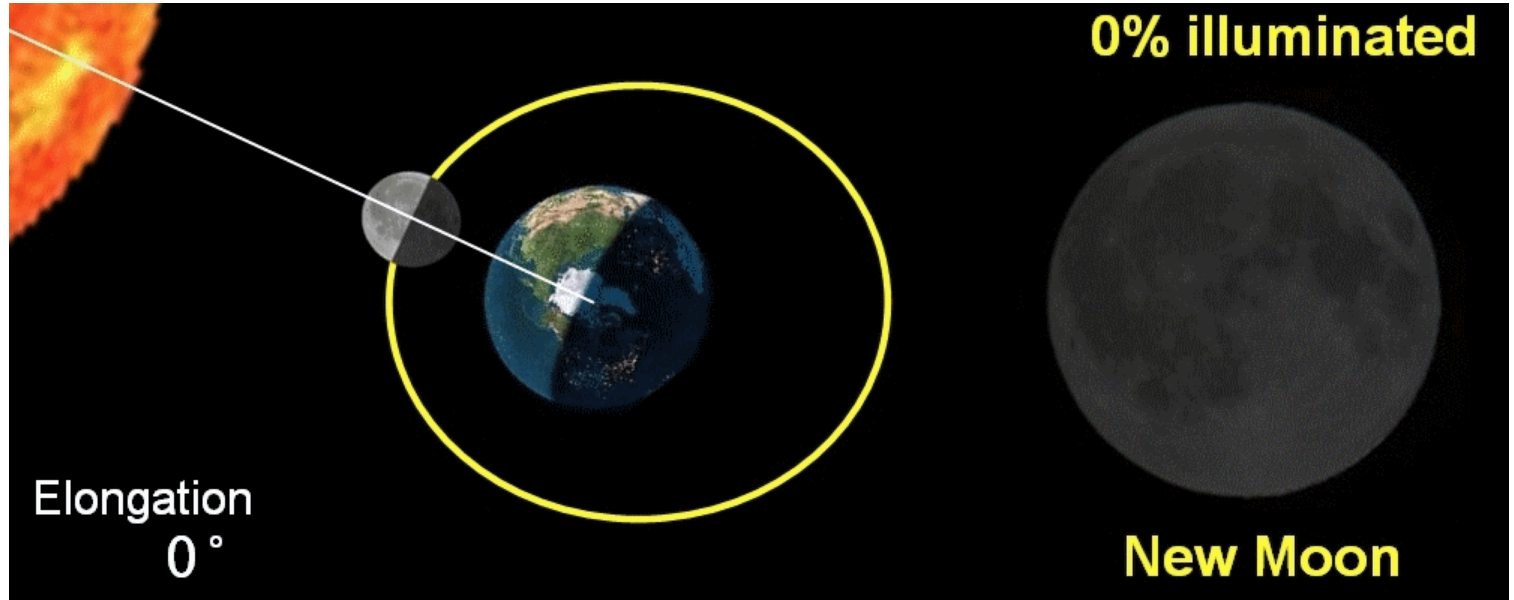
Anyway, when the sun, the moon and the earth line up in this way, the side of the moon that is facing the earth is completely dark, and so it cannot be seen. The moon is invisible.

The new moon around the time of the molad. It is invisible.

The new moon around the time of the molad. It is invisible.

As the moon continues its orbit around the earth, it moves away from the conjunction, and the side of the moon facing the earth can then catch a sliver of sunlight, which it then reflects down to us. At that moment, the new moon can be seen. This is the situation our present tractate of Talmud, Rosh Hashanah, is discussing. Here is what the moon looks about three days after the conjunction. Notice how we can now see the new crescent.

The new moon, several days after the conjunction.

The new moon, several days after the conjunction.

The question is, how much does the moon have to move in its orbit before that sliver of the new crescent can be seen here on earth? As we have seen, according to the passage in today’s page of Talmud, the new moon is visible a mere six hours after the conjunction. Here is Rashi:

נולד קודם חצות - היום בידוע שנראה היום קודם שתשקע החמה שאין הלבנה מתכסה מבני א"י שהם במערב אלא שש שעות אחר חדושה מתוך קוטנה שהלבנה לעולם בשש שעות לאחר חדושה בקרן מערבית דרומית ונראית להם

If the conjunction is before midday [i.e. 12 noon] - then the moon can certainly be seen before sunset [which is at 6.00pm] because for those living in Israel to the west of Babylon the moon is only invisible for six hours after the conjunction. Six hours after the conjunction the moon is always in the south-western sky and can be seen.

The Sages of the Talmud and those who interpreted them, like Rashi, took it as axiomatic that once the moon is six hours “old” which is to say, once six hours have passed from the time of the conjunction, a sliver of the new moon, may be visible, if the other atmospheric conditions, like a lack of clouds, are just right. The problem is, this does not appear to be anywhere near correct.

An Image of the New Moon at the Molad

On July 8, 2013 a French amateur astronomer named Thierry Legaultin managed to capture the moon at the precise instant it was new. His image, (below) shows the thinnest of lunar crescents, in full daylight (since a new moon is always near the sun in the sky). Legault noted that “it is the youngest possible crescent, the age of the moon at this instant being exactly zero. Celestial north is up in the image, as well as the sun. The irregularities and discontinuities are caused by the relief at the edge of the lunar disk (mountains, craters).”

“In order to reduce the glare,” he wrote, “the images have been taken in close infrared and a pierced screen, placed just in front of the telescope, prevents the sunlight from entering directly in the telescope.” Like this.

The youngest moon visible to the naked eye - It’s not six hours

Legault’s record is certainly impressive, but it’s not really helpful for our discussion, since the Mishnah and Talmud were written in an era long before infrared telephoto lenses, and describe the appearance of the new moon with the naked eye. So what is the earliest time that the new moon can be seen under those circumstances?

According to Debroah Byrd in an article in EarthSky, “a longstanding, though somewhat doubtful record for youngest moon seen with the eye was held by two British housemaids, said to have seen the moon 14 and three-quarter hours after new moon – in the year 1916.”

A more reliable record was achieved by Stephen James O’Meara in May 1990; he saw the young crescent with the unaided eye 15 hours and 32 minutes after new moon. The record for youngest moon spotted with the eye using an optical aid passed to Mohsen Mirsaeed in 2002, who saw the moon 11 hours and 40 minutes after new moon. But Legault’s photograph at the instant of new moon? That record can only be duplicated, not surpassed.

Ok, so the accepted current record stands at over 15 hours after the conjunction, which is two-and a half times as long as the Talmud declares such a moon could be visible. How might we explain this massive discrepancy?

The earth’s atmosphere back then was certainly a lot cleaner and less polluted with soot and other particles. That would make viewing small objects in the sky a lot easier. And there was no light pollution back then either, which is a huge obstacle in viewing the night sky. But these factors alone are not enough to allow a moon only six hours old to be viewed. And don’t suggest that people had better eyesight in the Talmudic era. According to Ivan Schwab, a professor of ophthalmology at the University of California, and author of Evolution's Witness: How Eyes Evolved. “As long as primates have been around, there's probably been myopia," though the rates of myopia have skyrocketed over the past three centuries. Although genes and nutrition may play a role in nearsightedness, education and myopia seem to be linked, suggesting that when people do a lot of close work, their eyes grow longer — the better to focus up close, but the worse for long-distance vision. So if you are an avid reader, you are unlikely to be a good witness to come before the Bet Din and testify that you had seen an early new moon.

In short, the Talmud’s claim that the new moon can (and perhaps can usually) be seen six hours after the conjunction cannot be supported, based on what we know today. It’s not even close. Talmudology welcomes its readers to propose some solutions for this conundrum.

Kiddush LevanaH in Islam

Jews are not the only people whose tradition requires the new moon to be observed by witnesses and reported to a central authority. Our Muslim brothers and sisters have a similar requirement in Islam; the new moon also drives their calendar, known as the Hijri Calendar (ٱلتَّقْوِيم ٱلْهِجْرِيّ‎ at-taqwīm al-hijrīy) and today’s Islamic date is 23rd Rabi ul Awal, 1443h.

Abdullah al-Khodairi at work in the Saudi dessert. From here.

In 2016 Al-jazeera featured an article about Abdullah al-Khodairi, the man appointed by the Saudi authorities to observe the tiny crescent of the new moon that indicates the start of the holy month of Ramadan. It was a responsibility that ran in his family; Abdullah recalled climbing a hill with his father and grandfather in 1979, when he was still in high school, observing the moon and then running back to his family to declare the beginning of Ramadan before the radio did. He is now the the head of the observatory at Majmaah University in Hotat al-udair and the author of a number of books on the moon, astronomy and Islam.

Just a few meters from Masjid al Haram mosque, which houses the Kaaba in Mecca, is the Abraj Al-Bait, the “Towers of the House," which is a complex of seven skyscraper hotels. In the central hotel tower is the Makkah Clock Royal Tower, which has the world's largest clock face (and third- tallest building). The Clock Tower Museum occupies the top four floors of the tower, where each floor is dedicated to a particular aspect of the relationship between astronomy and the human measurement of time. If you’d like to plan a visit you should click here, but if, like me, you travel on an Israeli passport, you will have to delay your trip until the Abraham Accords, which normalized diplomatic relationships between Israel and the UAE and Baharain, are ratified in Saudi Arabia; Israelis are still are still prohibited from entering the country. When you do visit, you can discuss the conundrum in today’s page of Talmud with the experts there. Perhaps they will even provide a satisfactory solution.

אם יאמר לך אדם יש חכמה בגוים תאמן
If a person tells you that there is wisdom among the nations of the world, believe them...
— איכה רבה ב יג
Print Friendly and PDF

Rosh Hashanah 6b ~ How Long is a Year?

There is a special rule about selling a house in a walled city in the Land of Israel. The seller has the right to buy back his property for one year. If he fails to do so in that time it becomes the permanent property of the buyer. This is learned from a verse in Leviticus:

ויקרא 25:30

וְאִ֣ם לֹֽא־יִגָּאֵ֗ל עַד־מְלֹ֣את לוֹ֮ שָׁנָ֣ה תְמִימָה֒ וְ֠קָ֠ם הַבַּ֨יִת אֲשֶׁר־בָּעִ֜יר אֲשֶׁר־[ל֣וֹ] חֹמָ֗ה לַצְּמִיתֻ֛ת לַקֹּנֶ֥ה אֹת֖וֹ לְדֹרֹתָ֑יו לֹ֥א יֵצֵ֖א בַּיֹּבֵֽל׃

If it is not redeemed before a full year has elapsed, the house in the walled city shall pass to the purchaser beyond reclaim throughout the ages; it shall not be released in the jubilee.

The next question is, what is meant by “a full year”? This is the subject of a dispute on today’s page of Talmud:

ראש השנה ו, ב

דְּתַנְיָא: ״שָׁנָה תְּמִימָה״, מוֹנֶה שְׁלֹשׁ מֵאוֹת וְשִׁשִּׁים וַחֲמִשָּׁה יוֹם כְּמִנְיָן יְמוֹת הַחַמָּה, דִּבְרֵי רַבִּי. וַחֲכָמִים אוֹמְרִים: מוֹנֶה שְׁנֵים עָשָׂר חֹדֶשׁ מִיּוֹם לְיוֹם

It was taught in a baraita: With regard to redeeming houses in a walled city the Torah states: “And if it not be redeemed within the space of a full year” (Leviticus 25:30), which indicates that he counts 365 days, in accordance with the number of days in a solar year; this is the statement of Rabbi Yehuda HaNasi. And the Rabbis say: He counts twelve months from day to day.

According to the great Rebbi Yehudah HaNasi (135-217 C.E.) a full year usually means a full solar year of 365 days. A solar year is the time it takes the earth to complete one revolution all the way around the sun. (Or for those of you living in a geocentric universe, that is the time taken for the sun to complete one revolution around the earth). Just like Rebbi, we assume that a solar year is 365 days long, but in fact it is a little less than 365 1/4 days: that is to say, 365 days 5 hours, 48 minutes and 46 seconds. Those extra five and a bit hours are the reason we have a leap year every four years or so, when they add up to almost another 24 hours. And there are other kinds of “solar” years.

The Solar Year

The solar year is the average amount of time it takes the sun to return to the same position as seen from the earth. It is usually measured from one vernal equinox to the next. (The vernal equinox is the day on which the length of day and of the night are equal.) You can see this on the drawing below, taken from H. A. Rey’s wonderful book The Stars (and yes, it is the same H.A. Rey of Curious George fame.) In the drawing, a solar year is the time it takes the sun (as seen from the earth) to orbit from one spring equinox to the next, which is about 365 days 5 hours 48 minutes and 30ish seconds, or 365.242 days.

The solar year is also known as the tropical year and it is also the length of our calendar year. In today’s page of Talmud when Rebbi referred to the “מִנְיָן יְמוֹת הַחַמָּה” or “the the number of days in a solar year” this is what he meant.

The sidereal year

Just like a spinning top the earth wobbles as it orbits the sun.

But there is another way of measuring the year, and it is the amount of time it takes the sun to appear against the same background of fixed stars. It is known as the sidereal year, from the Latin sidus meaning star. And a sidereal year is 20 min 24.5 seconds longer than a tropical year. The sidereal year is longer because of the precession of the equinoxes, the term given to the phenomenon that in addition to orbiting the sun, the earth is wobbling like a spinning top. As the earth returns to the same position it had one full solar orbit ago, the tilt of the earth is not now directly toward the Sun: because of the effects of precession, it is a little way "beyond" this. The sun does not line up against the background of the stars as it did one year ago, and we need to wait an additional few minutes for sun and earth to line up as they did then.

The lunar year

The rabbis were of the opinion that “the year” in question is the period of twelve lunar months that make up a regular (non-leap) Jewish year. That would be 354 days, which is 11 days and some shorter than a solar or sidereal year.

There is no “correct” way to count a year. It is a matter of convention. We have fiscal years and academic years, draconic years and sothic years. Today’s page of Talmud reminds us that so long as we are clear about what we are saying, a year can be defined in a number of different and interesting ways.

[The same passage appears in Yoma 65b, where this post originally appeared.]

Print Friendly and PDF