Megillah 23a ~ The Controversy over Shabbat Chatan

On today’s page of Talmud there is a fairly bland discussion about how many people are called to the Torah on various days. Here is an excerpt from a discussion about the seven people who are called on Shabbat. Read it carefully.

מגילה כב, א

אִיבַּעְיָא לְהוּ: מַפְטִיר, מַהוּ שֶׁיַּעֲלֶה לַמִּנְיָן שִׁבְעָה? רַב הוּנָא וְרַבִּי יִרְמְיָה בַּר אַבָּא, חַד אָמַר: עוֹלֶה, וְחַד אָמַר: אֵינוֹ עוֹלֶה

A dilemma was raised before the Sages: With regard to the reader who concludes [maftir] the Torah reading and reads from the Prophets [haftorah], what is the halakha; does he count toward the quorum of seven readers? Rav Huna and Rabbi Yirmeya bar Abba disagreed about this matter. One said: He counts, and one said: He does not count.

Ok, so according Rav Huna and Rabbi Yirmeya bar Abba disagree about how to count the person called to read the haftorah. Not a big deal really. And as most readers will know, our custom today is that we call seven people to the read from the Torah on Shabbat, and an eighth person is called to read the haftorah. This is also the way the halakha is codified in the Shulkhan Arukh.

אורח חיים רפ״ב:ד׳

נוהגים לקרות שבעה לגמור עמהם הפרשה ואומר קדיש וחוזר וקורא עם המפטיר מה שקרא השביעי. הגה וכן נוהגים בימים טובים שאין מפטיר ממנין הקרואים אבל בחול שאסור להוסיף על מנין הקרואים השלישי הוא מפטיר וביום שמוציאין ב' ספרים או ג' המפטיר קורא באחרונה וקטן יכול לקרות בפרשת המוספין או בד' פרשיות שמוסיפין באדר וכן נוהגים (ר"ן ומרדכי פ"ב דמגילה) אע"פ שיש חולקים ואומרים קדיש קודם שעולה המפטיר ואין חילוק בזה בין הוסיפו על מנין הקרואים או לא ובין מוציאין ס"ת א' או ג' (ב"י בשם הר"ר ישעיה והרא"ש ורבי ירוחם)

It is customary to read 7 (aliyot) to complete the parshah. We then say Kaddish, and then go back and the maftir reads what the seventh person read. RAMA: It is our custom on Yom Tov that the maftir is not from the amount of the readers. However, during the week, when it is forbidden to add to the amount of readers, the third one is the maftir. On a day where two or three Torahs are taken out, the maftir reads the last one. And a minor may read the additional parshah, or from the four parshiyot that are added in Adar, and this is our custom (R"an; Mordechai), even though there are those who disagree. And we say kaddish prior to the maftir being called up, there is no difference in this regarding adding to the amount of (aliyos) or not, or regarding taking out two or three Torahs (Beis Yosef in the name of R' Yeshayah; the Rosh; R' Yerucham).

The Dispute over the count on Shabbat Chatan

This area of Jewish law engendered a terrible dispute in the eighteenth century. It centered on the custom among Sephardic Jews of reading a special, additional Torah portion on the Sabbath after a wedding; the groom would be called to the Torah as the portion was chanted, but the precise status of this reading was not clear. Should it count as one of the standard seven portions that are read each week on the Sabbath, or should it be considered an additional, eighth reading? This turned out to be a surprisingly contentious question among the Italian rabbis of the eighteenth century.

In 1735 in Pisa, Rabbi Eliezer Supino ruled that the groom should be called up as one of the standard seven to read from the Torah, but this position was opposed by David ben Abraham Meldola and his cousin Rabbi Raphael Meldola. The Meldolas argued that the weekly Torah portion would be read as usual in seven parts, and that the groom would then be called to read as an eighth person. The dispute continued for almost a decade and involved the rabbinic leaders of several other communities, including Amsterdam, Tunis, and Algeria. In 1738, Supino published his reasoning in a small pamphlet called Kuntres Al Inyan Shabbat Hahatunnah (A Treatise Concerning the Sabbath Wedding,) but although it was printed in Amsterdam, the work was never released for sale to the public. Supino printed three hundred copies of his work but it remained in the Amsterdam printer’s warehouse for over two years, apparently as a result of a financial dispute between Supino and the publisher.

The Meldolas heard of the existence of the pamphlet and after exerting pressure on the publisher, seized and burned all but a single copy, which was saved from destruction and is now shelved in the library of the Jewish Theological Seminary in Jerusalem.

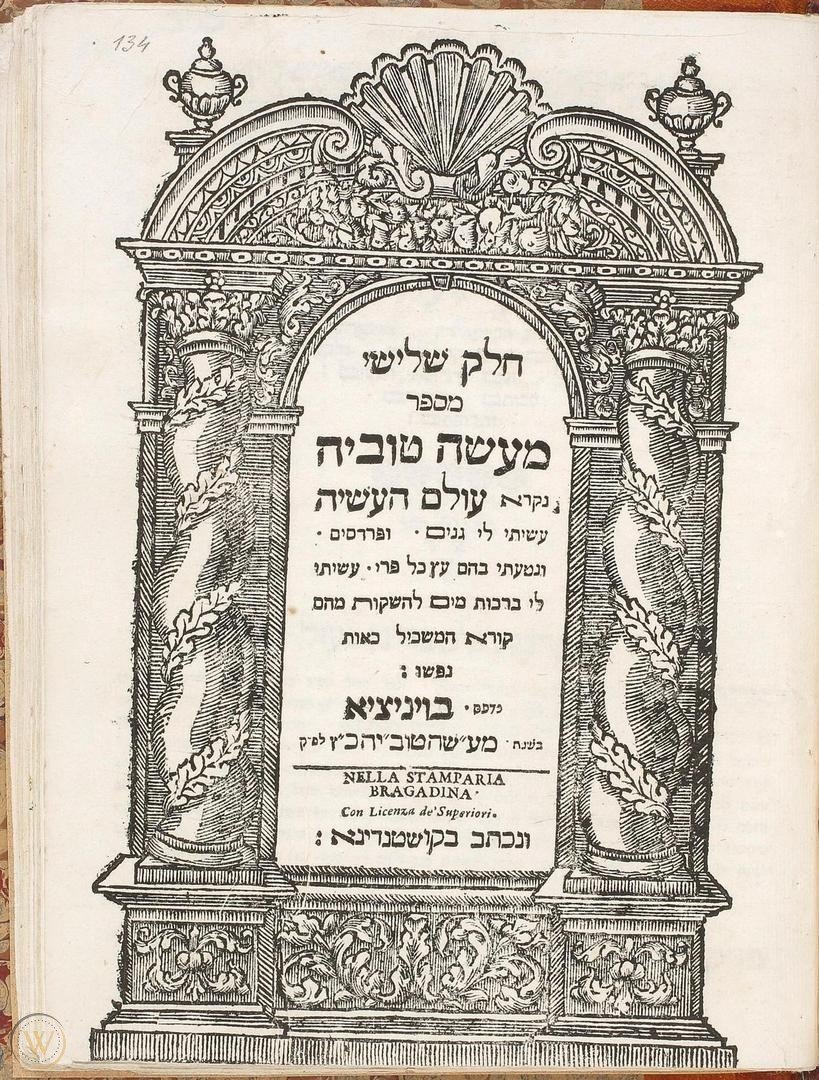
First page of the Responsa by Rabbi Eliezer Supino. It is the only known copy. All the others were burned by the publisher.

David Meldola, the son of Raphael was just twenty-one years old at the time of the incident that began the whole affair, and it was he who was sent by his father Raphael to locate and destroy the pamphlet by Supino. This early involvement at an impressionable age may explain why David Meldola remained obsessed with the affair: Seventeen years after the original episode (and after the deaths of Rabbi Supino and both Rabbis Meldola), David Meldola published a book of responsa that contained no fewer than eighteen chapters over sixty-one pages describing the affair and its resolution.

The argument between the Meldolas and Rabbi Supino largely revolved around the weight that should be placed on local customs, and the dramatic way in which the Meldolas destroyed Rabbi Supino’s work should be a chilling reminder of the power that these customs sometimes have over us.

Print Friendly and PDF

2021 End of the Year Talmudology Numbers

It has been another bumper year for Talmudology, with over 77,000 visits and 103,00 page views.

THE MOST POPULAR POSTS OF 2021

Here are the ten most popular posts of 2021, together with those of 2020 for comparison.

2021 Top Posts Last Year's Top Post
Pesachim 68a ~ Resurrection of the Dead A history of our attempts at resurrection, starting with the Bible,
and ending in a Yale lab, with re-animated pigs’ brains.
Avodah Zarah 28b ~ Ear Candling
The stupid - and fun side - of a silly way to clean your ears.
Avodah Zarah 28b ~ Ear Candling
The stupid - and fun side - of a silly way to clean your ears.
Bava Basra 126b ~ The Healing Power of Saliva
Saliva, wound healing, and the magic of a firstborn’s spit.
Bechorot 8a ~ Rashi on Mermaids
Mermaids in rabbinic (and Greek) literature. And a sighting by Christopher Columbus.
Kiddushin 82a ~ The Best Doctors Go to Hell
Doctors were at best useless, and at their worst, agents of death. To hell with them
Bava Basra 126b ~ The Healing Power of Saliva
Saliva, wound healing, and the magic of a firstborn’s spit.
Kiddushin 30a~ How Many Letters are in a Sefer Torah?
304, 801. Or 304, 805. And why the rabbis miscounted
Zevachim 113b ~ On the Identity of the Re'em
How the re’em survived Noah’s flood, and ended up on a prehistoric cave painting.
Kiddushin 29a ~ Swimming and Drowning
The Jewish requirement to teach a child to swim
Bechorot 16a ~ A Flat Earth, The Eye, and the Sky
The geocentric universe is modeled by the structure of an eye.
Bechorot 8a ~ Rashi on Mermaids
Mermaids in rabbinic (and Greek) literature. And a sighting by Christopher Columbus.
Kiddushin 29a ~ Swimming and Drowning
The Jewish requirement to teach a child to swim.
Berachot 50a ~ "The Three Who Ate" - on Yom Kippur
David Frischmann wrote a story about the rabbi who made Kiddish on Yom Kippur. But was it true?
Niddah 13 ~ Onanism, Self-Pollution and Potential People
The Talmud viewed sperm as potential people. It’s a viewpoint very removed from our own.
Bechorot 16a ~ A Flat Earth, The Eye, and the Sky
The geocentric universe is modeled by the structure of an eye.
Keritot 5b ~ Hemorrhoids, Plague, and the Ark of the Covenant
Recovering the true cause of the Plague at Ashdod. And it wasn’t hemorrhoids.
Berachot 2 ~ How Many Words Are In the Babylonian Talmud?
1.8 million, give or take
Kiddushin 82a ~ The Best Doctors Go to Hell
Doctors were at best useless, and at their worst, agents of death. To hell with them.
Niddah 13 ~ Onanism, Self-Pollution and Potential People
The Talmud viewed sperm as potential people. It’s a viewpoint very removed from our own.

WHERE ARE THE TALMUDOLOGY READERS FROM?

Here are the top five Talmudology reading countries:

  1. USA - 61% (47,000 visitors)

  2. Israel 12% (9,000 visitors)

  3. United Kingdom 5% (4,400 visitors)

  4. Canada 3% (3,000 visitors)

  5. Australia 2% (1,800 visitors)

And there are plenty of readers from unexpected places too. Over 1,200 people enjoyed Talmudology in India, and 150 read it in Korea. There were 43 readers from Serbia, 23 viewers from the Hashemite Kingdom of Jordan, and 17 on the island of Madagascar. We value your readership, and don’t worry, we cannot identify any of you in more detail, even if we wanted to.

We reached and exceeded our goal of 1,000 subscribers, and now have over 1,100. Onwards and upwards!

We are grateful to all those who took the time to email with comments and corrections. Help keep Talmudology honest and let us know if you spot an error.

Sign up here for email alerts, and follow us on Twitter (@Talmudology) as we continue to study science, medicine and the Talmud.

Plans for next year

This coming year will be a huge one for Talmudology. We will complete our posts on the entire Babylonian Talmud. Talmudology started half way through the study of Yevamot, and that is where we will be in May, some seven and a half years after the very first Talmudology post.

NEw Book Announcement

In the Fall, Oxford University Press we will publish a new history of the Jewish People, one based on their encounter with plagues and pandemics. You can read more about the book here.

Coming soon from Oxford University Press.

So stay healthy and look after yourselves, and if you can, look after someone else too.

תכלה שנה וקללותיה, תחל שנה וברכותיה

The Year and its Curses have Come to an End

May the Next Year and its Blessings Begin*

*See Talmud Bavli Megillah 31b

Print Friendly and PDF

Just published - A New Essay on Tuviah HaCohen and his Ma'aseh Tuviah

I am delighted to share the recent publication of a book of essays on the life and work of the remarkable Tuviah HaCohen (1652-1729), who was featured on Talmudology just a couple of months ago.

The new book of essays is called Ma’ase Tuviya (Venice 1708). Tuviya in Medicine and Science, has a forward from Fred Rosner, and is published by Hebrew University’s Hadassah Medical School.

You can see the Table of Contents and read my essay The Medicine of Tuviya Cohen in Comparison and Contrast by clicking the big button below.

Enjoy!

Print Friendly and PDF

Megillah 15 ~ Fear, Mood, and Menstruation

In today’s page of Talmud the rabbis wonder about the meaning of the verse in chapter four of the Book of Esther:

מגילה טו, א

״וַתִּתְחַלְחַל הַמַּלְכָּה״. מַאי ״וַתִּתְחַלְחַל״? אָמַר רַב: שֶׁפֵּירְסָה נִדָּה, וְרַבִּי יִרְמְיָה אָמַר: שֶׁהוּצְרְכָה לִנְקָבֶיהָ

The verse states: “Then the queen was exceedingly distressed” [vatithalhal] (Esther 4:4). The Gemara asks: What is the meaning of vatithalhal? Rav said: This means that she began to menstruate out of fear, as the cavities, ḥalalim, of her body opened. And Rabbi Yirmeya said: Her bowels were loosened, also understanding the verse as referring to her bodily cavities.

So today we will discuss Rav’s statement that because of Esther’s tremendous stress, she menstruated.

The effect of Stress on the Menstrual Cycle

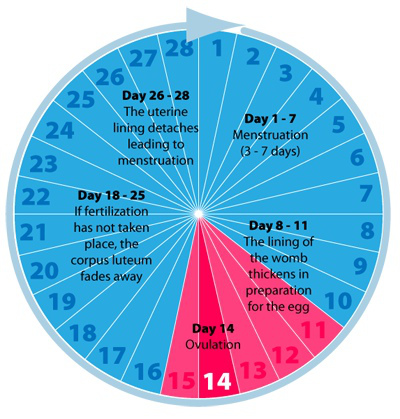
There has of course been a great deal of scientific work investigating the effect of the menstrual cycle on a women's mood. But there has been less examination of the effect of mood (or stress) on the cycle.  Elsewhere, Rabbi Meir says the very opposite of Rav. He claims that fear (or stress) prevents menstruation.

נדה ט,א

רבי מאיר אומר אם היתה במחבא והגיע שעת וסתה ולא בדקה טהורה שחרדה מסלקת את הדמים

Rabbi Meir says: If a woman was in hiding from danger, and the time of her fixed menstrual cycle came and she did not examine herself, nevertheless she is ritually pure, [as it may be assumed that she did not experience bleeding] because fear dispels the flow of menstrual blood.

In a third place in the Talmud these contradictory opinions are resolved:

סוטה כ, א

למימרא דבעיתותא מרפיא אין דכתיב ותתחלחל המלכה מאד ואמר רב שפירסה נדה והא אנן תנן חרדה מסלקת דמים פחדא צמית ביעתותא מרפיא

Does fright loosen the womb [and causes a woman to menstruate]? Yes, as the verse states (Esther 4:4) "...and the Queen [Esther] became very afraid" about which Rav explained:" she began to menstruate."

But haven't we learned elsewhere in a Mishnah (Niddah 39a) that fear suspends the discharge of menstrual blood? In fact, fear that is not sudden contracts [the womb and prevents bleeding], but sudden fear loosens [the womb and causes early menstrual bleeding].

Here are some of the things that the rabbis of the Talmud believed could induce menstruation:

  1. Carrying a heavy load (Tosefta Niddah 9:1)

  2. Jumping (ibid)

  3. Sudden fright (Niddah 71a, and Niddah 39a)

  4. Yearning for intercourse (Niddah 20b)

  5. Garlic, onions and peppers (Niddah 63b)

OK, but these beliefs aside, which of the two opinions, that or Rav or that of Rabbi Meir, are best supported by the science?

Data from both animal and human research indicate that psychological stress is associated with altered menstrual function.
— Barsom S, et al. Association between psychological stress and menstrual cycle characteristics in perimenopausal women. Women’s Health Issues 14 (2004) 235-241

The Effect of Stress on Menstrual Function

In a review from the Department of Biological Sciences at Ohio University, researchers acknowledged that stress is difficult to define. However, one final common pathway of stressors is the low availability of dietary energy. Ovulation - which is the first part of the cascade that leads to menstruation - has been blocked in hamsters "by food restriction, pharmacological blockers of carbohydrate and fat metabolism, insulin administration (which shunts metabolic fuels into storage), and cold exposure (which consumes metabolic fuels in thermogenesis)." Women athletes frequently experience a lack of menstruation, which is found in up to 65% of competitive young runners. But what about psychogenic causes of a disturbed menstrual cycle - after all, Rabbi Meir taught fear prevents menstruation? While not adressing this directly, the Ohio University researchers had this to say about the relationship between psychological stressors and amenorrhea (the lack of menstruation. Remember that word - it will come up again):

Associations between psychological disturbances and amenorrhea or infertility have long been interpreted as a causal relationship, but prospective studies demonstrating that psychogenic factors contribute to reproductive dysfunction in women are almost completely lacking . Early psychoanalytic conclusions that psychological conditions underlie involuntary infertility in women have been criticized recently on several grounds: first, the same psychological conditions have been found in analyses of fertile women; second, other women with very serious psychic problems conceive with ease; and third, couples with an unfulfilled desire for a child do not show psychological disorders any more frequently than do couples without fertility disorders. Even the direction of causality is questionable, because there are grounds for believing that infertility and its medical treatment cause the depression and anxiety observed in some infertility patients. These findings have led to the recommendation that the term ‘psychogenic infertility’ should be withdrawn from use because it is simplistic and anachronistic.

Menstruation and Incarceration

There is some other evidence we could consider: a 2007 paper published in Women's Health Issues which addressed the influence of stress on the menstrual cycle among newly incarcerated women.  Researchers analyzed 446 non-pregnant women who answered a number of detailed questions about their menstrual cycles.  They found that 9% reported amenorrhea (I told you what that meant two paragraphs ago) and that a third reported menstrual irregularities.  

Incarcerated women have high rates of amenorrhea and menstrual irregularity and the prevalence may be associated with certain stresses. Further research on the causes and consequences of menstrual dysfunction in this underserved population is needed.
— Allsworth J. et al. The influence of stress on the menstrual cycle among newly incarcerated women. Women's Helath Issues 2007; (17) 202-209.

As might be expected, the stressors of the incarcerated women in this study included drug and alcohol problems and sexual abuse. And it supports the assertion by Rabbi Meir that stress - in the form of incarceration, is causally linked to amenorrhea.  

A Longitudinal Study of Psychological Stress and Menstruation

The final study we will review comes from a cohort of predominantly white, well educated married women of whom 505 were "invited to participate join a special survey focusing on midlife and menopause." Rather than ask about stress and current menstruation, the researchers performed a two-year analysis. Here's what they found:

In analyzing stress levels and cycle characteristics across 2 years...women with marked increases in their level of stress (n =30) are shown to have decreased length (0.2 days/cycle) of menstrual cycle intervals and decreased duration of bleed (0.1 day/cycle) compared with increases in these measures (2.9 days/cycle for cycle interval; 0.3 days/cycle for duration of bleed) among women with no marked change in stress level (n=103); t-tests indicate that these differences are significant (p < .05).

Some of the differences that the researchers found in this group were really small - "0.3 days/cycle for duration of bleeding" but if you are into statistics this difference can be significant (that's what those t-tests are all about). But these statistical associations were not powerful, and the researchers concluded that "the results of this investigation...suggest that, in the long term, stressful life events have little relationship to the length of menstrual cycle intervals and the duration of menstrual bleeding in perimenopausal women."

The three studies we've reviewed (even that last one with its weak findings) all suggest that there is indeed a relationship between psychological stress and menstruation.  Generally, the effect of stress is to increase the length of the menstrual cycle which may result in amenorrhea.  Rabbi Meir, the great sage of the Mishnah, was certainly onto something when he noted just the same effect almost two thousand years ago. And as for Rav, well, perhaps he should have asked a woman. They generally are the experts in these matters.

Print Friendly and PDF