Yevamot 8b ~ Science, Torah, and The Deceased Wife’s Sister Controversy: Part I

For the last several pages, the Talmud has been analyzing one phrase in the Torah (Lev. 18:18):

וְאִשָּׁ֥ה אֶל־אֲחֹתָ֖הּ לֹ֣א תִקָּ֑ח לִצְרֹ֗ר לְגַלּ֧וֹת עֶרְוָתָ֛הּ עָלֶ֖יהָ בְּחַיֶּֽיהָ׃

Do not take [into your household as a wife] a woman as a rival to her sister and uncover her nakedness in the other’s lifetime.

The Talmud spends a total of twelve pages proving that this verse means that a man is forbidden to take his wife’s sister’s, even when she falls to him for levirate marriage (yibbum) following the death of her husband. This same verse was at the center of a fierce debate in Great Britain in the nineteenth century, which concerned the legality of a man marrying his dead wife’s sister. In telling the story of this debate, we will have to discuss what we mean when we say that science changes. We are also going to look at some Jewish skeptics of science, and their understandings and misunderstandings of the concept of a science that changes

We’re going to do this through the lens of Yevamot, and examine in some depth The British Medical Journal’s understanding of Ta’amei Hamitzvot, the reasons for the commandments in the Torah. We are going to dive deeply. So strap in. (Yes I know. Too many metaphors. Sorry.)

Background – Yevamot 8.

Let’s start by going back to that verse in Leviticus (18:18). The Torah states

וְאִשָּׁ֥ה אֶל־אֲחֹתָ֖הּ לֹ֣א תִקָּ֑ח לִצְרֹ֗ר לְגַלּ֧וֹת עֶרְוָתָ֛הּ עָלֶ֖יהָ בְּחַיֶּֽיהָ׃

Do not take [into your household as a wife] a woman as a rival to her sister and uncover her nakedness in the other’s lifetime.

Based on the word בחייה – “in the other’s lifetime”, the Talmud in today’s page of Talmud (8b) establishes that a man may marry his wife’s sister if, and only if, his wife had died. This is reflected in the Code of Jewish Law, the Shulchan Aruch, which ruled (as did Maimonides) that the prohibition against a man marrying his wife’s sister exists only while his wife is alive. On her death, a man may marry his deceased wife’s sister. 

שולחן ערוך אבן העזר הלכות אישות סימן טו סעיף כו 

אחות אשתו אסורה לו מן התורה כל זמן שאשתו קיימת לא שנא אם היא אחותה מן האב או מן האם ואפי' גירש את אשתו אבל לאחר מיתתה מותר באחותה וכל המגרש אפי' מחמת קול בעלמא נאסר בקרובותיה

His wife's sister is forbidden to him from the Torah, all the while his wife is alive; it makes no difference if (the sister) is paternal or maternal, or even if he has already divorced his wife. However, after her (his wife's) death, he may marry her sister.

Just to be clear – this is not the central focus of Yevamot, which is concerned with levirate marriage, when a man marries his dead brother’s widow. But it is very important since it will touch on issues central to science and Yevamot.  Let’s see how.  

Was Henry illegitimate?

The Duke of Beaufort by Henry Alken. From here.

The Jewish law allowing a man to marry his dead wife's sister was not followed in Victorian England. Quite the opposite - a marriage like this was forbidden. But a debate about this law began with a question about the the legitimacy the Duke of Beaufort. Henry Somerset (d. 1853) the seventh Duke of Beaufort, had married Georgina Fitzroy and had fathered two girls with her. But Georgina died in 1821, and the sad Duke then married her younger half-sister Emily, with whom he had a further six daughters, and a son. (I know this is beginning to sound like a complicated episode of Downton Abbey, but bear with me. It’s worth it.)  That son was Henry Charles FitzRoy Somerset (1824-1899), who later became the 8th Duke of Beaufort. But there was a problem. Perhaps Henry was not a legitimate heir to the House of Somerset, since he was the child of a union of a man and his wife’s sister (or in this case, half-sister.) If the old Duke’s marriage to his dead wife’s (half-) sister was prohibited, then Duke Henry was a bastard child and his inheritance would have to be passed on to other males in the family line. There was a lot at stake.

The solution came with the 1835 Act to render certain marriages valid and to alter the law with respect to certain voidable marriages, introduced by Lord Lyndhurst. This Act retrospectively made any marriage like the old Duke’s valid, but prohibited any such marriages from taking place in the future.  In this way, the present Henry, Duke of Beaufort, was not a bastard child after all; he could inherit the estate, and all was made good.

Except that it wasn’t. The Act did not settle matters at all, and ignited a debate in England that lasted seven decades. 

In addition to regular parliamentary bills and debates, pamphlets, letters, treatises and statements from all sides were published steadily through this period; major journals carried articles from leading figures in the controversy…and at least five novels took marriage with a deceased wife’s sister as their explicit subject
— Wallace, Anne D. “On the Deceased Wife’s Sister Controversy, 1835-1907."

The Chief Rabbi and the Royal Commission

In 1842, and almost every year after that, the British Parliament debated whether to legalize the marriage between a man and his dead wife’s sister. Queen Victoria appointed a Commission to look into the whole thing, and look it did, producing a report of over 150 pages in 1848.  Buried in that report is a letter from the Chief Rabbi Nathan Adler, who made the Jewish position very clear.

...the marriage of a widower with the sister of his deceased wife… is not only not considered as prohibited, but it is distinctly understood to be permitted, and on this point neither the Divine Law, nor the Rabbis, nor historical Judaism leave room for the least doubt.
— Chief Rabbi Nathan Adler, Appendix to the Report of the Commissioners appointed to inquire into the state and operation of the Law of Marriage

It didn’t much matter. The law remained the law, though it seemed that the British public ignored their learned lawmakers.  In one 1849 parliamentary debate, it was estimated that there were some 13,000 such marriages. These marriages in turn produced about 40,000 children, all of whom were, by Victorian standards, bastards.

Things became especially heated in the late 1870s when some 3,000 farmers (all, apparently from Norfolk – what was happening in Norfolk?) signed a petition “praying for the legislation of marriage with a deceased wife’s sister.” And so, in May 1879, the Prince of Wales himself introduced a bill to legalize this marriage in Britain’s Parliamentary upper chamber, the House of Lords. Their lordships droned on, and on, and on (the transcript takes up some eight pages of single space font) until the measure was struck down in a vote: “Contents 81: Not-Contents 101”.

But even in England, things do change, and by the beginning of the twentieth century, Parliament was ready to legalize what many women were already doing with their dead sister’s husband. The Deceased Wife’s Sister’s Marriage Act of 1907 was passed, and British law finally caught up with that of the Talmud.


Next time:

The scientists weigh in on the Marriage Act as we look at The British Medical Journal and its understanding of Ta’amei Hamitzvot and Yibbum.



Print Friendly and PDF

Happy Pi Day 2022, and Happy Birthday Albert Einstein

WHAT IS PI DAY, AND WHEN IS IT CELEBRATED?

From here.

Today, March 14, is celebrated as Pi Day by some of the mathematically inclined in the US. Why? Well, in most of the world, the date is written as day/month/year. So in Israel, all of Europe, Australia, South America and China, today's date, March 14th, would be written as 14/3. 

But not here in the US. Here, we write the date as month/day/year; it's a uniquely American way of doing things. (Like apple pie. And guns.) So today's date is 3/14. Which just happen to be the first few digits of pi, the ratio of the circumference of a circle to its diameter.

And that's why each year, some (particularly geeky) Americans celebrate Pi Day on March 14 (3/14). The year 2015 was Pi'ish than all others, since the entire date (when written the way we do in the US, 3/14/15) reflects five digits of pi, and not just the first three: 31415. Actually we got even more geeky: This day in 2015 at 9:26 and 53 seconds in the morning, the date and time, when written out, represented the first ten digits of Pi: 3141592653.

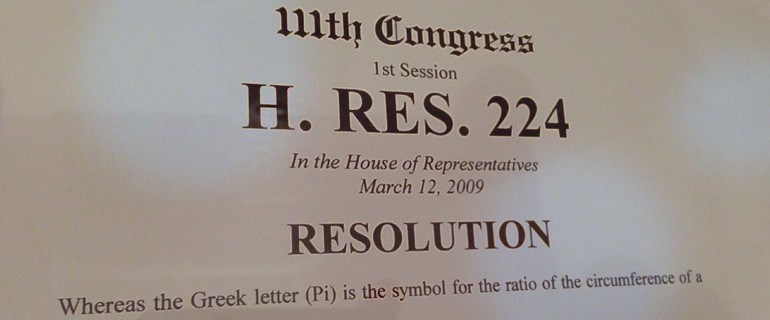
So that's why Pi Day is celebrated here in the US -  and probably not anywhere else. (It has even be recognized as such by a US Congressional Resolution. Really. I'm not making this up. And who says Congress doesn't get anything done?) 

PI IN THE BIBLE

In the ּBook of Kings (מלאכים א׳ 7:23) we read the following description of  a circular pool that was built by King Solomon. Read it carefully, then answer this question: What is the value of pi that the verse describes?

מלכים א פרק ז פסוק כג 

ויעש את הים מוצק עשר באמה משפתו עד שפתו עגל סביב וחמש באמה קומתו וקוה שלשים באמה יסב אתו סביב 

And he made a molten sea, ten amot from one brim to the other: it was round, and its height was five amot, and a circumference of thirty amot circled it.

Answer: The circumference was 30 amot and the diameter was 10 amot. Since pi is the ratio of the circumference of a circle to its diameter, pi in the Book of Kings is 30/10=3. Three - no more and no less.

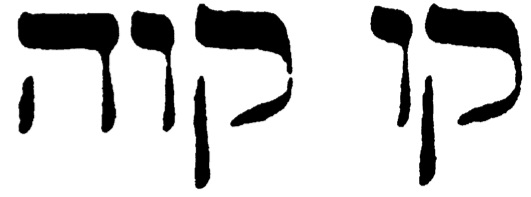
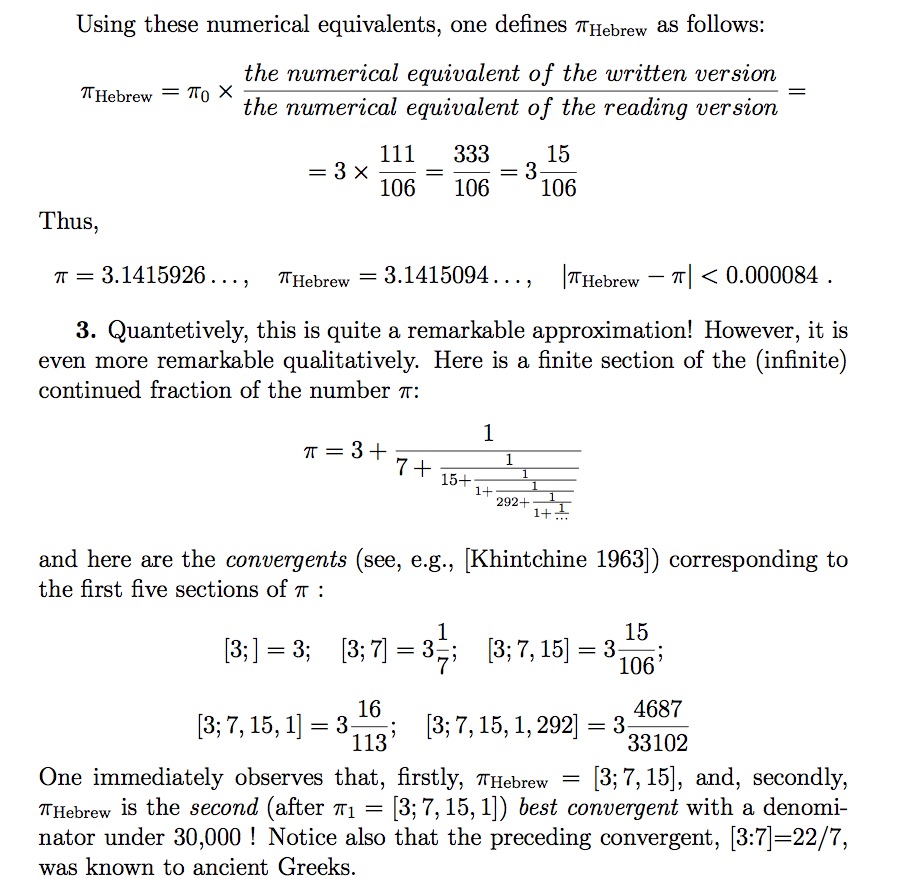
There are lots of papers on the value of pi in the the Bible. Many of them mention an observation that seems to have been incorrectly attributed to the Vilna Gaon.  The verse we cited from מלאכים א׳ spells the word for line as קוה, but it is pronounced as though it were written קו.  (In דברי הימים ב׳ (II Chronicles 4:2) the identical verse spells the word for line as קו.)  The ratio of the numerical value (gematria) of the written word (כתיב) to the pronounced word (קרי) is 111/106.  Let's have the French mathematician Shlomo Belga pick up the story - in his paper (first published in the 1991 Proceedings of the 17th Canadian Congress of History and Philosophy of Mathematics, and recently updated), he gets rather excited about the whole gematria thing:

A mathematician called Andrew Simoson also addresses this large tub that is described in מלאכים א׳ and is often called Solomon's Sea. He doesn't buy the gematria, and wrote about it in The College Mathematics Journal.

A natural question with respect to this method is, why add, divide, and multiply the letters of the words? Perhaps an even more basic question is, why all the mystery in the first place? Furthermore, H. W. Guggenheimer, in his Mathematical Reviews...seriously doubts that the use of letters as numerals predates Alexandrian times; or if such is the case, the chronicler did not know the key. Moreover, even if this remarkable approximation to pi is more than coincidence, this explanation does not resolve the obvious measurement discrepancy - the 30-cubit circumference and the 10-cubit diameter. Finally, Deakin points out that if the deity truly is at work in this phenomenon of scripture revealing an accurate approximation ofpi... God would most surely have selected 355/113...as representative of pi...

Still, what stuck Simoson was that "...the chroniclers somehow decided that the diameter and girth measurements of Solomon's Sea were sufficiently striking to include in their narrative." (If you'd like another paper to read on this subject, try this one, published in B'Or Ha'Torah - the journal of "Science, Art & Modern Life in the Light of the Torah." You're welcome.)

PI IN THE TALMUD

The Talmud echoes the biblical value of pi in many places. For example:

תלמוד בבלי מסכת עירובין דף יד עמוד א 

כל שיש בהיקפו שלשה טפחים יש בו רחב טפח. מנא הני מילי? - אמר רבי יוחנן, אמר קרא : ויעש את הים מוצק עשר באמה משפתו עד שפתו עגל סביב וחמש באמה קומתו וקו שלשים באמה יסב אתו סביב 

"Whatever circle has a circumference of three tefachim must have a diameter of one tefach."  The problem is that as we've already noted, this value of pi=3 is not accurate. It deviates from the true value of pi (3.1415...) by about 5%. Tosafot is bothered by this too.

תוספות, עירובין יד א

והאיכא משהו. משמע שהחשבון מצומצם וכן בפ"ק דב"ב (ד' יד:) גבי שני טפחים שנשתיירו בארון ששם ספר תורה מונח שהיא בהיקפה ששה טפחים ופריך כיון דלאמצעיתו נגלל נפיש ליה משני טפחים וכן בתר הכי דמשני בספר דעזרה לתחלתו נגלל ופריך אכתי תרי בתרי היכי יתיב משמע דמצומצם לגמרי וקשיא דאין החשבון מדוקדק לפי חכמי המדות

Tosafos can't find a good answer, and concludes "this is difficult, because the result [that pi=3] is not precise, as demonstrated by those who understand geometry." 

PI IN THE RAMBAM

In his commentary on the Mishnah (Eruvin 1:5) Maimonides makes the following observation:

פירוש המשנה לרמב"ם מסכת עירובין פרק א משנה ה 

צריך אתה לדעת שיחס קוטר העיגול להקפו בלתי ידוע, ואי אפשר לדבר עליו לעולם בדיוק, ואין זה חסרון ידיעה מצדנו כמו שחושבים הסכלים, אלא שדבר זה מצד טבעו בלתי נודע ואין במציאותו שיודע. אבל אפשר לשערו בקירוב, וכבר עשו מומחי המהנדסים בזה חבורים, כלומר לידיעת יחס הקוטר להקיפו בקירוב ואופני ההוכחה עליו. והקירוב שמשתמשים בו אנשי המדע הוא יחס אחד לשלשה ושביעית, שכל עיגול שקוטרו אמה אחת הרי יש בהקיפו שלש אמות ושביעית אמה בקירוב. וכיון שזה לא יושג לגמרי אלא בקירוב תפשו הם בחשבון גדול ואמרו כל שיש בהקיפו שלשה טפחים יש בו רוחב טפח, והסתפקו בזה בכל המדידות שהוצרכו להן בכל התורה.

...The ratio of the diameter to the circumference of a circle is not known and will never be known precisely. This is not due to a lack on our part (as some fools think), but this number [pi] cannot be known because of its nature, and it is not in our ability to ever know it precisely. But it may be approximated ...to three and one-seventh. So any circle with a diameter of one has a circumference of approximately three and one-seventh. But because this ratio is not precise and is only an approximation, they [the rabbis of the Mishnah and Talmud] used a more general value and said that any circle with a circumference of three has a diameter of one, and they used this value in all their Torah calculations.

So what are we to make of all this? Did the rabbis of the Talmud get pi wrong, or were they just approximating pi for ease of use?  After considering evidence from elsewhere in the Mishnah (Ohalot 12:6 - I'll spare you the details), Judah Landa, in his book Torah and Science, has this to say:

We can only conclude that the rabbis of the Mishnah and Talmud, who lived about 2,000 years ago, believed that the value of pi was truly three. They did not use three merely for simplicity’s sake, nor did they think of three as an approximation for pi. On the other hand, rabbis who lived much later, such as the Rambam and Tosafot (who lived about 900 years ago), seem to be acutely aware of the gross innacuracies that results from using three for pi. Mathematicians have known that pi is greater than three for thousands of years. Archimedes, who lived about 2,200 years ago, narrowed the value of pi down to between 3 10/70 and 3 10/71 ! (Judah Landa. Torah and Science. Ktav Publishing House 1991. p.23.)

HAPPY BIRTHDAY, EINSTEIN

Today, March 14, is not only Pi Day. It is also the anniversary of the birthday of Albert Einstein, who was born on March 14, 1879. As I've noted elsewhere, Einstein was a prolific writer; one recent book (almost 600 pages long) claims to contain “roughly 1,600” Einstein quotes. So it's hard to chose one pithy quote of his on which to close.  So here are two.  Happy Pi Day, and happy birthday, Albert Einstein.

As a human being, one has been endowed with just enough intelligence to be able to see clearly how utterly inadequate that intelligence is when confronted with what exists.
— Letter to Queen Elisabeth of Belgium, September 1932
One thing I have learned in a long life: That all our science, measured against reality, is primitive and childlike — and yet it is the most precious thing we have.
— Banesh Hoffman. Albert Einstein: Creator and Rebel. Plume 1973
Print Friendly and PDF

Yevamot 2 ~ Levirate Marriage Across Cultures

Over the next one hundred and twenty-one pages, we will be studying Yevamot. The tractate discusses levirate marriage, in which a man marries his deceased brother’s wife. Levirate marriage (from the Latin, levir, meaning a husband's brother) is only practiced when there had been no children from the union of the first brother and his wife. The Torah is very clear about the reason for the law:

וְהָיָ֗ה הַבְּכוֹר֙ אֲשֶׁ֣ר תֵּלֵ֔ד יָק֕וּם עַל־שֵׁ֥ם אָחִ֖יו הַמֵּ֑ת וְלֹֽא־יִמָּחֶ֥ה שְׁמ֖וֹ מִיִּשְׂרָאֵֽל׃

The first child that she bears shall be accounted to the dead brother, that his name may not be blotted out in Israel

Marc Chagall, Ruth at the Feet of Boaz, 1960. Lithograph, Musée Biblique Marc Chagall, France.

Levirate Marriage - it’s not just for the Jews

The custom of levirate marriage is hardly unique to Judaism, and forms of it are (or were) practiced in many other cultures. Here are just a few:

  • In the Code of Hammurabi

According to the late scholar of Judaism Father Roland Guérin de Vaux (1903-1971), lots of cultures that predated or were contemporary with early Israelite culture also had a form of levirate marriage. Here is an excerpt from his book Ancient Israel:


  • In Mongol Culture and in Yuan China

As Bettine Birge explained in her fascinating paper, in Mongol culture the rights to a woman’s person were were transferred to a groom's family in return for a payment. In addition, brides could also be obtained by capture, or by inheritance from an older male relative. She goes on to explain that this was the Mongol form of levirate marriage:


This background in important in understanding what happened in China, where the practice of levirate marriage was originally abhorred. Indeed, sexual relations between a widow and any of her husband's relatives was considered to be incest. However, during the Yuan dynasty of the thirteenth century, previous Chinese codes were abolished, and the ruler Kublai Khan decreed that any man had the right to take his father's wife or an older sister-in-law in levirate marriage.As Birge pointed out, Kubilai's decree was a sharp break with the policies of his government up to that time, and was inconsistent with his usual tolerance of indigenous customs. The whole thing was very confusing. “Over the next few years,” she wrote, “there was disagreement between different courts over the application of levirate law. Some lower courts continued to reject levirate marriage on the basis of Chinese laws, while official of the central long-standing government harshly enforced the 1271 edict.” In 1294 Kublai Khan died and was succeeded by his grandson Temur, who moved away from some of the policies of his zaide. As a result, new restrictions were placed on the rules of levirate marriage, and by 1330 all forms of the practice were outlawed for the Chinese, although by then there was already a trend moving in this direction.

Among those for whom it is not their original custom, it is an offense for a man to take his elder sister-in-law or a son to take his father’s secondary wives in a levirate union.
— 1330 Declaration of the Chinese Emperor Wen-tsung. Yuan-shih 33 p746.
  • In Yoruba Culture

The Yoruba are a west African ethnic group, with members in Nigeria, Benin and Togo. According to Samson and Olesugun Olanisebe of the Department of Religious Studies at Obafemi Awolowo University in Nigeria, the Yoruba practice a form of levirate marriage. It goes like this:

After the death of her husband, the widow goes through the mourning period to sever the bond between her and her dead husband. The period of mourning is about 3 months during which the widows must stay indoors to observe the mourning rites. They are not allowed to do anything that will take them out, but they have to keep themselves occupied with domestic work…. widowhood practices amongst the Yoruba is performed for various reasons such as the protection of the woman from being harmed by the spirit of her dead husband, to prove the innocence of the woman as regards the death of the husband and for the family to ascertain if the woman has been pregnant before the death of her husband so that they may claim responsibility for the pregnancy.

After the mourning, the widow who is qualified for re-marriage within the family would be allowed to choose one of the younger brothers of her deceased husband. There are some criteria that the widow must meet before being allowed to re-marry. These include the fact that she must be young and active for procreation, she must not have been found active in any amoral acts and she should not have been having illicit affairs before the death of her husband. The brother that is to marry the widow must also meet certain criteria such as the fact that he must be of the same family of the dead person, he must be younger than the dead husband, the relationship with the dead husband must have been cordial whilst the latter was alive, there must not have been any reported case of an illicit affair with the widow before her husband’s death and he must not have been found to have any connection with the death of his brother…

The issue of widow’s inheritance or remarriage is a decision which, in Yorubaland, belongs solely to the woman. The woman may decide to accept or reject the position of taking another husband.

  • In Zulu and in Dinka Culture

Levirate marriage is practiced by other ethnicities in Africa. In Zulu culture, “whenever a woman fails to give birth or is infertile, the husband’s family would find another woman who can produce children for the family, either through marriage or by using the infertile woman’s sister as surrogate.” And if a husband died before fathering a child “the levirate custom can be used to remedy the situation. Since it is culturally unacceptable for a man to die childless, if a man dies without a wife, the family would arrange a wife for one of his brothers on his behalf to perpetuate his name. The children born from such a union then belong to the deceased brother…in some Zambian communities, a levirate marriage is regarded as a form of sexual act of ritual cleansing for the widow who is to be inherited or wedded. ”

And among the Dinka, the largest ethnic group in Southern Sudan, levirate marriage is still practiced, “largely because the acquisition of many wives is important for the Dinka socioeconomic life style.” Here is how Stephanie Beswick described the custom:

In Dinka society a prospective husband pays bridewealth in cattle,often via a bidding system controlled by the prospective father-in- law. The highest bidder usually acquires the woman, and the bridewealth is made in a series of payments over an extended period of time.Under the system of levirate marriage, if a man dies before having paid all the bridewealth one of his brothers acquires the widow and continues making payments to the woman's family. Thus, a woman's procreative capabilities are never"wasted," and she is never without a husband to care for her and her children.

Many wives shall bring forth many daughters, who shall be married in return for great numbers of cattle
— Dinka saying, cited in Stephanie Beswick, "We Are Bought Like Clothes": The War over Polygyny and Levirate Marriage in South Sudan. Northeast African Studies, New Series, Vol. 8, No. 2 (2001), 37.

Posthumous Reproduction and Yibum in Modern Israel

As we have seen, levirate marriage crosses many different cultures and has been practiced for centuries. The levirate marriage Boaz performed with Ruth took place somewhere between 1,300 BCE and 1,100 BCE, which makes it at least three thousand years old. But there are very modern questions that surround this ancient custom. Here’s one: what happens if a married man died without children, but left frozen sperm that can impregnate his wife. If she conceives a child, is she still subject to the laws of yibum?

This case of posthumous reproduction was discussed in a paper by Avishalom Westreich published in the Journal of Law and the Biosciences in 2019. The paper (which won the prize for outstanding papers presented at the World Congress on Medical Law and Bioethics in 2018!) discusses how new technology affects religious laws and describes the Israeli debate over the posthumous sperm retrieval of fallen soldiers and their equivalents in the Jewish discussion of the early ‘forefather’ of this technology: levirate marriage. Westreich cited a responsum of the late Rabbi Zalman Nechemia Goldberg, who first framed his approach to the halakhic decision making process:

We note that according to Jewish law we need a reason to forbid, and without such a reason the natural situation is to permit. In this regard, relevant also is the fact that the Torah afforded great importance to the human desire to leave a name and remembrance in the world, as we can learn from the laws of levirate marriage.

Consequently, Rabbi Goldberg ruled that posthumous sperm retrieval should not be prohibited. Indeed it should be encouraged, because of “the natural desire for procreation, ‘to leave a name and remembrance’, which was the basis for the laws of levirate marriage.” In December 2016, the Israeli Supreme Court issued a decision which acknowledged that the right to procreate also applies to posthumous fertilization.

The question of whether the ensuing child would legally count as belonging to the deceased is the topic of halakhic debate. Rabbi Moshe Sternbuch thought it did not. “Where the fetus was conceived from sperm after the sperm-owner’s death, the sperm-owner cannot become his father, because it is impossible for a dead person to become a father.” Others, like the late Rabbi Shlomo Zalman Auerbach disagreed, and ruled that posthumous reproduction should be viewed as but a variant of the normal parent–child relationship. As such, it was subject to all the normal laws of inheritance, and should be viewed as complying with the religious commandment of ‘Be fruitful and multiply.’

Yevamot - a Sneak Preview

The tractate Yevamot, which we begin today, is full of fascinating material. Here on Talmudology will be discussing, among other things, the dangers of breastfeeding while pregnant, how Rava was the first person to report a scientific association between obesity and delayed puberty, how the Talmud thought that twins are formed, how to treat snake bites, and whether marriage can make you happier. And we will kick off with the debate in Victorian England about marrying a dead wife’s sister. So grab a Talmud and strap in. We are in for some treats.

Print Friendly and PDF

Chagigah 27a ~ The Fireproof Salamander

A salamander unharmed in the fire. From Koninklijke Bibliotheek, KB, KA 16, Folio 126r, c 1350. From here.

Today marks an important event in the Daf Yomi calendar. We finish studying the second order of the oral law, known as Mo’ed, which focussed on the laws of the festivals, though it covered a lot else besides. And on this very last page of Chagigah, which is also the very last page of Mo’ed, we read the following:

חגיגה לז, א

אָמַר רַבִּי אֲבָהוּ אָמַר רַבִּי אֶלְעָזָר: תַּלְמִידֵי חֲכָמִים אֵין אוּר שֶׁל גֵּיהִנָּם שׁוֹלֶטֶת בָּהֶן, קַל וָחוֹמֶר מִסָּלָמַנְדְּרָא: וּמָה סָלָמַנְדְּרָא שֶׁתּוֹלֶדֶת אֵשׁ הִיא — הַסָּךְ מִדָּמָהּ אֵין אוּר שׁוֹלֶטֶת בּוֹ, תַּלְמִידֵי חֲכָמִים שֶׁכל גּוּפָן אֵשׁ, דִּכְתִיב: ״הֲלוֹא כֹה דְבָרִי כָּאֵשׁ נְאֻם ה׳״ — עַל אַחַת כַּמָּה וְכַמָּה

Rabbi Abbahu said that Rabbi Elazar said: The fire of hell has no power over Torah scholars. This can be derived by an a fortiori inference from the salamander [a creature created out of fire and immune to its effects, and whose blood is fireproof]: If a salamander, which is merely a product of fire, and nevertheless when one anoints his body with its blood, fire has no power over him, all the more so should fire not have any power over Torah scholars, whose entire bodies are fire, as it is written: “Surely My words are as fire, says the Lord” (Jeremiah 23:29), and the words of Torah become part of the Torah scholars’ very bodies.

So according to Rav Elazar, if you rub yourself with the blood of the salamander, you will not be burned by contact with fire. That’s some claim. Before we consider where it came from, here are another couple of references to the magical ability of the salamander to resist fire.

other references to The Salamander

סנהדרין סג, ב 

אף חזקיה מלך יהודה ביקש אביו לעשות לו כן אלא שסכתו אמו סלמנדרא 

In another tractate, Sanhedrin, there is a discussion of idol worship, and the Talmud notes that some cult practices demanded that parents sacrifice their children by burning them alive. “Even the father of Hezekiah the king of Judea wanted to sacrifice him in this way, but his mother saved him by covering him with the blood of the salamander.” Rashi gives this explanation:

The salamander is a small creature that emerges from a furnace which has been burning for seven consecutive years. Fire cannot burn someone who has smeared himself with the blood of the salamander.

From where did Rashi get the idea that the salamander emerges from a fire that has been burning for seven years?  Perhaps from the Midrash Tanchumah, where it burns not seven years but seven days.

מדרש תנחומא (ורשא) פרשת וישב סימן ג

 בריות הגדלות באור ואין גדלות באויר ואיזו זו סלמנדרא כיצד הזגגין העושין את הזכוכית כשהן מסיקין את הכבשן שבעה ימים ושבעה לילות רצופין מכובד האור יוצא משם בריה הדומה לעכביש (ס"א לעכבר) והבריות קורין אותה סלמנדרא אדם סך ידו מדמה או אחד

  למה? על שתחילת בריאתה מן האור מאיבריו אין האור שולטת באותו מקום 

There are creatures that thrive in fire and not in air, like the salamander. How is it created? When glassmakers leave a furnace continuously alight for seven days and seven nights, out of the fire there emerges a creature that resembles a spider (or a mouse). That creature is called the salamander. If you cover your arm or any limb with its blood, it that place will become impervious to fire. Why is does the salamander have this ability? Because it was created from fire.

This is all rather strange. Where does this legend come from, and does science have anything to say about fireproof salamander? Read on.

[The salamander] has no digestive organs, and gets no food but from the fire, in which it constantly renews its scaly skin.
— Leonardo da Vinci, Book XX: Humorous Writings, The Notebooks of Leonardo da Vinci, edited by Jean Paul Richter, 1880

Identifying the Talmudic Salamander

There is in fact a European species of salamander called the Fire Salamander (Salamandra salamandra) which has bright markings that serve to warn predators that it is poisonous (and that they should therefore leave it alone).  But this cannot be the salamander referred to in the Talmud, because it is found in central and southern Europe, and not in the Middle East where the Talmud was written. The talmudic salamander is the Near Eastern Fire Salamander, found in Israel, Iran, Iraq, Syria and Lebanon. Here is a picture of one, taken on Mt. Carmel near Haifa. 

The Near Eastern Fire Salamander, (Salamandra infraimmaculata)

The salamander is an amphibian that can grow up to thirteen inches in length and feeds on insects and larva. According to Dr. Michael Warburg from the Technion, they can live for up to twenty years. He knows this because he visited the same pond on the top of Mt. Carmel for twenty-five years (!) and published a paper titled "Longevity in Salamandra infraimmaculata from Israel with a partial review of life expectancy in urodeles." And what was the name of the journal in which it was published I hear you ask. Good question.  It was Salamandra. Of course it was.

Salamanders live near ponds and streams, though they spend most of their adult lives out of the water.  They can exude a toxin when threatened, which can cause skin irritation but not much more. Since they do not have lungs they breath through their skin, which must be kept moist. And Dr. Warburg, the Technion salamander specialist, informs us that they lay their eggs in water. Not in furnaces. So from where did the rabbis of the Talmud get the ideas that they were fireproof creatures, born from within flames? They got it from the surrounding cultures which had similar stories about the origins of the salamander.

The FIREPROOF Salamander in other cultures

According to the explorer Marco Polo (d.1324) the name of the creature comes from the Persian words Sam meaning "fire," and Andar and meaning "within."  The Roman historian Pliny the Elder (23-79 CE)  wrote that the salamander was "so intensely cold as to extinguish fire by its contact, in the same way as ice does" which demonstrates that the fireproof salamander story goes back to long before the talmudic period. The legend is also found in the writings of Saint Isidore of Seville (560-636 AD) who lived around the time that the Talmud was redacted.

The Salamander is so called because it is strong against fire....It fights against fires and alone among living things, extinguishes them. For it lives in the midst of flames without pain and without being consumed and not only is not burned, but it puts the fire out.
— An Encyclopedist of the Dark Ages; Isidore of Seville, by Ernest Brehaut, Columbia University 1912, p228

The legend is also found some unusual contemporary places. In Ray Bradbury's dystopian novel Fahrenheit 451, books are banned and firemen don't have the job of putting out fires. Instead, they are tasked with burning any books that are found. Do you recall the name of their firetrucks? That's right - they were called Salamanders. The firemen also had an official symbol, which was a salamander.

We know an idea has deeply embedded itself in popular culture when it appears in The Simpsons. And in an episode called See Homer Run, Homer takes a job as The Safety Salamander, teaching schoolchildren about fire safety. And what does Homer need to wear for the job?  A salamander suit. Of course.  

From See Homer Run, in The Simpsons Season 17 Episode 6.

But that's fiction. Take a look at the logo of the International Association of Heat and Frost Workers below. It is a salamander over a fire, and insulating some pipes. And that is a fact.

Logo of the International Association of Heat and Frost Insulators and Allied Workers. It's a salamander over a fire, and insulating some pipes.

Evidence to the contrary

So the talmudic legend of the fire-proof salamander is a Jewish version of a legend found in contemporary Roman and Christian lore - a legend that still reverberates today. But although the Roman Pliny recounted the myth, he was also skeptical of it. There are numerous references on the internet which tell of Pliny throwing a salamander onto a fire, to see what would happen.  The salamander died.  But I cannot find a primary source for this story (please let me know if you find one), so let's go with Pliny's observations from his work Natural History:

As to what the magicians say, that it is proof against fire, being, as they tell us, the only animal that has the property of extinguishing fire, if it had been true, it would have been made trial of at Rome long before this. Sextius says that the salamander, preserved in honey and taken with the food, after removing the intestines, head, and feet, acts as an aphrodisiac: he denies also that it has the property of extinguishing fire.

We will leave the aphrodisiac properties of the salamander for another time, and focus instead on Pliny's observation that a simple test will confirm or falsify the legend. All you need are a couple of salamanders and a fire...which is also not an experiment too many of us would have the heart to do. But the Christian scholar, Pierius (d ~309) did.  In his work, cited by the British polymath Sir Thomas Browne Pierius wrote 

Whereas it is commonly said that a Salamander extinguisheth the fire, we have found by experience, that it is so far from quenching hot coals, that it dieth immediately therein.

And that should settle the matter. Rabbi Dr. Natan Slifkin did not throw a salamander into a fire, but he did accidentally leave one rather too close to a heat lamp, which is, I suppose, the next best thing. "I myself once found a fire salamander which I kept in a vivarium" he wrote in his fascinating book Sacred Monsters, "and when I accidentally left a heater too close to its cage, the salamander did not so much escape unscathed, as shrivel up into a withered corpse!"

A Fireproof Newt? SORTA

Rabbi Dr. Slifkin also references a report from a 1997 edition of Herpetological Review (All Amphibians, all of the time!) from a Mark Stromberg at the Hastings Natural History Reservation in California (part of UC Berkeley). He reported seeing the California Newt (Taricha Torosa) moving over the unburned litter in front of a controlled fire that had been burning for at least three hours. Then comes this:

Each newt walked directly into the flame front and did not pause while walking through the burning leaves. The slime covering their bodies foamed up, resembling an egg meringue. Within 20-30 s they were through the flames and on the cool, black ashes of the litter. Upon close examination, the now crusty white coating easily wiped off their wet bodies. I did not observe any skin blisters and the skin color looked normal. The newts were returned to the forest litter and they continued to walk downhill. They did not stop or curl up but walked normally, proceeding at near-record newt speed. As they walked through patches of un- burned grass, the leaves and litter removed almost all of the thin, white crust. They walked under a rotting log in dense litter and I did not follow them further. Fires are frequent in central, coastal California where T. torosa is common. Foaming of the skin secretions would dissipate heat and may be a mechanism used by this species to escape wildland fires.

(I tracked down the original. You can read it here, p82-84.)

This report is fascinating, but hardly proves that salamanders are fireproof.  At best, newts may have the ability to delay the brief harmful effects of a forest fire (which would certainly make evolutionary sense).  

An Explanation

Dr Warburg, the salamander guy from the Technion, noted in his paper that the salamander only spends about 1.25% of its adult life-time in ponds. The rest of the time it lives in rotting logs and leaf litters. This might explain the origin of the legend. When our ancestors, be they Jewish, Roman, or Christian would gather logs and kindling to light a fire, they might inadvertently sweep up a salamander or two with them. When these leaves and logs were set alight, the salamanders would scuttle out of the fire as quickly as they could, and ta-da, it looks like they were born from the flames. Perhaps that is how this whole salamander fire thing started.

The legend of the fireproof salamander is almost 2,000 years old, and certainly predates the Mishnah and Talmud.  It's a great story to tell around a campfire at night. Just don't be surprised if you see a salamander emerging, unscathed, from the ashes.

Congratulations to all who completed Chagigah and the Second Order of the Oral Law (מועד)

חזק חזק ונתחזק

Print Friendly and PDF