Torah for Pesach

Each year at the Pesach seder, many of us share the same stories we have been telling for years. That midrash that the Israelite mothers gave birth to six children at a time in Egypt, or Rabbi Yonatan’s assertion in Sotah that to break their spirits, the Egyptians made the men do the women’s work, and the women perform the men’s. In an effort to encourage something new, we present some unusual material for you to share at your seder. They come from Rabbi Zeev Zuckerman’s אוצר פלאות התורה, שמות, a work that can best be described as a sort of Ripley’s Believe It or Not on the Torah. We hope they add to your special night.

  1. Rashi forgot to eat the Afikoman

The Machzor Vitry is one of the oldest liturgical texts in Judaism. It contains prayers for the entire year, as well as the customs of the Jews of France, a commentary on the Ten Commandments and Pirkei Avot, liturgical poems, and a whole lot more. It was composed in the eleventh century by Rabbi Simcha of Vitry, a French scholar and student of the great Rashi. Buried deep in the Laws of eating the Afikoman is this:

הלכות פסח, ע״ד. שכח מלאכול אפיקומן

From here.

פעם אחת שכח ר' ולא אכל מצה אפיקומן אחר סעודה קודם ברכת המזון. ולאחר ברכת המזון הוזכר. ולא רצה לאכול ממנה. לפי שהיה צריך לברך אחריה ברכת המזון ולשתות מכוס של ברכה. ואי איפשר לשתות בין כוס של מזון לכוס של הלל. דאמור רבנן בין [הכוסות] הללו אם רצה לשתות ישתה בין שלישי לרביעי לא ישתה. ולא רצה לברך עליה ברכת המזון בלא יין לפי שתקנו חכמים כוס שלישי עליה ונראה שהיא צריכה כוס. ואפילו אחר כוס רביעי של הלל לא רצה לאכל מצה ולברך ברכת המזון. מפני שהן לא התקינו אלא ד' כוסות בלבד. אבל חמשה לא התקינו. ועל כן נמנע מלאכול מצה אחר ברכת המזון: והחזיק טעם בדבר זה שאין צריך לחזור ולאכל מצה. מפני שסתם רוב מצות שלנו עשויות כתיקון חכמים ויש בהן שימר לשם מצה. ומצה שאוכל בגמר סעודתו עולה לו לשם מצה של מצוה הואיל ונעשית בה שימור לשם מצה: וכן (נוהג) [נהג] רבינו שלמה מ"כ

Once, R. forgot to eat the Afikoman after the meal, before saying Birkat Hamazon. And after benching he remembered, but didn’t want to go back and eat it.

Who might this mysterious person “R” be? According to Rabbi Zeev Zuckerman, the author of the four volume set Otzar Pilaos Hatorah, R is none other than Rashi. This makes sense, since Rabbi Simcha ben Shmuel of Vitry (d. 1105) was a student of Rashi. And so we have an eyewitness account that the great Rashi himself once forgot to eat the Afikoman!

Machzor Vitry, Golschmidt edition. Vol II page 430, footnote 2.

But not everyone agrees that R was Rashi. Aryeh Goldschmidt published a critical edition of the Machzor Vitry between 2003-2009, and in his commentary he identified R as Rabbi Kalonymous the Elder. This would most likely have been Kalonymus ben Isaac who died in 1126. He was the father of Samuel he-Hasid, and the grandfather of the Judah he-Hasid. Judah was the author of the famous Sefer Hasidim (or at least most of it).

A similar observation was made by Rabbi Mordechai ben Hillel Ashkenazi, known simply as The Mordechai, who was the author of an important legal commentary on the Talmud, and who was murdered in the Rintfleisch pogrom of 1298. Here is his commentary on the Seder, in which he retold the story of Kalonymus forgetting to eat the afikomon:
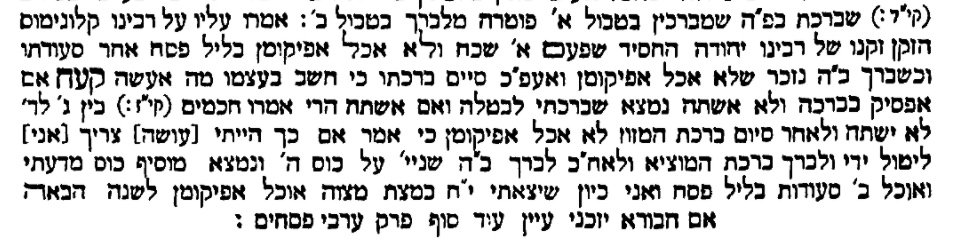
From Sefer Hamordechai. Vienna 1812. 96a.

For discussion: Have you ever forgotten a critical part of a Jewish ceremony? How did you feel?

  • There are lots of rules to remember and it is easy to mess up. So forgive yourself if you forget something - you are in good company.


2. When the Chatam Sofer was banished from his Library. by his wife. Twice

The famous Moses Sofer, known as Chatam Sofer, was asked a question by Dayan Yosef Yoel of Ternopil in the Ukraine. The Chatam Sofer gave his answer, but then added this rider:

I have no access to my study, for I have been exiled from it by the pious women who are cleaning for Peseach. Therefore, I could not go into further detail, as would have been expected…

Then it happened again. This time the question was from Rabbi Meir of the Hungarian town of Balassagyarmat (Yarmat in Yiddish). And again, Chatam Sofer gave his answer, but once more he was thwarted by the cleaning efforts going on around him.

Your dear letter recently reached me, but it is a time of lots of moving, because our women have moved things from here and there, and they don’t even allow me access to my books…

It wasn’t just the Chatam Sofer who complained. Rabbi Yaakov Schorr (1852-1923) who lived in Galicia had similar troubles around the Pesach preparations. In his responsa Divrei Yaakov, published in 1881, he seemed to be losing patience:
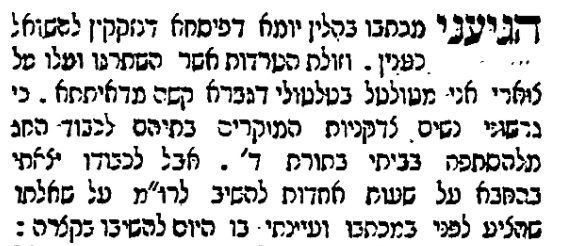
I received your query on these days leading to Pesach, which required you to ask an appropriate question. But I am overworked, as things pile up around my neck, and I am forced to move from place to place. For to be a man is harder than to be a woman (!), for I have been forced out of my home and the Torah of God, by the pious women who are preparing the house for Pesach. But I secretly stole a few hours to answer you…

The great Rabbi Yechezkel Landa of Prague, known as the Nodah Beyehuda was also a victim of Pesach cleaning. His son asked him whether fish brine was chametz. And here is how he began his answer:
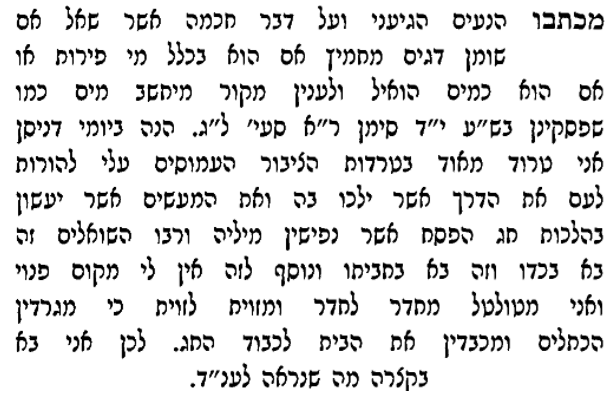
During these days of Nissan I am very busy with the problems of the community, who turn to me with the burden of showing them the proper path forward and how they should follow the many laws of Pesach. One comes with his flask and another with his barrel, and on top of this I have no free place of my own. I wander from room to room and from one corner to another while they scrape the walls and clean the house for Yom Tov. So I must be brief…

Oh, by the way, he ruled that fish brine was indeed chametz. Good to know.

For discussion: There are lots of changes we undertake on Pesach. Do you enjoy them, or find them challenging?

  • Just go with it. That’s what the Chatam Sofer did.


3. SPARE A THOUGHT FOR THOSE WHO SERVE

As we sit down for our seder, we should spare a thought for those whose own seder must be curtailed because they serve others. There are countless nurses and doctors, soldiers and police, ambulance crews and public servants, (and if you are off to a hotel, lots of wait staff, chefs and servers) who continue to work so that we may recline. Sometimes, even rabbis have to give up their seder to serve others. Shmuel Salant (1816-1909) who served as the Chief Rabbi of Jerusalem for seventy years apparently cut his own seder short, so that he could be ready to help others with their halakhic questions on the first night of Pesach.
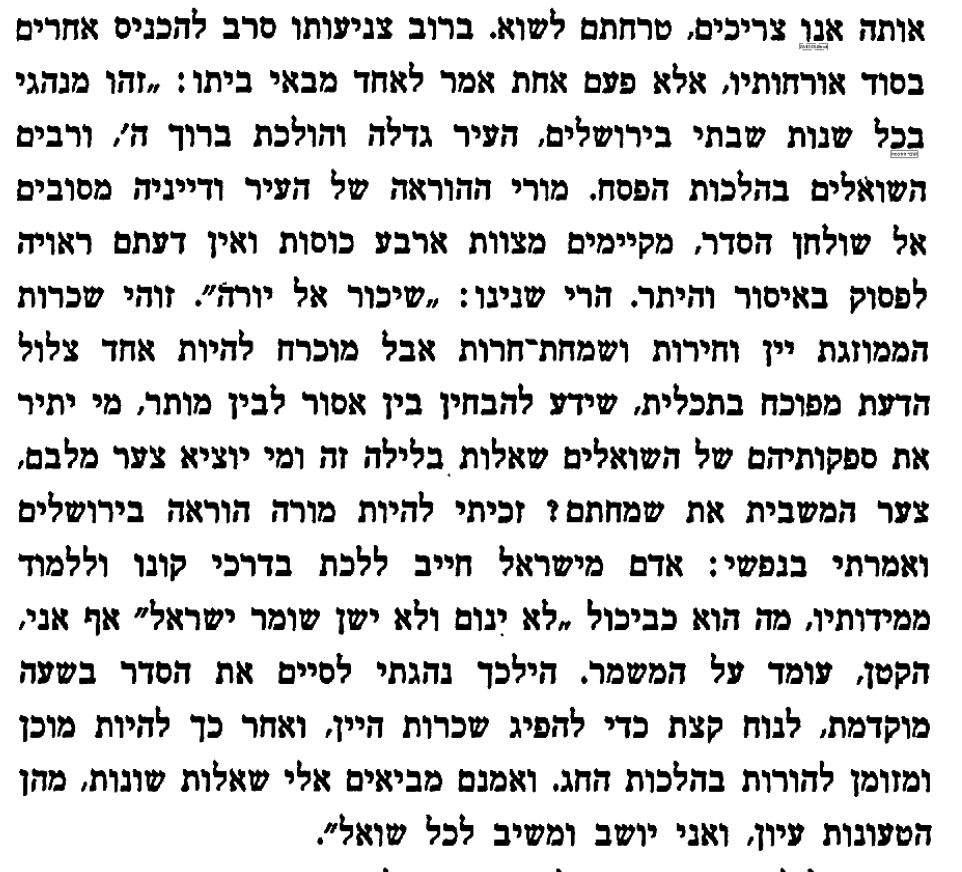
From Rimon Y. and Wasserman Y. Shmuel Bedoro. Tel Aviv. Maslul, 1961. 107.

Rabbi Salant was concerned that if he was to drink the four cups of wine, he would not be able to answer any halakhic question that might occur on the Seder night, for a person who has drank wine is forbidden to rule until he sobers up. Consequently, he would have the custom to finish his seder quickly, take a quick nap to sleep off the alcohol, and then wake up ready to answer any questions that might come his way. It’s a charming insight into the life of a public servant, and should remind us to thank all those who toil so that we may enjoy Pesach.

For discussion: There are lots of people who work hard to get us to this night. Spend a moment going around the table to thank them.

  • And if you are one of those public servants, thank you.


4. MAY a Husband sell Chametz to his non-Jewish wife?

Rabbi Yaakov Jacob ben Joseph Reischer (c.1661–1733) served as a dayyan in Prague, and later served in Worms and Metz. Among his three volumes of responsa is this gem:

In the state where I live there is a Jew who married a Gentile. She follows her own customs in every aspect, while he follows the customs of Israel. What happens to the chametz that is found in the house after Pesach? Is it permissible to be used, since it was the chametz that belonged to a Gentile, or is it forbidden, since a wife’s property also belongs to her husband?
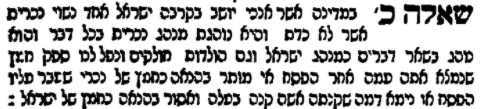
Rabbi Zeev Zuckerman, (from whose work אוצר פלאות התורה, שמות these examples are taken) drew from this responsum an example of the sensitivity with which we should reply to any question, and not disparage the one who asked. I suppose it would have been a better question to ask if a Jewish husband may sell his chametz to his non-Jewish wife, but that wasn’t exactly the question asked of Rabbi Reischer, who ruled that in this case, the chametz was indeed permitted after Pesach.

For discussion: Is there something special about Pesach that resonates with us, even if we are less careful to follow other parts of Jewish practice?

  • Always be kind to those with a question about Jewish law.

Happy Passover from Talmudology!

Download this post and have it ready to read at your Seder:


Want even more? Then enjoy the Talmudology Passover Reader, first published last year.

Print Friendly and PDF

New Essay: When Shemitta and a Pandemic Coincide

This year we are living through both a shemitta year and a pandemic in Israel, and exactly 120 years ago these same conditions were also present as the Jewish inhabitants of Ottoman Palestine faced the threats of a shemitta year and a terrible wave of pandemic cholera.

To read a new essay published at TraditionOnline about how the Jews of the First Aliyah faced that terrible year, and how it differs from the present shmitta-pandemic conjunction, click here.

Print Friendly and PDF

Yevamot 22a ~ The Mamzer

On today’s page of Talmud there is a discussion about whether a mamzer may perform the mitzvah of yibbum:

יבמות כב, א

מַתְנִי׳ מִי שֶׁיֵּשׁ לוֹ אָח מִכל מָקוֹם זוֹקֵק אֶת אֵשֶׁת אָחִיו לְיִבּוּם וְאָחִיו הוּא לְכל דָּבָר

גְּמָ׳ מִכל מָקוֹם לְאֵתוֹיֵי מַאי אָמַר רַב יְהוּדָה לְאֵתוֹיֵי מַמְזֵר פְּשִׁיטָא אָחִיו הוּא מַהוּ דְּתֵימָא לֵילַף אַחְוָה אַחְוָה מִבְּנֵי יַעֲקֹבמָה לְהַלָּן כְּשֵׁרִין וְלֹא פְּסוּלִין אַף כָּאן כְּשֵׁרִין וְלֹא פְּסוּלִין קָא מַשְׁמַע לַן

MISHNA: In the case of anyone who has a brother of any kind, that brother creates a levirate bond causing his yevama to be required to perform levirate marriage if the first brother dies childless….

GEMARA: The Gemara asks: With regard to the statement that a brother of any kind causes his yevama to be required to perform levirate marriage, what additional case does this come to add? Rav Yehuda said: This adds the case of a mamzer, who, notwithstanding his status, is considered a brother…

Who is a MaMzer?

A mamzer is a child born of a certain union that is forbidden in the Torah. Examples would be a child born from an adulterous relationship (where the woman is married to another person) or an incestuous one. A mamzer is not a child born out of wedlock, and who was once known as a bastard. The Torah prohibits a mamzer from entering into marriage with an ordinary Jew:

דברים כג, ג

לֹא־יָבֹ֥א מַמְזֵ֖ר בִּקְהַ֣ל יְהֹוָ֑ה גַּ֚ם דּ֣וֹר עֲשִׂירִ֔י לֹא־יָ֥בֹא ל֖וֹ בִּקְהַ֥ל יְהֹוָֽה׃

The mamzer shall be admitted into the congregation of God; no descendant of such, even in the tenth generation, shall be admitted into the congregation of God

According to Rabbi Abahu in the Talmud Yerushalmi (Kiddushin 3:12) the word mamzer comes from the Hebrew מום זר - mum zar - “a strange defect.” It is on the basis of this etymology that many have tried to find defects in the anatomy or the personality of a mamzer. Today on Talmudology we will examine rabbinic attitudes towards the mamzer.

The Mamzer is infertile, and more likely to die early

According to the famous medieval scholar Rabbi Jacob ben Asher (c. 1269 - c. 1343), who was also known as the Ba’al Haturim, a mamzer is infertile:

בעל הטורים דברים כג, ג

לא יבא ממזר בקהל ה' סמך ממזר לפצוע דכה שממזר אינו מוליד כפצוע דכא

The verse about the mamzer is written close to the verse about the person with crushed genitalia to teach that just like that person, a mamzer cannot reproduce.

In a variation on this theme, the medieval Sefer Hasidim wrote that a mamzer can indeed reproduce, but his or her children will be infertile:

מכאן יש לומר למוליד ממזר לא מבעיא דלא קיים מצות פריה ורביה אלא שמעכב את המשיח דקאמר ממזר לא חי אותו ממזר שמוליד לא יוליד בנים דלא חיי כטרפה

Both of these assertions are at odds with the Torah itself, in which the verse stated that no descendants of the mamzer were to be admitted into the congregation, which surely implies that a mamzer can indeed reproduce. And while I know of no clinical study looking at the fertility of the children of prohibited unions, there is, prima facie, no reason whatsoever to believe that children born, say, of an adulterous relationship, are infertile.

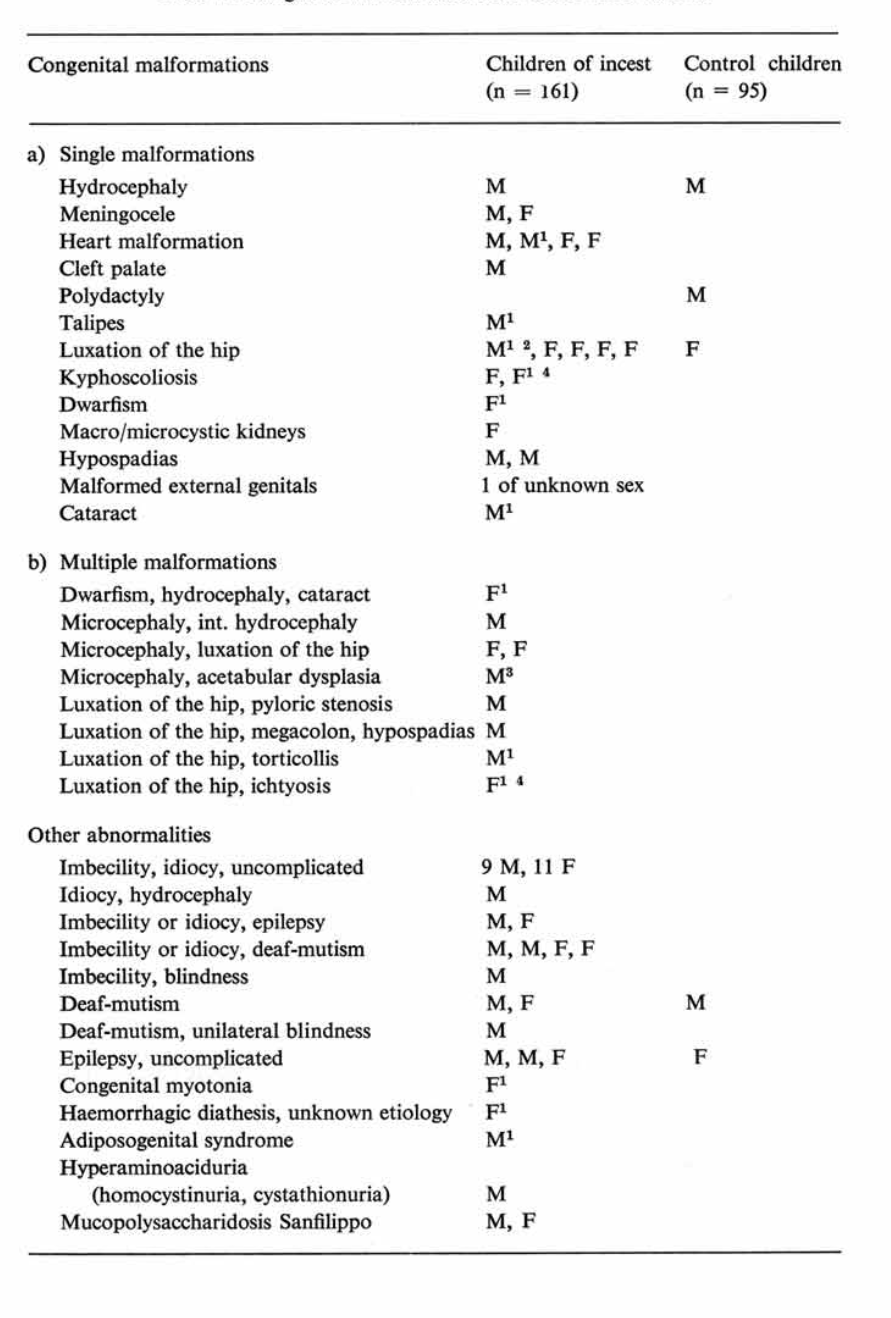
Of course, this is not true of children born of incestuous unions. In these cases, there is indeed a higher likelihood of all manner of genetic problems, of which infertility may be one expression. A paper published in 1979 titled A Study of Chidren of Incestuous Matings noted that in a group of 161 children from incestuous matings, prenatal, neonatal and infant mortality was higher than among half-siblings who were offspring of unrelated parents, and this group also had a higher rate of congenital malformations. Thus, the observation of Rav Huna in the Talmud Yerushalmi (קידושין ד, א) that “a mamzer does not live for more than thirty days” (אֵין מַמְזֵר חַיי יוֹתֵר מִשְּׁלֹשִׁים יוֹם) might actually have some factual basis, at least for a subset of mamzerim.

Congenital malformations and other abnormalities. From E. Seemanova. A study of children of incestuous matings. Human Heredity 1971: 21: 108-128.

On the Characteristics of a Mamzer

Some rabbis believed that the mamzer was endowed with certain talents, while others wrote that he (or she) was physically different to other people. According Abba Shaul in the Talmud Yerushalmi (Kiddushin 4:11), “most mamzerim are intelligent - רוֹב מַמְזֵירִין פִּקְחִין. (Abba Shaul may also have been behind the famous aphorism that “the best physicians should go to hell”, but we have dealt with that elsewhere.) Still, Abba Shaul’s sweeping statement was not seen as a compliment. Here is the standard commentary on the Yerushalmi, called Korban Ha’edah. It was written by the German rabbi David ben Naphtali Frankel (~1704-1762):

רוב ממזרים פקחי. שדומין לאביהן שהם בעלי ערמה לפתות הנשים ולהסתיר מעשיהם מבני האדם ונ"מ להזהר מהם

Most mamzerim are intelligent: Because they are like their fathers, who are crafty in their ability to seduce women and hide their actions from others. It is important to be aware of this characteristic, so that we can beware of them.

The other standard commentary on the Yerushalmi, Moshe Margolies’ Pnei Moshe, makes exactly the same point:

רוב ממזרים פקחין. שהן דומין לאביהן בעלי ערמה ומתנכלים בתחבולות לפתות הנשים ולהסתיר מעשיהם מבני אדם

So a better translation of the original Yerushalmi, according to these two commentaries, would be: “Most mamzerim are crafty, and therefore they should not be trusted.” It was this belief that led the authors of the early medieval Hebrew work Toldot Yeshu - “A History of Jesus,” to claim that Jesus was himself a mamzer, because he had acted in a brazen manner in front of the Sanhedrin.

A similar observation is made in the minor tractate Kallah:

עז פנים רבי אליעזר אומר ממזר רבי יהושע אומר בן הנדה רבי עקיבא אומר ממזר ובן הנדה

The bold-faced, Rabbi Eliezer said, is the mamzer; the son of a niddah, said Rabbi Joshua; Rabbi Akivah said: Both a mamzer and the son of a niddah.

Given the long tradition of ascribing personality characteristics to the mamzer, it is not surprising that some went one step further and claimed that the mamzer has certain specific physical characteristics. Rabbi Elijah ben Solomon Abraham Hacohen, of Smyrna (~1650-1729) was a mystic who produced over thirty books. Like many of his time, Rabbi Elijah was a strong believer in palm reading, the belief that lines on the palm reflect the personality and future fate of a person. He also believed in a version of phrenology, in which bumps on the skull indicate a person’s intelligence and other qualities. In his work Midrash Talpiot, which was a collection of rabbinic sayings mixed with his own observations, Rabbi Elijah wrote that “the shape of the ear will reflect if there is any degree of mamzerut” - “באזן ניכר מי שיש בו צד ממזרות.” Alas, the rabbi did not give any more details, fearing that they might be misused.

Elijah Hacohen. Midrash Talpiot, Lemberg 1875, 30.

The mamzer cannot enter Jerusalem

Avot de’Rabbi Natan is companion text to the Mishnaic Pirkei Avot, and is usually printed along with the minor tractates of the Talmud. It was composed sometime in the era of the Gaonim, between 650-900 CE. In its eighth chapter we read the following:

אבות דרנבי נתן יב, ח

וכן מי שעובר עבירה והוליד ממזר אומרים לו ריקה חבלת בעצמך חבלת בו [שאותו ממזר היה רוצה ללמוד תורה עם אותן התלמידים] שהיו יושבין ושונין בירושלים והיה הממזר הולך עמהן עד שהגיע לאשדוד עומד שם ואומר אוי לי אילו לא הייתי ממזר כבר הייתי יושב ושונה בין התלמידים שלמדתי עד עכשיו ולפי שאני ממזר איני יושב ושונה בין התלמידים לפי שאין ממזר נכנס לירושלים כל עיקר שנאמר (זכריה ט) וישב ממזר באשדוד (והכרתי גאון פלשתים

So, too, with someone whose sexual transgression produces a mamzer. They say to him: Empty one! You have ruined yourself and you have ruined him as well! [For this mamzer would have wanted to study Torah with the rest of the students] who sit and study in Jerusalem. But this mamzer would go with them only up to Ashdod, and then would stop there and say: Woe is me! If I were not a mamzer, I would have gone to sit and study among the students whom I have been studying with until now. But because I am a mamzer, I cannot sit and study among these students. For a mamzer cannot enter Jerusalem at all, as it says (Zechariah 9:6), “The mamzer will stay in Ashdod, (and I will cut off the pride of the Philistines.”

Mi Sheberach for a Mamzer

In one of his volumes of responsa, Rabbi Chezkiah Fivel Plaut (1818-1894) was asked whether it was permissible to call a mamzer up to the Torah. Rabbi Plaut, who was a student of the Chatam Sofer, concluded that it is indeed permitted, but was not certain that it was permitted to say the general prayer for the well-being of the person called to the Torah, known as the Mi Sheberach (מי שברך). “I am uncertain whether to say the Mi Shebarch, because the focus of this blessing is on his children, and God forbid that there would be more mamzerim among the Jewish people.”

Chezkiah Feival Plaut. Likutei Chaver ben Chaim. Munkach 1883. 104b.

Tattooing the Forehead of a mamzer with a warning

Rabbi Yishmael Hacohen (1723-1811), came from a distinguished rabbinic family and took over the mantle of leadership in the Italian city of Modena from his older brother who died in 1781. In 1881 he was asked by Rabbi Avraham Yona of Venice whether it was permitted to tattoo the forehead of a mamzer with the word “mamzer,” which would serve as a warning sign not to allow this person to marry into the Jewish community. The halakhic concerns revolve around the question of tattooing, and not, as we might think today, as to whether this was a reasonable thing to do.

Rabbi Yona was an enthusiastic supporter of the idea, but Rabbi Yishmael was, at least initially, not sure. But at the end of his lengthy responsa he concluded that it was indeed permitted, since although tattooing was forbidden, if it was performed by a Gentile it was allowed in this case, for it prevented “a greater transgression.” This opinion is cited in דרכי תשובה יורה דעה קפ, סק’א.


It is permitted to tattoo the forehead of a mamzer. From Yishmael ben Avraham Hacohen. Zera Emet. Vol 3, 140b.


Modern Efforts to Ignore Mamzerut

There are certain caterogical rulings in the Torah that the rabbis did their best to ignore. The Torah demand “an eye for an eye, a tooth for a tooth” (Exodus 21:23–27), but the rabbis ignored this and interpreted the verse as requiring monetary compensation (Bava Kamma 83b–84a). The Torah demanded that loans be forgiven every seven years during the shmitta year (Deuteronomy 15:1–6), but the rabbis found this law to be unworkable. So Hillel Hazaken created the prozbul which protected the investment of the lenders. Despite the severity of the prohibition of mamzer, and not withstanding some of the later rabbinic statements that we have seen, talmudic and contemporary rabbis were often very sympathetic to the plight of the mamzer, and went to extreme legal lengths to remove the label. So, for example, later in this tractate (Yevamot 80b) Rava ruled that a child born twelve months after a married woman’s husband left her and travelled abroad was not a mamzer. Perhaps, he argued, the pregnancy had just been unusually long.

יבמות פ, ב

אֶלָּא הָא דַּעֲבַד רָבָא תּוֹסְפָאָה עוֹבָדָא בְּאִשָּׁה שֶׁהָלַךְ בַּעְלָהּ לִמְדִינַת הַיָּם וְאִישְׁתַּהִי עַד תְּרֵיסַר יַרְחֵי שַׁתָּא וְאַכְשְׁרֵיהּ כְּמַאן כְּרַבִּי דְּאָמַר מִשְׁתַּהֵא

With regard to the action taken by Rava Tosfa’a concerning a woman whose husband went overseas and her baby was delayed in her womb for the twelve months of the year following her husband’s departure, and Rava Tosfa’a rendered the child fit, arguing that the husband is presumed to be the father and the child is not a mamzer…

Perhaps the best example recent example of this effort comes from the late Rabbi Ovadia Yosef (1920-2013) who was the Sephardi Chief Rabbi of Israel from 1973-1983. He was asked about the case of a young woman who believed that she was a mamzeret. Her mother had been married by a haredi rabbi to a man who subsequently left her, converted to Christianity, married another woman, and refused to give his first a Jewish divorce. This wife later obtained a civil (but not a Jewish) divorce, remarried civilly and had the daughter. This daughter was indisputably the result the union of a woman who is married (under Jewish law) and a man who was not her husband, that making her children mamzerim.

But Rabbi Yosef found a way to demonstrate that the daughter was not technically a mamzeret, although he never explicitly stated any discomfort with the notion of mamzer. In his work Yabiah Omer (volume 7, Even Ha’ezer 6) he refused to allow any testimony from the mother, since she was an interested party. He also refused to allow any testimony from the haredi rabbi who performed the marriage, since he was but a single witness, and two witnesses are required to establish proof in Jewish law. He continued along this vein until he concluded that there was enough uncertainty in the case to remove the label of mamzerut from the daughter, and allow her to marry into the Jewish people.

שו׳ת יביע אומר, חלק ז, אה׳ע סימן ו

The rabbinic attitude towards mamzerut demonstrates that there really has never been a single rabbinic attitude towards the problem. Some made the life of the mamzer extraordinarily difficult, and even suggested that the mamzer had physical or character flaws. One even suggested that the mamzer be tattooed as a warning to others. But others went to great efforts to remove the need to categorize any person as a mamzer. Let’s end with a reminder that in classic Jewish teaching, the mamzer can rise to great religious heights, regardless of the actions of his or her parents.

משנה הוריות ג, ח

מַמְזֵר תַּלְמִיד חָכָם קוֹדֵם לְכֹהֵן גָּדוֹל עַם הָאָרֶץ

But if there were a mamzer who is a Torah scholar and a High Priest who is an ignoramus, a mamzer who is a Torah scholar is rescued before a High Priest who is an ignoramus, as Torah wisdom surpasses all else.


Print Friendly and PDF

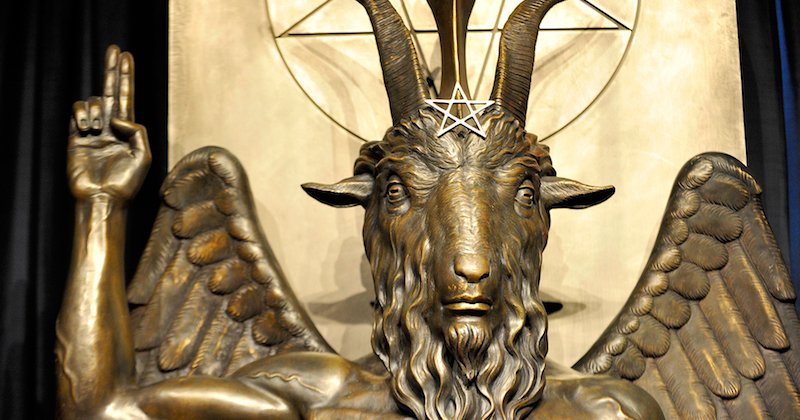
Yevamot 16a ~ Copernicus is the Firstborn of Satan

On today’s page of Talmud, Rav Dosa calls his brother Yonatan a little devil. Literally:

יבמות טז, א

אָמַר לָהֶם: אָח קָטָן יֵשׁ לִי, בְּכוֹר שָׂטָן הוּא, וְיוֹנָתָן שְׁמוֹ, וְהוּא מִתַּלְמִידֵי שַׁמַּאי

I have a younger brother who is the firstborn of the Satan, and his name is Yonatan, and he is among the disciples of Shammai…

Rashi explains that he meant this in a good way:

בכור שטן הוא: חריף ועומד על שמועה ועושה מעשה ואינו שב משמועתו לעשות כרבים

The first born of Satan: He is very sharp. He stands by what he teaches, and doesn't give in to the majority…

which is why the Schottenstien Talmud translates the phrase as “he is a first-class adversary.”

Following Rashi’s lead, many other commentators explain that the phrase “firstborn of the Satanis really a compliment. It means clever, or crafty, or, as we might say today, “devilishly clever.” But that is not how it was used by Tuviah Cohen, the seventeenth century physician who wrote an important encyclopedia called Ma’aseh Tuviah.

Tuviah Cohen

We learned about Tuviah in a previous post, which you can read here. To recap, Tuviah studied in a yeshivah in Cracow, and at the age of twenty-six, entered the University of Frankfurt, where he began to study medicine. Despite being taken under the wing of Fredrick William, the elector of Brandenburg, and receiving a stipend from him, anti-Jewish sentiment prevented Tuviah from graduating. As a result, he left for the University of Padua, where he graduated with a degree in medicine in 1683 and soon found employment as a physician in Turkey. He published his only work, Ma’aseh Tuviah (The Work of Tuviah), in Venice in 1708 and moved in 1715 to Jerusalem, where he died in 1729.

Portrait of Tuviah Cohen, from his work  Ma’aseh Tuviah, Venice, 1708.

Tuviah Cohen has long been a favorite of historians of science and Judaism. Perhaps this is because he was a reformer of sorts, ready to sweep away old superstitions and replace them with scientific knowledge. Perhaps it is because his book, Ma’aseh Tuviah, was “ ... the best-illustrated Hebrew medical work of the pre-modern era,” full of wonderful drawings about astronomy and anatomy. Perhaps it is because his book is so clearly printed and a pleasure to read in the original. Or perhaps it is because Cohen was so adamantly opposed to Copernicus that he called him the “Firstborn of Satan”—which made his the first Hebrew work to attack Copernicus and his heliocentric system.

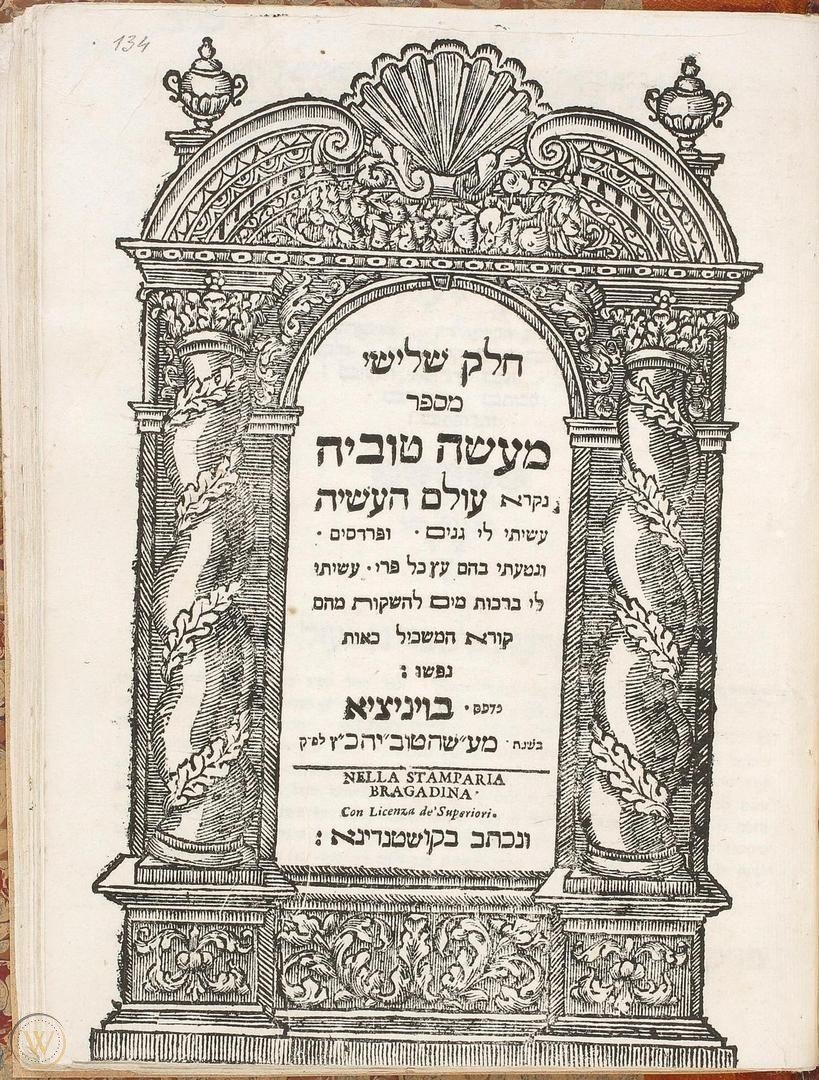
Front page of the first edition of Ma’aseh Tuviah, Venice 1707.

Tuviah’s Famous Encyclopedia

Tuviah painfully remembered one particular area in which he lacked knowledge: the discipline of astronomy. It was astronomy that the Talmud considered to be the example par excellence of Jewish wisdom that would be acknowledged by Gentiles. Examining the verse “For this is your wisdom and understanding among the nations” [Deut. 4:6], the Talmud had concluded that it referred to “the calculation of the seasons and the constellations,” that is, the ability to create an accurate calendar and to forecast the positions of the stars and planets. Tuviah was especially troubled by the taunts that Jews had no proper astronomical understanding, given the pride of place of astronomy in the Talmud. He recalled his days in the university:

We would undertake long debates with us every day about questions of belief, and would many times embarrass us asking “where is your wisdom and understanding—it has been taken from you and given to us!” Although we were knowledgeable in Bible, Talmud and Midrashim, we were like paupers when we debated them. This is why I became a zealot for the Lord and swore that before I died I would neither sleep nor rest until I had written a work that included knowledge and skills...for although we walk in this dark and bitter exile God has been our light and there are still wise and learned men among us. . . .

He therefore addressed this topic in detail in his encyclopedic Ma’aseh Tuviah.

The first depiction of the heliocentric system in Hebrew literature. From Ma’aseh Tuviah, Venice, 1708, 50b.

Copernicus is “the Firstborn of Satan”

Which brings us, finally, to the phrase on today’s page of Talmud. Tuviah’s section on astronomy included the first depiction in Hebrew literature of the new(wish) heliocentric model of the universe, first published by Nicolas Copernicus in 1542. But having explained the new model (which by then was nearly two centuries old) he rejected it in favor of the traditional earth centered or geocentric model. And he did so with an unforgettable chapter title:

Chapter Four.
Bringing all the claims and proofs used by Copernicus and his supporters

showing that the Sun is at rest and the Earth is mobile;

and know how to refute him, for he is the Firstborn of Satan.

Is it possible that since the phrase could be taken as a backhanded compliment, Tuviah also meant it that way? One historian, Noah Rozenbloom, believes that this may indeed be the case. He suggested that Cohen may actually have been a secret admirer of Copernicus, and that the name “Firstborn son of Satan” should not be understood as an affront. 

Although Rozenbloom’s suggestion is an intriguing possibility, it is highly unlikely that Tuviah Cohen was a closet Copernican. The entire structure of the chapter (as well as its very title Olam HagalgalimThe World of the Spheres) demonstrated Cohen’s allegiance to the old Ptolemaic system in which the earth was stationary, and he laid out several objections to the Copernican model. Tuviah was not a closet Copernican. But he was certainly persistent in his opposing the new astronomy. He was gifted, and refused to be swayed by others. Perhaps, then, it is Tuviah who should be given the accolade “the firstborn of Satan.” In a good way, of course.

[Want to read more about Ma’aseh Tuviah? Checkout Chapter Five of this book.]

Print Friendly and PDF