Gittin 89a ~ Breastfeeding in Public

גיטין פט,א 

אכלה בשוק, גירגרה בשוק, הניקה בשוק – בכולן רבי מאיר אומר תצא

If a married woman ate in the street, or walked with her head held high in the street, or nursed in the street - in all these cases Rabbi Meir said that she must leave her husband.

In the penultimate page of Gittin, the Talmud discusses immodest behavior. Rabbi Meir declared that three displays are so immodest that  any wife who expressed them should also be suspected of adultery. One of these behaviors is "nursing in the street." As a consequence, if a wife were to breastfeed in public, she cannot stay with her husband because of the possibility (- or is it the probability? -) that she had also committed adultery. 

Let's clear one thing up right away. Maimonides, in his Mishneh Torah rejects the position of Rabbi Meir, as does the definitive Shulchan Aruch  (אבן העזר ו, טז) :

רמב"ם הלכות איסורי ביאה פרק יז הלכה כא 

יצא קול על הבתולה שהיא בעולה אין חוששין לה ותנשא לכהן גדול, יצא עליה קול שהיא שפחה אין חוששין לה ותנשא אפילו לכהן, יצא לה שם מזנה בעיר אין חוששין לה, ואפילו הוציאה בעלה משום שעברה על דת יהודית או בעדי דבר מכוער ומת קודם שיתן לה גט הרי זו מותרת לכהן שאין אוסרין אשה מאלו אלא בעדות ברורה או בהודאת פיה

...if a husband divorced his wife because she transgressed Jewish practice or because she did a repulsive thing - and he died before he was able to give her the Get (Bill of Divorce), she is permitted to marry a Cohen [who is normally forbidden to marry a divorcee]. For we do not forbid a woman to her husband for any of these reasons unless there is clear evidence, or she admits to it herself (Mishneh Torah Hil. Issurei Biah 17:21).

As we have noted many times, societal definitions of immodest behavior change over time and between locations, and are continuing to evolve. Perhaps no better example of this evolution are attitudes towards breastfeeding in a public space. Rabbi Meir's attitude, while it may appear extreme, was in fact one that prevailed until recently in many cultures - especially our own. (That is why in 2014 Pope Francis made headlines when he encouraged mothers in the Sistine Chapel to nurse their children.)

Public Breastfeeding laws

1.  THE US

Back in 2013, a review of  breastfeeding laws in the US, researchers at Harvard noted that the majority of states have legislation permitting women to breastfeed in any location and exempting breastfeeding from indecency laws.  However, a decade ago fewer than half the states required employers to provide break time accommodations, prohibit employment discrimination based on breastfeeding, or offer breastfeeding women exemption from jury duty.

The first breastfeeding law was passed in New York in 1984 with legislation exempting breastfeeding from public indecency offences. In 1993, Florida and North Carolina enacted laws to permit women to breastfeed in any public or private location. In 1994, Iowa passed the first legislation to excuse or postpone jury duty for breastfeeding women... Minnesota passed a law that required employers to provide break time and a private space for mothers to express milk.
— Nguyen, TT. Hawkins, SS. Current state of US breastfeeding laws. Maternal & Child Nutrition 2013. 9: 350-358.

Happily, things have gotten better. For example, in July 2019 Congress passed the Fairness for Breastfeeding Mothers Act. And according to the National Conference of State Legislators, “all fifty states, the District of Columbia, Puerto Rico and the Virgin Islands have laws that specifically allow women to breastfeed in any public or private location.” To wit

  • Thirty-one states, the District of Columbia, Puerto Rico and the Virgin Islands exempt breastfeeding from public indecency laws. (Alaska, Arizona, Arkansas, Florida, Idaho, Illinois, Kentucky, Louisiana, Massachusetts, Michigan, Minnesota, Mississippi, Missouri, Montana, Nevada, New Hampshire, New York, North Carolina, North Dakota, Oklahoma, Pennsylvania, Rhode Island, South Carolina, South Dakota, Tennessee, Utah, Virginia, Washington, West Virginia, Wisconsin and Wyoming.)

  • Thirty states, the District of Columbia and Puerto Rico have laws related to breastfeeding in the workplace. (Arkansas, California, Colorado, Connecticut, Georgia, Hawaii, Illinois, Indiana, Kentucky, Louisiana, Maine, Maryland, Massachusetts, Minnesota, Montana, Nebraska, New Jersey, New Mexico, New York, North Dakota, Oklahoma, Oregon, Rhode Island, South Carolina, Tennessee, Texas, Utah, Vermont, Virginia and Washington.)

  • Twenty-two states and Puerto Rico exempt breastfeeding mothers from jury duty or allow jury service to be postponed. (California, Colorado, Connecticut, Delaware, Idaho, Illinois, Iowa, Kansas, Kentucky, Michigan, Mississippi, Missouri, Montana, Nebraska, New York, Oklahoma, Oregon, Pennsylvania, South Dakota, Utah and Virginia.)

  • Four states and Puerto Rico have implemented or encouraged the development of a breastfeeding awareness education campaign. (California, Illinois, Minnesota and Missouri)

These laws are important because state laws that support breast feeding are associated with increased breastfeeding rates - and the health benefits that follow.

2.  THE UK

In the United Kingdom, breastfeeding in public was addressed in the Equality Act of 2010. Under this legislation, treating a woman unfavorably because she is breastfeeding is sex discrimination and against the law.  The Act protects nursing mothers in public places such as parks, sports and leisure facilities, and when using public transport.  They are also protected in stores, restaurants, hotels movie theatres (known as "cinemas" there), and gas stations. In Scotland it is a criminal offense to try to prevent a woman from feeding a child under two in any place in which the public has access and in which the child is entitled to be. Anyone who tries to do so can be prosecuted under the Equality Act.

3.  ISRAEL

A 2007 survey of pediatricians, family physicians, and gynecologists in Israel concluded that physicians had a positive disposition towards breastfeeding but that their knowledge about it was somewhat low. The authors noted that "it is highly important to increase physicians’ awareness of breastfeeding women’s needs," though they did not address the issue of nursing in public. A 2004 report from the Kenesset (עידוד הנקה בישראל) noted that only 32% of Jewish mothers were breastfeeding their infants a six months, (compared with 50% of Arab mothers,) but the report did not address nursing in public.

In an amendment to the 1954 חוק עבודת נשים, תשי"ד law to protect the rights of women, (סעיף7 (ג) (3)) a mother who is employed full-time may take up to one hour each day to breastfeed for the four months following her return from maternity leave. The Ministry of Health has published guidelines around the rights to breastfeed while at work.

Breastfeeding in Public - One Rabbi's Responsum

Rabbi Brad Artson of the Zeigler School of Rabbinic Studies in Los Angeles has written a thoughtful תשובה (responsum) on the question of breast feeding in public. "When it was possible to avoid baring the breast," he wrote, reviewing several talmudic passages, "it seems to be the preferred approach of the rabbis. Forced stripping [which was part of the Sotah ritual] was a sign of humiliation. And, finally, the rabbis dispute whether or not such an act as public breast-feeding is a sufficient cause for divorce (ultimately deciding that it is not)." He concluded his twelve page responsum  (which was approved 14 to 3) with these words: 

Reading the sources in the light of these considerations, I understand halakhah to permit public breast-feeding, including in a Beit Midrash or synagogue sanctuary during a worship service, so long as it is done in a modest, subtle, and dignified fashion. (This requirement would be met, for example, by using a cloth or towel to cover breast and baby, by the maternity shirts specially made for this purpose, or by nursing in the rear of the room.) It is also preferable that Jewish institutions provide places where mothers who prefer to nurse in private may do so.

Many synagogue arks are emblazoned with the words דע לפני מי אתה עומד , know before Whom you stand. In Torah study and in prayer, we are in the presence of the One whose salvation is intimated through human nursing:


לְמַעַן תִּינְקוּ וּשְֹבַעְתֶּם מִשֹּׁד תַּנְחֻמֶיהָ לְמַעַן תָּמֹצּוּ וְהִתְעַנַּגְתֶּם מִזִּיז כְּבוֹדָהּת

"That you may suck, and be satisfied with the breasts of her consolations; that you may drink deeply, and be delighted with the abundance of her glory.”


Jewish institutions, in particular, have an obligation to welcome, facilitate, and support nursing mothers and their babies.

These are words that Jews of any and all denominations should get behind.

An amendment no. 6 and printed in the Congressional Record to establish that no funds may be used to enforce any prohibition on women breastfeeding their children in Federal buildings or on Federal property.
— Bill Summary & Status 106th Congress (1999 - 2000) House Ammendment 295.
Former airwoman Tara Ruby photographed active duty soldiers at Fort Bliss in El Paso, Texas, September 2015.

Former airwoman Tara Ruby photographed active duty soldiers at Fort Bliss in El Paso, Texas, September 2015.

NEXT TIME ON TALMUDOLOGY: THE CHANGING INSTITUTION OF MARRIAGE

Print Friendly and PDF

Gittin 86b ~ How do Pigeons Drink?

In a brief digression from the rules of gittin, the Talmud digresses into ornithology. If a bird sips water in which ashes of the red heifer have been placed (known as מי חטאת) the water can no longer be used. This applies to all birds except for the pigeon, because it sips the water from the container and presumably none falls back into the water from its mouth. The source for this is a Mishnah from masechet (tractate) Parah (9:3).

כל הָעוֹפוֹת פּוֹסְלִין בְּמֵי חַטָּאת, חוּץ מִן הַיּוֹנָה – מִפְּנֵי שֶׁמּוֹצֶצֶת.

All birds disqualify water of purification by drinking from it, (because some of the water spills from the bird’s beak back into the basin after being disqualified by having been in the bird’s mouth.) This is the halakha with regard to all birds except for the pigeon, because it sucks the water, (which prevents it from spilling back).

Screen Shot 2019-01-27 at 10.22.42 AM.png

HOW PIGEONS DRINK

We are most fortunate that back in 1982 Professor G.A. Zweers from the zoological laboratory at the University of Leiden published what is surely the definitive paper on the topic, Drinking of the Pigeon (Columba Livia L.). Zweers opens his 43 page gem by noting that birds drink in many different ways. “Most of them drink like waterfowl; they walk to or through the water, move their beak open and close their beak several times, take some water, tip head and let the water run down by gravity.” However the way in which pigeons drink had for many years been a source of academic debate, and it was time to clear this up once and for all. So Zweers decided to “formulate a mechanical model for the drinking of pigeons….” and film them merrily drinking using high speed cameras. Now Talmudology readers are the lucky beneficiaries of these herculean efforts.

 
Screen Shot 2019-01-27 at 9.42.29 AM.png
 

Using a frame by frame analysis of high speed films and X-ray motion pictures, Zweers figured out that thirsty pigeons use “a double-suction or vacuum-pump model” to drink. Here is how it works:

Consummatory drinking is a series of similar movement cycles, each transporting one dose of water into the oesophagus. The swallowing movement cycle shows five phases:

1, capillary action of the beak tips;

2, lingual suction

3, pharyngeal preparation

4, pharyngeal suction;

and 5, oesophageal collection.

A double build up of an area of low air pressure occurs. As a result of the retraction of the tongue in the mouth (acting as a piston in a cylinder) low air pressure develops in the buccal cavity and water is sucked into the mouth. Secondly, a lower air pressure area develops in the pharynx as a result of a depression of its floor, so that the water in the mouth is given a momentum caudad, by which it is forced over the larynx into the oesophagus.

It’s not only pigeons who suck…

The Mishnah rules that other than the pigeon any bird that drinks the waters of purification renders it unusable, because it is only the pigeon that sucks in water through its beak. All other birds drink using different mechanisms, during which time drops of water may fall back into the water, and render it unfit. But this isn’t quite the case. Some parrots like the parakeet (known in the United Kingdom and many parts of the Commonwealth as budgerigar) and the fig parrots also use a sucking mechanism to swallow, though they are native to Oceania and the islands of south-east Asia, so the rabbis of the Talmud could not have known this. The African fork-tailed drongo (Dicrurus adsimilis) sucks in water like pigeons, but then tip their heads back to swallow it. And finally, the common sandgrouse drinks using a very similar mechanism to pigeons.

To conclude: the pigeon is not the only bird that uses suction to drink, but it is certainly one of the few species that do so. We had the benefit of high-speed photography and a determined German professor, but the rabbis of the Mishnah had only their daily observations to guide them, and most of the time that was good enough.

Pigeons and doves are among the few birds that can suck water while their head is down. They don’t need to look skyward to swallow.
— Bird Watchers Digest
Print Friendly and PDF

Gittin 71~ The Relationship between Hearing and Intelligence

Not too far from where I live is Gallaudet University. It was founded in 1864 with a Charter signed by Abraham Lincoln. (And here’s a fun fact: to this day the diplomas of all Gallaudet graduates are signed by the presiding U.S. president.) Among its alumni are the actress Shoshanah Stern, the poet Dorothy Miles and Wilma Newhoudt-Druchen, a member of South Africa’s Parliament. Oh, I forgot to tell you. Gallaudet is a university for the deaf and hard-of-hearing. Which brings us to today’s daf.

In a discussion of whether and how a deaf man may divorce his wife, we read the following:

גיטין עא, א

אָמַר רַב כָּהֲנָא אָמַר רַב: חֵרֵשׁ שֶׁיָּכוֹל לְדַבֵּר מִתּוֹךְ הַכְּתָב, כּוֹתְבִין וְנוֹתְנִין גֵּט לְאִשְׁתּוֹ. אָמַר רַב יוֹסֵף: מַאי קָא מַשְׁמַע לַן? תְּנֵינָא: נִשְׁתַּתֵּק, וְאָמְרוּ לוֹ: ״נִכְתּוֹב גֵּט לְאִשְׁתְּךָ?״ וְהִרְכִּין בְּרֹאשׁוֹ, בּוֹדְקִין אוֹתוֹ שְׁלֹשָׁה פְּעָמִים, אִם אָמַר עַל לָאו – ״לָאו״, וְעַל הֵן – ״הֵן״, הֲרֵי אֵלּוּ יִכְתְּבוּ וְיִתְּנוּ

Rav Kahana says that Rav says: With regard to a deaf-mute who can express himself through writing, the judges of the court may write and give a bill of divorce to his wife based on his written instructions.

Rav’s teaching here is that a deaf person needs to demonstrate the ability to communicate in order to be able to issue a get, the Jewish bill of divorce. A few lines later this ruling is further delineated:

תַּנָּאֵי הִיא – דְּתַנְיָא, אָמַר רַבָּן שִׁמְעוֹן בֶּן גַּמְלִיאֵל: בַּמֶּה דְּבָרִים אֲמוּרִים – בְּחֵרֵשׁ מֵעִיקָּרוֹ, אֲבָל פִּיקֵּחַ וְנִתְחָרֵשׁ – הוּא כּוֹתֵב וְהֵן חוֹתְמִין

Rabban Shimon ben Gamliel said: In what case is this statement that the court may not rely on the written testimony of a deaf-mute with regard to a bill of divorce said? Only in the case of a deaf-mute who was deaf from the outset, i.e., from birth. But if he had been halakhically competent, i.e., he could previously hear, but became a deaf-mute later, then he may write instructions to give his wife a bill of divorce and they, the witnesses, should sign, in accordance with the opinion of Rav Kahana.

There are several other legal constraints placed on a deaf person:

In a discussion of who may perform the ritual act of semicha - laying hands on an animal before its sacrifice, the Mishnah lays down the following rules:

מנחות צג, א

הכל סומכין חוץ מחרש שוטה וקטן וסומא ועובד כוכבים והעבד והשליח והאשה

Everyone [who brings an animal offering] places their hands upon its head, except for a deaf-mute, an deranged person, a minor, a blind person, a gentile, a Canaanite slave, the agent of the owner of the offering who brings the offering on the owner’s behalf, and a woman.

The Talmud explains why the deaf are excluded: חרש שוטה וקטן דלאו בני דעה “a deaf -mute, a deranged person and and a minor are not mentally competent.”

This is a widespread legal principle that appears often in the Talmud. For example, this group of three are not required to appear in Jerusalem three times a year, they may not write a get, (bill of divorce) and they may not serve as a ritual slaughterer unless properly supervised.

Which raises the question - what have we learned about the relationship between intelligence and hearing?

The Rabbinic and the Roman

American Sign Language: “Deaf.” Touch your finger on your cheek near your ear, then move your finger in a small arch and touch it near the mouth. Start and end the sign on the cheek.

American Sign Language: “Deaf.” Touch your finger on your cheek near your ear, then move your finger in a small arch and touch it near the mouth. Start and end the sign on the cheek.

To better understand the rabbinic rulings about the deaf, we must put them into a historical context. “In the early law of Rome” wrote the historian Albert Gaw (from Gallaudet) over a century ago, “the deaf-mute from birth was considered incapable; he was classed with the madman and the infant; he was unable to perform without assistance any legal act in his own behalf.” Hmm. Sounds familiar? Gaw continues:

It is evident that the deaf and dumb would naturally be debarred from engaging in such formal and solemn acts as the making of stipulations, testaments, codicils, executory trusts, and donations mortis causa, at least so long as the ability to spéak or to understand speech was requisite for the performance of these acts. In like manner, the deaf and dumb would be unable to take part in adoptions, emancipations, solemn manumissions, and would be excused from the duties of guardianship as long as verbal formalities were required to give validity to these acts. Also because of their inability to speak and hear they would not be chosen to act as judges, arbiters, witnesses, or procurators. They would also be barred from solemn entrance upon an inheritance because of the necessity of repeating the prescribed formula at the time of entry, which for a person both deaf and dumb would be physically impossible. Even for persons adventitiously deaf who retained their speech some of the above named acts were prohibited, as a person who could not hear was held to be unable to carry out the letter of the law as to the repetition of the formula made imperative on pain of nullity. The solemn forms of marriage, confarreatio et coemptio, could not be complied with by persons who were deaf and dumb; neither could a deaf-mute buy and sell by the formal emptio venditio or mancipatio.

...the Romans did not consider deafness a separate phenomenon from mutism and... consequently, many believed all deaf people were incapable of being educated. Ancient Roman law, in fact, classified deaf people as ‘mentecatti furiosi’ which may be translated roughly as raving maniacs and claimed them uneducable.
— Elana Radutsky. The Education of Deaf People in Italy and the Use of Italian Sign Language. In Van Cleve (ed) Deaf History Unveiled. Gallaudet University Press 2002.p 239

Things got (a little) better under Emperor Justinian (527-565 CE). His code recognized different types of deafness and distinguished between them in law. Those deaf people who could write enough to conduct their daily affairs were granted legal rights.

Into the (Not so) Modern Age

The rights of the hard-of-hearing remained mired due to a lack of understanding about the nature of deafness, and an aversion to understanding their sign language. In fact, so strong was this aversion that at the infamous Milan conference of 1880, sign language instruction was banned. Banned. Instead, the members of the Second International Congress on the Education of the Deaf declared that oral instruction (lip-reading and speech) was to be used exclusively. Ignorance reigned supreme.

Alexander Graham Bell, (yes, he of the telephone) was one of those behind the Milan declaration. He later wrote a treatise “Upon the Formation of a Deaf Variety of the Human Race” in which he noted that many deaf people marry other deaf people. Sometimes these marriages produced children who were hard-of-hearing. Bell, the card-carrying eugenicist, found this unacceptable. And so in his paper (published by the National Academy of Sciences no less) he suggested outlawing the marriage of two deaf people. It’s enough to make you throw your phone across the room.

Research on the intelligence of the hard of hearing

In 1968 the psychologist McCay Vernon published a now classic paper “Fifty Years of Research on the Intelligence of Deaf and Hard-of-Hearing Children.” He pointed out the biases in IQ assessment of deaf children resulting from improper testing methods, research participant sampling, and even the experience level of the evaluators themselves. He reviewed 37 studies that measured the intelligence of samples of deaf and hard-of-hearing children performed between 1930 and 1965. Here are some of Vernon’s conclusions (but keep in mind that he was writing this in the 1960s, and our notions of the utility of standardized IQ tests as a measure of anything have evolved considerably since then.)

  • The communication problems of profound hearing loss, the attentive set of deaf children toward psychological examination, and other aspects of test administration rule out the validity of group intelligence testing.

  • Almost all of the investigations involved only samples of deaf children who were in school programs for the hearing impaired. This approach involved incomplete sampling and left unanswered the question of the intelligence of deaf children not in these schools.

  • The work done by investigators who were experienced in the psychological testing of deaf children at the time they did their work (see the notations in this table) yielded results showing the deaf and the hearing more nearly equal in intelligence. As the experience of the examiner has strong direct bearing on the validity of test results, these studies must be given special emphasis in any consideration of the relative intelligence of deaf and hearing children on IQ measures.

  • Based on an understanding of the disease conditions causing deafness, it is apparent that many of the etiologies of profound hearing loss are also responsible for other neurological impairment which frequently results in lower intelligence. “The point to be made is that the relationship, if any, between developmental delays and deafness is not causal but is due to the common etiology which brought about both the deafness and the developmental delay.”

  • These studies indicate that there is no relationship between degree of hearing loss and IQ or the age of onset of deafness and IQ.

In sum, the implication of the research of the last fifty years which compared the IQ of the deaf with the hearing and of subgroups of deaf children indicates that when there are no complicating multiple handicaps, the deaf and hard-of-hearing function at approximately the same IQ level on performance intelligence tests as do the hearing.
— McCay Vernon. Fifty Years of Research on the Intelligence of Deaf and Hard-of-Hearing Children: A Review of Literature and Discussion of Implications. Journal of Rehabilitation of the Deaf 1968: 1; 1–11,

On one of the most thorough reviews of the literature since the publication of Vernon’s paper is found in a book called “Deafness, Deprivation and IQ,” by Jeffrey Braden from the University of Wisconsin. It is a deep dive into the methodologies of intelligence tests, what they measure and what they don’t. Braden found that deafness has very little impact on non-verbal intelligence; the impact of deafness is simply to lower verbal IQs and not affect non-verbal IQs. Which is what you would expect. His analysis of all the data also revealed that deaf children with deaf parents have performance IQs that are above the mean for hearing people. Above it. (Alexander Graham Bell, did you get that message?)

In her 2003 paper What the Rabbis Heard: Deafness in the Mishnah Bonnie Gracer noted that

The ancient Jews did live amongst the ancient Greeks and Romans. It is therefore not surprising that the rabbis, as evidenced in the Mishnaic canon, incorporated into Jewish law Greco Roman beliefs linking hearing, speech, intelligence, and morality. It is clear, however, that the rabbis viewed all people, including deaf people, as unique individuals. The Mishnaic delineation of multiple categories of deafness resulted in not every deaf person being "categorically" disqualified or exempt from the performance of specific mitzvot. The rabbis observed deaf people, paid enough attention to notice detail, and deemed deaf people worthy of life, legal rulings, and protections. From the standpoint of deaf history, these are all extremely positive developments.

They are. But still not good enough.

On the Role of Science

In 1971 Rabbi Moshe Feinstein ruled that hearing aids would give a congenitally deaf person all the rights and obligations of one who hears normally. But five years earlier, in 1966, the great Torah scholar Yaakov Yechiel Weinberg published an article in the journal Hechal Shlomo about the religious rights and duties of a deaf Jew. He concluded by explaining that there were two approaches to this issue. Some rabbis believed deafness to be an organic deficit in the brain that also caused a degree of “mental handicap” (חסרון דעת) that remained despite any degree of education. Others believe that any degree of developmental delay was entirely due to a lack of adequate education. Consequently, once educated in school, the deaf were to be treated like any other Jew. Then he continued:

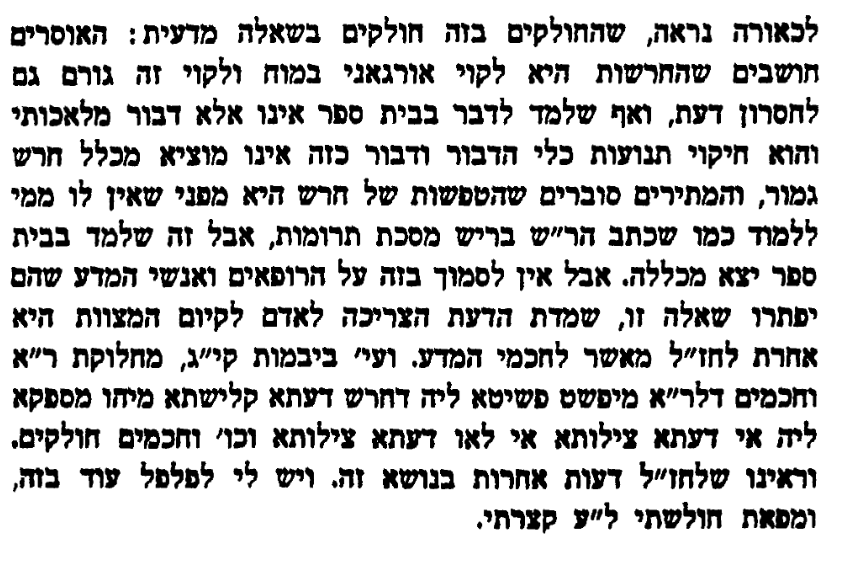
But we are not to rely on physicians or scientists to answer this question for us. For the measure of understanding required for a person to uphold mitzvot is entirely different for the rabbis than it is for scientists.

“הרב י.י. וינברג "חרש שלמד לדבר לחיוב מצוות. היכל שלמה שנה בשנה תשכ׳ה. 128

“הרב י.י. וינברג "חרש שלמד לדבר לחיוב מצוות. היכל שלמה שנה בשנה תשכ׳ה. 128

Rav Weinberg was of course correct: what is reality in halakha and what is reality in reality are often two very different things. But still, this was an unusual position to take, for as Marc Shapiro noted in his excellent intellectual biography of R. Weinberg, “the tendency to take into account modern social and educational issues is constantly present in his responsa.”Surely the religious status of a deaf person would be a test case for just that approach.

The halakhic status of the deaf should make us uncomfortable. It raises many difficulties and challenges about the way Judaism once viewed - and often still does view - those with disabilities and people who were not free agents of their own time. The sages of the Mishnah and Talmud, influenced by cultural norms like those in ancient Rome, deemed the deaf not “mentally competent.” Two thousand years later, with the march of science we know that that this is factually incorrect. But you don’t need the science to tell you that. You just need to be lucky enough to know a deaf person.

Print Friendly and PDF

Talmudology for Tisha B'Av: Titus and Tinnitus

Francesco Hayez (1791-1882): The destruction of the Temple of Jerusalem.

My purpose in this discussion is to review briefly the ancient evidence for the death of Titus, to consider some of the recent ideas about the circumstances of the event and, finally, to suggest that, from an examination of evidence in our sources which has so far gone virtually unnoticed, one of the most intractable-seeming of the ancient sources may just possibly contain the truth.
— Murison, C.L The Death of Titus; A reconsideration. Ancient History Bulletin 1995: 9, 3-4. 135-142.

Tisha B’Av, the Fast of the Ninth of the month of Av, is a day that traditionally commemorates the destruction of the First and Second Temples that once stood in Jerusalem. Over the centuries however, Tisha B’Av took on an expanded role as a time to commemorate the collective tragedies of the Jewish People, from the Crusades to the Holocaust, and all tragedies in between.

שולחן ערוך אורח חיים תקנ’ד ומשנה ברורה שם

ומותר ללמוד מדרש איכה ופרק אלו מגלחין וכן ללמוד פירוש איכה ופירוש איוב

איכה - וכן אגדת החורבן בפרק הניזקין ובפרק חלק ולקרות בחורבן הנזכר ביוסיפון מותר

Because of the sad nature of the day, the rabbis forbade the study of Torah on it. Such study brings joy, and this is an emotion that is out of keeping with Tisha B’Av (שֶׁנֶּאֱמַר: ״פִּקּוּדֵי ה׳ יְשָׁרִים מְשַׂמְּחֵי לֵב״). However, it is permitted to study certain passages that are sad or depressing (preferably both). One of these passages is from our current tractate Gittin, and we studied it a few days ago.

גיטין נו, ב

מָה עָשָׂה? תָּפַשׂ זוֹנָה בְּיָדוֹ וְנִכְנַס לְבֵית קדְשֵׁי הַקֳּדָשִׁים, וְהִצִּיעַ סֵפֶר תּוֹרָה וְעָבַר עָלֶיהָ עֲבֵירָה. וְנָטַל סַיִיף וְגִידֵּר אֶת הַפָּרוֹכֶת, וְנַעֲשָׂה נֵס וְהָיָה דָּם מְבַצְבֵּץ וְיוֹצֵא, וּכְסָבוּר הָרַג אֶת עַצְמו,

What did Titus do when he conquered the Temple? He took a prostitute with his hand, and entered the Holy of Holies with her. He then spread out a Torah scroll underneath him and committed a sin, i.e., engaged in sexual intercourse, on it. Afterward he took a sword and cut into the curtain separating between the Sanctuary and the Holy of Holies. And a miracle was performed and blood spurted forth. Seeing the blood, he thought that he had killed God.

ּEventually Titus was punished and died at the age of 41. The cause? A gnat:

בְּרִיָּה קַלָּה יֵשׁ לִי בְּעוֹלָמִי, וְיַתּוּשׁ שְׁמָהּ עֲלֵה לַיַּבָּשָׁה וְתַעֲשֶׂה עִמָּהּ מִלְחָמָה. עָלָה לַיַּבָּשָׁה, בָּא יַתּוּשׁ וְנִכְנַס בְּחוֹטְמוֹ, וְנִקֵּר בְּמוֹחוֹ שֶׁבַע שָׁנִים. יוֹמָא חַד הֲוָה קָא חָלֵיף אַבָּבָא דְּבֵי נַפָּחָא, שְׁמַע קָל אַרְזַפְתָּא, אִישְׁתִּיק; אֲמַר: אִיכָּא תַּקַּנְתָּא. כֹּל יוֹמָא מַיְיתוּ נַפָּחָא וּמָחוּ קַמֵּיה. לְגוֹי – יָהֵיב לֵיהּ אַרְבַּע זוּזֵי, יִשְׂרָאֵל – אֲמַר לֵיהּ: מִיסָּתְיָיךְ דְּקָא חָזֵית בְּסָנְאָךְ. עַד תְּלָתִין יוֹמִין עֲבַד הָכִי; מִכָּאן וְאֵילָךְ, כֵּיוָן דְּדָשׁ, דָּשׁ.

a gnat came, and entered the nostril of Titus, and picked at his brain for seven years. Titus suffered greatly from this until one day he passed by the gate of a blacksmith’s shop. The gnat heard the sound of a hammer and was silent and still. Titus said: I see that there is a remedy for my pain. Every day they would bring a blacksmith who hammered before him. He would give four dinars as payment to a gentile blacksmith, and to a Jew he would simply say: It is enough for you that you see your enemy in so much pain. He did this for thirty days and it was effective until then. From that point forward, since the gnat became accustomed to the hammering, it became accustomed to it, and once again it began to pick away at Titus’s brain.

תַּנְיָא, אָמַר רַבִּי פִּנְחָס בֶּן עֲרוּבָא: אֲנִי הָיִיתִי בֵּין גְּדוֹלֵי רוֹמִי, וּכְשֶׁמֵּת פָּצְעוּ אֶת מוֹחוֹ, וּמָצְאוּ בּוֹ כְּצִפּוֹר דְּרוֹר מִשְׁקַל שְׁנֵי סְלָעִים. בְּמַתְנִיתָא תָּנָא: כְּגוֹזָל בֶּן שָׁנָה – מִשְׁקַל שְׁנֵי לִיטְרִין.

It is taught in a baraita that Rabbi Pineḥas ben Arova said: I was at that time among the noblemen of Rome, and when Titus died they split open his head and found that the gnat had grown to the size of a sparrow weighing two sela. It was taught in another baraita: It was like a one-year-old pigeon weighing two litra.

Might there be a medical explanation for this story?

Titus and a Brain Tumor

In 1995 Charles Murison published a suggestion in the Ancient History Bulletin. After reviewing contemporary Roman accounts of the death of Titus, he concluded that

Titus was believed to have died of a fever, perhaps exacerbated by cold bathing or harsh medical treatment; furthermore, Domitian was suspected of some involvement in hastening his end, but actual accusations of poisoning were not, apparently, contemporary.

He then turned to our passage of Talmud, and suggested that it described the death of Titus from a brain tumor, and that this was more likely than the fever hypothesis.

All in all, then, while certainty is obviously not attainable, I would argue that the Talmudic suggestion that Titus died of a brain tumour fits the facts, known and deducible, of the last fourteen months of his life better than any other hypothesis.

Titus and Tinnitis

According to ENT surgeon extraordinaire (and Talmudology neighbor) David Eisenman, this story “mixed with both plausible and fanciful elements” is “one of the earliest detailed case reports of PT [pulsatile tinnitus] in the classical literature.” Tinnitus is a buzzing like sound in the ear without any external auditory stimulus, or, in medicalese “the abnormal self- perception of an internally generated vascular somatosound.” In his 2018 paper on Pulsatile Tinnitus Associated With Sigmoid Sinus Wall Anomalies (now a classic work on the topic) he noted that some historians have suggested that the story of the gnat in the ear can best be explained as Titus having died from complications related to a cerebellopontine angle tumor. However, Eisenman believes that this was a misidentification of “the presumed histopathology as an acoustic neuroma or meningioma rather than as the far more likely jugular foramen paraganglioma with both intracranial and middle ear involvement, a well-known neoplastic cause of PT.” And that banging of the anvil? “It masked the sound, after which he [Titus] hired such a workman to sit before him, banging continuously to mask his self-perception of the somatosound. This provided transient relief for 30 days, after which the masking was no longer effective.” And that sparrow or pigeon sized gnat they found in the head of the departed Titus? It was “an intracranial mass with the appearance of a small bird.”

And what if it was really a gnat?

Dr. Eisenman the ENT surgeon has also encountered an actual “gnat in the brain,” or at least a version of it. In 2010 he published a paper titled Myiasis of the External and Middle Ear, where myiasis is “the infestation of human tissue by fly larvae that feed on the host's dead or living tissue and cause disease.” The case describes a

44-year-old woman [who] presented with 6 days of progressive left-sided ear pain aural fullness, and tinnitus… The symptoms began shortly after she disembarked from an airplane on vacation in the Dominican Republic. She felt something fly into her left ear. A bug was removed by the treating physician, but 24 to 48 hours later she began to hear the tinnitus and felt pressure in the ear. She returned to the United States and sought consultation.

When he took a look, Dr Eisenman found “live insect larvae filling the external auditory canal,” (where the external auditory canal is the tube into which you pop your ear buds). Here are some pictures (you are welcome):

(A) Endoscopic view of right external auditory canal, with maggots burrowing under skin and through tympanic membrane. B) View of single maggot after extraction. From Hatten et al. Myiasis of the External and Middle Ear. Annals of Otology, Rhinology & Laryngology 119(7):436-438.

The only way to get all those maggots out of the ear was to anesthetize the patient in the operating room and dig them out.

So Titus went mad from tinnitus. It has a certain poetic ring to it. And may your Tisha B’Av be a meaningful one.

כל הַמִּתְאַבֵּל עַל יְרוּשָׁלַיִם — זוֹכֶה וְרוֹאֶה בְּשִׂמְחָתָהּ

Print Friendly and PDF