Yevamot 64

Chullin 4b~ Circumcision, Shechita, and Hemophilia A

In today’s page of Talmud, we are deeply engrossed in the question of who is qualified to be a shochet, one who slaughters food in accordance with Jewish law. A baraita (a set of oral teachings that never quite made it into the Mishnah) is quoted that teaches that an uncircumcised man may be a shochet. Then the Talmud asks:

חולין ד, ב

ה"ד אילימא מתו אחיו מחמת מילה האי ישראל מעליא הוא אלא פשיטא מומר לערלות וקא סבר מומר לדבר אחד לא הוי מומר לכל התורה כולה

This uncircumcised man, what are the circumstances? If we say that he is an uncircumcised man whose brothers died due to circumcision and the concern is that he might suffer a similar fate, clearly he may slaughter, as he is a full-fledged Jew and not a transgressor at all. Rather, it is obvious that he is a transgressor with regard to remaining uncircumcised, as he refuses to be circumcised, and the tanna holds that he may nevertheless slaughter an animal since a transgressor concerning one matter is not a transgressor concerning the entire Torah.

The Talmud here is referring to the sad case in which a mother loses her sons because they bleed to death following circumcision. In this encore presentation, let’s revisit the topic, which we first met way back in Yevamot 64a.

יבמות סד, א

תניא מלה הראשון ומת שני ומת שלישי לא תמול דברי רבי רבן שמעון בן גמליאל אומר שלישי תמול רביעי לא תמול... א"ר יוחנן מעשה בארבע אחיות בצפורי שמלה ראשונה ומת שניה ומת שלישית ומת רביעית באת לפני רבן שמעון בן גמליאל אמר לה אל תמולי

It was taught: If she circumcised her first son and he died, and her second son and he too died, she should not circumcise her third son, so taught Rebbi.  Rabbi Shimon ben Gamliel stated that she should indeed circumcise her third child, but [if he died] she must not circumcise her fourth...Rabbi Yochanan said that there was once a case in Zippori in which four sisters had sons:  The first sister circumcised her son and he died, the second sister circumcised her son and he died, the third sister circumcised her son and he died, and the forth sister came to Rabbi Shimon ben Gamliel and he told her "you must not circumcise your son" (Yevamot 64a).

The Talmud here is describing a disease that is affected through the maternal line (hence the four sisters - all of whom seem to pass this disease on to their male children). The disease is X-linked Hemophilia A; the term X-linked indicates that the faulty gene is carried on the X chromosome, which is men is always inherited from the mother. Hemophilia A is an X-linked recessive genetic disease, first described by the American physician John Conrad Otto, who in 1803 described a bleeding disorder that ran in families and mostly affected the men. John Hay from Massachusetts published an account of a "remarkable hemorrhagic disposition" in the New England Journal of Medicine in 1813.

Hay, John. Account of a Remarkable Haemorrhagic Disposition, Existing in Many Individuals of the Same Family. New England Journal of Medicine 1813:2;3;221-225.

Hay, John. Account of a Remarkable Haemorrhagic Disposition, Existing in Many Individuals of the Same Family. New England Journal of Medicine 1813:2;3;221-225.

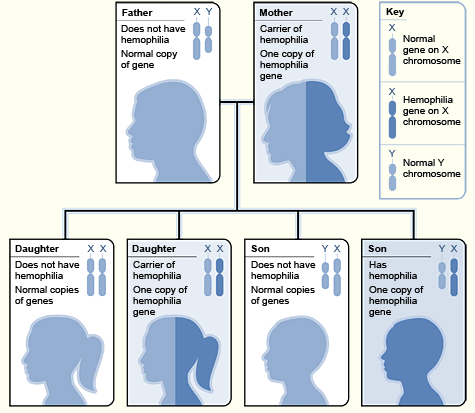
 If the mother is a carrier  - as were each of the four sisters in Zippori - then she has a one in four chance of passing on the disease to a child, and that affected child will always be a son:
Courtesy NHLBI

Courtesy NHLBI

The rabbis argued over a technical point - that is, how many cases of bleeding are needed to establish a pattern. According to Rebbi (that is  Rebbi Yehuda Ha-Nasi, c. 135-217 CE.) two cases were sufficient, while Rabbi Shimon ben Gamliel insisted on three cases before ruling that there was a life threatening pattern.  Indeed the disease in boys must have been very perplexing, because (as you can see in the diagram above) not every boy would be affected. In fact, if the mother is a carrier and the father is not, there is only a 50% chance of a boy having hemophilia.  It is this fact that perhaps explains the dispute between Rebbi and Rabbi Shimon ben Gamliel regarding how many children need to exhibit the disease before we can assume that any future male child will also have it.  If every boy born in the family would have been a hemophiliac, Rabbi Shimon's ruling would have seemed unnecessarily cruel.  But since by chance, half of the boys born might not have hemophilia, the need to demonstrate the prevalence of the disease (in a society in which its genetic foundations were not known) seems eminently sensible.

In  Hemophilia A there are various genetic mutations that result in low levels of clotting factors. These levels may be only mildly decreased, or so low that severe life threatening hemophilia results. It is treated with transfusions of clotting factors which restore the levels to normal. Although these transfusions must be given several times a week in those with severe disease, there is hope that recombinant clotting factors can lengthen the time between the needed transfusions.

The hemophiliac as a shochet

The law discussed in Yevamot that forbids circumcision where there is a family history of hemophilia was certainly practiced. Later in Yevamot, the Mishnah records the case of a priest who was not circumcised -  because of the deaths of his brothers when they underwent the procedure. Today we read that a man who was not circumcised because he had hemophilia may serve as a shochet. The Talmud records not only the earliest known description of hemophilia, but the emphasis on the preservation of life as a normative Jewish practice. 

Print Friendly and PDF

Avodah Zara 27a~ Circumcision, Death, and Hemophilia A

Can a(n uncircumcised) hemophiliac be a mohel?

On this page of Talmud there is a fascinating dispute about the biblical source of the rule that a gentile may not perform a ritual circumcision - brit mila. Daru bar Pappa (in the name of Rav) claimed it comes from the verse “And as for you, וְאַתָּה אֶת בְּרִיתִי תִשְׁמֹר you shall keep My covenant, you, and your descendants after you throughout their generations,” (Gen. 17:9) meaning that only your descendants may perform mila. Rabbi Yochanan had a different proof text, just three verses later (Gen. 17:13), when Abraham was told “ הִמּוֹל יִמּוֹל circumcise those who are born to you…” The use of the double emphasis הִמּוֹל יִמּוֹל teaches that a Jew must be circumcised by one who is already circumcised.

Although the law is clear, the use of the different proof-texts has ramifications for some specific cases that the Talmud now considers. One of them is the case of a man who could not be circumcised because his own brother had died from the procedure. According to Daru bar Pappa, such a man may himself act as a mohel and perform brit mila, since he is (at least) descended from those who are required to be circumcised. According to Rabbi Yochanan, however, this person is disqualified from being a mohel. He may indeed be a fully-fledged Jew, but הִמּוֹל יִמּוֹל teaches that he must himself have a brit mila in order to perform it on others.

עבודה זרה כז, א

אֶלָּא אִיכָּא בֵּינַיְיהוּ יִשְׂרָאֵל שֶׁמֵּתוּ אֶחָיו מֵחֲמַת מִילָה, וְלֹא מָלוּהוּ. לְמַאן דְּאָמַר ״וְאַתָּה אֶת בְּרִיתִי תִשְׁמֹר״ — אִיכָּא, לְמַאן דְּאָמַר ״הִמּוֹל יִמּוֹל״ — לֵיכָּא

Rather, there is a difference between them [Daru bar Pappa and Rabbi Yochanan] with regard to a Jew whose brothers died due to circumcision, and as a result, they did not circumcise him. According to the one [Daru bar Pappa] who says that the halakha is derived from the verse: “And as for you, you shall keep My covenant,” there is reason to permit such a person to perform circumcision, as he is a Jew. According to the one [Rabbi Yochanan] who says that the halakha is derived from the phrase: “He must be circumcised [הִמּוֹל יִמּוֹל],” there is no reason to permit this Jew to perform circumcision, as he is not circumcised himself.

So today we will discuss hematology, with a special focus on the disease that is the basis of the case on today’s daf, called hemophilia.

X-linked Hemophilia and the exemption from Brit Mila

A more detailed discussion of the disease is found on Yevamot 64b:

יבמות סו, ב

תניא מלה הראשון ומת שני ומת שלישי לא תמול דברי רבי רבן שמעון בן גמליאל אומר שלישי תמול רביעי לא תמול... א"ר יוחנן מעשה בארבע אחיות בצפורי שמלה ראשונה ומת שניה ומת שלישית ומת רביעית באת לפני רבן שמעון בן גמליאל אמר לה אל תמולי

It was taught: If she circumcised her first son and he died, and her second son and he too died, she should not circumcise her third son, so taught Rebbi.  Rabbi Shimon ben Gamliel stated that she should indeed circumcise her third child, but [if he died] she must not circumcise her forth...Rabbi Yochanan said that there was once a case in Zippori in which four sisters had sons:  The first sister circumcised her son and he died, the second sister circumcised her son and he died, the third sister circumcised her son and he died, and the fourth sister came to Rabbi Shimon ben Gamliel and he told her "you must not circumcise your son" (Yevamot 64:).

The Talmud here is describing a disease that is affected through the maternal line (hence the four sisters - all of whom seem to pass this disease on to their male children). The disease is X-linked Hemophilia A; the term X-linked indicates that the faulty gene is carried on the X chromosome, which in men is always inherited from the mother. Hemophilia A is an X-linked recessive genetic disease, first described by the American physician John Conrad Otto, who in 1803 described a bleeding disorder that ran in families and mostly affected the men. John Hay from Massachusetts published an account of a "remarkable hemorrhagic disposition" in the New England Journal of Medicine in 1813.

Hay, John. Account of a Remarkable Haemorrhagic Disposition, Existing in Many Individuals of the Same Family. New England Journal of Medicine 1813:2;3;221-225.

Hay, John. Account of a Remarkable Haemorrhagic Disposition, Existing in Many Individuals of the Same Family. New England Journal of Medicine 1813:2;3;221-225.

 If the mother is a carrier  - as were each of the four sisters in Zippori - and the father is not, then she has a one in four chance of passing on the disease to a child, and that affected child will always be a son:

Courtesy NHLBI

Courtesy NHLBI

The rabbis argued over a technical point - that is, how many cases of bleeding are needed to establish a pattern. According to Rebbi (that is  Rebbi Yehuda Ha-Nasi, c. 135-217 CE.) two cases were sufficient, while Rabbi Shimon ben Gamliel insisted on three cases before ruling that there was a life threatening pattern.  Indeed the disease in boys must have been very perplexing, because (as you can see in the diagram above) not every boy would be affected. In fact, if the mother is a carrier and the father is not, there is only a 50% chance of a boy having hemophilia.  It is this fact that perhaps explains the dispute between Rebbi and Rabbi Shimon ben Gamliel regarding how many children need to exhibit the disease before we can assume that any future male child will also have it.  If every boy born in the family would have been a hemophiliac, Rabbi Shimon's ruling would have seemed unnecessarily cruel.  But since by chance, half of the boys born might not have hemophilia, the need to demonstrate the prevalence of the disease (in a society in which its genetic foundations were not known) seems eminently sensible.

In  Hemophilia A there are various genetic mutations that result in low levels of clotting factors. These levels may be only mildly decreased, or so low that severe life threatening hemophilia results. It is treated with transfusions of clotting factors which restore the levels to normal. Although these transfusions must be given several times a week in those with severe disease, there is hope that recombinant clotting factors can lengthen the time between the needed transfusions.

Later in Yevamot, the Mishnah records the case of a priest who was not circumcised -  because of the deaths of his brothers when they underwent the procedure. So this law was certainly practiced, and the Talmud records not only the earliest known description of hemophilia, but the emphasis on the preservation of life as a normative Jewish practice. 

Print Friendly and PDF

Yevamot 64b~ Circumcision, death, and Hemophilia A

Today’s page of Talmud discusses the complications that may arise following a circumcision:

יבמות סו. ,ב

תניא מלה הראשון ומת שני ומת שלישי לא תמול דברי רבי רבן שמעון בן גמליאל אומר שלישי תמול רביעי לא תמול... א"ר יוחנן מעשה בארבע אחיות בצפורי שמלה ראשונה ומת שניה ומת שלישית ומת רביעית באת לפני רבן שמעון בן גמליאל אמר לה אל תמולי

It was taught: If she circumcised her first son and he died, and her second son and he too died, she should not circumcise her third son, so taught Rebbi. Rabbi Shimon ben Gamliel stated that she should indeed circumcise her third child, but [if he died] she must not circumcise her fourth...Rabbi Yochanan said that there was once a case in Zippori in which four sisters had sons: The first sister circumcised her son and he died, the second sister circumcised her son and he died, the third sister circumcised her son and he died, and the fourth sister came to Rabbi Shimon ben Gamliel and he told her, "you must not circumcise your son" (Yevamot 64:)

The Talmud here is describing a disease that is passed through the maternal line (hence the four sisters - all of whom seem to pass this disease on to their male children). The disease is X-linked Hemophilia A; the term X-linked indicates that the faulty gene is carried on the X chromosome, which is always inherited from the mother. Hemophilia A is an X-linked recessive genetic disease, first described by the American physician John Conrad Otto, who in 1803 described a bleeding disorder that ran in families and mostly affected the men. John Hay from Massachusetts published an account of a "remarkable hemorrhagic disposition" in the New England Journal of Medicine in 1813.

Hay, John. Account of a Remarkable Haemorrhagic Disposition, Existing in Many Individuals of the Same Family. New England Journal of Medicine 1813:2;3;221-225.

 If the mother is a carrier  - as were each of the four sisters in Zippori - then she has a one in four chance of passing on the disease to a child, and that affected child will always be a son:

Courtesy NHLBI

The rabbis argued over a technical point - that is, how many cases of bleeding are needed to establish a pattern. According to Rebbi (that is  Rebbi Yehuda Ha-Nasi, c. 135-217 CE.) two cases were sufficient, while Rabbi Shimon ben Gamliel insisted on three cases before ruling that there was a life-threatening pattern.  Indeed the disease in boys must have been very perplexing, because (as you can see in the diagram above) not every boy would be affected. In fact, if the mother is a carrier and the father is not, there is only a 50% chance of a boy having hemophilia.  It is this fact that perhaps explains the dispute between Rebbi and Rabbi Shimon ben Gamliel regarding how many children need to exhibit the disease before we can assume that any future male child will also have it.  If every boy born in the family would have been a hemophiliac, Rabbi Shimon's ruling would have seemed unnecessarily cruel.  But since by chance, half of the boys born might not have hemophilia, the need to demonstrate the prevalence of the disease (in a society in which its genetic foundations were not known) seems eminently sensible.

In  Hemophilia A there are various genetic mutations that result in low levels of clotting factors. These levels may be only mildly decreased, or so low that severe life-threatening hemophilia results. It is treated with transfusions of clotting factors which restore the levels to normal. Although these transfusions must be given several times a week in those with severe disease, there is hope that recombinant clotting factors can lengthen the time between the needed transfusions.

Later in Yevamot, the Mishnah records the case of a priest who was not circumcised -  because of the deaths of his brothers when they underwent the procedure. So this law was certainly practiced, and the Talmud records not only the earliest known description of hemophilia, but the emphasis on the preservation of life as a normative Jewish practice. 

Print Friendly and PDF

Yevamot 64b ~ Urinary Tract Infections, and the Class That Went On For Too Long

This is the first of two posts for Yevamot 64 that we will learn on Tuesday. The second part will be published tomorrow.

יבמות סד,ב

רב גידל איעקר מפרקיה דרב הונא רבי חלבו איעקר מפרקיה דרב הונא רב ששת איעקר מפרקיה דרב הונא

Rav Gidel became sterile on account of Rav Huna's lectures, Rav Chelbo became sterile on account of Rav Huna's lectures and Rav Sheshet became sterile on account of Rav Huna's lectures...

Rav Huna had a lot to answer for.  His lectures went on, and on, and on, and on and on and on.  A couple of pages ago, on Yevamot 62b, Rashi explained the relationship between these lengthy classes and infertility:

איעקר מפרקיה דרב הונא.שהיה מאריך בדרשיו וצריכים למי רגלים ומעמידים עצמן ונעקרים כדתניא בבכורות 

Rav Huna would give a lengthy class and people needed to use the toilet. They delayed urinating, and as a result became sterile, as we learn in the tractate Bechorot

The suggestion here is that holding-it-in can lead to problems of fertility, and there is a least a theoretical reason why Rav Huna's lengthy classes had the unintended consequence of lowering the reproductive rates of his students.  There is a clear relationship between male infertility and repeated infections of the genitourinary tract. Here, for example, is  how one urology textbook opens its chapter on male genital tract infections and infertility:

Male Genital Tract Infections and Infertility. Neal, DE, Weinstein, SH. In Male Reproductive Dysfunction ed Kandeel FR. Informa Healthcare 2007

Any male GU infection such as prostatitis, urethritis or epididymo-orchitis can reduce both sperm count and the quality of the seminal fluid. OK, but what does that have to do with not urinating when you feel the urge? Well here's the thing: that not-going-when-you-need-to is not a good idea.

Delayed Micturation and UTIs

It's quite a challenge to determine scientifically the effect of holding-it-in (and hereafter referred to as delayed micturition, because it sounds nicer) on the risk of getting a urinary tract infection.  You can't very easily randomly assign one large group of healthy volunteers to urinating whenever they want, and a second to urinating only three times a day.

However, there are a couple of observational studies that may be able to tell us something about the risk of delayed micturition.  A 1968 study of 112 women with a documented UTI reported that further UTIs could be reduced by voiding  every two hours during the day (which sounds rather too good to be true). And a 1979 study from the (not-very-widely-read-but-it-really-is-a-journal) Scandinavian Journal of Urology and Nephrology reported that the frequency of UTI was significantly higher among women with three or less voidings per day compared with those who have to go four or more times per day. (Whether this is true for women outside of northern Jutland where the study was conducted remains unclear.)

So a decreased voiding frequency is associated with an increased number of infections, and urinary tract infections are associated with decreased fertility. Thus by the rule of transitive relations (or something clever like it) decreased voiding may indeed be associated in a causative way with decreased fertility.  

All this is highly speculative, and it would certainly be unusual for male sterility to directly result from delayed micturition.  But here's the weird thing: teachers are slightly more likely to suffer urinary tract infections when compared with the general population. Is that because they too, like their students, hold-it-in? (Yes, I know it didn't reach statistical significance, but the authors thought it was important to note, and so do I.)   

Kovess-Masféty, V. Do teachers have more health problems? Results from a French cross-sectional survey. BMC Public Health 20066:101;1-13

 Poor Rav Huna, talking on and on and on, while his miserable students had to sit there with their legs crossed and could likely only think of only one thing. We will give the last word to Rav Acha bar Yaakov, another hapless student of Rav Huna. 

אמר רב אחא בר יעקב שיתין סבי הוינא וכולהו איעקור מפרקיה דרב הונא לבר מאנא

Rav Acha bar Yaakov said, we were a group of sixty students, and all of us became sterile because of Rav Huna's lectures - except me (Yevamot 64b).

Students be warned.

Print Friendly and PDF