Ketuvot 36 ~ The Aylonit Syndrome and Turner's Syndrome

איילונית - אין לה לא קנס ולא פיתוי
​ There is no fine for the rape or seduction of an Aylonit

— Ketuvot, 36a

Aylonit Syndrome

An Aylonit is a woman who is congenitally unable to have childern.  In the fifth chapter of Niddah (47b) the Mishnah describes the signs which suggest that a woman is an Aylonit:

תלמוד בבלי נדה דף מז עמוד ב 

...בת עשרים שנה שלא הביאה שתי שערות, תביא ראיה שהיא בת עשרים שנה - והיא איילונית, לא חולצת ולא מתיבמת

A woman who is twenty years old and has not grown two pubic hairs..is classified as an Aylonit...

Earlier in our current tractate, Ketuvot (11a), the Talmud suggested the etymology of the word Aylonit:  "איילונית - דוכרנית דלא ילדה - an Aylonit [is given this name] as if she is a ram [דכר is the Aramic translation of the Hebrew word איל– a ram] which [being a male] cannot give birth"

In the last tractate that we studied (Yevamot 80b) the Talmud gives four other signs of this condition, which are codified by Maimonides:

רמב"ם הלכות אישות פרק ב הלכה ו 

ואלו הן סימני אילונית, כל שאין לה דדין, ומתקשה בשעת תשמיש, ואין לה שיפולי מעיים כנשים, וקולה עבה ואינה ניכרת בין איש לאשה

These are the signs that a woman is an Aylonit: She has not developed breasts, she has difficulty during sexual intercourse [that is, she has a diminished libido], the mons pubis is lacking, and she has such a deep voice that it is indistinguishable from that of a man...(Mishneh Torah, Hil. Ishus, 2:6)

There are many reasons for a woman to be infertile, but because the Talmud lists a number of signs other than infertility, we are able to narrow down the possible causes in the special case of the Aylonit. As many have previously noted, the cause of the Aylonit is likely to be what, (since 1938) we now call Turner's Syndrome.  

Turner's Syndrome

In 1938 an American endocrinologist names Henry Turner published a paper describing a newly observed syndrome in seven female patients. (A syndrome is a series of medical abnormalities which occur together.) It consisted of a triad of infantilism, a webbed neck, and a deformity of the elbow. It was found only in female patients, and was associated with delayed or absent sexual development. We now know (and Turner did not) that it is caused by a genetic aberration in which the patient has a missing X chromosome. Instead of carrying 44 regular and two X chromosomes, a woman with (what we now call) Turner's Syndrome has one missing X chromosome. (It gets a little more complicated: in some cases of Turner's Syndrome the woman has only part of one of the X chromosomes missing. And in others, the women's cells contain a mixture of both normal - 45XX - and abnormal - 45X - chromosomes. This is called mosaicism. But let's keep our focus.)
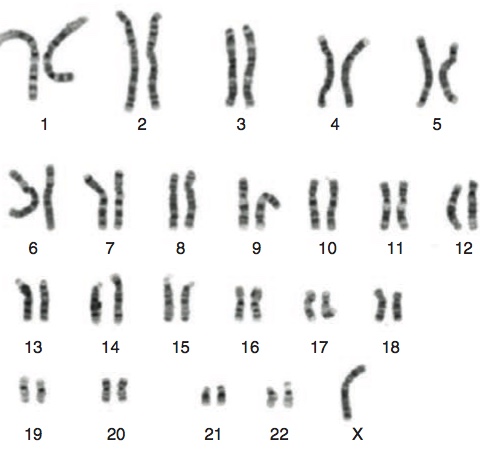
Sex chromosome analyses in Turner's Syndrome.  Here the 22 pairs of autosomes are grouped according to size and the sex chromosomes placed at the end; in this case, there is only one X chromosome.  From Saenger and Bondy. Turner …

Sex chromosome analyses in Turner's Syndrome.  Here the 22 pairs of autosomes are grouped according to size and the sex chromosomes placed at the end; in this case, there is only one X chromosome.  From Saenger and Bondy. Turner Syndrome. In Sperling M. (ed.) Pediatric Endocrinology. Pittsburgh PA, Elsevier 2014.

Turner's Syndrome occurs in about 1 out of every 2,000 live-born girls. In addition to infertility in most, there are liver problems, high blood pressure, cardiac disorders and various metabolic disorders. Most of the girls with Turner's Syndrome have skeletal abnormalities and a short stature. In girls with the 45X variant, there is ovarian failure and hence infertility, although the cause is not yet clear.    

The variable appearance of Turner syndrome. Both of these 7-year-old girls with short stature have the 45X variant of Turner syndrome. The girl on the left was diagnosed at birth due to prominent neck webbing and low-set and…

The variable appearance of Turner syndrome. Both of these 7-year-old girls with short stature have the 45X variant of Turner syndrome. The girl on the left was diagnosed at birth due to prominent neck webbing and low-set and posteriorly rotated ears. She also has micrognathia and a low posterior hairline. In contrast, the girl on the right was diagnosed at age 7 due to short stature without “classical” stigmata of Turner syndrome, and she is more typical of the clinical presentation of the majority of girls with Turner syndrome diagnosed in the 21st century.  From Saenger and Bondy. Turner Syndrome. In Sperling M. (ed.) Pediatric Endocrinology. Pittsburgh PA, Elsevier 2014. 

Girls and women with Turner syndrome may have low self-esteem and more shyness and social anxiety than controls. In a population-based study of 566 French women with Turner syndrome, low self- esteem was associated with hearing impairment and limited sexual experience, whereas age at first sexual intercourse was related to age at puberty and paternal socioeconomic class.
— Levitsky, L. Turner Syndrome. Current Opinion Endocrinology, Feb 2015

study of Polish women with Turner's Syndrome, found that these women had less "...interest in males, less frequent sexual activity, later initiation of sexual life and a less frequent orgasm rate." Other studies found that women with this syndrome were less likely to establish a relationship with a partner, and were less sexually active than women from the general population. All this suggests that the Talmud's description in which they suffer from "difficulties during intercourse" (מתקשה בשעת תשמיש) may be correct.   

Let's remember that behind these scientific findings are real women with the same range of  sensitivities, feelings, hopes and aspirations as those of us who have two functioning sex chromosomes.  Let's give the last word to Harley Gould, a researcher at the National Institutes of Health:

Moreover, it is important to remember that society continues to dis- criminate against people that are different, and that being short, or infertile, or looking different impose quite a social burden on individuals... Our demonstration of very similar academic, employment...suggests that genomic imprinting of X-linked genes has little to do with functioning in school or socially...We would like to add to that concept the positive observation that many individuals with Turner Syndrome display excellent coping skills, including perseverance in the face of adversity and equability of temperament.
— Harley Gould et al. High Levels of Education and Employment Among Women with Turner Syndrome. Journal of Women's Health 2013. 22:(3) 230-235.
Print Friendly and PDF

Ketuvot 29 ~ The Terror of Rape

משנה מסכת כתובות פרק ג משנה א 

אלו נערות שיש להן קנס הבא על הממזרת ועל הנתינה ועל הכותית הבא על הגיורת ועל השבויה ועל השפחה שנפדו ושנתגיירו ושנשתחררו פחותות מבנות שלש שנים ויום אחד הבא על אחותו ועל אחות אביו ועל אחות אמו ועל אחות אשתו ועל אשת אחיו ועל אשת אחי אביו ועל הנדה יש להן קנס אף על פי שהן בהכרת אין בהן מיתת בית דין: 

These are the girls (aged between twelve and twelve and a half) for who a fine is levied for raping them...

Today we begin to study the third chapter of Ketuvot, which focuses on the damages to be paid to a virgin who was raped, (or seduced,) by a man. These laws were later codified in the Shulhan Arukh, the code of Jewish Law, written by R. Yosef Karo (d. 1575) in sixteenth century Israel.

שולחן ערוך אבן העזר הלכות אונס ומפתה סימן קעז 

סעיף א

 המפתה בתולת ישראל (עד שלא תבגר, והיא מבת שלשה ואילך) (טור הרא"ש), משלם בושת ופגם וקנס. ואם אנסה, משלם עוד צער. ואם נשאה המפתה, אינו צריך ליתן קנס

סעיף ב

אונס ומפתה, דנין אותה בשלשה דיינים, ובלבד שיהיו סמוכים, בא"י. והאידנא שאין סמוכים, מנדין אותו עד שפייס את חבירו; וכד יהיב ליה שיעור מאי דחזי למיהב, שדינן ליה. (והבת, כל זמן שהיא ברשות אביה, הכל לאביה (גם זה שם). ועיין בטור סימן זה שהאריך בדינים אלו, והרב המחבר קצר בהם, שאינם שכיחין 

סעיף ג

האונס את הבתולה, חייב לישא אותה, ובלבד שהיא ואביה יהיו מרוצים, אפי' היא חגרת או סומא, ואינו רשאי להוציאה לעולם אלא לרצונה. לפיכך אין צריך לכתוב לה כתובה. ואם עבר והוציאה, כופין אותו להחזירה

As an emergency physician, I have cared for a number of women who have been raped.  I have interviewed them, examined them, and collected forensic evidence. The horrors of their having been assaulted was, I am sure, compounded by my legally necessary but emotionally gratuitous clinical exam. There is a danger that the talmudic discussion can, likewise seem overly clinical. But behind the legal back and forth is a brutal reality. To help keep the victim front and center, let's talk about the crime of rape.

International Rape Statistics

Rape plagues society everywhere. It's really hard to get accurate statistics to compare countries, since reporting rates and definitions of what actually constitutes rape vary. With that caveat, here's what the UN found:

Penalties for Rape

United States. In 2008, there were about 203,000 victims of rape age 12 and older. The penalties for rape vary by state. In New York, rape in the first degree is a felony that carries a penalty of 5-25 years in prison. In New Jersey, first degree sexual assault carries a sentence of 10-20 years. In Massachusetts, rape that results "in serious injury" (doesn't all rape result in that?) is punishable by life in prison, and no less that 20 years if committed by force (isn't that all rape?). The rape of a child under 16 carries a similar penalty. In 1977 the Supreme Court ruled that under the Eighth Amendment, the rape of an adult woman could not carry the death penalty. There are almost 160,000 men in prison for rape in the US.

US. Department of Justice. Office of Justice Programs, Bureau of Justice Systems. Prisoners in 2013.

US. Department of Justice. Office of Justice Programs, Bureau of Justice Systems. Prisoners in 2013.

United Kingdom. Rape carries a penalty of 11-17 years in custody, with a minimum of 10 years in prison if the victim was a child between 13 and 16 years of age.  If the victim was under 13, the starting penalty is 13 years in prison. The average time served for rape in the UK is eight years.

Israel. Rape of an adult carries a penalty of 4-16 years in prison. In addition the victim may receive damages of up to 228,000 NIS. Rape of a child under 16, or carried out with a firearm, or with the assistance of another person, carries a minimum sentence of 20 years (see חוק העונשים התשל׳ז–1977, and later amendments). 

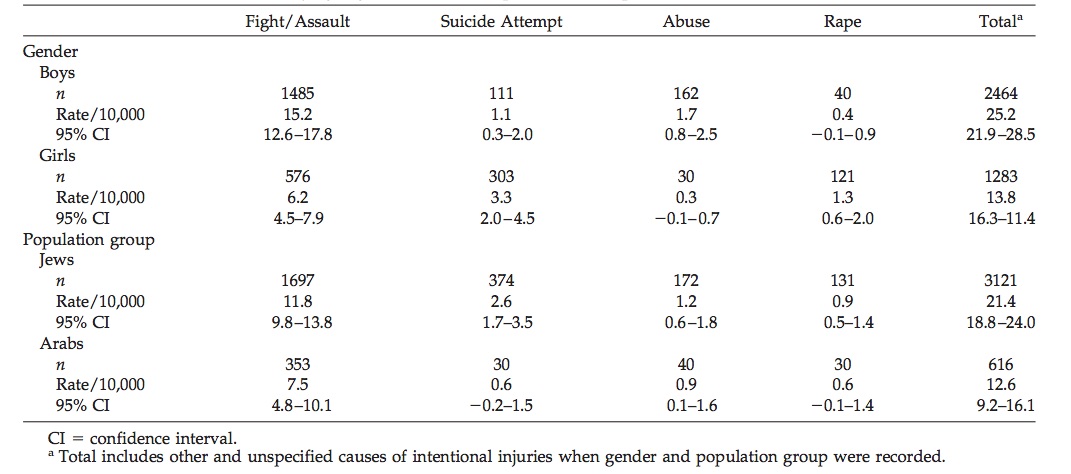
Causes of Intentional Injury by Gender and Population. From Gofin, R. et al. Intentional Injuries Among the Young; Presentation to Emergency Rooms, Hospitalization and Death in Israel.  Journal of Adolescent Health 2000:27:433-44.

Causes of Intentional Injury by Gender and Population. From Gofin, R. et al. Intentional Injuries Among the Young; Presentation to Emergency Rooms, Hospitalization and Death in Israel.  Journal of Adolescent Health 2000:27:433-44.

In a study of children with intentional injuries treated in Israeli ERs, the rates for rape were 1.5 times higher in the Jewish children compared with Arab children. 

Although selected cases may reach the ER, it is estimated that between 1-4 in 10 or 20 cases of rape are reported. Stigmatization, fear, and feelings of shame or guilt may preclude rape disclosure by victims or their caretakers.
— Rosa Gofin. Intentional Injuries Among the Young In Israel, 2000.


Jewish law. Rape (including rape of a child older than three) is punishable by a fine of 50 shekels paid to the father of the victim.  The rapist is required to marry his victim (unless she or her father refuse) and he cannot forcibly divorce her.  In addition, the rapist must pay damages for pain and suffering, and monetary loss, the latter based on the lower value a woman who is not a virgin has in the market for marriage. If the rapist marries the victim, some of these fines are not levied. There are no fines for the rape of a child under three, or the rape of an unmarried  woman who is not a virgin. Rape of a married woman is punishable by death.

A President of Israel, A Convicted Rapist

In December 2010, then President of Israel Moshe Katsav was convicted of rape while he had been  serving as Israel's Minister of  Tourism in 1998. The verdict was upheld by the Israeli Supreme Court, and Katsav began his seven-year prison sentence in December 2011. The national shame at this crime was perhaps slightly mitigated by one of its lessons, articulated by Prime Minister Netanyahu, "that all are equal before the law, and that every woman has exclusive rights to her body."

In his commentary to R. Karo's  שולחן ערוך,  R. Moshe  Isserles (d.1572)  explained that the שולחן ערוך did not detail the laws of rape, because it was such a rare crime - (הרב המחבר קצר בהם, שאינם שכיחין).  How wrong, how very sadly wrong, he was. 


Print Friendly and PDF

Ketuvot 23b ~ The Cohen Gene

HEllo, I'm Your New Cohen

משנה כתובות דף כג עמוד ב 

וכן שני אנשים, זה אומר כהן אני וזה אומר כהן אני - אינן נאמנין, ובזמן שהן מעידין זה את זה - הרי אלו נאמנין; רבי יהודה אומר: אין מעלין לכהונה על פי עד אחד

Likewise in the case of two men; one says, "I am a Cohen", and the other says "I am a Cohen", they are not believed. If however they testify about one another they are believed. R. Yehuda said: we do not elevate [a person] to the status of Cohen based on the testimony of only one witness....

Being a Cohen comes with rights and duties. They get called to the Torah first, and are given preference to lead Birkat Hamazon.  During Temple times, they got lots and lots of food.  But how do you prove you are a Cohen, and entitled to these privileges?  According to the Mishnah in today's Daf Yomi, (and discussed in detail in the talmudic discussion that follows,) you need witnesses to attest to your status. But what if the Cohen was mistaken about his ancestors? What if the witnesses were being paid to dupe the locals into believing the Cohen was legitimate? Is there an alternative to the methods mentioned in this Mishnah? Perhaps.

The Saturday Night Live Cohen 

My friend Misha Galperin, (formerly the CEO of the Jewish Federation of Greater Washington and  of International Development at The Jewish Agency) is a Cohen. Only he didn't know it when he arrived in America from the Soviet Union.  Here's what happened, as told to me in an email that he kindly allowed me to share:

Five months after arriving in the US, I am sitting in the lounge of Yeshiva University's dorm watching SNL with my tutor who was teaching me Alef Bet is so I can start classes on Monday.
A skit starts with guest host Leonard Nimoy dressed as Mr. Spock - with ears - and at the end he raises his right palm in the symbolic gesture and says: "Live long and prosper!"
I turn to the tutor and ask him what this gesture means. Why?--he asks. "Because my father taught me this, and his father taught it to him before being murdered by Nazis in 1941. My father did not know what it meant, but he taught me..."

And so Misha learned that he was a Cohen from Saturday Night Live. But not all Cohanim are so lucky. (Fun fact: Leonard Nimoy ז’ל wrote about his decision to give Mr. Spock this priestly hand salute in his 1997 autobiography I Am Not Spock.)  With neither witnesses nor TV to help, is there another way to establish one's genealogy as a member of the priestly class? That's where the Cohen Gene comes in.  

The Cohen Gene

If all Cohanim are descended from Aaron, and the privilege is only transmitted from father to son, then perhaps being a Cohen can be genetically linked to a chromosome that is only passed from father to son. And there is such a chromosome. It's the Y chromosome, and all (fertile) men carry a copy that comes only from their biological father. (Quick recap: girls are XX and boys are XY. So all girls carry one X chromosome from mum and one X chromosome from dad. Boys, on the other hand, only get their X chromosome from mum, and their Y chromosome from dad. This can lead to other problems like hemophilia, which we've talked about elsewhere.) That's exactly what prompted  Karl Skorecki from the Technion, and colleagues from University College London, to analyze the Y chromosome in Cohanim and compare it to the rest of the Jewish population.  In 1997 they published a paper in Nature that looked at a special bit of the Y chromosome called YAP. Actually, they looked at 6 kinds of the YAP haplotype, (a haplotype being what geneticists call bunches of DNA sequences), and compared their frequency in Cohanim and non-Cohanim.    

Skorecki K, et al. Y Chromosomes of Jewish Priests. Nature 1997. 385:32.

Skorecki K, et al. Y Chromosomes of Jewish Priests. Nature 1997. 385:32.

As you can see highlighted, the YAP+ haplotype was found in only 1.5% of those who self-identified as Cohanim, but in over 18% of non-Cohanim.  The different frequency was found in both Ashkenazi and Sephardi Cohanim,  a result that the authors claimed was "consistent with an origin for the Jewish priesthood antedating the division of world Jewry into Ashkenazic and Sephardic communities."

These Y-chromosome haplotype differences confirm a distinct paternal geneology for Jewish priests.
— Skorecki et al. Nature 1997. 385: 32.

David Goldstein, who directs the  Center for Human Genome Variation at Duke University, also published a study on the Y-chromosome of Cohanim, using a sample that included the DNA swabbed "from the mouths of sunbathers on the beaches of Tel Aviv." Here is what Goldstein concluded:

Despite the high levels of variation, we could see a clear difference between Cohen and Israelite chromosomes. The most common chromosomes observed in the Israelites (that is, non-Cohen and non-Levite Jews) were found in only 12% of the Israelite individuals sampled. By contrast, more that half of the Cohen Y chromosomes were identical at the sites considered - that is, the majority of the self-identified Cohanim had the same type of Y chromosome. Even more remarkable, this same type of Y was found at high frequencies in both Ashkenazi (45%) and Sephardi (56%) Cohanim. (Goldstein, p.31)

Goldstein named this chromosome type the Cohen Modal Haplotype, and claimed that it showed "definitively" that Cohen status was not adopted (i.e. made up by some, eager for the benefits) but inherited.  And now things started to get really interesting. 

Dating the Original Aaron

So all, (OK, not all, but certainly most) of the approximately 500,000 Cohanim alive today seem to have originated from a common ancestor - a primordial Cohen. And just when did he live? Well, by analyzing small differences in the Cohen Modal Haplotype, and assuming that a generation time is 25 years, Goldstein et al. stated (with a confidence interval of 95%) that the origin of the priestly Y chromosome was "sometime during or shortly before the Temple period in Jewish history."

Not So Fast...

OK, a couple of things need to be noted here, before anyone claims that "genetics proves the Bible." First- as Goldstein himself notes in his book, his numbers may be off, by quite a bit:

Permit me here, after what was for me the first - and still one of the few - real thrills of discovery that punctuate the tedium and detail of science, the necessary reality check. Our results appeared to be a striking confirmation of the oral tradition. It even led to repeated claims in the press that my colleagues and I "found Aaron's Y chromosome." But although three thousand years is our best guess [as to when Primordial Cohen may have lived] the range of possible dates was and is very broad. Given our uncertainty about the ways mutations happen and how fast, we may be off by several hundred years or more in either direction. (Goldstein p.38).

Second, some later work done by Skorecki (he of the Technion 1997 Nature paper) suggests that the class of Cohanim may have had more than one common ancestor.  This work posits that there was not one primordial Cohen, but a few clans of Cohanim, from whom all later Cohanim are descended. (Or more technically stated:"...lineages characterized by the 6 Y-STRs used to define the original Cohen Modal Haplotype are associated with two divergent sub-clades...and thus cannot be assumed to represent a single recently expanding paternal lineage.")

And finally, work from Brigham Young University (and boy, those guys are really into ancestry) reminds anyone looking to do a quick Cohen DNA test to be careful.

The Cohen Modal Haplotype is observed in high frequency within the Cohanim, but also presents with significant incidence in other non-Jewish populations. The occurrence of the CMH in deeply divergent SNP haplogroups also indicates a lack of specificity of the CMH to the ancient Hebrew population. As such, inference of relation to Jewish populations for individuals or groups should be performed with caution when using the original CMH definition, as a false-positive result is likely.

 "A false positive is likely" - in other words, the test may show you are a Cohen, but really...you aren't. 

Genetic Testing - It's Not Just for Cohanim

And now that a Cohen "Gene" may have been identified, what about the rest of us non-Cohanim? Some have used genetic testing to discover a forgotten heritage or find long-lost cousins.  One rather keen family member of Polonsky rabbinic lineage (claiming in passing to be descended from King David, the Kalonymos family, and Rashi) used the presence of a "relatively rare R-M124 haplotype" on the Y chromosome to confirm a common ancestor and find a new marker that represents "Polonsky rabbinic lineage." (I confess I am jealous. My grandfather drove a black London taxi, and last time I checked, Rashi was not one of my known ancestors.) 

It's Not About Your Ancestors, It's About You

רמב"ם הלכות שמיטה ויובל פרק יג הלכות יב –יג 

ולמה לא זכה לוי בנחלת ארץ ישראל ובביזתה עם אחיו? מפני שהובדל לעבוד את יי לשרתו ולהורות דרכיו הישרים ומשפטיו הצדיקים לרבים שנאמר יורו משפטיך ליעקב ותורתך לישראל, לפיכך הובדלו מדרכי העולם לא עורכין מלחמה כשאר ישראל ולא נוחלין ולא זוכין לעצמן בכח גופן, אלא הם חיל השם שנאמר ברך יי חילו, והוא ברוך הוא זוכה להם, שנאמר: אני חלקך ונחלתך

ולא שבט לוי בלבד אלא כל איש ואיש מכל באי העולם אשר נדבה רוחו אותו והבינו מדע להבדל לעמוד לפני יי לשרתו ולעובדו לדעה את יי והלך ישר כמו שעשהו האלהים ופרק מעל צוארו עול החשבונות הרבים אשר בקשו בני האדם הרי זה נתקדש קדש קדשים. ויהיה יי חלקו ונחלתו לעולם ולעולמי עולמים ויזכה לו בעה"ז דבר המספיק לו כמו שזכה לכהנים ללוים, הרי דוד עליו השלום אומר: יי מנת חלקי וכוסי אתה תומיך גורלי

Why did the Levi'im not receive a portion in the inheritance in Israel and in the spoils of war like their brethren? Because they were set aside to serve God, to minister to Him and to instruct the masses about His just paths and righteous judgments... Therefore they were set apart from the mundane matters of the world. They do not wage war like the remainder of the Jewish people, nor do they receive an inheritance, nor do they acquire for themselves through their physical power. Instead, they are God's legion...and He provides for them...

Not only the tribe of Levi, but any human whose spirit moves him and who understands with his wisdom to set himself aside and stand before God - to serve Him and minister to Him and to know Him, proceeding justly as God made him, removing from his neck the yoke of the many mundane things which people seek - that person is sanctified like the Holy of Holies [in the Temple]. God will be his portion and heritage forever and will provide what is sufficient for him in this world, just as He provides for the Cohanim and the Levi'im...

Maimonides, in his Mishnah Torah,  reminds us about what is really important. It's not bringing a witness into town and telling everyone who your ancestors are. And it's not getting a DNA test to prove your stock. It's about searching for religious meaning in a world of materialism.  And that search is open to anyone, woman or man, Jew or not, Cohen, Levi, or even a plain old Yisrael.  

Print Friendly and PDF

Ketuvot 15a ~ Talmudic Probability Theory

תלמוד בבלי כתובות דף טו עמוד א 

  א"ר זירא: כל קבוע כמחצה על מחצה דמי ..מנא ליה לר' זירא הא? ...מתשע חנויות, כולן מוכרות בשר שחוטה ואחת בשר נבלה, ולקח מאחת מהן ואינו יודע מאיזה מהן לקח - ספיקו אסור, ובנמצא - הלך אחר הרוב, 

R. Zera said: Any doubt about something that is fixed in its place is considered be a fify-fifty chance... Where does he learn this from ? [From a Baraisa which teaches the following. Consider a town in which] there are nine shops, all of which sell kosher meat, and one store that sells sells meat that is not kosher. If a person bought meat from one of these [ten] stores but he cannot recall from which, his doubt means that the meat is forbidden. But if he found a piece of meat [in the street and he cannot tell from which store it came] he may follow the majority [and assume the meat is kosher]...

As Dov Gabbay and Moshe Koppel noted in their 2011 paper, there is something odd about talmudic probability. If we find some meat in an area where there are p kosher stores and q non-kosher stores, then all other things being equal, the meat is kosher if and only if p > q.This is clear from the parallel text in Hullin (11a) where the underlying principal is described as זיל בתר רובא – follow the majority. Or as Gabbay and Koppel explain it:

Given a set of objects the majority of which have the property P and the rest of which have the property not-P, we may, under certain circumstances, regard the set itself and/or any object in the set as having property P.
— Gabbay and Koppel 2010

In other words, what happens is that if there are more kosher stores than there are trief, the meat is considered to have become kosher. It's not that the meat is most likely to be kosher and may therefore be eaten.  Rather it takes on the property of being kosher

We encountered another example of talmudic probability theory only a week ago, on Ketuvot 9a. There, a newly-wed husband claims that his wife was not a virgin on her wedding night. The Talmud argues that his claim needs to be set into a context of probabilities:

  1. She was raped before her betrothal.

  2. She was raped after her betrothal.

  3. She had intercourse of her own free will before her betrothal.

  4. She had intercourse of her own free will after her betrothal.

Since it is only the last of these that renders her forbidden to her husband (stay focussed and don't raise the question of a husband who is a Cohen), the husband's claim is not supported, based on the probabilities. Here is how Gubbay and Koppel explain the case - using formal logic:

 
Detail from Gabbay paper.jpg
 

Oh, and the reference to Bertrand's paradox? That is the paradox in which some questions about probability - even ones that seem to be entirely mathematical, have more than one correct solution; it all depends on how you think about the answer. One if its formulations goes like this: Given a circle, find the probability that a chord chosen at random will be longer than the side of an inscribed equilateral triangle. Turns out there are three correct solutions. Gubbay and Koppel claim that just like that paradox, the solution to many talmudic questions of probability will have more than one correct answer, depending on how you think about that answer.

Rabbi Nahum Eliezer Rabinovitch (b.1928) is the Rosh Yeshiva of the hesder Yeshivah Birkat Moshe in Ma'ale Adumim.  (He also has a PhD. in the Philosophy of Science from the University of Toronto, published in 1973 as Probability and Statistical Inference in Ancient and Medieval Jewish Literature.)  Rabbi Rabinovitch seems to have been the first to point out the relationship between Bertrand's paradox and talmudic probability theory in his 1970 Biometrika paper Combinations and Probability in Rabbinic Literature. There, the Rosh Yeshiva wrote that "the rabbis had some awareness of the different conceptions of probability as a measure of relative frequencies or a state of general ignorance."

James Franklin, in his book on the history of probability theory, notes that codes like the Talmud (and the Roman Digest that was developed under Justine c.533) "provide examples of how to evaluate evidence in cases of doubt and conflict.  By and large, they do so reasonably. But they are almost entirely devoid of discussion on the principles on which they are operating." But it is unfair to expect the Talmud to have developed a notion of probability theory as we have it today. That wasn't its interest or focus. Others have picked up this task, and have explained the statistics that is the foundation of  talmudic probability. For this, we have many to thank, including the Rosh Yeshiva, Rabbi Rabinovitch שליט׳א.

(The [Roman] Digest and) the Talmud are huge storehouses of concepts, and to be required to have an even sketchy idea of them is a powerful stimulus to learning abstractions.
— James Franklin. The Science of Conjecture: Evidence and Probability Before Pascal, 349.
Print Friendly and PDF