Ketuvot 50a ~ The Economic Costs of Raising Children

Kids Today

Deep inside a recent study of the use of electronic media by children in the US was this remarkable finding: almost as many children now have their own tablets (7%) as parents did two years ago. Here's another gem from the same report: Two years ago, about half (52%) of all children ages 8 and under lived in a home where they had access to a smartphone or tablet; today, three-quarters (75%) do. Some children have quite comfortable lives, it would seem.  But it wasn't always that way.

Kids Back Then 

Today's page of Talmud (Ketuvot 50a) reminds us of another kind of reality that children once faced. Back then, it was a much more harsh world. And not just because the kids were not given their own iPhone.  In fact, according to the Talmud, they were lucky just to get food and shelter. 

תלמוד בבלי כתובות דף נ עמוד א

אשרי שומרי משפט עושה צדקה בכל עת - וכי אפשר לעשות צדקה בכל עת? דרשו רבותינו שביבנה ... זה הזן בניו ובנותיו כשהן קטנים

“Happy are those who keep justice, who perform charity at all times” (Psalms 106:3). But is it possible to perform charity at all times? This, explained our Rabbis in Yavneh...refers to one who sustains his sons and daughters when they are minors.
— Talmud Bavli, Ketuvot 50a.

In yesterday's Daf, we learned that a person's legal obligation to support their children ends when those children reach the age of six. From that age, the parents' obligations to give their children water, food and clothing is not a legal one, but a moral one. If a parent refuses to support a child older than six, the courts can impose pressure to do so. But there is no legal obligation to support your child once they reach the ripe old age of six.  Because of this ruling, the Talmud considers the support of minor children to be an act of charity.  (Try bringing that argument up the next time your child asks for a cellphone upgrade.)  Here is how this law is codified.  

שולחן ערוך אבן העזר הלכות כתובות סימן עא סעיף א

 חייב אדם לזון בניו ובנותיו עד שיהיו בני שש ...ומשם ואילך, זנן כתקנת חכמים עד שיגדלו. ואם לא רצה, גוערין בו ומכלימין אותו ופוצרין בו. ואם לא רצה, מכריזין עליו בצבור ואומרים: פלוני אכזרי הוא ואינו רוצה לזון בניו, והרי הוא פחות מעוף טמא שהוא זן אפרוחיו; ואין כופין אותו לזונן...במה דברים אמורים, בשאינו אמוד, אבל אם היה אמוד שיש לו ממון הראוי ליתן צדקה המספקת להם, מוציאים ממנו בעל כרחו, משום צדקה, וזנין אותם עד שיגדלו 

A person is obligated to support his sons and daughters until they reach the age of six...From that age, he is required by rabbinic decree to support them until they grow up. If he does not wish to support them, we admonish him until he complies.  If he still refuses, we announce to the public: "So-and-so is a cruel person, and does not wish to support his children. He is worse than an unclean  bird - even that bird cares for its chicks." But we cannot force him to support his children.  

But this only applies when we have assessed that indeed he cannot support them financially.  But if we assessed him, and found that he has the money to give to charity and this would allow the children to live, we take the money from him by force, in the name of charity, and support the children until they grow up. (Shulchan Aruch Even Ha'Ezer 71:1)

The Economic Costs of Raising Children

Raising children is an expensive undertaking.  It requires parents to put in years and years of emotional, material and psychological effort. Those material costs can be calculated, and here they are:
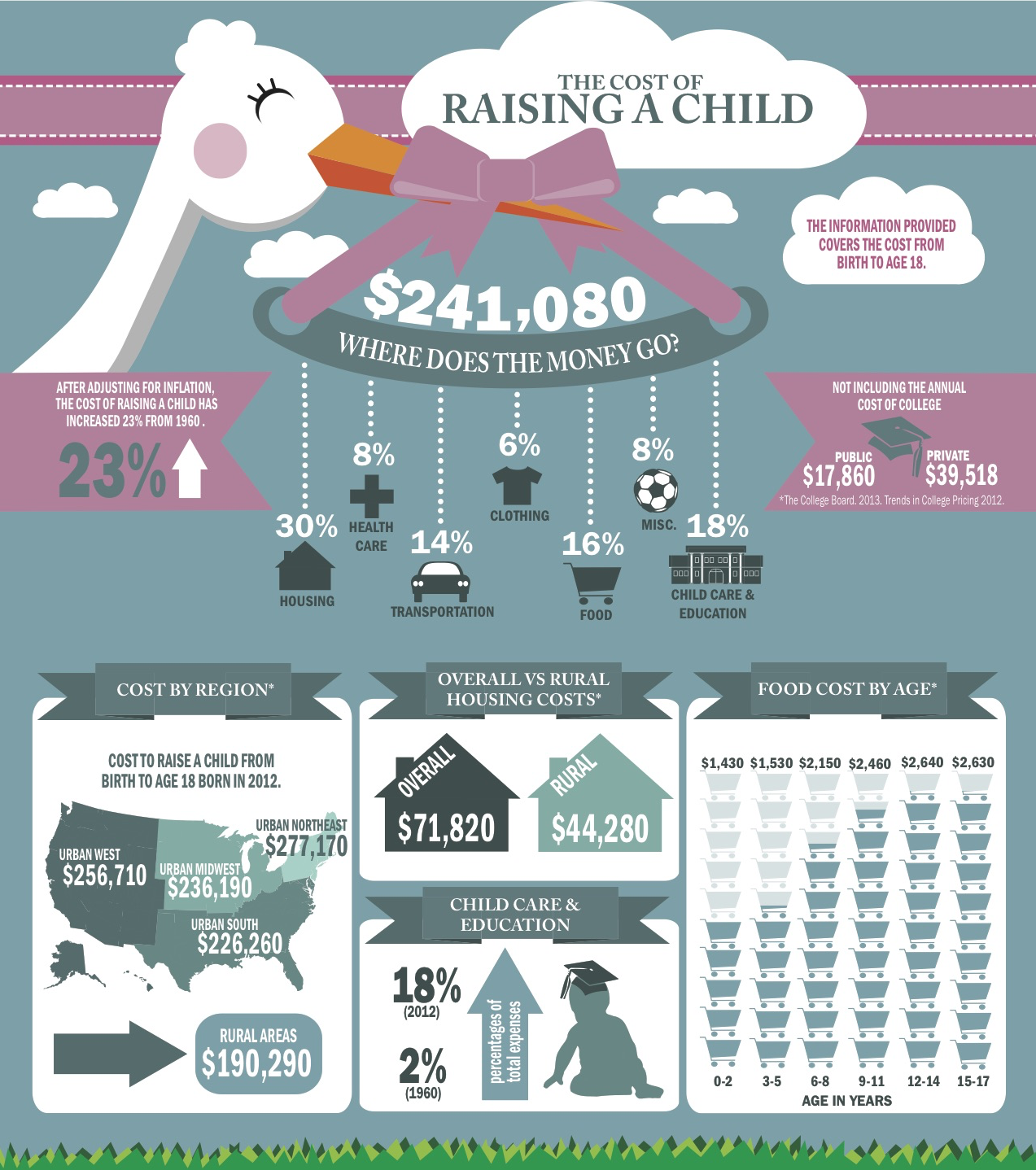
Expenditures of Children by Families, 2012. US. Dept of Agriculture, Center for Nutrition Policy and Promotion. Miscellaneous Publication No. 1528-2012. August 2013.

Expenditures of Children by Families, 2012. US. Dept of Agriculture, Center for Nutrition Policy and Promotion. Miscellaneous Publication No. 1528-2012. August 2013.

So according to the USDA, it costs - on average - about $241,000 to raise a child in the US. That sounds like a bargain to me.  It cost that just to put one of my children through through twelve years of their Jewish school. And that's before I'd bought them a slice of bread. Or an iPhone.

For someone making $60,000 a year, in America, that’s middle class...But in this Orthodox community, $60,000 means you aren’t going to make it.
— Rabbi Ilan Feldman, leader of Congregation Beth Jacob, interviewed in Tablet, July 11, 2014.

Research by the sociologists Sabino Kornrich and Frank Furstenberg has demonstrated that the way Americans spend money on their children has changed over the last several decades.  It turns out that before the the 1990s, parents spent most on children in their teen years. However, after the 1990s, spending patterns shifted, and was greatest when children were under the age of 6 and in their mid-twenties. We've also changed the where we spend on our children - and education now accounts for more than half of what US parents spend on their children. 
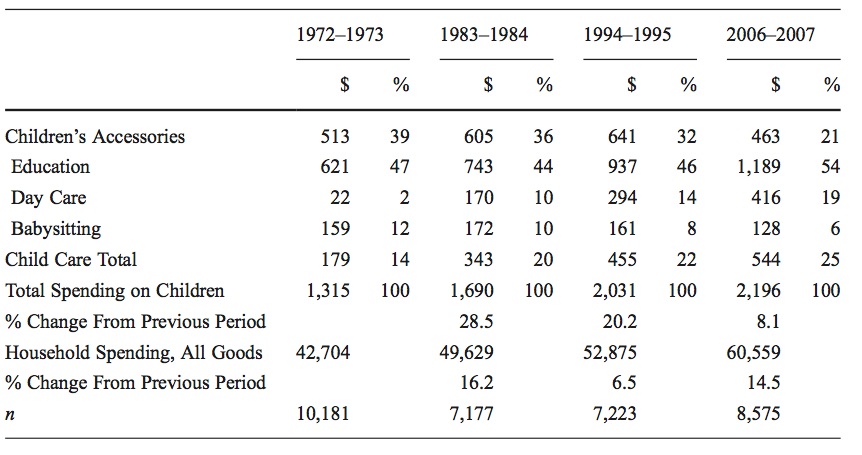
Average spending per child by year and percentage of expenditures in each area for all households with children age 0 to 24. From Kornrich and Furstenburg.  Investing in Children. Demography 2013. 50:1-23.

Average spending per child by year and percentage of expenditures in each area for all households with children age 0 to 24. From Kornrich and Furstenburg.  Investing in Children. Demography 2013. 50:1-23.

There's some good news too, for girls. In the 1970s, parents in households with only male children spent significantly more than parents in households with only female children - and nearly all of that extra money was spent on education. But by the early 2000s, the data showed a reversal: households with only female children spent more than households with only male children. 

Kronrich and Fursetnberg concluded that parents are investing more heavily in their children now than in the past. "While scholars debate exactly which resources matter most for children’s development... parents are demonstrating a substantial willingness to spend in order to better their children’s circumstances. These results mirror other shifts in parental behavior: parents are having fewer children and, through a range of activities like spending time with their children and choosing activities that impart cultural capital, are investing more intensively in the children they do have." 

Treat Your Children Well

Jewish law considers the support of a child to be an act of charity rather than a legal obligation. There is a similar ruling that shows an interesting symmetry at the other end of the spectrum. The Shulchan Aruch (הלכות צדקה סימן רנא) writes

 וכן הנותן מתנות לאביו והם צריכים להם, הרי זה בכלל צדקה

... a child who gives a gift to his parent who needs it, can include this as an act of charity

Just as you are not legally obligated to support your children when they are young, your children have no legal obligation to support you in your old age.  If they choose to do so, their act is one of charity. So treat your children well; they'll be the ones who will choose your nursing home.

Spending on children is one of the most direct ways that parents can invest in children. Parental spending can buy children experiences that build human and cultural capital: high-quality education, residence in better neighborhoods, and potentially high-quality child care while children are young and parents are at work.
— Kornrich and Furstenburg. Investing in Children. Demography 2013. 50:3.
Print Friendly and PDF

The Solar Eclipse

Friday March 20 - An Astronomic Trifecta, +1

Tomorrow, Friday March 20, 2015, is a very important day for astronomers. That's because three events will coincide: the Spring (Vernal) equinox, a super-moon (in which either a full moon or a new moon occurs during the moon's closest approach to Earth) and...a solar eclipse. (And then of course on Friday night it is ראש הודש ניסן – the start of the month of Nissan.) We will discuss the eclipse, which unfortunately will only be visible over north Africa, Israel and most of Europe, as you can see in the animation. (For those in North America, there will be nothing to see, since the eclipse will occur during the night.  If you live there, the next solar eclipse will be on August 21, 2017.  You may stop reading this, and return to this page in two and-a-half years.)

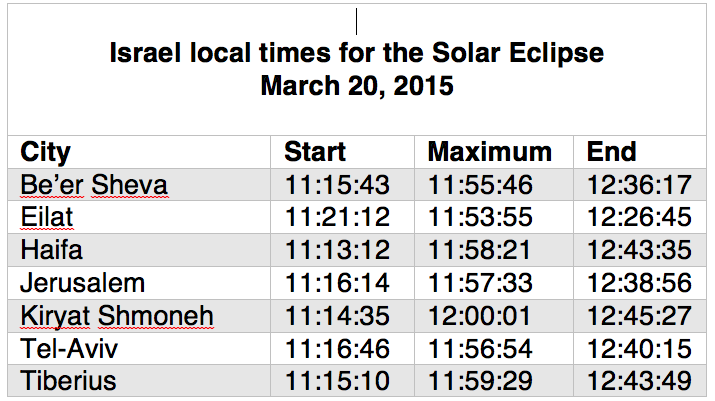
In Israel, and over most of Europe, this solar eclipse will be partial, with the moon taking only a little bite out of the sun's disc. (To experience a full solar eclipse you'll need to be somewhere in the north Atlantic or on Denmarks's Faroe Islands, which are about 200 miles northwest of Scotland.) In Jerusalem the eclipse will begin at 11:16am.  At its maximum (11:58am)  there won't be any noticeable darkening, but if the sky is clear, you'll see something like this:

Screen Shot 2015-03-18 at 10.17.18 AM.png

The Talmud on Eclipses

תלמוד בבלי סוכה דף כט עמוד א 

תנו רבנן: בזמן שהחמה לוקה - סימן רע לעובדי כוכבים, לבנה לוקה - סימן רע לשונאיהם של ישראל, מפני שישראל מונין ללבנה ועובדי כוכבים לחמה...

תנו רבנן: בשביל ארבעה דברים חמה לוקה: על אב בית דין שמת ואינו נספד כהלכה, ועל נערה המאורסה שצעקה בעיר ואין מושיע לה, ועל משכב זכור, ועל שני אחין שנשפך דמן כאחד

Our Rabbis taught, A solar eclipse is a bad omen for idolaters; a lunar eclipse is a bad omen for Israel, because Israel reckons [its calendar] by the moon, and idolaters by the sun...

Our Rabbis taught, A solar eclipse happens because of four things:
1. When an Av Bet Din [head of the Rabbinic Court] died and was not properly eulogized;
2. If a betrothed girl cried out aloud in the city and there was no-one to save her [from being raped];
3. Because of homosexuality; and
4 If two brothers were killed at the same time.
— Sukkah 29a

That's what we have - four causes of a solar eclipse.  And how does Rashi explain this passage?       לא שמעתי טעם בדבר  - "I have not heard any explanation for this." 

The Real Cause of a Solar Eclipse

יערות דבש, דרוש י’ב

יערות דבש, דרוש י’ב

Another attempt to explain the Talmud was offered by Jonatan Eybeschutz (d. 1764). In 1751 Eybeschutz was elected as chief rabbi of the Three Communities (Altona, Hamburg, and Wandsbek), and was later accused of being a secret follower of the false messiah Shabtai Zevi. In January 1751, Eybeschutz gave a drasha Hamburg in Hamburg in which he addressed the very same problem that the Maharal had noted: if a solar eclipse is a predictable event, how can it be related to human conduct? His answer was quite different: The Talmud in Sukkah is not actually addressing the phenomenon that we call a solar eclipse. According to Eybeschutz, the phrase in Sukkah "בזמן שהחמה לוקה" actually means - "when there are sunspots."

Inventive though this is, it is as implausible as the suggestion of the Maharal. In the first place, sunspots were almost (but not quite impossible) to see prior to the invention of the telescope. They were described in March 1611 by a contemporary of Galileo named Christopher Scheiner (though Galileo lost no-time in claiming that he, not Scheiner was the first to correctly interpret what they were.) Because sunspots were so difficult to see with the naked eye, it seems unlikely that this is what the rabbis in Gemara Sukkah were describing.

Courtesy of NASA

Courtesy of NASA

Christopher Scheiner, Rosa Ursina sive Sol (Bracciai 1626-1630)

Christopher Scheiner, Rosa Ursina sive Sol (Bracciai 1626-1630)

Second, according to Eybeschutz, sunspots "have no known cause, and have no fixed period to their appearance".  We can't fault Eybeschutz  for his first claim, but - even by the science of his day - his second was not correct. In fact both Scheiner and Galileo knew  - and wrote - that sunspots were permanent (at least for a while) and moved slowly across the face of the sun.

Sidebar: Eybeschutz, Sunspots and Copernicus

It's interesting to note that Galileo got very excited about the discovery that the spots moved across the face of the sun. This suggested (though it did not prove) that the sun itself was spinning. Galileo had also discovered that Jupiter was orbited by moons. Both of these discoveries now added further support to the Copernican model in which the Earth was spinning on its own axis, and was not the center of all the movement of objects in the sky. But Eybeschutz did not believe Copernicus was correct: "Copernicus and his supporters have made fools of themselves when they declare that the Earth orbits [the Sun]. They have left us with a lie, and the truth will bear itself witness that the Earth stands still for ever."  Eybeschutz wanted to have sunspots explain away a talmudic mystery, but he dismissed the evidence that they provided in other matters - namely, that the earth moves.  

Was the Plague of Darkness a Solar Eclipse? 

Since we are only a couple of weeks before פסח, we will end with another look at an old theory, in which the Plague of Darkness was caused not by a miracle, but rather by a (conveniently timed) solar eclipse.  In 1916 Eduard Mahler (d. 1945)  suggested this explanation in his Handbuch der Jüdischen Chronologie, (Vienna 1887).  According to Mahler, there was a solar eclipse visible in Egypt on Thursday March 13, 1335 BC. Since this was the only such eclipse, it would date the Exodus as occurring on March 27th, 1335 BC.

However, there's an obvious problem: the Torah describes the darkness lasting for three days. But a solar eclipse is over in a matter of minutes.  Mahler has in interesting answer: instead of reading the verses (in Exod. 10) like this:

(22) there was a thick darkness in all the land of Egypt for three days. (23) They did not see each other, or get up from their places for three days.

read them like this:

(22)  there was a thick darkness in all the land of Egypt. (23) For three days they did not see each other, or get up from their places for three days.

The eclipse lasted only a few minutes, but its effect on the Egyptians lasted three days. And what about the Jews in Goshen -why was there no Plague of Darkness there? Because they lived outside of the totality -  the area in which the complete eclipse occurred -  and would not have noted any significant darkening. Now there are some problems with this theory - like the fact that according to NASA, the solar eclipse to which Mahler referred seems to have been only a partial eclipse throughout Egypt. Still, it makes for a good discussion. Try that at your Seder Table.

Print Friendly and PDF

Ketuvot 41 ~ Good Dog. Bad Dog.

Az a yid hot a hunt, iz oder der hunt keyn hunt nit, oder der yid iz keyn yid nit

If a Jew has a dog, either the dog is no dog, or the Jew is no Jew
— Sholem Aleichem. Rabtshik. Mayses far Yidishe Kinder. Ale Verk. Warsaw 1903.

From today's daf:

תלמוד בבלי כתובות דף מא עמוד ב 

ר' נתן אומר: מנין שלא יגדל אדם כלב רע בתוך ביתו, ולא יעמיד סולם רעוע בתוך ביתו? שנאמר: ולא תשים דמים בביתך

Rabbi Natan said: From where do we learn that a person should not raise a bad dog in his house, and should not place a rickety ladder in his house? [From the Torah, where] it states "You shall not place blood in your house" (Deut 22:8).

[First, a disclaimer. I've owned dogs all of my married life, and currently own two of them. Still, I'll try to be as objective as possible.] 

Jews and dogs don't traditionally get along. In Bava Kamma 93a, Rabbi Eliezer does not mince his words: רבי אליעזר הגדול אומר: המגדל כלבים כמגדל חזירים .למאי נפקא מינה? למיקם עליה בארור

Rabi Eliezer the Great said: Soemone who breeds dogs is like someone who breeds pigs. What is the practical outcome of this comparison? To teach that those who breed dogs are cursed...
— Bava Kamma 83a

The American Veterinary Medical Association estimates that in the US there are about 43 million households that own almost 70 million dogs; that means over one-third of the households in the US own a dog.  (Fun Fact: Cats are owned by fewer households in the US, but are more often owned in twos or more. That means that there are more household cats - some 74 million - than there are dogs.) In the UK, a 2007 study estimated that 31% of all households owned a dog.

Bad Dogs

There are some really bad dogs. In a 10 year period from 2000-2009, one paper identified 256 dog-bite related fatalities in the US. Of course that's a tiny number compared to the overall number of dogs owned, but that's still 256 to many; the tragedy is compounded when you read that over half the victims were less than ten years old

Partaken, GJ. et al. Co-occurrence of potentially preventable factors in 256 dog bite–related fatalities in the United States (2000–2009). Journal of the American Veterinary Medical Association 2013. 243:12: 1726-1736.

Partaken, GJ. et al. Co-occurrence of potentially preventable factors in 256 dog bite–related fatalities in the United States (2000–2009). Journal of the American Veterinary Medical Association 2013. 243:12: 1726-1736.

Fatalities from dog bites are rare. Dog bites are not. Over my career as an emergency physician I must have treated hundreds of patients with dog bites. And my experience is pretty typical. One recent study estimated that more than half the population in the US will be bitten by an animal at some time, and that dogs are responsible for 80-90% of these injuries. 

Good Dogs

Although Jews are thought not to have a historical affinity for dogs, one theologian has reassessed the evidence. In his 2008 paper Attitudes toward Dogs in Ancient Israel: A Reassessment, Geoffrey Miller  suggests that in fact dogs were not shunned in Israelite society. He notes that the remains of over a thousand dogs were discovered in a dog cemetery near Ashkelon dating from about the 5th century BC. It was described as "by far the largest animal cemetery known in the ancient world" by Lawrence Stager who also pointed out that during this period, Ashkelon was a Phoenician city - not a Jewish one. Miller surveys several mentions of dogs in the Bible and the Book of Tobit, and concludes that at least some Israelites "valued dogs and did not view them as vile, contemptible creatures." Joshua Schwartz from Bar-Ilan University surveyed Dogs in Jewish Society in the Second Temple Period and in the Time of the Mishnah and Talmud (a study that marked "...the culmination of several years of study of the subject of dogs...").  He found that while "most of the Jewish sources from the Second Temple period and the time of the Mishnah and Talmud continue to maintain the negative attitude toward dogs expressed in the Biblical tradition" there were some important exceptions. There were sheep dogs (Gen. Rabbah 73:11) and hunting dogs (Josephus, Antiquities 4.206) and guard dogs (Pesahim 113a), and yes, even pet dogs (Tobit, 6:2), though Schwartz concedes that "it is improbable that dogs in Jewish society were the objects of the same degree of affection as they received in the Graeco-Roman world or the Persian world."  

תלמוד ירושלמי (ונציה) מסכת תרומות פרק ח דף מו טור א /ה”ג

זמין חד רבן ואייתיב כלבא גביה אמר ליה ביזיון אנא חייב לך אמר ליה רבי טיבו אנא משלם ליה שביין עלון לקרתא עאל חד מינהון בעא מינסב איתתי ואכל ביציו

A certain person invited a sage to his home, and [the householder] sat his dog next to him. [The sage] asked him, ‘How did I merit this insult?’ [The house-holder] responded, ‘My master, I am repaying him for his goodness. Kidnappers came to the town, one of them came and wanted to take my wife, and the dog ate his testicles.’
— PT Terumot 8:7

Whatever your feeling about dogs, lets's be sure to remember that they serve alongside soldiers in the IDF, where they save lives. In 1969, Motta Gur (yes, the same Mordechai "Motta" Gur who commanded the unit that liberated the Temple Mount in the Six Day War, and who uttered those amazing words "The Temple Mount is in our hands!" הר הבית בידינו‎,) wrote what was to become a series of children's books called Azit, the Canine Paratrooper (later turned into a popular feature film with the same title. And now available on Netflix. (Really. It is available on Netflix.)  But IDF dogs don't just feature in fiction. They are a fact, and an amazing addition to the IDF, where they make up the Oketz unit.  Here's a news report (in Hebrew) about the amazing work these dogs - and their handlers- perform. Keep them in your prayers.

Print Friendly and PDF

Happy Pi Day, Happy Birthday Albert Einstein

Pi Day- Ad from paper.jpg

What is Pi Day, and When is it Celebrated?

Tomorrow, March 14, is celebrated by many in the US as Pi Day.  Why? Well, in most of the world, the date is written as day/month/year. So in Israel, all of Europe, Australia, South America and China, tomorrow's date, March 14th, would be written as 14/3. 

But not here in the US. Here, we write the date as month/day/year; it's a uniquely American way of doing things. (Like apple pie. And guns.) So tomorrow's date will be 3/14. Which just happen to be the first few digits of pi, the ratio of the circumference of a circle to its diameter.

3.14159265358979323846264338327950288419716939937510
— The First 50 Digits of Pi

And that's why each year, some (particularly geeky) Americans celebrate Pi Day on March 14 (3/14).  But this year, 2015, is more Pi'ish than all others, since the entire date (when written the way we do in the US, 3/14/15) reflects five digits of pi, and not just the first three: 31415. Actually you can go even more geeky: Tomorrow, at 9:26 and 53 seconds in the morning, the date and time, when written out, represent the first ten digits of Pi: 3141592653.) 

So that's why Pi Day is celebrated here in the US -  and probably not anywhere else. (It has even be recognized as such by a US Congressional Resolution. Really. I'm not making this up. And who says Congress doesn't get anything done?) 

But tomorrow is Shabbat, so we will celebrate Pi Day a day early (Pie Day מוקדם), following the פסק of my colleagues at the National Institutes of Health, (where this kind of thing is taken really seriously):

Pi in the Bible

In the ּBook of Kings (מלאכים א׳ 7:23) we read the following description of  a circular pool that was built by King Solomon. Read it carefully, then answer this question: What is the value of pi that the verse describes?

מלכים א פרק ז פסוק כג 

ויעש את הים מוצק עשר באמה משפתו עד שפתו עגל סביב וחמש באמה קומתו וקוה שלשים באמה יסב אתו סביב 

And he made a molten sea, ten amot from one brim to the other: it was round, and its height was five amot, and a circumference of thirty amot circled it.

Answer: The circumference was 30 amot and the diameter was 10 mot. Since pi is the ratio of the circumference of a circle to its diameter, pi in the Book of Kings is 30/10=3. Three - no more and no less.

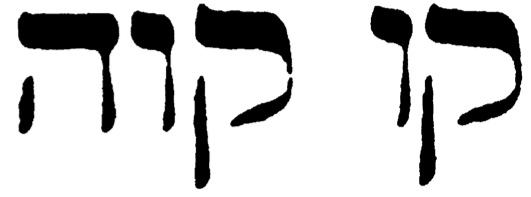
There are lots of papers on the value of pi in the the Bible. Many of them mention an observation that seems to have been incorrectly attributed to the Vilna Gaon.  The verse we cited from מלאכים א׳ spells the word for line as קוה, but it is pronounced as though it were written קו.  (In דברי הימים ב׳ (II Chronicles 4:2) the identical verse spells the word for line as קו.)  The ratio of the numerical value (gematria) of the written word (כתיב) to the pronounced word (קרי) is 111/106.  Let's have the French mathematician Shlomo Belga pick up the story - in his paper (first published in the 1991 Proceedings of the 17th Canadian Congress of History and Philosophy of Mathematics, and recently updated), he gets rather excited about the whole gematria thing:

Detail of calculation of gematria.jpg

A mathematician called Andrew Simoson also addresses this large tub that is described in מלאכים א׳ and is often called Solomon's Sea. He doesn't buy the gematria, and wrote about it in The College Mathematics Journal.

A natural question with respect to this method is, why add, divide, and multiply the letters of the words? Perhaps an even more basic question is, why all the mystery in the first place? Furthermore, H. W. Guggenheimer, in his Mathematical Reviews...seriously doubts that the use of letters as numerals predates Alexandrian times; or if such is the case, the chronicler did not know the key. Moreover, even if this remarkable approximation to pi is more than coincidence, this explanation does not resolve the obvious measurement discrepancy - the 30-cubit circumference and the 10-cubit diameter. Finally, Deakin points out that if the deity truly is at work in this phenomenon of scripture revealing an accurate approximation of pi... God would most surely have selected 355/113...as representative of pi...

Still, what stuck Simoson was that "...the chroniclers somehow decided that the diameter and girth measurements of Solomon's Sea were sufficiently striking to include in their narrative." (If you'd like another paper to read over Shabbat on this subject, try this one, published in B'Or Ha'Torah - the journal of "Science, Art & Modern Life in the Light of the Torah." You're welcome.)

Pi in the Talmud

The Talmud echoes the biblical value of pi in many places. For example:

תלמוד בבלי מסכת עירובין דף יד עמוד א 

כל שיש בהיקפו שלשה טפחים יש בו רחב טפח. מנא הני מילי? - אמר רבי יוחנן, אמר קרא : ויעש את הים מוצק עשר באמה משפתו עד שפתו עגל סביב וחמש באמה קומתו וקו שלשים באמה יסב אתו סביב 

"Whatever circle has a circumference of three tefachim must have a diameter of one tefach."  The problem is that as we've already noted, this value of pi=3 is not accurate. It deviates from the true value of pi (3.1415...) by about 5%. Tosafot is bothered by this too.

תוספות, עירובין יד א

והאיכא משהו. משמע שהחשבון מצומצם וכן בפ"ק דב"ב (ד' יד:) גבי שני טפחים שנשתיירו בארון ששם ספר תורה מונח שהיא בהיקפה ששה טפחים ופריך כיון דלאמצעיתו נגלל נפיש ליה משני טפחים וכן בתר הכי דמשני בספר דעזרה לתחלתו נגלל ופריך אכתי תרי בתרי היכי יתיב משמע דמצומצם לגמרי וקשיא דאין החשבון מדוקדק לפי חכמי המדות

Tosafos can't find a good answer, and concludes "this is difficult, because the result [that pi=3] is not precise, as demonstrated by those who understand geometry." 

Pi in the Rambam

In his commentary on the Mishnah (Eruvin 1:5) Maimonides makes the following observation:

פירוש המשנה לרמב"ם מסכת עירובין פרק א משנה ה 

צריך אתה לדעת שיחס קוטר העיגול להקפו בלתי ידוע, ואי אפשר לדבר עליו לעולם בדיוק, ואין זה חסרון ידיעה מצדנו כמו שחושבים הסכלים, אלא שדבר זה מצד טבעו בלתי נודע ואין במציאותו שיודע. אבל אפשר לשערו בקירוב, וכבר עשו מומחי המהנדסים בזה חבורים, כלומר לידיעת יחס הקוטר להקיפו בקירוב ואופני ההוכחה עליו. והקירוב שמשתמשים בו אנשי המדע הוא יחס אחד לשלשה ושביעית, שכל עיגול שקוטרו אמה אחת הרי יש בהקיפו שלש אמות ושביעית אמה בקירוב. וכיון שזה לא יושג לגמרי אלא בקירוב תפשו הם בחשבון גדול ואמרו כל שיש בהקיפו שלשה טפחים יש בו רוחב טפח, והסתפקו בזה בכל המדידות שהוצרכו להן בכל התורה.

...The ratio of the diameter to the circumference of a circle is not known and will never be known precisely.  This is not due to a lack on our part (as some fools think), but this number [pi] cannot be known because of its nature, and it is not in our ability to ever know it precisely.  But it may be approximated ...to three and one-seventh.  So any circle with a diameter of one has a circumference of approximately three and one-seventh.  But because this ratio is not precise and is only an approximation, they [the rabbis of the Mishnah and Talmud] used a more general value and said that any circle with a circumference of three  has a diameter of one, and they used this value in all their Torah calculations.

So what are we to make of all this? Did the rabbis of the Talmud get pi wrong, or were they just approximating pi for ease of use?  After considering evidence from elsewhere in the Mishnah (Ohalot 12:6 - I'll spare you the details), Judah Landa, in his book Torah and Science, has this to say:

We can only conclude that the rabbis of the Mishnah and Talmud, who lived about 2,000 years ago, believed that the value of pi was truly three. They did not use three merely for simplicity’s sake, nor did they think of three as an approximation for pi. On the other hand, rabbis who lived much later, such as the Rambam and Tosafot (who lived about 900 years ago), seem to be acutely aware of the gross innacuracies that results from using three for pi. Mathematicians have known that pi is greater than three for thousands of years. Archimedes, who lived about 2,200 years ago, narrowed the value of pi down to between 3 10/70 and 3 10/71 !
— Judah Landa. Torah and Science. Ktav Publishing House 1991. p.23.

Happy Birthday, Einstein

Tomorrow, March 14, is not only Pi Day. It is also the anniversary of the birthday of Albert Einstein, who was born on March 14, 1879. As I've noted elsewhere, Einstein was a prolific writer; one recent book (almost 600 pages long) claims to contain “roughly 1,600” Einstein quotes. So it's hard to chose one pithy quote of his on which to close.  So here are two.  Shabbat shalom, Happy Pi Day, and happy birthday, Albert Einstein.


The most beautiful experience we can have is the mysterious. It is the fundamental emotion that stands at the cradle of true art and true science. Whoever does not know it and can no longer wonder, no longer marvel, is as good as dead, and his eyes are dimmed. It was the experience of mystery — even if mixed with fear — that engendered religion. A knowledge of the existence of something we cannot penetrate, our perceptions of the profoundest reason and the most radiant beauty, which only in their most primitive forms are accessible to our minds: it is this knowledge and this emotion that constitute true religiosity. In this sense, and only this sense, I am a deeply religious man...
— Albert Einstein. Ideas and Opinions. New York. Crown 1954. p11.
 
There could be no greater calamity than a permanent discord between us and the Arab people. Despite the great wrong that has been done to us, we must strive for a just and lasting compromise with the Arab people. Let us recall that in former times no people lived in greater friendship with us than the ancestors of these Arabs.
— Shaviv and Rosen (eds). General Relativity and Gravitation. Wiley. p.242.
Print Friendly and PDF