Gittin 30b ~ Longevity II: Death and Wealth

גיטין ל ,ב

חברך מית אשר איתעשר לא תאשר

If you hear that your friend has died, believe it. But if you hear that he became wealthy, don't believe it. (Gittin 30b)

calculator.jpeg

Not every aphorism can be scientifically tested.  Is a bird in the hand really worth two in the bush? Which species of bird? How old? How far away is the bush?  How many cooks is too many to spoil the broth?  Aphorisms are short phrases that summarize a basic truth, and as such they that do not easily lend themselves to scientific scrutiny. Having admitted this, let's have some fun anyway by subjecting a talmudic aphorism to just such scrutiny.  The aphorism is found in today's page of Talmud, (Gittin 30b) and declares that a person is more likely to die than become wealthy. It is cited in the name of Rav Pappa, who himself declares it to be a common saying. He died around 375 CE in Babylonia.

Some Cautions

To be completely fair, the saying should be compared to the conditions of the society in which it arose.  Although we have tried to estimate longevity back in Babylonia, we don't have anywhere near the mortality data by decade that we would need. Nor do we know what was meant by the term wealthy, and what proportion of the Jewish population of fourth-century Babylonia attained such wealth.  So let's be really unfair and analyze the aphorism using contemporary data from one part of the developed world - the United States.

What do we talk about when we talk about wealthy?

It is hard to agree on a definition of wealthy. We could use the famous Mishnah in Avot (4:1) as a measure: "איזהו עשיר? השמח בחלקו": "Who is wealthy? One who is satisfied with what he has." The problem with this definition is that an unsatisfied billionaire would not be counted as wealthy. But because wealth usually refers to an amount of money, that's the understanding we will use.

In the recently published academic text Geographies of the Super-RichIain Hay (the Distinguished Professor of Human Geography at Flinders University in Australia, no less) notes that wealth takes on "different meanings depending on one's age, culture, ideology and personal point of view." Some have defined it as the ability to live comfortably off the interest of one's wealth - a figure in the EU of about 3 million euros (or about $3.3 million).  In the UK, some researchers defined the wealthy as those who owned £5 million or more in disposable assets, while in the US, entry into Richistan begins with a household worth of $1million. If we agree to use the definition of wealthy - or High Net Worth Individuals (HNWI) as individuals who hold financial assets in excess of $1million, then this is what the numbers look like:

Top Five Largest Net Worth Populations

Rank Country High Net Worth Population
1 United States 3,104,000
2 Japan 1,739,000
3 Germany 924,000
4 China 535,000
5 United Kingdom 454,000

Data from the World Wealth Report 2007, and cited in Hay, I (ed). Geographies of the Super-Rich. Edward Elgar 2013. p6

Given that the US population in 2007 was about 300 million, then the wealthy make up about 1%

Next, we need to figure out the age at which millionaires become, well, millionaires. According to data from here, it takes 32 years for the average self-made millionaire to reach that lofty goal. (We will ignore inherited wealth, to keep things simple.)  More specifically, 

  • 1% became wealthy before the age of 40

  • 3% became wealthy between age 40 and 45

  • 16% became wealthy between age 46 and 50

  • 28% became wealthy between age 51 and 55

  • 31% became wealthy between age 56 and 60

  • 21% became wealthy after the age of 60

What are Your chances of Dying?

The Social Security Administration's Actuarial Life Table shows the probability of death at a given age.  Here is the data summarized by decade:

Age Probability of Death for Men Probability of Death for Women
20 0.1% <0.1%
30 0.1% 0.1%
40 0.2% 0.1%
50 0.5% 0.3%
60 1.1% 0.6%
70 2.4% 1.6%
80 6.1% 4.4%

The Upshot - The Aphorism Seems Correct

So now let's put this all together. As you can see in the table below, by age 40 you have about a 0.01% chance of having become a self-made millionaire. At that same age, your chances of dying are far higher: 0.2% for men and half that for women. In other words, at age 40 you are twenty times more likely to die than to become a self-made millionaire if you are a man. Women have slightly better odds: They are only ten times more likely to die at that age than to become a millionaire.

Probability estimates of dying or beomming a self-made millionaire in the US

Age Probability of Death for Men Probability of Death for Women Proportion of millionaires who achieved wealth by age Prevalence of millionaires in the general population by age
20 0.10% <0.10% <1% <0.01%
30 0.10% 0.10% 1% 0.01%
40 0.20% 0.10% 1% 0.01%
50 0.50% 0.30% 19% 0.19%
60 1.10% 0.60% 59% 0.59%
70 2.40% 1.60% 21% 0.21%
80 6.10% 4.40% unknown unknown

Things don't change much with age. Most self-made millionaires make their money between the age of 50 and 60. The likelihood of death at age 60 is 1.1% for men - twice as high as the likelihood of a having become a self-made millionaire, though for women the odds are about the same.

It would seem that the aphorism quoted in today's page of Talmud is indeed correct - at least for the population in the US, based on some very rough statistical estimates.  Given that the mortality rates were far higher in centuries past, this aphorism was probably so obviously true that it needed no statistical back flips to support it.  

 

Print Friendly and PDF

Gittin 28a ~ Longevity I: How Long Do We Live?

גיטין כח, א

מתני' המביא גט והניחו זקן או חולה נותן לה בחזקת שהוא קיים

גמ' אמר רבא לא שנו אלא זקן שלא הגיע לגבורות וחולה שרוב חולים לחיים אבל זקן שהגיע לגבורות וגוסס שרוב גוססין למיתה לא

 איתיביה אביי המביא גט והניחו זקן אפי' בן מאה שנה נותן לה בחזקת שהוא קיים תיובתא ואי בעית אימא כיון דאיפליג איפליג

MISHNAH: If an agent brought a Get and the husband was an old man or was sick, he should still give it to the wife on the assumption that the husband is still alive...

old-man-laughing.jpg

GEMARA: Rava said: [this Mishnah] speaks only of a husband who is not yet eighty years old and of a husband who is ill [but not dying], because most ill people recover. But if the husband is an old man who has already reached the age of eighty, or was in the process of dying, then the Get should not be given to the wife, because most people who are dying do actually die. 

Abaye raised the following objection [to Rava from a Baraisa]: 'If an agent was bringing a Get and he left when the husband was old, even a hundred years old, he should give it to the wife on the assumption that the husband is still alive. 

This is indeed a refutation [to Rava]. But it is still possible to accept Rava’s position, because [in the case of the Baraisa] if a man reaches such an exceptional age, he is altogether exceptional and unlike other elderly men [and so it may be assumed that the elderly husband is still alive when his appointed agent reaches the wife to give her the Get.]

This is the first of a two part examination of statements of longevity in the Talmud, and how they measure up against data from the sciences today.  Was Rava correct in assuming the outer limit of longevity to be around 80 years, and do those who make it into their golden years have good odds of making it even further? Let's take a look.

Nasty, Brutish and Short

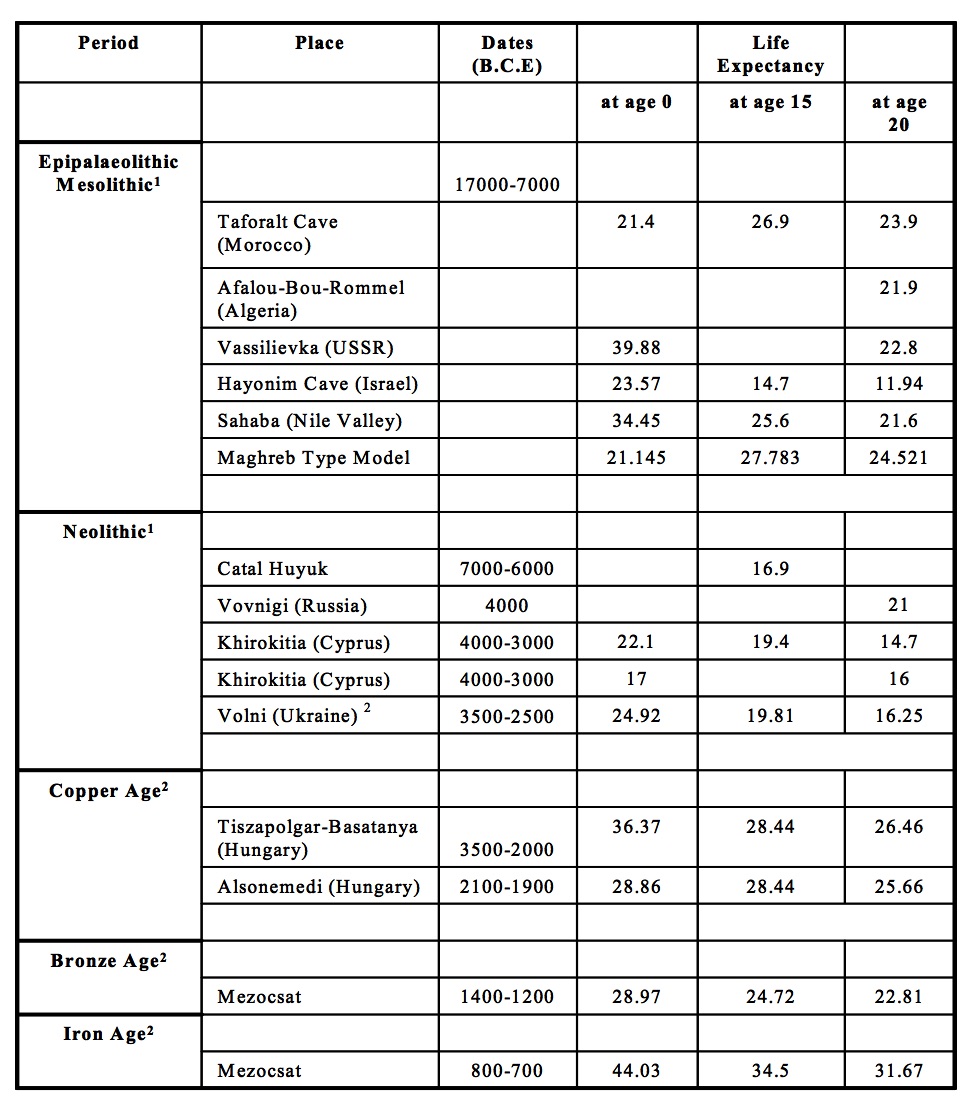
It's quite a challenge to estimate how long most people lived way, way back. But there are some data to suggest that life was, as Thomas Hobbs wrote in his Leviathan "nasty brutish and short". For example, in the Bronze Age - that would be the time in which the Patriarch Abraham, Isaac and Jacob lived lived - life expectancy was about 20-30 years.  So yes, Abraham's death at the age of 175, or Sarah's at the age of 127, are both examples of ultra-extreme-turbo-charged longevity.   

Life Expectancy: From the Epipalaeolithic Period to the Iron Age. From Oded Galor and Omer Moav.Life Expectancy: From the Epipalaeolithic Period to the Iron Age. Unpublished paper 2005.

Life Expectancy: From the Epipalaeolithic Period to the Iron Age. From Oded Galor and Omer Moav.Life Expectancy: From the Epipalaeolithic Period to the Iron Age. Unpublished paper 2005.

Longevity of Human and Other Primates

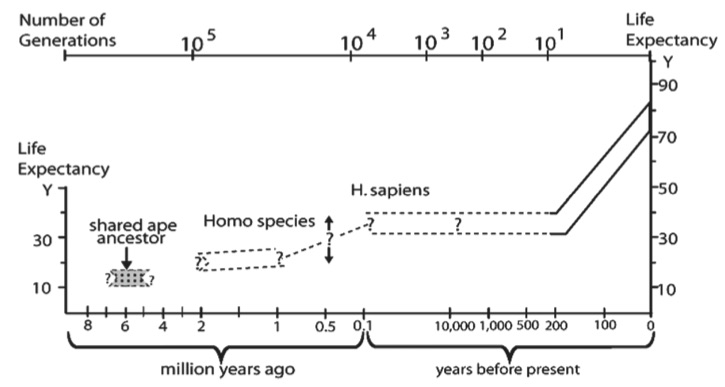
Among all the primates, humans have the greatest life expectancy at birth.  Before the industrial era, human life expectancy at puberty was about 30 years, about twice that of chimpanzees.  Based on evidence from tooth eruption found in skulls it has been possible to estimate the life expectancy of the earliest common ancestor of humans and the great apes. But all this was long ago and far away, and, let's be honest, we really don't know very much about what happened back then. However we do have better data about more recent societies, so let's jump to life under the Romans...

Evolution of the human life expectancy (LE).&nbsp;The LE at birth of the shared great ape ancestor is hypothesized to approximate that of chimpanzees, which are the closest species to humans by DNA sequence data. The LE of chimpanzees at puberty is …

Evolution of the human life expectancy (LE). The LE at birth of the shared great ape ancestor is hypothesized to approximate that of chimpanzees, which are the closest species to humans by DNA sequence data. The LE of chimpanzees at puberty is about 15 years, whereas pre-industrial humans had LE at puberty of about 30 years Since 1800 during industrialization, LE at birth as well as at later ages has more than doubled. LE estimates for ancestral Homo species are hypothesized to be intermediate based on allometric relationships . Ages of adult bones cannot be known accurately after age 30 even in present skeletons .The proportion of adults to juveniles does, however, suggest a shift toward greater LE at birth. The few samples in any case cannot give statistically reliable estimates at a population level. The number of generations is estimated at 25 years for humans.From Finch, C.  Evolution of the Human Lifespan, Past, Present, and Future: Phases in the Evolution of Human Life Expectancy in Relation to the Inflammatory Load. Proceedings of the American Philosophical Society. 2012:156 (1). 9-44

Life Expectancy in the Roman Empire

Life Table for the Roman Empire, adapted from Parkin, TG. Demography and Roman Society. John Hopkins University Press 1992.

Life Table for the Roman Empire, adapted from Parkin, TG. Demography and Roman Society. John Hopkins University Press 1992.

In Roman society, lifespan remained pretty short, and it was still rather brutish. One-third of all new-borns died within their first year of life.  This high infant death rate put the average life expectancy at birth to 20-30 years. But if an infant made it beyond that stormy first year, her projected life expectancy was 33 years. Indeed as you got older, your projected life expectancy increased: if you made it to the age of 45 (and only 6% of the population did) then your projected life expectancy was whopping 61 years, as you can see in the chart. However, very few reached the age of 60, and it is estimated that fewer that 1 in 1,000 (0.001%) lived to age 80.  (By comparison, today in Israel over 3% of the population is over 80. In the US its almost 4%.) Based on a number of sources, the historian John Barclay wrote "that people who died in their 60s would be considered to have lived a full life."

Life Expectancy in the Middle Ages and Beyond

Life Expectancy (at birth) in England 1540 -1870. From Wrigley, E.A., and R.S. Schofield.&nbsp;The Population History of England 1541-1871: A Reconstruction Harvard University Press,1981. 

Life Expectancy (at birth) in England 1540 -1870. From Wrigley, E.A., and R.S. Schofield. The Population History of England 1541-1871: A Reconstruction Harvard University Press,1981.


Life in the middle ages was not much better. Life expectancy at birth was around 35 years. As urbanization increased and people began to live in closer proximity  to one another, the mortality risk increased.  Two Israeli scholars estimate that "...life expectancy at birth fell from about 40 at the end of the 16th century to about 33 in the beginning of the 17th century while mortality rates increased by nearly 50%."  Life expectancy continued to remain low by modern standards over the next few centuries, although there was an upward trend.

Life Expectancy in the Modern World

Things have gotten much better, very quickly. In the US the average length of life was about 47 years in 1900. Today it is almost double that. This is true for all of the economically developed countries, thought if you want to maximize your chances for a long life, you should live in Monaco; the life expectancy is almost 90 years. But unfortunately only about 30,000 people live there. (This data comes from the CIA, so it must be true.) Although there remains a large disparity in life expectancy between the developed world and Africa, life expectancy is increasing across the globe as a whole.

By Rcragun (Own work) [CC BY 3.0 (http://creativecommons.org/licenses/by/3.0)], via Wikimedia Commons

By Rcragun (Own work) [CC BY 3.0 (http://creativecommons.org/licenses/by/3.0)], via Wikimedia Commons

Back to the Talmud

In the passage from the Talmud with which we opened, Rava suggests that a man who has reached eighty is at the very limit of his natural life-span, and may die at any time. If such a person sent an agent to end his marriage - and presuming the trip was relatively long - we cannot assume the elderly husband will still be alive by the time the agent reaches his destination.  Rava's assumption is supported by the evidence we have reviewed here. Today, life expectancy in the economically advanced nations hovers right around 80 years, and so Rava's 80 year suggestion seems particularly fitting. But will it remain so in the future? Over the last century the average length of life doubled: could this happen again over the span of the present century?  There is no end to "experts" predicting a huge increase in longevity, but for the foreseeable future a slow increase to around 100 years (at least in the developed nations) is certainly possible. This is not to suggest that Rava's estimates were only correct for us today. It would seem in that in many earlier societies, eighty years was a reasonable guess for the outer limit of how long it is possible to live.  

There's one other point. Abaye objected to Rava by citing a Baraisa:  "If an agent was bringing a Get and he left when the husband was old, even a hundred years old, he should give it to the wife on the assumption that the husband is still alive."  To reconcile this with Rava, the Talmud suggests that once a person has reached an old age, he has shown himself to be "exceptional" (איפליג). Actuarial studies today show that this is indeed the case - and it is certainly likely to have been true in Rava's time. (He died around the age of 70 in 352 CE in Babylonia). In Roman times, although chances were against you living to 50 - if you did make it to that birthday you could expect to live a further eleven years. And take a careful look at the chart below, which shows life expectancy today once you make it to 65 years of age or better.

Estimates of life expectancy at selected ages, in two longitudinally followed US populations for persons who remain fully functional.&nbsp;Values in parentheses represent the average lifespan (mean age at death). From Manton KG, Stallard E, Tolley H…

Estimates of life expectancy at selected ages, in two longitudinally followed US populations for persons who remain fully functional. Values in parentheses represent the average lifespan (mean age at death). From Manton KG, Stallard E, Tolley HD. Limits to human life expectancy: evidence, prospects and implications. Population and Development Review 1991. 17 (4): 603-637.

Today, if you make it to 85, you might expect another 20 years of life (or only 11 if you are man). So the Talmud is spot on - once you prove yourself to have exceptional longevity, the future looks pretty good. Until it doesn't.

Next time on Talmudology, Longevity II:

"If  you hear that your friend died, believe it. If you hear that he became wealthy, don't believe it."

Our days may come to seventy years, or eighty, if our strength endures;
— Psalm 90.
Print Friendly and PDF

Nedarim 41b ~ Fever

נדרים  מא, א–ב

אמר רבא האי אישתא אי לאו דפרוונקא דמלאכא דמותא מעלי כחיזרא לדיקלי חד לתלתין יומין

Rava said about a fever: "Were it not for the fact that it is an agent of the Angel of Death, it would be beneficial for a person as a prickly foliage is for palm trees, if it is experienced once every thirty days...(Nedarim 41a-b).

As an emergency physician I've treated hundreds and hundreds of patients who came to the ER with a fever.  In fact fever is the third most common reason in the US for which people visit the ER - accounting for over 5 million visits each year. At virtually every visit they'd be given a medicine to reduce their fever, as if by doing so we were achieving something medically important. But in this page of Talmud, we read that according to Rava, fever is actually beneficial to a person (at least when it does not kill...).  How does this claim made by Rava, a Babylonian sage who died around the year 352 CE, stand up to today's medical science? Remarkably well, it turns out. Here's why.

Fever 101

Here are some basic things to know about fever. First, it is usually defined as a core temperature in humans above 38.3 C, or 101 F.  Second, there are lots of reasons why people get a fever, of which bacterial and viral infections are the most common, but not the only causes.  Third, and this is really important, not all fevers mean the same thing in terms of their seriousness.  Fever in a baby less than a month old requires an urgent and extensive evaluation. The same fever in a healthy toddler does not.  Fever in a healthy teenager is not the same as fever in an elderly patient on chemotherapy.  Finally, fever is not caused by the infection, at least not in the way you might think. It is the body's response to that infection that produces a fever.  Here's how.

The Biochemical Pathway to Fever

When bacteria infect the body, their foreign structure is recognized by white cells in the blood called macrophages. These macrophages then release a prostaglandin E2, interleukin-1, interleukin-6, and tumor necrosis factor. These act on a region deep in the brain called the hypothalamus, which acts as a thermostat for the body. Under the influence of interleukin-1 the hypothalamus releases a hormone called cyclooxygenase 2 (COX-2) which resets the body's thermostat, causing the temperature of the body to rise by a few degrees.  

How a fever is caused by a bacterial infection. From Evans, Repasky and Fisher. Fever and the thermal regulation of immunity: the immune system feels the heat. Nature Reviews Immunology June 2015: 15: 337.

How a fever is caused by a bacterial infection. From Evans, Repasky and Fisher. Fever and the thermal regulation of immunity: the immune system feels the heat. Nature Reviews Immunology June 2015: 15: 337.

It's not just people who get fevers. Dogs and cats do too, as do mice (and all mammals), reptiles, and even goldfish. Why would so many animals respond to an infection by developing a fever?

The Benefits of Fever

The reason is simple. The immune system fights infections better when the body is hotter. The way it does this is now well-understood but very complicated; here are just the highlights. 

Under what immunologists call "thermal stress" (and the rest of us call "a fever",) neutrophils, the white cells that are needed to fight infection, are released in greater numbers from the bone marrow.  These neutrophils also do a better job of fighting bacteria at the site of the infection when the body is warmer.  Fever also improves the killing ability of another group of blood cells called natural killer cells, and it increases the ability of the macrophages to ingest and destroy the invading bacteria. As last month's excellent review of fever and the thermal regulation of immunity in Nature Reviews concluded, "[t]he picture that emerges is one in which febrile temperatures serve as a systemic alert system that broadly promotes immune surveillance during challenge by invading pathogens."  

So your body does a better job of fighting bacteria when it is hotter.  Why then, do doctors give medicines that reduce a fever?  Good question. The truth is, they really shouldn't.

Don't Reach for That Tylenol/Paracetomol/AcAmol 

Acomol.jpg

If you are the parent of a child with a fever, you are likely to give your sick offspring a medicine that interferes with the immune system, like Tylenol if you are in the US, Paracetamol if you are in the UK or South Africa, or Acamol in Israel (though they are different words for the same medicine.)  But if, as we have seen, the body does a better job of fighting infection when it is a few degrees hotter, might reducing the fever lead to a worse outcome for the child?

This question was recently examined by a group from McMaster University in Canada. They looked at the side effects of reducing a fever in those who are sick from a population level . What happens in a large group of people when some of them - infected with, say, influenza - take medicines to reduce their fever? The answer is that more of them transmit the virus and so more of them fall ill.  On a population level the effect is rather drastic:

Putting together our estimates of the treatment probability p and the individual transmission enhancement factor fi ...we conclude that the current practice of frequently treating fevers with antipyretic medication has the population-level effect of enhancing the transmission of influenza by at least 1% (95% CI: 0.04–3%)...This estimate does not take into account the known effect that the infectious period of influenza is also increased by antipyresis, nor does it take into account the potentially large effect of increasing the rate of contact among infectious and susceptible individuals because antipyresis makes infectious individuals feel better...To put our lower bound...into perspective, consider that approximately 41,400 ...deaths per year are attributed to seasonal influenza epidemics in the United States (and an order of magnitude more worldwide). Taken at face value, our results indicate, for example, that...at least 700 deaths per year ... could be prevented in the US alone by avoiding antipyretic medication for the treatment of influenza...

In the absence of meaningful evidence for the beneficial effects of fever reduction, the commonplace reduction of fever in critically ill patients must be called into question.
— Ryan and Levy. Clinical Review: Fever in intensive care patients. Critical Care 2003, 7:224.

The Canadian investigators concluded that "...the use of antipyretics can have subtle and potentially important negative effects at the population level. Any medical intervention that aims to relieve the symptoms of an infectious disease in an individual should also be evaluated in light of potentially harmful effects at the population level..." And it's not just populations that can suffer; individual patients are at risk too. In a 2011 paper looking at the treatment of fever in very ill patients with sepsis in the ICU,  a French team looked at the beneficial and detrimental effects of fever, and concluded that "...the widespread use of antipyretic methods in ICU patients is not supported by clinical data and fever control may be harmful, particularly when an infectious disease is progressing..."

From Lainey Y. et al. Clinical review: Fever in septic ICU patients - friend or foe? Critical Care 2011:15:222

From Lainey Y. et al. Clinical review: Fever in septic ICU patients - friend or foe? Critical Care 2011:15:222

The Death of Rav Assi - from Fever

So Rava's teaching in tomorrow's dafNedarim 41b appears to be spot on.  Fever is indeed beneficial for the body, though it is a sign that something bad is going on.  Elsewhere in the Talmud (Niddah 36b, which we will learn on November 28, 2019, הבא עלינו לטובה) we read that another Babylonian Amora, Rav Assi, died from a fever accompanied with chills - the classic description of sepsis (and a lot else besides, too). It is interesting to note that Rav Assi's attendants tried to reduce his fever.  Perhaps they not aware of the tradition that Rava - who was born two generations later - would later teach.

R. Assi fell ill and they had to put him in hot [blankets] to relieve him from chills, and in cold [compresses] to relieve him from heat,[but] his soul departed to its eternal rest. (Niddah 36b.)

Fever may be beneficial, but the underlying infection of which it is a sign never is.  Which is why,in the next daf  (Nedaraim 42,) Rava's teaching was not accepted by by Rav Nachman bar Yitzchak who retorted: לא היא ולא תירייקה:  "Give me neither fever, nor its antidote!"

Print Friendly and PDF

Gittin 19a ~ Mishnaic Inks

משנה גיטין יט, א

scribe-at-work-.jpg

בכל כותבים בדיו בסם בסיקרא ובקומוס ובקנקנתום ובכל דבר שהוא של קיימא אין כותבין לא במשקין ולא במי פירות ולא בכל דבר שאינו מתקיים 

A get may be written with any material, with ink, with paint, with red pigment, with gum, or with shoe blackening, or with anything which lasts. It may not be written with liquids or with fruit-juice or with anything that is not lasting...

Which international best-seller was set in the middle ages and featured a poisonous ink used to illuminate manuscripts? Click here for the answer.

It is a challenge to identify each of the materials mentioned in this Mishnah, but that hasn't stopped people from trying. In a 1964 paper published in Chymia (that would be the International Journal for Chemistry), Martin Levey from Yale University suggested that דיו – diyo is a black ink whose color is due to soot particles.  Based on prior work (by Low and others) he wrote that that the best soot came from olive oil, which was then mixed with balsam. קנקנתום -Kankantum is translated in the Schottenstein Talmud as copper sulfate. How the editors arrived at this translation is not clear. Perhaps they are basing it on אורח חיים הלכות תפילין לב, ג where the משנה ברורה suggests that it is "קופער וואסער" - "copper water".  Levey claims that in Babylonia, kankantum was green and contained not copper but ferrous sulfate. In a more recent paper on the ink content of middle Persian documents, the author found that they too contained lamp soot which was gathered from inside a chimney that burned linseed oil. The soot was then sieved to produce a fine powder that was bound with Gum Arabic, made from the sap of the acacia tree.

...He dictated all these words to me, and I wrote them with ink in the book.
— Jeremiah 36:18

Dead Sea Ink

A group of German scientists recently analyzed the ink on one of the Dead Sea Scrolls and reported their findings in Dead Sea Discoveries. They used x-ray spectroscopy, in which an electron beam is bounced over the sample, and the spectrum of radiation that is given off is measured. As you can see in the figure below, the spectrum of the Dead Sea Scroll ink is similar to Gum Arabic, but it contains peaks that suggest other compounds, including a gum produced by the Acacia Raddiana, known in Hebrew as שיטה סלילנית. Not surprisingly this tree is only found in very dry or desert climates.   

Spectroscopy results of the ink from a Dead Sea Scroll (1QHa) marked as TG ink, compared with Gum Arabic, Gum Rasdsiana and ink prepared according to Maimonides' recipe. &nbsp;From Ira Rabin, Oliver Hahn, Timo Wolff, Admir Masic and Gisela Weinberg.…

Spectroscopy results of the ink from a Dead Sea Scroll (1QHa) marked as TG ink, compared with Gum Arabic, Gum Rasdsiana and ink prepared according to Maimonides' recipe.  From Ira Rabin, Oliver Hahn, Timo Wolff, Admir Masic and Gisela Weinberg. On the Origin of the Ink of the Thanksgiving Scroll (1QHodayot). Dead Sea Discoveries, 2009: 16 (1)97-106.

But the German team made an amazing discovery. No, really, it was amazing.  They compared the spectrum given off by the Dead Sea Scroll ink to a recipe for ink that Maimonides details in his Mishneh Torah,  and which is shown in the lowermost line in the Figure above.  You can see how it resembles TG sample that is the scroll ink. Here is what they wrote:  

To our astonishment the best correspondence was found when comparing the spectra of the ink from the scroll with a sample of ours prepared according to Maimonides' recipe, dating from the 12th century.

Analysis of the spectrum of the scroll ink also suggests the presence of tannins -a group of chemicals naturally found in many trees and plants. The authors note that Maimonides' recipe uses gall-nuts, which contain tannins.  

Maimonides' prescription could indicate the survival of an ancient use, whose actual reason had been forgotten. In this case the tannins would chemically bind the ink to the parchment collagen, explaining the surprising durability of the scroll inks as compared to the usual, physisorbed, carbon-based ink.   

Let's conclude with that recipe from the Rambam's Mishneh Torah, which is almost identical to the ink used on a Dead Sea Scroll that was written around 100 CE. Today there are several recipes for ink, but for those who use the Rambam's, they are following a recipe that has been in continuous use for at least 1,900 years. That what the science in this daf tells us.   

רמב"ם הלכות תפילין ומזוזה וספר תורה פרק א 

כיצד מעשה הדיו, מקבצין העשן של שמנים או של זפת ושל שעוה וכיוצא בהן וגובלין אותן בשרף האילן ובמעט דבש ולותתין אותו הרבה ודכין אותו עד שיעשה רקיקין ומיבשין אותו ומצניעין אותו, ובשעת כתיבה שורהו במי עפצים וכיוצא בו וכותב בו, שאם תמחקנו יהיה נמחק, וזהו הדיו שמצוה מן המובחר לכתוב בו ספרים תפילין ומזוזות

How is the ink made? One collects lamp-black obtained from oil or from pitch, wax  or similar substances; one binds them with wood resin and a little honey, and they are kneaded well and flattened into cakes.  Then they are dried and put away. When they are used to write, they are soaked in gall-nut water or something similar and he writes with it.  And if the writing needs to be erased, it may be erased.  This is the finest ink used for writing a Sefer Torah, Tefillin, and Mezuzot. (Hil. Tefillin 1:4).

Print Friendly and PDF