Israel's Noble History

Free Clipart

Update: There have been  no new Israeli winners of the Nobel Prize since this was posted last year. But the story of this remarkable group of talented Israelis is certainly worth telling again today, the Fifth of Iyyar, the anniversary of the day on which Israel declared statehood in 1948.

ISRAELI NOBEL PRIZE WINNERS FOR $200 PLEASE, ALEX

Quick. Name three Israelis who have won a Nobel Prize. Come on. You can do this. Still need a hint? Click here. See, I told you you'd know.  
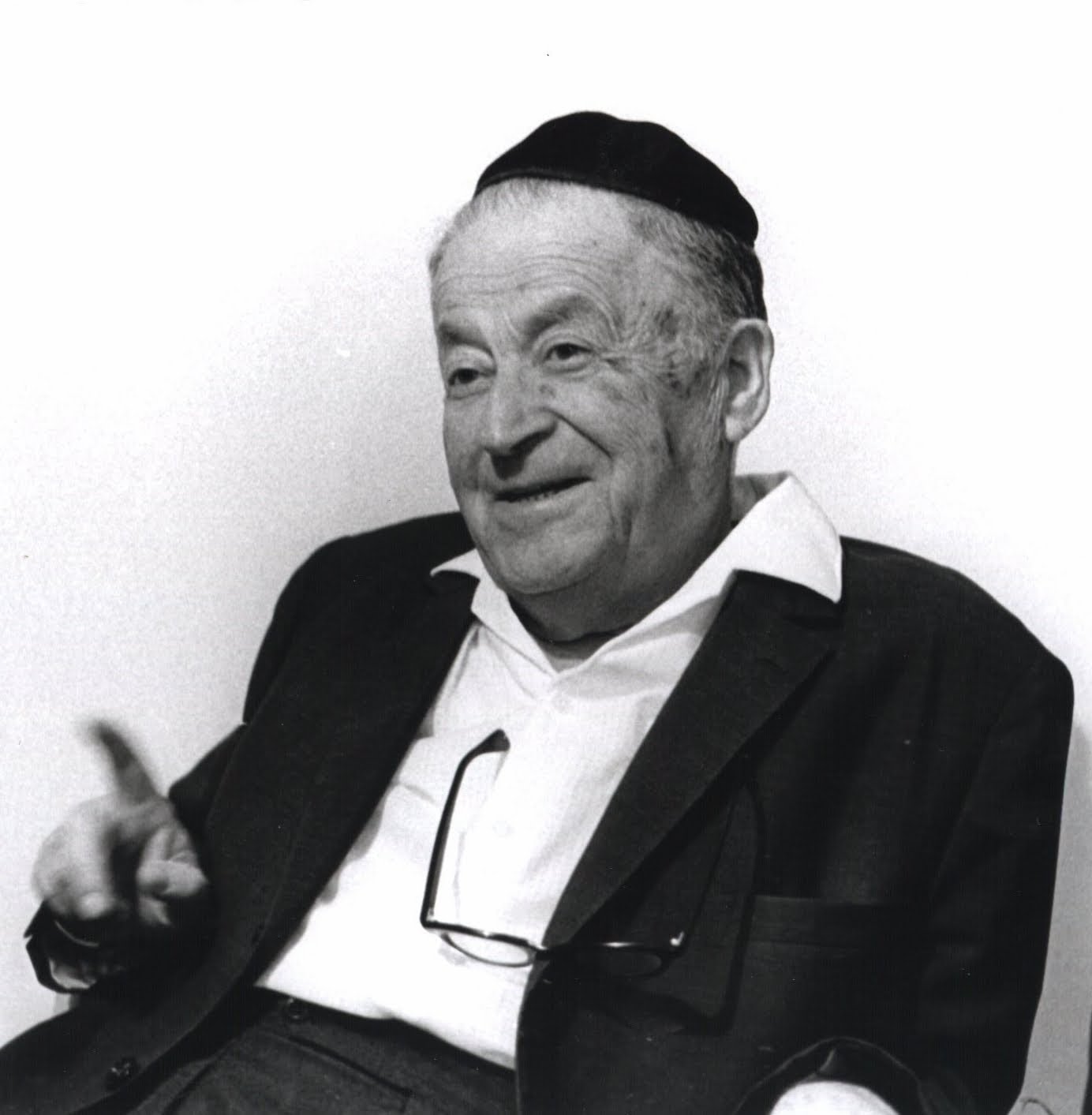
OK, those were easy. How about this one.  Which Israel won a Nobel Prize for literature? Need a hint? He was awarded it in 1966 for " his profoundly characteristic narrative art with motifs from the life of the Jewish people" and his photo is shown here. Still not sure? You may have read his work on Rosh Hashanah and Yom Kippur which was translated into English as Days of Awe...Of course; it was Shai Agnon, who was born in Galicia, moved to what was then Palestine (twice) and died in Jerusalem in 1970.

As of this year there have been twelve Israeli winners of the Nobel Prize. We've noted Agnon as the single winner for literature, and (as you may have answered correctly) there have been three winners of the Nobel Peace Prize: Menachem Begin (1978), Yizhak Rabin and Shimon Peres (both in 1994).  That leaves eight more prizes. In honor of Yom Ha'atzmaut, Israel's Independence Day, we will pause from our analysis of science in the Talmud and reflect on the Israeli winners of this prize, given each year (in accordance with the will of Alfred Nobel) "to those who, during the preceding year, shall have conferred the greatest benefit on mankind."

DANIEL KAHNEMAN, ECONOMICS, 2002

Following at an eight year prize-drought, Israel picked up her fifth Nobel in 2002, when Daniel Kahneman was awarded the 2002 Prize in Economics. In his biographical sketch, Kahneman credits his early days in the IDF with the first cognitive illusion he discovered.

“… after an eventful year as a platoon leader I was transferred to the Psychology branch of the Israel Defense Forces….We were looking for manifestations of the candidates’ characters… we felt…we would be able to tell who would be a good leader and who would not. But the trouble was that, in fact, we could not tell... The story was always the same: our ability to predict performance at the school was negligible...I was so impressed by the complete lack of connection between the statistical information and the compelling experience of insight that I coined a term for it: “the illusion of validity.” Almost twenty years later, this term made it into the technical literature. It was the first cognitive illusion I discovered.
— Daniel Kahneman, Biographical sketch at Nobelprize.org

(I was about two-thirds of the way through Kahneman's recent best-seller Thinking Fast and Slow, when I left it on a flight from Tel Aviv. Please let me know if you find it.) 

CIECHANOVER AND HERSHKO, CHEMISTRY 2004

In 2004 Aaron Ciechanover and Avram Hershko, both from the Technion in Haifa (together with Irwin Rose), were awarded the Nobel Prize in Chemistry for their discovery of how cells breaks down some proteins and not others. They discovered ubiquitin-mediated proteolysis, a process where an enzyme system tags unwanted proteins with many molecules another protein called ubiquitin. The tagged proteins are then transported to the proteasome, a large multi-subunit protease complex, where they are degraded.

ROBERT AUMANN, ECONOMICS, 2005

Robert Aumanm from the Hebrew University won the 2005 Nobel Prize in Economics for his work on conflict, cooperation, and game theory (yes, the same kind of game theory made famous by John Nash, portrayed in A Beautiful Mind). Aumann worked on the dynamics of arms control negotiations, and developed a theory of repeated games in which one party has incomplete information.  The Royal Swedish Academy of Sciences noted that this theory is now "the common framework for analysis of long-run cooperation in the social science." The kippah-wearing professor opened his speech at the Nobel Prize banquet with the following words (which were met with cries of  אמן from some members of the audience):

ברוך אתה ה׳ אלוקנו מלך העולם הטוב והמיטב

The four-minute video of his talk should be required viewing for every Jewish high school student (and their teachers).

ADA YONATH, CHEMISTRY, 2009

Remember ribosomes from high school? They are the machines inside all living cells that read messenger RNA and link amino acids in the right order to make proteins.  In 2009, Ada Yonath from the Weizmann Institute shared the Nobel Prize in Chemistry for her work on the structure and function of the ribosome. Specifically, she reported their three-dimensional structure and her work in the 1980s was "instrumental for obtaining the robust and well diffracting ribosome crystals that eventually led to high resolution structures of the two ribosomal subunits." Why is this important?  Well, many antibiotics target the ribosomes of bacteria, and so knowledge of how antibiotics bind to the ribosome may help in the design of new and more efficient drugs.  
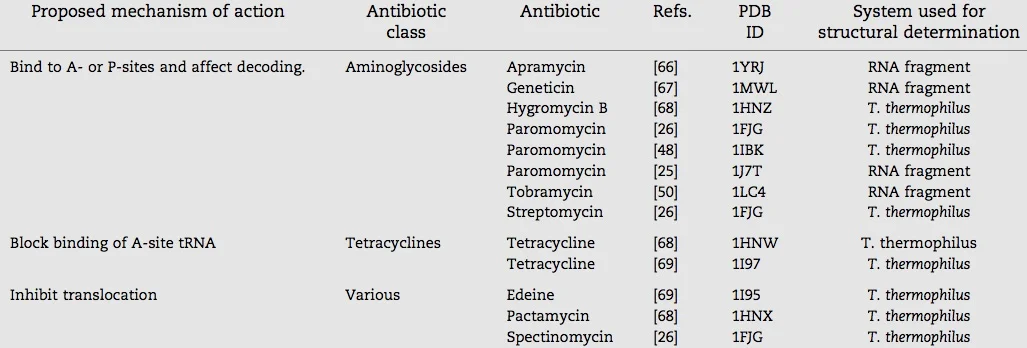
Available structures of antibiotics targeting the small ribosomal subunit (30S). From Franceschi and Duffy. Structure-based drug design meets the ribosome. Biochemical Pharmacology 2006; 71; 1016-1025.

Available structures of antibiotics targeting the small ribosomal subunit (30S). From Franceschi and Duffy. Structure-based drug design meets the ribosome. Biochemical Pharmacology 2006; 71; 1016-1025.

DAN SHECHTMAN, CHEMISTRY, 2011

in 1982, Shechtman was working at the US. National Institute of Standards and Technology. As he waslooking through an electronic microscope at the structure of new material that he was studying, and noted that the atoms had arranged themselves "in a manner that was contrary to the laws of nature." 

אין חיה כזו – There is no such entitiy" was how he recalled responding to what he had seen.  Shechtman double checked his findings and submitted them for publication; the paper was rejected immediately, not worthy even of being sent on for peer review.  But Shechtman did manage to get his work published, work that the Nobel Committee found questioned a fundamental truth of science: that all crystals consist of repeating, periodic patters. Shechtman's discovery of what were later to be called quasicrystals  was important not only because of what he found. It was important that he found. Here's why:

Over and over again in the history of science, researchers have been forced to do battle with established “truths”, which in hindsight have proven to be no more than mere assumptions. One of the fiercest critics of Dan Shechtman and his quasicrystals was Linus Pauling, himself a Nobel Laureate on two occasions. This clearly shows that even our greatest scientists are not immune to getting stuck in convention. Keeping an open mind and daring to question established knowledge may in fact be a scientist’s most important character traits.
— The Swedish Academy of Sciences. The Nobel Prize in Chemistry 2011. Information for the Public

ARIEH WARSHEL AND MICHAEL LEVITT, CHEMISTRY 2013

Israel's two most recent Nobel Prize winners are Arieh Warshel and Michael Levitt. In 2013 they shared the prize in, yes, you've guessed it...Chemistry, (together with Marin Karplus, a Jew, but not yet an Israeli).  Working together in the 1970s on GOLEM, the supercomputer at the Weizmann Institute, they developed computer programs that could simulate chemical reactions with the help of quantum physics.  These programs, and their offshoots, are used in a variety ways, from optimizing solar panels to designing new drugs.

THE LAST WORD

There you have it. Twelve remarkable Israelis who have contributed to peace efforts, science and literature, and whose efforts were recognized by a Nobel Prize. As we celebrate Yom Ha'atzmaut, let's give the last word to the 2005 winner Robert Aumann, who noted in his banquet speech just  what it really important in life. 

We have participated in the human enterprise – raised beautiful families. And I have participated in the realization of a 2000-year-old dream – the return of my people to Jerusalem, to its homeland.
— Robert Aumann, Nobel Prize banquet speech, 2005.


Print Friendly and PDF

Kiddushin 30a ~ How Many Letters are in a Sefer Torah?

קידושין ל, א

לפיכך נקראו ראשונים סופרים, שהיו סופרים כל האותיות שבתורה, שהיו אומרים: וא"ו דגחון חציין של אותיות של ספר תורה, דרש דרש  חציין  של תיבות, והתגלח של פסוקים

Therefore the early sages were called "counters" - soferim - because they counted all the letters of the Torah. They used to say: the letter vav of the word Gachon (Lev.11:42) is the half-way point of the letter of a Torah. The words "darosh darash" (Lev. 10:16) represent the half way point of the number of words in the Torah. The verse that begins with the word "Vehitgalach" (Lev.13:33) is the half way point of the number of verses in the Torah...

Today's page of Talmud in the Daf Yomi cycle covers some important material for those interested in the way in which Judaism and science interact.   The business of counting the letters in the Torah was apparently taken very seriously - so much so that one of the names by which the rabbis of the Talmud were known  - soferim - means "those who count."  To this day, the person who handwrites a Sefer Torah is called a counter (סופר), and not a writer (כותב). The Talmud emphasizes that this counting exercise was taken so seriously that the letters, words and verses were counted, and counted again. 

קידושין ל, א

בעי רב יוסף וא"ו דגחון מהאי גיסא או מהאי גיסא א"ל ניתי ס"ת ואימנינהו מי לא אמר רבה בר בר חנה לא זזו משם עד שהביאו ספר תורה ומנאום

Rav Yosef asked a question: This letter vav of the word Gachon, is it part of the first half or part of the second half of the letters of the Torah? They said to him, "let us bring a Torah scroll and count! For didn't Rabbah bar bar Channah say in a similar context: "They did not move from there until they brought a Torah scroll and counted all its letters"...


The View of Tradition, And OF the Journal Tradition

Writing in Tradition in 1964, the late scholar Louis Rabinowitz (d. 1984) asked how Orthodox Jews should regard the text of the Torah , "...upon which depends the whole enduring magnificent structure of the Oral Law and the Halakhah, in comparison with those texts which show variants from it?"  Here is his reply:

The answer is surely simple and logical. “The early scholars were called Soferim,” declares the Talmud (Kid. 30a) “because they were wont to count (soferim) all the letters of the Torah.” The meticulous manner in which they carried out this task is sufficiently indicated in the same passage by the information which it elicited to the effect, for instance, that the vav of gachon (Lev. 9:42 - [sic]) marks the half-way mark of the letters of the Torah, the words darosh darash of Lev. 10:16 the dividing line between the words...


With what loving care and sacred devotion, then, did they jealously guard every letter of the text! What exhaustive and detailed regulations they laid down in order to ensure that the copying of the scrolls should be completely free from human error! There has been nothing like it in the history of literature or religion, and in this respect the Massoretic text stands indisputably in a class by itself.
— Louis Rabinowitz. Torah Min Ha-Shamayim.Tradition: A Journal of Orthodox Jewish Thought, 1964-5: 7;1: 34-45

Leaving aside the ironic typographic error that mis-references the location of the vav of Gachon, was the late rabbi Rabinowitz correct in remarking on the "loving care and sacred devotion," with which "they jealously guard every letter of the text"?

So how many letters are there in a Torah?

There are varied counts given for the number of letters in the Torah, but a couple of results seem to be most popular.

One website shares the source code used to count the words and letters in Torah; its results are shown below, and are off by four when compared to others who claim to have counted.

Letters and Words in the Torah
Words Letters
בראשית 20,614 78,063
שמות 16,714 63,527
ויקרא 11,950 44,790
במדבר 16,408 63,529
דברים 14,295 54,892
TOTAL 79,981 304,801

And How Many Verses Are There?

The same website gives a count of 5,844 verses in the Torah.  Rabbi Yair Chaim ben Moses Bachrach (d. 1702), author of the Chavot Ya'ir, notes that there are 5,845 verses in the chumashim he used. But today's daf of Talmud records that there are 5,888 verses. And here is the count from Even-Shoshan's קונקורדנציה חדשה (New Concordance of the Bible):

From Even-Shoshan (ed.) A New Concordance of the Bible. Kiryat Sefer, Jerusalem 1987.

From Even-Shoshan (ed.) A New Concordance of the Bible. Kiryat Sefer, Jerusalem 1987.

Side-Bar: From Where did Even-SHoshan Get his word count?

Even-Shoshan lists his reference as Rabbi Chaim Mordechai Brecher, who published a Yiddish translation of the entire Hebrew Bible. (Brecher was born in what is now the Ukraine in 1880 and died in New York in 1965.  His Yiddish translation was published in New York in 1941, and was republished six times, the last in 1957.)  At the end of the second volume of his translation (p. נא), R. Brecher addressed the thorny question of the letter and word counts in our Torahs, and had this to say:

The truth is, this [question of how many words there are in a Sefer Torah] is astonishing, and I couldn't rest because of it. So I decided to count them, and I, myself, counted all the words in the entire Torah. In order to make it clear to the reader that I didn't make a mistake in my count, I am here providing a list of all the verses in all the chapters as they are currently divided...My count is correct. As the ancient wise men say: Love Plato, love Aristotle, and love the truth most of all.

R. Brecher's total word count is 79,976 (although this count actually comes from here) - and so his half way point in the Torah is word #39,988. 

The Misplaced Middle of the Torah

Now back to today's page of Talmud. According to it, the middle letter of the Torah is the Vav of the word Gachon, (גחון) found in פרשת שמיני. However this claim is way off. Since there are about 304,805 letters in the Torah scrolls in use today, (I say about because of what we have just noted regarding the precise count,) the middle letter would be letter # 152,403, the first word of this verse (Lev 8.29):

ויקרא פרק ח פסוק כט 

ויקח משה את החזה ויניפהו תנופה לפני יקוק מאיל המלאים למשה היה למנה כאשר צוה יהו–ה את משה 

However the Vav of the word Gichon, is letter #157,236 - off by 4,833 letters. Oy.

It's no better regarding the words. If we go with the actual word count as being 79,980, then the middle words are # 39,990 and #39,991. These are the words יצק אל in verse below (Lev. 8:18):

ויקרא פרק ח פסוק טו 

וישחט ויקח משה את הדם ויתן על קרנות המזבח סביב באצבעו ויחטא את המזבח ואת הדם יצק אל יסוד המזבח ויקדשהו לכפר עליו

But the middle words of the Torah, according to Today's daf, are דרש דרש found over 900 words later (Lev.10:16):

ויקרא פרק י פסוק טז 

ואת שעיר החטאת דרש דרש משה והנה שרף ויקצף על אלעזר ועל איתמר בני אהרן הנותרם לאמר

That's a lot of letters to miscount, especially if your name is "the counter." Several suggestions have been made to address these discrepancies:

1.  The text of the Torah that the rabbis of the Talmud were using was significantly different to the one we use today.  This is possible, but then why does the Talmud never cite of any of these extra words and verses? The discrepant count is about 3% - that's a lot of missing text.

2.  The rabbis in the Talmud were not good at math. Again, possible, but the Talmud claims that they took the counting so seriously that they were called COUNTERS. It also claims that they undertook the counting exercise on several different occasions.  Were they really that bad at math?

3. The rabbis in the Talmud didn't mean this count to be taken literally. While many apologists like this answer, it is at total odds with the text. The Talmud states: they counted.

4.  The rabbis guesstimated the count. Perhaps the rabbis never really counted, but guessed at where the middle of the Torah lay: somewhere in the middle of the middle of the Five Books. After that, the letter vav of the word Gachon became the official midpoint, even though it was not accurate.  The problem with this suggestion is again, that the Talmud states that the soferim actually counted, and counted again. Not that they guessed, and guessed again.  

Science, Math and Judaism

Of all the scientific disciplines, it is mathematics that is first introduced to us. We teach toddlers to count, sometimes before they can even walk, and we all pursue some kind of mathematical training through high school.  Unlike medicine or physics or biology or astronomy, mathematics is something we all do, to some degree.  And we all understand what counting means.  This passage in the Talmud is the most readily understandable example of a conflict between science and Judaism. It is a conflict in which the basic text of rabbinic Judaism declares a fact that is, well, just not a fact.  Some find this conflict to be so intellectually troubling that their only path is to reject Jewish practice. Others, equally aware of the conflict, are comfortable with their intellectual position in which the scientific inaccuracies of the Talmud require no wholesale rejection of Jewish practice. Where do you fit on this spectrum, and, perhaps more importantly, what can you do to engage in a respectful dialogue with those whose opinions on these matters are not your own?

Print Friendly and PDF

Kiddushin 29a ~ Swimming and Drowning

קידושין כט, א

האב חייב בבנו למולו ולפדותו וללמדו תורה ולהשיאו אשה וללמדו אומנות וי"א אף להשיטו במים רבי יהודה אומר כל שאינו מלמד את בנו אומנות מלמדו ליסטות ליסטות ס"ד אלא כאילו מלמדו ליסטות

With respect to his son, a father is obligated to circumcise him, to redeem him [if he is a firstborn], to teach him Torah, to marry him off, and to teach him a craft.  Some say, he is also obligated to teach him to swim...(Kiddushin 29a)


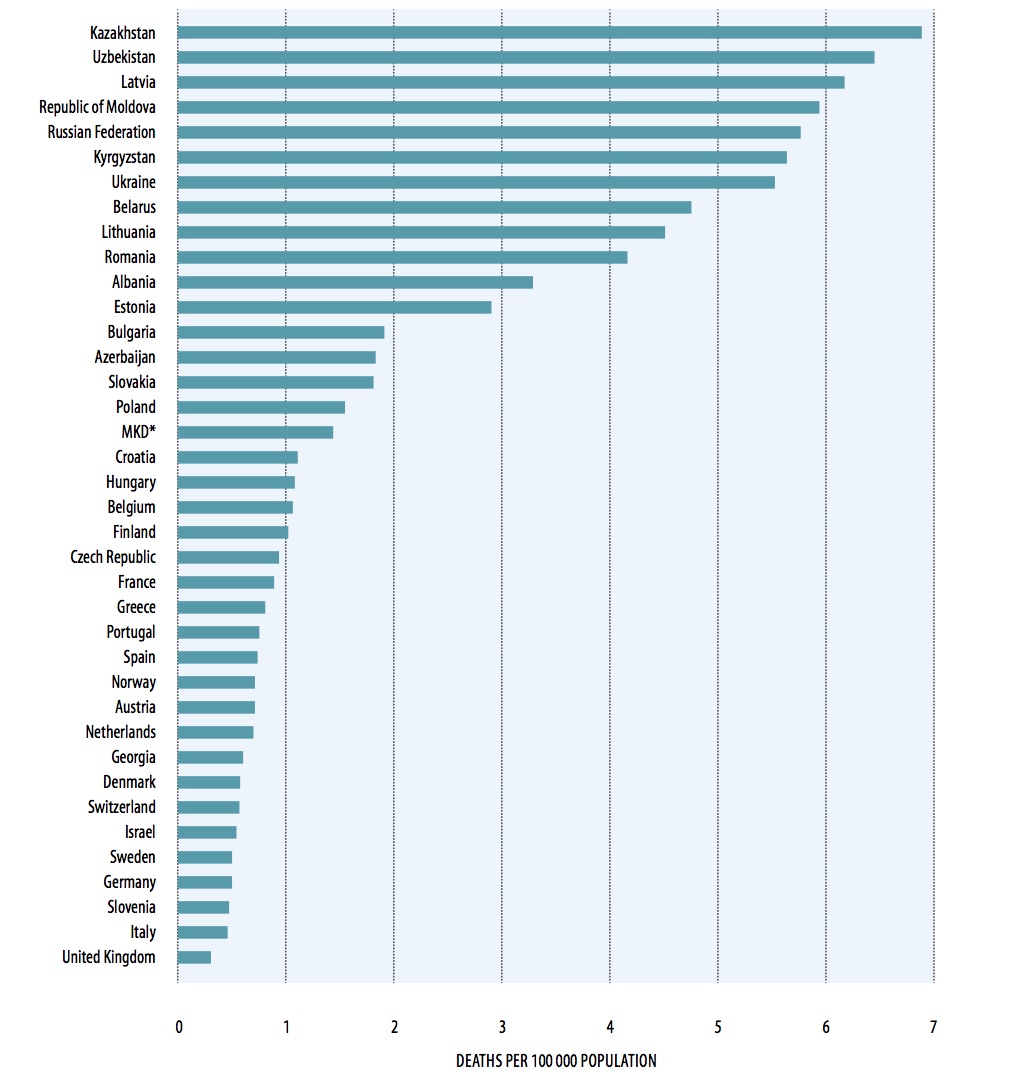
Every year, according to The World Health Organization, more than 5,000 children drown in Europe. And for every child who drowns (the majority of whom are under five years of age) at least two others suffer lifelong neurological disability.  

Average standardized mortality rates for drowning in children aged 0–19 years in the WHO European Region, 2003–2005 or most recent three years. From The European Report on Child Injury Prevention. World Health Organization 2008.

Average standardized mortality rates for drowning in children aged 0–19 years in the WHO European Region, 2003–2005 or most recent three years. From The European Report on Child Injury Prevention. World Health Organization 2008.

In the United States, there are an average of ten drowning deaths each day. Of the more than 3,500 people who drown each year in the US, about a fifth are children under the age of 14.  And here are some other facts that may surprise you about drowning in the US, courtesy of the Centers for Disease Control:

  • Nearly 80% of people who die from drowning are male.

  • Children ages 1-4 have the highest drowning rates. In 2009, among children 1-4 years old who died from an unintentional injury, more than 30% died from drowning.

  • Among children ages 1-4, most drownings occur in home swimming pools.

  • Drowning is responsible for more deaths among children 1-4 than any other cause except congenital anomalies (birth defects).

  • Between 2005 and 2009, the fatal unintentional drowning rate for African Americans was significantly higher than that of whites across all ages.  The disparity is widest among children 5-14 years old. The fatal drowning rate of African American children ages 5-14 is almost three times that of white children in the same age range.

  • The disparity is most pronounced in swimming pools; African American children drown in swimming pools at rates 5.5 times higher than those of whites.  

How We Drown

Unlike the movie depiction of a person loudly flailing as he tries to stay afloat, the process of drowning is actually very quiet; there is usually no noise and little to see.


Once the victim disappears under the surface, the oxygen content of the blood rapidly decreases and unconsciousness follows quickly. In most cases water enters the lungs and results in wet drowning: This causes constriction of the blood vessels in the lungs (and for the medically curious among you, hypertension with a ventilation/perfusion mismatch, aggravated by surfactant destruction and washout, decreased lung compliance and atelectasis. Acute respiratory failure is common.There. Now you know.)  But in 10–20% of deaths from drowning, a small amount of water entering the larynx causes persistent spasm, which results in chocking and an immediate outpouring of thick mucus, froth and foam, but without significant aspiration; this is called dry drowning.

What's more Dangerous - a swimming pool or a gun?

The dangers of children drowning is real. So real that it turns out that owning a pool is more dangerous that owning a gun. (Notice to readers outside the US: you can own a gun here...) Dunber and Levitt, in their wildly popular 2005 book Freakonomics (p135-6) explained why this is so:

Consider the parents of an eight-year-old girl named, say, Molly. Her two best friends, Amy and Imani, each live nearby. Molly's parents know that Amy's parents keep a gun in their house, so they have forbidden Molly to play there. Instead,Molly spends a lot of time at Imani's house,which has a swimming pool in the backyard. Molly's parents feel good about having made such a smart choice to protect their daughter.

But according to the data, their choice isn't smart at all. In a given year,there is one drowning of a child for every  11,000 residential pools in the United States. In a country with 6 million pools, this means that roughly 550 children under the age of ten drown each year.) Meanwhile, there is 1 child killed by a gun for every1 million-plus guns. In a country with an estimated 200 million guns, this means that roughly 175 children under ten die each year from guns.The likelihood of death by pool (1 in 11,000) versus death by gun (1 in 1 million - plus ) isn't even close: Molly is far more likely to die in a swimming accident at Imani's house than in gunplay at Amy's.

A Common Sense Halacha?

In his commentary on the Mishnah, Maimonides counts the command to teach a child to swim as one of the duties incumbent on a parent (or, more precisely on a father). 

פירוש המשנה לרמב"ם מסכת קידושין פרק א משנה ז 

 מצות הבן על האב שש מצות ואלו הן, למולו ולפדותו וללמדו תורה ולהשיאו אשה וללמדו אומנות ולהושיטו בנהר. ולמדו לכולם מן הכתובים בראיות שיארך ביאורם כאן ואין תועלת מרובה בכך, כל אלו חייב האב לעשותם לבן, ואין האם חייבת לעשותם לבנה והוא ענין אמרם האנשים חייבין והנשים פטורות

There are six duties incumbent on a father towards his son: 1) to circumcise him; 2) to redeem him [from a Cohen if he is a firstborn]; 3) to teach him Torah; 4) to marry him to a woman; 5) to teach him a trade and 6) to teach him to swim...A father is required to do each of these things, but a mother is not required to teach them to her daughter, for this is one of those things that fall into the category of "men are obligated and women are exempted"... 

However in his Mishnah Torah, Maimonides did not include the obligation to teach swimming, and this obligation is also omitted in the sixteenth century normative Shulchan Aruch. There is no obvious reason for this omission, though this question would make a great topic of conversion at your Shabbat table tonight. But not everything that makes sense needs to be part of the code of Jewish Law. It can just be...a sensible thing to do.  Perhaps there is no better example of this than a parent, (mother or father) teaching their child, (son or daughter,) to swim.  

As a father who has lost a son, I know first-hand the unbearable pain that comes with a child’s death. Amidst my grief, I am able to take some small solace in the fact that everything possible was done to fight the disease that took my son’s life. If my son had died in a backyard pool due to my own negligence, I would not even have that to cling to. Parents who have lost children would do anything to get their babies back. Safeguard your pool so you don’t become one of us.
— Steven Levitt, co-author of Freakonomics. "Pools more dangerous than guns". Chicago Sun-Times 7/28/2001
Print Friendly and PDF

Kiddushin 25b ~ Can Elephants Jump?

In a discussion of how one acquires ownership of an animal, Rabbi Shimon rules that they must be lifted - literally, lifted.  And then the Talmud asks how exactly an animal is lifted.

קידושין כה, ב 

אלא מעתה פיל לרבי שמעון במה יקנה אמר ליה אביי בחליפין אי נמי בשוכר את מקומו רבי זירא אמר מביא ארבעה כלים ומניחן תחת רגליו

If so, how would one acquire an elephant according to Rabbi Shimon?  Abaye said to him - by means of chalifin [a token exchange of a utensil or piece of clothing to finalize the transaction]. Rebbi Zeira says, the buyer brings in four vessels and places them under the elephant's feet [demonstrating that the elephant has now entered the buyer's domain]. (Kiddushin 25b)

A.H Atwell, National Geographic.

A.H Atwell, National Geographic.

Now leaving aside why the Talmud wondered about elephants when one could ask the same thing about say, cows or a horses, and leaving aside the question of just how Rebbi Zeira would go about getting his elephant to stand with each leg on a pot, the reader surely wants to know if there is um, an easier way to acquire an elephant. And yes, there is. The Talmud offers another helpful way to gain possession of your very own Dumbo. אי נמי בחבילי זמורות - "An alternative is to use bundles of vines." Rashi offers an explanation: the vines are three tefachim [about 30 cm.] heigh, and the elephant is led to stand on them, "and any lifting that is above three tefachim is called lifting [for the purposes of the transfer of ownership]."

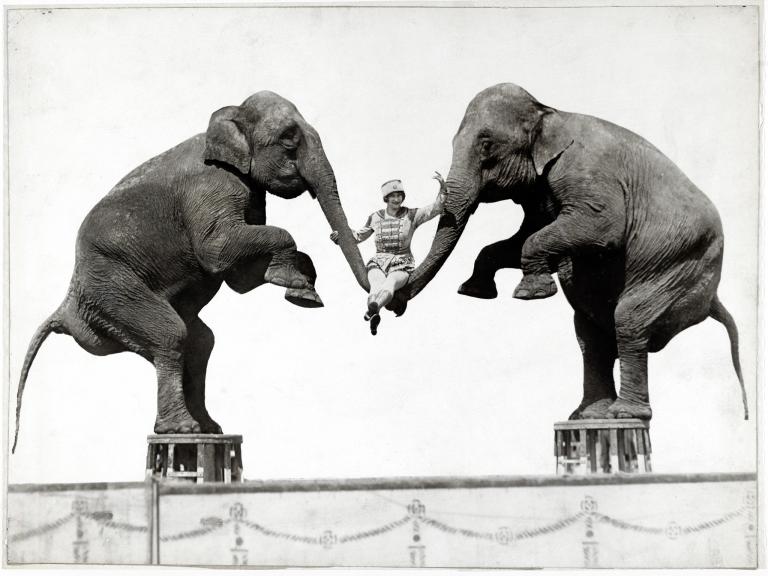
Elephants at the circus in Washington DC. two days ago. They demonstrated - just in time - that Rebbi Zeira's suggestion was indeed workable. So long as you have a full time elephant trainer...

Elephants at the circus in Washington DC. in 2016 They demonstrated - just in time - that Rebbi Zeira's suggestion was indeed workable. So long as you have a full time elephant trainer...

Tosafot's Solution - jumping elephants

Tosafot, a collection of medieval commentaries on the Talmud, is dissatisfied with Rashi for a number of reasons. First, if the Talmud had meant to suggest that a platform three tefachim in height be built, it would have said so, and not concocted some contraption using grape vines. Second, the grape vines, are legally considered to be part of the ground itself, so the elephant standing on them would not be separate from the ground, which is precisely what is needed to effect a legal transfer of ownership.    

In light of these objections, Rav Meshulam offers his own explanation of what the Talmud meant when it suggested using vines.

אי נמי בחבילי זמורות. פי' בקונטרס משכחת לה להגבהת פיל בחבילי זמורות הגבוהים מן הארץ שלשה ומעלהו עליהן דהגבהת ג' הגבהה היא דנפיק לה מתורת לבוד ולפירושו בכלים לא מצי למימר דליקני מדין הגבהה שיניח כלים תחת רגליו דסתמייהו אין בעוביין שלשה טפחים ולפי' ר"ת דמפרש דהגבהה בטפח קני צ"ל סתם כלים אין בעוביין טפח וקשה אמאי נקט חבילי זמורות לנקוט אבנים או עצים ומפרש הרב משולם דלהכי נקט חבילי זמורות לפי שהן מאכל פיל כדאמרינן פרק מפנין (שבת דף קכח.) מטלטלין חבילי זמורות בשבת מפני שהן מאכל לפילין ומגביהין לפיל חבילי זמורות למעלה והוא קופץ ומגביה את עצמו מן הארץ ואוכלן ואין לתמוה אי חשיבא הגבהה בהכי דכה"ג אשכחן בפרק שילוח הקן (חולין דף קמב.) כי היכי דליגבינהו ולקנינהו

...Rav Meshulam therefore explained that the Talmud offered the explanation of vines because elephants eat them...and we lift up the vines in front of the elephant , which will jump up to eat them, thereby lifting itself off of the ground...

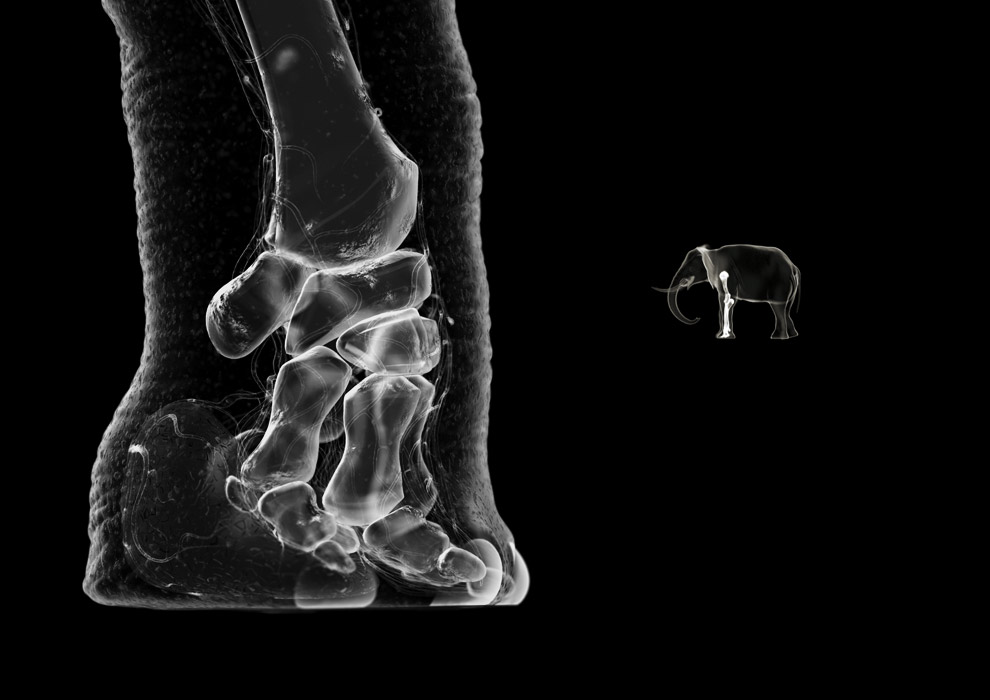
Elephants stand on tip toe. From here.

Elephants stand on tip toe. From here.

There is one small problem with Rav Meshulam's explanation: elephants can't jump. Here is Tony Barthel, curator of Elephant Trails at the National Zoo in Washington DC.  "If you were to look at an elephant’s skeleton, you’ll see that they’re standing on their tippy toes...All the bones are pointed straight down.” This means that they cannot jump, even if they wanted to.  Elephants cannot jump, and they cannot technically even run, since that requires all four legs to be off the ground at once. Why then did Rav Meshulam suggest this explanation, one which is not biologically possible?  Here is Rabbi Dr. Natan Slifkin's answer, from his Torah Encyclopedia of the Animal Kingdom:

The answer is that he had no reason to believe otherwise. There were no zoos in medieval Europe, and very few elephants.The emperor Charlemagne, king of the Franks,received an elephant as a gift in 797.Frederick II used an elephant in his capture of Cremona in 1214. King Henry III of England received an elephant from Israel in 1254. Alfonso V of Portugal gave an elephant to Renew d'Anjou in 1477. The Vatican was given an elephant in 1514. But the average person in those times never saw an elephant. Illustrations from that era show that artists, basing themselves on stories,were very unsure about how to depict elephants.They were often portrayed as possessing a body like those of horses or deer, sometimes even with split hooves. Of particular relevance to us is that they are sometimes drawn with the hindlimb structure of lions or dogs, poised with elastic energy. Rav Meshullam ben Nathan, who was born in Provence in 1120 and passed away in Melun in 1180, never saw either a live elephant or an accurate drawing of one. He thus had every reason to believe that, like other animals elephants can jump.

So there you have it.  Don't suggest biological explanations if you've not studied biology. Even if you are Rashi's son-in-law.

From here, the thirteenth century Book of the Marvels of the World (Livre des Merveilles du Monde). Note the bent hind legs of the elephant, which suggest the ability to jump.

From here, the thirteenth century Book of the Marvels of the World (Livre des Merveilles du Monde). Note the bent hind legs of the elephant, which suggest the ability to jump.

[An expanded version of Rabbi Dr. Slifkin's essay can be found here.]

Print Friendly and PDF