Science and Certainty

Chullin 57b ~ Ants, Rabbi Shimon ben Chalafta, and the Scientific Method

Today we learn one of the central texts in the Talmud that discusses the relationship between experience and authority.

חולין נז, ב

…אמרו עליו על רבי שמעון בן חלפתא שעסקן בדברים היה

מאי עסקן בדברים? א"ר משרשיא דכתיב (משלי ו, ו) "לך אל נמלה עצל ראה דרכיה וחכם אשר אין לה קצין שוטר ומושל תכין בקיץ לחמה" אמר איזיל איחזי אי ודאי הוא דלית להו מלכא 

אזל בתקופת תמוז פרסיה לגלימיה אקינא דשומשמני נפק אתא חד מינייהו אתנח ביה סימנא על אמר להו נפל טולא נפקו ואתו דלייה לגלימיה נפל שמשא נפלו עליה וקטליה אמר שמע מינה לית להו מלכא דאי אית להו הרמנא דמלכא לא ליבעו 

א"ל רב אחא בריה דרבא לרב אשי ודלמא מלכא הוה בהדייהו א"נ הרמנא דמלכא הוו נקיטי אי נמי בין מלכא למלכא הוה דכתיב (שופטים יז, ו) בימים ההם אין מלך בישראל איש הישר בעיניו יעשה אלא סמוך אהימנותא דשלמה

They said about Rabbi Shimon ben Chalafta that he was a researcher of various matters… The Gemara asks: From what episode did Rabbi Shimon ben Chalafta earn the title: Researcher of matters? Rav Mesharshiyya said: He saw that it is written: “Go to the ant, you sluggard; consider her ways, and be wise; which having no chief, overseer, or ruler, provides her bread in the summer” (Proverbs 6:6–8). Rabbi Shimon ben Chalafta said: I will go and see if it is correct that they have no king.

He went in the season of Tammuz, i.e., summer. Knowing that ants avoid intense heat, he spread his cloak over an ant hole to provide shade. One of the ants came out and saw the shade. Rabbi Shimon placed a distinguishing mark on the ant. It went into the hole and said to the other ants: Shade has fallen. They all came out to work. Rabbi Shimon lifted up his cloak, and the sun fell on them. They all fell upon the first ant and killed it. He said: One may learn from their actions that they have no king; as, if they had a king, would they not need the king’s edict to execute their fellow ant?

Rav Acha, the son of Rava, said to Rav Ashi: But perhaps the king was with them at the time and gave them permission. Or perhaps they already had permission from the king to kill the ant. Or perhaps it was a time between kings, as it is written: “In those days there was no king in Israel; every man did that which was right in his own eyes”(Judges 17:6). Rather, rely on the credibility of Solomon, the author of Proverbs, that ants have no king.

The “experimenter”?

There is a great deal to unpack in this passage. First we need to understand exactly what is meant by the term used to describe Rabbi Shimon: “עסקן בדברים.” It can be translated in a few ways, each with their own subtle meanings.

Literally translated, the words mean he was involved in things. The Steinsaltz (Koren) Talmud translates the phrase as researcher of various matters, while the Schottenstein (ArtScroll) Talmud translates it as an experimenter, echoing the earlier Soncino translation an experimenter in all things. Goldschmidt's German translation (the first translation of the entire Babylonian Talmud, published 1897-1935) states “das er sich mit Dingen zu befassen pflegte” that Rabbi Shimon “used to deal with things.”

But there is more to the Schottenstein translation, which adds the following note: “Literally: one who involved himself with matters; i.e. he performed experiments to test the veracity of propositions.” Now that is quite a claim, for it suggests that 1) Rabbi Shimon sought to validate, and by definition invalidate the truth claims of the Bible and 2) that there was a scientific method as far back as Rabbi Shimon, circa 200 C.E.

Who was Shimon ben Chalafta?

We know rather little of the life of Rabbi Shimon, although he is the subject of several aggadic legends. He was extremely poor but fortunately he was also the object of divine intervention. Rabbi Shimon was saved from a nasty end involving lions by the miraculous appearance of heavenly meat (Sanhedrin 59b), and was the recipient of another heavenly gift - a gem of great wealth - which enabled to him to buy food for Passover (which goes to show that the high cost of kosher food for Passover is a long Jewish tradition).

And what about that title “the experimenter”? What else did he check out, or examine, or decipher? Alas, we will never know. This is the only place in all of Jewish literature in which he is described as
עסקן בדברים.

The origins of the experiment

The first scientific experiment, claims the historian of science David Wootton, happened on September 19, 1648. It involved measuring the height of a tube of mercury (in what we would later call a “barometer”) at various elevations in the region of Massif Central in central France. (The height of the mercury was three inches lower at the top of a 3,000 foot summit than it was back home in the garden.) It was the “first proper experiment” writes Wootton,

in that it involves a carefully designed procedure, verification (the onlookers are there to ensure this is really a reliable account), repetition, and independent replication, followed rapidly by dissemination.

Of course there had been earlier experiments - Ptolemy and Galen had carried them out, and among the most famous early experiment was the one performed by the Arab scientist Ibn al-Haytham. In the eleventh century he demonstrated (at least to his own satisfaction) that the eyes work by receiving light, rather than by emitting it. But before the scientific revolution there had been remarkably few such experiments, and certainly none like the barometer experiment. Aristotle was likely to blame, for two reasons. First, he assumed that adequate knowledge of any subject he discussed was already available, and second, “the Aristotelian tradition insisted that the highest form of knowledge was deductive, or syllogist knowledge.”

In addition, there was the status of the Bible as a source of knowledge about the world. Since it was the word of a God who did not lie, its observations were no less important than any experimental or philosophical proofs. (Elsewhere we have examined in some detail rabbinic philosophies and the scientific method, and I am told there is a great book on the relationship between science and rabbinic thought.)

In a nutshell, the scientific method involves making a prediction and then carrying out an experiment to verify - or falsify it. The great philosopher of science Karl Popper (d. 1994) took it a stage further, and introduced the concept of falsifiability. For a statement to be scientific he claimed, it must be falsifiable, that is, it must make a declaration that can be tested. And Rabbi Shimon was doing no such thing.

What was Rabbi Shimon doing?

Rabbi Shimon was certainly not carrying out an experiment in any way we use the word today. Instead he was observing nature, and noting how things seemed to work. And this is no small matter. In this respect he was like Charles Darwin who also carried out meticulous observations. On the basis of these Darwin developed a theory, which in his case was the theory of evolution, a theory that, as it turned out, is indeed falsifiable.

Neither Rabbi Shimon ben Chalafta nor Rav Acha would have declared the words of Proverbs incorrect based on any of their own observations. What is more, some one-hundred and fifty years later, Rav Acha questioned Rabbi Shimon’s methodology. Why, he asked, is Rabbi Shimon so certain that his observations lead to his conclusion? Perhaps there were other explanations of what Rabbi Shimon had observed that would conclude, contra his deduction, that an ant colony actually had a king. Rav Acha makes a point that would be echoed in rabbinic texts centuries later: observations of the natural order can be explained in any number of ways; the only privileged source of knowledge is the Bible.

Now of all the branches of Natural History, Entomology is unquestionably the best fitted for thus disciplining the mind of youth...no study affords a fairer opportunity of leading the young mind to the great truths of Religion, and of impresing it with the most lively ideas of the power, wisdom, and goodness of the Creator.
— William Kerby. An Introduction to Entomology: Or Elements of the Natural History of Insects. London 1818. xvi.

And do ants have kings?

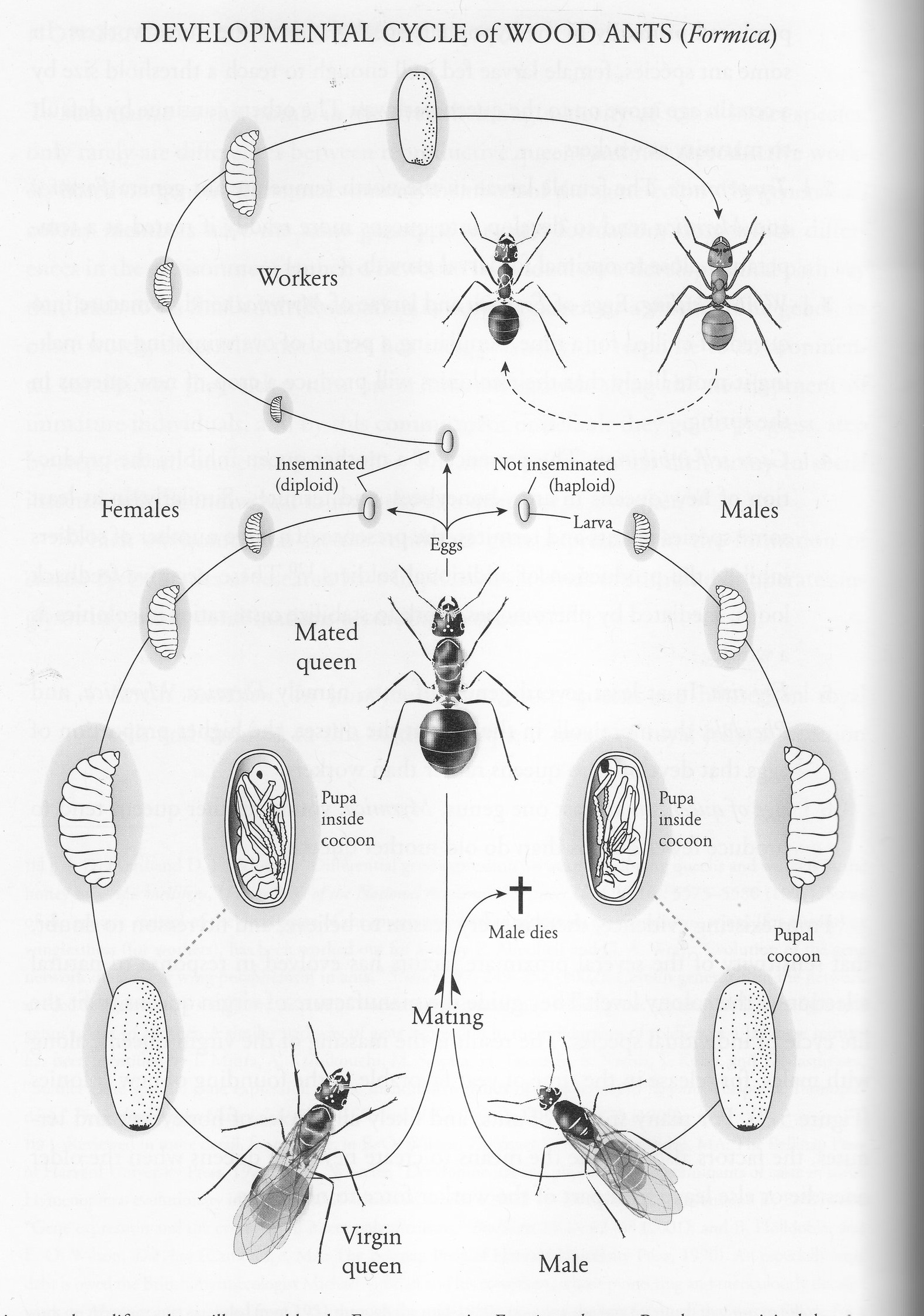
Basic ant colony life. From and Holldobler and Wilson. The Super-Organism; The Beauty. Elegance and Strangeness of Insect Colonies. Norton 2009. 138

Basic ant colony life. From and Holldobler and Wilson. The Super-Organism; The Beauty. Elegance and Strangeness of Insect Colonies. Norton 2009. 138

No. They have Queens. Who are like kings except they are not male. Although this is generally true, it is not the case for all species of ants. E.O. Wilson and Bert Holldobler won a Pulitzer Prize for their now classic 1990 work, The Ants. Holldobler is a Professor of Life Sciences at Arizona State University, and Wilson is a Harvard Professor who has been studying ants for over five decades, so together they must really knows their stuff. “In the Australian Pachycondyla sublaevis” they wrote in their beautiful book The Superorganism “there is no anatomically distinct queen. Instead the top-ranked worker mates and lays eggs… and joins those just beneath her in caring for the brood, while the workers of lower rank forage outside the nest for food.”

To summarize: Ant colonies do not have kings, and usually (but not always), they have a queen. (Though to further complicate matters more the Formica Yessenis ant of Japan can have, in Wilson’s words “millions of queens.”) And so King Solomon was not correct when he wrote “"אין לה קצין שוטר ומושל” - that ants have “no chief, overseer, or ruler” (although I guess you could re-interpret the verse to mean that they have no ruler in the sense of how we use the word today).

But Rabbi Shimon was correct about there being various castes or ranks within the nest. He described how one ant was killed by others of the same cast, and in fact this may occur for a number of reasons. For example, in a 2013 paper titled Enforcement of Reproductive Synchrony via Policing in a Clonal Ant, the authors note that “worker policing controls genetic conflicts between individuals and increases colony efficiency.” In other words, the colony will control reproductive rights by turning on, and in some cases killing, other members of the nest. And in a letter to Nature, researchers reported that if the queen is challenged by another female she chemically marks the pretender who is then punished by low-ranking females.

Seeing the Divine in the Insect

Rabbi Shimon made his observations about the social structure of ants about 1,600 years before William Kirby who in 1808 published his “Introduction to Entomology the very first general study of entomology. But like many works of science from the Victorian-era it is also a book about God. Throughout, Kirby notes the truth of Scripture and the stamp of a Divine Creator, which he insists can be recognized by studying insects. In this regard, Kirby was echoing exactly the sentiment in the Book of Proverbs cited in today’s page of Talmud. “Go to the ant, you sluggard; consider her ways, and be wise.”

Rabbi Shimon wasn’t the only tanna who saw the divine in the insect world. In a few pages (63a) we will read that when Rabbi Yochanan would study ant behavior, he would say a verse from Psalm 37:7 “צדקתך כהררי אל” Your righteousness is like the mighty mountains.” Why? Because, explains Rashi, God provides food for the ants, who then do not need to work hard to sustain the colony. It’s a beautiful homily, though once you read through The Ants, the suggestion that ants have it easy is fanciful.

The author of Scripture is also the author of Nature: and this visible world, by types indeed, and by symbols, declares the same truths as the Bible does by words. To make the naturalist a religious man – to turn his attention to the glory of God, that he may declare his works, and in the study of his creatures may see the loving-kindness of the Lord – may this in some measure be the fruit of my work…’
— William Kirby, Correspondence, Dec 21 1800

Rabbi Shimon ben Chalafta left no halachic teachings, and the only example we have of his inquisitive mind is today’s story about his field observations of ants. But he left an indelible mark on the oral tradition, because the Mishna, upon which all later Talmudic discussions are based, ends with his wise words.

אָמַר רַבִּי שִׁמְעוֹן בֶּן חֲלַפְתָּא, לֹא מָצָא הַקָּדוֹשׁ בָּרוּךְ הוּא כְּלִי מַחֲזִיק בְּרָכָה לְיִשְׂרָאֵל אֶלָּא הַשָּׁלוֹם, שֶׁנֶּאֱמַר (תהלים כט), ה’ עֹז לְעַמּוֹ יִתֵּן ה’ יְבָרֵךְ אֶת עַמּוֹ בַשָּׁלוֹם
Rabbi Shimon ben Chalafta said: The Holy One, blessed be He, found no vessel that can [sufficiently] hold the blessing for Israel, save for peace, as the verse says, (Psalms 29:11) “God will give strength to His nation, God will bless His nation with peace.”
— Mishnah Uktzin 3:12

And let us say Amen.

Print Friendly and PDF

Shavuot Redux~ How Many Letters are in a Sefer Torah?

In honor of shavuot that celebrates the giving of the torah, a repost from the talmudology archives.

Shavuot begins on Thursday evening, so we are publishing this early.

Enjoy the cheesecake.

קידושין ל, א

לפיכך נקראו ראשונים סופרים, שהיו סופרים כל האותיות שבתורה, שהיו אומרים: וא"ו דגחון חציין של אותיות של ספר תורה, דרש דרש  חציין  של תיבות, והתגלח של פסוקים

Therefore the early sages were called "counters" - soferim - because they counted all the letters of the Torah. They used to say: the letter vav of the word Gachon (Lev.11:42) is the half-way point of the letter of a Torah. The words "darosh darash" (Lev. 10:16) represent the half way point of the number of words in the Torah. The verse that begins with the word "Vehitgalach" (Lev.13:33) is the half way point of the number of verses in the Torah...

This page of Talmud covers some important material for those interested in the way in which Judaism and science interact.   The business of counting the letters in the Torah was apparently taken very seriously - so much so that one of the names by which the rabbis of the Talmud were known  - soferim - means "those who count."  To this day, the person who handwrites a Sefer Torah is called a counter (סופר), and not a writer (כותב). The Talmud emphasizes that this counting exercise was taken so seriously that the letters, words and verses were counted, and counted again. 

קידושין ל, א

בעי רב יוסף וא"ו דגחון מהאי גיסא או מהאי גיסא א"ל ניתי ס"ת ואימנינהו מי לא אמר רבה בר בר חנה לא זזו משם עד שהביאו ספר תורה ומנאום

Rav Yosef asked a question: This letter vav of the word Gachon, is it part of the first half or part of the second half of the letters of the Torah? They said to him, "let us bring a Torah scroll and count! For didn't Rabbah bar bar Channah say in a similar context: "They did not move from there until they brought a Torah scroll and counted all its letters"...

The View of Tradition, And OF the Journal Tradition

Writing in Tradition in 1964, the late scholar Louis Rabinowitz (d. 1984) asked how Orthodox Jews should regard the text of the Torah , "...upon which depends the whole enduring magnificent structure of the Oral Law and the Halakhah, in comparison with those texts which show variants from it?"  Here is his reply:

The answer is surely simple and logical. “The early scholars were called Soferim,” declares the Talmud (Kid. 30a) “because they were wont to count (soferim) all the letters of the Torah.” The meticulous manner in which they carried out this task is sufficiently indicated in the same passage by the information which it elicited to the effect, for instance, that the vav of gachon (Lev. 9:42 - [sic]) marks the half-way mark of the letters of the Torah, the words darosh darash of Lev. 10:16 the dividing line between the words...


With what loving care and sacred devotion, then, did they jealously guard every letter of the text! What exhaustive and detailed regulations they laid down in order to ensure that the copying of the scrolls should be completely free from human error! There has been nothing like it in the history of literature or religion, and in this respect the Massoretic text stands indisputably in a class by itself.
— Louis Rabinowitz. Torah Min Ha-Shamayim.Tradition: A Journal of Orthodox Jewish Thought, 1964-5: 7;1: 34-45

Leaving aside the ironic typographic error that mis-references the location of the vav of Gachon, was the late rabbi Rabinowitz correct in remarking on the "loving care and sacred devotion," with which "they jealously guard every letter of the text"?

So how many letters are there in a Torah?

There are varied counts given for the number of letters in the Torah, but a couple of results seem to be most popular.

One website shares the source code used to count the words and letters in Torah; its results are shown below, and are off by four when compared to others who claim to have counted.

Letters and Words in the Torah
Words Lettlers
בראשית 20,614 78,063
שמות 16,714 63,527
ויקרא 11,950 44,790
במדבר 16,408 63,529
דברים 14,295 54,892
TOTAL 79,981 304,801

And How Many Verses Are There?

The same website gives a count of 5,844 verses in the Torah.  Rabbi Yair Chaim ben Moses Bachrach (d. 1702), author of the Chavot Ya'ir, notes that there are 5,845 verses in the chumashim he used. But today's daf of Talmud records that there are 5,888 verses. And here is the count from Even-Shoshan's קונקורדנציה חדשה (New Concordance of the Bible):

From Even-Shoshan (ed.) A New Concordance of the Bible. Kiryat Sefer, Jerusalem 1987.

Side-Bar: From Where did Even-SHoshan Get his word count?

Even-Shoshan lists his reference as Rabbi Chaim Mordechai Brecher, who published a Yiddish translation of the entire Hebrew Bible. (Brecher was born in what is now the Ukraine in 1880 and died in New York in 1965.  His Yiddish translation was published in New York in 1941, and was republished six times, the last in 1957.)  At the end of the second volume of his translation (p. נא), R. Brecher addressed the thorny question of the letter and word counts in our Torahs, and had this to say:

The truth is, this [question of how many words there are in a Sefer Torah] is astonishing, and I couldn't rest because of it. So I decided to count them, and I, myself, counted all the words in the entire Torah. In order to make it clear to the reader that I didn't make a mistake in my count, I am here providing a list of all the verses in all the chapters as they are currently divided...My count is correct. As the ancient wise men say: Love Plato, love Aristotle, and love the truth most of all.

R. Brecher's total word count is 79,976 (although this count actually comes from here) - and so his half way point in the Torah is word #39,988. 

The Misplaced Middle of the Torah

Now back to today's page of Talmud. According to it, the middle letter of the Torah is the Vav of the word Gachon, (גחון) found in פרשת שמיני. However this claim is way off. Since there are about 304,805 letters in the Torah scrolls in use today, (I say about because of what we have just noted regarding the precise count,) the middle letter would be letter # 152,403, the first word of this verse (Lev 8.29):

ויקרא פרק ח פסוק כט 

ויקח משה את החזה ויניפהו תנופה לפני יקוק מאיל המלאים למשה היה למנה כאשר צוה יהו–ה את משה 

However the Vav of the word Gichon, is letter #157,236 - off by 4,833 letters. Oy.

It's no better regarding the words. If we go with the actual word count as being 79,980, then the middle words are # 39,990 and #39,991. These are the words יצק אל in verse below (Lev. 8:18):

ויקרא פרק ח פסוק טו 

וישחט ויקח משה את הדם ויתן על קרנות המזבח סביב באצבעו ויחטא את המזבח ואת הדם יצק אל יסוד המזבח ויקדשהו לכפר עליו

But the middle words of the Torah, according to Today's daf, are דרש דרש found over 900 words later (Lev.10:16):

ויקרא פרק י פסוק טז 

ואת שעיר החטאת דרש דרש משה והנה שרף ויקצף על אלעזר ועל איתמר בני אהרן הנותרם לאמר

That's a lot of letters to miscount, especially if your name is "the counter." Several suggestions have been made to address these discrepancies:

1.  The text of the Torah that the rabbis of the Talmud were using was significantly different to the one we use today.  This is possible, but then why does the Talmud never cite of any of these extra words and verses? The discrepant count is about 3% - that's a lot of missing text.

2.  The rabbis in the Talmud were not good at math. Again, possible, but the Talmud claims that they took the counting so seriously that they were called COUNTERS. It also claims that they undertook the counting exercise on several different occasions.  Were they really that bad at math?

3. The rabbis in the Talmud didn't mean this count to be taken literally. While many apologists like this answer, it is at total odds with the text. The Talmud states: they counted.

4.  The rabbis guesstimated the count. Perhaps the rabbis never really counted, but guessed at where the middle of the Torah lay: somewhere in the middle of the middle of the Five Books. After that, the letter vav of the word Gachon became the official midpoint, even though it was not accurate.  The problem with this suggestion is again, that the Talmud states that the soferim actually counted, and counted again. Not that they guessed, and guessed again.  

Science, Math and Judaism

Of all the scientific disciplines, it is mathematics that is first introduced to us. We teach toddlers to count, sometimes before they can even walk, and we all pursue some kind of mathematical training through high school.  Unlike medicine or physics or biology or astronomy, mathematics is something we all do, to some degree.  And we all understand what counting means.  This passage in the Talmud is the most readily understandable example of a conflict between science and Judaism. It is a conflict in which the basic text of rabbinic Judaism declares a fact that is, well, just not a fact. Some  find this conflict to be so intellectually troubling that their only path is to reject Jewish practice. Others, equally aware of the conflict, are comfortable with their intellectual position in which the scientific inaccuracies of the Talmud require no wholesale rejection of Jewish practice. Where do you fit on this spectrum, and, perhaps more importantly, what can you do to engage in a respectful dialogue with those whose opinions on these matters are not your own?

May you be blessed with a meaningful Shavuot.

Print Friendly and PDF

Talmudology on the Parsha, Shmini: ~ How Many Letters are in a Sefer Torah?

ויקרא 10:16

אֵ֣ת ׀ שְׂעִ֣יר הַֽחַטָּ֗את דָּרֹ֥שׁ דָּרַ֛שׁ מֹשֶׁ֖ה וְהִנֵּ֣ה שֹׂרָ֑ף וַ֠יִּקְצֹ֠ף עַל־אֶלְעָזָ֤ר וְעַל־אִֽיתָמָר֙ בְּנֵ֣י אַהֲרֹ֔ן הַנּוֹתָרִ֖ם לֵאמֹֽר׃

Then Moses carefully inquired about the goat of sin offering, and it had already been burned! He was angry with Eleazar and Ithamar, Aaron’s remaining sons, and said,

In this week’s parsha, Moses gets angry with Eleazar and Ithamar, two of the sons of Aaron. What is of interest to us this week is not why Moses was angry. Instead we will focus on two short words in the verse above “דרש דרש” meaning “he carefully inquired.” Most of the classic commentaries interpret this to mean that Moses asked two questions, rather than just one. But the Talmud occupies itself not with the meaning of these words, but their location in a Sefer Torah. They are, according to talmudic tradition, the halfway point in the number of words in the Torah.

קידושין ל, א

לפיכך נקראו ראשונים סופרים, שהיו סופרים כל האותיות שבתורה, שהיו אומרים: וא"ו דגחון חציין של אותיות של ספר תורה, דרש דרש  חציין  של תיבות, והתגלח של פסוקים

Therefore the early sages were called "counters" - soferim - because they counted all the letters of the Torah. They used to say: the letter vav of the word Gachon (Lev.11:42) is the half-way point of the letter of a Torah. The words "darosh darash" (Lev. 10:16) represent the half way point of the number of words in the Torah. The verse that begins with the word "Vehitgalach" (Lev.13:33) is the half way point of the number of verses in the Torah...

The business of counting the letters in the Torah was apparently taken very seriously - so much so that one of the names by which the rabbis of the Talmud were known  - soferim - means "those who count."  To this day, the person who handwrites a Sefer Torah is called a counter (סופר), and not a writer (כותב). The Talmud emphasizes that this counting exercise was taken so seriously that the letters, words and verses were counted, and counted again. 

קידושין ל, א

בעי רב יוסף וא"ו דגחון מהאי גיסא או מהאי גיסא א"ל ניתי ס"ת ואימנינהו מי לא אמר רבה בר בר חנה לא זזו משם עד שהביאו ספר תורה ומנאום

Rav Yosef asked a question: This letter vav of the word Gachon, is it part of the first half or part of the second half of the letters of the Torah? They said to him, "let us bring a Torah scroll and count! For didn't Rabbah bar bar Channah say in a similar context: "They did not move from there until they brought a Torah scroll and counted all its letters"...

 The View of Tradition, And OF the Journal Tradition

Writing in Tradition in 1964, the late scholar Louis Rabinowitz (d. 1984) asked how Orthodox Jews should regard the text of the Torah , "...upon which depends the whole enduring magnificent structure of the Oral Law and the Halakhah, in comparison with those texts which show variants from it?"  Here is his reply:

The answer is surely simple and logical. “The early scholars were called Soferim,” declares the Talmud (Kid. 30a) “because they were wont to count (soferim) all the letters of the Torah.” The meticulous manner in which they carried out this task is sufficiently indicated in the same passage by the information which it elicited to the effect, for instance, that the vav of gachon (Lev. 9:42 - [sic]) marks the half-way mark of the letters of the Torah, the words darosh darash of Lev. 10:16 the dividing line between the words...


With what loving care and sacred devotion, then, did they jealously guard every letter of the text! What exhaustive and detailed regulations they laid down in order to ensure that the copying of the scrolls should be completely free from human error! There has been nothing like it in the history of literature or religion, and in this respect the Massoretic text stands indisputably in a class by itself.
— Louis Rabinowitz. Torah Min Ha-Shamayim.Tradition: A Journal of Orthodox Jewish Thought, 1964-5: 7;1: 34-45

Leaving aside the ironic typographic error that mis-references the location of the vav of Gachon, was the late rabbi Rabinowitz correct in remarking on the "loving care and sacred devotion," with which "they jealously guard every letter of the text"?

So how many letters are there in a Torah?

There are varied counts given for the number of letters in the Torah, but a couple of results seem to be most popular.

One website shares the source code used to count the words and letters in Torah; its results are shown below, and are off by four when compared to others who claim to have counted.

Letters and Words in the Torah
Words Letters
בראשית 20,614 78,063
שמות 16,714 63,527
ויקרא 11,950 44,790
במדבר 16,408 63,529
דברים 14,295 54,892
TOTAL 79,981 304,801

And How Many Verses Are There?

The same website gives a count of 5,844 verses in the Torah.  Rabbi Yair Chaim ben Moses Bachrach (d. 1702), author of the Chavot Ya'ir, notes that there are 5,845 verses in the chumashim he used. But today's daf of Talmud records that there are 5,888 verses. And here is the count from Even-Shoshan's קונקורדנציה חדשה (New Concordance of the Bible):

From Even-Shoshan (ed.) A New Concordance of the Bible. Kiryat Sefer, Jerusalem 1987.

From Even-Shoshan (ed.) A New Concordance of the Bible. Kiryat Sefer, Jerusalem 1987.

Side-Bar: From Where did Even-SHoshan Get his word count?

Even-Shoshan lists his reference as Rabbi Chaim Mordechai Brecher, who published a Yiddish translation of the entire Hebrew Bible. (Brecher was born in what is now the Ukraine in 1880 and died in New York in 1965.  His Yiddish translation was published in New York in 1941, and was republished six times, the last in 1957.)  At the end of the second volume of his translation (p. נא), R. Brecher addressed the thorny question of the letter and word counts in our Torahs, and had this to say:

The truth is, this [question of how many words there are in a Sefer Torah] is astonishing, and I couldn't rest because of it. So I decided to count them, and I, myself, counted all the words in the entire Torah. In order to make it clear to the reader that I didn't make a mistake in my count, I am here providing a list of all the verses in all the chapters as they are currently divided...My count is correct. As the ancient wise men say: Love Plato, love Aristotle, and love the truth most of all.

R. Brecher's total word count is 79,976 (although this count actually comes from here) - and so his half way point in the Torah is word #39,988. 

The Misplaced Middle of the Torah

According to the Talmud, the middle letter of the Torah is the Vav of the word Gachon, (גחון) found in פרשת שמיני. However this claim is way off. Since there are about 304,805 letters in the Torah scrolls in use today, (I say about because of what we have just noted regarding the precise count,) the middle letter would be letter # 152,403, the first word of this verse (Lev 8.29):

ויקרא פרק ח פסוק כט 

ויקח משה את החזה ויניפהו תנופה לפני יקוק מאיל המלאים למשה היה למנה כאשר צוה יהו–ה את משה 

However the Vav of the word Gichon, is letter #157,236 - off by 4,833 letters. Oy.

It's no better regarding the words. If we go with the actual word count as being 79,980, then the middle words are # 39,990 and #39,991. These are the words יצק אל in verse below (Lev. 8:18):

ויקרא פרק ח פסוק טו 

וישחט ויקח משה את הדם ויתן על קרנות המזבח סביב באצבעו ויחטא את המזבח ואת הדם יצק אל יסוד המזבח ויקדשהו לכפר עליו

But the middle words of the Torah, according to Today's daf, are דרש דרש found over 900 words later (Lev.10:16):

ויקרא פרק י פסוק טז 

ואת שעיר החטאת דרש דרש משה והנה שרף ויקצף על אלעזר ועל איתמר בני אהרן הנותרם לאמר

That's a lot of letters to miscount, especially if your name is "the counter." Several suggestions have been made to address these discrepancies:

1.  The text of the Torah that the rabbis of the Talmud were using was significantly different to the one we use today.  This is possible, but then why does the Talmud never cite of any of these extra words and verses? The discrepant count is about 3% - that's a lot of missing text.

2.  The rabbis in the Talmud were not good at math. Again, possible, but the Talmud claims that they took the counting so seriously that they were called COUNTERS. It also claims that they undertook the counting exercise on several different occasions.  Were they really that bad at math?

3. The rabbis in the Talmud didn't mean this count to be taken literally. While many apologists like this answer, it is at total odds with the text. The Talmud states: they counted.

4.  The rabbis guesstimated the count. Perhaps the rabbis never really counted, but guessed at where the middle of the Torah lay: somewhere in the middle of the middle of the Five Books. After that, the letter vav of the word Gachon became the official midpoint, even though it was not accurate.  The problem with this suggestion is again, that the Talmud states that the soferim actually counted, and counted again. Not that they guessed, and guessed again.  

Science, Math and Judaism

Of all the scientific disciplines, it is mathematics that is first introduced to us. We teach toddlers to count, sometimes before they can even walk, and we all pursue some kind of mathematical training through high school.  Unlike medicine or physics or biology or astronomy, mathematics is something we all do, to some degree.  And we all understand what counting means.  This passage in the Talmud is the most readily understandable example of a conflict between science and Judaism. It is a conflict in which the basic text of rabbinic Judaism declares a fact that is, well, just not a fact.  Some find this conflict to be so intellectually troubling that their only path is to reject Jewish practice. Others, equally aware of the conflict, are comfortable with their intellectual position in which the scientific inaccuracies of the Talmud require no wholesale rejection of Jewish practice. Where do you fit on this spectrum, and, perhaps more importantly, what can you do to engage in a respectful dialogue with those whose opinions on these matters are not your own?

Print Friendly and PDF

Kiddushin 30a ~ How Many Letters are in a Sefer Torah?

קידושין ל, א

לפיכך נקראו ראשונים סופרים, שהיו סופרים כל האותיות שבתורה, שהיו אומרים: וא"ו דגחון חציין של אותיות של ספר תורה, דרש דרש  חציין  של תיבות, והתגלח של פסוקים

Therefore the early sages were called "counters" - soferim - because they counted all the letters of the Torah. They used to say: the letter vav of the word Gachon (Lev.11:42) is the half-way point of the letter of a Torah. The words "darosh darash" (Lev. 10:16) represent the half way point of the number of words in the Torah. The verse that begins with the word "Vehitgalach" (Lev.13:33) is the half way point of the number of verses in the Torah...

Today's page of Talmud in the Daf Yomi cycle covers some important material for those interested in the way in which Judaism and science interact.   The business of counting the letters in the Torah was apparently taken very seriously - so much so that one of the names by which the rabbis of the Talmud were known  - soferim - means "those who count."  To this day, the person who handwrites a Sefer Torah is called a counter (סופר), and not a writer (כותב). The Talmud emphasizes that this counting exercise was taken so seriously that the letters, words and verses were counted, and counted again. 

קידושין ל, א

בעי רב יוסף וא"ו דגחון מהאי גיסא או מהאי גיסא א"ל ניתי ס"ת ואימנינהו מי לא אמר רבה בר בר חנה לא זזו משם עד שהביאו ספר תורה ומנאום

Rav Yosef asked a question: This letter vav of the word Gachon, is it part of the first half or part of the second half of the letters of the Torah? They said to him, "let us bring a Torah scroll and count! For didn't Rabbah bar bar Channah say in a similar context: "They did not move from there until they brought a Torah scroll and counted all its letters"...


The View of Tradition, And OF the Journal Tradition

Writing in Tradition in 1964, the late scholar Louis Rabinowitz (d. 1984) asked how Orthodox Jews should regard the text of the Torah , "...upon which depends the whole enduring magnificent structure of the Oral Law and the Halakhah, in comparison with those texts which show variants from it?"  Here is his reply:

The answer is surely simple and logical. “The early scholars were called Soferim,” declares the Talmud (Kid. 30a) “because they were wont to count (soferim) all the letters of the Torah.” The meticulous manner in which they carried out this task is sufficiently indicated in the same passage by the information which it elicited to the effect, for instance, that the vav of gachon (Lev. 9:42 - [sic]) marks the half-way mark of the letters of the Torah, the words darosh darash of Lev. 10:16 the dividing line between the words...


With what loving care and sacred devotion, then, did they jealously guard every letter of the text! What exhaustive and detailed regulations they laid down in order to ensure that the copying of the scrolls should be completely free from human error! There has been nothing like it in the history of literature or religion, and in this respect the Massoretic text stands indisputably in a class by itself.
— Louis Rabinowitz. Torah Min Ha-Shamayim.Tradition: A Journal of Orthodox Jewish Thought, 1964-5: 7;1: 34-45

Leaving aside the ironic typographic error that mis-references the location of the vav of Gachon, was the late rabbi Rabinowitz correct in remarking on the "loving care and sacred devotion," with which "they jealously guard every letter of the text"?

So how many letters are there in a Torah?

There are varied counts given for the number of letters in the Torah, but a couple of results seem to be most popular.

One website shares the source code used to count the words and letters in Torah; its results are shown below, and are off by four when compared to others who claim to have counted.

Letters and Words in the Torah
Words Letters
בראשית 20,614 78,063
שמות 16,714 63,527
ויקרא 11,950 44,790
במדבר 16,408 63,529
דברים 14,295 54,892
TOTAL 79,981 304,801

And How Many Verses Are There?

The same website gives a count of 5,844 verses in the Torah.  Rabbi Yair Chaim ben Moses Bachrach (d. 1702), author of the Chavot Ya'ir, notes that there are 5,845 verses in the chumashim he used. But today's daf of Talmud records that there are 5,888 verses. And here is the count from Even-Shoshan's קונקורדנציה חדשה (New Concordance of the Bible):

From Even-Shoshan (ed.) A New Concordance of the Bible. Kiryat Sefer, Jerusalem 1987.

From Even-Shoshan (ed.) A New Concordance of the Bible. Kiryat Sefer, Jerusalem 1987.

Side-Bar: From Where did Even-SHoshan Get his word count?

Even-Shoshan lists his reference as Rabbi Chaim Mordechai Brecher, who published a Yiddish translation of the entire Hebrew Bible. (Brecher was born in what is now Ukraine in 1880 and died in New York in 1965.  His Yiddish translation was published in New York in 1941, and was republished six times, the last in 1957.)  At the end of the second volume of his translation (p. נא), R. Brecher addressed the thorny question of the letter and word counts in our Torahs, and had this to say:

The truth is, this [question of how many words there are in a Sefer Torah] is astonishing, and I couldn't rest because of it. So I decided to count them, and I, myself, counted all the words in the entire Torah. In order to make it clear to the reader that I didn't make a mistake in my count, I am here providing a list of all the verses in all the chapters as they are currently divided...My count is correct. As the ancient wise men say: Love Plato, love Aristotle, and love the truth most of all.

R. Brecher's total word count is 79,976 (although this count actually comes from here) - and so his half way point in the Torah is word #39,988. 

The Misplaced Middle of the Torah

Now back to today's page of Talmud. According to it, the middle letter of the Torah is the Vav of the word Gachon, (גחון) found in פרשת שמיני. However this claim is way off. Since there are about 304,805 letters in the Torah scrolls in use today, (I say about because of what we have just noted regarding the precise count,) the middle letter would be letter # 152,403, the first word of this verse (Lev 8.29):

ויקרא פרק ח פסוק כט 

ויקח משה את החזה ויניפהו תנופה לפני יקוק מאיל המלאים למשה היה למנה כאשר צוה יהו–ה את משה 

However the Vav of the word Gichon, is letter #157,236 - off by 4,833 letters. Oy.

It's no better regarding the words. If we go with the actual word count as being 79,980, then the middle words are # 39,990 and #39,991. These are the words יצק אל in verse below (Lev. 8:18):

ויקרא פרק ח פסוק טו 

וישחט ויקח משה את הדם ויתן על קרנות המזבח סביב באצבעו ויחטא את המזבח ואת הדם יצק אל יסוד המזבח ויקדשהו לכפר עליו

But the middle words of the Torah, according to Today's daf, are דרש דרש found over 900 words later (Lev.10:16):

ויקרא פרק י פסוק טז 

ואת שעיר החטאת דרש דרש משה והנה שרף ויקצף על אלעזר ועל איתמר בני אהרן הנותרם לאמר

That's a lot of letters to miscount, especially if your name is "the counter." Several suggestions have been made to address these discrepancies:

1.  The text of the Torah that the rabbis of the Talmud were using was significantly different to the one we use today.  This is possible, but then why does the Talmud never cite of any of these extra words and verses? The discrepant count is about 3% - that's a lot of missing text.

2.  The rabbis in the Talmud were not good at math. Again, possible, but the Talmud claims that they took the counting so seriously that they were called COUNTERS. It also claims that they undertook the counting exercise on several different occasions.  Were they really that bad at math?

3. The rabbis in the Talmud didn't mean this count to be taken literally. While many apologists like this answer, it is at total odds with the text. The Talmud states: they counted.

4.  The rabbis guesstimated the count. Perhaps the rabbis never really counted, but guessed at where the middle of the Torah lay: somewhere in the middle of the middle of the Five Books. After that, the letter vav of the word Gachon became the official midpoint, even though it was not accurate.  The problem with this suggestion is again, that the Talmud states that the soferim actually counted, and counted again. Not that they guessed, and guessed again.  

Science, Math and Judaism

Of all the scientific disciplines, it is mathematics that is first introduced to us. We teach toddlers to count, sometimes before they can even walk, and we all pursue some kind of mathematical training through high school.  Unlike medicine or physics or biology or astronomy, mathematics is something we all do, to some degree.  And we all understand what counting means.  This passage in the Talmud is the most readily understandable example of a conflict between science and Judaism. It is a conflict in which the basic text of rabbinic Judaism declares a fact that is, well, just not a fact.  Some find this conflict to be so intellectually troubling that their only path is to reject Jewish practice. Others, equally aware of the conflict, are comfortable with their intellectual position in which the scientific inaccuracies of the Talmud require no wholesale rejection of Jewish practice. Where do you fit on this spectrum, and, perhaps more importantly, what can you do to engage in a respectful dialogue with those whose opinions on these matters are not your own?

Print Friendly and PDF