Bava Kamma 60b ~ Quarantine and Social Isolation

בבא קמא ס, ב

ת"ר דבר בעיר כנס רגליך

Our Rabbis taught: When there is an epidemic in the town keep your feet inside your house (Bava Kamma 60b.)

Social Isolation

There is a long history of isolating those with disease, beginning with our own Hebrew Bible:

 (כל ימי אשר הנגע בו יטמא טמא הוא בדד ישב מחוץ למחנה  מושבו.  (ויקרא פרק יג, מו

As long as they have the disease they remain unclean. They must live alone; they must live outside the camp (Lev. 13:46).

(צו את בני ישראל וישלחו מן המחנה כל צרוע וכל זב וכל טמא לנפש. (במדבר ה, ב

Command the people of Israel to remove from the camp anyone who has a skin disease or a discharge, or who has become ceremonially unclean by touching a dead person (Num. 5:2).

These are examples of social isolation, that is, individual and community measures that reduce the frequency of human contact during an epidemic. Here, for example, are some of the ways that social distancing was enforced during the Spanish flu epidemic of 1918-1918, an outbreak that killed about 40 million people worldwide:

... isolation of the ill; quarantine of suspect cases and families of the ill; closing schools; protective sequestration measures; closing worship services; closing entertainment venues and other public areas; staggered work schedules; face-mask recommendations or laws; reducing or shutting down public transportation services; restrictions on funerals, parties, and weddings; restrictions on door-to-door sales; curfews and business closures; social-distancing strategies for those encountering others during the crisis; public-health education measures; and declarations of public health emergencies. The motive, of course, was to help mitigate community transmission of influenza.

The teaching in tomorrow's page of Talmud emphasizes not the isolation or removal of those who are sick, but rather the reverse - the isolation of those who are well.  Of course the effect is the same: there is no contact between those who are ill and those who are well, but since there are usually many more well than there are sick, the effort and social disruption of isolation of the healthy will be much greater.  

Implementation of social distancing strategies is challenging. They likely must be imposed for the duration of the local epidemic and possibly until a strain-specific vaccine is developed and distributed. If compliance with the strategy is high over this period, an epidemic within a community can be averted. However, if neighboring communities do not also use these interventions, infected neighbors will continue to introduce influenza and prolong the local epidemic, albeit at a depressed level more easily accommodated by healthcare systems.
— Glass, RJ. et al. Targeted Social Distancing Design for Pandemic Influenza. Emerging Infectious Diseases 2006. 12: (11); 1671-1681.

It is not hard to see a relationship between expelling those who are ill and denying entry to those whose health is in doubt.  In the 14th century, when Europe was ravaged by several waves of bubonic plague that killed one-third of the population, many towns enacted measures to control the disease. Around 1347 the physician Jacob of Padua advised the city to establish a treatment area outside of the city walls for those who were sick.  "The impetus for these recommendations" wrote Paul Sehdev  from the University of Maryland School of Medicine, "was an early contagion theory, which promoted separation of healthy persons from those who were sick. Unfortunately, these measures proved to be only modestly effective and prompted the Great Council of the City to pursue more radical steps to prevent spread of the epidemic." And so the notion of quarantine was born. Here is Sehdev's version of the story:

In 1377, the Great Council passed a law establishing a trentino, or thirty-day isolation period . The 4 tenets of this law were as follows: (1) that citizens or visitors from plague-endemic areas would not be admitted into Ragusa until they had first remained in isolation for 1 month; (2) that no person from Ragusa was permitted go to the isolation area, under penalty of remaining there for 30 days; (3) that persons not assigned by the Great Council to care for those being quarantined were not permitted to bring food to isolated persons, under penalty of remaining with them for 1 month; and (4) that whoever did not observe these regulations would be fined and subjected to isolation for 1 month. During the next 80 years, similar laws were introduced in Marseilles, Venice, Pisa, and Genoa. Moreover, during this time the isolation period was extended from 30 days to 40 days, thus changing the name trentino to quarantino, a term derived from the Italian word quaranta, which means “forty."

The precise rationale for changing the isolation period from 30 days to 40 days is not known. Some authors suggest that it was changed because the shorter period was insufficient to pre- vent disease spread . Others believe that the change was related to the Christian observance of Lent, a 40-day period of spiritual purification. Still others believe that the 40-day period was adopted to reflect the duration of other biblical events, such as the great flood, Moses’ stay on Mt. Sinai, or Jesus’ stay in the wilderness. Perhaps the imposition of 40 days of isolation was derived from the ancient Greek doctrine of “critical days,” which held that contagious disease will develop within 40 days after exposure. Although the underlying rationale for changing the duration of isolation may never be known, the fundamental concept embodied in the quarantino has survived and is the basis for the modern practice of quarantine.

More talmudic health measures during an epidemic

In addition to staying indoors, tomorrow's page of  Talmud recommends two other interventions during a plague:

ת"ר דבר בעיר אל יהלך אדם באמצע הדרך מפני שמלאך המות מהלך באמצע הדרכים

Our Rabbis taught: When there is an epidemic in the town, a person should not walk in the middle of the road, for the Angel of Death walks in the middle of the road...

 ת"ר דבר בעיר אל יכנס אדם יחיד לבית הכנסת שמלאך המות מפקיד שם כליו

Our Rabbis taught: When there is an epidemic in the town, a person should not enter the synagogue alone, because the Angel of Death deposits his tools there...

It probably won't surprise you to learn that neither of these two measures is discussed in the medical literature, and in fact if there's an epidemic in town, you probably shouldn't go to shul at all. Nevertheless, the first suggestion made by the rabbis - to isolate yourself from others during an epidemic - is a basic part of public infection control. You'd be wise to listen.  

שולחן ערוך יורה דעה הלכות מאכלי עובדי כוכבים סימן קטז סעיף ה 

עוד כתבו שיש לברוח מן העיר כשדבר בעיר, ויש לצאת מן העיר בתחלת הדבר, ולא בסופו. וכל אלו הדברים הם משום סכנה, ושומר נפשו ירחק מהם ואסור לסמוך אנס או לסכן נפשו בכל כיוצא בזה

Initial growth of an infectious contact network. Colored rectangles denote persons of designated age class, and colored arrows denote groups within which the infectious transmission takes place. In this example, from the adult initial seed (large pu…

Initial growth of an infectious contact network. Colored rectangles denote persons of designated age class, and colored arrows denote groups within which the infectious transmission takes place. In this example, from the adult initial seed (large purple rectangle), 2 household contacts (light purple arrows) bring influenza to the middle or high school (blue arrows) where it spreads to other teenagers. Teenagers then spread influenza to children in households who spread it to other children in the elementary schools. Children and teenagers form the backbone of the infectious contact network and are critical to its spread; infectious transmissions occur mostly in the household, neighborhood, and schools. From Glass, RJ. et al. Targeted Social Distancing Design for Pandemic Influenza. Emerging Infectious Diseases 2006. 12: (11); 1671-1681.

Print Friendly and PDF

Bava Kamma 55a ~ Does a Goose have a Scrotum?

בבא קמ נה,א

אמר שמואל אווז ואווז הבר כלאים זה בזה ... מאי טעמא ? אמר אביי זה ביציו מבחוץ וזה ביציו מבפנים

Shmuel said "a domestic goose and a wild goose are kilayim with one another"...what is the reason [to classify them as two distinct species]? Abbaye explained, the male wild goose has testicles that are external, but the male domestic goose has testicles that are internal...(Bava Kama 55a)

The Emden goose, a species of domestic goose.

The Emden goose, a species of domestic goose.

The Koren Talmud on Wild and Domestic Geese

In today's Daf Yomi page of Talmud, we enter a brief discussion of the biblical prohibition of כלאים - kilayim - which is the prohibition of cross breeding two different species, be they plant or animal.  According to the great talmudic sage  Abbaye (died c. 339 CE), cross breeding a domestic goose and a wild goose is forbidden as well, because they seem to be two different species as evidenced by their anatomy: "the male wild goose has testicles that are external, but the male domestic goose has testicles that are internal."  Here is the background note found in The Koren Talmud

Today, these two types of birds are treated as one species. The wild goose is classified as the Anser anser, also known as the greylag goose, and the domestic goose is classifeid as the Anser anser domestica. Although the differences between them are not always apparent, they do differ in several ways, such as in their appearance, voice, and behavior. In terms of their appearance, they differ in color, as the wild goose is usually gray and the domestic goose white, and the neck of the domestic goose is shorter than that of the wild goose.
Another difference is that the male organ of the wild goose is more recognizable than that of the domestic goose. As for laying eggs, the wild goose lays fewer eggs than the domestic goose, which can lay more than ten eggs at a time.

All of this is very helpful indeed, but it does not address the claim that was made by Abbaye and which Rashi clarifies: "ביצי הזכרות ניכרין באווז הבר מבחוץ"  - that the testes of wild geese may be seen outside of the body.  Is that the case? Let's see what the geese experts have to say.

The Handbook of Bird Biology

The avian urogenital system. From  Lovette IJ. and Fitzpatrick JW. The Handbook of Bird Biology, Wiley-Blackwell 2016, 198.

The avian urogenital system. From  Lovette IJ. and Fitzpatrick JW. The Handbook of Bird BiologyWiley-Blackwell 2016, 198.

Here are the ornithologists at the Cornell Lab of Ornithology on the location of bird testes:

Oval or elliptical in shape, avian testes are paired and lie within the body cavity at anterior end of each kidney.

In most birds the the intestinal, urinary, and generative canals open into a cavity called the cloaca.  However the Cornell Handbook notes that a few species including ostriches, ducks and geese, have a more advanced copulatory organ, the cloacal phallus. "Although often called a 'penis', this structure differs from the mammalian equivalent: since it lacks an internal urethra, sperm must travel along the external surface of the phallus." Good to know.

The Manual of Ornithology: Avian Structure and Function

The authors of the 1993  Manual of Ornithology are an interesting duo: on is a professor of biology, and the other, a radiologist. Here is their description of  where bird testes are located:

Male birds have paired testes within the abdominal cavity just anterior and ventral to the lobes of the kidneys. During much of the year the testes may be difficult or impossible to find because of their small size, but during the breeding season the testes may grow to several hundred times their non-breeding size, resembling two bean-shaped organs lying next to the kidneys on the dorsal abdominal wall...Some birds experience a nightly drop in body temperature that allows sperm development in males.  In other species the male develops a cloacal protuberance, a swelling of the terminal end of the vas deferens.  This functions like a mammalian scrotum, holding the developing sperm away from the high temperatures within the abdomen. 

To be clear: there are no testes on the outside of the body, as Abbaye claims; the closest we get to this is a small swelling during the mating season. 

Goose Production

The last reference book we will look at is Goose Production, published in 2002 by Food and Agriculture  Organization of the United Nations. Chapter Five addresses the male (and female) reproductive system found in geese:

There are two bean-shaped testicles inside the body cavity which produce both spermatozoa and male hormones. They are highly vascularized and change in size and position according to whether the gander is sexually active or not...the copulatory organ of the gander is very well developed. It is invaginated, spiral-like, and is about 15cm in length.

To recap: Geese testes are only located within the body cavity. No birds - geese included - have a scrotum, though sometimes the cloaca may swell to hold the maturing sperm.  And of course there is no difference between the natural and wild goose in any of these anatomical facts.

So what Did Abbaye mean?

What then, are we to make of Abbaye's testicular error? A couple of options spring to mind:

  1. The translation of  אווז - avaz - as a goose is wrong, and he was referring to another species. The problem with this is (1) there is no dispute as to the translation and identification of this word and (2) even if Abbaye was referring to another species of bird, in no species do the testes reside in any place other than snugly inside the abdomen.

  2. The geese in Abbaye's time were different.  There is no way to determine if this claim is true, though based on what we know about evolution it would be a pretty remarkable evolutionary change in the space of less than  two millennia.  Wait a minute, you say: what about the article two days ago in The New York Times with the title 'Evolution Is Happening Faster Than We
    Thought
    '? Perhaps two millennia is enough time for a change like this to occur?  Well, it is true that certain evolutionary changes may happen more quickly than scientists had previously expected, but this only happens "as long as natural selection — the relative benefit that a particular characteristic bestows on its bearer - is strong." One place where this happens is within our cities, where, for example, the temperature can be much higher or the ambient light much brighter, than in the surrounding countryside. However no such selective pressure is known to have occurred for geese living betwen Abbaye's time and our own.  Absent this evolutionary pressure, the suggestion that the internal anatomy of geese has changed is without any merit. 

  3. Abbaye was wrong.  Abbaye was descended from a family of priests, and after the death of his parents was raised by an uncle and a kindly foster mother.  As a young man Abbaye spent some time in poverty: he worked at night irrigating agricultural canals so that he could be free during the day for study. Eventually his fortune changed and he became a wine trader and a farmer with tenants of his own. But there is no record of his having worked closely with animals, and animal husbandry would be an unlikely occupation for the head of the rabbinic academy in Pumbedita, a position that he occupied for the last five years of his life. It is very likely then, that wise as he was, Abbaye simply had no factual experience on which to base his claim that wild and domesticated geese have different male sexual organs. It is always best to speak with authority only about that which you are certain is correct.  Abbaye was certainly in authority as a great leader of a great rabbinic academy. But being in authority, and being an authority are by no means the same. That's a great lesson to remember.

Testes of pheasant during the reproductive season.  From here.

Testes of pheasant during the reproductive season.  From here.

Print Friendly and PDF

Bava Kamma 50 ~ Ten Tefachim to Death

משנה, בבא קמא נ, ב

החופר בור ברה"ר ונפל לתוכו שור או חמור חייב אחד החופר בור שיח ומערה חריצין ונעיצין חייב א"כ למה נאמר בור מה בור שיש בו כדי להמית עשרה טפחים אף כל שיש בו כדי להמית עשרה טפחים היו פחותין מעשרה טפחים ונפל לתוכו שור או חמור ומת פטור ואם הוזק בו חייב

If a man digs a pit on public ground and a bull or a donkey falls into it, he is liable for damages. Whether he dug a pit, or a ditch, or a cave, trenches, or wedge-like ditches, he is liable for damages that his digging caused. If so why is pit mentioned in the Torah? It is to teach the following: just as a standard pit can cause death because it is ten tefachim [handbreadths] deep, so too for any other excavation to have sufficient depth to cause death, it must be ten tefachim deep. Where, however, they were less than ten tefachim deep, and a bull or a donkey fell into them and died, the digger would be exempt.  But if then animal was only injured by falling into them, the digger would be liable. (Mishnah, Bava Kamma 50b.)

The Highest Fall Survived (without a parachute)

According to The Guinness Book of Records, Vesna Vulovic  holds the world record for the highest fall survived without parachute. And how high was that? Really, really high:

Vesna Vulovic (Yugoslavia) was 23 working as a Jugoslavenski Aerotransport hostess when she survived a fall from 10,160 m (33,333 ft) over Srbsk, Kamenice, Czechoslovakia (now Czech Republic), on 26 January 1972 after the DC-9 she was working aboard, blew up. She fell inside a section of tail unit. She was in hospital for 16 months after emerging from a 27 day coma and having many bones broken...She never suffered any psychological trauma as a result of the incident, and never experienced any fear of flying. She is still alive today, and flies with some regularity. However, Vulovic does not consider herself lucky. Thirty years after the crash, in an interview she said:  ''I'm not lucky. Everybody thinks I am lucky, but they are mistaken. If I were lucky I would never have had this accident and my mother and father would be alive. The accident ruined their lives too."

In my years as an emergency physician I saw countless patients with injuries from falls. Most injuries were relatively minor, but several of my patients died. Is there a minimum height below which a fall would result in a trivial, or at least a non-fatal injury? Based on my experience, the answer is an unequivocal no.  A fall from any height, however low, can result in a serious or fatal injury, and that includes a fall from standing. But that's just my experience. What does the medical literature say? Does it agree with the assertion of the Mishnah that a fall below 10 tefachim (about 76 cm or 30 inches) cannot result in a fatal injury? Let's take a look...

At autopsy, classic findings in falls from height include aortic lacerations and vertebral compression fractures, as well as ring fractures of the skull base...Severe head injuries most frequently occurred in falls from heights below 10m and above 25m, whereas in the group that fell from 10 to 25m, few head injuries were seen and they rarely were the cause of death.
— Turk, EM. Tsokos, M. American Journal of Forensic Medical Pathology 2004;25: 194–199

The Epidemiology of Falls

Falls are very common. In the US they make up about a third of the injuries that lead to an ED visit in the each year - that's close to eight million visits.  In keeping with my experience, national data shows that only about 1% of all fall injuries that come to the ED are profound.  And here's another interesting finding that is in keeping with my own clinical experience: it's close to impossible to predict what kind of injury a person will have based on the height of the from which the victim falls. In a paper that examined over six-hundred fatal falls that occurred in Singapore, the authors noted that  

...there was much variability in the injury severity scores, in relation to the height of fall... Thus, a subject who had fallen through a height of 10 m, with primary feet impact, could have sustained complete traumatic transection of the thoracic aorta, with haemorrhage into the pleural cavities but little else by way of serious injury; while another, similar, subject could have fallen through 20 m and had sustained multiple head, thoracic and abdominal injuries...

In fact theses authors had a very hard time coming up with a model that describes the height of fall and indicators of injury severity other than to give this rather useless nugget: "Our findings suggested that the height of fall was significantly associated with ... the extent of injury." Well thanks. But it's one thing to fall 10m or more (that's over 30 feet for those if you not on the metric system). What about falls from less lofty heights?

Falls Down the Stairs, and Falls from Standing

Let's start with falls down the stairs. German forensic pathologists published a paper in Forensic Science International that addressed this aspect of falls in 116 fatal cases.  The most frequent victim was a man between 50 and 60 years old, and brain and skull injuries were the most common cause of death. About 8% broke their spines as they fell and (shocker) many were intoxicated. So stairs can kill.  

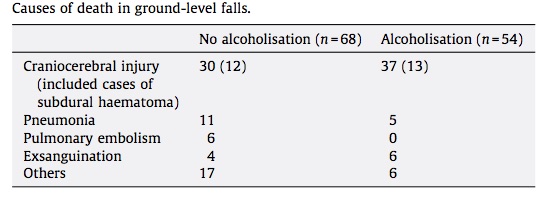
What about falls from standing? Well back to the German forensic pathologists, who this time published a retrospective analysis of 291 fatal falls. Of these, 122 -that's 42% - were falls from standing. About 80% of these ground-level falls were not immediately fatal, and the victim survived anywhere from three hours to almost a year post injury. Almost 60% of the men and 11% of the women who sustained a fatal ground-level fall were (shocker again) intoxicated.  So there we have it. The medical literature demonstrates that falls from standing can certainly be lethal.  Especially after kiddush.

From Thierauf A. et al. Retrospective analysis of fatal falls. Forensic Science International 2010. 198. 92–96. Forgive the English. It wasn't their first language.

From Thierauf A. et al. Retrospective analysis of fatal falls. Forensic Science International 2010. 198. 92–96. Forgive the English. It wasn't their first language.

The US federal government has also weighed in on the matter. OSHA, the Occupational, Safety and Health Administration has a ruled that a duty to erect fall barriers to protect employees only applies when the fall will be more than 6 feet (1.8m).  

Each employee who is constructing a leading edge 6 feet (1.8 m) or more above lower levels shall be protected from falling by guardrail systems, safety net systems, or personal fall arrest systems.
— 29 CFR 1926.501

Back to the Mishnah

The Mishnah rules that only a pit more than 30 inches (ten tefachim) deep is lethal should someone  - or some animal - fall in. We have seen that this has no medical validity. But that doesn't really matter for a legal system.

Consider the legal limit for alcohol allowed when driving. In my home state of Maryland, it is 0.08%, (though of course your ability to drive safely is impaired at levels considerably lower). So what happens if a driver is stopped and his blood alcohol content is 0.07%? Well, it's simple: he is not legally impaired and so may continue to drive.  Is this an indictment of the Maryland drunk driving laws? Not really. Maryland, like all other states, sets its blood alcohol limit; if a driver is close, but below the limit, no penalty follows.

Jewish law too, has to set limits and measures, below which legal penalties do not apply.  The Mishnah's ruling that a pit is only fatal if it is more than 30 inches deep is a legal one - not a medial one.  It works to set limits and insure public safety. A person who digs a pit only 9.5 tefachim deep is not legally liable, and a pit that is a full 10 tefachim deep is certainly rarely lethal if a person accidentally falls in.  But for the sake of public safety a ruling  - arbitrary though it is - had to be made.  So be careful when you dig your pit in a public thoroughfare.

Print Friendly and PDF

Bava Kamma 46a ~ Injuries from Cows

בבא קמא מו, א

שור שנגח את הפרה ונמצא עוברה בצדה ואין ידוע אם עד שלא נגחה ילדה אם משנגחה ילדה משלם חצי נזק לפרה ורביע נזק לולד וכן פרה שנגחה את השור ונמצא ולדה בצדה ואין ידוע אם עד שלא נגחה ילדה אם משנגחה ילדה משתלם חצי נזק מן הפרה ורביע נזק מן הולד

If a bull gored a cow and its newly-born calf is found dead nearby, and it is not known whether the birth of the calf preceded or followed the goring, half damages are paid for the injuries inflicted upon the cow but only quarter damages are paid for the loss of the calf. If a cow gored a bull and a live calf was found nearby, so that it was unknown whether the birth of the calf preceded or followed the goring, half damages can be recovered out of the value of cow ,and quarter damages out of the  value of her calf. (Bava Kamma 46a.)

BullS vs people: the score so far

The Spanish Matador Victor Barrio was gored to death by a bull in Teruel, Spain last Shabbat. He was buried on Monday.

The Spanish Matador Victor Barrio was gored to death by a bull in Teruel, Spain last Shabbat. He was buried on Monday.

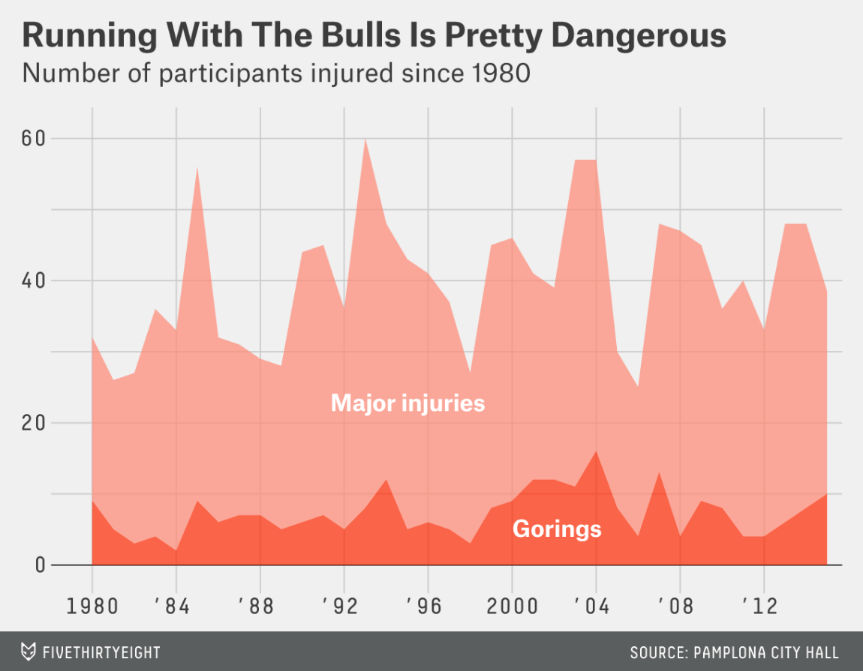
It's been a tough week for bullfighters. Last week, during the annual festival of running with the bulls in Pamplona, eleven men (including three Americans) were gored.  Meanwhile in the Italian village of Pedreguer near Valencia, a 28-year-old man died after a bull’s horn pierced his lung and heart during a run with the bulls there. Finally, last Shabbat, on the very day that we learned a page of Talmud about bullfighting, Victor Barrio, a 29-year-old professional matador, was killed when a bull’s horn pierced his chest as he competed in a fight in the town of Teruel in the eastern region of Aragon. He was the first matador to die in a bullfight since 1992. As we learned last week, Lorenzo, the 1,000 pound bull would not have been held liable in Jewish law, but this fact didn't help the him. Or his mother.   The killer bull and his mother were slaughtered for meat, because in Spanish tradition, the mother of any bull that kills a human is also destined to be slaughtered, in order to “kill off the bloodline”.  This news seems to make more relevant the talmudic discussions of the liabilities if an ox gores a person. But wait a minute. The opening chapters of Bava Kamma, the tractate currently being studied in the Daf Yomi cycle, focuses heavily on the legal liabilities of an ox that gores. But these were bulls. Is there any difference?

Just what is an ox?

The Hebrew word used in the Talmud is shor - (שור, rhymes with shore). Consider the following verse from Leviticus 22:27:

שור או כשב או עז כי יולד והיה שבעת ימים תחת אמו 

Here are some of the ways it is translated into English:

  • When a bull or a goat is born, it shall be seven days under its mother... (Robert Alter. The Five Books of Moses. [Alter seems to have forgotten to translate the word כשב]).

  • When an ox or a sheep or a goat is born, it shall be seven days under its mother...(S.R. Hirsch. The Pentateuch, translated into English by Isaac Levy.)

  • When any of the herd, or a sheep, or a goat is brought forth, then it shall be seven days under its dam..(The Pentateuch, translated into English by M. Rosenbaum and A.M. Silberman.)

  • When an ox or a sheep or a goat is born, it shall stay seven days with its mother...(The JPS Torah Commentary, ed. N. Sarna.)

  • When a bullock or a sheep or a goat is brought forth, then it shall be seven days under its dam...(Koren Jerusalem Bible.)

  • When a calf, a lamb or a goat is born, it is to remain with its mother for seven days...(New International Version.)

  • When a bullock, or a sheep, or a goat, is brought forth, then it shall be seven days under the dam...(King James Bible)

There are more, but you get the point. The word shor (שור) has been translated as a bull, an ox, a calf, a bullock and as a collective, any of the herd.  The Koren Talmud, The ArtScroll Schottenstein Talmud and the Soncino Talmud all translate it as ox.  Confused? Me too.

Here are some of  The Shorter Oxford English Dictionary definitions of an ox:

1. The domestic bovine quadruped (sexually dist. as bull and cow); in common use, applied to the male castrated and used for draught purposes, or reared to serve as food.

2. Zool. Any beast of the bovine family of ruminants, including the domestic European species, the 'wild oxen' preserved in certain parks in Britain, the buffalo, bison, gaur, yak, musk-ox, etc.

In his late nineteenth century translation of the Jerusalem Talmud into French, Moise Schwab translated the word shor as "le bouef" (rather than "le teureau"). De Sola's English translation of the Mishnah, published in 1843, uses the word ox. So does the 1878 compendium by Joseph Barclay, and the first complete English translation of the Talmud, by Michael Rodkinson, published between 1896 and 1903.  The translation of shor as ox is goes back to these early translations, but the suggestion that the meaning of the word is a 'castrated male bovine quadraped' is certainly wrong. Jews are forbidden to castrate their animals, and a castrated bull would have been ineligible to use as a sacrifice. And so we must conclude that the best translation of the word shor (שור) is a bull. 

The delightfully named lecturer Dr. Goodfriend from California State University recently published a lengthy paper (in this book) on the various terms for cattle in the Bible, and the question of whether a castrated bull (a gelding) could have been offered as a sacrifice in the Temple.  The good professor Goodfriend concludes that indeed the prohibition against the castration of animals "would have placed the Israelite farmer at a disadvantage as fewer suitable animals would have been available for his use." One possible way to overcome come this (other than to use cows for ploughing) would have been to import castrated bulls from those who lived outside of Israel.  

Cow-related trauma is a common among farming communities and is a potentially serious mechanism of injury that appears to be under-reported in a hospital context. Bovine-related head-butt and trampling injuries should be considered akin to high-velocity trauma.
— Murphy, CG. McGuire, CM. O’Malley, N. Harrington P. Cow-related trauma: A 10-year review of injuries admitted to a single institution. Injury 2010. 41: 548–550.

Injuries from Domestic bulls (and Cows too)

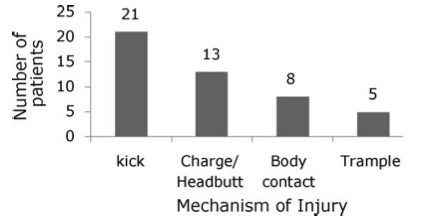
Mechanisms of injury from cows. From Murphy, CG. McGuire, CM. O’Malley, N. Harrington P. Cow-related trauma: A 10-year review of injuries admitted to a single institution. Injury 2010. 41: 548–550.

Mechanisms of injury from cows. From Murphy, CG. McGuire, CM. O’Malley, N. Harrington P. Cow-related trauma: A 10-year review of injuries admitted to a single institution. Injury 2010. 41: 548–550.

Injures from bullfighting are hardly surprising, and the Talmud in Bava Kamma does not focus its attention on them. Rather, it addresses injuries from domestic bulls and cows outside of the bull fighting arena. This is made clear in the Mishnah we will learn in the Daf Yomi cycle tomorrow, which discusses injuries caused by a cow. It turns out that these kind of injuries remain common even today. In 2009, orthopedists from Our Lady of Lourdes Hospital in Ireland published a fascinating paper entitled Cow-related trauma: A 10-year review of injuries admitted to a single institution. Over a decade, the hospital admitted 47 people with cow related trauma, most of whom sustained their injuries from kicking (unlike matadors, who suffer from horn related injuries). And next time you feel like walking across a field containing some gentle-looking cows, remember this: one of the patients was admitted with a head injury, a hip fracture and hypothermia after being trampled on by his herd of cattle in a field and found a number of hours later.

If a bull be a goring bull and it is shown that he is a gorer, and he does not bind his horns, or fasten the bull, and the bull gores a free-born man and kills him, the owner shall pay one-half a mina in money. If he kills a man’s slave, he shall pay one-third of a mina.”
— Code of Hammurabi, Articles 251–252.

In another paper Blunt Bovine and Equine Trauma - from La Crosse Lutheran Hospital in Wisconsin, researchers provided this illustrative case:

A 57-year-old male was pinned to the ground by a 2,000 pound dairy bull and repeatedly knocked to the ground forcefully at least seven times before he was able to crawl from the pen…Examination revealed the following injuries: bilateral flail chest, 13 rib fractures, bilateral hemopneumothoraces, renal contusion, two forearm fractures, left shoulder dislocation, bilateral scapula fractures, and dental alveolar fractures. The patient was treated by...mechanical ventilation for 15 days…His hospital course was complicated by Klebsiella pneumonia and at 16-month followup he remained severely dyspneic, unable to perform his usual farm work.

Cattle look gentle, and for the most part, they are.  But they are large beasts with incredible strength. Hikers (and farmers) beware.

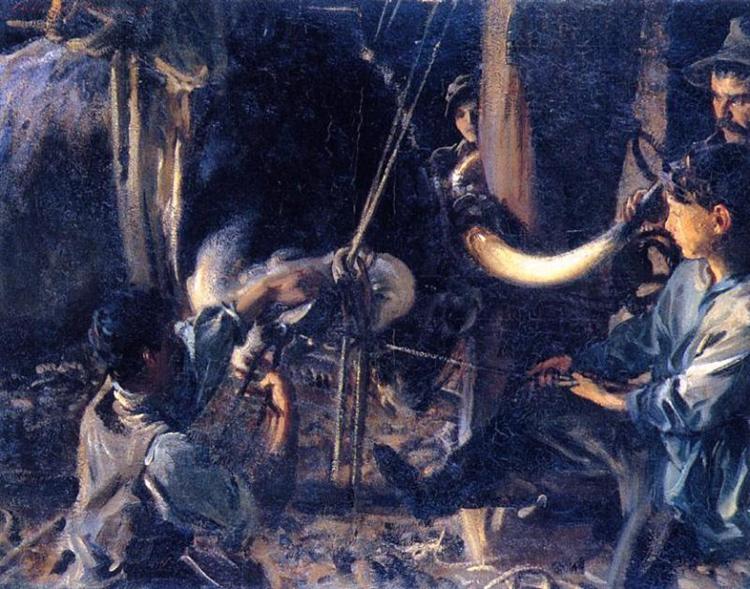
John Singer Sargent. Shoeing The Ox, 1910. Oil on board. From the collection of the Aberdeen Art Gallery, Aberdeen, Scotland.

John Singer Sargent. Shoeing The Ox, 1910. Oil on board. From the collection of the Aberdeen Art Gallery, Aberdeen, Scotland.

Print Friendly and PDF