Arachin 9b ~ The Problem of the Moving Molad

To understand a passage in today’s page of Talmud requires a deep dive into lunar mechanics. Take it slowly and it all makes sense. We will get back to the Talmud in a moment. But first, some astronomy.

The Molad and the lunar conjunction

Each Jewish lunar cycle begins on the molad (lit. birth). This is the moment at which the sun, the moon and the earth line up. At that time the moon is completely invisible because no sunlight can reach the side of the moon that faces us. In astronomy, this moment is called the lunar conjunction.

The precise moment of the lunar conjunction. It should be the same as the calculated time of the molad. But it isn’t.

The precise moment of the lunar conjunction. It should be the same as the calculated time of the molad. But it isn’t.

The Jewish lunar month (based on Babylonian measurements) has a fixed period of 29 days, 12 hours, 44 minutes and 3+1/3 second (or 29 days, 12 hours, and 793 chalakim, a chelek being 1/1080 of an hour). So if you know the time of the molad of one Jewish month, the next one will be precisely 29 days, 12 hours, 44 minutes and 31/3 seconds later. On the Shabbat before the start of every Jewish month (except one), the time of the molad is announced in the synagogue. The first day of that new month follows the molad, though the interval of time between the two varies. So far so good.

Here’s the Problem - and you could even see it

From here.

From here.

The problem is that the length of the calculated molad and the actual length of time between one conjunction and the next is not the same. There was a visual demonstration of this in North America during the total solar eclipse of 2017.

A total solar eclipse occurs when the moon gets directly between the sun and the earth and they are all on the same plane. That time is of course by definition, the same as the lunar conjunction for that month. The 2017 eclipse began on August 21 at 15:46 GMT which was 5:58pm in Jerusalem. That was when the moon started to move across the face of the sun. The total eclipse - when the moon directly covered the sun, occurred at 18:25 and 35 seconds GMT, which was 8:25:35pm in Jerusalem. That is the true astronomic lunar conjunction. But the molad for that month (which was Rosh Chodesh Elul) was announced as “Tuesday, August 22, at 10:44 a.m. and 15 chalakim” (Jerusalem time) — about 12 hours and 20 minutes hours later.

That solar eclipse (which I was lucky enough to witness on the beach in Charleston South Carolina - it was amazing-) visibly demonstrated two things. First, that molad we announce on the Shabbat preceding Rosh Chodesh represents a theoretical time only, and has absolutely no relationship to any astronomical phenomenon. And second, that the molad and the lunar conjunction are often several hours apart.

Why the molad time is not astronomically correct

The length of the Jewish lunar month is very precise, but alas, not accurate. Or at least not accurate enough. This is because the actual length of a lunar month varies from month to month and from year to year. It is affected by the speed of the earth’s orbit around the sun which changes as the earth gets closer or further away from the sun, and the changing distance of the moon from the earth (neither orbit being perfectly circular). NASA kindly provided a histogram which shows the length of the lunar month over 5,000 years. As you can see, thousands and thousands of lunar months have longer or shorter lengths compared to the mean length of the month.

Length of lunation over 5,000 years.png

The actual lunar month is longer than the molad month when the earth is moving at its slowest (the aphelion) and the moon is moving at its fastest (the perigee). In addition, the average length of our solar day (fixed at 24 hours) is getting longer as the tides imperceptibly slow the spin of the earth on its axis. The moon also slows the spin of the earth; every 100 years the day is about 2 milliseconds longer.

Today the average difference between the traditional moladot and the true mean lunar conjunctions, (referred to the meridian of Jerusalem) range from 2+1/2 hours early (Nisan) to 5 +2/3 hours late (TishreiCheshvan), but the maximum differences range from 12 hours early to 16 hours late.

Sometimes then, the Jewish lunar month is shorter or longer than the actual lunar month, but over time it is not all averaging out. Something remarkable is happening: more and more of the calculated molad lunar months are falling behind the actual new moon. You can see this graphically below, thanks to the clever work of Dr. Irv Bromberg at the university of Toronto. The chart depicts the average relationship between the molad and the actual time of the lunar conjunction. The difference between the red line and the blue curve represents the error of the molad with respect to the actual lunar conjunction.
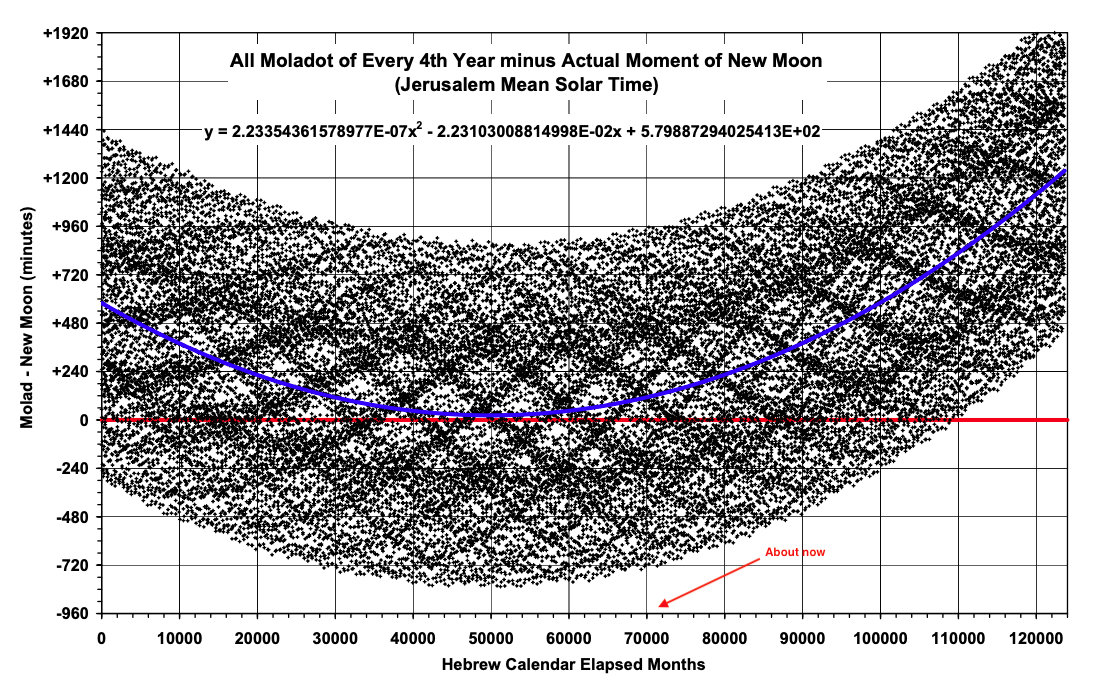
Dots above the thick horizontal line at zero indicate months in which the molad was or will be after the actual new moon. Dots below the thick horizontal line at zero indicate months in which the molad was or will be before the actual new moon.The d…

Dots above the thick horizontal line at zero indicate months in which the molad was or will be after the actual new moon. Dots below the thick horizontal line at zero indicate months in which the molad was or will be before the actual new moon.The difference between the red line and the blue curve represents the error of the molad with respect to the actual lunar conjunction. From here.

Now we can tackle today’s daf

Since some Jewish months have 29 days and others have 30, the average should be 29 1/2 days, But what do we do with that extra 44m and 3secs (or 793 chalakim) left over each month? Eventually they will add up to an entire 24-hour day, and so every three years or so an additional day must be added into the length of one of the Jewish months to bring it back into synchrony with the true lunar conjunction. In such a Jewish year (if it is a regular year) there will then be 355 days instead of the usual 354.

But even this adjustment is not enough. This three-year tweek still leaves an additional 48 minutes each year which adds up to just over one day every 30 years.* So every 30 years an additional day must be added to one of the Jewish months, and (if it is a regular year) there will then be 355 days instead of the usual 354.

ערכין ט,ב

והאיכא יומא דשעי ויומא דתלתין שני

This extra fraction beyond twenty-nine and a half days is compounded month after month and year after year, and as a result, eventually there is an additional day that must be added to the calendar every three years due to the accumulation of hours, and an additional day that must be added every thirty years due to a further accumulation of the extra parts of an hour.

But as we have seen even this fix does not get us back on track over the long run. In about another 3,000 years every calculated molad will be after the actual lunar conjunction, and the difference will grow over time (following the path of the blue curve in the graph above). Who will fix the problem then?

ואין לנו לדאוג כ”כ יותר כי בודאי בעת ההיא וגם הרבה קודם יהיה הגאולה ונקדש ע”פ הראיה
There is no need to worry [about any future problems with the calendar] for certainly by that time the Redemption will have occurred and we will go back to sanctifying the new moon through the testimony of witnesses.
— Biur Halacha 427.

*For the calendrically inclined:

1 Jewish lunar month= 29d 12 h 793ch

Those extra 793ch are a problem.

Over a year of 12m they add (793ch x 12=) 9,516ch or 8h 48s to the length of the lunar cycle.

So over 3 years that is an additional 24 hours = 1 day PLUS 876 ch or 48m 40 secs

Over 30 years that additional 876ch is 26,280ch or just over one day (one day is 25,920ch).

Print Friendly and PDF

Arachin 7a ~ Post Mortem Cesarean Section

ערכין ז,א

א"ר נחמן אמר שמואל האשה שישבה על המשבר ומתה בשבת מביאין סכין ומקרעים את כריסה ומוציאין את הוולד

Rabbi Nachman said in the name of Shmuel: If a pregnant woman in labor died on Shabbat, we bring a knife, incise the abdomen and deliver the child.

A Modern case of post mortem Cesarean Sections

A post mortem cesarean section is (mercifully) vanishingly rare. One review published in 1971 claimed that at the time there were fewer than 150 cases with infant survival reported in the world literature.

But it does happen. A recent case report from Turkey is pretty typical of the sort of things that gets published in medical journals. A 29 year old woman who was 31 weeks pregnant suffered massive head and chest injuries in a car accident. She stopped breathing in the ambulance and CPR was started, which continued in the emergency department. An emergency cesarean section was performed “15 minutes after arrest” and a baby girl was delivered. The baby required breathing support and had some bleeding complications, but was discharged after a month in the hospital and remained healthy with no neurological or physical problems. Alas not all cases end like this; most of the infants die soon after delivery.

Although informed consent is often not realistic, physicians should be aware that as a community they are not only medically mandated but also morally, ethically and legally required to perform perimortem CS.
— Druker L. et al. Perimortem cesarean section for maternal and fetal salvage: concise review and protocol. Acta Obstetricia et Gynecologica Scandinavica 93 (2014) 965–972

post mortem Cesarean Sections in ANCIENT Greece and Rome

An early Roman law, Lex Regia, attributed to Numa Pompilius the second king of Rome (753–673 BCE) seems to require the procedure:

Negat lex regia mulierem quae praegnans mortua sit, humari, antequam partus ei exciditur: qui contra fecerit spem animantis cum gravida peremisse videtur.

The lex regia forbids the burial of a pregnant woman before the young has been excised: who does otherwise, clearly causes the promise of life to perish with the mother.

An even earlier written report of a post mortem cesarean birth is the stuff of myth. The Greek poet Pindar (c. 518-438 BCE.) described the birth of the god Asclepius by cesarean section, after his mother Coronis was murdered in a fit of rage by his father Apollo:

Thus he spoke, and with his first stride came and snatched the neonate from the corpse, while the burning flames parted for him. (Pindar, Pythian Ode Three, 43-44) [6]

Woodcut of the post mortem cesarean birth of the Greek god Asclepius. From Alessandro Beneditti's De Re Medica published in 1549.

Woodcut of the post mortem cesarean birth of the Greek god Asclepius. From Alessandro Beneditti's De Re Medica published in 1549.

The quicker the better

It has long been known that fetal survival from a post mortem cesarean section depends on the speed at which it may be delivered and resuscitated. The seventeenth century Portuguese physician Rodrigo de Castro (1546-1627) explained why:

Physicians should be warned of a very important matter. After the mother’s death, the neonate can not survive in the womb, unless it is removed from the uterus when the soul migrates from the maternal body or shortly before, while the mother is in agony and the vital spirits are still present. The reason is that when the mother’s life and her movements cease, the neonate’s life and its heartbeats also cease, which depends on the neonate’s distension and contraction of two umbilical arteries. When this movement ceases in the maternal body it also ceases in the neonate, because it does not carry the spirit through its mouth before cutting the navel. While the neonate is in the uterus it cannot breathe through its mouth, wrapped in membranes, closed within the uterus walls and surrounded by so many membranes and fluids; therefore we must believe that all those…who survived were removed when the mother’s heart was still beating or the mother was still alive.

(Castro, R. De universa mulierum medicina. Oficina Frobeniana, Hamburgo, 1603, II vol, II. 447. From here.)

Castro was spot on. Compare his insights to those published in this 2009 case report.

The performance of a perimortem Caesarean delivery is a challenging aspect of maternal resuscitation. Adherence to a ‘4 min rule’ means that the response team must rapidly assess the patient, institute appropriate resuscitation, and also prepare for delivery. The timing of restoration of adequate cardiac output is critical for both the mother and the baby, with the mother likely to experience hypoxia earlier in the course of an arrest due to the increased oxygen demands of pregnancy and decreased oxygen storage, while the fetus is reliant on the maternal circulation for oxygen supply.

In their recent review of the topic, Lior Drukker from Sha’arei Zedek hospital together with colleagues from Hadassah hospital in Jerusalem reviewed the protocol for a peri-mortem cesarean section. In these instances the mother is close to death or still undergoing CPR, but resuscitation efforts have not yet been abandoned. They provided this useful flow-chart for those considering the procedure:

Resuscitation protocol in pregnancy following maternal collapse. From Druker L. et al. Perimortem cesarean section for maternal and fetal salvage: concise review and protocol. Acta Obstetricia et Gynecologica Scandinavica 93 (2014) 965–972.

Resuscitation protocol in pregnancy following maternal collapse. From Druker L. et al. Perimortem cesarean section for maternal and fetal salvage: concise review and protocol. Acta Obstetricia et Gynecologica Scandinavica 93 (2014) 965–972.

And if you are quick enough the baby has a chance; a review of reports of infant survival from 1985-2004 identified thirty-eight perimortem sections, some resulting in twins and one, remarkably, that delivered triplets. Out of thirty-eight perimortem cesarean deliveries, thirty surviving infants were delivered. (But bear in mind that there is a tremendous amount of selection bias here. Physicians tend to publish only those cases in which there was a successful outcome.)

 
Perimortem cesarean deliveries with surviving infants with reports of time from maternal cardiac arrest to delivery of the infant, 1985-2004. From Katz V. Balderston K. DeFeest M. Perimortem cesarean delivery: Were our assumptions correct? American …

Perimortem cesarean deliveries with surviving infants with reports of time from maternal cardiac arrest to delivery of the infant, 1985-2004. From Katz V. Balderston K. DeFeest M. Perimortem cesarean delivery: Were our assumptions correct? American Journal of Obstetrics and Gynecology 2005. 192; 1916–21


It may save the mother’s life too

Sometimes a perimortem section does not only save the life of the fetus; it saves the life of the mother too. There are several cases in the literature in which this has been described. When lying on her back, the mother’s circulation is severely impeded as the gravid uterus presses on the inferior vena cava, the main conduit returning blood to the heart. It also presses down on the aorta, the garden-hose-like vessel that carries blood away from the heart. Delivery of the baby immediately relieves these two compressions and improves the maternal circulation, which also makes any CPR efforts more effective.

The Talmud did not believe a post mortem cesarean section to be a futile procedure. Precisely because there was a chance of saving the infant, usual Sabbath prohibitions could be overridden. What we now understand is that occasionally this extreme last ditch effort might save not one life, but two.

[See also Bava Basra 142 for a further discussion of cesarean sections and maternal death rates.]

Print Friendly and PDF

Arachin 5a ~ Rabbi Meir on Maximizing Meaning

The tractate Arachin (ערכין) studies the rules about a specific kind of donation to the Temple: a donation of someone’s monetary worth. But what happens if you make a nonsensical declaration like “I vow to give the value of a newborn child” when such a child has, at least technically, no monetary value? The rabbis state that the pledge is meaningless and so no money need be donated. But the great Rabbi Meir (c.~2nd century CE) disagreed:

ערכין ה,ב

אין אדם מוציא דבריו לבטלה

A person does not say things without reason
— Rabbi Meir, Arachin 5

This teaching established a hermeneutic principle that came to be widely discussed over 1,800 years later, most notably by three American philosophers Willard Quine (d. 2000),  Ronald Dworkin (d. 2013) and Donald Davidson (d. 2003). It is the Principle of Charity.

The Principle of Charity 

The Principle of Charity asks the reader (or listener) to interpret the text they are reading (or words they are hearing) in a way that would make them optimally successful.  Here's how Moshe Halbertal from the Hebrew University explained it:

[A]lthough a person’s words might be read as self-contradictory and thus meaningless, they should not be interpreted in that way. If someone tells us he feels good and bad, we should not take his statement as meaningless but rather understand by this that sometimes he feels good and sometimes bad, or that his feelings are mixed.
— Moshe Halbertal. People of the Book. Harvard University Press 1997, p27.

Other philosophers of language, like the late American analytical philosopher Donald Davidson developed this Principle of Charity. “We make maximum sense of the words of others,” wrote Davidson, “when we interpret in a way that optimizes agreement.” But sometimes The Principle of Charity requires that the reader change the meaning of the text in order to maximize the likelihood of agreement with the author’s words, as long as such a rational or coherent interpretation is available to the reader. It is the attempt to read the text in the “best” possible light.

We could include in this discussion Ludwig Wittgenstein (d. 1951). In his Philosophical Investigations he claimed that there is no single correct way that language works. Instead, there are "language games" - with the rules of the game changing as the needs of the speaker change. Or the American philosopher John Searle's important work Speech Acts, in which speech follows certain rules, and it is the context of the words that determine which rules are in force.  Or the father of deconstruction, the French Sephardi philosopher Jacques Derrida (d. 2004) who believed that once they are cut off from their author, words can mean something other than what they meant in their original context. Or J.L Austin or Paul Ricoeur or....

Just remember that it was Rabbi Meir who introduced us to the hermeneutic Principle of Charity. Now who can please fix that Wiki article so that Rabbi Meir gets his just recognition?

[Repost from here].

Print Friendly and PDF

Arachin 4b ~ The Tumtum, the Androgyne, and the Fluidity of Gender

ערכין ד,ב

זכר - ולא טומטום ואנדרוגינוס

“A male” - and not a tumtum or androgyne.

In addition to male and female, the Talmud describes two other gender categories: tumtum and androgynous. The tumtum is a person whose genitalia are somehow hidden or covered, so that it is not known if they are male or female. In contrast, the genitalia of the androgyne (an ancient Greek word formed from ἀνδρός  andros - “man” and γυνή gune, - “woman”) are in plain sight. It just isn’t clear whether they are male or female organs. The two are mentioned on at least twenty-three pages of the Babylonian Talmud, and in no fewer than nine halachot in the Jerusalem Talmud, so let’s figure out what, from a medical perspective, they are.

The Tumtum

There is no ambiguity about the gender of a tumtum. We just need to get a glimpse of the genitals. (The eleventh century dictionary known as the Aruch connects the word tumtum with the word atum (אטום), meaning sealed.) The problem is that the genitals are covered by what is usually described as skin. Once this cover is surgically opened, the gender will be revealed. In fact according to Rav Ammi (Yevamot 64a), both Abraham and Sarah were each a tumtum. Yes, you read that correctly. Each had genitalia that were hidden. Rav Ammi suggests this as an explanation as to why the couple were infertile for so many years. Once the covering had been removed the couple could then procreate as normal, and along came Isaac.

אמר רבי אמי אברהם ושרה טומטמין היו שנאמר (ישעיהו נא, א) הביטו אל צור חוצבתם ואל מקבת בור נוקרתם וכתיב (ישעיהו נא, ב) הביטו אל אברהם אביכם ואל שרה תחוללכם

Rabbi Ami said: Abraham and Sarah were originally tumtumin, as it is stated: “Look to the rock from where you were hewn, and to the hole of the pit from where you were dug” (Isaiah 51:1), and it is written in the next verse: “Look to Abraham your father and to Sarah who bore you” (Isaiah 51:2),

רשי:

חוצבתם - נעשה לו זכרות: “Hewn”: He was made into a male

נוקרתם - נעשה לה נקבות : “From where you were dug” which made here a female

Urologists have yet to identify this syndrome.

Screen Shot 2019-06-17 at 2.31.21 PM.png

The Androgyne

In 1797 the physician James Parsons, published a book which he dedicated to the Royal Society of London, of which he was a Fellow: “ A Mechanical and Critical Inquiry into the Nature of Hermaphrodites.” Parsons noted that the Romans “had laws made against their Androgyni [which were] remarkably severe; for whensoever a child was reputed one of these, his sentence was to be shut up in a chest alive, and thrown into the sea…

Parsons was not only well-read in Roman law; he cited the fourth chapter of the Mishnah in Bikkurim, which contains a list of the ways in which the androgne sometimes resembles a man, and sometimes a woman:

ביכורים פרק ד

כֵּיצַד שָׁוֶה לַאֲנָשִׁים: מְטַמֵּא בְּלֹבֶן כַּאֲנָשִׁים, וְזוֹקֵק לְיִבּוּם כַּאֲנָשִׁים, וּמִתְעַטֵּף וּמִסְתַּפֵּר כַּאֲנָשִׁים, וְנוֹשֵׂא אֲבָל לֹא נִשָּׂא כַּאֲנָשִׁים, וְחַיָּב בְּכָל מִצְוֹת הָאֲמוּרוֹת בַּתּוֹרָה כַּאֲנָשִׁים:

In what ways is the andogyne like men?…He dresses like men; He can take a wife but not be taken as a wife, like men. [When he is born] his mother counts the blood of purification, like men; He may not be secluded with women, like men. He is not maintained with the daughters, like men…And he must perform all the commandments of the Torah, like men.

כֵּיצַד שָׁוֶה לַנָּשִׁים: מְטַמֵּא בְּאֹדֶם כַּנָּשִׁים, וְאֵינוֹ מִתְיַחֵד עִם הָאֲנָשִׁים כַּנָּשִׁים, וְאֵינוֹ עוֹבֵר עַל "בַּל תַּקִּיף" וְלֹא עַל "בַּל תַּשְׁחִית" וְלֹא עַל "בַּל תְּטַמֵּא לַמֵּתִים" כַּנָּשִׁים, וּפָסוּל מִן הָעֵדוּת כַּנָּשִׁים, וְאֵינוֹ נִבְעַל בַּעֲבֵירָה כַּנָּשִׁים, וְנִפְסַל מִן הַכְּהֻנָּה כַּנָּשִׁים:

And in what ways is he like women?… he must not be secluded with men, like women; And he doesn’t make his brother’s wife liable for yibbum (levirate marriage); And he does not share [in the inheritance] with the sons, like women; And he cannot eat most holy sacrifices, like women…. he is disqualified from being a witness, like women…

The Androgyne & Congenital Adrenal Hyperplasia

Ambiguous genitalia in neonates. From here.

Ambiguous genitalia in neonates. From here.

One of the most common causes of androgyny is congenital adrenal hyperplasia (CAH), caused by a mutation in the CYP21 gene. The adrenal glands, which sits atop the kidneys, are where the action takes place. They produce androgens, which are then converted into the potent sex hormone testosterone. In most (95%) cases of CAH, there is a deficiency of the enzyme 21-hydroxylase. As a result, the adrenal glands produce excessive amounts of the virilizing hormone androgen. (It also causes severe salt wasting, which can be very dangerous, but we are not getting into that now. And there are different severities of the syndrome, but you’ve got a limited attention span, so we will keep it simple.) This excessive androgen production does very little in (XY) males; their genitalia look normal. But in genetic (XX) baby girls the androgens affect the external genitalia and they may become ambiguous: the clitoris becomes enlarged, sometimes to the degree that it resembles a penis. In very severe cases the baby girl has what appears to be an empty scrotum, and may be raised as a boy, all the while being an XX girl with CAH.

Today all newborns are screened for 21-hydroxylase. The deficiency can be treated with hormone replacement, and the genital ambiguity may be corrected, although this latter intervention has, over the last decades, become very controversial.

Anecdotally, in the Western world most [intersex] babies were raised as female because the genitalia were easier to reconstruct... clinical experience suggests that cultural factors are very influential. This may be no bad thing as there is no ‘right’ medical answer and the child will have to grow up in the community into which it is born.
— Woodhouse, C.R.J. Intersex Surgery in the Adult. BJU International 2004. 93 (3): 57-65

The androgyne and the hermaphrodite

The Soncino Talmud identifies the androgyne as a hermaphrodite, that is, a person with both male and female genitalia. So does Goldschmidt’s German translation (“der zwitter”). Cases of true hermaphroditism are extremely rare, and there are only a few scattered case reports in the medical literature. (You can read one reported from Sheba Hospital in Tel Aviv here.) Rather than there being two sets, in these cases the genitalia are ambiguous, and although they have both ovarian and testicular tissue the scrotum does not always contain testes.

Alice Dreger, formerly a Professor of Medical Humanities and Bioethics at Northwestern University, (it’s complicated) wrote a terrific (and controversial) book that tackles some of the issues facing intersex people - those who were once called hermaphrodites. In the past, when faced these difficult cases of intersex or ambiguous genders, clinicians focused on what she calls a “gonadal division.” (Since biopsies and genetic sequencing were not available to the rabbis of the Talmud, they, like clinicians, focused on this gonadal division, for what else could they do?) But, she notes,

a system that emphasizes gonadal anatomy above all else suffers from two major deficits. First, it is scientifically questionable, because it relies on the anatomy of the gonads (functioning or not) more than any other considerations. Second, it provides little clinical help, often confusing and harming the patient, and sometimes also the physician.

Instead, she advocates for a description based on etiology and the patient’s needs. “Such an approach would have the salutary effects of improving patient and physician understanding and reducing the biases that are inherent in the use of the current language of 'hermaphroditism'.”

True hermaphrodites: defined as presenting at least one ovary and at least one testis, or at least one ovotestis...The scientific understanding of sexual development has progressed tremendously in the last 125 years, but the existing taxonomy does not reflect that progress. Scientists and clinicians now recognize that the structure of the gonads does not correlate simply with genotype, phenotype, physiology, diagnosis, or gender identity. The anatomy of testicular tissue in women with androgen insensitivity syndrome (AIS) is quite similar to the anatomy of testicular tissue in non- intersex males, yet their physiologies, phenotypes and gender identities differ markedly.
— Dreger, A, et al. Changing the Nomenclature/Taxonomy for Intersex. Journal of Pediatric Endocrinology & Metabolism 2005. 18, 729-733

The many Shades of Gender

We are used to think that when an egg carrying an X chromosome meets a sperm carrying an X or Y chromosome, one of two things will happen: a genetic female (46XX) or a genetic male (46XY) with genitalia to match. But in fact it is way more complicated than that. We know that there are at least 14 genes involved in the process of sexual differentiation, and many more will likely be discovered. A mutation or malfunction of any of these has a dramatic effect on the process of gender differentiation. For example if there is a defect in the enzymes involved in producing testosterone, there may be ambiguous external genitalia; deficiency of the enzyme 5α-reductase results in variable degrees of under-masculinized external genitalia and genital ambiguity; individuals with partial androgen insensitivity syndrome may also have ambiguous genitalia, and there is no consensus regarding an optimal sex of rearing them; and newborns with congenital adrenal hyperplasia, may have male appearing genitalia while all the time being 46XX.

We have previously noted the strange effects of yet gene discovered in the 1980s. This sex-determining gene on a tiny bit of the male Y chromosome is called the sry gene. That gene tells the body to develop into a male or female appearing body. Sometimes the sry gene sneaks off of the Y gene and makes its way into the DNA of an XX female. As a result, she will develop male anatomy while genetically remaining an XX female. (Please read that sentence again, just to be sure you have understood it.) And sometimes the sry gene on an XY genetic male can mutate and not work. In that case, the genetic male appears to have the organs of a female, which is what occurs in Swyer syndrome. (You can hear more about the amazing sex-changing effects of sry in this fascinating podcast.)

And then there is the small community in the Dominican Republic where there have been a number of cases in which little girls grow a penis and turn into little boys. These observations were first reported to the scientific community in 1974, and are caused by a deficiency of the steroid 5α-reductase. Here is how the BBC explained what is going on when they reported about it in 2015.

When you are conceived you normally have a pair of X chromosomes if you are to become a girl and a set of XY chromosomes if you are destined to be male. For the first weeks of life in womb you are neither…Then, around eight weeks after conception, the sex hormones kick in. If you're genetically male the Y chromosome instructs your gonads to become testicles and sends testosterone to a structure called the tubercle, where it is converted into a more potent hormone called dihydro-testosterone. This in turn transforms the tubercle into a penis. If you're female and you don't make dihydro-testosterone then your tubercle becomes a clitoris…the reason [some genetic males] don't have male genitalia when they are born is because they are deficient in an enzyme called 5-alpha-reductase, which normally converts testosterone into dihydro-testosterone.

So the boys, despite having an XY chromosome, appear female when they are born. At puberty, like other boys, they get a second surge of testosterone. This time the body does respond and they sprout muscles, testes and a penis.

So gender identity is very complicated. James Parsons, that physician who wrote the book on hermaphrodites in 1797 tackled some of the difficult questions that were addressed in Mishnah Bikkurim: can a hermaphrodite get married? (yes, but to which gender varies by case); can they be a witness? (only if the “predominating sex” is male); can they be ordained as a minister? (no); The rabbis were puzzled as to the “true” gender of the androgyne, and so classified them as sometimes male, and sometimes female. It was the best they could do at the time, and Parsons, writing 1,500 years later did the same. Thanks to modern medicine we have learned why these intersex cases occur, but as a society we have still a long way to go to help make their lives easier.

Print Friendly and PDF