Yoma 29a ~ Psalm 22 and the Husband Stitch

Psalm 22 opens with the following phrase: לִמְנַצֵּחַ עַל אַיֶּלֶת הַשַּׁחַר - and it turns out to be rather difficult to translate. One translation is “To the chief Musician upon Aijeleth Shahar,” which is not really much of a translation. Another translation is “For the leader; according to “The deer of the dawn.””


The rabbis may have understood the words, but they found the meaning of this verse to be challenging. In today’s page of Talmud there are three explanations. The first comes from Rabbi Abahu:

יומא כט,א

דִּכְתִיב: ״לִמְנַצֵּחַ עַל אַיֶּלֶת הַשַּׁחַר״, מָה אַיָּלָה זוֹ קַרְנֶיהָ מַפְצִילוֹת לְכָאן וּלְכָאן, אַף שַׁחַר זֶה מַפְצִיעַ לְכָאן וּלְכָאן.

It is as it is written: “For the leader, about the morning hind” (Psalms 22:1); just as the antlers of a hind branch out from here to there, so too, the light of dawn diffuses from here to there.

This explanation is an atmospheric one. Just as the antlers of a deer grow in several different directions, so to the light of the dawn, known as אַיֶּלֶת הַשַּׁחַר “ayelet hashahar” - is diffused in many directions.(One of the many meanings of the phrase אַיֶּלֶת הַשַּׁחַר is “the morning star, “which is the name of the planet Venus.)

Another explanation comes from Rabbi Assi, who links Queen Esther to the appearance of the dawn:

אָמַר רַבִּי אַסִּי: לָמָּה נִמְשְׁלָה אֶסְתֵּר לְשַׁחַר — לוֹמַר לָךְ: מָה שַׁחַר סוֹף כל הַלַּיְלָה, אַף אֶסְתֵּר סוֹף כל הַנִּסִּים

Rabbi Assi said: Why was Esther likened to the dawn? It is to tell you: Just as the dawn is the conclusion of the entire night, so too, Esther was the conclusion of all miracles performed for the entire Jewish people.

That’s nice. But it is on the explanation of Rabbi Zeira that we will focus:

אָמַר רַבִּי זֵירָא: לָמָּה נִמְשְׁלָה אֶסְתֵּר לְאַיָּלָה — לוֹמַר לָךְ: מָה אַיָּלָה רַחְמָהּ צַר וַחֲבִיבָה עַל בַּעְלָהּ כל שָׁעָה וְשָׁעָה כְּשָׁעָה רִאשׁוֹנָה, אַף אֶסְתֵּר הָיְתָה חֲבִיבָה עַל אֲחַשְׁוֵרוֹשׁ כל שָׁעָה וְשָׁעָה כְּשָׁעָה רִאשׁוֹנָה

Rabbi Zeira said: Why is Esther likened to a doe? It is to tell you: Just as in the case of a doe its womb is narrow and it is desirable to its mate at each and every hour like it is at the first hour, so too, Esther was desirable to Ahasuerus at each and every hour like she was at the first hour.

Rabbi Zeira here articulates a very surprising explanation, whose purpose was to praise Esther's anatomy. He claims that the vagina of the female deer (and not the uterus, even though that is the usual translation of the word rechem,) is especially “narrow” and so the male deer finds intercourse especially pleasurable. (A female deer is called called a doe or a hind, from where we get the Yiddish word for a deer - hinda.) So too, the wicked Persian King Ahasuerus longed for intercourse with Esther and found each time as pleasurable as the first.

So a couple of things. First, the vagina of a deer is not especially narrow. It is the perfect size for what it needs to do. It is no more comparatively narrow than that of a dog, a monkey, or a whale, and there no evidence whatsoever that male deer have a greater urge to mate than does the male of any other species. Indeed, it is the very presence of those other species on the planet that indicates that the mating urge of the males of each of those species is perfect, thank you very much. Even that of the Black Widow spider, in whom the tiny male mates with the larger female, only to be eaten alive, in an example of what biologists call sexual cannibalism.

Second, Rabbi Zeira’s midrashic explanation in fact tells us about his mindset, rather than revealing any fact of the natural world. A man longs for intercourse with a woman who has a narrow, or tight vagina. That is what Rabbi Zeira is saying. But before you mutter something inappropriate under your breath, you should realize that this fantasy is still prevalent, and can be found in the medical literature.

The Husband Stitch

Here is a 2020 entry from Medical News Today about “the husband stitch.”

unsplash-image-C2QbMA_nHYE.jpg

The “husband stitch” refers to an extra stitch that some women may have received after vaginal delivery led to their perineum becoming cut or torn.

This stitch extends beyond what is necessary to repair a natural tear during childbirth or a cut from an episiotomy. The supposed purpose of the husband stitch is to tighten the vagina to its predelivery state.

It is important to note that the husband stitch is neither an accepted practice nor an approved medical procedure. Researchers have gathered most of the evidence about the husband stitch from the testimony of women who have had it and from healthcare workers who have witnessed it.

The origin of the husband stitch, or vaginal tightening surgery, traces back to the mid-1950s.

While repairing a vaginal delivery tear or episiotomy, a gynecologist would tighten the entrance of a woman’s vagina by adding an extra stitch.

Doctors stated that this procedure could improve a woman’s well-being by preserving the size and shape of the vagina, either to increase the frequency of her orgasms or to enhance a man’s pleasure in intercourse. At that time, it was also called the husband’s knot or a vaginal tuck.

Is the husband stitch an urban legend? No. Here is an excerpt from a peer-reviewed paper that appeared in Seminars in Plastic Surgery titled Aesthetic surgery of the female genitalia:

Vaginal laxity, as it is called, is a common complaint among parous women. Although women report that reduced sexual sensation is the most common specific symptom of vaginal laxity, it is not clear that this phenomenon is directly related to sexual dysfunction.

Vaginal tightening surgery has been around since the mid fifties, where gynecologists used to tighten the entrance of a woman's vagina with an extra stitch while repairing vaginal and perineum tears or episiotomies after giving birth. At that time it was notoriously known as the “husband's stitch,” the “husband's knot,” or the “vaginal tuck,” and doctors discreetly referred to this procedure as “improving a woman's well-being.”

The goal of these procedures is to reconstruct (or to narrow) the lower third of the vagina, which includes “the orgasmic platform, internal and external vaginal diameter (introitus) and the perineal body.” The procedure enhances vaginal muscle tone strength and control, and decreases internal and external vaginal diameters. Women choosing to have their vaginas tightened are generally healthy women without true functional disorders. 

In vaginal tightening procedures, portions of mucosa are excised from the vaginal fornices (via scalpel, needle electrode, or laser) to surgically “tighten” the lower third of the vagina. Presently there is no standardization of this procedure: It can be an anterior colporrhaphy, a high-posterior colporrhaphy, an excision of lateral vaginal mucosa, or a combination…known complications are localized infection and vaginal bleeding. Ninety five percent of patients treated with lateral colporrhaphy reported an improvement in sexual sensitivity, as well as greater vaginal tightness at the 6 months follow-up

Rabbi Ziera’s explanation of the first verse of Psalm 22 reflects this male fantasy, one which today, some women will accomodate by undergoing surgery. Rather than shy away from discussing these intimate and important areas of our life, the Talmud gives us an opportunity to explore them. It is up to us to do so with modesty, empathy and equity, while always giving the lead to women that for centuries, they were denied.

They take the baby so that they may fix me where they cut. They give me something that makes me sleepy, delivered through a mask pressed gently to my mouth and nose. My husband jokes around with the doctor as he holds my hand.

– How much to get that extra stitch? he asks. You offer that, right?
– Please, I say to him. But it comes out slurred and twisted and possibly no more than a small moan. Neither man turns his head toward me.

The doctor chuckles. You aren’t the first –

I slide down a long tunnel, and then surface again, but covered in something heavy and dark, like oil. I feel like I am going to vomit.

– the rumor is something like –
– like a vir–

And then I am awake, wide awake, and my husband is gone and the doctor is gone. And the baby, where is –

The nurse sticks her head in the door.

– Your husband just went to get a coffee, she says, and the baby is asleep in the bassinet.

The doctor walks in behind her, wiping his hands on a cloth.

– You’re all sewn up, don’t you worry, he said. Nice and tight, everyone’s happy. The nurse will speak with you about recovery. You’re going to need to rest for a while.
— Carmen Maria Machado, The Husband Stitch. Granta.
Print Friendly and PDF

You Talked: We Listened. Copernicus Now in Paperback

Every few days I would get an email asking if there was a way to buy my book other than by winning the New Jersey Lottery. The list price for the hardback edition of New Heavens and a New Earth; The Jewish Reception of Copernican Thought is…$105. I know. Insane.

But armed with some good sales numbers Oxford University Press has released a new paperback edition. So now the wait is over. You can head over to Amazon and buy it for the bargain price of only $34.95 - that’s a third of the hardback price. It’s the perfect summer read for those lazy days round the pool or at the beach.

So for all those who wrote, thank you for your interest and support.

You can download and read the Table of Contents and the Introduction here and here.

This fascinating volume offers both a definitive history of the Jewish encounter with Copernican thought and a carefully-nuanced analysis of how religion and science interact. A model study.
— — Jonathan D. Sarna, Braun Professor of American Jewish History, Brandeis University and Chief Historian, National Museum of American Jewish History, Philadelphia, PA
..a major work of historical scholarship which is sure to provide a vital point of reference in the science-religion debate for years to come
— — Mark Harris, University of Edinburgh. Expository Times, May 2015.
Très bien documenté et très dense tout en restant très agréable à lire et très accessible, rempli de bon sens et de pondération dans ses analyses et ses conclusions, très utile pour notre temps...
— — Jean-Francois Stoffel, Review of Ecclesiastical History 2017
Jeremy Brown has written a deeply researched and insightful account of a fascinating chapter in the often-fraught encounter between religion and science: the impact of the Copernican revolution on Jewish thinkers from its first appearance to today. This is an enthralling work, a wonderful addition to scholarship on a subject that continues to engage us today.
— The late Chief Rabbi Lord Sacks, author of The Great Partnership: God, Science and the Search for Meaning
Print Friendly and PDF

Yoma 20b ~ Sound Propagation at Night

In discussing the service on Yom Kippur, the holiest day of the Jewish Year, the Talmud notes that the voice of the Cohen Gadol, the High Priest, could be heard from a distance of ten parsangs. In case you were wondering, a parsang is an old Persian measure, and is about 3 miles or almost 5km. This means that the voice of the High Priest could be heard over 30 miles away! The Talmud notes that it could be heard at this distance even during the day, when sound does not travel as far as it does at night. Here it is, in the original:

שקלים כ,א

דְּאָמַר מָר: וּכְבָר אָמַר ״אָנָא הַשֵּׁם״ וְנִשְׁמַע קוֹלוֹ בִּירִיחוֹ. וְאָמַר רַבָּה בַּר בַּר חָנָה אָמַר רַבִּי יוֹחָנָן: מִירוּשָׁלַיִם לִירִיחוֹ עֲשַׂר פַּרְסֵי

וְאַף עַל גַּב דְּהָכָא אִיכָּא חוּלְשָׁא, וְהָכָא לֵיכָּא חוּלְשָׁא. וְהָכָא יְמָמָא, וְהָתָם לֵילְיָא

דְּאָמַר רַבִּי לֵוִי: מִפְּנֵי מָה אֵין קוֹלוֹ שֶׁל אָדָם נִשְׁמָע בַּיּוֹם כְּדֶרֶךְ שֶׁנִּשְׁמָע בַּלַּיְלָה? מִפְּנֵי גַּלְגַּל חַמָּה שֶׁמְּנַסֵּר בָּרָקִיעַ כְּחָרָשׁ הַמְנַסֵּר בַּאֲרָזִים

There already was an incident where the High Priest recited, in his confession that accompanied the placing of hands on his bull on Yom Kippur: Please God, and his voice was heard in Jericho. And Rabba bar bar Chana said that Rabbi Yochanan said: The distance from Jerusalem to Jericho is ten parasangs.

…here it was during the day, when sound does not travel as well, that the High Priest recited his confession… As Rabbi Levi said: Why is a person’s voice not heard during the day in the manner that it is during the night? It is due to the fact that the sound of the sphere of the sun traversing the sky generates noise like the noise generated by a carpenter sawing cedars, and that noise drowns out other sounds…

So today on Talmudology we ask: Is Rabbi Levi correct? Does sound really travel further at night? And if so, why?

Yes. It is true

Rabbi Levi is completely correct. Sound does indeed travel further at night, as you can see below in this helpful graphic. (For the man with the trumpet, think Cohen Gadol. For the dog, think Jericho.)

From here.

From here.

The first thing to know is that the speed of sound is dependent on the temperature of the air. Sound moves quicker in warm air and slower in cold air. During the day the sun heats up the earth’s surface, and in particular it heats up the air that is closest to the ground, which is where the sound travels the fastest. But a heat gradient bends the sound waves upwards, much in the same way that a lens bends light rays. (The gradient in which atmospheric temperature decreases with elevation by an amount known as the adiabatic lapse rate.) As a result, the sound waves travels up and away from the listener, and the sounds are quieter.

The reverse happens at night. At night the ground cools quickly. The higher air is warmer than the air close to the ground. The sound further from the ground travels faster at night causing the sound wave to refract back towards the earth. The listener now hears them as louder than they were during the day. It’s physics! (Though it should be noted that some physicists dispute this explanation.)

It’s not just sound waves

Why radio waves travel further at night. From here.

Why radio waves travel further at night. From here.

Here’s a fact that Rabbi Levi did not know. It’s not just sound that is heard better at night. Radio waves are heard better at night too, though for an entirely different reason. To be precise, this does not happen with all radio waves, but just those on the AM and short wave frequencies. Because radio waves only travel in straight lines, they do not follow the curvature of the earth’s surface, and so have a natural range of only 30-40 miles. But they can be transmitted up to the ionosphere, where they bounce off of it and down, back to earth. At night, that ionosphere is protected from the electromagnetic radiation that streams from the sun and tends to distort it. And so the radio waves are reflected back down with less interference, which means they travel further and are easier to detect. As a result, some distant AM radio stations (remember those?) can only be heard at night, though the whole thing becomes rather a moot point since nearly everything broadcast can now be found on the internet, for which the ionosphere is not needed.

Noise pollution

We have demonstrated that sound travels further at night, using our knowledge of the properties of sound waves and the phenomenon of refraction. Rabbi Levi knew none of this, but he had something that very few of us today have: a quiet natural environment. What many of us never experience thanks to noise pollution, he experienced each and every night. He, together with the other sages of the Talmud lived in a world that had no noise other than the sound of human voices around a crackling fire and the background music of the natural world. It was an utterly different experience. Our modern world has given us many things to be grateful for, but noise is not one of them.

Print Friendly and PDF

Yoma 18b ~ Yom Kippur, The High Priest and Nocturnal Pollution

The Mishnah on today’s page of Talmud describes the preparations undertaken by the Cohen Gadol (High Priest) serving at the Temple in Jerusalem, in the run up to the holiest day of the year, Yom Kippur, the Day of Atonement:

וימא יח, א

כל שִׁבְעַת הַיָּמִים לֹא הָיוּ מוֹנְעִין מִמֶּנּוּ מַאֲכָל וּמִשְׁתֶּה, עֶרֶב יוֹם הַכִּפּוּרִים עִם חֲשֵׁיכָה לֹא הָיוּ מַנִּיחִין אוֹתוֹ לֶאֱכוֹל הַרְבֵּה, מִפְּנֵי שֶׁהַמַּאֲכָל מֵבִיא אֶת הַשֵּׁינָה

For seven days before Yom Kippur they would not withhold any food or drink from the Cohen Gadol that he desired. However, on Yom Kippur eve at nightfall, they would not allow him to eat a great deal because food induces sleep [and they did not allow him to sleep].

The Talmud explains why the Cohen Gadol was not allowed to sleep:

תַּנְיָא, רַבִּי יְהוּדָה בֶּן נָקוֹסָא אוֹמֵר: מַאֲכִילִין אוֹתוֹ סְלָתוֹת וּבֵיצִים כְּדֵי לְמַסְמְסוֹ. אָמְרוּ לוֹ: כל שֶׁכֵּן שֶׁאַתָּה מְבִיאוֹ לִידֵי חִימּוּם

…Rabbi Yehuda ben Nekosa says: On Yom Kippur eve they feed him fine flour and eggs in order to loosen his bowels, so that he will not need to relieve himself on Yom Kippur. They said to Rabbi Yehuda ben Nekosa: In feeding him those foods, all the more so that you bring him to a state of arousal. [Feeding him those foods is antithetical to the efforts to prevent the High Priest from becoming impure, as they are liable to cause him to experience a seminal emission.]

How to Prevent a nocturnal Seminal Emission

Leaving aside the dispute about the details, the goal of the menu was not in question. It was to prevent the Cohen Gadol from a nocturnal seminal emission. Actually the menu was also important, as we read later on:

לֹא אֶתְרוֹג, וְלֹא בֵּיצִים, וְלֹא בָּשָׂר שָׁמֵן, וְלֹא יַיִן יָשָׁן. וְיֵשׁ אוֹמְרִים: אַף לֹא יַיִן לָבָן, מִפְּנֵי שֶׁהַיַּיִן לָבָן מֵבִיא אֶת הָאָדָם לִידֵי טוּמְאָה

They do not feed him citrons, eggs or aged wine, and some say they also do not feed him white wine, because white wine causes a person to become ritually impure through a seminal emission…

דְּתָנוּ רַבָּנַן: חֲמִשָּׁה דְּבָרִים מְבִיאִים אֶת הָאָדָם לִידֵי טוּמְאָה, וְאֵלּוּ הֵן: הַשּׁוּם וְהַשַּׁחֲלַיִם וַחֲלֹגְלוֹגוֹת וְהַבֵּיצִים וְהַגַּרְגִּיר

…The Sages taught: Five food items bring a man to a state of impurity due to emission. And these are: Garlic, cress, purslane, eggs, and arugula.

And then comes this helpful advice, unrelated to Yom Kippur:

אָמַר רַב גִּידֵּל אָמַר רַב: אַכְסְנַאי לֹא יֹאכַל בֵּיצִים, וְלֹא יִישַׁן בְּטַלִּיתוֹ שֶׁל בַּעַל הַבַּיִת

Rav Giddel said that Rav said: A guest should neither eat eggs, because they lead to a seminal emission, nor sleep in a garment belonging to the homeowner, his host, because if he experiences a seminal emission and it gets on the garment, he will be diminished in the estimation of his host…

Now back to the main attraction. The next Mishnah outlines how the night of Yom Kippur was spent keeping the Cohen Gadol awake:

יומא יח, ב

אִם (הוּא) הָיָה חָכָם — דּוֹרֵשׁ, וְאִם לָאו — תַּלְמִידֵי חֲכָמִים דּוֹרְשִׁים לְפָנָיו. וְאִם רָגִיל לִקְרוֹת — קוֹרֵא, וְאִם לָאו — קוֹרִין לְפָנָיו. וּבַמֶּה קוֹרִין לְפָנָיו: בְּאִיּוֹב וּבְעֶזְרָא וּבְדִבְרֵי הַיָּמִים. זְכַרְיָה בֶּן קְבוּטָל אוֹמֵר: פְּעָמִים הַרְבֵּה קָרִיתִי לְפָנָיו בְּדָנִיֵּאל.

If he was a scholar, he would teach Torah. If he was not a scholar, Torah scholars would teach Torah before him. And if he was accustomed to read the Bible, he would read; and if he was not, they would read the Bible before him. And what books would they read before him to pique his interest so that he would not fall asleep? They would read from Job, and from Ezra, and from Chronicles. Zekharya, son of Kevutal, says: Many times I read before him from the book of Daniel.

Rashi reminds us why all of this was necessary:

אם היה חכם דורש - בדבר הלכה כל ליל יוה"כ שלא יישן ויראה קרי

If he was a scholar, he would teach Torah - words of Jewish law throughout the night of Yom Kippur, so that he does not falls asleep and possibly have a seminal emission.

Later in this tractate (36a) the Talmud states that one of the sacrifices on Yom Kippur was performed in an unusual location in the Temple. It took place there משום חולשה דכהן גדולֹ - “because the Cohen Gadol was weak” and the new location would save him from the need to carry the sacrificial blood a few more steps. But this concern for the “weakness of the Cohen Gadol seems counterintuitive. On the one hand, he is made to stay awake for the entire night in order to prevent the remote possibility of a nocturnal seminal emission. This was an enormous physical imposition. As an emergency physician I worked hundreds of night shifts and can attest to how physically draining they are. (For those of you who want a sense of this, remember the last time you took an overnight flight. How did you feel coming off the plane?) And on the other hand we go to unusual efforts to minimize any unnecessary physical activity that he might be required to do.

All this demonstrates that the Talmudic concern for a Cohanic nocturnal emission was extremely serious. For this reason several interventions were put in place to prevent this possibility, even though they seem to be in themselves onerous.ּ But we are not quite done yet.

no one got any sleep on the night of yom kippur

יומא יט, ב

מַתְנִי׳ בִּקֵּשׁ לְהִתְנַמְנֵם, פִּרְחֵי כְהוּנָּה מַכִּין לְפָנָיו בְּאֶצְבַּע צְרָדָא, וְאוֹמְרִים לוֹ: אִישִׁי כֹּהֵן גָּדוֹל! עֲמוֹד וְהָפֵג אַחַת עַל הָרִצְפָּה. וּמַעֲסִיקִין אוֹתוֹ עַד שֶׁיַּגִּיעַ זְמַן הַשְּׁחִיטָה.

unsplash-image--R2uNyGmeM4.jpg

MISHNA: If the High Priest sought to sleep at night, the young priests would snap the middle [tzerada] finger against the thumb before him, and they would say to him every so often: My Master, High Priest. Stand from your bed and chill yourself once on the floor and overcome your drowsiness. And they would engage him in various ways until the time would arrive to slaughter the daily offering.

In fact the Talmud notes that lots of people, and not just the young priests, would stay awake all night for the singular purpose of preventing the Cohen Gadol from dozing, and perhaps having a nocturnal emission:

יומא יט, ב

מִיַּקִּירֵי יְרוּשָׁלַיִם לֹא הָיוּ יְשֵׁנִין כל הַלַּיְלָה, כְּדֵי שֶׁיִּשְׁמַע כֹּהֵן גָּדוֹל קוֹל הֲבָרָה וְלֹא תְּהֵא שֵׁינָה חוֹטַפְתּוֹ. תַּנְיָא, אַבָּא שָׁאוּל אָמַר: אַף בִּגְבוּלִין הָיוּ עוֹשִׂין כֵּן זֵכֶר לַמִּקְדָּשׁ

The prominent men of Jerusalem would not sleep the entire night but instead engaged in Torah study, so that the High Priest would hear the sound of noise in the city and sleep would not overcome him in the silence of the sleeping city. It was taught in a Baraita that Abba Shaul said: They would do so even in the outlying areas and stay awake all night in acknowledgment of the Temple…

Let’s summarize all this. Here are the steps that were taken in order to prevent the possibility of the Cohan Gadol falling asleep and having a nocturnal seminal emission:

  • The Cohen Gadol was fed a special diet on the eve of Yom Kippur.

  • He was not fed eggs, white wine or garlic, which were thought to cause a nocturnal emission

  • He stayed awake the whole night.

  • Other had to stay up all night too, in order to study with the Cohen Gadol to keep him from dozing.

  • The general population of Jerusalem (and some of the local villages too) also stayed up all night so that the noise of their learning would keep the Cohen Gadol awake.

Given the extremes to which the Jews of the Temple time went to prevent the High Priest from the remote possibility of a nocturnal seminal emission, we can conclude that it was an extremely unwanted event. So today we will examine the science of nocturnal seminal emissions.

A Medical History of Nocturnal emissions

In his helpful paper on the topic, Mels van Driel, a Dutch urologist, noted that “penile (and clitoral) erections occur in several contexts, some of which have nothing to do with sexuality - for example the nocturnal ones.” He points out that these erections occur in infants, whom we may fairly suppose are not having erotic dreams. In adults they may not always be accompanied by dreams with an erotic content.

Plato (427–347 BCE) described the penis as “disobedient and self-willed, like a creature that is deaf to reason, and it attempts to dominate all because of its frenzied lusts.” The Greek physician Galen (129-200 CE), who was the first to describe the penile anatomy responsible for erections, wrote that “men full of sperm will imagine that they are having sexual intercourse” so that the more intercourse there was, the less would be the frequency of nocturnal emissions.

The early Church Fathers were remarkably modern in their understanding. St. Augustine (354–430 CE) wrote that a wet dream was not the fault of the dreamer, “since the dreamer cannot control the images that appear in his dreams.” Another famous theologian, Thomas Aquinas (1224–1274 ) wrote “that it is clear that a nocturnal orgasm is never a sin in itself. Though sometimes it is the result of a preceding sin.” (Which would have been a useful insight to have shared with the Cohen Gadol.) Just as the Jewish High Priest battled against wet dreams, Christian monks did so in the Middle Ages. According to van Driel “they even tied metal crucifixes to their genitals before going to bed to combat these temptations.”

Then the whole nocturnal erections thing got a bit out of hand, as van Driel describes. It’s well worth a read:

Following Augustine, ecclesiastical law considered it more or less a mortal sin if men with [erectile dysfunction] ED and hence infertile turned out to have entered into marriage. To the end of the 17th century, ED was an even ground for divorce. In an extensive study, the historian Pierre Darmon describes the manner in which those suffering from ED were treated in those days, especially in France. During the trials of the ecclesiastical courts, the defendants in any case had to prove that they possessed normal external genitals, and a jury composed of theologians, doctors, and midwives had to assess it. The court records show that, if necessary, the members of the jury sat at the defendant’s bedside at night to be able to judge any [sleep related erections] SREs occurring. The pompous rituals surrounding these trials indirectly confirmed the power of the Catholic Church. Initially, there was some degree of discretion, but in the course of the 16th century, the church authorities shifted sharply from spiritual voyeurism to actual voyeurism. By this time, they not only required a demonstration of the rigid erection but also of its “elasticity and natural movement.” Sometimes, the jury also insisted on having a demonstration of ejaculation. Naturally, as time went by, this was not enough either, and the married couple had to have sexual intercourse in the presence of the jury, the so-called “congress.” It was not until 1677 that the Catholic Church dispensed with impotence trials.

In men the nature of the genital organs is disobedient and self-willed, like a creature that is deaf to reason, and it attempts to dominate all because of its frenzied lusts.”
— Plato (427–347 BCE)

It was between the 17th to the 19th centuries that nocturnal emissions were first described as “pollutions,” though the Talmud had long described them this way. Van Driel wrote that in 1818, “a French surgeon named Jalade-Lafond even designed a corset for the penis, which reached from the shoulders to the knees. This was followed by many other devices, including a metal tube that dangled from a leather jerkin, a brainchild of the German Johann Fleck.” One of the “most influential figures in the scientific history of human sexuality,” a man by the name of Richard Freiherr von Krafft-Ebing (1840–1902), “was erroneously convinced that morning erections are induced by a full urinary bladder. Another founder of sexology, Henry Havelock Ellis (1859–1939), really feared Sleep Related Erections (SREs) and nocturnal ejaculations because in the Victorian Age, every child was taught that they would increase in frequency and lead to death.” Actually Ellis took the whole thing to a new level, and kept a diary that documented, over some eight years, his own nocturnal ejaculations, and his efforts to prevent them. Here is a excerpt:

It has been said that urinating will relieve the pressure and quiet the erection. I gave this a fair trial for a long period and found no difference in the net result, though sometimes an emission might be thereby postponed a day or so. Getting out of bed and walking up and down to allay erection was of similarly temporary effect.

Anonymously, he also published a paper in 1904 on his findings, noting that at age thirty, he averaged three to four per month. “This capacity will no doubt vary greatly in different individuals. In some it will be greater, in others less than this, but there is decidedly a physiological limit…. orgasm. Inhibition was very possible and never more than temporary. I need scarcely say that the emission was never induced.” Ever the scientist, he made sure to verify the source of the moisture. “I examined it once under a microscope and saw numbers of spermatozoa, proving it to be true semen.”

The Ages of Male Sexual Activity

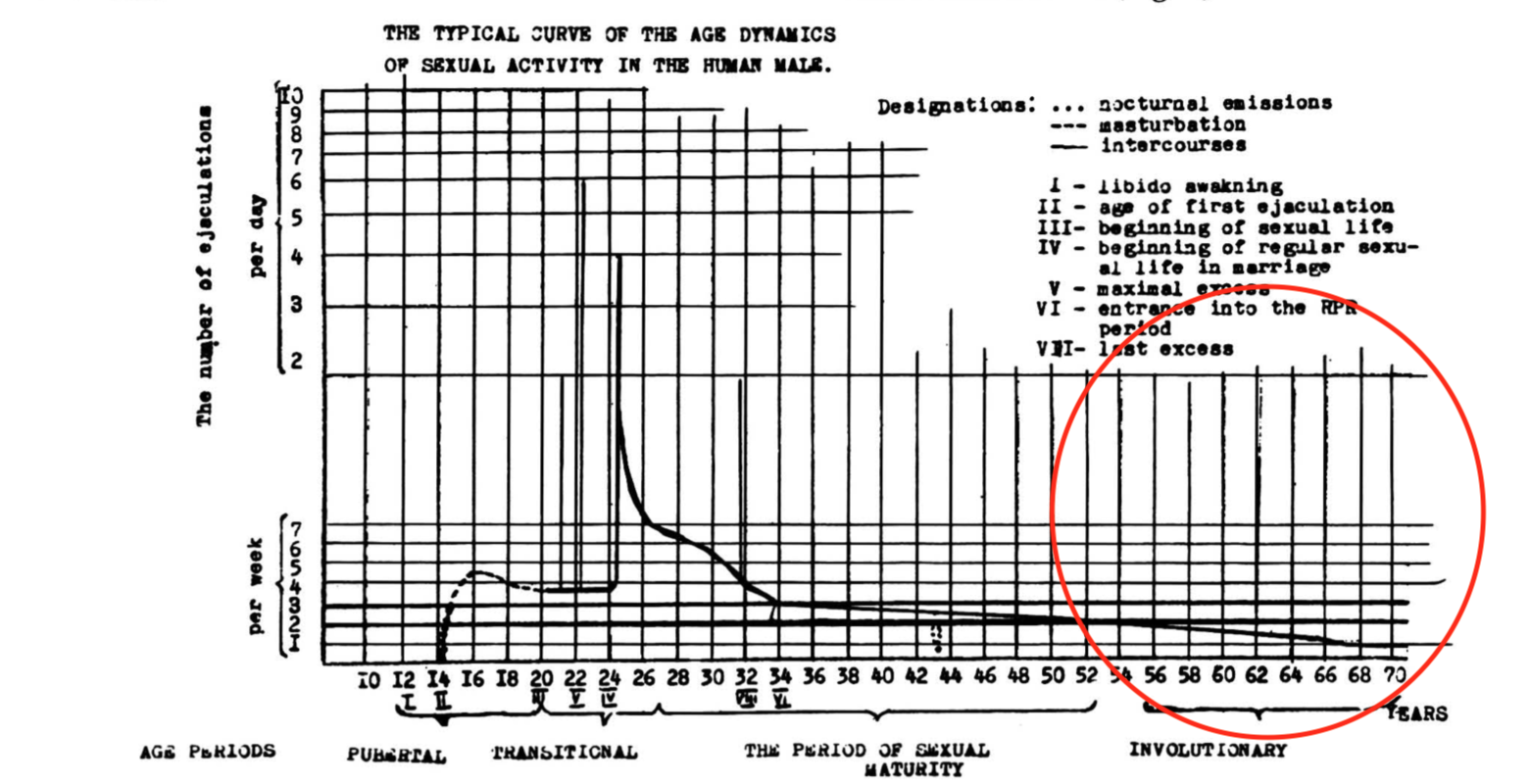
In a 1980 paper titled the Age Aspects of the Male Sexual Activity, the author noted that “in contrast to all the other basic functions the sexual activity is notable for the most strongly pronounced dependencies from the age of a person.” It is suggested that there are four periods of male sexual activity and in the earliest of them, the pubertal phase, there are the first ejaculations. This occurs around 14 year of age, and about half occur as nocturnal emissions. That study was performed in Russia, but around the same time another collected information from 104 college aged males with an average age of 23. It found that most of the men (the plurality of which were Mormon) had experiences a nocturnal emissions.

In the 1970s Ismet Karacan published a series of papers with rather unforgettable titles, such as The ontogeny of nocturnal penile tumescence, The effect of sexual intercourse on sleep patterns and nocturnal penile erections and Sexual arousal and activity: Effect on subsequent nocturnal penile tumescence patterns. The upshot of these was the finding that during life, sleep related erections become fewer and shorter. As men age, they have fewer and fewer wet dreams, a finding also reported by the Russian researcher G. S. Vassilchenko, and shown in the graph below, where you should note the tail end of the graph. Which brings us back to the Talmud.

Four stages graph.png
ועתה ראה והבן, איך יבלבל את האדם ענין הנ”ל, וכי יש לו להתרעם על שלא היה לו נס כמו לכהן הגדול ביום הכפורים

Now understand, my son, how confusing this matter [of wet dreams] is, for should you resent the fact that a miracle did not occur [to prevent them] as it did for the Cohen Gadol?
— Rebbe Nachman of Breslov. Likkutei Moharan 2, Torah 117 (H.T. to Talmudology reader Asher Scheiner)

It never happened

Later in this tractate (21a) there is a list of miracles that occurred in the Temple.(This is also listed in the Mishanh in Avot, 5:5.) One of these was that the sacrificial meat never became putrid. Another was this:

יומא כב, א

וְלֹא אֵירַע קֶרִי לְכֹהֵן גָּדוֹל בְּיוֹם הַכִּפּוּרִים

And a seminal emission did not befall the High Priest on Yom Kippur.

The suggestion is that this was a miracle, and indeed it is listed as such. But a review of the science clearly demonstrates that there was nothing miraculous about this. Nocturnal emissions are a normal part of adolescence (in women too), and they decrease with age.

It will come as no surprise to recall that the Cohen Gadol, the High Priest who performed the Yom Kippur rituals, was an old, or older man. There were of course exceptions, and since the office was generally inherited, the Cohen Gadol might start his rein as a young man. Indeed Maimonides ruled that he could not start his reign until he was at least twenty years old (רמב׳ם משנה תורה, הלכות כלי המקדש 5:15 ). But it was usually a lifetime position. Eli, the high priest of the Mishkan at Shiloh, functioned as the Cohen Gadol until his death. At the age of 98. And John Hyrcanus (יוחנן הורקנוס) was born in 134 BCE and installed as Cohen Gadol in 164 BCE at the age of only thirty. But he held the post for some forty years until his death in 104 BCE at the age of seventy. The Cohen Gadol might start his rein subject to the same naturally produced nocturnal emissions as every other man. But as he aged these pollutions would decrease and eventually cease, not as a result of any miracle, but as a result of the normal physiology of aging.

Science vs Religion, again

When we think of areas of conflict between religion and science, we might at first consider evolution, or creation, and the like. But as we have just discovered, a topic as private as the cause of nocturnal seminal emissions, when properly understood, also raises a conflict. In the Talmud and in the later halakhic codes (such as the one below) such emissions are brought on by foods or by lustful thoughts. But a scientific explanation reveals that these emissions are common, are age (and likely hormonally) related, and are not necessarily related to erotic dreaming. Indeed, they are as natural as sleep itself. That’s what we should teach young boys as they begin puberty. But what should we teach them about this topic from a Jewish perspective, and how might the two be reconciled?

קיצור שולחן ערוך 151:5

מִי שֶרָאָה, חַס וְשָׁלוֹם, קְרִי בַּלַּיְלָה, כְּשֶׁנֵּעוֹר מִשְּׁנָתוֹ, יִטּוֹל יָדָיו וְיֹּאמַר בְּשִׁבְרוֹן לֵב, רִבּוֹנוֹ שֶל עוֹלָם, עָשִׂיתִי זֹאת שֶׁלֹּא בְּכַוָּנָה, רַק בְּהִרְהוּרִים רָעִים וּבְמַחֲשָׁבוֹת רָעוֹת. לָכֵן יְהִי רָצוֹן מִלְּפָנֶיךָ, ה' אֱלֹהַי וֵאלֹהֵי אֲבוֹתַי, מְחַק בְּרַחֲמֶיךָ הָרַבִּים עָוֹן זֶה, וְתַצִּילֵנִי מֵהִרְהוּרִים רָעִים וְכַיוֹצֵא בָהֶם לְעוֹלָם וָעֶד, אָמֵן וְכֵן יְהִי רָצוֹן

If, God forbid, you had a seminal emission at night, upon waking up from your sleep you should wash your hands and say with a contrite heart, "Master of the Universe I have done this unwittingly but it was due to sinful thoughts and sinful reflections; therefore, may it be Your will Adonoy, my God, and the God of my fathers, to erase this iniquity through your great mercy, and save me from sinful thoughts, and from similar occurrences forever and ever. Amein, so may it be Your will."

Next time on Talmudology:

Why sound travels further at night

Print Friendly and PDF