Israel's Noble History

Free Clipart

ISRAELI NOBEL PRIZE WINNERS FOR $200 PLEASE, ALEX

Quick. Name three Israelis who have won a Nobel Prize. Come on. You can do this. Still need a hint? Click here. See, I told you you'd know.  
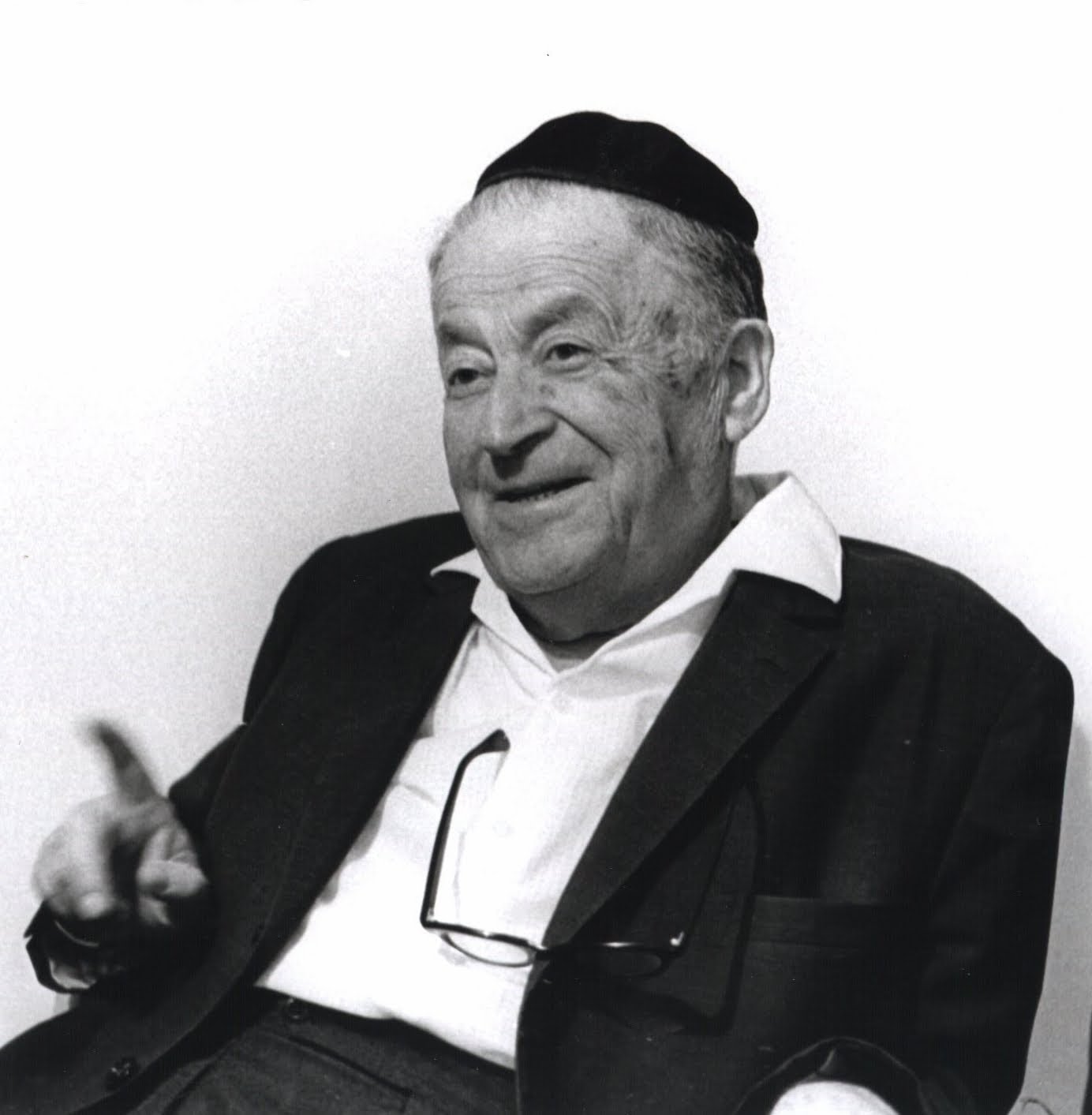
OK, those were easy. How about this one.  Which Israel won a Nobel Prize for literature? Need a hint? He was awarded it in 1966 for "his profoundly characteristic narrative art with motifs from the life of the Jewish people" and his photo is shown here. Still not sure? You may have read his work on Rosh Hashanah and Yom Kippur which was translated into English as Days of Awe...Of course; it was Shai Agnon, who was born in Galicia, moved to what was then Palestine (twice) and died in Jerusalem in 1970.

As of this year there have been twelve Israeli winners of the Nobel Prize. We've noted Agnon as the single winner for literature, and (as you may have answered correctly) there have been three winners of the Nobel Peace Prize: Menachem Begin (1978), Yizhak Rabin and Shimon Peres (both in 1994). That leaves eight more prizes. In honor of Yom Ha'atzmaut, Israel's Independence Day, we will pause from our analysis of science in the Talmud and reflect on the Israeli winners of this prize, given each year (in accordance with the will of Alfred Nobel) "to those who, during the preceding year, shall have conferred the greatest benefit on mankind."

DANIEL KAHNEMAN, ECONOMICS, 2002

Following at an eight year prize-drought, Israel picked up her fifth Nobel in 2002, when Daniel Kahneman was awarded the 2002 Prize in Economics. In his biographical sketch, Kahneman credits his early days in the IDF with the first cognitive illusion he discovered.

“… after an eventful year as a platoon leader I was transferred to the Psychology branch of the Israel Defense Forces….We were looking for manifestations of the candidates’ characters… we felt…we would be able to tell who would be a good leader and who would not. But the trouble was that, in fact, we could not tell... The story was always the same: our ability to predict performance at the school was negligible...I was so impressed by the complete lack of connection between the statistical information and the compelling experience of insight that I coined a term for it: “the illusion of validity.” Almost twenty years later, this term made it into the technical literature. It was the first cognitive illusion I discovered.
— Daniel Kahneman, Biographical sketch at Nobelprize.org

(I was about two-thirds of the way through Kahneman's recent best-seller Thinking Fast and Slow, when I left it on a flight from Tel Aviv. Please let me know if you find it.) 

CIECHANOVER AND HERSHKO, CHEMISTRY 2004

In 2004 Aaron Ciechanover and Avram Hershko, both from the Technion in Haifa (together with Irwin Rose), were awarded the Nobel Prize in Chemistry for their discovery of how cells breaks down some proteins and not others. They discovered ubiquitin-mediated proteolysis, a process where an enzyme system tags unwanted proteins with many molecules of another protein called ubiquitin. The tagged proteins are then transported to the proteasome, a large multi-subunit protease complex, where they are degraded.

ROBERT AUMANN, ECONOMICS, 2005

Robert Aumann from the Hebrew University won the 2005 Nobel Prize in Economics for his work on conflict, cooperation, and game theory (yes, the same kind of game theory made famous by John Nash, portrayed in A Beautiful Mind). Aumann worked on the dynamics of arms-control negotiations, and developed a theory of repeated games in which one party has incomplete information.  The Royal Swedish Academy of Sciences noted that this theory is now "the common framework for analysis of long-run cooperation in the social science." The kippah-wearing professor opened his speech at the Nobel Prize banquet with the following words (which were met with cries of אמן from some members of the audience):

ברוך אתה ה׳ אלוקנו מלך העולם הטוב והמיטב

The four-minute video of his talk should be required viewing for every Jewish high school student (and their teachers).

ADA YONATH, CHEMISTRY, 2009

Remember ribosomes from high school? They are the machines inside all living cells that read messenger RNA and link amino acids in the right order to make proteins.  In 2009, Ada Yonath from the Weizmann Institute shared the Nobel Prize in Chemistry for her work on the structure and function of the ribosome. Specifically, she reported their three-dimensional structure and her work in the 1980s was "instrumental for obtaining the robust and well diffracting ribosome crystals that eventually led to high resolution structures of the two ribosomal subunits." Why is this important?  Well, many antibiotics target the ribosomes of bacteria, and so knowledge of how antibiotics bind to the ribosome may help in the design of new and more efficient drugs.  

Available structures of antibiotics targeting the small ribosomal subunit (30S). From Franceschi and Duffy. Structure-based drug design meets the ribosome. Biochemical Pharmacology 2006; 71; 1016-1025.

DAN SHECHTMAN, CHEMISTRY, 2011

in 1982, Shechtman was working at the US. National Institute of Standards and Technology. As he was looking through an electronic microscope at the structure of new material that he was studying, and noted that the atoms had arranged themselves "in a manner that was contrary to the laws of nature." 

אין חיה כזו – There is no such entitiy" was how he recalled responding to what he had seen. Shechtman double checked his findings and submitted them for publication; the paper was rejected immediately, not worthy even of being sent on for peer review. But Shechtman did manage to get his work published, work that the Nobel Committee found questioned a fundamental truth of science: that all crystals consist of repeating, periodic patters. Shechtman's discovery of what were later to be called quasicrystals  was important not only because of what he found. It was important that he found. Here's why:

Over and over again in the history of science, researchers have been forced to do battle with established “truths”, which in hindsight have proven to be no more than mere assumptions. One of the fiercest critics of Dan Shechtman and his quasicrystals was Linus Pauling, himself a Nobel Laureate on two occasions. This clearly shows that even our greatest scientists are not immune to getting stuck in convention. Keeping an open mind and daring to question established knowledge may in fact be a scientist’s most important character traits.
— The Swedish Academy of Sciences. The Nobel Prize in Chemistry 2011. Information for the Public

ARIEH WARSHEL AND MICHAEL LEVITT, CHEMISTRY 2013

Israelis continued with a winning streak at chemistry. In 2013 Arieh Warshel and Michael Levitt shared the prize in, yes, Chemistry, (together with Marin Karplus, a Jew, but not yet an Israeli). Working together in the 1970s on GOLEM, the supercomputer at the Weizmann Institute, they developed computer programs that could simulate chemical reactions with the help of quantum physics.  These programs, and their offshoots, are used in a variety ways, from optimizing solar panels to designing new drugs.

Joshua Angrist, Economics 2021

The most recent Israeli Nobel laureate is Joshua Angrist, who was awarded the 2021 Nobel Prize in Economics. Angrist, who is a professor at The Massachusetts Institute of Technology, was born in the US but lived in Israel in the 1980s, where he served as a paratrooper. He holds dual US-Israeli nationality, and has spent much of his career analyzing the economics of schooling and the effect of class size on academic achievement. One of his papers looks at the “Maimonides Rule,” named for, well, Maimonides, who apparently noted a correlation between class size and student achievement.

THE LAST WORD

There you have it. Thirteen remarkable Israelis who have contributed to peace efforts, science and literature, and whose efforts were recognized by a Nobel Prize. As we celebrate Yom Ha'atzmaut, let's give the last word to the 2005 winner Robert Aumann, who noted in his banquet speech just what is really important in life. 

We have participated in the human enterprise – raised beautiful families. And I have participated in the realization of a 2000-year-old dream – the return of my people to Jerusalem, to its homeland.
— Robert Aumann, Nobel Prize banquet speech, 2005.


Print Friendly and PDF

Yevamot 54a ~ Bizarre Talmudic Scenarios

On this page of Talmud we read of a very bizarre case:

יבמות נד, א

 אָמַר רַבָּה: נָפַל מִן הַגָּג וְנִתְקַע — חַיָּיב בְּאַרְבָּעָה דְּבָרִים, וּבִיבִמְתּוֹ לֹא קָנָה. בְּנֵזֶק, בְּצַעַר, בְּשֶׁבֶת, בְּרִפּוּי. אֲבָל בּוֹשֶׁת לָא מִיחַיַּיב, דְּאָמַר מָר: אֵין חַיָּיב עַל הַבּוֹשֶׁת עַד שֶׁיִּתְכַּוֵּון

Rabba said: One who fell from a roof and was inserted into a woman due to the force of his fall is liable to pay four of the five types of indemnity that must be paid by one who damaged another, and if she is his yevama he has not acquired her in this manner. He is liable to pay for injury, pain, loss of livelihood, and medical costs. However, he is not liable to pay for the shame he caused her, as the Master said: One is not liable to pay for shame unless he intends to humiliate his victim…

As weird Talmudic cases go, this is among the weirdest. It is entirely impossible, and not least because this would happen. Did the rabbis of the Talmud really believe that such a case could occur? To answer this, let’s consider come other rather implausible cases from across the Babylonian Talmud.

 The AMAZING Shechita Knife

We begin with a fanciful question that is somewhat analogous to tomorrow’s falling Yibbum case. What happens if a person throws a knife across the room, but in doing so the flying knife somehow manages to cut the neck of an animal in just the correct fashion to perform a kosher shechita (ritual slaughter). Is the meat of this slaughtered animal kosher?

חולין לא, א

דתני אושעיא זעירא דמן חבריא זרק סכין לנועצה בכותל והלכה ושחטה כדרכה ר' נתן מכשיר וחכמים פוסלים הוא תני לה והוא אמר לה הלכה כר' נתן

Oshaya, the youngest of the company of Sages, taught a baraita: If one threw a knife to embed it in the wall and in the course of its flight the knife went and slaughtered an animal in its proper manner, Rabbi Natan deems the slaughter valid and the Rabbis deem the slaughter not valid. Oshaya teaches the baraita and he says about it: The halakha is in accordance with the opinion of Rabbi Natan that there is no need for intent to perform a valid act of slaughter.

 The Fish That Pulled a Plough

The Bible (Deuteronomy 22:10) forbids a farmer to plough his land using an ox and a donkey together. While no reason for this law is given, we might suppose it has something to do with the concern that doing so might cause unnecessary pain to the smaller (or perhaps the larger?) animal. Regardless of the reason, the Talmud explains that this law applies to any kind of work and any two different species of animal. Then comes this fantastic question: “What is the law if someone pulls his wagon using a goat and a fish?” 

בבא קמא נה, א

בעי רחבה המנהיג בעיזא ושיבוטא מהו מי אמרינן כיון דעיזא לא נחית בים ושיבוטא לא סליק ליבשה לא כלום עביד או דלמא השתא מיהת קא מנהיג

The Sage Rachava raised a dilemma: With regard to one who drives a wagon on the seashore with a goat and a shibbuta, a certain species of fish, together, pulled by the goat on land and the fish at sea, what is the halakha? Has he violated the prohibition against performing labor with diverse kinds, in the same way that one does when plowing with an ox and a donkey together, or not?

This turned out to be such a hard question that the Talmud could not answer it. The Rosh concludes though that just to be sure, best not to hitch up your wagon to a fish, if you also intend for it to be pulled by a goat (ולא איפשיטא ואזלינן לחומרא). Don’t say you weren’t warned.

The Bird that built her nest on a person’s head

The Bible also demands that the mother bird must be shooed away before collecting the eggs upon which she is brooding. But what happens if a bird makes her nest in a person’s hair? Must this mother be driven away before her eggs are collected? (Chullin 139b)

חולין קלט, ב

אמרי ליה פפונאי לרב מתנה מצא קן בראשו של אדם מהו? אמר (שמואל ב טו, לב) ואדמה על ראשו

The residents of Pappunya said to Rav Mattana: If one found a nest on the head of a person, what is the halakha with regard to the mitzva of sending away the mother? Is the nest considered to be on the ground, such that one is obligated in the mitzva? Rav Mattana said to them that one is obligated in the mitzva in such a case because the verse states: “And earth upon his head” (II Samuel 15:32), rather than: Dirt upon his head, indicating that one’s head is considered like the ground. 

(And just to be clear - the Talmud is not discussing a case like this one, in which a woman allowed an abandoned fledgling to nest in her long har for 84 days, though it is, I will admit, a very touching story.)

One hypothetical too many

Sometimes, even bizarre questions can go too far. If a baby pigeon is found within 50 cubits of a coop, it is presumed to belong to the owner of that coop. If it is found further away than 50 cubits, it belongs to the finder. Ever keen to push the limits of rabbinic law, Rabbi Yirmiyah asked “if one foot of the pigeon is within the fifty cubits and one foot is outside, to whom does it belong?” This apparently was one question too many. The rabbis (rather unfairly in my opinion) expelled Rabbi Yirmiyah from the Yeshivah for asking it.

בבא בתרא כג, ב

בָּעֵי רַבִּי יִרְמְיָה רַגְלוֹ אַחַת בְּתוֹךְ חֲמִשִּׁים אַמָּה וְרַגְלוֹ אַחַת חוּץ מֵחֲמִשִּׁים אַמָּה מַהוּ וְעַל דָּא אַפְּקוּהוּ לְרַבִּי יִרְמְיָה מִבֵּי מִדְרְשָׁא

Rabbi Yirmeya raises a dilemma: If one leg of the chick was within fifty cubits of the dovecote, and one legwas beyond fifty cubits, what is the halakha? The Gemara comments: And it was for his question about this far-fetched scenario that they removed Rabbi Yirmeya from the study hall, as he was apparently wasting the Sages’ time. 

The Role of Bizarre cases

In a 2004 paper published in Thalia: Studies in Literary Humor, Hershey Friedman, a Professor of Business at Brooklyn College, suggested that “whether a situation is possible or not is immaterial when the Talmud is trying to establish legal principles.”  

Purely theoretical (at least in their days) cases are discussed because the sages felt that principles derived from these discussions would clarify the law and thus provide a more thorough understanding of it. Discussions of theoretical cases in the Talmud have allowed scholars of today to use the Talmudic logic and principles to solve current legal questions 

The theoretical questions make a legal point, and it is that legal point that is the real object of the discussion. Whether or not the case could actually happen is immaterial. Friedman also suggests that these unusual cases serve to keep the material interesting, and also act as brain teasers, which don’t necessarily make a legal point but serve to sharpen the minds of both the students and the teachers who ask them.

There was a time, not many years ago, when a lawyer could feel reasonably confident as he approached oral argument in the United States
Supreme Court if he had thoroughly absorbed the record in his case and
had obtained a working knowledge of all relevant cases. No longer. Today, an advocate must, more than ever before, prepare himself for a
stream of hypothetical questions touching not only on his own case but on
a variety of unrelated facts and situations.
— E. Barrett Prettyman Jr., The Supreme Court's Use of Hypothetical Questions at Oral Argument, 33 Cath. U. L. Rev. 555 (1984). 555.

 Hypothetical Cases in the US Legal System

It may help to understand the role that these weird cases have in the Talmud by understanding that hypothetical cases have an important role to play in many legal systems, including that of the United States. Consider this series of questions that were asked in the famous 1984 case of California vs Carney. Police officers entered a motor home without a search warrant, and found marijuana. The question before the court was whether this motor home was a more like a car, which should not require a search warrant, or more like a home, which would. There were various appeals, and the case ended up being heard in front of the US Supreme Court, which is where the following hypothetical questions were raised:

Q: Well, what if the vehicle is in one of these mobile home parks and hooked up to water and electricity but still has its wheels on?

Q: Suppose somebody drives a great big stretch Cadillac down and puts it in a parking lot, and pulls all the curtains around it, including the one over the windshield and around all the rest of them. Would that be a home?

Or how about this exchange back in 1982, (and the subject of which is once again a hot topic of debate in the US). In Board of Education v.Pico, the question before the Court was whether a public school board could remove books which it found to be objectionable from the shelves of junior and senior high school libraries, in order to promote the community's "moral, social, and political values." 

Q: Suppose they [the Board] barred the St. James version of the New Testament, and the Constitution of the United States, and the Declaration of Independence?

Q: Suppose some of these books were assigned as outside reading, and the children were told, you can get it in the public library?

Q. Suppose you had a book, counsel, that had been the subject of criminal proceedings, and conviction of someone in connection with that book had been sustained, a criminal conviction. Would you say that the book comes under this broad authority you suggest? 

(By the way, the Court, in a 5-to-4 decision, held that as centers for voluntary inquiry and the dissemination of information and ideas, school libraries enjoy a special affinity with the rights of free speech and press. Therefore, the School Board could not restrict the availability of books in its libraries simply because its members disagreed with their content. That might be useful to remember.)

There are many, many similar examples. Here is one of my favorites. It comes from United States v. Ross, in which the defendant’s lawyer argued that a small brown paper bag should not have been searched for narcotics because it was protected under the Fourth Ammendment, the right against unlawful search. Here is one of the hypotheticals:

Q: Suppose what they were hunting for was, say, a waffle iron, a stolen waffle iron, or something else that couldn't go in the paper bag. You might have probable cause to search the car for the waffle iron, but if you got to the paper bag, you wouldn't be searching it, would you?

Commenting on this case, the late American lawyer Elijah Barrett Prettyman Jr. (d. 2016) wrote that “one cannot help but be impressed with how far removed some hypotheticals are from the facts before the Court. In Ross, the brown paper bag case, one Justice had the police hunting for a waffle iron.”

Why we need Hypotheticals

Hypothetical cases are really important when the Supreme Court is trying to figure out the difficult cases that come before it. And they are all difficult cases, because if they were easy, the Supreme Court wouldn’t be considering them. The rabbis of the Talmud needed to do the same, which is why they often consider outlandish, implausible or downright fanciful cases to ponder.

The best way to think about these cases is to add in the following missing words: “Hypothetically, what would happen if…” Then, as if by magic, they cease to be silly and start to be really important.

Print Friendly and PDF

Looks Like We Made It!

As astute readers who have followed Talmudology since its inception will have already noted, last week we reached an incredible milestone. The last post, on Yevamot 42, was not just another day in the life of Talmudology. Because, seven and a half years ago, on November 15, 2014, an earlier version of that post was the very first one published on Talmudology. That’s right. It means that we have now completed Talmudology on the entire Babylonian Talmud.

Over the last seven and a half years Talmudology has published about 320 original essays, several of which were re-posted when the Talmud repeated itself. Over those years, this website has had over 221,000 unique visitors, and over 390,000 page views. That’s a lot of Talmudology.

What’s Next for Talmduology?

We will continue to re-publish our posts following the one-page-a-day Daf Yomi cycle. If you teach Daf Yomi, you can navigate to our Topics by Tractate section, and see what is available for each page before it comes up.

In addition, we will put out new material whenever the occasion calls for it. For example we never addressed the topic of weird and outlandish cases in the Talmud, so that will be remedied with a brand-new post on Yevamot 54. In addition to adding material we managed to skip the first time, the existing posts will be updated whenever necessary, because while the Talmud doesn’t change, science sometimes does.

We also hope to publish Talmudology in a two (to perhaps three) volume work, making it accessible on Shabbat, and available as a gift for your favorite Bar or Bat Mitzvah. This is an exciting (if daunting) project, and we are in discussion with a major publisher, so stay tuned…

Over the last seven and a half years, a lot has happened. I danced at the weddings of three of my children, and celebrated the birth of four grandchildren. I travelled widely, mourned the loss of a parent, underwent heart surgery, and watched with great pride as my wife took on a new position at Yeshiva University. In other words, life. Throughout it all I had Talmudology to keep me out of mischief; it was, and still is, a joy to produce.

Thank you to the many readers who pointed out errors of fact or grammar, and who made suggestions to improve the posts and sent fascinating material to help me do so. You have made Talmudology better, and your letters of support have brought many a smile to my face.

חזק ונתחזק

Jeremy

Print Friendly and PDF

Yevamot 42a~ The Baby Born After Eight Months, and Getting Pregnant While Nursing

There is general agreement that a widow must wait a period of time after the death of her husband before re-marrying, to ensure that should she see signs of  pregnancy soon after the death of her first husband, the paternity of the child will not be in doubt.  The Talmud assumes that all pregnancies become obvious within three months of conception, and so a woman can remarry after she waits three months from the death of her first husband. Shmuel explains the importance of uncontested paternity: 

יבמות מד, א

אָמַר רַב נַחְמָן אָמַר שְׁמוּאֵל, מִשּׁוּם דְּאָמַר קְרָא: ״לִהְיוֹת לְךָ לֵאלֹהִים וּלְזַרְעֲךָ אַחֲרֶיךָ״, לְהַבְחִין בֵּין זַרְעוֹ שֶׁל רִאשׁוֹן לְזַרְעוֹ שֶׁל שֵׁנִי

The verse states with regard to Abraham: “To be a God to you and your seed after you” (Genesis 17:7), which indicates that the Divine Presence rests with someone only when his seed can be identified as being descended from him, i.e., there are no uncertainties with regard to their lineage. Therefore, to prevent any uncertainties concerning the lineage of her child, the woman must wait so that it will be possible to distinguish between the seed of the first husband and the seed of the second husband. After three months, if she has conceived from her previous husband, the pregnancy will already be noticeable.

So far so good. But then the Talmud analyses the viability of a child born prematurely in which the father may be either the first husband who subsequently died, or a second man, to whom the mother re-married very son after the death of her first husband. The Talmud suggests that the women need wait two and a half months after the death of her first husband. If a child is born seven months later, it must have been fathered by the second husband, since (i) if it was fathered by the first husband the gestational period would be nine and a half months, which is assumed to be impossible, and (ii) if it was  fathered by the first husband but was born prematurely, the gestational period would have to have been eight months - and as Rashi explains - an eight month fetus is not viable.

בר תמניא לא חיי Yevamot 42~...an eight month fetus cannot survive
— Rashi, Yevamot 42a

Elsewhere, the Talmud specifically notes that an eight month fetus is not viable. In Bava Basra, a child born after eight months is declared to be mukzteh, that is, it is in a category of objects that must not be moved on Shabbat: 

דתניא בן שמנה הרי הוא כאבן ואסור לטלטלו בשבת

For it was taught in a Braisa. A baby born at eight months of gestation is treated like a stone [on Shabbat, because it is muktzeh.]

The premature baby is given the status of a stone because it was not considered to be viable. As a result, even though all the rules of Shabbat may usually be ignored in order to save a life, in this instance, there is no such provision. The baby will die regardless, so the usual Shabbat rules cannot be violated.

but what about the facts?

But what happens when this rabbinic belief ran up against the facts? Which is to say, how could the rabbis explain the cases in which a woman gave birth to an eight-month fetus, and it did indeed survive? There were surely many examples of this kind of premature birth. How did the rabbis square it with their understanding of things?

To answer this we turn to the parallel text in the Talmud Yerushalmi (Yevamot 4:2:5). In explaining why the word וַיִיצֶר - “he created” (Gen. 2:7) is written with two yods instead of the expected spelling “וַיִצֶר”, Rabbi Zeira explained (in the name of Rav Huna) that the verse teaches that there are two kinds of gestations:

מְנַיִין שְׁתֵּי יְצִירוֹת. רִבִי זְעִירָא בְשֵׁם רִבִּי הוּנָא. וַיִיצֶר. יְצִירָה לְשִׁבְעָה וִיצִירָה לְתִשְׁעָה. נוֹצָר לְשִׁבְעָה וְנוֹלָד לִשְׁמוֹנָה חַיי. כָּל־שֶׁכֵּן לְתִשְׁעָה. נוֹצָר לְתִשְׁעָה וְנוֹלָד לִשְׁמוֹנָה אֵינוֹ חַייָה. נוֹצָר לְתִשְׁעָה וְנוֹלָד לְשִׁבְעָה

From where the two creations? Rebbi Ze‘ira in the name of Rebbi Huna: “He created”, a creation for seven and a creation for eight. If he was created for seven but born at eight, he lives; so much more if [born] by nine. If he was created for nine and born at eight, he does not live.

Did you follow that? There are really two kinds of fetus, one that will be viable at seven months and another at nine. If a seven month fetus is born at eight months, it can live, because it was really a fully formed seven month fetus. But if a nine month fetus is born after only eight months, it will not survive, because it was never fully formed. In this way, Rabbi Huna was able to explain the observation that there are in fact some babies born after eight months that are viable. It’s clever. But hardly persuasive. Rather than abandon the whole eight-month-fetus-is-not-viable thing, Rabbi Huna came up with a new theory , and even found a source for it in the Torah itself.

This belief - that a fetus of seven months gestation may survive, but one born in the eighth month of gestation cannot do so - is very odd. But it wasn't a uniquely Jewish belief.

...it is the women who make the judgments and ... insist that the eighth-month babies do not survive, but the others do.
— Hippocrates, On the Seventh-Month Child

The Eight Month Fetus in the Ancient World

Homer's Iliad, written around the 8th century BCE,  records that a seven month fetus could survive. But it is not until Hippocrates (c. 460-370 BCE, or some 500 years before Shmuel), that we find a record of the  belief that a fetus of eight months' gestation cannot survive, while a seventh month fetus (and certainly one of nine month gestation) can. His Peri Eptamenou (On the Seventh Month Embryo) and Peri Oktamenou (On the Eight-Month Embryo) date from the end of the fifth century BCE, but this belief is viewed with skepticism by Aristotle.

In Egypt, and in some other places where the women are fruitful and are wont to bear and bring forth many children without difficulty, and where the children when born are capable of living even if they be born subject to deformity, in these places the eight-months' children live and are brought up, but in Greece it is only a few of them that survive while most perish. And this being the general experience, when such a child does happen to survive the mother is apt to think that it was not an eight months' child after all, but that she had conceived at an earlier period without being aware of it.

The belief that an eight month fetus cannot survive has a halakhic reification: Maimonides ruled that if a boy was born prematurely in the eighth month of his gestation and the day of his circumcision (8 days after his birth) fell out on shabbat, the circumcision - which otherwise would indeed occur on shabbat, is postponed until Sunday, the ninth day after his birth. 

ומי שנולד בחדש השמיני לעבורו קודם שתגמר ברייתו שהוא כנפל מפני שאינו חי... אין דוחין  השבת אלא נימולין באחד בשבת שהוא   יום תשיעי שלהן     

(הלכות מילה 1:11)

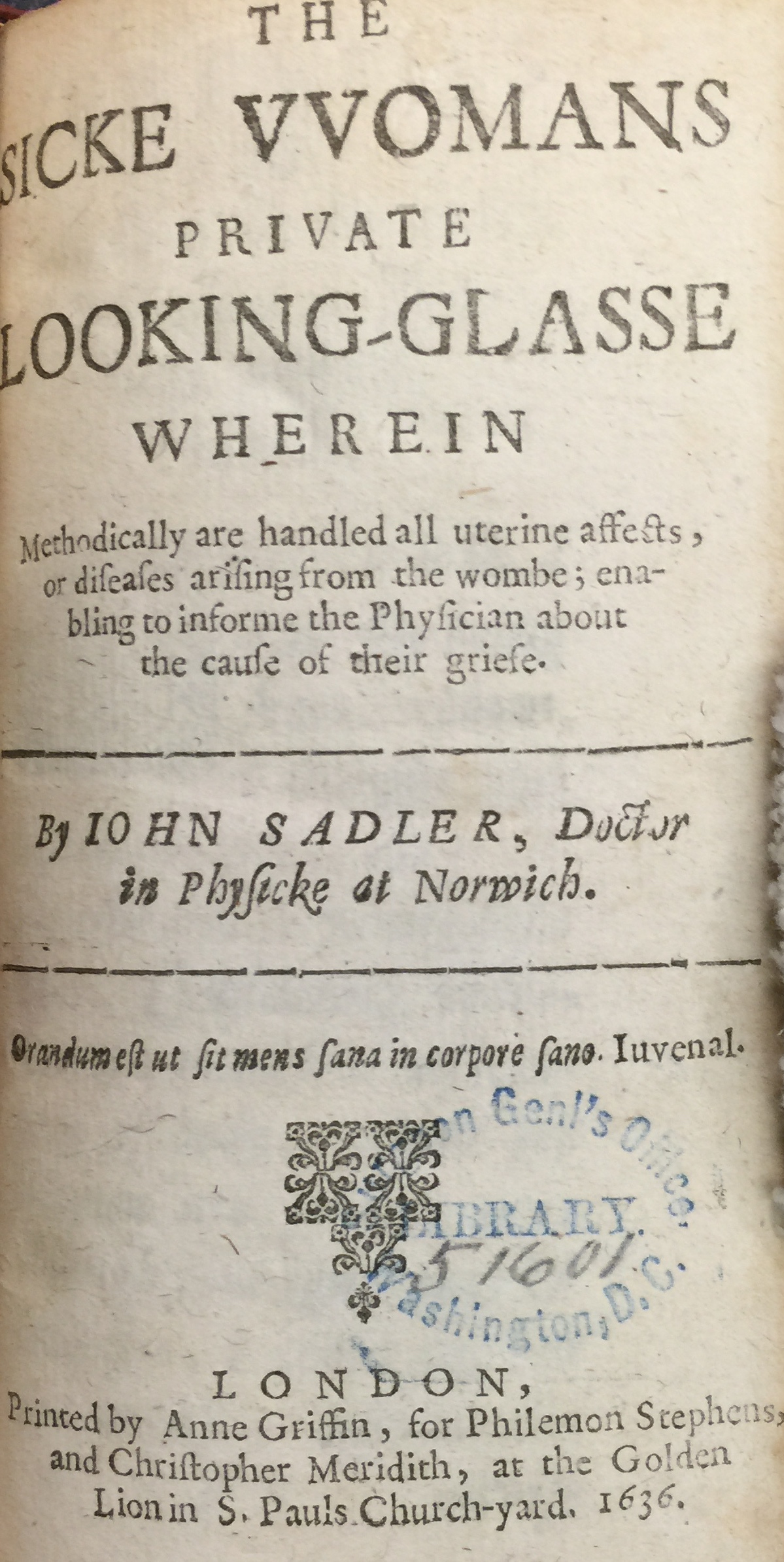
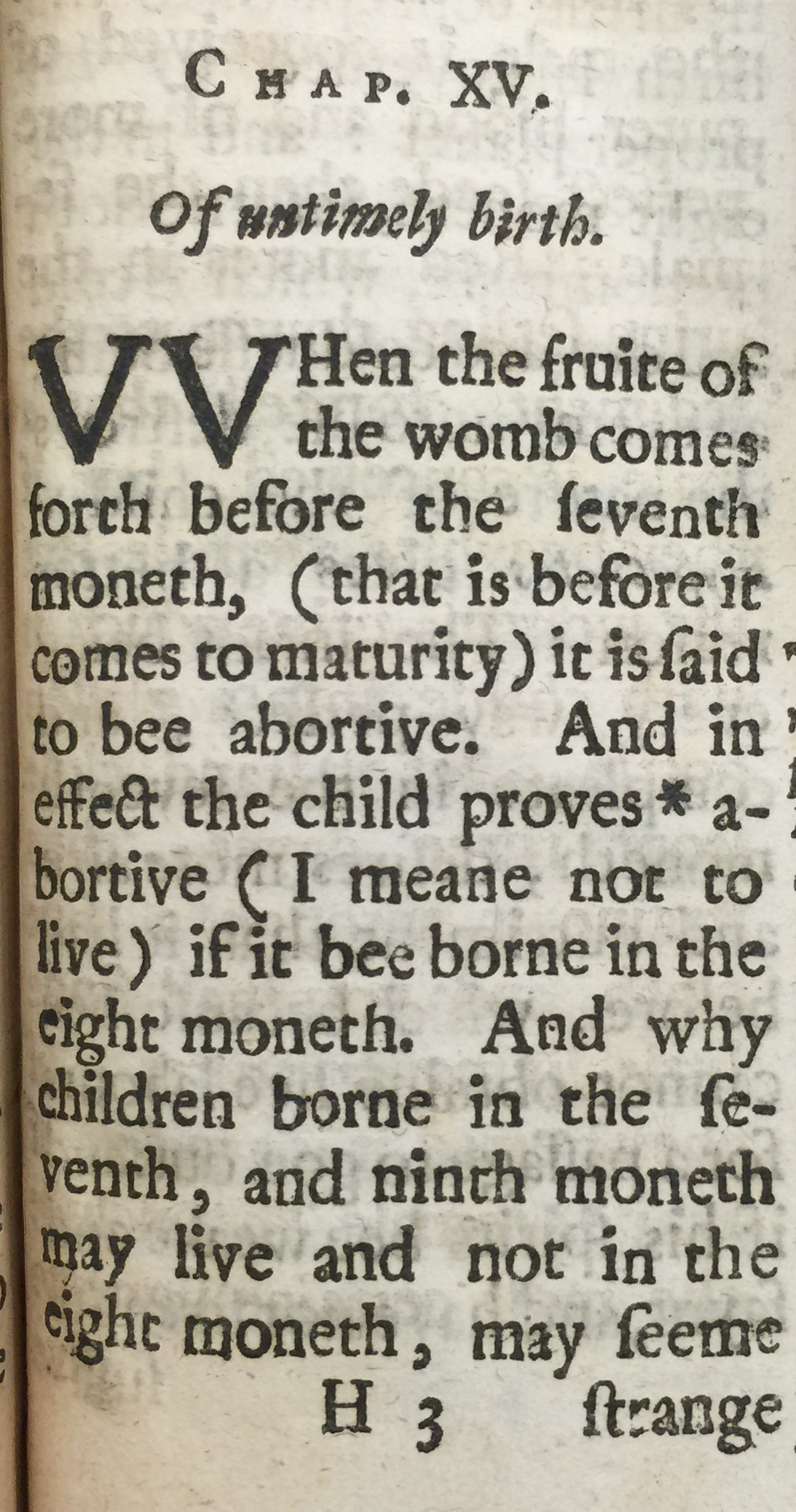
This belief persisted well into the early modern era. Here is a state of the art medical text published in 1636  by John Sadler.  Read what he has to say on the reasons that an eight month fetus cannot survive (and note the name of the publisher at the bottom of the title page-surely somewhat of a rarity then) : 

John Sadler. The Sicke Womans Private Looking Glasse. London 1636. From the Collection of the National Library of Medicine, Bethesda MD

Saturn predominates in the eighth month of pregnancy, and since that planet is "cold and dry"," it destroys the nature of the childe". That, or some odd yearning of the child to be born in the seventh but not the eight month (according to Hippocrates) is the reason that a child born at seven and nine months' gestation may survive, but not one born at after only eight months.

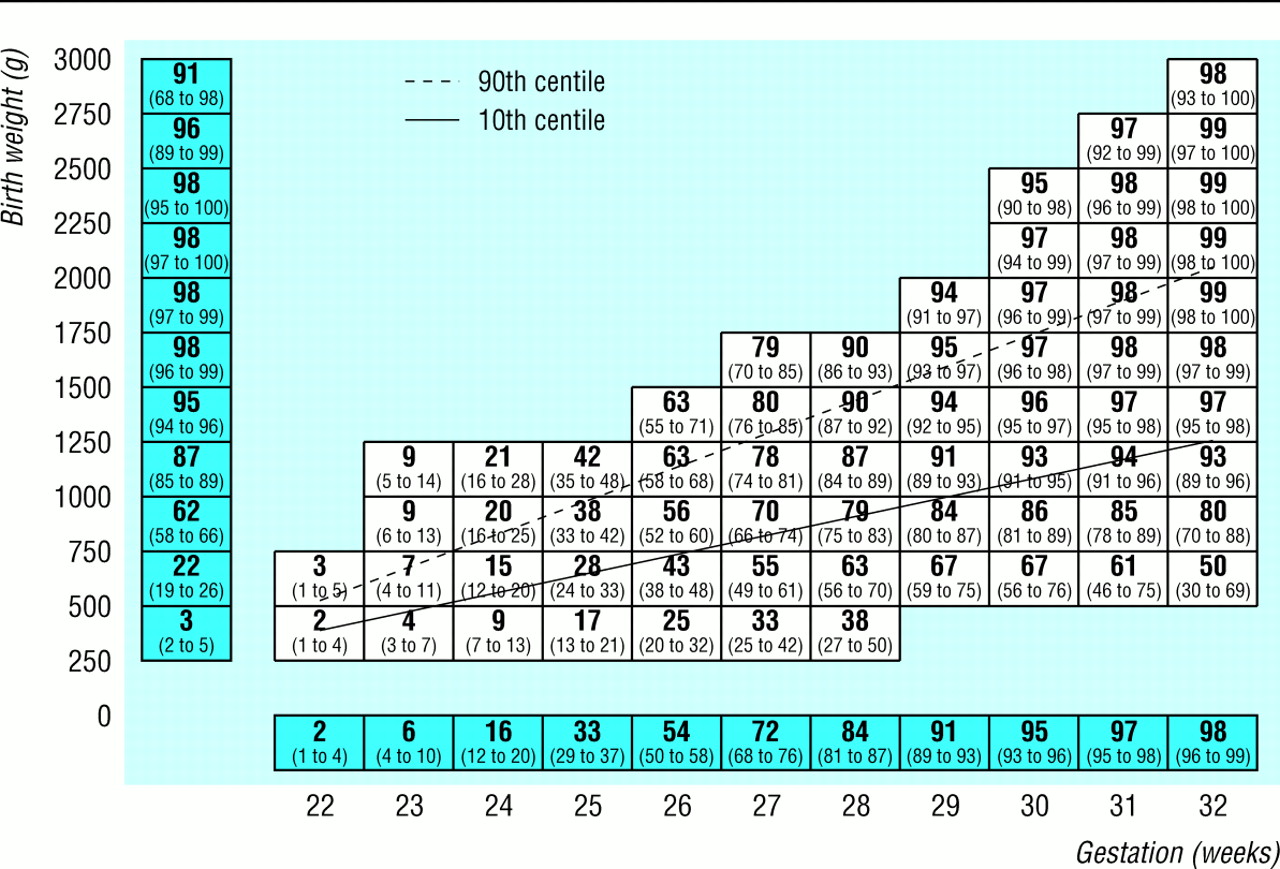
Today, gestational length is of course critical, and, all things being equal, the closer the gestational length is to full term, the greater the likelihood of survival.   We can say with great certainty, that an infant born at 32 weeks or later (that's about eight months) is in fact more likely to survive than one born at 28 weeks (a seven month gestation.) In fact, a seven month fetus has a survival rate of 38-90% (depending on its birthweight), while an eight month fetus has a survival rate of 50-98%. Here is the data, taken from a British study.

Draper Elizabeth S, Manktelow Bradley, Field David J, James David. Prediction of survival for preterm births by weight and gestational age: retrospective population based study  BMJ 1999; 319:1093

More recently, a study from the Technion in Haifa showed that even the last six weeks of pregnancy play a critical role in the development of the fetus. This study found a threefold increase in the infant death rate in those born between  34 and 37 weeks when compared full term babies.  

You can read more on the history of the eight month fetus in a 1988 paper by  Rosemary Reiss and Avner Ash.  From what we have reviewed, the talmudic belief in the unusually low survival rate of an eight month fetus (compared to a seven month one) is one that was widely shared in the ancient world. And one that is not supported by any of the evidence we now have.


Pregnancy as a contraceptive

We now turn to the second pregnancy related topic on today’s daf. According to the Talmud, if a mother becomes pregnant while nursing, her milk supply will become turbid and (unless an alternative is found) her nursing child may die.

יבמות מד, ב

סתם מעוברת למניקה קיימא דלמא איעברה ומעכר חלבה וקטלה ליה 

Many of us will have heard that it is not possible for a mother to become pregnant while she is breast-feeding, and many mothering websites address this question. So how can the Talmud suggest that a breast-feeding mother can conceive?

You may have heard from a friend that nursing can serve as a form of birth control — and while that’s not entirely untrue, it’s not the whole story either.
— Whattoexpect.com

The question we have to answer is, how good a contraceptive is nursing? In a word (well, actually two words) it depends. In the first 3-6 months after birth, and if the baby is fed only on breast milk, some claim that breast feeding is a pretty good contraceptive, and is effective about 98% of time. But if mum skips a feed here or there, or if mum's periods have restarted, all bets are off.  Here's data from an old paper on the topic. Take a close look at the last column- the failure rates per 100 women.

Those are high failure rates -as high as one in five - which makes it a pretty unreliable contraceptive. A review of breastfeeding as a contraceptive was published in 2003 in the widely respected Cochrane Reviews; it concluded that "[f]ully breastfeeding women who remain amenorrheic have a very small risk of becoming pregnant in the first 6 months after delivery when relying on lactational sub fertility". However, - and this is really important - it is not possible to know when amenorrhea is likely to end, and so an IUD is suggested as additional contraception wherever possible.

Overall, the talmudic suggestion that conception is possible while a mother is breastfeeding her child is, scientifically speaking, spot on.

Print Friendly and PDF