Pigs

Bechorot 7a ~ Pig x Sheep

This post is for the page of Talmud we will study on Friday.

(There’s a lot going on this week.)

On this page of Talmud there is a debate regarding the crossbreeding of different species, and the possibility that a non-kosher animal (say, a pig) could fertilize a kosher animal (like a sheep):

בכורות ז, א

והאמר ר' יהושע בן לוי לעולם אין מתעברת לא טמאה מן הטהור ולא טהורה מן הטמא ולא גסה מן הדקה ולא דקה מן הגסה ולא בהמה מן חיה ולא חיה מן בהמה חוץ מר' אליעזר ומחלוקתו שהיו אומרים חיה מתעברת מבהמה

...R. Yehoshua ben Levi said: A non-kosher female can never conceive from a kosher male, nor a kosher female from a non-kosher male, nor a large animal from a small animal, nor a small animal from a large animal, nor a domesticated animal from a non-domesticated animal, nor a non-domesticated animal from a domesticated animal, except for R. Eliezer and his disputant [in Chulin 79b], who claimed that a non-domesticated animal can conceive from a domesticated animal...(Bechorot 7a)

Here is the Talmud in Bava Kama that records that view of “R. Eliezer and his disputant.”

בבא קמא עז, ב – עח, א

ואמר רבא זה בנה אב כל מקום שנאמר שה אינו אלא להוציא את הכלאים ...אמר לך ר"א כי איתמר דרבא לטמא שנולד מן הטהור ועיבורו מן הטמא...וטהורה מטמאה מי מיעברא אין דקיי"ל דאיעבר מקלוט 

Rava said this establishes a model and teaches that wherever the term שה [seh] is stated in the Bible, it is meant to exclude a hybrid... R. Eliezer would say to you  - when did Rava state his model?  With respect to a non-kosher animal that was born from a kosher mother and a non-kosher father...But can a kosher animal conceive from a non-kosher animal? Yes, for it has been established that this case refers to a kosher animal that was conceived from a [kosher mutant animal that was] born with uncloven hooves. (Bava Kamma 77b-78a)

A pig in sheep's clothing? Nope. Just a pig.

A pig in sheep's clothing? Nope. Just a pig.

Here the Talmud claims that a non-kosher animal (say, a pig) could not fertilize a kosher animal (like a sheep). If an animal appears to have the features of a sheep-pig cross-breed, it is, in fact, the offspring of a kosher animal that is breed with another kosher animal but which looks non-kosher because of a mutation that causes it to have non-cloven hooves. Here is that case:

k= kosher; m= mutant, born with non-cloven hooves

k= kosher; m= mutant, born with non-cloven hooves

Which leads to the question of the day: Can a kosher animal indeed successfully breed with a non-kosher animal? Let's take a look.

When a pig loves a sheep

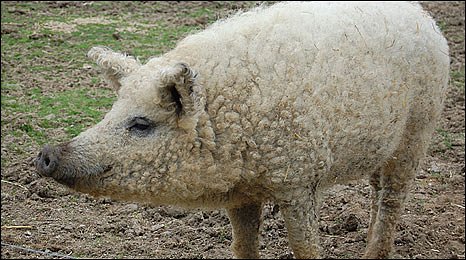
Pigs have been known to act, well, like pigs, and copulate with sheep. But could this lead to a baby peep, or ship, or whatever you'd like to call it? There are pictures that suggest this may be so, but in actual fact this pig with wool is the rare Hungarian Mangalitza pig, and has no sheep ancestry.  

At the beginning of the twentieth century, Foster Dwight Coburn, a farmer who also served as the secretary of the Kansas Department of Agriculture published Swine in America; a text-book for Breeder, Feeder and Student, and on page 63 he made the following observation: 

There exists in some sections of Old Mexico a type of “hog” represented as the product of crossing a ram with a sow, and the term “Cuino” has been applied to this rather violent combination. The ram used as a sire to produce the Cuino is kept with the hogs from the time he is weaned. A resident of Mexico has given the following description of the Cuino: “The sow used to produce the Cuino belongs to any race, but as a rule to the Razor-Back family, which is the more numerous. There is never any difficulty with her accepting the ram when breeding time comes. The progeny is a pig—unmistakably a pig—with the form and all the characteristics of the pig, but he is entirely different from his dam if she is a Razor-Back. He is round-ribbed and blocky, his short legs cannot take him far from his sty, and his snout is too short to root with. His head is not unlike that of the Berkshire. His body is covered with long, thick, curly hair, not soft enough to be called wool, but which nevertheless he takes from his sire. His color is black, white-black, and white-brown and white. He is a good grazer and is mostly fed on grass with one or two ears of corn a day, and on these he fattens quickly. The Cuino reproduces itself, and is often crossed a second and third time with a ram. Be it what it may, the Cuino is the most popular breed of hogs in the state of Oaxaca, and became so on account of their propensity to fatten on little food.”

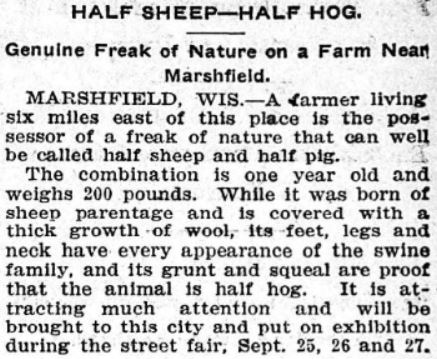
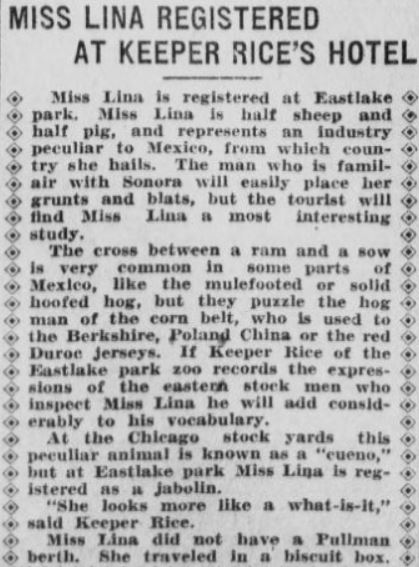
It may have been the most popular pig breed in Oxaca, but it was still rather an oddity in the US; newspapers found them interesting, as evidenced by two reports, from 1902 and 1908 about sheep-pig hybrids.  

The Minneapolis Journal, September 24, 1902, from here.

The Minneapolis Journal, September 24, 1902, from here.

Los Angeles Herald. October 3, 1908, from here.

Los Angeles Herald. October 3, 1908, from here.

Species and interbreeding

Despite these reports, it would seem that the rule suggested by R. Yehoshua ben Levi is correct. Different species cannot successfully interbreed, because, well, because that's the definition of a species, as the Oxford English Dictionary makes clear:

A group of living organisms consisting of similar individuals capable of exchanging genes or interbreeding. The species is the principal natural taxonomic unit, ranking below a genus and denoted by a Latin binomial, e.g., Homo sapiens.

So although it is a tautology, you get the idea: a species by definition can only breed with other members of its own species. If a pig and a sheep could breed and have offspring, they'd be members of the same species. But they are not. Pigs belong to genus Sus, and the species Scrofa, whereas sheep belong to the genus Ovis and the species Aries. Pigs have 38 chromosomes, and sheep have 54.  So they cannot cross-breed.  (Lions and tigers both have 38 chromosomes, so they can cross breed, and produce a liger.)

But it's not as simple as that.  Even if you don't have the same number of chromosomes, you can still sometimes breed outside your species. Horses have 64 chromosomes and donkeys have 62. Yet they can cross breed, resulting in a mule (if mom was a horse) or a hinny (if mum was a donkey), although both are nearly always sterile. Horses belong to the genus Equus and the species ferus, and donkeys belong to the same genus but to a different species, africanus.  Yet they can interbreed.  Which raises the question: should a horse and a donkey be re-classified as belonging to the same species? But that would be odd, because they look so different and act in very different ways.

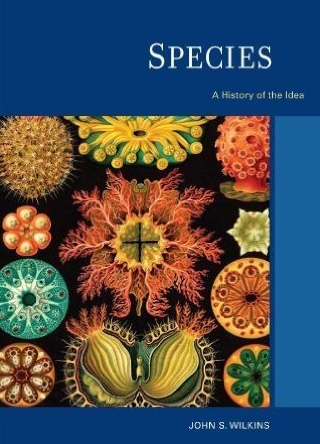
These kinds of questions  are perplexing, and have challenged the world of biology since the time of Carl Linnaeus (d. 1778) who gave the world a way of categorizing and naming all living things called binomial nomenclature. Briefly it goes like this: the grey wolf belongs to the genus Canis and the species lupus.  Dogs belong to the same genus, Canis, and are a subspecies of wolves, so their scientific name is Canis lupus familiaris (which I suppose makes it a trinomial nomenclature).  We belong to the genus Homo and the species sapiens, whereas chimpanzees belong to a different genus and species, Pan troglodytes. Anyway just what gets a creature into one species class or another is a really challenging question, one that is still being played out in the scientific literature. There's even a 320 page book from the University of California Press in which the author "provides a new perspective on the relationship between philosophical and biological approaches" to the concept of a species. For now, though, R. Yehoshua ben Levi's generalization found in Bechorot is pretty close to the Linnaean taxonomy we use today.  We can also conclude that the general rule of the Talmud from today's daf, that a kosher animal could not successfully breed with a non-kosher one, is a pretty good rule of thumb.

“Every living thing loves its like,
and every person his own sort.
All creatures flock together with their kind.”
— Ecclesiasticus, 13:15.


[Repost from Bava Kama 77.]

Print Friendly and PDF

Menachot 64b ~ Cursed Be He Who Raises Swine

Today we are going to talk about pigs. But before we get into it, here is some important background, courtesy of the Jewish historian of the first century, Josephus.

From here.

From here.

Following the death of their father Alexander Yannai in the first century B.C.E. two brothers, Hyrcanus and Aristobulus fought over which would ascend to the Hasmonean throne. Both appealed to Rome (which turned out to be a very bad idea) and in 63 B.C.E. the military leader Pompey turned up to sort things out. He backed Hyrcanus, who was the Cohen Gadol, (high priest) at the time, and who had been originally named as the heir. Pompey captured Aristobulus and took him off to Rome, and he let Hyrcanus remain as the Cohen Gadol. But Pompey refused to Hyrcanus become king. And that is how the Romans came to Jerusalem, or as Josephus put it “we lost our liberty, and became subject to the Romans.” OK. Now here is the relevant part in tomorrow’s Daf Yomi:

מנחות סד, ב 

תנו רבנן כשצרו מלכי בית חשמונאי זה על זה והיה הורקנוס מבחוץ ואריסטובלוס מבפנים בכל יום ויום היו משלשלין להן דינרין בקופה ומעלין להן תמידין היה שם זקן אחד שהיה מכיר בחכמת יוונית לעז להם בחכמת יוונית אמר להן כל זמן שעסוקין בעבודה אין נמסרין בידכם למחר שלשלו להן דינרין בקופה והעלו להן חזיר כיון שהגיע לחצי חומה נעץ צפרניו בחומה ונזדעזעה ארץ ישראל ארבע מאות פרסה על ארבע מאות פרסה באותה שעה אמרו ארור שיגדל חזיר וארור שילמד בנו חכמת יוונית ועל אותה שעה שנינו מעשה שבא עומר מגגות צריפין ושתי הלחם מבקעת עין סוכר

The Sages taught: When the kings of the Hasmonean monarchy besieged each other [in their civil war,] Hyrcanus was outside of Jerusalem, besieging it, and Aristoblus was inside. On each and every day they would lower dinars in a box from inside the city, and those on the outside would send up animals for them to bring the daily offerings in the Temple. A certain elderly man was there [in Jerusalem] who was familiar with Greek wisdom. He communicated to those on the outside by using words understood only by those proficient in Greek wisdom. The elderly man said to them: “As long as they are engaged with the Temple service, they will not be delivered into your hands.” Upon hearing this, on the following day, when they lowered dinars in a box, they sent up a pig to them. Once the pig reached halfway up the wall, it inserted its hooves into the wall and Eretz Yisrael shuddered four hundred parasangs by four hundred parasangs. When the Sages saw this, they said at that time: Cursed is he who raises pigs, and cursed is he who teaches his son Greek wisdom…

“Alongside circumcision and Sabbath observance, the prohibition against pork is considered one of the clearest identifiers of what a Jew does and, as such, who is a Jew.”
— Jordan Rosenblum. ‘Why Do You Refuse to Eat Pork?’’ Jews, Food, and Identity in Roman Palestine. The Jewish Quarterly Review 2011. 100 (1): 95–110

Pig Husbandry in Iron Age Israel - North vs SOuth

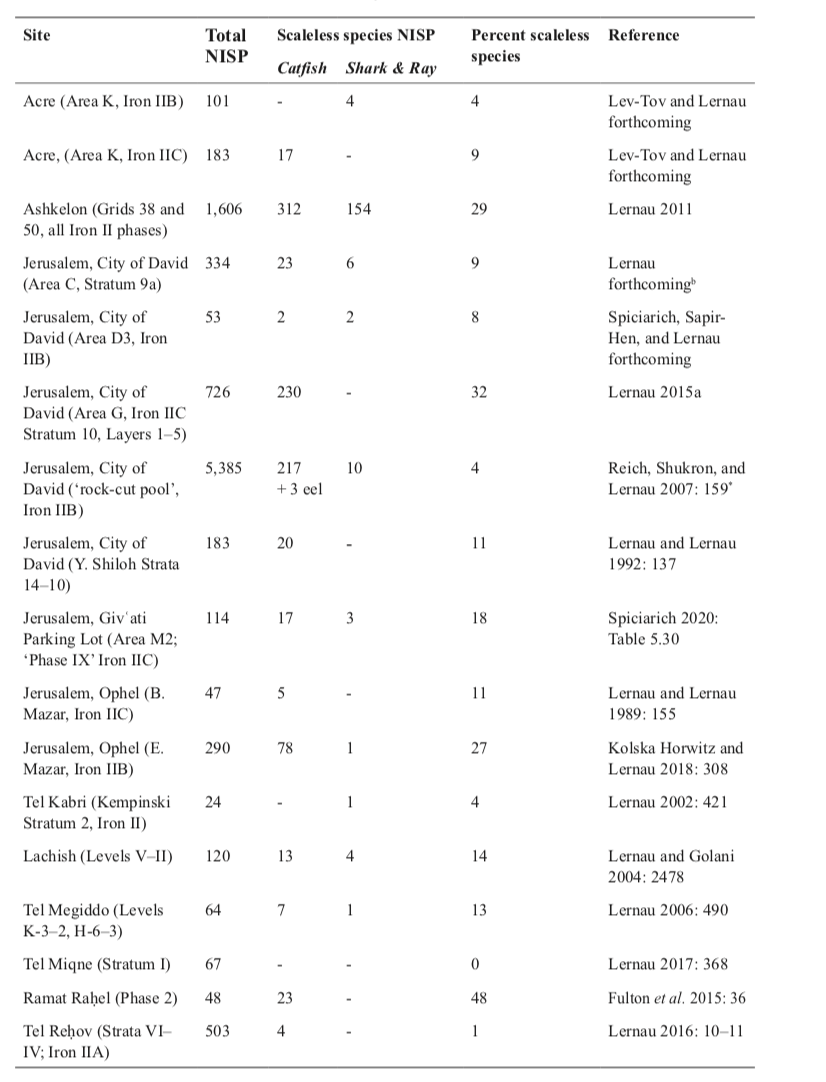
It has been long taken as a given that archeologists could use the presence (or absence) of pig remains to distinguish a Philistine from an Israelite settlement. For example, in known Philistine sites from Iron Age I (~950-780 BCE) like Ashdod and Ekron, pig bones account for 7-19% of the animal remains, depending on which strata you are excavating. This is a much higher percentage than is found in Israelite settlements of the same period. But in 2013 this assumption was challenged by a group of top-notch Israeli archeologists (including the controversial Israel Finkelstein) who reviewed the evidence for it. They studied data from 35 sites in Israel, and found a remarkable trend. In the territory of what was once the Northern Kingdom of Israel, pig remains account for 3-7% of all animal remains. But in the Southern Kingdom of Judah, pig remains are almost absent. (The site of Aroer is a bit of an anomaly, with more than 3% pigs. However this site seems to have been a rest stop for many international travelers and so may have served a more international cuisine.) There was a dichotomy between the kingdoms of Israel and Judah that was manifest in whether they ate pork.

Sapir-Hen, L. Bar-Oz, G. Finkelstein, I. Pig Husbandry in Iron Age Israel and Judah. New Insights Regarding the Origin of the "Taboo." Zeitschrift des Deutschen Palästina-Vereins (1953-), Bd. 129, H. 1 (2013), pp. 1-20.

Sapir-Hen, L. Bar-Oz, G. Finkelstein, I. Pig Husbandry in Iron Age Israel and Judah. New Insights Regarding the Origin of the "Taboo." Zeitschrift des Deutschen Palästina-Vereins (1953-), Bd. 129, H. 1 (2013), pp. 1-20.

Why was there a rapid rise in the frequency of pigs being eaten in northern Israelite sites during Iron Age II (the period between 870 and 680 BCE)? Among the answers proposed is that “the pig taboo could have been another Judahite cultural trait that was opposed to the situation in the north, and which the authors [of the Torah] wished to impose on the entire Israelite population.” Alternatively, it may have been a result of the larger population found in the Northern Kingdom of Israel. “This process” wrote the authors of the paper Pig Husbandry in Iron Age Israel and Judah “brought about shrinkage of the open areas that are important for sheep/goat husbandry, and could have forced the Iron Age IIB population to a shift in meat production, breeding smaller herds of sheep and goats and concentrating more on pigs, which could supply large and immediate sources of meat.” In contrast, the population of the Kingdom of Judah was much smaller than that of Israel. Hence they had more open space to raise livestock.

By the way, it was the Philistines who were responsible for importing European type pigs into the Middle East. Dr Merav Meiri of the Department of Zoology at Tel Aviv University analyzed the DNA of ancient pigs in the area, and found that they possessed a European gene signature. This raises the possibility that European pigs were brought to the region by the Sea Peoples who migrated to the Levant around 900 BCE, bringing their pigs with them.

Pigs & Ancient Rome

Whether or not pigs were eaten in some parts of Biblical Israel, there is no doubt that not eating pork became synonymous with Jewish practice. In Rome, things were different. There, eating pork was widespread and enjoyed, and it was one of the most common meats associated with its residents. And as Jordan Rosenblum points out in his 2010 paper Why Do You Refuse to Eat Pork?’’ Jews, Food, and Identity in Roman Palestine swine were one of the four most common animals used for sacrifices in Rome. It was used in the most sacred rite of the Roman religion known as the suovetaurilia, in which a pig, a sheep and a goat were sacrificed to Mars, as part of a ceremony consecrating the land to the gods. According to the Roman philosopher Epictetus “the conflict between Jews and Syrians and Egyptians and Romans, [was] not over the question whether holiness should be put before everything else and should be pursued in all circumstances, but whether the particular act of eating swine’s flesh is holy or unholy.”

Our Passage in the Talmud Yerushalmi

In the Jerusalem Talmud, there is a similar description of the story told in tomorrow’s Daf Yomi, with an important difference. Can you spot it?

תלמוד ירושלמי (וילנא) מסכת ברכות פרק ד

א"ר לוי אף בימי מלכות רשעה הזאת היו משלשלין להן שתי קופות של זהב והיו מעלין להם שני כבשים ובסוף שלשלו להן ב' קופות של זהב והעלו להם שני חזירים לא הספיקו להגיע לחצי חומה עד שנעץ החזיר בחומה ונזדעזעה החומה וקפץ מ' פרסה מארץ ישראל באותה שעה גרמו העונות ובטל התמיד וחרב הבית

R. Levi said: ‘‘Also during the days of that Evil Empire [Rome], they would lower to them two baskets of gold and they would send up to them two lambs. At the end [of the siege], they lowered to them two baskets of gold and they sent up to them two pigs. They did not reach halfway up the wall when the pig stuck [its nails] in the wall and the wall shook and [the pig] jumped forty parasangs from the land of Israel. At that moment, the sins brought about both the suspension of the continual offering and the destruction of the Temple.

Here is the difference: in the Yerushalmi version the substitution of the pig for the lambs is directly linked to the destruction of Jerusalem, and not just to a general ban on the raising of pigs. “Rome’s secret weapon in times of war with the Jews” wrote Rosenblum, “is to deploy the very animal that functions as a metonym for Rome itself.”

So pigs turn out to have played more of a role in our history than would be expected. In biblical times, eating pork may have been a marker of whether you came from Israel or Judea, and pork, or at least its symbolism, played a pivotal role in the onset of the Roman attack on the Second Temple.

“Archaeologists take pigs very seriously.”

— Israel Finkelstein cited in "Who’d Import Pigs to Israel? Ancient Europeans, Researchers Say." New York Times Nov 5, 2014. A7.

Next time on Talmudology: The Chemistry of Chametz.

Print Friendly and PDF

Bava Kamma 77b ~ Pig x Sheep

בבא קמא עז, ב – עח, א

ואמר רבא זה בנה אב כל מקום שנאמר שה אינו אלא להוציא את הכלאים ...אמר לך ר"א כי איתמר דרבא לטמא שנולד מן הטהור ועיבורו מן הטמא...וטהורה מטמאה מי מיעברא אין דקיי"ל דאיעבר מקלוט 

Rava said this establishes a model and teaches that wherever the term שה [seh] is stated in the Bible, it is meant to exclude a hybrid... R. Eliezer would say to you  - when did Rava state his model?  With respect to a non-kosher animal that was born from a kosher mother and a non-kosher father...But can a kosher animal conceive from a non-kosher animal? Yes, for it has been established that this case refers to a kosher animal that was conceived from a [kosher mutant animal that was] born with uncloven hooves. (Bava Kamma 77b-78a)

A pig in sheep's clothing? Nope. Just a pig.

A pig in sheep's clothing? Nope. Just a pig.

In toady's page of Talmud we read of a debate regarding the crossbreeding of different species, and the possibility that a non-kosher animal (say, a pig) could fertilize a kosher animal (like a sheep). Here the Talmud seems to suggest that this could not happen, and that when this possibility is raised, it refers to a kosher animal that is breeding with another kosher animal but which looks non-kosher because of a mutation that causes it to have non-cloven hooves. Here is that case:

k= kosher; m= mutant, born with non-cloven hooves

k= kosher; m= mutant, born with non-cloven hooves

This debate is part of a larger one found in another tractate of the Talmud, Bechorot. Here is part of that discussion:

בכורות ז, א

והאמר ר' יהושע בן לוי לעולם אין מתעברת לא טמאה מן הטהור ולא טהורה מן הטמא ולא גסה מן הדקה ולא דקה מן הגסה ולא בהמה מן חיה ולא חיה מן בהמה חוץ מר' אליעזר ומחלוקתו שהיו אומרים חיה מתעברת מבהמה וא"ר ירמיה דאיעבר מקלוט בן פרה ואליבא דרבי שמעון

...R. Yehoshua ben Levi said: A non-kosher female can never conceive from a kosher male, nor a kosher female from a non-kosher male, nor a large animal from a small animal, nor a small animal from a large animal, nor a domesticated animal from a non-domesticated animal, nor a non-domesticated animal from a domesticated animal, except for R. Eliezer and his disputant [in Chulin 79b], who claimed that a non-domesticated animal can conceive from a domesticated animal...(Bechorot 7a)

Which leads to the question of the day: Can a kosher animal indeed successfully breed with a non-kosher animal? Let's take a look.

When a pig loves a sheep

Pigs have been known to act, well, like pigs, and copulate with sheep. (There's even a video of it, if you are interested). But could this lead to a baby peep, or ship, or whatever you'd like to call it? There are pictures that suggest this may be so, but in actual fact this pig with wool is the rare Hungarian Mangalitza pig, and has no sheep ancestry.  

At the beginning of the twentieth century, Foster Dwight Coburn, a farmer who also served as the secretary of the Kansas Department of Agriculture published Swine in America; a text-book for Breeder, Feeder and Student, and on page 63 he made the following observation: 

There exists in some sections of Old Mexico a type of “hog” represented as the product of crossing a ram with a sow, and the term “Cuino” has been applied to this rather violent combination. The ram used as a sire to produce the Cuino is kept with the hogs from the time he is weaned. A resident of Mexico has given the following description of the Cuino: “The sow used to produce the Cuino belongs to any race, but as a rule to the Razor-Back family, which is the more numerous. There is never any difficulty with her accepting the ram when breeding time comes. The progeny is a pig—unmistakably a pig—with the form and all the characteristics of the pig, but he is entirely different from his dam if she is a Razor-Back. He is round-ribbed and blocky, his short legs cannot take him far from his sty, and his snout is too short to root with. His head is not unlike that of the Berkshire. His body is covered with long, thick, curly hair, not soft enough to be called wool, but which nevertheless he takes from his sire. His color is black, white-black, and white-brown and white. He is a good grazer and is mostly fed on grass with one or two ears of corn a day, and on these he fattens quickly. The Cuino reproduces itself, and is often crossed a second and third time with a ram. Be it what it may, the Cuino is the most popular breed of hogs in the state of Oaxaca, and became so on account of their propensity to fatten on little food.”

It may have been the most popular pig breed in Oxaca, but it was still rather an oddity in the US; newspapers found them interesting, as evidenced by two reports, from 1902 and 1908 about sheep-pig hybrids.  

The Minneapolis Journal, September 24, 1902, from here.

The Minneapolis Journal, September 24, 1902, from here.

Los Angeles Herald. October 3, 1908, from here.

Los Angeles Herald. October 3, 1908, from here.

Species and interbreeding

Despite these reports, it would seem that the rule suggested by R. Yehoshua ben Levi is correct. Different species cannot successfully interbreed, because, well, because that's the definition of a species, as the Oxford English Dictionary makes clear:

A group of living organisms consisting of similar individuals capable of exchanging genes or interbreeding. The species is the principal natural taxonomic unit, ranking below a genus and denoted by a Latin binomial, e.g., Homo sapiens.

So although it is a tautology, you get the idea: a species by definition can only breed with other members of its own species. If a pig and a sheep could breed and have offspring, they'd be members of the same species. But they are not. Pigs belong to genus Sus, and the species Scrofa, whereas sheep belong to the genus Ovis and the species Aries. Pigs have 38 chromosomes, and sheep have 54.  So they cannot cross-breed.  (Lions and tigers both have 38 chromosomes, so they can cross breed, and produce a liger.)

But it's not as simple as that.  Even if you don't have the same number of chromosomes, you can still sometimes breed outside your species. Horses have 64 chromosomes and donkeys have 62. Yet they can cross breed, resulting in a mule (if mom was a horse) or a hinny (if mum was a donkey), although these are nearly always sterile. Horses belong to the genus Equus and the species ferus, and donkeys belong to the same genus but to a different species, africanus.  Yet they can interbreed.  Which raises the question: should a horse and a donkey be re-classified as belonging to the same species? But that would be odd, because they look so different and act in very different ways.

These kinds of questions  are perplexing, and have challenged the world of biology since the time of Carl Linnaeus (d. 1778) who gave the world a way of categorizing and naming all living things called binomial nomenclature. Briefly it goes like this: the grey wolf belongs to the genus Canis and the species lupus.  Dogs belong to the same genus, Canis, and are a subspecies of wolves, so their scientific name is Canis lupus familiaris (which I suppose makes it a trinomial nomenclature).  We belong to the genus Homo and the species sapiens, whereas chimpanzees belong to a different genus and species, Pan troglodytes. Anyway just what gets a creature into one species class or another is a really challenging question, one that is still being played out in the scientific literature. There's even a 320 page book from the University of California Press in which the author "provides a new perspective on the relationship between philosophical and biological approaches" to the concept of a species. For now, though, R. Yehoshua ben Levi's generalization found in Bechorot is pretty close to the Linnaean taxonomy we use today.  We can also conclude that the general rule of the Talmud from today's daf, that a kosher animal could not successfully breed with a non-kosher one, is a pretty good rule of thumb.

“Every living thing loves its like,
and every person his own sort.
All creatures flock together with their kind.”
— Ecclesiasticus, 13:15.

 Next time on Talmudology: Is garlic good for you? 

Print Friendly and PDF

Ta'anit 21b ~ Pandemics in Pigs

On today’s page of Talmud we continue the discussion of pandemics, and one of Jewish responses to them, which is to fast. But in this passage of Talmud the victims of the pandemic are not human. They are pigs.

תענית כא, ב

אֲמַרוּ לֵיהּ לְרַב יְהוּדָה: אִיכָּא מוֹתָנָא בַּחֲזִירֵי. גְּזַר תַּעֲנִיתָא. נֵימָא קָסָבַר רַב יְהוּדָה מַכָּה מְשׁוּלַּחַת מִמִּין אֶחָד מְשׁוּלַּחַת מִכל הַמִּינִין? לָא, שָׁאנֵי חֲזִירֵי — דְּכמְיָין מְעַיְיהוּ לִבְנֵי אִינָשֵׁי

On one occasion, they said to Rav Yehuda: There is pestilence among the pigs. Rav Yehuda decreed a fast. The Gemara asks: Let us say that Rav Yehuda maintains that a plague affecting one species will come to affect all species, and that is why he decreed a fast. The Gemara answers: No, in other cases there is no cause for concern. However, pigs are different, as their intestines are similar to those of humans. Consequently, their disease might spread to people.

Rav Yehuda’s ruling became normative Jewish practice, and is codified in the Shulhan Arukh:

שולחן ערוך אורח חיים 576:2-3

היה דבר במדינה ושיירו' הולכו' ובאו' ממנה למדינה אחר' שתיהן מתענו' אע"פ שהן רחוקו' זו מזו

ואם היה דבר בחזירים מתענין מפני שמעיהם דומים לשל בני אדם וכל שכן אם היה דבר בעכו"ם ולא בישראל שמתענים

…If there was an outbreak in one area and those who escaped were able to flee to another, both places must fast, even though they may be far apart.

If there was an outbreak of disease among pigs, we declare a fast because their intestines are similar to those of humans, and certainly if there was an outbreak among idolators that spared Jews we must still declare a fast.

Influenza in Pigs and People

Jews are required to fast in response to an epidemic, regardless of whether it had spread in their own particular community. They also have to do so even if the disease remained within the animal reservoir.

This requirement was ominously prescient, because one strain of influenza, the A strain, infects not only humans, but several other mammalian species, as well as some birds. The animal strains may pass from one mammalian species to another, sometimes gaining virulence as they do so. The 1918 influenza pandemic, which killed at least 50 million people, is thought to have originated as a bird virus which then passed through a mammalian host, most likely pigs, before infecting humans. In 1975, swine flu threatened the US and led the federal government to undertake an enormous – and very controversial – mass vaccination program. And in 2009 there was another outbreak of swine flu, which originated in Mexico. The Jewish requirement to fast in response to an outbreak of swine flu, is, medically speaking, spot on.

A Jewish Prayer for cattle

This sensitivity to zoonotic infections was not just theoretical; there is at least one example of a prayer specifically composed to save animals during a pandemic. It is a beautifully printed prayer sheet titled “A Prayer to End an Outbreak of Disease among the Cattle” and may have been composed in Italy in the late eighteenth century., but there are no further details of its origins. I am grateful to Sharon Hurwitz and Ann Brener of the Library of Congress for bringing this remarkable document to my attention. (The reference to it is Library of Congress Hebrew Broadside Collection, Hebrew Cage no. 21.)

A Prayer to End an Outbreak of Disease among the Cattle. Library of Congress Hebrew Broadside Collection, Hebrew Cage no. 21

Here is a flavor of the prayer:

Master of the Universe, Creator of the heavens who spread them out in the celestial sky and over the land, who bestowed a soul in the people that dwell on land and a spirit in those who walk on it!

You created all the animals, beasts, creatures, and birds of flight. What is humanity that you should remember it? What are people that you should visit them, that your divinity should pity them, that your honor and glory should crown them?…

You have made him master over your handiwork, laying the world at his feet. Flocks in their thousands, God’s creatures, the birds of the skies and the fish in the oceans, so that the poor may have food and be satiated. Let all who seek God speak his praises, may their hearts endure forever. 

As a result of our sins [these animals] were smitten, and our sins prevented good for them. The disease has started to attack animals and birds. How the animals sighed, how the flocks despaired, for God’s hand afflicted them and scattered a plague in their midst... 

Grant a complete cure and healing to all all flesh through your goodness and through your mercy, as it is written God is good to all, his mercy extends over all his creations.We beseech you, let your mercy be stronger than your justice. See our poverty and our burden, and accept our repentance and our prayers with pity…

Please God, please heal all the creatures with a heart, heal, turn away your anger, annul all the evil decrees for us and for all Israel with abundant mercy, and end the plague that attacks all the animals and the beasts in the fields…

The Anglican and Catholic Churches Also Prayed for Cattle

Unusual though this prayer may seem at first, it was not a uniquely Jewish expression. As Alasdair Raffe noted in his excellent paper on the topic, in England the Anglican Church added a prayer for the relief of cattle mortality in 1748 which was used daily for the next eleven years. And when bovine disease recurred during an outbreak of cholera in 1865, three new prayers were composed for the Anglican service.

Still, these prayers could be controversial. “In 1754 a clerical correspondent of the London Evening Post complained that the prayer for the relief of disease in cattle had 'nothing of the Spirit of the Gospel in it’ and was an invitation to the congregation 'to be carnally minded,' though this probably says more about the state of mind of the correspondent than it does of the clerics who composed these prayers.

In 1866 Alexander Goss, the Roman Catholic Bishop of Liverpool wrote a series of prayers for cattle “whether presented to you in droves or in their stalls.”

Let us pray
O God, our refuge and strength, hear the pious prayers of thy church, thou, author of piety, and grant that we obtain speedily what we are asking for full of confidence. …
Let us pray
May these animals receive thy blessing, O Lord: may their bodies be saved and be delivered from all evil through the intercession of the blessed Antony. Through Christ our Lord. Amen.
Let us pray
We humbly beseech thy mercy, o Lord, and pray that thou mayst grant protection to these cattle and (other) animals from all the devil’s deception and power, as well as from any illness, through the power of the blessing with your name. Be thou, O Lord, their defense, their support in life and their remedy in illness, and multiply thy mercy and kindness, so that thy holy name will be glorified forever. Amen.

[The priest then sprinkles holy water. ]

In Jewish law, we are to pray for others who are suffering in a pandemic, whether or not we ourselves are also affected. We are to pray for Jews, Gentiles, “idolators” and yes, even for pigs.

Print Friendly and PDF